Menopause Treatment Market (2026-2036)
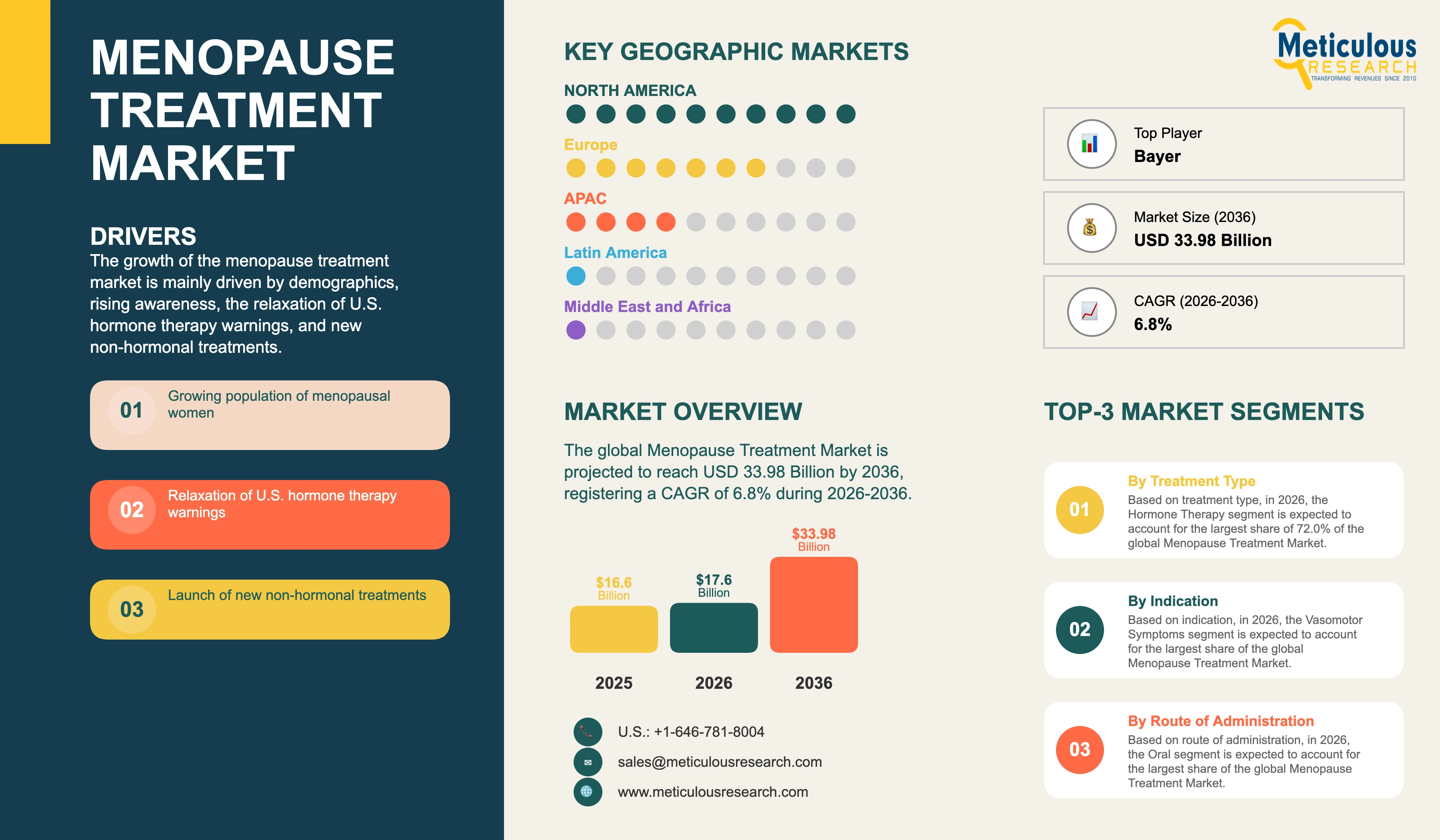
The global menopause treatment market was valued at USD 16.60 billion in 2025. This market is expected to reach USD 33.98 billion by 2036 from an estimated USD 17.60 billion in 2026, registering a CAGR of 6.8% during the forecast period (2026-2036).
- Published
- Nov 2026
- Pages
- 275
- Format
- PDF + Excel
- Report ID
- MRHC - 1042637
- Base year
- 2025
- 2025 · BASELINE
- $16.60B
- 2036
- $33.98B
- CAGR 2026–2036
- 6.8%
2025 baseline · 2026–2036 forecast at 6.8% CAGR · hover a bar for the value
Key highlights
On November 10, 2025, the U.S. Food and Drug Administration announced plans to remove the boxed warnings from menopausal hormone therapies, including language on cardiovascular disease, breast cancer, and probable dementia, while retaining the endometrial cancer warning for systemic estrogen-alone products, according to Regulatory Affairs Professionals Society reporting. The Associated Press reported that the change applies to more than 20 pills, patches, and creams containing estrogen and progestin.
The FDA approved Bayer's Lynkuet (elinzanetant), the first dual neurokinin-1 and neurokinin-3 receptor antagonist, for moderate to severe hot flashes due to menopause in October 2025, after earlier approvals in the U.K., Switzerland, Australia, and Canada, and Bayer projected annual peak sales of about EUR 1 billion, according to Xtalks and Fierce Pharma. The drug was later approved in the European Union.
Astellas' Veozah (fezolinetant), a neurokinin-3 receptor antagonist approved by the FDA in May 2023, generated JPY 33.8 billion, or about USD 221 million, in fiscal 2024, below the company's expectations, and Astellas reported that sales in the first six months of its current fiscal year grew by nearly 55% to about USD 146 million, according to Pharmaphorum.
In Bayer's OASIS 1 and OASIS 2 phase III trials, Lynkuet reduced vasomotor symptoms by 56% to 58% after four weeks and 65% to 67% after twelve weeks, and the drug does not carry the boxed liver warning that the FDA added to Veozah's label, according to the phase III results published by Bayer.
Bayer has noted that the global population of menopausal women is projected to reach 1.2 billion by 2030, and companies such as Estetra, Gedeon Richter, Noema Pharma, and Fervent Pharmaceuticals are developing additional candidates for the menopause market. These pipeline programs include new estrogen compounds, novel non-hormonal mechanisms, and treatments for sleep disturbances linked to menopause. Menopause-focused telehealth companies and employer benefit programs are also expanding access to specialists, which is increasing diagnosis and treatment rates among working women. Women in senior workplace roles are also driving demand for convenient care.
By treatment type, hormone therapy accounts for the larger share of 72.0% in 2026, while non-hormonal therapy registers the higher CAGR.
By indication, vasomotor symptoms account for the largest share in 2026 and also register the highest CAGR.
By route of administration, oral accounts for the largest share in 2026, while transdermal registers the highest CAGR.
By distribution channel, retail pharmacies account for the largest share of 56.0% in 2026, while online pharmacies register the highest CAGR.
By geography, North America accounts for the largest share of 44.0% in 2026, while Asia-Pacific registers the highest CAGR of 8.9%.
Report summary
| Particulars | Details |
|---|---|
| Forecast Period | 2026-2036 |
| Base Year | 2025 |
| Estimated Year | 2026 |
| CAGR (Value) | 6.8% |
| Format | PDF, Excel & Cloud Portal · 275 pages |
| Market Size (Value) in 2025 | USD 16.60 billion |
| Market Size (Value) in 2026 | USD 17.60 billion |
| Market Size (Value) by 2036 | USD 33.98 billion |
| Segments Covered | Treatment Type, Indication, Route of Administration, Distribution Channel, Geography |
| Countries Covered | U.S., Canada, Rest of North America, Germany, U.K., France, Italy, Spain, Netherlands, Poland, Switzerland, Belgium, Sweden, Denmark, Norway, Finland, Austria, Ireland, Rest of Europe, Japan, China, India, South Korea, Australia, Indonesia, Thailand, Singapore, Malaysia, Vietnam, Philippines, Taiwan, New Zealand, Rest of Asia-Pacific, Brazil, Mexico, Argentina, Colombia, Chile, Peru, Rest of Latin America, Saudi Arabia, U.A.E., Israel, South Africa, Turkey, Egypt, Rest of Middle East & Africa |
| Key Companies | 14 companies and other companies |
| Largest Segment by Treatment Type (2026) | Hormone Therapy (72.0%) |
| Largest Segment by Distribution Channel (2026) | Retail Pharmacies (56.0%) |
| Largest Region (2026) | North America (44.0%) |
| Fastest-Growing Region | Asia-Pacific (CAGR 8.9%) |
Report overview
Segments covered: treatment type, indication, route of administration, distribution channel.
The growth of this market is mainly driven by the large and growing population of women in perimenopause and menopause, rising awareness and diagnosis of menopause symptoms, the U.S. Food and Drug Administration's November 2025 decision to remove most of the boxed warning from menopausal hormone therapy products, the launch of new non-hormonal treatments for vasomotor symptoms such as Bayer's Lynkuet, the growth of menopause-focused telehealth and specialist care, and the increasing number of women who remain in the workforce during menopause. However, factors such as continuing concerns about the safety of hormone therapy among some women and physicians, safety warnings and monitoring requirements for some non-hormonal therapies, the availability of low-cost generic hormone products, limited insurance coverage for some treatments, and low treatment rates in many emerging markets are expected to restrain the growth of this market to some extent.
Menopause is the permanent end of menstrual periods, typically occurring between the ages of 45 and 55, and it is preceded by a transition period known as perimenopause during which hormone levels fluctuate. The decline in estrogen during perimenopause and menopause causes symptoms such as hot flashes and night sweats, known as vasomotor symptoms, sleep disturbances, mood changes, and the genitourinary syndrome of menopause, which includes vaginal dryness, pain during intercourse, and urinary symptoms. These symptoms can last for many years and significantly affect quality of life, work productivity, and relationships. Menopause is also associated with longer-term health risks, such as osteoporosis and cardiovascular disease.
This report covers the global menopause treatment market, including prescription hormone therapies, such as estrogen-only and combined estrogen-progestogen products delivered orally, transdermally, vaginally, and by other routes, and non-hormonal prescription therapies, such as neurokinin receptor antagonists, selective serotonin and serotonin-norepinephrine reuptake inhibitors approved or used for vasomotor symptoms, selective estrogen receptor modulators, and other prescription treatments for menopause symptoms. The market is analyzed by treatment type, indication, route of administration, distribution channel, and geography. Over-the-counter supplements, osteoporosis drugs, and digital menopause services are analyzed in separate reports. The market is measured on a revenue basis at manufacturer selling prices.
Hormone therapy is the most effective treatment for vasomotor symptoms and the genitourinary syndrome of menopause, but its use fell sharply after the publication of the Women's Health Initiative study in 2002, which linked hormone therapy to increased risks of breast cancer, stroke, blood clots, and heart disease. The FDA subsequently required boxed warnings on all estrogen products, and prescriptions declined among women of all ages, including younger women for whom the benefits generally outweigh the risks. Subsequent analyses have shown a more nuanced picture, with lower risks for women who start treatment before age 60 or within 10 years of menopause.
In November 2025, the FDA announced that it would remove most of the boxed warning from menopausal hormone therapy products, eliminating language on cardiovascular disease, breast cancer, and probable dementia, while retaining the warning on endometrial cancer for systemic estrogen-alone products. The agency also recommended that labeling suggest starting systemic hormone therapy in women under 60 or within 10 years of menopause onset. This change followed a July 2025 expert panel and is expected to increase prescriptions of hormone therapy in the U.S., although some experts have criticized the process used to reach the decision.
The range of non-hormonal treatment options for vasomotor symptoms has also expanded significantly over the past three years. Astellas' Veozah, approved by the FDA in May 2023, was the first neurokinin-3 receptor antagonist for vasomotor symptoms, and Bayer's Lynkuet, approved by the FDA in October 2025, is the first dual neurokinin-1 and neurokinin-3 receptor antagonist. These drugs offer an option for women who cannot or prefer not to use hormone therapy, such as women with a history of breast cancer or certain cardiovascular risks. Veozah's uptake was initially slower than expected, partly because of a boxed warning for rare liver injury, but sales have been growing, and Bayer expects peak annual sales of about EUR 1 billion for Lynkuet.
Hormone therapy accounts for the largest share of the market by treatment type, while non-hormonal therapy is the fastest-growing treatment type. Vasomotor symptoms are the largest and fastest-growing indication. Oral products account for the largest share by route of administration, while transdermal products are the fastest-growing route. Retail pharmacies are the largest distribution channel, while online pharmacies are the fastest-growing channel. North America accounts for the largest share of the market, while Asia-Pacific is the fastest-growing region.
The market includes large pharmaceutical companies with established hormone therapy and new non-hormonal brands, such as Bayer, Astellas, Pfizer, Novo Nordisk, and Organon, women's health specialists such as Besins Healthcare, Theramex, Gedeon Richter, Mayne Pharma, and Duchesnay, and generic manufacturers such as Viatris, Teva, Amneal, and Lupin. The availability of low-cost generic estrogen and progestogen products means that a significant share of prescriptions is filled with generics, while branded products compete on new delivery forms, combinations, and non-hormonal mechanisms.
Over the forecast period, the menopause treatment market is expected to grow steadily, supported by demographic trends, greater awareness, the relaxation of U.S. hormone therapy warnings, new non-hormonal therapies, and expanding access to menopause care. At the same time, the market's growth will depend on physician and patient attitudes toward hormone therapy, the commercial success of non-hormonal treatments, pricing and reimbursement, and access to care in emerging markets.
North America is expected to account for the largest share of 44.0% of the market in 2026, mainly due to the large population of menopausal women in the U.S., high healthcare spending, early launches of non-hormonal treatments, telehealth growth, and the FDA's relaxation of hormone therapy warnings.
Asia-Pacific is projected to register the highest CAGR of 8.9% during the forecast period, driven by aging populations, rising awareness, improving healthcare access, low current treatment rates, and expected launches of new treatments.
The report profiles 14 companies, including Bayer, Astellas, Pfizer, Novo Nordisk, Organon, Besins Healthcare, Theramex, Gedeon Richter, Mayne Pharma, Duchesnay, Viatris, Teva, Amneal, and Lupin.
The FDA removed language on cardiovascular disease, breast cancer, and probable dementia from the boxed warning of menopausal hormone therapies, retained the endometrial cancer warning for systemic estrogen-alone products, and recommended starting systemic therapy in women under 60 or within 10 years of menopause onset.
Report infographic
Market dynamics
18 factors across 5 forcesLarge and growing population of women in menopause
The number of women in perimenopause and menopause is large and growing worldwide as populations age and life expectancy increases. Bayer has noted that the global population of menopausal women is projected to reach 1.2 billion by 2030. Women now spend a significant portion of their lives after menopause, and many experience symptoms that affect their health, sleep, work, and quality of life for years. A large share of women in this age group remain in the workforce, which increases the economic importance of managing menopause symptoms effectively.
Population aging is particularly pronounced in Europe, Japan, South Korea, and China, while large populations in India, Southeast Asia, and Latin America are also reaching menopausal age. This demographic trend creates a large and growing base of potential patients for menopause treatments.
Many women also experience symptoms for longer than once thought, with some studies indicating that vasomotor symptoms can last for seven years or more, which increases the duration of treatment and the overall demand for therapies. Longer treatment durations also increase lifetime revenue per patient for manufacturers of both hormonal and non-hormonal products.
Rising awareness and diagnosis of menopause symptoms
Awareness of menopause has increased significantly in recent years, driven by public discussion, advocacy by women's health organizations and public figures, media coverage, employer initiatives, and the growth of menopause-focused digital health companies. Women are increasingly seeking help for symptoms that were once considered a normal part of aging to be endured, and healthcare providers are paying more attention to menopause in clinical practice and training.
Menopause-focused telehealth companies, such as virtual menopause clinics, have made it easier for women to consult specialists and receive prescriptions, which increases diagnosis and treatment rates. Employers are also adding menopause support to their benefits, encouraging women to seek care.
Relaxation of U.S. warnings on hormone therapy
The FDA's November 2025 decision to remove most of the boxed warning from menopausal hormone therapy products is expected to be one of the most important drivers of the market. The boxed warning, which had been in place since the early 2000s, discouraged many women and physicians from using hormone therapy, even for women in whom the benefits clearly outweighed the risks. The president of the American College of Obstetricians and Gynecologists said the warnings had created a lot of hesitancy among patients.
By removing language on cardiovascular disease, breast cancer, and probable dementia and recommending treatment for women under 60 or within 10 years of menopause onset, the FDA has made it easier for physicians to discuss and prescribe hormone therapy. This change is expected to increase hormone therapy prescriptions in the U.S. and may influence attitudes in other countries over time.
Launch of new non-hormonal treatments
The approval of new non-hormonal treatments for vasomotor symptoms is expanding the treatment options available to women, particularly those who cannot or prefer not to use hormone therapy. Astellas' Veozah was approved in 2023, and Bayer's Lynkuet was approved in the U.K. in July 2025, in the U.S. in October 2025, and in the European Union and other markets. These drugs target neurokinin receptors in the brain that regulate body temperature, providing a new mechanism of action for treating hot flashes and night sweats.
Non-hormonal treatments are important for women with a history of hormone-sensitive cancers, women at higher risk of blood clots or cardiovascular disease, and women who prefer to avoid hormones. Strong marketing by Bayer and Astellas and growing physician familiarity with the new drugs are expected to drive rapid growth in non-hormonal therapy over the forecast period.
Growth of menopause-focused telehealth and specialist care
The growth of virtual menopause clinics and menopause-focused telehealth services is making it easier for women to access specialists, receive evidence-based advice, and obtain prescriptions. Many women report that their primary care physicians have limited time or training to address menopause symptoms, and virtual clinics fill this gap by providing specialized care at scale. These services often prescribe hormone therapy and new non-hormonal treatments, which increases treatment rates and drives demand for prescription products.
The growth of online pharmacies and home delivery also makes it easier for women to obtain and refill prescriptions, which supports adherence and long-term use of menopause treatments. Greater media attention to menopause is also reducing stigma and encouraging women to discuss symptoms with physicians.
Table of contents
12 chapters · 164 sections · 275 pages · click to expandSegmental analysis
| Segment | Largest share (2026) | Fastest growth (2026–2036) |
|---|---|---|
| By Treatment Type | Hormone therapy | Non-hormonal therapy |
| By Indication | Vasomotor symptoms | Vasomotor symptoms |
| By Route of Administration | Oral | Transdermal |
| By Distribution Channel | Retail pharmacies | Online pharmacies |
| Other segments | Oral | Transdermal |
By Treatment Type
- Menopause Treatment Market Analysis by Treatment Type
- The hormone therapy segment is expected to account for the largest share of 72.0% of the global menopause treatment market.
- The large share of this segment is mainly due to the established efficacy of hormone therapy as the most effective treatment for vasomotor symptoms and the genitourinary syndrome of menopause, the wide range of hormone products available in oral, transdermal, vaginal, and other forms, the large number of women already using hormone therapy, and the FDA's November 2025 decision to remove most of the boxed warning, which is expected to increase prescriptions in the U.S. Hormone therapy includes estrogen-only therapy, which is generally used by women without a uterus, and combined estrogen-progestogen therapy, which is used by women with a uterus to protect against endometrial cancer.
- Hormone therapy products are offered by companies such as Pfizer, Bayer, Novo Nordisk, Organon, Besins Healthcare, Theramex, Gedeon Richter, Mayne Pharma, and many generic manufacturers.
- Transdermal estradiol products and vaginal estrogen products are important parts of the segment, and new formulations, such as products containing estetrol and body-identical combinations, are expected to support growth.
- However, the non-hormonal therapy segment is projected to register the highest CAGR during the forecast period.
- The rapid growth of this segment is driven by the launch of new neurokinin receptor antagonists, including Astellas' Veozah and Bayer's Lynkuet, the large number of women who cannot or prefer not to use hormone therapy, strong marketing and medical education by Bayer and Astellas, approvals in new markets, and the development of additional non-hormonal candidates.
- Non-hormonal therapies also include selective serotonin reuptake inhibitors such as low-dose paroxetine, selective estrogen receptor modulators such as ospemifene for the genitourinary syndrome of menopause, and other prescription treatments.
- Revenue growth in the hormone therapy segment is expected to be moderated by generic competition, even as prescription volumes increase, while the non-hormonal segment benefits from premium-priced branded products, which supports its rapid revenue growth.
- Within hormone therapy, combined estrogen-progestogen therapy is used by women with a uterus, while estrogen-only therapy is used mainly by women who have had a hysterectomy.
- Body-identical hormones and new estrogens such as estetrol are attracting interest from physicians and patients who want treatments with favorable safety profiles, while generic oral estradiol and progesterone remain widely prescribed because of their low cost.
By Indication
- Menopause Treatment Market Analysis by Indication
- The vasomotor symptoms segment is expected to account for the largest share of the global menopause treatment market.
- The large share of this segment is mainly due to the high prevalence of hot flashes and night sweats, which affect a large majority of women during the menopause transition, their significant impact on sleep, work, and quality of life, and the fact that vasomotor symptoms are the most common reason women seek treatment for menopause.
- Both hormone therapy and the new non-hormonal neurokinin receptor antagonists are approved primarily for vasomotor symptoms.
- This segment is also projected to register the highest CAGR during the forecast period, driven by the launch and growth of non-hormonal treatments for vasomotor symptoms, the expected increase in hormone therapy prescriptions following the FDA's labeling changes, growing awareness of treatment options, and the growth of telehealth menopause care.
- Potential new indications for non-hormonal drugs, such as vasomotor symptoms caused by endocrine therapy for breast cancer, could further expand this segment.
- The genitourinary syndrome of menopause segment forms the second-largest segment, supported by the high prevalence of vaginal dryness and related symptoms among postmenopausal women and the availability of effective local vaginal estrogen, prasterone, and ospemifene treatments, although this condition remains underdiagnosed.
- The sleep, mood, and other symptoms segment accounts for the remaining share of the market and includes treatments for sleep disturbances, mood changes, and other menopause-related symptoms.
- Because many women experience several symptoms at once, treatments that address multiple symptoms, such as systemic hormone therapy, are often preferred, while targeted treatments are used for specific symptoms or for women who cannot use hormones.
- Growing recognition of sleep problems and mood changes during perimenopause is also expected to increase demand for treatments that address these symptoms alongside vasomotor symptoms.
- Sleep problems, mood changes, and cognitive symptoms are increasingly recognized as important parts of the menopause transition, and research into treatments that address these symptoms is growing.
- Bone health is another important consideration, as estrogen loss increases the risk of osteoporosis, and hormone therapy is approved in some markets for the prevention of postmenopausal osteoporosis in women at risk.
By Route of Administration
- Menopause Treatment Market Analysis by Route of Administration
- The oral segment is expected to account for the largest share of the global menopause treatment market.
- The large share of this segment is mainly due to the convenience and familiarity of oral tablets and capsules, the wide availability of low-cost generic oral estrogen and progestogen products, and the oral administration of the new non-hormonal neurokinin receptor antagonists, Veozah and Lynkuet.
- Oral products are prescribed by many primary care physicians and gynecologists as the default form of treatment.
- However, the transdermal segment is projected to register the highest CAGR during the forecast period.
- The rapid growth of this segment is driven by evidence that transdermal estrogen may carry a lower risk of blood clots than oral estrogen, growing physician preference for transdermal products, the availability of patches, gels, and sprays that allow flexible dosing, and the expected increase in hormone therapy use following the FDA's labeling changes.
- The vaginal segment forms the third-largest segment, supported by local estrogen products, prasterone, and vaginal rings for the genitourinary syndrome of menopause, while other routes account for the remaining share.
- Other routes include injectable and implant products, which are used in a small number of markets.
By Distribution Channel
- Menopause Treatment Market Analysis by Distribution Channel
- The retail pharmacies segment is expected to account for the largest share of 56.0% of the global menopause treatment market.
- The large share of this segment is mainly due to the outpatient nature of menopause treatment, the wide network of retail pharmacies, and the fact that most women fill their prescriptions for hormone therapy and non-hormonal treatments at local pharmacies.
- However, the online pharmacies segment is projected to register the highest CAGR during the forecast period.
- The rapid growth of this segment is driven by the growth of telehealth menopause services that prescribe and deliver medications directly to patients, the convenience of home delivery and automatic refills, and growing consumer comfort with online healthcare.
- The hospital pharmacies segment accounts for the remaining share of the market and serves women treated in hospital-based gynecology and menopause clinics.
- Hospital pharmacies are particularly important for women with complex medical histories, such as breast cancer survivors, who are often managed by specialist teams that coordinate menopause care with oncology and cardiology services.
- Retail pharmacies benefit from established relationships with prescribers and patients and from pharmacist counseling, which helps women understand dosing and side effects.
- Online pharmacies are growing quickly because telehealth menopause providers often deliver prescriptions directly to patients, and many women prefer the privacy and convenience of home delivery for long-term treatments.
Other segments
- The oral segment is expected to account for the largest share of the menopause treatment market, while the transdermal segment is projected to register the highest CAGR during the forecast period.
- The retail pharmacies segment is expected to account for the largest share of 56.0% of the menopause treatment market, while the online pharmacies segment is projected to register the highest CAGR during the forecast period.
Geographic analysis
North America
Largest shareIn 2026, North America is expected to account for the largest share of 44.0% of the global menopause treatment market. The large share of this region is mainly due to the large population of women in perimenopause and menopause in the U.S., high healthcare spending, the availability of a wide range of branded and generic hormone products, the early launch of non-hormonal treatments such as Veozah and Lynkuet, the growth of menopause-focused telehealth services, and the FDA's November 2025 decision to remove most of the boxed warning from hormone therapy products, which is expected to increase prescriptions. The Associated Press reported that the change applies to more than 20 hormone products. Canada also has a significant market and approved Lynkuet in 2025.
Asia-Pacific
Fastest growthAsia-Pacific is projected to register the highest CAGR of 8.9% during the forecast period. The rapid growth of this region is mainly driven by rapidly aging populations in Japan, South Korea, and China, the large number of women reaching menopausal age in China, India, and Southeast Asia, rising awareness of menopause and women's health, improving access to healthcare, and the expected launch of new non-hormonal treatments in the region. Treatment rates in many Asia-Pacific countries are currently low, which leaves significant room for growth as awareness and access improve. Australia approved Lynkuet in 2025.
Europe
Europe accounts for a significant share of the market, supported by aging populations in Germany, the U.K., France, Italy, and Spain, well-established use of hormone therapy, particularly transdermal products, growing public discussion of menopause in the U.K. and other countries, and the approval of non-hormonal treatments such as Veoza and Lynkuet. The U.K. was the first country to approve Lynkuet, in July 2025.
Latin America
Latin America accounts for a smaller share of the market, with demand concentrated in Brazil and Mexico, while the Middle East & Africa accounts for the smallest share, with growing awareness and access in Saudi Arabia, the U.A.E., and South Africa. Rising healthcare spending and the expansion of women's health clinics in these countries are expected to support steady growth. Regional differences in awareness, cultural attitudes, regulatory labeling, reimbursement, and access to specialists shape the use of menopause treatments around the world. Regions with aging populations and low current treatment rates are expected to see the fastest growth. The approval of new non-hormonal treatments in more countries over the forecast period is also expected to narrow differences in treatment options between regions. Latin America and the Middle East & Africa account for smaller shares of the market, but demand is growing as awareness increases and access to women's health services improves in Brazil, Mexico, Argentina, Colombia, Saudi Arabia, the U.A.E., Israel, and South Africa. Brazil and Mexico have large populations of women reaching menopausal age and growing private healthcare sectors, while Gulf countries are investing in women's health services as part of broader healthcare reforms. Cultural attitudes and limited awareness still restrict treatment rates in many countries in these regions, which represents a long-term opportunity.
Competitive landscape
The global menopause treatment market is moderately fragmented, with the top five players estimated to account for about 40% of the market in 2025. The market includes large pharmaceutical companies with hormone therapy and non-hormonal brands, women's health specialty companies, and generic manufacturers.
Bayer markets Lynkuet, the first dual neurokinin-1 and neurokinin-3 receptor antagonist, along with hormone therapy products, and considers Lynkuet one of its most important growth products. Astellas markets Veozah, the first neurokinin-3 receptor antagonist for vasomotor symptoms. Pfizer markets conjugated estrogen products, including Premarin and Duavee, while Novo Nordisk offers vaginal estrogen, and Organon, Besins Healthcare, Theramex, Gedeon Richter, Mayne Pharma, and Duchesnay offer hormone and non-hormonal products for menopause symptoms. Viatris, Teva, Amneal, and Lupin supply generic hormone products.
Companies in this market compete on efficacy, safety, convenience, delivery systems, pricing, market access, physician relationships, and brand awareness. Key strategies include launching new non-hormonal treatments, expanding into new markets and indications, developing new hormone formulations and delivery systems, investing in physician and patient education, partnering with telehealth providers, and managing pricing and reimbursement.
We expect competition in the non-hormonal segment to intensify as Bayer and Astellas compete directly and as new candidates advance through development. In the hormone therapy segment, companies with differentiated transdermal, vaginal, and body-identical products are likely to benefit most from the expected increase in prescriptions, while generic manufacturers will continue to supply a large share of volume. Partnerships with telehealth menopause providers and employers are expected to become more important channels for reaching women. Companies are also investing in direct-to-consumer advertising and digital education campaigns to raise awareness of menopause symptoms and available treatments, particularly in the U.S.
Recent competitive activity has focused on new product approvals and market expansion. Bayer has launched Lynkuet in the U.S., the U.K., and other markets after a series of approvals in 2025, while Astellas has continued to expand the use of Veozah, which is marketed as Veoza in Europe. Women's health specialists such as Theramex, Gedeon Richter, and Besins Healthcare have strengthened their hormone therapy portfolios through licensing and acquisitions, and generic manufacturers continue to launch lower-cost versions of established hormone products. We expect licensing deals and acquisitions of late-stage menopause assets to continue as companies seek to build portfolios in this growing market.
Some of the key players operating in the menopause treatment market are Bayer AG, Astellas Pharma Inc., Pfizer Inc., Novo Nordisk A/S, Organon & Co., Besins Healthcare, Theramex, Gedeon Richter Plc, Mayne Pharma Group Limited, Duchesnay Inc., Viatris Inc., Teva Pharmaceutical Industries Ltd., Amneal Pharmaceuticals, Inc., and Lupin Limited, among others.
- —
The FDA announced plans to remove most of the boxed warning from menopausal hormone therapies in November 2025, approved Bayer's Lynkuet in October 2025, and Lynkuet was also approved in the U.K., Canada, Australia, Switzerland, and the European Union, while Astellas reported strong growth in Veozah sales.
- Theramex
- Gedeon Richter
- Besins Healthcare
Expert perspectives
The menopause treatment market is entering a new phase after two decades in which concerns about hormone therapy suppressed treatment rates. The combination of greater awareness, new non-hormonal therapies, the FDA's relaxation of hormone therapy warnings, and the growth of menopause-focused care is expected to increase the number of women who receive treatment for their symptoms.
Over the forecast period, the market is expected to grow at a CAGR of 6.8%, from USD 17.60 billion in 2026 to USD 33.98 billion in 2036. Growth will be supported by demographics, awareness, regulatory changes, new treatments, and telehealth. The market's growth rate is moderate because generic hormone products account for a large share of prescriptions, but the shift toward premium non-hormonal therapies and differentiated hormone products is expected to lift average revenue per patient over time.
Among the market segments, hormone therapy is the largest treatment type, while non-hormonal therapy grows fastest. Vasomotor symptoms are the largest and fastest-growing indication, oral products are the largest route of administration, while transdermal products grow fastest, and retail pharmacies are the largest distribution channel, while online pharmacies grow fastest. North America is the largest region, and Asia-Pacific is the fastest-growing region at a CAGR of 8.9%.
In our view, the most important factor for the market over the forecast period will be how physicians and patients respond to the FDA's labeling changes. If hormone therapy use recovers significantly among women under 60, prescription volumes could increase substantially, although generic competition will moderate revenue growth. The response in other countries, where labeling and guidelines differ, will also be important. Regulators in Europe and Asia are likely to review the evidence that underpinned the U.S. decision, and any changes to their labeling would further support hormone therapy use.
We also expect non-hormonal therapies to be the main source of revenue growth, as Bayer and Astellas expand their neurokinin receptor antagonists into more markets and as additional candidates are developed. Safety monitoring and pricing will be key factors in their success. Telehealth providers and employers are likely to play an increasingly important role in connecting women with treatment. Companies that combine effective products with strong physician education, patient support, and partnerships with digital health providers are likely to gain share, while those relying only on mature generic products face continued pricing pressure.
Overall, we believe the menopause treatment market will grow steadily over the forecast period, with non-hormonal therapies, transdermal hormone products, and Asia-Pacific providing the fastest growth. Improving access to care for the large number of untreated women remains the market's largest long-term opportunity.
Customer perspectives
Patients for menopause treatments include women in perimenopause and menopause with vasomotor symptoms, the genitourinary syndrome of menopause, sleep disturbances, and mood changes, while prescribers include gynecologists, primary care physicians, menopause specialists, and telehealth clinicians. Treatment decisions depend mainly on symptom severity, efficacy, safety and individual risk factors, patient preference for hormonal or non-hormonal options, route of administration, cost, insurance coverage, and access to knowledgeable clinicians. Payers and pharmacy benefit managers also influence treatment choices through formulary decisions, prior authorization requirements, and coverage of branded products, particularly for new non-hormonal therapies. Prescribers also consider the latest labeling and guideline changes when discussing options with patients.
Gynecologist - U.S.
Removing the boxed warning has made conversations about hormone therapy much easier. More of my patients under 60 are willing to try it, and many prefer patches or gels.
This comment explains why hormone therapy accounts for 72.0% of the market and why transdermal products are the fastest-growing route of administration.
This comment explains why non-hormonal therapy is the fastest-growing treatment type and why vasomotor symptoms are the largest indication. Many women in this situation also fill prescriptions at retail pharmacies, which account for 56.0% of the market.
This comment explains why Asia-Pacific is the fastest-growing region and why low treatment rates represent a significant opportunity. Employers in Japan and other Asia-Pacific countries are also beginning to address menopause in workplace health programs, which encourages more women to consult physicians about their symptoms.
“I cannot take hormones, and my hot flashes were affecting my sleep and work. A non-hormonal medicine has made a real difference for me.”
“Many Japanese women have not sought treatment for menopause symptoms, but awareness is increasing, especially among women who are working.”
Frequently asked questions
The global menopause treatment market was valued at USD 16.60 billion in 2025, up from USD 15.80 billion in 2024, and is estimated at USD 17.60 billion in 2026. The market includes prescription hormone therapies and non-hormonal prescription treatments for menopause symptoms.
Cite this report
Meticulous Research. (2026). Menopause Treatment Market - Global Opportunity Analysis and Industry Forecast (2026-2036) (Report No. MRHC - 1042637). Meticulous Market Research Pvt. Ltd. https://www.meticulousresearch.com/product/menopause-treatment-market-7320