Women's Health Supplements Market (2026-2036)
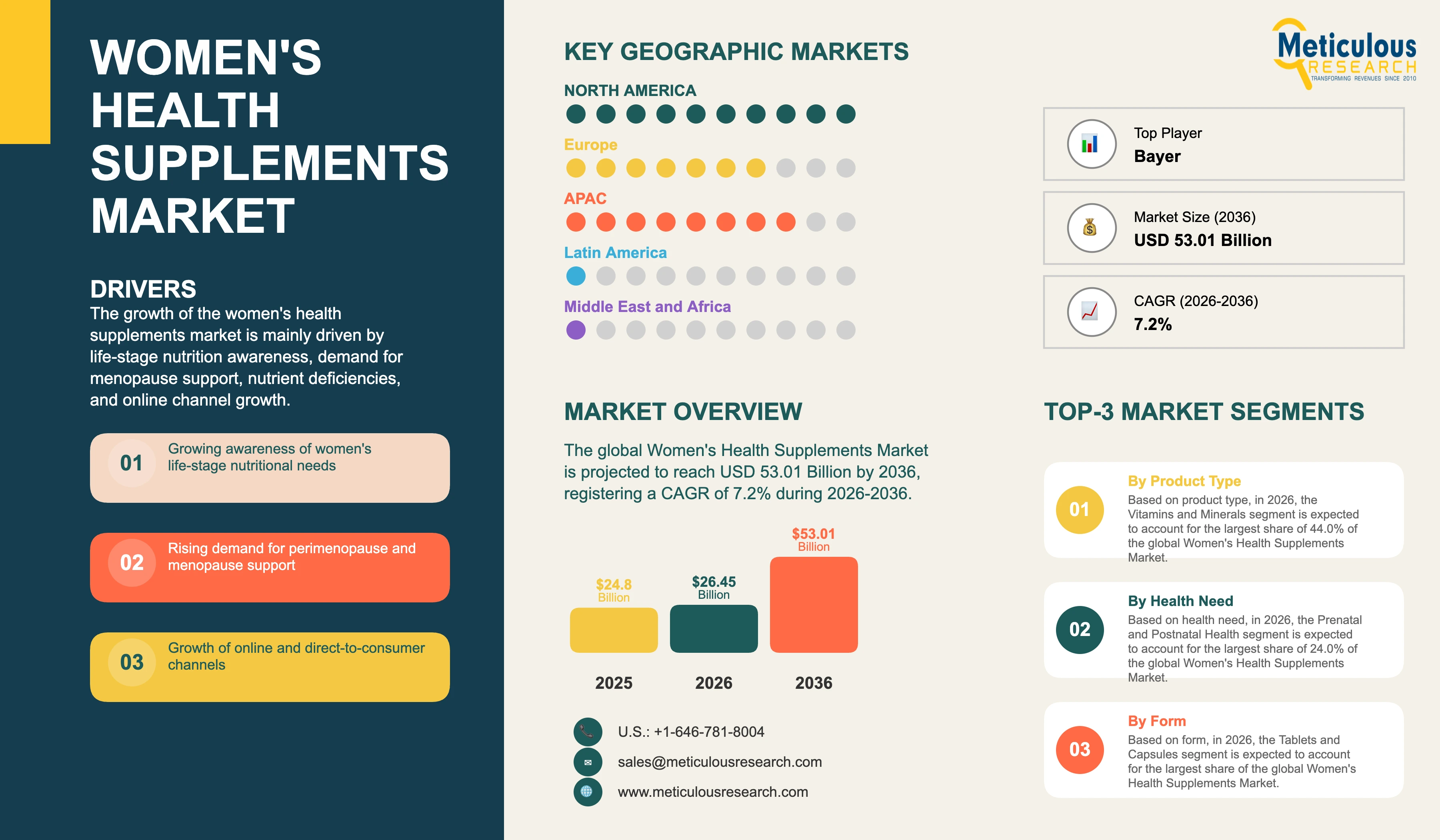
The global women's health supplements market was valued at USD 24.80 billion in 2025. This market is expected to reach USD 53.01 billion by 2036 from an estimated USD 26.45 billion in 2026, registering a CAGR of 7.2% during the forecast period (2026-2036).
- Published
- Nov 2026
- Pages
- 311
- Format
- PDF + Excel
- Report ID
- MRHC - 1042554
- Base year
- 2025
- 2025 · BASELINE
- $24.80B
- 2036
- $53.01B
- CAGR 2026–2036
- 7.2%
2025 baseline · 2026–2036 forecast at 7.2% CAGR · hover a bar for the value
Key highlights
The U.S. women's health supplement category, as tracked by SPINS across conventional, natural, and convenience retail channels, reached USD 1.28 billion in sales for the year ending April 19, 2026, with condition-specific formulations growing more than ninefold from a small base, while SPINS data also showed a 28.5% year-over-year increase in sales of perimenopause-related formulas.
Unilever acquired the supplement brand Grüns in April 2026 for close to USD 500 million, and Danone acquired the Belgian biotics company The Akkermansia Company in June 2025, while Capstone Partners reported in June 2026 that women's health has moved from a niche segment to a strategic priority for acquirers in the vitamins and supplements industry.
The U.K. Advertising Standards Authority ruled in March 2026 that three menopause-specific supplement brands had breached advertising codes by making treatment-style claims, highlighting growing regulatory attention to so-called menowashing as menopause products become mainstream. The rulings found that the brands had implied their products could treat menopause symptoms, which is not permitted for food supplements.
Innova Market Insights reported that global supplement launches with menopause claims increased by 17% between April 2021 and March 2026, and Thorne launched Perimenopause Complete and a women's libido product supported by a campaign featuring well-known female athletes and actors, reflecting the growing focus of brands on perimenopause.
About 64% of American women report taking some kind of supplement, according to BeautyMatter, and the U.S. National Institutes of Health Office of Dietary Supplements notes that bone mineral density can decline by about 1% per year after menopause, which supports continued demand for calcium, vitamin D, and other bone health supplements among older women. The same source notes that approximately 30% of postmenopausal women in the U.S. and Europe have osteoporosis.
By product type, vitamins and minerals account for the largest share of 44.0% in 2026, while probiotics register the highest CAGR.
By health need, prenatal and postnatal health accounts for the largest share of 24.0% in 2026, while perimenopause and menopause registers the highest CAGR.
By form, tablets and capsules account for the largest share in 2026, while gummies and chewables register the highest CAGR.
By distribution channel, pharmacies and drug stores account for the largest share in 2026, while online and direct-to-consumer registers the highest CAGR.
By geography, North America accounts for the largest share of 36.0% in 2026, while Asia-Pacific registers the highest CAGR of 8.9%.
Report summary
| Particulars | Details |
|---|---|
| Base Year | 2025 |
| Estimated Year | 2026 |
| Forecast Period | 2026-2036 |
| Market Size in 2025 | USD 24.80 billion |
| Market Size in 2026 | USD 26.45 billion |
| Market Size by 2036 | USD 53.01 billion |
| CAGR (2026-2036) | 7.2% |
| Format | PDF, Excel & Cloud Portal · 311 pages |
| Largest Segment by Product Type (2026) | Vitamins and Minerals (44.0%) |
| Largest Segment by Health Need (2026) | Prenatal and Postnatal Health (24.0%) |
| Largest Region (2026) | North America (36.0%) |
| Fastest-Growing Region | Asia-Pacific (CAGR 8.9%) |
| Companies Profiled | 15 companies and other companies |
| Segments Covered | Product Type, Health Need, Form, Distribution Channel, Geography |
| Countries Covered | U.S., Canada, U.K., Germany, France, Italy, Spain, Netherlands, Poland, Sweden, Switzerland, Rest of Europe, China, Japan, India, Australia, South Korea, Indonesia, Thailand, Vietnam, Philippines, Malaysia, Rest of Asia-Pacific, Brazil, Mexico, Argentina, Colombia, Rest of Latin America, Saudi Arabia, U.A.E., South Africa, Rest of Middle East & Africa |
Report overview
Segments covered: product type, health need, form, distribution channel.
The growth of this market is mainly driven by growing awareness of women's specific nutritional needs across life stages, rising demand for products that support perimenopause and menopause, the high prevalence of nutrient deficiencies such as iron, folate, and vitamin D among women, increasing focus on preventive health and healthy ageing, the growth of online and direct-to-consumer channels, and strong investment and acquisition activity by consumer health and food companies in women's health brands. However, factors such as limited clinical evidence for some ingredients and claims, regulatory scrutiny of marketing claims, product quality and safety concerns, and price sensitivity in some markets are expected to restrain the growth of this market to some extent.
Women's health supplements are dietary supplements formulated and marketed specifically for women's nutritional and health needs across different life stages. They include women's multivitamins and mineral supplements, prenatal and postnatal supplements, supplements for menstrual health and premenstrual symptoms, fertility supplements, perimenopause and menopause supplements, bone and joint health supplements, urinary and vaginal health supplements, and other products targeting women's energy, mood, sleep, hair, skin, and heart health. They contain vitamins and minerals, botanicals and herbal extracts, probiotics, omega-3 fatty acids, proteins, collagen, and other ingredients, and they are sold as tablets, capsules, gummies, powders, and liquids. This report covers supplements positioned for women and sold through pharmacies, supermarkets, online and direct-to-consumer channels, and specialty and practitioner channels. General supplements not targeted at women, prescription medicines, and hormone therapies are analyzed in separate reports. The market is measured on a revenue basis at manufacturer selling prices.
Women are the largest and most regular consumers of dietary supplements in many countries around the world. About 64% of American women report taking some kind of supplement, and women are more likely than men to use supplements as part of a preventive health routine. Women's nutritional needs change significantly across life stages, from menstruation and pregnancy to perimenopause, menopause, and older age, and many women have specific nutrient needs, such as higher iron requirements during reproductive years, increased folate and iodine requirements before and during pregnancy, and higher calcium and vitamin D requirements after menopause. These needs have created a large market for supplements designed specifically for women.
The women's health supplements market has changed significantly in both product focus and marketing over recent years. Traditionally, women's supplements focused mainly on multivitamins, prenatal vitamins, and calcium for bone health, often with generic marketing. Today, brands are developing products for specific health needs and life stages, such as perimenopause, menopause, polycystic ovary syndrome, fertility, urinary tract health, vaginal health, and libido, often with clinically studied ingredients and more open communication about topics that were previously taboo. SPINS data show that sales of perimenopause-related formulas in the U.S. grew by 28.5% year-over-year, and Innova Market Insights reports a 17% increase in global supplement launches with menopause claims between April 2021 and March 2026.
Vitamins and minerals account for the largest share of the market by product type, reflecting the wide use of women's multivitamins, prenatal vitamins, iron, folate, calcium, and vitamin D. Botanicals and herbal supplements, such as black cohosh, chasteberry, evening primrose oil, ashwagandha, and other ingredients used for menopause, menstrual health, and stress, are the second-largest segment, and probiotics, used for vaginal, urinary, and digestive health, are the fastest-growing product type. Prenatal and postnatal health is the largest health need, while perimenopause and menopause is the fastest-growing health need.
The market is served by large consumer health and pharmaceutical companies, such as Bayer, Haleon, Otsuka's Pharmavite, Nestlé Health Science, Church & Dwight, Unilever, Procter & Gamble, and Amway, regional leaders such as Vitabiotics in the U.K., Blackmores and Swisse in Australia, and By-health in China, and a growing number of digitally native and specialist brands, such as Ritual, Thorne, and many smaller menopause and fertility brands. Large companies are acquiring women's health brands to strengthen their portfolios, as shown by Pharmavite's acquisition of the urinary health brand Uqora, which complements its menopause brand Equelle.
Pharmacies and drug stores account for the largest share of the market by distribution channel, supported by pharmacist recommendations and the wide availability of prenatal and women's multivitamins, while online and direct-to-consumer channels are the fastest-growing, supported by subscription models, personalized recommendations, and social media marketing. North America is the largest regional market, while Asia-Pacific is the fastest-growing region, supported by rising incomes and health awareness in China, India, and Southeast Asia.
Regulatory scrutiny of products and marketing claims is increasing as the category grows and attracts new brands. The U.K. Advertising Standards Authority ruled in March 2026 that three menopause-specific brands had breached advertising codes by making treatment-style claims, and regulators in the U.S., Europe, and other regions continue to monitor claims and product quality. Brands that support their claims with clinical evidence and transparent ingredient sourcing are expected to gain consumer trust.
Over the forecast period, the women's health supplements market is expected to grow steadily, supported by life-stage nutrition, menopause awareness, preventive health, digital channels, and investment. At the same time, evidence, regulation, quality, and pricing will shape the competitive landscape.
Expectant mothers ask us for advice on folic acid and prenatal vitamins every day, and we recommend trusted brands with the right doses.
Women's health products, including collagen, probiotics, and menopause supplements, are among our fastest-growing categories, and gummies are especially popular with younger customers.
North America is expected to account for the largest share of 36.0% of the market in 2026, mainly due to high supplement use among women, high awareness of women's health issues, a large menopause population, leading brands, and a large online market.
Asia-Pacific is projected to register the highest CAGR of 8.9% during the forecast period, driven by large female populations, rising incomes and health awareness, government support for maternal health, rapid e-commerce growth, and an ageing female population.
The report profiles 15 companies, including Bayer, Haleon, Otsuka (Pharmavite), Nestlé Health Science, Church & Dwight, Unilever, Procter & Gamble, Amway, Vitabiotics, H&H Group (Swisse), Blackmores, By-health, Nature's Way, Thorne, and Ritual.
Report infographic
Market dynamics
18 factors across 5 forcesGrowing awareness of women's life-stage nutritional needs
Awareness of women's specific nutritional needs across life stages has grown significantly, supported by health professionals, public health campaigns, women's health advocates, and social media. Women are increasingly seeking supplements designed for their stage of life, such as prenatal supplements before and during pregnancy, postnatal supplements during breastfeeding, and products for perimenopause, menopause, and healthy ageing. Brands are responding with products tailored to these needs, which encourages women to use supplements consistently and often to use several products at once.
Healthcare professionals also play an important role, since obstetricians, gynecologists, and primary care physicians commonly recommend folic acid and prenatal vitamins before and during pregnancy, and calcium and vitamin D for older women, which supports demand for these products.
Public health guidance in many countries recommends folic acid supplementation for women who may become pregnant to reduce the risk of neural tube defects, which provides a strong and stable base of demand for prenatal supplements.
Rising demand for perimenopause and menopause support
Menopause has moved from a taboo topic to a mainstream health and consumer category, supported by greater public discussion, workplace menopause policies, media coverage, and celebrity advocacy. Hundreds of millions of women worldwide are in perimenopause or menopause, and many experience symptoms such as hot flashes, sleep problems, mood changes, weight gain, joint pain, and changes in bone health. While hormone therapy is the main medical treatment for many symptoms, many women seek supplements for symptom relief or general support, either alongside medical treatment or because they cannot or prefer not to use hormones.
SPINS data show a 28.5% year-over-year increase in U.S. sales of perimenopause-related formulas, and Innova Market Insights reports a 17% increase in global supplement launches with menopause claims between April 2021 and March 2026. Brands such as Thorne, Equelle, and many specialist companies have launched perimenopause and menopause products, and retailers are dedicating more shelf space to this category.
The ageing of the female population in North America, Europe, China, Japan, and other countries means that the number of women in midlife and older age will continue to increase, which supports long-term growth of menopause and healthy ageing supplements.
High prevalence of nutrient deficiencies among women
Nutrient deficiencies remain common among women in both developed and developing countries worldwide. Iron deficiency and anemia affect a large share of women of reproductive age, particularly in low- and middle-income countries, and deficiencies in vitamin D, folate, iodine, calcium, and vitamin B12 are also common. Pregnancy and breastfeeding increase nutrient requirements, and vegetarian and vegan diets, restrictive diets, and certain medications can increase the risk of deficiencies. Supplements are widely used to address these deficiencies, and public health programs in many countries recommend or provide iron and folic acid supplements for women.
Growing awareness of these deficiencies, supported by diagnostic testing and health professional advice, encourages women to use targeted supplements.
Focus on preventive health and healthy ageing
Consumers are increasingly focused on preventive health, wellness, and healthy ageing, and women in particular tend to be proactive about managing their health. Supplements that support bone health, heart health, cognitive health, energy, sleep, stress, skin, and hair are popular among women who want to maintain their health and quality of life as they age. The U.S. National Institutes of Health Office of Dietary Supplements notes that bone mineral density can decline by about 1% per year after menopause, which supports demand for calcium, vitamin D, and other bone health supplements.
Women's growing participation in fitness and sports is also increasing demand for protein, creatine, and other sports nutrition products formulated for women.
Growth of online and direct-to-consumer channels
Online and direct-to-consumer channels have made it easier for women to discover, compare, and buy women's health supplements, including products for sensitive topics such as menopause, fertility, and intimate health. Digitally native brands use subscription models, personalized quizzes, telehealth partnerships, and social media marketing to reach consumers, and large retailers and e-commerce platforms have expanded their women's health assortments. These channels also allow new brands to enter the market quickly and test new products.
Personalized nutrition services, which recommend supplements based on questionnaires, biomarkers, or genetic information, are also growing and often target women. Online marketplaces also give consumers access to reviews and product comparisons, which helps evidence-based brands build trust.
Table of contents
12 chapters · 164 sections · 311 pages · click to expandSegmental analysis
| Segment | Largest share (2026) | Fastest growth (2026–2036) |
|---|---|---|
| By Product Type | Tablets and capsules | Gummies and chewables |
By Product Type
- The tablets and capsules segment is expected to account for the largest share of the women's health supplements market, while the gummies and chewables segment is projected to register the highest CAGR during the forecast period.
- The pharmacies and drug stores segment is expected to account for the largest share of the women's health supplements market, while the online and direct-to-consumer segment is projected to register the highest CAGR during the forecast period.
- The segment is growing fastest because of greater awareness and open discussion of menopause, the large and growing number of women in midlife, the launch of dedicated perimenopause and menopause products, more retail shelf space, and digital platforms focused on menopause.
Geographic analysis
North America
Largest shareIn 2026, North America is expected to account for the largest share of 36.0% of the global women's health supplements market. The large share of this region is mainly due to high supplement use among women, with about 64% of American women reporting supplement use, high awareness of women's health issues, the large menopause population, the strong presence of leading brands and companies such as Pharmavite, Church & Dwight, Bayer, Haleon, Unilever, Procter & Gamble, Thorne, and Ritual, a large online and direct-to-consumer market, and active investment and acquisition activity in women's health brands. The U.S. is the largest market in the region, followed by Canada. SPINS data show strong growth in U.S. sales of perimenopause and condition-specific products.
Asia-Pacific
Fastest growthAsia-Pacific is projected to register the highest CAGR of 8.9% during the forecast period. The rapid growth of this region is mainly driven by large female populations, rising incomes and health awareness, government support for maternal and women's health, the rapid growth of e-commerce and cross-border e-commerce, the popularity of collagen and beauty-from-within products, and the ageing female population in China, Japan, South Korea, and Australia. China, Japan, India, Australia, South Korea, Indonesia, Thailand, Vietnam, the Philippines, and Malaysia are important markets, and brands such as Swisse, Blackmores, By-health, Elevit, and Centrum have strong positions in the region. Japan's large population of older women supports strong demand for bone health, joint health, and healthy ageing supplements.
Europe
Europe accounts for a significant share of the global market, supported by high awareness of women's health, strong pharmacy channels, well-established brands such as Vitabiotics' Pregnacare and Menopace, Elevit, and Centrum, and growing demand for menopause products, supported by public discussion of menopause in the U.K. and other countries. The U.K., Germany, France, Italy, Spain, the Netherlands, Poland, Sweden, and Switzerland are important markets, and EU rules on health claims and the U.K. Advertising Standards Authority's enforcement shape how products are marketed.
Latin America
Latin America and the Middle East & Africa account for smaller shares of the market but are growing steadily, supported by rising incomes, growing health awareness, and expanding pharmacy and e-commerce channels in Brazil, Mexico, Saudi Arabia, the U.A.E., and South Africa. Brazil is the largest market in Latin America, and high rates of vitamin D deficiency among women in Gulf countries support demand for vitamin D and bone health supplements.
Competitive landscape
The global women's health supplements market is highly fragmented, with the top five players estimated to account for about 25% of the market in 2025. The market includes large consumer health and pharmaceutical companies, food and beverage companies with health divisions, direct-selling companies, regional supplement leaders, retailer private labels, and many digitally native and specialist brands.
Bayer, with brands such as One A Day and Elevit, and Haleon, with Centrum, are leading global players in women's multivitamins and prenatal supplements. Otsuka's Pharmavite offers Nature Made and the women's health brands Equelle and Uqora, Church & Dwight offers Vitafusion gummies, Unilever offers OLLY and acquired Grüns in 2026, Nestlé Health Science offers Garden of Life and Pure Encapsulations, Procter & Gamble offers New Chapter, and Amway offers Nutrilite. Vitabiotics is a leader in the U.K. with Pregnacare and Menopace, H&H Group's Swisse and Kirin's Blackmores are leaders in Australia and China, By-health is a leading Chinese supplement brand, Nature's Way offers botanical supplements, and Thorne and Ritual are prominent premium and digitally native brands.
Companies in this market compete on clinical evidence, ingredient quality and transparency, brand trust, health professional recommendations, product innovation, format, price, distribution reach, and digital marketing. Key strategies include launches of life-stage and condition-specific products, acquisitions of women's health brands, partnerships with healthcare professionals and femtech platforms, investment in clinical studies, and expansion in e-commerce and Asia-Pacific.
Large companies benefit from established brands, broad distribution, and resources for research and marketing, while smaller and digitally native brands compete through innovation, targeted positioning, and direct engagement with consumers. We expect acquisition activity to remain strong, as large companies seek to add fast-growing women's health brands to their portfolios.
Retailer private labels are also significant competitors, particularly for basic products, which puts pressure on branded companies to differentiate through evidence and innovation. Ingredient suppliers also play an important role, since many brands rely on clinically studied branded ingredients for menopause, urinary health, and other needs. Contract manufacturers enable new brands to launch products quickly. This keeps barriers to entry low.
Some of the key players operating in the women's health supplements market are Bayer AG, Haleon plc, Otsuka Holdings Co., Ltd. (Pharmavite), Nestlé Health Science, Church & Dwight Co., Inc., Unilever PLC, The Procter & Gamble Company, Amway Corp., Vitabiotics Ltd., H&H Group (Swisse), Blackmores Limited (Kirin Holdings), By-health Co., Ltd., Nature's Way Brands, LLC, Thorne HealthTech, Inc., and Ritual, among others.
- —
Unilever acquired Grüns in April 2026 for close to USD 500 million, the U.K. Advertising Standards Authority ruled against three menopause brands in March 2026, SPINS reported 28.5% growth in U.S. sales of perimenopause formulas, and Danone acquired The Akkermansia Company in June 2025.
- Bayer AG
- Haleon plc
- Otsuka Holdings Co., Ltd. · Pharmavite
- Nestlé Health Science
- Church & Dwight Co., Inc.
- Unilever PLC
- Procter & Gamble Company
- Amway Corp.
- Vitabiotics Ltd.
- H&H Group · Swisse
- Blackmores Limited · Kirin Holdings
- Nature's Way Brands, LLC
- Thorne HealthTech, Inc.
- Ritual
Expert perspectives
Women's health supplements are becoming one of the most dynamic categories in the dietary supplement industry. Growing recognition that women's nutritional needs differ across life stages, increasing openness about menopause and other women's health topics, and strong investment by large companies are transforming a category that was once dominated by generic multivitamins and prenatal vitamins.
Over the forecast period, the market is expected to grow at a CAGR of 7.2%, from USD 26.45 billion in 2026 to USD 53.01 billion in 2036. Growth will be supported by life-stage nutrition awareness, menopause support, nutrient deficiencies, preventive health, and online channels.
Among the market segments, vitamins and minerals are the largest product type, while probiotics grow fastest. Prenatal and postnatal health is the largest health need, while perimenopause and menopause grows fastest, tablets and capsules are the largest form, while gummies and chewables grow fastest, and pharmacies and drug stores are the largest distribution channel, while online and direct-to-consumer channels grow fastest. North America is the largest region, and Asia-Pacific is the fastest-growing region at a CAGR of 8.9%.
In our view, the most important change over the forecast period will be the shift from broad women's wellness claims to evidence-based products for specific life stages and health needs. Brands that invest in clinical studies, use effective doses of well-studied ingredients, communicate transparently, and work with healthcare professionals will gain trust and market share, while brands that rely on vague or exaggerated claims face increasing regulatory and reputational risks.
Perimenopause and menopause will be the most important growth area, supported by demographic trends and changing attitudes. We also expect microbiome-based products, personalized nutrition, and integration with femtech and telehealth platforms to create new opportunities.
Acquisition activity is likely to remain strong, as large consumer health and food companies seek to build women's health portfolios, and we expect further consolidation of digitally native brands. Rising customer acquisition costs will make it harder for small brands to scale independently. We also expect Asia-Pacific to account for a growing share of the market, supported by rising incomes, e-commerce, and an ageing female population, with international and local brands competing strongly. Regulatory enforcement of marketing claims is likely to increase, which will favor brands with strong evidence and compliance capabilities. Women's growing purchasing power and willingness to invest in their health will continue to support premium products.
Overall, we believe the women's health supplements market will grow steadily over the forecast period and become increasingly specialized, evidence-based, and digitally connected.
Customer perspectives
Consumer, aged 48 - perimenopause, U.S.
I started having sleep problems and hot flashes, and I wanted something designed for perimenopause rather than a generic multivitamin. I look for products with real studies behind them and discuss them with my doctor.
Frequently asked questions
The global women's health supplements market was valued at USD 24.80 billion in 2025, up from USD 23.20 billion in 2024, and is estimated at USD 26.45 billion in 2026. The market includes vitamins and minerals, botanicals and herbal supplements, probiotics, omega-3 fatty acids, and proteins, collagen, and other products formulated for women.
Cite this report
Meticulous Research. (2026). Women's Health Supplements Market - Global Opportunity Analysis and Industry Forecast (2026-2036) (Report No. MRHC - 1042554). Meticulous Market Research Pvt. Ltd. https://www.meticulousresearch.com/product/womens-health-supplements-market-7237