Lithium Market (2026-2036)
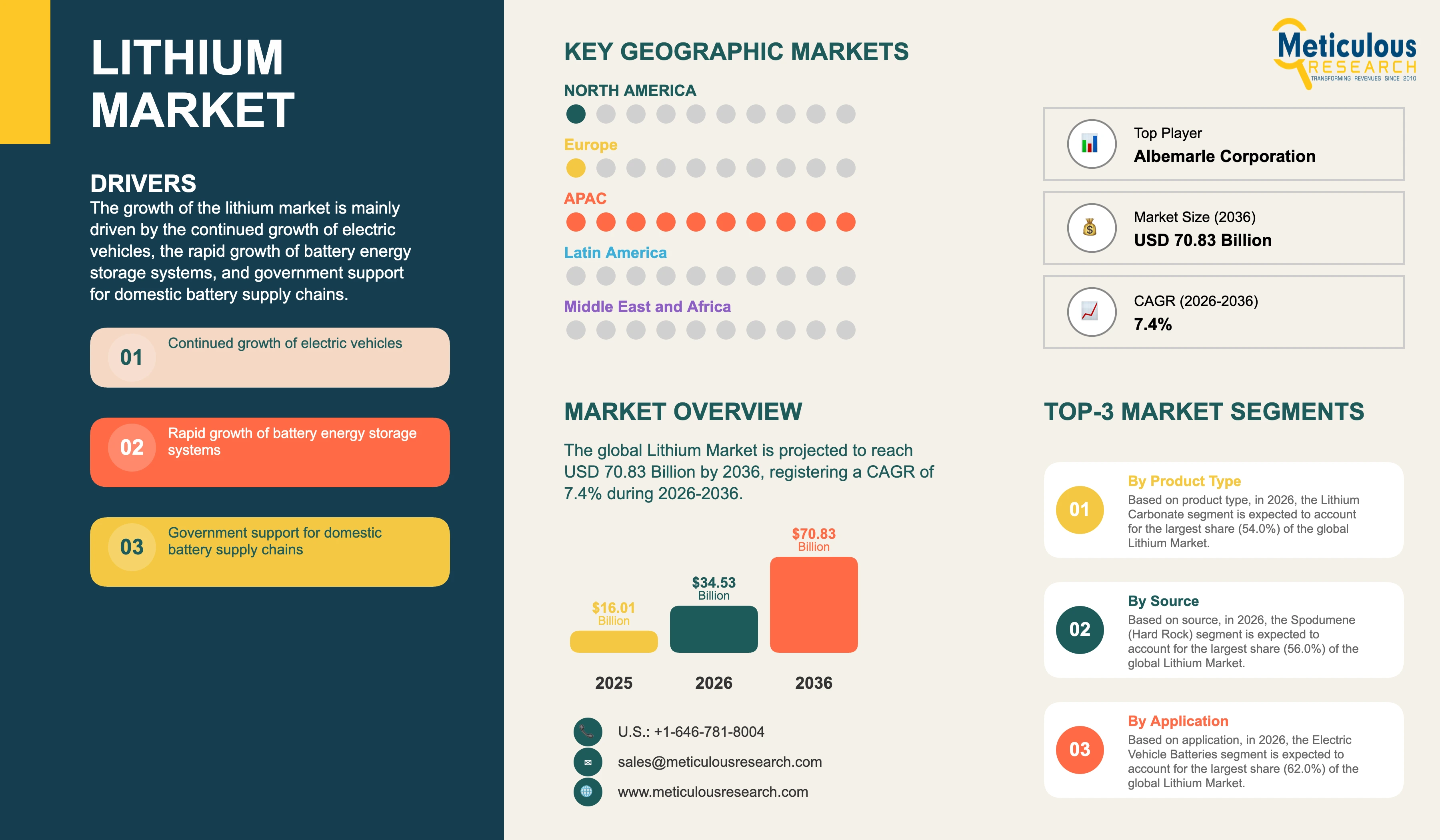
The global lithium market was valued at USD 16.01 billion in 2025. This market is expected to reach USD 70.83 billion by 2036 from an estimated USD 34.53 billion in 2026, registering a CAGR of 7.4% during the forecast period (2026-2036). In terms of volume, this market is expected to reach 4.02 million tons of lithium carbonate equivalent (LCE) by 2036 from an estimated 1.78 million tons of LCE in 2026, registering a CAGR of 8.5% during the forecast period.
- Published
- Nov 2026
- Pages
- 281
- Format
- PDF + Excel
- Report ID
- MRCHM - 1042484
- Base year
- 2025
- 2025 · BASELINE
- $16.01B
- 2036
- $70.83B
- CAGR 2026–2036
- 7.4%
2025 baseline · 2026–2036 forecast at 7.4% CAGR · hover a bar for the value
Key highlights
Lithium prices recovered strongly in 2026 after falling sharply in 2024 and 2025, with lithium carbonate futures on the Guangzhou Futures Exchange reaching 134,500 yuan per ton on 29 December 2025, up 130% from the 2025 low, and average 2026 prices for lithium carbonate and lithium hydroxide in mainland China forecast at about USD 20,100 per ton and USD 19,600 per ton.
Global lithium mine production reached about 290, 000 tons of lithium content in 2025, up from 222,000 tons in 2024, led by Australia, China, Chile, and Argentina, according to the U.S. Geological Survey.
Tianqi Lithium expects global lithium demand to reach about 2 million tons of LCE in 2026, driven by electric vehicles and the rapid growth of energy storage, while the International Energy Agency estimates that demand could reach about 3.7 million tons of LCE by 2035.
Albemarle's Energy Storage segment reported first-quarter 2026 net sales of USD 891 million, up 70%, on a 51% increase in prices and 14% higher volumes, while Tianqi Lithium forecast a very sharp increase in first-half 2026 profit.
CATL secured a safety production permit for its Jianxiawo lepidolite mine in Jiangxi, China, on 29 June 2026, allowing it to restart a mine that had been idle since August 2025 and that accounts for a meaningful share of global lithium supply.
Rio Tinto completed its USD 6.7 billion acquisition of Arcadium Lithium in 2025, becoming one of the largest lithium producers, while Lithium Americas continues to develop its Thacker Pass project in Nevada with support from the U.S. Department of Energy and General Motors.
Mineral Resources announced the restart of its Bald Hill lithium mine in Western Australia, which had been placed on care and maintenance in November 2024, as higher prices encouraged the return of idled supply.
Lithium metal is the fastest-growing product type, recycled lithium is the fastest-growing source, and energy storage system batteries are the fastest-growing application.
By product type, lithium carbonate accounts for the largest share of 54.0% in 2026, while lithium metal registers the highest CAGR.
By source, spodumene (hard rock) accounts for the largest share in 2026, while recycled lithium registers the highest CAGR.
By application, electric vehicle batteries account for the largest share of 62.0% in 2026, while energy storage system batteries register the highest CAGR.
By geography, Asia-Pacific accounts for the largest share of 86.0% in 2026, while North America registers the highest CAGR of 12.7%.
Report summary
| Particulars | Details |
|---|---|
| Forecast Period | 2026-2036 |
| Base Year | 2025 |
| Estimated Year | 2026 |
| CAGR (Value) | 7.4% |
| Format | PDF, Excel & Cloud Portal · 281 pages |
| Market Size (Value) in 2025 | USD 16.01 billion |
| Market Size (Value) in 2026 | USD 34.53 billion |
| Market Size (Value) in 2036 | USD 70.83 billion |
| Segments Covered | Product Type, Source, Application, and Geography |
| Countries Covered | Asia-Pacific, North America, Europe, and Rest of the World |
| Key Companies | Albemarle, SQM, Ganfeng Lithium, Tianqi Lithium, Rio Tinto, PLS, Mineral Resources, Sichuan Yahua, Sinomine Resource, Zijin Mining, Sigma Lithium, Liontown Resources, Lithium Americas, and Eramet |
| Market Volume (2026 to 2036) | 1.78 million tons LCE to 4.02 million tons LCE (CAGR 8.5%) |
| Largest Segment by Product Type (2026) | Lithium Carbonate (54.0%) |
| Largest Segment by Application (2026) | Electric Vehicle Batteries (62.0%) |
| Largest Region (2026) | Asia-Pacific (86.0%) |
| Fastest-Growing Region | North America (CAGR 12.7%) |
Report overview
Segments covered: product type, source, application.
The growth of this market is mainly driven by the continued growth of electric vehicles, the very rapid growth of battery energy storage systems for power grids and data centers, government policies supporting electrification and domestic battery supply chains, and the strong recovery of lithium prices in 2026 after a prolonged downturn. However, factors such as the high volatility of lithium prices, the concentration of lithium refining in China, and the long lead times and high costs of new mining and refining projects outside China are expected to restrain the growth of this market to some extent.
Lithium is a light metal that is essential for lithium-ion batteries, which power electric vehicles, energy storage systems, smartphones, laptops, and many other devices. Lithium is mined from hard rock deposits, mainly spodumene in Australia, China, Brazil, Zimbabwe, and Canada, and from brines in salt flats in Chile, Argentina, Bolivia, China, and the U.S. It is then refined into battery-grade chemicals, mainly lithium carbonate and lithium hydroxide, which are used to make cathode materials and electrolytes. This market covers the sale of refined lithium chemicals, lithium metal, and technical-grade lithium concentrates used directly in industry, measured in value and in tons of lithium carbonate equivalent (LCE). Spodumene concentrate sold to refiners is not counted separately, to avoid double counting with the refined chemicals made from it.
Batteries account for most lithium demand today, as the growth of electric vehicles and energy storage has transformed lithium from a small specialty chemical into a strategic commodity. Lithium carbonate is mainly used for lithium iron phosphate (LFP) cathodes, which dominate electric vehicle batteries in China and most energy storage systems, while lithium hydroxide is mainly used for nickel-rich cathodes in longer-range electric vehicles. Traditional uses in glass, ceramics, lubricating greases, and pharmaceuticals now account for a small share of demand. Lithium is also used in aluminum-lithium alloys for aircraft, in air treatment, and in some medicines, but these uses are small compared with batteries.
The lithium market is known for large price swings, as prices rose to record highs in 2022 as electric vehicle demand surged, then fell by more than 80% through 2024 and much of 2025 as new supply from Australia, China, Africa, and South America outpaced demand. Many high-cost mines were closed or placed on care and maintenance, and projects were delayed. Prices then recovered strongly from late 2025 into 2026, supported by the rapid growth of energy storage demand, supply disruptions such as the suspension of CATL's Jianxiawo mine in China, and falling inventories, which nearly doubled the value of the market in 2026 compared with 2025. Volumes also grew strongly in 2025 and 2026, as battery production in China reached record levels.
China plays a central role in the lithium supply chain, because although Australia is the largest miner, China refines most of the world's lithium chemicals, produces most of its cathode materials and batteries, and controls significant mining assets in Africa, South America, and Australia through companies such as Ganfeng Lithium, Tianqi Lithium, Zijin Mining, Sinomine Resource, and CATL. Outside China, the largest producers are Albemarle, SQM, Rio Tinto, which acquired Arcadium Lithium in 2025, PLS (formerly Pilbara Minerals), and Mineral Resources. Chinese refiners also process large volumes of lepidolite from Jiangxi province, which is a higher-cost source that responds quickly to price changes.
Governments in the U.S., Europe, and other regions are working to build lithium supply chains outside China, through funding, tax credits, trade measures, and partnerships with resource-rich countries. Projects such as Lithium Americas' Thacker Pass mine in Nevada, supported by the U.S. Department of Energy and General Motors, and new refineries in the U.S., Europe, and Australia aim to reduce dependence on Chinese refining. Resource-rich countries are also seeking more value from their lithium, with Chile pursuing a national lithium strategy with greater state participation, Zimbabwe banning exports of raw lithium ore and planning to restrict concentrate exports, and Argentina attracting large investments. Argentina's investment incentive regime for large projects has attracted major commitments from Rio Tinto, Eramet, and other companies.
Looking ahead, lithium demand is expected to more than double over the forecast period, led by electric vehicles and energy storage. New extraction technologies, such as direct lithium extraction (DLE) from brines, and recycling of spent batteries are expected to add supply, while sodium-ion batteries could reduce lithium demand in some energy storage and low-cost vehicle applications. Prices are expected to remain volatile, but long-term demand growth and the need for new supply are expected to support investment. Battery chemistry choices will also shape demand for different lithium products, with LFP favoring carbonate and nickel-rich chemistries favoring hydroxide.
Report infographic
Market dynamics
15 factors across 5 forcesContinued growth of electric vehicles
Electric vehicles are the largest source of lithium demand, as each battery electric vehicle uses tens of kilograms of LCE in its battery. Global electric vehicle sales continued to grow strongly in 2025, led by China, where new energy vehicles accounted for more than half of new car sales, and by growth in Europe and emerging markets. Plug-in hybrids and range-extended vehicles also use lithium-ion batteries, adding to demand.
Although electric vehicle growth has slowed in some markets, such as the U.S., because of policy changes, long-term targets for vehicle electrification in China, Europe, and many other countries are expected to keep demand growing over the forecast period. Larger battery packs, electric trucks and buses, and electric two- and three-wheelers in Asia also add to demand. Electric vehicle batteries account for the largest share of the market. Electric heavy trucks, which use very large battery packs, are also starting to scale up in China, which could add significant lithium demand. The shift to LFP batteries in many vehicles also supports demand for lithium carbonate. Battery prices fell sharply in 2024 and 2025 as lithium prices dropped, which helped make electric vehicles more affordable and supported sales growth.
Rapid growth of battery energy storage systems
Battery energy storage systems (BESS) have become one of the fastest-growing sources of lithium demand, as utilities, grid operators, and companies install large batteries to integrate solar and wind power, stabilize grids, and provide backup power for data centers. Most of these systems use LFP batteries, which require lithium carbonate. China, the U.S., Europe, Australia, the Middle East, and other regions are installing large amounts of energy storage, and the growth of AI data centers is adding further demand.
Energy storage demand helped drive the recovery of lithium prices in 2026 and is expected to grow faster than electric vehicle demand over the forecast period. Energy storage system batteries are the fastest-growing application in this market. Policies such as capacity markets, renewable energy targets, and storage mandates in many countries are expected to support continued growth. Some energy storage projects may use sodium-ion batteries, but lithium-ion is expected to remain dominant. Storage systems with four or more hours of duration are becoming more common, which increases the amount of battery capacity, and therefore lithium, per project.
Government support for domestic battery supply chains
Governments in the U.S., Europe, Japan, South Korea, India, and other countries are supporting domestic battery and critical mineral supply chains to reduce dependence on China. Measures include tax credits for domestic production, loans and grants for mines and refineries, government equity stakes, trade measures, and critical minerals agreements with resource-rich countries.
In the U.S., the Department of Energy has supported Lithium Americas' Thacker Pass project, and other projects in Nevada, Arkansas, and North Carolina are being developed. The EU's Critical Raw Materials Act sets targets for domestic extraction, processing, and recycling, and supports strategic projects in Portugal, Germany, France, and other countries. North America is the fastest-growing region in this market. These policies are expected to support new demand and supply outside China. Japan, South Korea, and India also support battery supply chains through subsidies, and India has launched a national critical minerals mission to secure lithium supply. Long-term offtake agreements between governments, automakers, and producers are becoming an important tool for financing new projects.
Recovery of lithium prices and new investment
The recovery of lithium prices in 2026, after a long downturn, has improved the finances of lithium producers and is encouraging the restart of idled mines and the resumption of delayed projects. Albemarle's Energy Storage segment reported a 70% increase in net sales in the first quarter of 2026, and Tianqi Lithium and other producers reported sharply higher profits.
Higher prices are expected to support investment in new supply, including mine expansions in Australia, brine projects in Argentina and Chile, and new refineries in several countries. Mineral Resources has announced the restart of its Bald Hill mine, and other idled operations are being reconsidered. However, producers remain cautious after the recent downturn, and new supply is expected to come online gradually. Many producers are prioritizing cost reduction and balance sheet repair before committing to major new projects. Demand growth continues.
Table of contents
11 chapters · 120 sections · 281 pages · click to expandSegmental analysis
| Segment | Largest share (2026) | Fastest growth (2026–2036) |
|---|---|---|
| By Product Type | Lithium carbonate | Lithium metal |
| By Source | Spodumene (hard rock) | Recycled lithium |
| By Application | Electric vehicle batteries | Energy storage system batteries |
By Product Type
- The lithium carbonate segment is expected to account for the largest share of 54.0% of the global lithium market.
- The large share of this segment is mainly due to the dominance of LFP batteries in energy storage systems and in a large share of electric vehicles, particularly in China, which use lithium carbonate as their main lithium input.
- Lithium carbonate is the most widely produced lithium chemical, made from both brines and hard rock ores, and it is the benchmark product for lithium pricing in China and globally.
- It is used in LFP cathodes, in some nickel-based cathodes, in electrolyte salts, and in traditional applications such as glass and ceramics.
- Brine producers in Chile and Argentina, such as SQM, Albemarle, and Rio Tinto, produce mainly lithium carbonate, and Chinese refiners convert large volumes of spodumene and lepidolite into carbonate.
- The rapid growth of LFP batteries in energy storage and in cost-sensitive electric vehicles has made carbonate the fastest-growing major lithium chemical by volume in recent years, and battery makers outside China are also adopting LFP.
- Lithium carbonate futures on the Guangzhou Futures Exchange have become an important pricing reference, and their rise from the 2025 low drove much of the increase in market value in 2026.
- Carbonate is expected to remain the largest product type over the forecast period.
- Battery-grade carbonate commands a premium over technical-grade carbonate, and quality consistency is a key factor for battery makers when choosing suppliers.
- However, the lithium metal segment is projected to register the highest CAGR during the forecast period.
- The rapid growth of this segment is driven by the expected commercialization of solid-state and lithium-metal batteries and by demand from primary batteries, aerospace alloys, and pharmaceuticals.
- Lithium hydroxide, lithium concentrate (technical grade), and lithium chloride and other compounds make up the rest of the market.
- Lithium hydroxide is mainly used for nickel-rich cathodes in longer-range electric vehicles, and its demand depends on the share of these chemistries in Europe, North America, Japan, and South Korea.
- Technical-grade concentrate is used directly in glass and ceramics, while lithium chloride is used to produce lithium metal and in air treatment.
By Source
- The spodumene (hard rock) segment is expected to account for the largest share of the market.
- The large share of this segment is mainly due to the large output of spodumene mines in Australia, which is the world's largest lithium producer, and the growth of hard rock mining in China, Brazil, Zimbabwe, Mali, and Canada.
- Spodumene is mined as hard rock ore, concentrated, and then refined into lithium carbonate or hydroxide, mostly in China.
- Australia's mines, operated by companies such as PLS, Mineral Resources, Albemarle, Tianqi Lithium, IGO, and Liontown Resources, account for a large share of global supply, and hard rock mining has expanded rapidly in Africa and Brazil, often with Chinese investment.
- Spodumene mines can be developed and expanded more quickly than brine operations, which makes them important for responding to demand changes, although their production costs are generally higher.
- The price recovery in 2026 is supporting the restart of idled spodumene mines, such as Mineral Resources' Bald Hill mine, and the expansion of existing operations.
- Spodumene is particularly important for lithium hydroxide production, which is often made directly from spodumene concentrate.
- Lithium content in spodumene concentrate is typically around 6% lithium oxide, and its price is closely linked to lithium chemical prices in China.
- African producers, particularly in Zimbabwe and Mali, have become an important new source of spodumene, often owned by Chinese companies.
- However, the recycled lithium segment is projected to register the highest CAGR during the forecast period.
- The rapid growth of this segment is driven by the growing volume of spent batteries and manufacturing scrap, new recycling capacity in China, Europe, and North America, and the EU's recycled content and recovery targets.
- Brine and lepidolite and other ores make up the rest of the market.
- Brine production in Chile and Argentina has the lowest costs in the industry, and new DLE projects could increase its share over time.
- Lepidolite mining in Jiangxi, China, is a higher-cost source whose output is closely linked to prices and environmental permits.
By Application
- The electric vehicle batteries segment is expected to account for the largest share of 62.0% of the market.
- The large share of this segment is mainly due to the large and growing number of battery electric and plug-in hybrid vehicles produced worldwide, each of which uses tens of kilograms of LCE in its battery.
- Electric vehicles have been the main driver of lithium demand for the past decade, and they are expected to remain the largest application over the forecast period.
- China is the largest electric vehicle market, with new energy vehicles accounting for more than half of new car sales in 2025, and Europe and other regions continue to expand electric vehicle production.
- Battery chemistries vary by market, with LFP dominant in China and growing elsewhere, and nickel-rich chemistries used for longer-range vehicles in Europe, the U.S., Japan, and South Korea.
- Electric trucks, buses, two-wheelers, and three-wheelers add further demand, and battery packs are getting larger in some segments, while improvements in efficiency reduce lithium use per kWh.
- Policy changes, such as the reduction of U.S. electric vehicle tax credits, may slow growth in some markets, but long-term electrification targets support continued demand.
- Automakers are also securing lithium supply through long-term contracts and investments in mining and refining.
- General Motors, Tesla, Ford, and other automakers have signed direct supply agreements with lithium producers in recent years.
- However, the energy storage system batteries segment is projected to register the highest CAGR during the forecast period.
- The rapid growth of this segment is driven by the large-scale deployment of battery storage for renewable energy integration, grid stability, and data center backup power in China, the U.S., Europe, the Middle East, and other regions.
- Consumer electronics batteries, glass and ceramics, lubricating greases, and other applications make up the rest of the market.
- Energy storage demand has also become more stable than electric vehicle demand in some markets, because it is driven by utility and data center investment rather than consumer purchases.
Geographic analysis
Asia-Pacific
Largest shareIn 2026, Asia-Pacific is expected to account for the largest share of 86.0% of the global lithium market. The large share of this region is mainly due to China's dominant role in lithium refining, cathode production, and battery manufacturing, along with large battery industries in South Korea and Japan. China is by far the largest consumer of lithium chemicals, as it produces most of the world's cathode materials and lithium-ion batteries for electric vehicles, energy storage, and electronics. Chinese companies, such as CATL, BYD, and other battery makers, and cathode producers, such as Hunan Yuneng and others, buy large volumes of lithium carbonate and hydroxide from domestic refiners, which process spodumene from Australia, Africa, and Brazil, lepidolite from Jiangxi, and brine from Qinghai and Tibet. South Korea and Japan are major consumers of lithium hydroxide for nickel-rich cathodes made by companies such as LG Energy Solution, Samsung SDI, SK On, POSCO Future M, and Panasonic. Australia is the world's largest lithium miner, and India, Indonesia, and other countries are developing battery industries. Asia-Pacific's share is expected to decline over the forecast period as battery production grows in North America and Europe, but it will remain dominant. Indonesia, which has large nickel resources, is building an integrated battery industry that will also need lithium.
North America
Fastest growthNorth America is projected to register the highest CAGR of 12.7% during the forecast period. Growth is driven by new battery plants in the U.S. and Canada, the growth of energy storage, government support for domestic supply chains, and new lithium projects such as Thacker Pass in Nevada and DLE projects in Arkansas. U.S. foreign entity of concern rules, which limit the use of Chinese-sourced materials in projects that receive federal tax credits for battery and energy storage manufacturing, have encouraged companies to secure non-Chinese lithium supply.
Europe
Europe holds a smaller share of the market, supported by battery plants in Germany, Poland, Hungary, France, and other countries, the EU's Critical Raw Materials Act and Battery Regulation, and new lithium refining and mining projects. Europe's battery industry has faced setbacks, such as the bankruptcy of Northvolt, but several Asian battery makers continue to operate large plants in the region.
Latin America
The Rest of the World includes Latin America, which is a major lithium producer through Chile, Argentina, and Brazil, and the Middle East and Africa, where Zimbabwe, Mali, and other countries are growing producers, but where lithium consumption remains small.
Competitive landscape
The lithium market is moderately concentrated, with a group of large producers accounting for a significant share of supply and a larger number of smaller miners and refiners. Albemarle, SQM, Ganfeng Lithium, Tianqi Lithium, and Rio Tinto, which acquired Arcadium Lithium in 2025, are among the largest producers, each with integrated mining and refining operations in several countries.
Other important players include PLS and Mineral Resources in Australian spodumene, Sichuan Yahua and Sinomine Resource in Chinese refining and African mining, Zijin Mining in China, Argentina, and Africa, Sigma Lithium in Brazil, Liontown Resources in Australia, Lithium Americas in the U.S., and Eramet in Argentina. Battery makers such as CATL also own lithium mines, and new entrants are developing DLE and recycling projects. Oil and gas companies, such as ExxonMobil and Equinor, are also entering the lithium market through DLE projects in the U.S. and elsewhere.
The top five players are estimated to account for 46.5% of the market in 2025, reflecting the strong positions of Albemarle, SQM, Ganfeng Lithium, Tianqi Lithium, and Rio Tinto in both mining and refining. Tianqi Lithium also holds a large stake in SQM, which links two of the largest producers. Concentration is lower in spodumene mining and in Chinese refining, where many mid-sized companies compete. Smaller producers often compete by focusing on specific regions or by partnering with larger buyers that provide financing in exchange for offtake.
Producers use several strategies to grow in this market, including expanding mining and refining capacity, acquiring other producers and projects, signing long-term supply agreements with battery makers and automakers, developing DLE and other new technologies, investing in recycling, and partnering with governments and state-owned companies in resource-rich countries. Many producers also cut costs and delayed projects during the 2024 and 2025 downturn and are now reconsidering expansions as prices recover. Competition is expected to center on cost position, resource quality, refining capability, product quality, sustainability, and the ability to supply customers outside China. Producers that can show low carbon footprints and responsible mining practices are increasingly preferred by automakers and battery makers in Europe and North America.
Some of the key players operating in the lithium market are Albemarle Corporation, Sociedad Química y Minera de Chile S.A. (SQM), Ganfeng Lithium Group Co., Ltd., Tianqi Lithium Corporation, Rio Tinto Group, PLS Group Limited, Mineral Resources Limited, Sichuan Yahua Industrial Group Co., Ltd., Sinomine Resource Group Co., Ltd., Zijin Mining Group Co., Ltd., Sigma Lithium Corporation, Liontown Resources Limited, Lithium Americas Corp., and Eramet S.A.
- —
CATL secured a permit to restart its Jianxiawo mine in June 2026, Albemarle's Energy Storage net sales rose 70% in the first quarter of 2026, Mineral Resources announced the restart of its Bald Hill mine, and CATL agreed to deploy 5 GWh of sodium-ion storage in Europe with Alfen.
- Albemarle
- SQM
- Ganfeng Lithium
- Tianqi Lithium
- Rio Tinto
- PLS
- Mineral Resources
- Sichuan Yahua
- Sinomine Resource
- Zijin Mining
- Sigma Lithium
- Liontown Resources
- Lithium Americas
- Eramet
Expert perspectives
The lithium market is entering a new phase after a deep downturn, with prices recovering strongly in 2026 on the back of rapid energy storage growth, continued electric vehicle demand, and supply disruptions. The value of the market roughly doubled between 2025 and 2026, highlighting how much of the market's value depends on prices, which remain highly volatile. Energy storage has become a second major pillar of demand alongside electric vehicles, which makes the market less dependent on a single sector.
Over the forecast period, demand is expected to more than double in volume terms, led by electric vehicles and energy storage, while value growth is expected to be slower than volume growth because 2026 prices are above long-term incentive levels. New supply from Australia, Africa, South America, and China, along with DLE and recycling, is expected to keep the market roughly balanced over the long term, but periods of shortage and surplus are likely.
Lithium metal is the fastest-growing product type, recycled lithium is the fastest-growing source, and energy storage system batteries are the fastest-growing application. Lithium carbonate, spodumene, and electric vehicle batteries remain the largest segments, reflecting the dominance of LFP batteries and hard rock supply.
Asia-Pacific remains the dominant region, while North America is the fastest-growing region at a CAGR of 12.7%. The main swing factors are electric vehicle and energy storage growth, the pace of new supply, Chinese policy on mining and exports, government support outside China, and the adoption of sodium-ion batteries. Trade measures and resource nationalism could also affect supply chains. Technology changes, such as the adoption of solid-state batteries or sodium-ion batteries, could shift demand between lithium products and change total lithium needs.
For battery makers and automakers, the key decision is securing long-term lithium supply at manageable prices, through contracts, investments, and diversification of sources. For producers, success depends on low costs, high-quality resources, refining capability, and the ability to manage price cycles. Producers with integrated operations and diverse customer bases are expected to perform best. Investors should expect continued price cycles, as new supply responds to high prices with a delay and then often overshoots demand. Companies with low-cost resources, such as Chilean and Argentine brines and high-grade Australian spodumene, are best positioned to remain profitable through the cycle.
Overall, growth in this market rests on the global shift to electric vehicles and renewable energy, which requires large amounts of lithium. Price volatility will continue, but long-term demand growth is expected to support investment across the supply chain.
Customer perspectives
The dominance of LFP batteries in energy storage and many electric vehicles is why lithium carbonate accounts for 54.0% of the market and why energy storage system batteries are the fastest-growing application.
Director of Battery Supply Chain - Automaker, U.S.
We need lithium from sources that qualify for our supply chain rules, which means investing in projects in North America and allied countries. It costs more upfront, but it gives us security of supply.
Government support and automaker investment are driving rapid growth in North America, the fastest-growing region at a CAGR of 12.7%, while electric vehicle batteries remain the largest application at 62.0% of the market.
Regulation and rising prices are driving the fast growth of recycled lithium as a source, which is expected to become a meaningful part of supply in the second half of the forecast period. Recyclers are also signing long-term agreements with battery makers and automakers to secure feedstock. Recycled lithium also helps battery makers meet the EU's recycled content requirements for new batteries.
“Energy storage orders have grown so fast that our lithium carbonate needs have jumped. After the price swings of the last few years, we now secure most of our volume through long-term contracts and our own resource stakes.”
“The first big wave of end-of-life electric vehicle batteries is coming, and the EU's recovery and recycled content targets mean battery makers will need our material. Higher lithium prices also make recycling much more profitable.”
Frequently asked questions
The market was valued at USD 16.01 billion in 2025 and USD 15.73 billion in 2024, and is estimated at USD 34.53 billion in 2026, reflecting the strong recovery of lithium prices.
The market is expected to reach USD 70.83 billion by 2036, supported by electric vehicles, energy storage, government support for battery supply chains, and new investment.
The market is expected to register a CAGR of 7.4% from 2026 to 2036 in value terms and 8.5% in volume terms, with volume rising from 1.78 million tons of LCE in 2026 to 4.02 million tons of LCE in 2036.
Lithium prices in 2026 are above the long-term levels needed to support new supply, so average prices are expected to ease somewhat over the forecast period while volumes continue to grow strongly.
Growth is driven by the continued growth of electric vehicles, the rapid growth of battery energy storage systems, government support for domestic battery supply chains, and the recovery of lithium prices and new investment.
The high volatility of lithium prices and the concentration of refining in China restrain growth, while the long lead times and high costs of new projects and competition from sodium-ion and other technologies remain key challenges.
Key opportunities include direct lithium extraction from brines, battery recycling, lithium metal for next-generation batteries, and new supply in Africa, South America, and North America.
Lithium prices recovered strongly from late 2025 into 2026, with carbonate futures in China rising 130% from the 2025 low by the end of December 2025, driven by rapid energy storage demand, supply disruptions such as the suspension of CATL's Jianxiawo mine, and falling inventories.
Sodium-ion batteries could reduce lithium demand growth in some applications, especially when lithium prices are high, but their lower energy density limits their use in most electric vehicles, so lithium-ion is expected to remain dominant.
Lithium carbonate is expected to account for the largest share of 54.0% of the market in 2026, while lithium metal is projected to register the highest CAGR.
Recycled lithium is projected to register the highest CAGR among sources, while spodumene (hard rock) holds the largest share.
Electric vehicle batteries are expected to account for the largest share of 62.0% of the market in 2026, while energy storage system batteries are projected to register the highest CAGR.
Asia-Pacific is expected to account for the largest share of 86.0% of the market in 2026.
North America is projected to register the highest CAGR of 12.7% during the forecast period, supported by new battery plants and domestic lithium projects.
The report profiles 14 companies, including Albemarle, SQM, Ganfeng Lithium, Tianqi Lithium, Rio Tinto, and PLS. The top five players account for an estimated 46.5% of the market in 2025.
CATL secured a permit to restart its Jianxiawo mine in June 2026, Albemarle's Energy Storage net sales rose 70% in the first quarter of 2026, Mineral Resources announced the restart of its Bald Hill mine, and CATL agreed to deploy 5 GWh of sodium-ion storage in Europe with Alfen.
Cite this report
Meticulous Research. (2026). Lithium Market - Global Opportunity Analysis and Industry Forecast (2026-2036) (Report No. MRCHM - 1042484). Meticulous Market Research Pvt. Ltd. https://www.meticulousresearch.com/product/lithium-market-7167