Lithium Salt Electrolytes Market (2026-2036)
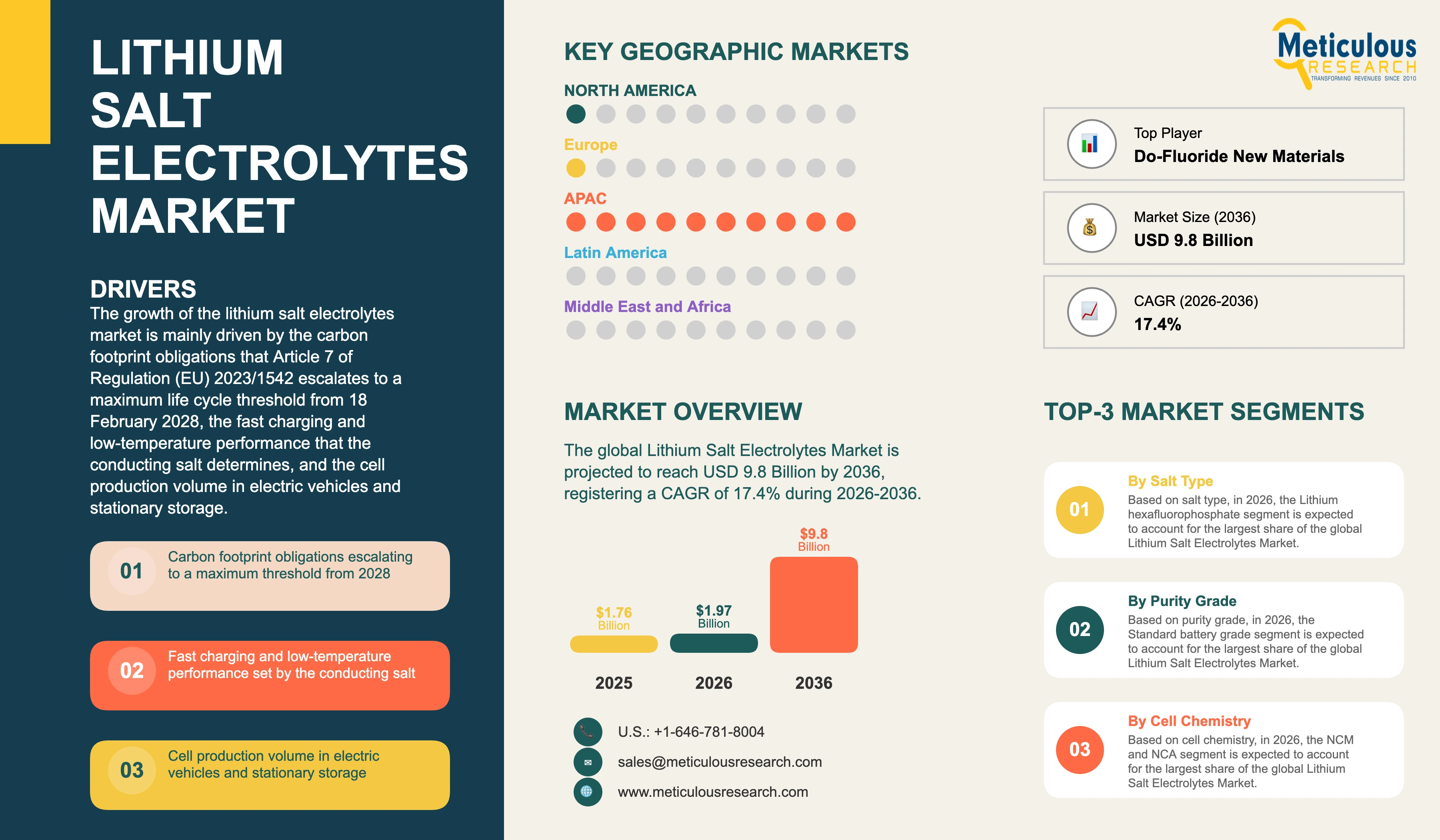
The global lithium salt electrolytes market was valued at USD 1.76 billion in 2025. This market is expected to reach USD 9.80 billion by 2036 from an estimated USD 1.97 billion in 2026, registering a CAGR of 17.4% during the forecast period (2026-2036).
- Published
- Nov 2026
- Pages
- 260
- Format
- PDF + Excel
- Report ID
- MRCHM - 1042674
- Base year
- 2025
- 2025 · BASELINE
- $1.76B
- 2036
- $9.80B
- CAGR 2026–2036
- 17.4%
2025 baseline · 2026–2036 forecast at 17.4% CAGR · hover a bar for the value
Key highlights
The global lithium salt electrolytes market is estimated at USD 1.97 billion in 2026 and is projected to reach USD 9.80 billion by 2036.
Market volume is estimated at 205.00 kilotons in 2026 and is projected to reach 888.85 kilotons by 2036 at a CAGR of 15.8%, measured as salt supplied on a dry basis.
The average selling price is estimated at USD 9.60 per kg in 2026 and is projected to rise to USD 11.02 per kg by 2036 as lithium bis(fluorosulfonyl)imide takes a larger share of the mix.
This market measures salts supplied as the conducting salt and is not additive to the electrolyte additives market, which measures lithium salts used at additive loadings.
Lithium hexafluorophosphate is expected to account for the largest salt type share in 2026, while lithium bis(fluorosulfonyl)imide is projected to register the highest CAGR of 27.8%.
Standard battery grade is expected to hold the largest purity share in 2026, while high-purity low-moisture grade is projected to grow fastest at a CAGR of 20.6%.
NCM and NCA chemistries are expected to be the largest cell chemistry served in 2026, while LMFP and manganese-rich chemistries are projected to register the highest CAGR of 23.4%.
Electric vehicles are expected to account for the largest application share in 2026, while stationary energy storage is projected to grow fastest at a CAGR of 21.6%.
Asia-Pacific is expected to hold the largest regional share in 2026, while North America is projected to register the highest CAGR of 26.4%.
Article 7(1) of Regulation (EU) 2023/1542 requires a carbon footprint declaration for each battery model per manufacturing plant, expressed in kilograms of carbon dioxide equivalent per kilowatt-hour of lifetime energy, with a breakdown by life cycle stage and a web link to the supporting study.
That declaration applies to electric vehicle batteries from 18 February 2025, to rechargeable industrial batteries above 2 kWh other than those with exclusively external storage from 18 February 2026, to LMT batteries from 18 August 2028 and to rechargeable industrial batteries with external storage from 18 August 2030.
Article 7(2) requires a label showing the carbon footprint and the carbon footprint performance class, applying to electric vehicle batteries from 18 August 2026 and to rechargeable industrial batteries from 18 August 2027.
Article 7(3) requires technical documentation demonstrating that the declared life cycle carbon footprint is below a maximum threshold, applying to electric vehicle batteries from 18 February 2028 and to rechargeable industrial batteries from 18 February 2029.
The maximum threshold applies to LMT batteries from 18 August 2031 and to rechargeable industrial batteries with external storage from 18 August 2033.
The Commission is required to review the number of carbon footprint performance classes and their thresholds every three years.
Article 7(4) requires the Commission to assess by 31 December 2030 whether to extend these requirements to portable batteries and to rechargeable industrial batteries of 2 kWh or less.
Article 7(5) exempts batteries placed on the market or put into service before undergoing preparation for re-use, preparation for repurposing, repurposing or remanufacturing.
Report summary
| Particulars | Details |
|---|---|
| Base Year | 2025 |
| Forecast Period | 2026-2036 |
| Market Size in 2025 | USD 1.76 billion |
| Market Size in 2026 | USD 1.97 billion |
| Market Size by 2036 | USD 9.80 billion |
| Value CAGR (2026-2036) | 17.4% |
| Format | PDF, Excel & Cloud Portal · 260 pages |
| Volume in 2026 | 205.00 kilotons |
| Volume by 2036 | 888.85 kilotons |
| Volume CAGR (2026-2036) | 15.8% |
| Volume Basis | Salt supplied on a dry basis, not as solution |
| Average Selling Price in 2026 | USD 9.60 per kg |
| Average Selling Price by 2036 | USD 11.02 per kg |
| Price Direction | Rising, as lithium bis(fluorosulfonyl)imide takes share from lithium hexafluorophosphate |
| Measurement Basis | Lithium salts supplied as the conducting salt in liquid battery electrolytes, covering lithium hexafluorophosphate, lithium bis(fluorosulfonyl)imide, lithium bis(trifluoromethanesulfonyl)imide, lithium tetrafluoroborate and other conducting salts, and excluding lithium salts used at additive loadings, the base carbonate and ether solvents, the finished formulated electrolyte, lithium carbonate and lithium hydroxide feedstock, solid and polymer electrolytes and their precursors, sodium salts for sodium-ion cells, and cathode and anode materials |
| Relationship to Adjacent Markets | Not additive to the electrolyte additives market, which measures lithium salts used at additive loadings; upstream of the formulated electrolyte and downstream of lithium carbonate, neither of which is counted here |
| Largest Salt Type | Lithium hexafluorophosphate |
| Fastest-Growing Salt Type | Lithium bis(fluorosulfonyl)imide (CAGR 27.8%) |
| Largest Purity Grade | Standard battery grade |
| Fastest-Growing Purity Grade | High-purity low-moisture grade (CAGR 20.6%) |
| Largest Cell Chemistry | NCM and NCA |
| Fastest-Growing Cell Chemistry | LMFP and manganese-rich (CAGR 23.4%) |
| Largest Application | Electric vehicles |
| Fastest-Growing Application | Stationary energy storage (CAGR 21.6%) |
| Largest Region | Asia-Pacific |
| Fastest-Growing Region | North America (CAGR 26.4%) |
| Segments Covered | Salt Type, Purity Grade, Cell Chemistry, Application, and Geography |
| Geographies Covered | Asia-Pacific, Europe, North America, Latin America, and Middle East & Africa |
| Companies Profiled | 11 companies, including Do-Fluoride New Materials Co., Ltd., Guangzhou Tinci Materials Technology Co., Ltd., Central Glass Co., Ltd., Shenzhen Capchem Technology Co., Ltd., Stella Chemifa Corporation, and Nippon Shokubai Co., Ltd. |
Report overview
Segments covered: salt type, purity grade, cell chemistry, application.
The growth of this market is mainly driven by the carbon footprint obligations that Article 7 of Regulation (EU) 2023/1542 escalates from declaration through performance class labelling to a maximum life cycle threshold for electric vehicle batteries from 18 February 2028, the fast charging and low-temperature performance that the conducting salt rather than the solvent determines, the cell production volume in electric vehicles and stationary storage, and the salt capacity being committed outside Asia to serve cell plants under construction there. However, factors such as the hydrolysis of lithium hexafluorophosphate in the presence of trace moisture and the hydrogen fluoride it generates, and the hydrofluoric acid handling and anhydrous processing that confine production to a small number of sites, are expected to restrain the growth of this market to some extent.
Lithium salt electrolytes are the lithium salts dissolved in a battery electrolyte to carry charge between the electrodes, supplied as the conducting salt rather than as a functional additive. Market sizing in this report is on both a value basis in USD and a volume basis in kilotons measured as salt supplied on a dry basis, with average selling price derived from the two. The measurement basis covers lithium hexafluorophosphate, lithium bis(fluorosulfonyl)imide, lithium bis(trifluoromethanesulfonyl)imide, lithium tetrafluoroborate and other conducting salts, and it excludes lithium salts used at additive loadings, the base carbonate and ether solvents, the finished formulated electrolyte, lithium carbonate and lithium hydroxide feedstock, solid and polymer electrolytes and their precursors, sodium salts for sodium-ion cells, and cathode and anode materials.
Separating the conducting salt from the same compounds used as additives is what keeps this market coherent and prevents it overlapping the electrolyte additives market. A salt dosed at a few per cent to modify interface formation performs a different function from the same salt dissolved at full molarity to carry current, it is specified against different criteria and it is bought in a different quantity, so the two uses belong in different markets. This market is also upstream of the formulated electrolyte and downstream of lithium carbonate, neither of which is counted here. The three positions are consecutive rather than additive.
Article 7(1) of Regulation (EU) 2023/1542 requires a carbon footprint declaration for each battery model per manufacturing plant, expressed in kilograms of carbon dioxide equivalent per kilowatt-hour of lifetime energy delivered, with a breakdown by life cycle stage, the identification number of the EU declaration of conformity and a web link to the supporting study. That obligation applies to electric vehicle batteries from 18 February 2025, to rechargeable industrial batteries above 2 kWh other than those with exclusively external storage from 18 February 2026, to LMT batteries from 18 August 2028 and to industrial batteries with external storage from 18 August 2030.
The escalation written into Article 7 is what makes the provision material rather than administrative. Paragraph 2 adds a label showing the carbon footprint and a performance class from 18 August 2026 for electric vehicle batteries and 18 August 2027 for rechargeable industrial batteries, and paragraph 3 then requires technical documentation demonstrating that the declared life cycle footprint falls below a maximum threshold from 18 February 2028 for electric vehicle batteries and 18 February 2029 for industrial batteries, with LMT batteries following from 18 August 2031. Disclosure becomes comparison and comparison becomes a pass or fail condition within three years.
A threshold rather than a declaration is what reaches the salt. Lithium hexafluorophosphate is manufactured from lithium carbonate, phosphorus pentachloride and anhydrous hydrogen fluoride in an energy intensive process requiring rigorous moisture exclusion, and the footprint of that step accumulates into the figure a cell maker must declare and eventually keep below a limit. Where the salt is made and on what electricity therefore enters a calculation that was previously commercial rather than regulatory. A supplier able to document a low footprint competes on something a buyer must now report.
Lithium hexafluorophosphate holds the position it does because no alternative matches the combination it provides. It gives high ionic conductivity in carbonate solvents, a wide electrochemical stability window, and it passivates the aluminium current collector on the cathode side, which several otherwise attractive salts fail to do and which causes aluminium corrosion at operating potentials. It is also produced at a scale and price no other lithium salt approaches. Every cell manufacturing line, formation protocol and quality system in the industry is built around it.
The weakness of the dominant salt is chemical rather than commercial. Lithium hexafluorophosphate exists in equilibrium with lithium fluoride and phosphorus pentafluoride, and in the presence of trace moisture it hydrolyses to generate hydrogen fluoride, which attacks the cathode surface, dissolves transition metals and degrades the interphase on the anode. Moisture control through manufacture, packaging, transport and electrolyte filling is therefore part of the product specification rather than good practice. The same instability limits high-temperature performance and sets much of the ageing behaviour of a cell.
Lithium bis(fluorosulfonyl)imide addresses precisely those limitations. It delivers higher conductivity than lithium hexafluorophosphate at the same concentration, substantially better thermal stability, better retention of performance at low temperature and no hydrogen fluoride generation on contact with moisture, which together serve fast charging and cold-weather range. It costs several times as much per kilogram and requires aluminium corrosion to be managed through formulation. Use at full conducting concentration therefore remains confined to those cells where the performance gain justifies the cost, which is why it grows fastest while lithium hexafluorophosphate carries the volume.
Purity requirements in this market are stated in parts per million and they govern cell performance directly. Residual moisture, free acid, metallic impurities and insoluble matter each initiate reactions that consume lithium inventory, raise impedance or produce gas, and a cell manufacturer specifies limits that the salt producer must hold consistently across every batch rather than on average. Reaching and documenting those levels is the main technical barrier in the business, ahead of synthesis itself. High-purity low-moisture grade consequently grows faster than standard battery grade.
Production concentration follows the hydrogen fluoride requirement more than the lithium. Manufacturing lithium hexafluorophosphate requires anhydrous hydrogen fluoride handling, fluoride effluent treatment and processing under rigorous moisture exclusion, which demands permitting, containment and worker protection that confine capacity to a small number of sites in a small number of countries. Salt capacity is now being committed in Europe and North America to serve cell plants under construction there, from a base close to zero. North America consequently registers the highest regional CAGR at 26.4%.
Report infographic
Market dynamics
15 factors across 5 forcesCarbon Footprint Obligations Escalating to a Maximum Threshold From 2028
Article 7(1) of Regulation (EU) 2023/1542 has required since 18 February 2025 that electric vehicle batteries carry a carbon footprint declaration per model and per manufacturing plant in kilograms of carbon dioxide equivalent per kilowatt-hour of lifetime energy, with a breakdown by life cycle stage, and Article 7(2) adds a performance class label from 18 August 2026 while Article 7(3) requires the declared footprint to fall below a maximum threshold from 18 February 2028. Lithium hexafluorophosphate is made from lithium carbonate, phosphorus pentachloride and anhydrous hydrogen fluoride in an energy intensive process, so its footprint accumulates into that figure. Where the salt is made and on what electricity therefore becomes a reportable input rather than a commercial detail, and a cell maker that cannot evidence that figure cannot complete the declaration at all. The Commission is also required to review the number of performance classes and their thresholds every three years, so the requirement tightens rather than settling once met.
Fast Charging and Low-Temperature Performance Set by the Conducting Salt
Ionic conductivity, thermal stability and low-temperature retention are governed by the conducting salt rather than by the solvent blend around it, so a cell designed for high charging rates or for cold climate operation reaches its limit at the salt before anywhere else. Lithium bis(fluorosulfonyl)imide delivers higher conductivity at the same concentration, substantially better thermal stability and better cold performance than lithium hexafluorophosphate, and it generates no hydrogen fluoride on contact with moisture. Those are the properties vehicle platforms are specifying as charging rates rise. Lithium bis(fluorosulfonyl)imide consequently registers the highest salt type CAGR at 27.8%. The same properties also reduce the rate at which a cell loses capacity in service, which feeds into the durability values a manufacturer must now declare.
Cell Production Volume in Electric Vehicles and Stationary Storage
Every lithium-ion cell manufactured contains a conducting salt at a quantity set by electrolyte volume and molarity rather than by any discretionary choice, so demand here is a direct function of cell output. Stationary storage adds volume at a different chemistry weighting, since lithium iron phosphate cells carry a different electrolyte formulation from high-nickel cells, and it grows at the highest application CAGR of 21.6%. The two applications together make salt volume grow at a rate close to cell output. The driver is volumetric and operates independently of the regulatory provisions above, so it sets a floor under demand whatever happens to the delegated acts and their timetable. Salt consumption per kilowatt-hour is also set by electrolyte volume and molarity rather than by any discretionary specification choice, so volume in this market tracks cell output more closely than in almost any other battery materials category, and it does so without the formulation variables that complicate additive demand or the variable loadings that govern additive consumption.
Salt Capacity Committed Outside Asia to Serve New Cell Plants
Conducting salt capacity outside Asia has been close to zero relative to consumption, and the cell plants under construction in Europe and North America require electrolyte supplied locally because formulated electrolyte has a limited shelf life and is costly to ship, which pulls salt capacity behind it. The carbon footprint obligations under Article 7 reinforce the same direction by making the footprint of imported material a reportable figure. Projects are therefore being committed against cell plant schedules rather than against salt market prices. North America registers the highest regional CAGR at 26.4% and Europe follows at 24.0%, both from very small bases, and both ahead of the regions where the salt is currently made.
Table of contents
12 chapters · 143 sections · 260 pages · click to expandSegmental analysis
| Segment | Largest share (2026) | Fastest growth (2026–2036) |
|---|---|---|
| By Salt Type | Lithium hexafluorophosphate | Lithium bis(fluorosulfonyl)imide |
| By Purity Grade | Standard battery grade | High-purity low-moisture |
| By Cell Chemistry | NCM and NCA chemistries | LMFP and manganese-rich chemistries |
| By Application | Electric vehicles | Stationary energy storage |
By Salt Type
- Lithium Salt Electrolytes Market Analysis by Salt Type
- The lithium hexafluorophosphate segment is expected to account for the largest share of the global lithium salt electrolytes market.
- The large share of this segment is mainly due to the combination of high ionic conductivity in carbonate solvents, a wide electrochemical stability window and passivation of the aluminium current collector that no alternative salt matches, the production scale and price no other lithium salt approaches, and the qualification of every cell manufacturing line and formation protocol in the industry around it.
- However, the lithium bis(fluorosulfonyl)imide segment is projected to register the highest CAGR of 27.8% during the forecast period.
- The rapid growth of this segment is attributed to higher conductivity at the same concentration, substantially better thermal stability, better retention of performance at low temperature, and the absence of hydrogen fluoride generation on contact with moisture, which removes the degradation pathway that governs much of cell ageing.
- Lithium bis(trifluoromethanesulfonyl)imide holds a narrower position where its thermal stability is required and its lower conductivity can be accepted, and lithium tetrafluoroborate serves high-temperature and low-temperature applications where its weaker conductivity is outweighed by stability.
- Other conducting salts cover the oxalate and borate compounds used where interface formation rather than bulk conduction is the objective.
- Salt selection follows whether cost or performance governs the cell, since the dominant salt wins on the first and the imide salts on the second, and most commercial formulations now contain more than one of them rather than relying on a single salt alone.
By Purity Grade
- Lithium Salt Electrolytes Market Analysis by Purity Grade
- The standard battery grade segment is expected to account for the largest share of the global lithium salt electrolytes market.
- The large share of this segment is mainly due to its adequacy for the majority of cells in production including the lithium iron phosphate cells that dominate stationary storage, the cost advantage over more rigorously purified material, and the established production base built to those specifications.
- However, the high-purity low-moisture segment is projected to register the highest CAGR of 20.6% during the forecast period.
- The rapid growth of this segment is attributed to residual moisture, free acid, metallic impurities and insoluble matter each initiating reactions that consume lithium inventory, raise impedance or generate gas, the limits in parts per million that cell manufacturers require to hold across every batch rather than on average, and the tightening of those limits as cell energy density rises and tolerance for side reactions falls with it.
By Cell Chemistry
- Lithium Salt Electrolytes Market Analysis by Cell Chemistry
- The NCM and NCA chemistries segment is expected to account for the largest share of the global lithium salt electrolytes market.
- The large share of this segment is mainly due to the cell volume these chemistries represent in passenger vehicle platforms, the higher operating voltages that place greater demand on salt stability, and the electrolyte formulations built around high-nickel surfaces that require the most carefully specified salt.
- However, the LMFP and manganese-rich chemistries segment is projected to register the highest CAGR of 23.4% during the forecast period.
- The rapid growth of this segment is attributed to the higher operating voltages these chemistries use than lithium iron phosphate, the manganese dissolution that a hydrolysing salt accelerates and that an imide salt avoids, and the growth of the chemistries themselves from a small base.
- Lithium iron phosphate accounts for the largest volume position and grows faster than NCM in tonnage while using a lower cost salt specification, since its lower operating voltage places less demand on electrochemical stability, which is part of why salt volume grows more slowly than salt value in this market.
- Other lithium chemistries cover the cobalt oxide and manganese oxide cells that remain in consumer and power tool applications.
- Cell chemistry sets the voltage window and the impurity tolerance the salt must meet rather than the quantity consumed, which is governed by electrolyte volume.
By Application
- Lithium Salt Electrolytes Market Analysis by Application
- The electric vehicles segment is expected to account for the largest share of the global lithium salt electrolytes market.
- The large share of this segment is mainly due to the cell volume vehicle electrification represents relative to every other application, the fast charging and low-temperature requirements that raise salt specification per cell, and the carbon footprint obligations that apply to electric vehicle batteries earliest under Article 7 of Regulation (EU) 2023/1542.
- However, the stationary energy storage segment is projected to register the highest CAGR of 21.6% during the forecast period.
- The rapid growth of this segment is attributed to deployment driven by electricity market and policy factors independent of the vehicle cycle, the lithium iron phosphate chemistries that dominate the application and consume salt at a different specification, and qualification periods shorter than an automotive platform requires.
- Consumer electronics accounts for a smaller and slower growing share in which the salt specification is demanding because the chemistries run at high voltage for volumetric energy, but cell volumes are modest against automotive and storage demand.
- Other applications cover power tools, two and three wheelers and industrial equipment.
- Application does not change the quantity of salt per kilowatt-hour materially, since that is set by electrolyte volume and molarity, but it does decide which salt and which purity grade a cell is qualified around, and both of those choices are effectively fixed for the life of the platform once series production has actually started.
Geographic analysis
Asia-Pacific
Largest shareIn 2026, Asia-Pacific is expected to account for the largest share of the global lithium salt electrolytes market. The large share of this region is mainly due to the concentration of conducting salt capacity in China, Japan and South Korea, the anhydrous hydrogen fluoride and fluorochemical base that supports it, the electrolyte blending and cell manufacturing immediately downstream, and two decades of qualification history with regional cell makers. China is projected to register a CAGR of 15.8%, India a CAGR of 22.0% and South Korea a CAGR of 18.4% during the forecast period. A producer in Asia-Pacific supplying a cell maker serving Europe therefore has to evidence its own manufacturing emissions on the same basis as a European plant would. Salt manufacture itself remains concentrated where anhydrous hydrogen fluoride capability and permitting coincide, which is why Asia-Pacific holds the overwhelming majority of supply throughout the forecast period while the fastest growth occurs elsewhere. Anhydrous hydrogen fluoride capability also cannot be stood up alongside a cell plant on the same timetable, which is why new regional salt supply lags new regional cell capacity by several years.
North America
Fastest growthHowever, North America is projected to register the highest CAGR of 26.4% during the forecast period, from a very small base. The rapid growth of this region is attributed to salt capacity being committed where almost none existed, the cell plants under construction that require electrolyte blended locally because formulated electrolyte has a limited shelf life and is costly to ship, and the critical mineral sourcing requirements attached to vehicle incentives. The United States is projected to register a CAGR of 26.8%.
Europe
Europe is projected to grow at 24.0%, with Germany at 24.6% and Poland at 23.8%, where the carbon footprint declaration under Article 7(1) has applied to electric vehicle batteries since 18 February 2025, the performance class label applies from 18 August 2026 and the maximum threshold from 18 February 2028, and where cell capacity under construction requires local electrolyte and therefore local salt.
Latin America
Latin America is projected to grow at 17.0% and the Middle East & Africa at 15.0%, both from negligible bases and almost entirely through imported electrolyte rather than local salt production. Regulation written for one market reaches salt manufacturing decisions in another, because a carbon footprint declaration with a breakdown by life cycle stage attaches to a battery placed on the European market regardless of where its salt was made.
Competitive landscape
The global lithium salt electrolytes market is characterised by the presence of Chinese producers operating the largest lithium hexafluorophosphate capacity, Japanese fluorochemical companies with long qualification histories and high-purity capability, Korean electrolyte producers integrating backwards into salt, and European specialty chemical companies in the imide salts. Competition is contested on purity consistency, on secured anhydrous hydrogen fluoride supply and increasingly on documented manufacturing footprint rather than on price alone, because an out-of-specification batch costs a cell maker far more than the salt. Do-Fluoride New Materials Co., Ltd., Guangzhou Tinci Materials Technology Co., Ltd., Central Glass Co., Ltd., Shenzhen Capchem Technology Co., Ltd. and Stella Chemifa Corporation together accounted for an estimated 52.4% of this market in 2026, while the companies profiled in this report together accounted for an estimated 76.8%.
Article 7(1) of Regulation (EU) 2023/1542 has applied to electric vehicle batteries since 18 February 2025, Article 7(2) requires a carbon footprint performance class label from 18 August 2026 and Article 7(3) requires the declared life cycle footprint to fall below a maximum threshold from 18 February 2028. Qualification of lithium bis(fluorosulfonyl)imide as a primary conducting salt, commitment of salt capacity in Europe and North America, and integration of salt production into electrolyte operations accounted for most competitive activity through 2026.
Integration rather than merchant supply is reshaping the field, because an electrolyte producer that makes its own salt controls both the formulation and its security of supply. Do-Fluoride New Materials Co., Ltd. and Zhejiang Juhua Co., Ltd. compete from fluorochemical positions, Guangzhou Tinci Materials Technology Co., Ltd. and Shenzhen Capchem Technology Co., Ltd. from integrated salt and electrolyte operations, Central Glass Co., Ltd., Stella Chemifa Corporation, Morita Chemical Industries Co., Ltd. and Kanto Denka Kogyo Co., Ltd. on high-purity capability, and Nippon Shokubai Co., Ltd. and Syensqo SA in the imide salts. Some of the key players operating in the lithium salt electrolytes market are Do-Fluoride New Materials Co., Ltd. (China), Guangzhou Tinci Materials Technology Co., Ltd. (China), Central Glass Co., Ltd. (Japan), Shenzhen Capchem Technology Co., Ltd. (China), Stella Chemifa Corporation (Japan), Morita Chemical Industries Co., Ltd. (Japan), Kanto Denka Kogyo Co., Ltd. (Japan), Nippon Shokubai Co., Ltd. (Japan), Enchem Co., Ltd. (South Korea), Zhejiang Juhua Co., Ltd. (China), and Syensqo SA (Belgium), among others.
- —
Article 7(1) of Regulation (EU) 2023/1542 requires a carbon footprint declaration for each battery model per manufacturing plant in kilograms of carbon dioxide equivalent per kilowatt-hour of lifetime energy with a breakdown by life cycle stage, applying to electric vehicle batteries from 18 February 2025, to rechargeable industrial batteries above 2 kWh other than those with exclusively external storage from 18 February 2026, to LMT batteries from 18 August 2028 and to industrial batteries with external storage from 18 August 2030. Article 7(2) requires a label showing the carbon footprint and performance class from 18 August 2026 for electric vehicle batteries and 18 August 2027 for rechargeable industrial batteries. Article 7(3) requires technical documentation demonstrating that the declared life cycle carbon footprint is below a maximum threshold from 18 February 2028 for electric vehicle batteries, 18 February 2029 for rechargeable industrial batteries, 18 August 2031 for LMT batteries and 18 August 2033 for industrial batteries with external storage. The Commission must review the number of performance classes and their thresholds every three years, and under Article 7(4) must assess by 31 December 2030 whether to extend these requirements to portable batteries and to rechargeable industrial batteries of 2 kWh or less.
- Do-Fluoride New Materials Co., Ltd.
- Guangzhou Tinci Materials Technology Co., Ltd.
- Central Glass Co., Ltd.
- Shenzhen Capchem Technology Co., Ltd.
- Stella Chemifa Corporation
- Nippon Shokubai Co., Ltd
Expert perspectives
Value grows at 17.4% against 15.8% in volume over the forecast period, and the average selling price rises from USD 9.60 per kg in 2026 to USD 11.02 per kg by 2036. That direction comes from mix as lithium bis(fluorosulfonyl)imide takes share from lithium hexafluorophosphate at several times the price per kilogram, not from any increase in the cost of making either. A tonnage view of this market understates what is happening inside it.
This total covers salts supplied as the conducting salt and is not additive to the electrolyte additives market, where the same compounds appear at additive loadings. A salt dosed at a few per cent to modify interface formation is a different product proposition from the same salt at full molarity carrying current, and the two are bought in different quantities against different criteria.
Article 7 matters because it escalates rather than merely discloses. Declaration for electric vehicle batteries has applied since 18 February 2025, the performance class label follows from 18 August 2026 and a maximum life cycle threshold from 18 February 2028, with the Commission reviewing classes and thresholds every three years. Lithium hexafluorophosphate is made in an energy intensive process from lithium carbonate, phosphorus pentachloride and anhydrous hydrogen fluoride, so where it is made and on what electricity becomes a reportable input.
The chemistry of the dominant salt is also its ceiling. Lithium hexafluorophosphate hydrolyses in trace moisture to generate hydrogen fluoride, which attacks the cathode, dissolves transition metals and degrades the anode interphase, and no formulation removes that mechanism. It is why moisture control is part of the specification rather than good practice, and why a salt that does not do it has a case wherever the cost can be carried.
What limits the imide salts is aluminium rather than cost. Lithium hexafluorophosphate passivates the aluminium current collector and imide salts do not, so corrosion has to be managed through a co-salt, an additive or a modified collector, and that has to be resolved for each cell design rather than once. Substitution is therefore formulation work rather than a purchasing decision, which is why it proceeds cell by cell.
Capacity cycles deserve more weight than they usually receive here. Plants require anhydrous hydrogen fluoride handling, effluent treatment and moisture-excluded processing that take years to permit and commission, while demand moves on vehicle programme timelines, so supply and demand have repeatedly fallen out of step and prices have moved far more than consumption. The price path in this forecast reflects mix, and it should not be read as a view on any particular cycle within the period.
Customer perspectives
Batch-level consistency on moisture and free acid governs salt purchasing because a failed batch costs far more than the material, and documented manufacturing footprint has become a purchasing question because it enters a figure the customer must publish.
Conducting salt rather than solvent sets the conductivity and thermal limits that fast charging encounters, and the imide salts that resolve them introduce aluminium current collector corrosion that has to be addressed in formulation.
Long plant lead times against demand that moves on vehicle programme schedules have produced price moves far larger than changes in consumption, which is why buyers favour long-term agreements over spot purchasing, and why a producer values a committed offtake as highly as a buyer values committed supply.
“Moisture and free acid are the two numbers we watch, and we watch them batch by batch rather than as an average, because an out-of-specification delivery costs us far more than the salt is worth. What is new is that our customers now ask us where the salt was made and on what power, because that figure goes into what they publish.”
“The salt is what limits us, not the solvent. Once we push the charging rate the conductivity and the thermal behaviour of the conducting salt become the constraint, and the imide salt solves both. Then we spend six months sorting out aluminium corrosion that we never had to think about before.”
“These plants take years to permit and build, and demand moves on vehicle programme timing, so the two have never lined up. We have seen the price move several times more than actual consumption did. That is why we contract long term rather than buying on the market.”
Frequently asked questions
This market was valued at USD 1.59 billion in 2024 and USD 1.76 billion in 2025, and is estimated at USD 1.97 billion in 2026. In volume terms it is estimated at 205.00 kilotons in 2026 as salt supplied on a dry basis.
Cite this report
Meticulous Research. (2026). Lithium Salt Electrolytes Market - Global Opportunity Analysis and Industry Forecast (2026-2036) (Report No. MRCHM - 1042674). Meticulous Market Research Pvt. Ltd. https://www.meticulousresearch.com/product/lithium-salt-electrolytes-market-7357