
Medical Lithium Battery Market (2025-2035)
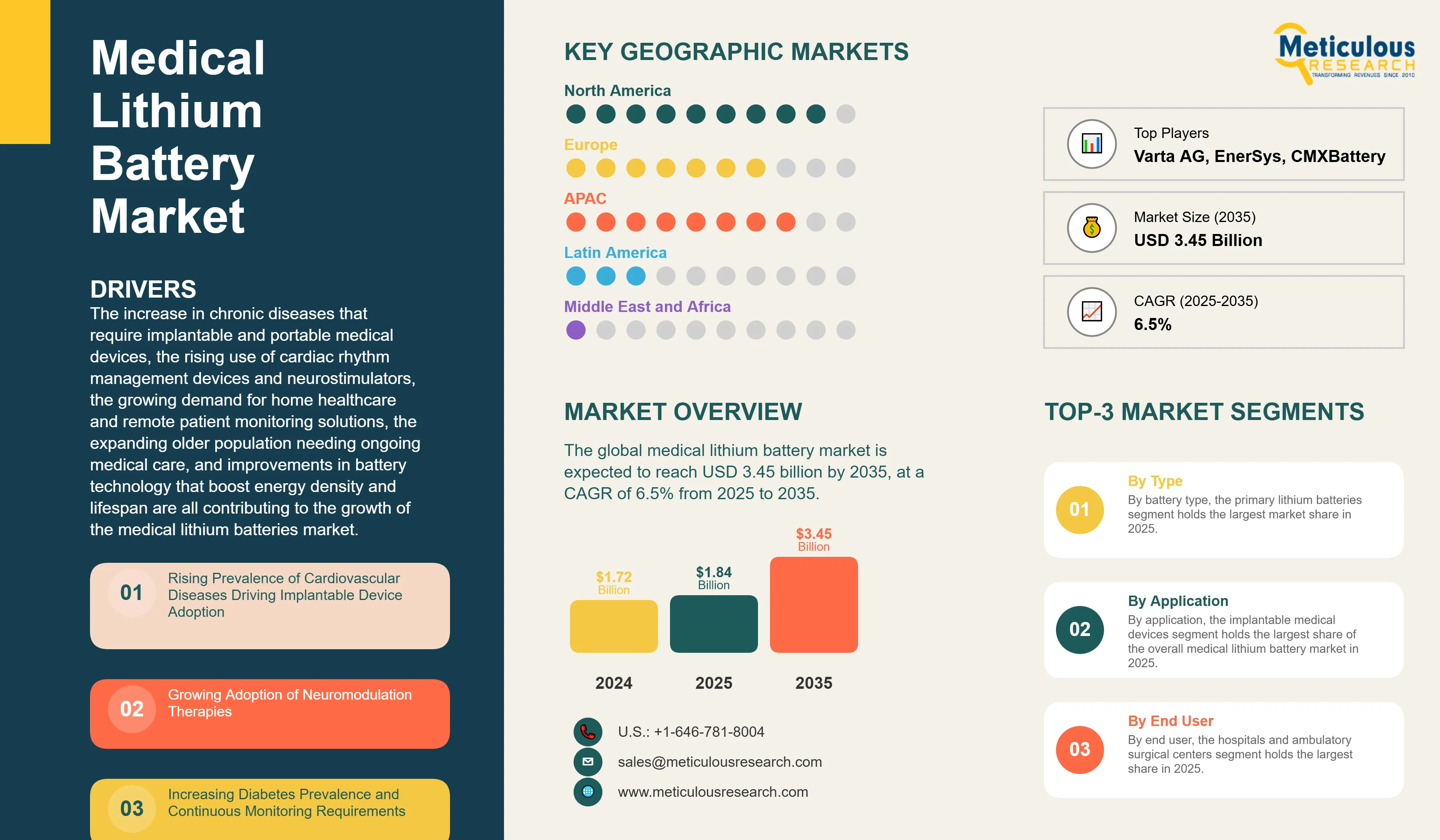
The global medical lithium battery market was valued at USD 1.72 billion in 2024. This market is expected to reach USD 1.84 billion in 2025 and grow to about USD 3.45 billion by 2035, at a CAGR of 6.5% from 2025 to 2035.
- Published
- Oct 2025
- Pages
- 230
- Format
- PDF + Excel
- Report ID
- MRHC - 1041623
- Base year
- 2024
- 2024 · BASELINE
- $1.72B
- 2035
- $3.45B
- CAGR 2025–2035
- 6.5%
2024 baseline · 2025–2035 forecast at 6.5% CAGR · hover a bar for the value
Key highlights
In terms of revenue, the global medical lithium battery market is valued at USD 1.84 billion in 2025 and is projected to reach USD 3.45 billion by 2035.
The market is expected to grow at a CAGR of 6.5% from 2025 to 2035.
North America dominates the global medical lithium battery market with the largest market share in 2025.
Asia Pacific is expected to witness the fastest CAGR during the forecast period.
By battery type, the primary lithium batteries segment holds the largest market share in 2025.
By battery type, the rechargeable lithium-ion batteries segment is expected to witness the fastest growth during the forecast period.
By application, the implantable medical devices segment holds the largest share of the overall medical lithium battery market in 2025.
By application, the wearable medical devices segment is expected to witness the fastest CAGR during the forecast period.
By end user, the hospitals and ambulatory surgical centers segment holds the largest share in 2025.
By end user, the homecare settings segment is expected to witness the fastest CAGR during the forecast period.
Report summary
| Particulars | Details |
|---|---|
| Report Coverage | Details |
| Market Size by 2035 | USD 3.45 Billion |
| Market Size in 2025 | USD 1.84 Billion |
| Market Size in 2024 | USD 1.72 Billion |
| Market Growth Rate from 2025 to 2035 | CAGR of 6.5% |
| Format | PDF, Excel & Cloud Portal · 230 pages |
| Dominating Region | North America |
| Fastest Growing Region | Asia Pacific |
| Base Year | 2024 |
| Forecast Period | 2025 to 2035 |
| Segments Covered | Battery Type, Application, End User, and Region |
| Regions Covered | North America, Europe, Asia-Pacific, Latin America, and Middle East & Africa |
Report overview
Segments covered: battery type, application, end user.
The increase in chronic diseases that require implantable and portable medical devices, the rising use of cardiac rhythm management devices and neurostimulators, the growing demand for home healthcare and remote patient monitoring solutions, the expanding older population needing ongoing medical care, and improvements in battery technology that boost energy density and lifespan are all contributing to the growth of the medical lithium batteries market. These batteries are used in hospitals, outpatient surgical centers, home care settings, and long-term care facilities around the world.
The medical lithium batteries provide reliable, long-lasting energy for life-critical applications. Medical lithium batteries are built to meet strict regulatory standards and performance needs specific to healthcare, such as biocompatibility, hermetic sealing, predictable discharge rates, wide temperature ranges, and long shelf life. These power sources are vital for implantable cardiac devices like pacemakers and defibrillators, neurostimulators for managing pain and movement disorders, drug delivery systems, hearing aids, portable diagnostic equipment, and wearable health monitors that need steady, dependable power over long periods.
The market includes primary (non-rechargeable) lithium batteries that offer excellent energy density and reliability for implantable devices that need to operate for decades. It also includes rechargeable lithium-ion and lithium-polymer batteries for external medical equipment that needs frequent recharging. These come in different configurations, such as coin cells, cylindrical cells, prismatic cells, and custom-designed battery packs with advanced battery management systems for safety and performance monitoring.
The overall medical lithium battery market is growing primarily due to the growing global burden of cardiovascular diseases, neurological disorders, and metabolic conditions that require device-based interventions. There is also a rising preference for less invasive procedures and outpatient care that rely on battery-powered medical technologies. Furthermore, the factors such as increased healthcare spending in emerging economies that improve access to medical devices, aging populations facing more chronic diseases, innovations in battery chemistry that extend device life, miniaturization that allows for smaller implants with longer operational life, and the growing trend toward connected health and remote patient monitoring that requires portable and wearable medical devices drive the growth of this market.
A major trend in the medical lithium battery market is the ongoing progress in battery chemistry and design aimed at extending operational life and increasing energy density. This change is driven by the demand for longer-lasting implants that lower the need for surgical replacements and improve patient quality of life. Modern pacemaker batteries now typically last 10 to 15 years, compared to 5 to 7 years for earlier models. Implantable cardioverter defibrillators achieve operational spans of 7 to 10 years despite their higher power needs for shock delivery. Manufacturers are creating lithium-silver vanadium oxide and lithium-manganese dioxide chemistries that offer better voltage stability and energy capacity in smaller sizes. This trend allows for the development of next-generation implantable devices with improved features, including multi-chamber pacing, advanced arrhythmia detection algorithms, wireless telemetry, and integrated sensors, all while maintaining or extending battery life. The push for longer battery life lowers healthcare costs linked to replacement surgeries, reduces patient risk from repeat procedures, and boosts device reliability. Battery innovations also help miniaturize implantable devices, making them suitable for pediatric patients and allowing for less invasive implantation procedures that speed up recovery times and cut complications.
Another significant trend transforming the market is the rapid adoption of rechargeable lithium-ion battery systems with wireless charging for external and semi-implantable medical devices. This shift addresses the issues of primary batteries in high-power applications while providing greater convenience and flexibility for patients managing chronic conditions. Rechargeable systems are becoming standard in cochlear implants, spinal cord stimulators, deep brain stimulators, and external insulin pumps, where power needs surpass what primary batteries can efficiently provide or where frequent battery changes would be impractical.
The shift toward rechargeable systems is particularly strong in neuromodulation applications, where the effectiveness of therapy often depends on stimulation intensity and frequency, creating power demands that primary batteries cannot support over acceptable replacement periods. Advanced battery management systems in these devices track charge levels, optimize charging cycles, and give patients clear feedback through smartphone applications, integrating medical device management into connected health systems. This change supports more aggressive therapy protocols, allows for adaptive stimulation based on patient activity and symptoms, and positions medical devices as long-term therapeutic partners instead of products that require periodic replacement.
Asia Pacific is expected to witness the fastest growth from 2025 to 2035. This growth is mainly attributed to the rapidly aging populations in Japan, China, and South Korea, the rising prevalence of lifestyle-related chronic diseases, improving healthcare infrastructure, more affordable medical devices, and the growing use of new therapeutic technologies in emerging economies in the region.
Economic development and a growing middle class in China, India, Southeast Asia, and other countries in the Asia Pacific are making it easier for people to access advanced medical care. This includes implantable cardiac devices and neurostimulators that were once mainly available in developed markets. Government healthcare programs in places like China and India are focusing on managing cardiovascular diseases. They are also expanding insurance coverage for implantable medical devices, which creates demand for medical-grade lithium batteries.
With greater health awareness and patient empowerment, more people are accepting medical device therapies. This trend is broadening the market to include not just hospitals but also outpatient clinics, specialized cardiac centers, and home healthcare. E-commerce platforms and growing pharmacy networks make it easier for people to get portable medical devices and wearable health monitors powered by lithium batteries.
Medical tourism in countries like Thailand, Singapore, and India is attracting international patients for cardiac procedures and neurosurgery. This increase leads to higher device implantation rates and greater battery use. The lower initial penetration of implantable medical devices in these markets compared to Western countries, along with better healthcare access and affordability, offers significant growth potential as these markets develop over the forecast period.
Report infographic
Market dynamics
8 factors across 2 forcesRising Prevalence of Cardiovascular Diseases Driving Implantable Device Adoption
A key factor driving the growth of the medical lithium battery market is the increasing global burden of cardiovascular diseases. These diseases are the leading cause of death worldwide and create a significant demand for cardiac rhythm management devices powered by lithium batteries. The World Health Organization reports that cardiovascular diseases cause about 17.9 million deaths every year, which is 32% of all global deaths. The rates of cardiac arrhythmias, heart failure, and sudden cardiac arrest risk continue to rise due to an aging population, higher rates of obesity and diabetes, and improved survival from acute cardiac events that leave patients with chronic conditions needing device-based treatments.
Pacemakers and implantable cardioverter defibrillators are the largest application segment for medical lithium batteries, with millions of devices implanted around the world each year. These life-saving devices rely entirely on battery performance since battery depletion requires the surgical replacement of the entire device generator. The American Heart Association estimates that over 3 million people globally live with pacemakers, and about 300,000 new pacemakers are implanted every year in the United States. Implantable cardioverter defibrillators provide life-saving shocks for dangerous arrhythmias and serve an additional 1.5 million patients worldwide, with around 200,000 new implants each year.
The growing uses for cardiac rhythm management devices, such as heart failure with reduced ejection fraction, bradycardia in older populations, and the primary prevention of sudden cardiac death in high-risk patients, continue to widen the patient population eligible for these treatments. Newer devices now offer cardiac resynchronization therapy, remote monitoring capabilities, and advanced diagnostic features, which all increase power needs and raise the importance of battery technology in device performance. The essential nature of these applications, where battery failure could lead to serious injury or death, drives stringent quality standards and creates significant demand for high-reliability medical-grade lithium batteries that can provide predictable performance over long operational periods.
Table of contents
12 chapters · 141 sections · 230 pages · click to expandGeographic analysis
North America
Largest shareThe U.S. medical lithium battery market is projected to grow at a CAGR of 6.2% from 2025 to 2035. North America holds the largest share of the global medical lithium battery market in 2025. This is mainly due to its strong healthcare infrastructure, high healthcare spending per person, early adoption of new medical technologies, a solid regulatory framework that supports device innovation, the presence of major medical device manufacturers, and a high number of chronic diseases that drive device implantation rates. The U.S. is the largest market for medical lithium batteries. It has a wide network of hospitals, surgical centers, and cardiac electrophysiology labs that perform hundreds of thousands of implantable device procedures each year. The U.S. leads the world in cardiac rhythm management device implantation rates, with around 500,000 pacemaker and defibrillator procedures performed annually. Each of these procedures relies on advanced lithium battery technology. High rates of cardiovascular disease, diabetes, and neurological disorders in the region create significant demand for battery-powered implantable and portable medical devices. Medicare and private insurance offer good coverage for implantable cardiac devices, neurostimulators, and continuous glucose monitoring systems. This reduces financial barriers to adopting these devices and boosts battery demand. U.S. Medical Lithium Battery Market Size and Growth 2025 to 2035 By Region
Competitive landscape
- EaglePicher Technologies LLC
- Quallion LLC (Integer Holdings Corporation)
- Saft Batteries (TotalEnergies)
- Ultralife Corporation
- Panasonic Industry Co. Ltd.
- EVE Energy Co. Ltd.
- Varta AG
- Maxell Holdings Ltd.
- Renata SA · Swatch Group
- Electrochem Solutions Inc.
- Tadiran Batteries
- EnerSys
- GrepowBattery
- Shenzhen Grepow Battery Co. Ltd.
- Shenzhen Jiayi Lithium Battery Co. Ltd.
- Shenzera Industries Ltd.
- CMXBattery
- Murata Manufacturing Co. Ltd.
- Sony Corporation
- Samsung SDI Co. Ltd.
Frequently asked questions
The medical lithium battery market is expected to grow from USD 1.84 billion in 2025 to USD 3.45 billion by 2035.
Cite this report
Meticulous Research. (2025). Medical Lithium Battery Market - Global Opportunity Analysis and Industry Forecast (2025-2035) (Report No. MRHC - 1041623). Meticulous Market Research Pvt. Ltd. https://www.meticulousresearch.com/product/medical-lithium-battery-market-6306