Lithium Iron Phosphate Recycling Market (2026-2036)
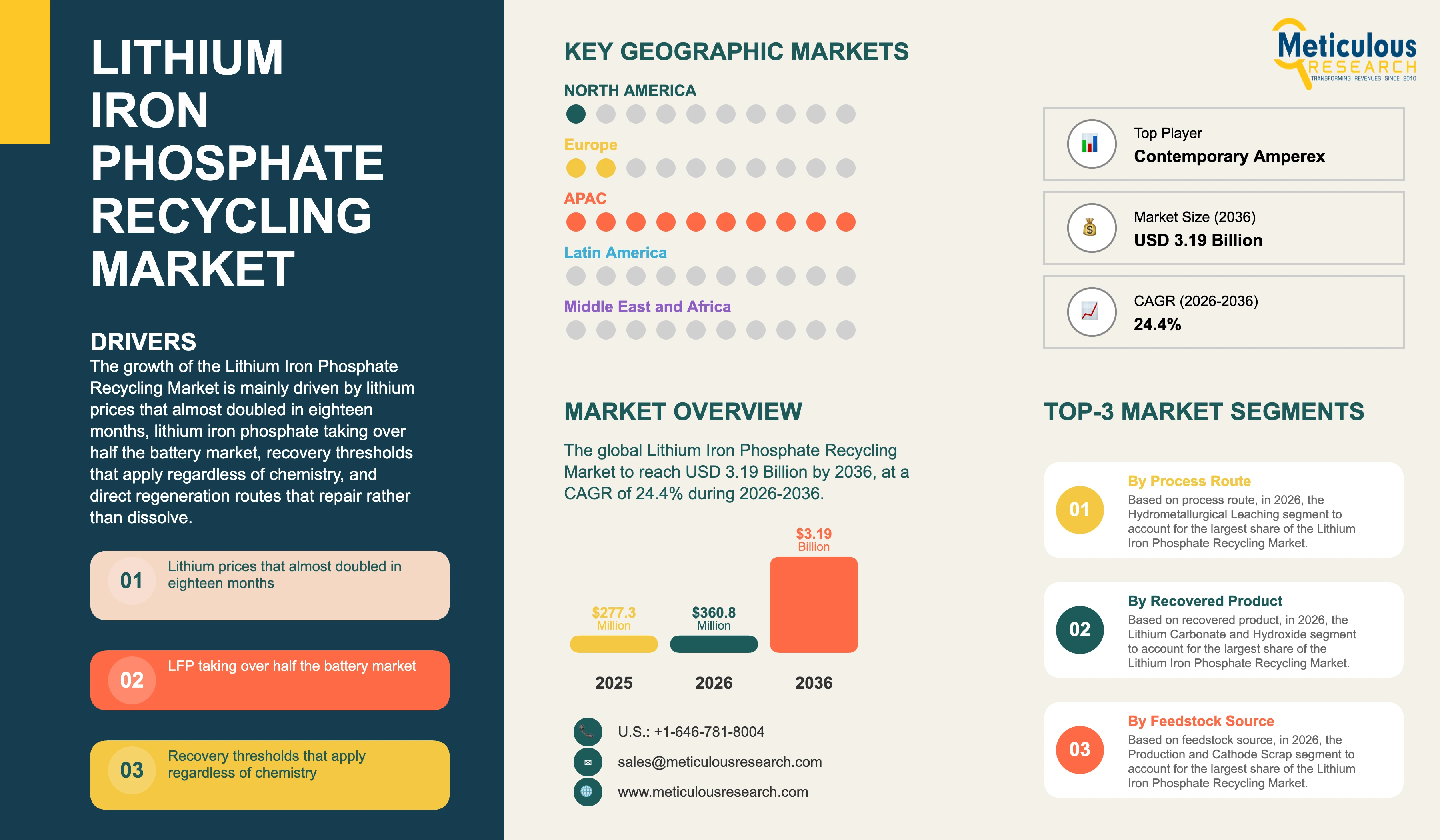
The lithium iron phosphate recycling market is valued at USD 360.8 million in 2026 and is projected to reach USD 3.19 billion by 2036, at a CAGR of 24.4% during the forecast period. The market was valued at USD 277.3 million in 2025 and at USD 212.5 million in 2024.
- Published
- Nov 2026
- Pages
- 241
- Format
- PDF + Excel
- Report ID
- MRCHM - 1042762
- Base year
- 2025
- 2024 · HISTORICAL
- $212.5M
- 2036
- $3.19B
- CAGR 2026–2036
- 24.4%
2024–2025 baseline · 2026–2036 forecast at 24.4% CAGR · hover a bar for the value
Key highlights
This market measures the value of products recovered from spent lithium iron phosphate batteries and lithium iron phosphate black mass, at the recycler gate, on a tonne of black mass processed basis.
It measures the whole of the lithium iron phosphate portion excluded from the black mass hydrometallurgy title in this series, so the two titles are complementary rather than overlapping and are not additive.
Lithium iron phosphate contains no nickel and no cobalt, so the only substantially payable metal is lithium, alongside iron phosphate, graphite and residual copper and aluminium.
Recovered value is estimated at USD 1, 950 per tonne of black mass in 2026 against USD 6,850 per tonne for nickel and cobalt bearing black mass, about 28%, which is the quantitative meaning of the low value chemistry problem in this market.
Lithium iron phosphate accounts for over half of the global electric car battery market and over 90% of the battery energy storage market, so the feedstock pool is the largest of any chemistry and still growing.
Lithium prices almost doubled between January 2025 and April 2026 on strong energy storage demand and constrained supply, with Zimbabwe export restrictions and tighter permitting in the Jiangxi region of China named among the supply constraints.
Lithium demand has grown around 25% a year on average over the past two years, driven largely by energy storage, and lithium supply deficits are projected to persist through 2035.
That price movement rather than the regulation is what has made this market viable, because the one payable metal in the chemistry became materially more valuable within eighteen months.
Annex XII of Regulation (EU) 2023/1542 requires all recycling to recover at least 50% of lithium by 31 December 2027, rising to 80% by 31 December 2031, with no distinction drawn by cathode chemistry.
Ace Green Recycling stated commercial lithium recovery of around 75% from lithium iron phosphate batteries, producing lithium carbonate above 99% purity through a modular room-temperature fully electrified hydrometallurgical process with no Scope 1 emissions and zero liquid and solid waste.
A disclosed commercial recovery of about 75% clears the 50% threshold applying from the end of 2027 but sits five percentage points below the 80% threshold applying from the end of 2031, which is the central technical gap in this market.
That company announced a leased site at Mundra in Gujarat on 8 January 2025, targeting 10,000 tonnes a year of lithium iron phosphate recycling capacity in India by 2026, with up to 50 jobs at the site and Indian headcount above 100 when fully operational.
Ten thousand tonnes a year would be about 5.4% of world lithium iron phosphate black mass processed in 2026, which indicates how small individual projects remain against the feedstock arising.
Battery recycling capacity is highly concentrated, with China holding over three quarters of world pre-treatment capacity and 90% of material recovery capacity, and Korea leading material recovery outside China.
China also dominates lithium iron phosphate production itself, and proposed Chinese export controls on lithium iron phosphate cathode materials announced in October 2025 were suspended until November 2026.
Sulphuric acid, used in over 99% of hard-rock lithium processing, rose from 3% to over 11% of lithium chemical production cash costs and has overtaken energy as the largest component, which matters because acid is also the principal reagent in hydrometallurgical recycling.
Among recovered products, lithium carbonate and hydroxide are expected to hold the largest share in 2026, while regenerated cathode material is expected to grow fastest.
Among feedstock sources, production and cathode scrap is expected to hold the largest share in 2026, while stationary energy storage batteries are expected to grow fastest.
Report summary
| Particulars | Details |
|---|---|
| Base Year | 2025 |
| Actual Years | 2024-2025 |
| Forecast Period | 2026-2036 |
| Market Size in 2024 | USD 212.5 million |
| Market Size in 2025 | USD 277.3 million |
| Market Size in 2026 | USD 360.8 million |
| Market Size in 2036 | USD 3.19 billion |
| Value CAGR (2026-2036) | 24.4% |
| Format | PDF, Excel & Cloud Portal · 241 pages |
| Historical Value Growth | 30.5% in 2025 and 30.1% in 2026, above the forecast rate, because lithium prices almost doubled from a small base between January 2025 and April 2026; the forecast assumes volume rather than price does the work from here |
| Volume in 2025 | 152.39 kilotons |
| Volume in 2026 | 185.00 kilotons |
| Volume in 2036 | 1,286.45 kilotons |
| Volume CAGR (2026-2036) | 21.4% |
| Recovered Product Value, 2026 | USD 1,950 per tonne of black mass |
| Recovered Product Value, 2036 | USD 2,480 per tonne of black mass |
| Units | Value in USD million; volume in kilotons of lithium iron phosphate black mass processed; price in USD per tonne of black mass processed |
| Measurement Basis | Value of products recovered from spent lithium iron phosphate batteries and lithium iron phosphate black mass, measured at the recycler gate on a tonne of black mass processed basis |
| Relationship to Black Mass Hydrometallurgy Title | This title measures the whole of the lithium iron phosphate portion excluded from the black mass hydrometallurgy title in this series; the two are complementary rather than overlapping and are not additive |
| Value Gap Note | Recovered value of USD 1,950 per tonne is about 28% of the USD 6,850 per tonne recovered from nickel and cobalt bearing black mass, because lithium iron phosphate contains no nickel and no cobalt |
| Exclusions | Collection, discharge, dismantling, shredding and other pre-treatment that produces black mass; nickel and cobalt bearing black mass, counted in the black mass hydrometallurgy title in this series; cathode active material and precursor manufacture from virgin feedstock; primary lithium mining and chemical conversion; second-life battery reuse without material recovery |
| Segments: Process Route | Hydrometallurgical Leaching; Selective Lithium Extraction; Direct Regeneration and Relithiation; Other Recovery |
| Segments: Recovered Product | Lithium Carbonate and Hydroxide; Iron Phosphate; Regenerated Cathode Material; Graphite; Copper, Aluminium and Other |
| Segments: Feedstock Source | Production and Cathode Scrap; Stationary Energy Storage Batteries; End-of-Life Electric Vehicle Batteries; Light Electric Vehicle and Other Batteries |
| Largest Segment by Process Route, 2026 | Hydrometallurgical Leaching, at 58.0% |
| Fastest-Growing Segment by Process Route | Direct Regeneration and Relithiation, at 33.4% |
| Largest Segment by Recovered Product, 2026 | Lithium Carbonate and Hydroxide, at 62.0% |
| Fastest-Growing Segment by Recovered Product | Regenerated Cathode Material, at 32.3% |
| Largest Segment by Feedstock Source, 2026 | Production and Cathode Scrap, at 44.0% |
| Fastest-Growing Segment by Feedstock Source | Stationary Energy Storage Batteries, at 30.4% |
| Largest Region, 2026 | Asia-Pacific, at 74.0% |
| Fastest-Growing Region | Europe, at 27.7% |
| Fastest-Growing Country | Germany, at 29.4% |
| Slowest-Growing Country | Japan, at 21.8% |
| Regions Covered | Asia-Pacific; Europe; North America; Latin America; Middle East & Africa |
| Countries Covered | China; South Korea; India; Japan; Germany; France; Poland; U.S.; Canada; Mexico; Brazil; Saudi Arabia |
| Key Players | Contemporary Amperex Technology Co., Limited; GEM Co., Ltd.; Zhejiang Huayou Cobalt Co., Ltd.; Ganfeng Lithium Group Co., Ltd.; SungEel HiTech Co., Ltd.; Ace Green Recycling, Inc. |
| Top Five Share, 2026 | 38.4% |
| Profiled Companies Share, 2026 | 40.2% |
| Currency | USD |
Report overview
Market value is measured in in USD million; volume in kilotons of lithium iron phosphate black mass processed; price in USD per tonne of black mass processed. Segments covered: process route, recovered product, feedstock source.
In volume terms, the market is estimated at 185.00 kilotons of lithium iron phosphate black mass processed in 2026, rising to 1,286.45 kilotons by 2036, at a CAGR of 21.4%. The recovered product value is estimated at USD 1,950 per tonne of black mass in 2026 and USD 2,480 per tonne in 2036, the increase reflecting higher lithium recovery rates and iron phosphate recovered to battery grade rather than discarded.
The growth of this market is mainly driven by lithium prices that almost doubled between January 2025 and April 2026, lithium iron phosphate taking over half the electric car battery market and over 90% of stationary storage, recovery thresholds that apply regardless of chemistry, and direct regeneration routes that repair the cathode rather than dissolve it. However, factors such as recovered value per tonne at about a quarter of that from nickel and cobalt bearing black mass, disclosed lithium recovery that falls short of the 2031 threshold, acid costs that have overtaken energy as the largest cash cost in lithium chemical production, and recovery capacity concentrated in one country are expected to restrain the growth of this market to some extent.
Among process routes, hydrometallurgical leaching is expected to hold the largest share of this market in 2026, while direct regeneration and relithiation are expected to record the highest CAGR during the forecast period. Geographically, Asia-Pacific is expected to account for the largest share of this market in 2026, while Europe is expected to register the highest CAGR during the forecast period.
Lithium iron phosphate is the chemistry that solved cost and safety at the expense of energy density. Its olivine cathode uses iron and phosphate in place of nickel and cobalt, which removes the two metals that carry most of the value in a conventional lithium-ion cell and most of the supply risk. It accounts for over half of the global electric car battery market and over 90% of the battery energy storage market.
That same substitution creates the problem this market exists to solve. A tonne of lithium iron phosphate black mass carries lithium, iron, phosphate, graphite and residual copper and aluminium, and nothing else of consequence. Recovered value is estimated at USD 1,950 per tonne against USD 6,850 per tonne for nickel and cobalt bearing black mass, about 28%, so the same collection, discharge, dismantling and shredding effort yields roughly a quarter of the return.
Lithium is therefore not one payable metal among several but the whole commercial case. At about 2% to 3% lithium in the black mass, a recovery rate of a few percentage points moves the economics of a plant in a way that no improvement in iron or graphite recovery can, and a plant designed for nickel and cobalt chemistries cannot simply be pointed at this feedstock and expected to pay.
Price has done the work that regulation could not. Lithium prices almost doubled between January 2025 and April 2026 on strong energy storage demand and constrained supply, with Zimbabwe export restrictions and tighter permitting in the Jiangxi region of China named among the constraints, while lithium demand has grown around 25% a year over the past two years and supply deficits are projected to persist through 2035.
A chemistry whose only payable metal doubles in price within eighteen months becomes recyclable on commercial grounds rather than on compliance grounds, and that is the transition this market has just passed through. It also means the market inherits the volatility of a single commodity, with no second metal to cushion a reversal, which is the structural fragility behind an otherwise strong growth rate.
The obligation is nonetheless chemistry-blind, which is the structural unfairness at the centre of the market. Annex XII of Regulation (EU) 2023/1542 requires all recycling to recover at least 50% of lithium by 31 December 2027 and 80% by 31 December 2031, with no distinction drawn by cathode chemistry.
A nickel manganese cobalt recycler meets that threshold with a circuit funded by nickel and cobalt sales; a lithium iron phosphate recycler must build the same lithium circuit against a quarter of the recovered value. The threshold that is demanding for one chemistry is close to prohibitive for the other.
Disclosed performance shows how close the gap is. Ace Green Recycling stated commercial lithium recovery of around 75% from lithium iron phosphate batteries, producing lithium carbonate above 99% purity, which clears the 2027 threshold but sits five percentage points below the 80% required from the end of 2031.
Three process families compete for the material. Hydrometallurgical leaching dissolves the black mass in acid, takes lithium into solution and precipitates it as carbonate, discarding or separately recovering the iron phosphate residue, and it holds the installed base because the equipment is common to all chemistries.
Its weakness is reagent cost, and that weakness has grown. Sulphuric acid, used in over 99% of hard-rock lithium processing, rose from 3% to over 11% of lithium chemical production cash costs and overtook energy as the largest cash component, and acid is the principal reagent in the recycling leach as well. A cost inflation that squeezes the primary producer squeezes the recycler of the lowest value chemistry at the same moment, which is an unusually direct coupling between a mine and a recycling plant.
Selective lithium extraction takes only the lithium, leaching under milder conditions or by electrochemical means and leaving the iron phosphate structure largely intact, which cuts reagent consumption at the cost of forgoing the other fractions.
Direct regeneration and relithiation are the routes specific to this chemistry. Because the olivine structure survives cycling with little degradation, a spent cathode can be repaired by replenishing its lithium and re-annealing rather than dissolved and rebuilt from salts, which skips the entire refining chain.
That is a fundamentally better match to a low value chemistry than hydrometallurgy, because the product is cathode material rather than a salt, and the value captured is the cathode price rather than the metal price. It is the reason the segment grows at 33.4% against 21.8% for leaching.
Geography is unusually concentrated even by the standards of battery materials. China holds over three quarters of world pre-treatment capacity and 90% of material recovery capacity, with Korea leading material recovery outside China, and China also dominates lithium iron phosphate production itself.
Feedstock, cathode manufacture and recovery capacity therefore sit in the same place, and proposed Chinese export controls on lithium iron phosphate cathode materials announced in October 2025 and suspended until November 2026 show that the position is understood strategically rather than commercially.
Scale outside that concentration remains small. Ace Green Recycling announced a leased site at Mundra in Gujarat on 8 January 2025 targeting 10,000 tonnes a year of capacity in India by 2026, about 5.4% of world black mass processed in 2026, with up to 50 jobs at the site and Indian headcount above 100 when fully operational, which is the size at which a flagship non-Chinese project currently operates.
Recycling is nonetheless expected to ease supply strains materially. Secondary supply could roughly double its contribution by 2040, and average recycling rates across key energy minerals could rise from around 10% today to close to 20% by 2040 under current policy settings, with lithium recycling at an early stage but expected to expand rapidly.
Asia-Pacific is expected to account for 74.0% of this market in 2026, the highest regional concentration in this sub-domain, since China holds over three quarters of world pre-treatment capacity and 90% of material recovery capacity. Europe is projected to grow fastest at 27.7%, and Germany is the fastest growing country at 29.4%.
Europe grows fastest at 27.7%, driven by lithium recovery thresholds of 50% from 31 December 2027 and 80% from 31 December 2031 that apply irrespective of chemistry. The Middle East & Africa grows at 23.0% from a very small base, and Latin America at 24.0%, holding about a quarter of world lithium supply with output expected to grow by nearly 50% by the end of the decade.
This title measures the whole of the lithium iron phosphate portion excluded from that title, which covers nickel and cobalt bearing black mass only. The two are complementary rather than overlapping and are not additive, and the separation reflects genuinely different flowsheets, product sets and economics.
It contains no nickel and no cobalt, so the only substantially payable metal is lithium, alongside iron phosphate, graphite and residual copper and aluminium. Recovered value is estimated at USD 1,950 per tonne of black mass against USD 6,850 per tonne for nickel and cobalt bearing black mass, about 28%, while collection and pre-treatment cost broadly the same.
Ace Green Recycling has reported commercial lithium recovery of around 75% from lithium iron phosphate batteries, producing lithium carbonate above 99% purity. That clears the 50% threshold applying from 31 December 2027 but falls five percentage points below the 80% required from 31 December 2031, and the final percentage points are the most expensive to win.
The olivine structure of lithium iron phosphate survives cycling with little degradation, so the spent cathode can be repaired by replenishing its lithium and re-annealing rather than dissolved in acid and rebuilt from purified salts. The product is cathode material rather than a salt, so the route captures a cathode price and avoids the acid cost entirely.
Value grew 30.5% in 2025 and 30.1% in 2026 as lithium prices almost doubled from a small base. The forecast rate of 24.4% assumes volume rather than price does the work from here, since the price recovery has largely happened while the feedstock pool is only beginning to retire.
Contemporary Amperex Technology Co., Limited, GEM Co., Ltd., Zhejiang Huayou Cobalt Co., Ltd., Ganfeng Lithium Group Co., Ltd., SungEel HiTech Co., Ltd. and Ace Green Recycling, Inc. The top five hold 38.4% of this market in 2026 and the six profiled companies hold 40.2%.
Report infographic
Market dynamics
20 factors across 5 forcesLithium prices that almost doubled in eighteen months
Lithium prices almost doubled between January 2025 and April 2026, on strong energy storage demand and constrained supply, with Zimbabwe export restrictions and tighter permitting in the Jiangxi region of China named among the supply constraints.
Because lithium is the only substantially payable metal in this chemistry, that movement passes almost undiluted into recovered value per tonne of black mass, which is what converted lithium iron phosphate recycling from a compliance cost into a business.
Lithium demand has grown around 25% a year on average over the past two years and supply deficits are projected to persist through 2035, so the price support behind this market is structural rather than cyclical.
Lithium iron phosphate taking over half the battery market
Lithium iron phosphate accounts for over half of the global electric car battery market and over 90% of the battery energy storage market, so the eventual feedstock pool is larger than that of any other chemistry and is still growing in share.
Stationary storage matters more than vehicles for the near-term feedstock, because grid batteries installed from the early 2020s reach replacement on a shorter and more predictable cycle than vehicle packs and arrive at a single site in large quantities.
That is why stationary energy storage batteries grow fastest among feedstock sources at 30.4%, against 20.4% for production and cathode scrap, and why the volume curve in this market steepens through the 2030s.
Because storage is also where lithium iron phosphate holds the most dominant position, the chemistry and the retirement schedule reinforce one another rather than diverging as they do in vehicles.
Recovery thresholds that apply regardless of chemistry
Annex XII of Regulation (EU) 2023/1542 requires all recycling to recover at least 50% of lithium by 31 December 2027, rising to 80% by 31 December 2031, with no distinction drawn by cathode chemistry.
A threshold expressed on lithium alone is far more demanding for a chemistry whose only payable metal is lithium, so the regulation compels investment in exactly the stream where the commercial case is weakest.
Because the obligation falls on the producer rather than on the recycler, it creates willingness to pay a gate fee that a purely commercial calculation would not support, and that fee is what bridges the value gap against nickel and cobalt chemistries.
Direct regeneration routes that repair rather than dissolve
The olivine structure of lithium iron phosphate survives cycling with little degradation, so a spent cathode can be repaired by replenishing its lithium and re-annealing rather than dissolved in acid and rebuilt from purified salts.
That skips the refining chain entirely, avoids the sulphuric acid consumption that has risen from 3% to over 11% of lithium chemical production cash costs, and delivers cathode material rather than a metal salt.
Capturing a cathode price rather than a metal price is the only route that materially closes the value gap with nickel and cobalt chemistries, which is why direct regeneration grows at 33.4% and regenerated cathode material grows fastest among recovered products at 32.3%.
Table of contents
11 chapters · 123 sections · 241 pages · click to expandSegmental analysis
| Segment | Largest share (2026) | Fastest growth (2026–2036) |
|---|---|---|
| By Process Route | Hydrometallurgical leaching | Direct regeneration and relithiation |
| By Recovered Product | Lithium carbonate and hydroxide | Regenerated cathode material |
| By Feedstock Source | Production and cathode scrap | Stationary energy storage batteries |
| Other segments | Lithium carbonate and hydroxide | Regenerated cathode material |
By Process Route
- Lithium Iron Phosphate Recycling Market Analysis by Process Route
- Hydrometallurgical leaching is expected to account for the largest share of this market in 2026 at 58%.
- Dissolving black mass in acid, taking lithium into solution and precipitating it as carbonate is the established route, the equipment is common to every cathode chemistry, and it produces a lithium salt that an existing market already buys.
- It grows slowest at 21.8%, because the iron phosphate that constitutes most of the feedstock mass leaves as a low value residue, and because sulphuric acid has risen from 3% to over 11% of lithium chemical production cash costs and overtaken energy as the largest cash component.
- Selective lithium extraction grows at 25.4%, leaching under milder conditions or by electrochemical means to take only the lithium while leaving the iron phosphate structure largely intact, which cuts reagent consumption at the cost of forgoing the other fractions.
- It occupies a middle position, cheaper to run than a full leach but recovering less, and it suits an operator whose only committed offtake is for lithium carbonate.
- Direct regeneration and relithiation are projected to register the highest CAGR of 33.4% during the forecast period.
- Because the olivine structure survives cycling with little degradation, the spent cathode is repaired by replenishing lithium and re-annealing rather than dissolved and rebuilt from purified salts.
- The product is cathode material rather than a salt, so the route captures a cathode price rather than a metal price, which is the only lever that materially closes the value gap against nickel and cobalt chemistries.
- Other recovery routes grow at 20.4%, covering pyrometallurgical and mechanical separation configurations applied where the feedstock is too mixed or too contaminated for a chemistry-specific process to be worth the handling.
- Hydrometallurgical leaching is expected to hold the largest share in 2026 at 58.0%, since the equipment is common to every chemistry and the lithium salt has an established market.
- Direct regeneration and relithiation are projected to grow fastest at 33.4%, followed by selective lithium extraction at 25.4%.
By Recovered Product
- Lithium Iron Phosphate Recycling Market Analysis by Recovered Product
- Lithium carbonate and hydroxide are expected to account for the largest share of this market in 2026 at 62%.
- Lithium is the only substantially payable metal in this chemistry, it is present at about 2% to 3% of black mass, and Ace Green Recycling has reported commercial recovery of around 75% producing lithium carbonate above 99% purity.
- The segment grows at 23.1%, close to the market rate, tracking lithium prices that almost doubled between January 2025 and April 2026 together with processed volume, and it is the product against which the regulated recovery threshold is measured.
- Iron phosphate holds 15% and grows at 27.3%, representing the bulk of cathode mass and the fraction that a conventional leach discards as low value residue, so recovering it to battery grade converts the largest mass fraction from a disposal cost into a revenue line.
- Regenerated cathode material is projected to register the highest CAGR of 32.3% during the forecast period, delivered by direct regeneration and relithiation and sold at a cathode price rather than a metal price, which is a multiple of the salt value of the same lithium.
- Graphite grows at 21.3% as anode material is recovered and purified rather than burned off, supported by graphite having become a controlled and contested material in its own right.
- Copper, aluminium and other residues grow slowest at 19.3%, being largely removed in pre-treatment before the black mass reaches a recycler, so only the residual fraction entrained in the powder is counted in this market.
By Feedstock Source
- Lithium Iron Phosphate Recycling Market Analysis by Feedstock Source
- Production and cathode scrap is expected to account for the largest share of this market in 2026 at 44%.
- Cathode and cell plants generate scrap at coating, assembly and formation, it arrives clean, dry and of known chemistry, and China dominates lithium iron phosphate cathode production so the scrap arises next to the recovery capacity.
- The segment grows slowest at 20.4%, tracking cathode capacity additions rather than any retirement cycle, and scrap rates fall as plants mature, but it is the base load that allows plants to be commissioned before the retirement wave arrives.
- Stationary energy storage batteries are projected to register the highest CAGR of 30.4% during the forecast period.
- Lithium iron phosphate holds over 90% of the battery energy storage market, and grid batteries installed from the early 2020s reach replacement on a shorter and more predictable cycle than vehicle packs.
- A storage site delivers large quantities of a single known chemistry at one location on a scheduled date, which removes most of the collection, sorting and identification cost that makes vehicle pack recycling expensive.
- End-of-life electric vehicle batteries grow at 26.0% as the first large wave of lithium iron phosphate vehicle packs reaches retirement, arriving with mixed pack formats, uncertain state of charge and discharge and transport requirements that storage batteries largely avoid.
- Light electric vehicle and other batteries grow at 22.0% from a dispersed base of two-wheelers, power tools and consumer storage that is costly to collect relative to its value, and which arrives through consumer channels rather than industrial ones.
Other segments
- Lithium carbonate and hydroxide are expected to hold the largest share in 2026 at 62.0%, lithium being the only substantially payable metal in the chemistry.
- Regenerated cathode material is projected to grow fastest at 32.3%, followed by iron phosphate at 27.3%.
- Production and cathode scrap is expected to hold the largest share in 2026 at 44.0%, arriving clean and of known chemistry next to the recovery capacity.
- Stationary energy storage batteries are projected to grow fastest at 30.4%, followed by end-of-life electric vehicle batteries at 26.0%.
Geographic analysis
Asia-Pacific
Largest shareAsia-Pacific is expected to account for the largest share of this market in 2026, at 74%, the highest regional concentration of any title in this sub-domain. China holds over three quarters of world battery pre-treatment capacity and 90% of material recovery capacity, and also dominates lithium iron phosphate cathode production, so feedstock, cathode manufacture and recovery sit together. The region grows at 23.6%, slightly below the world rate, because its base is already large, with Korea leading material recovery outside China and India adding capacity, including a leased site at Mundra in Gujarat announced on 8 January 2025 targeting 10,000 tonnes a year by 2026.
Europe
Fastest growthEurope is projected to register the highest CAGR of 27.7% during the forecast period, driven by Annex XII of Regulation (EU) 2023/1542 and its lithium recovery thresholds of 50% from 31 December 2027 and 80% from 31 December 2031, which apply irrespective of cathode chemistry. Germany is the fastest growing country in this market at 29.4%, on cell and cathode capacity additions and on storage installations that will retire within the forecast period, with France, Poland and the Nordic countries holding recycling and pre-treatment positions.
North America
North America grows at 26.7% and holds 10% of this market, supported by the requirement that black mass sold by United States persons be allocated domestically, which creates refining demand inside the country where little lithium iron phosphate capacity exists.
Latin America
Latin America grows at 24.0% and the Middle East & Africa at 23.0%, both from very small bases, with Latin America holding about a quarter of world lithium supply and output expected to grow by nearly 50% by the end of the decade, which gives the region a primary rather than a secondary position. Regional shares in this market follow cathode manufacture rather than battery use, because production and cathode scrap is 44% of feedstock in 2026 and regenerated cathode material must be sold back to a cathode plant to realise its value. A region with batteries in service but no cathode industry can collect the feedstock without capturing the value, which is the position most of the world outside Asia-Pacific currently occupies.
Competitive landscape
This market is fragmented outside China and concentrated within it, with the six companies profiled holding 40.2% of it in 2026 and the top five 38.4%. Position depends on proximity to cathode manufacture, because the output must be sold back to a cathode plant, and on scale, because a chemistry yielding about 28% of the recovered value of nickel and cobalt black mass rewards scale above almost everything else.
Contemporary Amperex Technology Co., Limited holds the largest position through its Brunp recycling business, integrating recovery directly into its own cathode and cell production, which closes the loop within one group and removes the need to sell regenerated material into a merchant market.
GEM Co., Ltd. and Zhejiang Huayou Cobalt Co., Ltd. hold large Chinese recycling and precursor positions built on the same integration logic, while Ganfeng Lithium Group Co., Ltd. approaches from the lithium side, pairing recycling with primary lithium chemical conversion.
SungEel HiTech Co., Ltd. holds the leading Korean position, in a country that leads material recovery outside China, and Ace Green Recycling, Inc. holds a non-Chinese technology position, reporting around 75% commercial lithium recovery through a modular room-temperature fully electrified hydrometallurgical process and targeting 10,000 tonnes a year in India by 2026 from a site at Mundra leased in January 2025.
The structural division is between integrated cell and cathode groups recycling their own material and standalone recyclers selling into a merchant market. An integrated group captures the cathode price on regenerated material and needs no qualification cycle with a third party, while a standalone recycler must sell a lithium salt into an established market or win a cathode qualification it does not control.
Competitive activity has concentrated on process technology and on securing storage and scrap feedstock rather than on scale, because the recovered value per tonne is thin enough that an inefficient flowsheet does not merely reduce margin but removes it, and because the retirement wave has not yet arrived in volume.
Some of the key players operating in the lithium iron phosphate recycling market are Contemporary Amperex Technology Co., Limited, GEM Co., Ltd., Zhejiang Huayou Cobalt Co., Ltd., Ganfeng Lithium Group Co., Ltd., SungEel HiTech Co., Ltd., and Ace Green Recycling, Inc., among others.
- —
Lithium prices almost doubled between January 2025 and April 2026; proposed Chinese export controls on lithium iron phosphate cathode materials announced in October 2025 were suspended until November 2026; and Ace Green Recycling announced a leased site at Mundra in Gujarat on 8 January 2025, targeting 10,000 tonnes a year of lithium iron phosphate recycling capacity in India by 2026 with around 75% commercial lithium recovery.
- Contemporary Amperex Technology Co., Limited
- GEM Co., Ltd.
- Zhejiang Huayou Cobalt Co., Ltd.
- Ganfeng Lithium Group Co., Ltd.
- SungEel HiTech Co., Ltd.
- Ace Green Recycling, Inc
Expert perspectives
The stated demand driver for this market is low value chemistry recovery, and that is a problem statement rather than a growth driver. Recovered value is estimated at USD 1,950 per tonne of black mass against USD 6,850 per tonne for nickel and cobalt bearing black mass, about 28%, against a collection and pre-treatment cost that is broadly the same for either chemistry.
What changed is the lithium price. It almost doubled between January 2025 and April 2026 on strong energy storage demand and constrained supply, and because lithium is the only substantially payable metal in this chemistry, that movement passed almost undiluted into recovered value per tonne.
The regulation compels rather than enables. Annex XII of Regulation (EU) 2023/1542 sets a single lithium recovery threshold of 50% from the end of 2027 and 80% from the end of 2031 with no distinction by chemistry, so the stream with the weakest commercial case carries the same obligation as the strongest.
The best disclosed commercial performance does not yet meet that obligation. Around 75% lithium recovery clears the 2027 threshold but sits five percentage points below the 2031 requirement, and the final percentage points are the most expensive to win because the residual lithium is held in the least accessible parts of the structure.
The route that resolves the economics is not better leaching but not leaching at all. Direct regeneration repairs the olivine cathode by replenishing lithium rather than dissolving it, captures a cathode price instead of a metal price, and avoids acid that has risen from 3% to over 11% of lithium chemical production cash costs. It grows at 33.4% against 21.8% for leaching.
The constraint on that route is customer qualification rather than construction, since a cell maker must accept regenerated cathode against the same electrochemical specification as virgin material. Meanwhile the competitive position is set by proximity to cathode manufacture, which is why China holds 90% of world material recovery capacity and why 74% of this market sits in Asia-Pacific. A region that collects the batteries but has no cathode industry can hold the feedstock without capturing the value, and that is the position most of the world outside Asia currently occupies.
Customer perspectives
Cathode and precursor makers buy lithium carbonate on impurity specification rather than on origin, since sodium, calcium, magnesium and fluoride carried through from black mass appear later as cell performance loss.
They ask whether recovered iron phosphate can enter precursor manufacture directly, because that fraction is the bulk of the cathode mass and buying it recovered displaces a virgin purchase rather than merely reducing a waste stream.
Cell makers evaluating regenerated cathode material ask for the same electrochemical data they require of virgin material, including cycle life and rate capability over the full specification window, and they carry the qualification cost themselves.
They also ask how many cycles the feedstock cathode had seen, since the case for regeneration rests on the structure surviving cycling and must be evidenced for their own duty.
Storage operators approaching replacement ask for a treatment route to be contracted before installation rather than at retirement, so the residual value is recognised in the original investment case.
Vehicle makers ask who carries the cost given the thin recovered value, and negotiate gate fees on lithium iron phosphate packs where they would expect payment for nickel and cobalt packs.
Both groups ask for recovery rates to be warranted rather than described, since the obligation to reach 50% lithium recovery from the end of 2027 and 80% from the end of 2031 falls on the producer and is discharged by the recycler.
Buyers now ask about country of origin, because China holds 90% of world material recovery capacity and proposed export controls on lithium iron phosphate cathode materials announced in October 2025 were suspended until November 2026.
Regulated producers ask for documentation that will satisfy an auditor, since recovery rates have to be evidenced rather than achieved.
Recyclers ask cathode makers to specify what grade of iron phosphate would be accepted, since the difference between a disposal cost and a revenue line turns on a specification nobody has standardised.
Across all counterparties the recurring request is for a route that does not depend on the lithium price alone, which is the commercial argument for regeneration and the reason it is advancing faster than its installed base would suggest.
Frequently asked questions
The market is valued at USD 360.8 million in 2026, having stood at USD 277.3 million in 2025 and USD 212.5 million in 2024, and is projected to reach USD 3.19 billion by 2036.
A CAGR of 24.4% in value terms and 21.4% in volume terms between 2026 and 2036, with recovered product value rising from USD 1,950 per tonne of black mass to USD 2,480 per tonne.
Lithium prices that almost doubled between January 2025 and April 2026, lithium iron phosphate taking over half the electric car battery market and over 90% of stationary storage, lithium recovery thresholds that apply regardless of chemistry, and direct regeneration routes that repair the cathode rather than dissolve it.
Recovered value at about 28% of nickel and cobalt bearing black mass, disclosed lithium recovery of around 75% against an 80% threshold from the end of 2031, sulphuric acid costs that have overtaken energy as the largest cash component, and recovery capacity concentrated in one country.
Direct regeneration capturing a cathode price rather than a metal price; iron phosphate recovered to battery grade; stationary storage retirements arriving at single sites; and capacity outside the concentrated Chinese base.
Hydrometallurgical leaching is expected to hold the largest share in 2026 at 58.0%. Direct regeneration and relithiation are projected to grow fastest at 33.4%, followed by selective lithium extraction at 25.4%.
Lithium carbonate and hydroxide are expected to hold the largest share in 2026 at 62.0%. Regenerated cathode material is projected to grow fastest at 32.3%, followed by iron phosphate at 27.3%.
Production and cathode scrap is expected to hold the largest share in 2026 at 44.0%. Stationary energy storage batteries are projected to grow fastest at 30.4%, followed by end-of-life electric vehicle batteries at 26.0%.
Asia-Pacific is expected to account for 74.0% of this market in 2026, since China holds over three quarters of world pre-treatment capacity and 90% of material recovery capacity. Europe is projected to grow fastest at 27.7%, and Germany is the fastest growing country at 29.4%.
Europe grows fastest at 27.7%, driven by lithium recovery thresholds of 50% from 31 December 2027 and 80% from 31 December 2031 that apply irrespective of chemistry. The Middle East & Africa grows at 23.0% and Latin America at 24.0%, both from very small bases.
This title measures the whole of the lithium iron phosphate portion excluded from that title, which covers nickel and cobalt bearing black mass only. The two are complementary rather than overlapping and are not additive.
It contains no nickel and no cobalt, so the only substantially payable metal is lithium. Recovered value is estimated at USD 1,950 per tonne of black mass against USD 6,850 per tonne for nickel and cobalt bearing black mass, about 28%.
Ace Green Recycling has reported commercial lithium recovery of around 75% from lithium iron phosphate batteries. That clears the 50% threshold applying from 31 December 2027 but falls five percentage points below the 80% required from 31 December 2031.
The olivine structure of lithium iron phosphate survives cycling with little degradation, so the spent cathode can be repaired by replenishing its lithium and re-annealing rather than dissolved in acid. The product is cathode material rather than a salt, so the route captures a cathode price and avoids the acid cost.
Value grew 30.5% in 2025 and 30.1% in 2026 as lithium prices almost doubled from a small base. The forecast rate of 24.4% assumes volume rather than price does the work from here.
Contemporary Amperex Technology Co., Limited, GEM Co., Ltd., Zhejiang Huayou Cobalt Co., Ltd., Ganfeng Lithium Group Co., Ltd., SungEel HiTech Co., Ltd. and Ace Green Recycling, Inc. The top five hold 38.4% of this market in 2026 and the six profiled companies hold 40.2%.
Lithium prices almost doubled between January 2025 and April 2026; proposed Chinese export controls on lithium iron phosphate cathode materials announced in October 2025 were suspended until November 2026; and Ace Green Recycling announced a leased site at Mundra in Gujarat on 8 January 2025, targeting 10,000 tonnes a year in India by 2026.
Cite this report
Meticulous Research. (2026). Lithium Iron Phosphate Recycling Market - Global Opportunity Analysis and Industry Forecast (2026-2036) (Report No. MRCHM - 1042762). Meticulous Market Research Pvt. Ltd. https://www.meticulousresearch.com/product/lithium-iron-phosphate-recycling-market-7445