Lithium Sorbents Market (2026-2036)
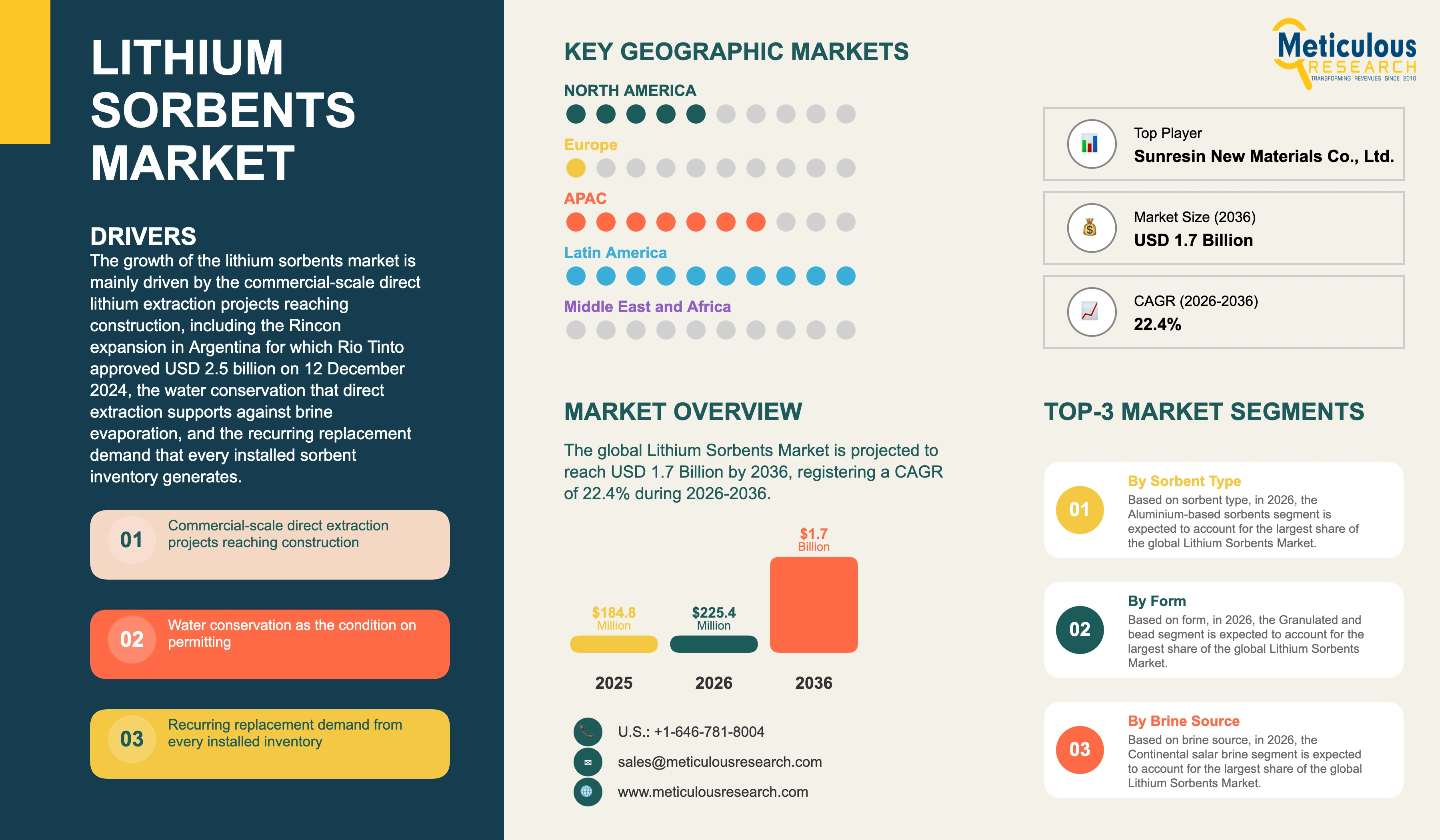
The global lithium sorbents market was valued at USD 184.8 million in 2025. This market is expected to reach USD 1.70 billion by 2036 from an estimated USD 225.4 million in 2026, registering a CAGR of 22.4% during the forecast period (2026-2036).
- Published
- Nov 2026
- Pages
- 268
- Format
- PDF + Excel
- Report ID
- MRCHM - 1042675
- Base year
- 2025
- 2025 · BASELINE
- $184.8M
- 2036
- $1.70B
- CAGR 2026–2036
- 22.4%
2025 baseline · 2026–2036 forecast at 22.4% CAGR · hover a bar for the value
Key highlights
The global lithium sorbents market is estimated at USD 225.4 million in 2026 and is projected to reach USD 1.70 billion by 2036.
Market volume is estimated at 4, 900.00 tonnes in 2026 and is projected to reach 44,193.35 tonnes by 2036 at a CAGR of 24.6%, measured as sorbent media supplied for initial fill and replacement.
The average selling price is estimated at USD 46.00 per kg in 2026 and is projected to reach USD 38.49 per kg by 2036.
Aluminium-based sorbents are expected to account for the largest sorbent type share in 2026, while manganese oxide ion sieves are projected to register the highest CAGR of 28.4%.
Granulated and bead forms are expected to hold the largest form share in 2026, while composite and resin-supported sorbents are projected to grow fastest at a CAGR of 27.4%.
Continental salar brine is expected to be the largest brine source in 2026, while geothermal brine is projected to register the highest CAGR of 32.0%.
New greenfield direct lithium extraction projects are expected to account for the largest end use share in 2026, while retrofit of existing brine operations is projected to grow fastest at a CAGR of 26.0%.
Latin America is expected to hold the largest regional share in 2026, while North America is projected to register the highest CAGR of 31.0%.
Rio Tinto announced on 12 December 2024 the approval of USD 2.5 billion to expand the Rincon project in Argentina, its first commercial-scale lithium operation.
The investment covers brine extraction through a production wellfield, processing and waste facilities, and associated infrastructure.
The total target is 60, 000 tonnes per year of battery-grade lithium carbonate, made up of a 3,000 tonne starter plant and a 57,000 tonne expansion plant.
The previously reported production target was approximately 53 kilotons per year over 40 years, with plans in place to build toward 60 kilotons through debottlenecking and improvement programmes.
The project uses direct lithium extraction, which the company states supports water conservation, reduces waste and produces lithium carbonate more consistently than other methods.
Rio Tinto states that it will use its advanced technology to halve the amount of water used in processing, without stating a baseline for that figure.
Construction of the expanded plant was scheduled to begin in mid-2025 subject to permitting, with first production expected in 2028.
A three-year ramp-up to full capacity is expected after first production.
The mine life is expected to be 40 years.
The investment was included in the capital expenditure guidance given at the company Investor Seminar of 4 December 2024.
Report summary
| Particulars | Details |
|---|---|
| Base Year | 2025 |
| Forecast Period | 2026-2036 |
| Market Size in 2025 | USD 184.8 million |
| Market Size in 2026 | USD 225.4 million |
| Market Size by 2036 | USD 1.70 billion |
| Value CAGR (2026-2036) | 22.4% |
| Format | PDF, Excel & Cloud Portal · 268 pages |
| Volume in 2026 | 4,900.00 tonnes |
| Volume by 2036 | 44,193.35 tonnes |
| Volume CAGR (2026-2036) | 24.6% |
| Volume Basis | Sorbent media supplied for initial fill and replacement |
| Average Selling Price in 2026 | USD 46.00 per kg |
| Average Selling Price by 2036 | USD 38.49 per kg |
| Measurement Basis | Solid media that selectively bind lithium from an aqueous stream and release it on elution, covering aluminium-based sorbents including lithium-aluminium layered double hydroxide, manganese oxide and titanium oxide ion sieves, other inorganic sorbents and the granulated, bead, powder and resin-supported forms in which they are supplied, and excluding solvent extraction reagents, ion-exchange and nanofiltration membranes and electrodialysis stacks, evaporation pond infrastructure, general-purpose water treatment resins, the recovered lithium carbonate and hydroxide themselves, and lithium battery materials |
| Largest Sorbent Type | Aluminium-based sorbents |
| Fastest-Growing Sorbent Type | Manganese oxide ion sieves (CAGR 28.4%) |
| Largest Form | Granulated and bead |
| Fastest-Growing Form | Composite and resin-supported (CAGR 27.4%) |
| Largest Brine Source | Continental salar brine |
| Fastest-Growing Brine Source | Geothermal brine (CAGR 32.0%) |
| Largest End Use | New greenfield direct lithium extraction projects |
| Fastest-Growing End Use | Retrofit of existing brine operations (CAGR 26.0%) |
| Largest Region | Latin America |
| Fastest-Growing Region | North America (CAGR 31.0%) |
| Segments Covered | Sorbent Type, Form, Brine Source, End Use, and Geography |
| Geographies Covered | Latin America, Asia-Pacific, North America, Europe, and Middle East & Africa |
| Companies Profiled | 10 companies, including Sunresin New Materials Co., Ltd., Lanxess AG, DuPont de Nemours, Inc., Ecolab Inc., Mitsubishi Chemical Group Corporation, and Lilac Solutions, Inc. |
Report overview
Segments covered: sorbent type, form, brine source, end use.
In volume terms, this market is estimated at 4,900.00 tonnes in 2026 and is projected to reach 44,193.35 tonnes by 2036, registering a CAGR of 24.6% during the same period, measured as sorbent media supplied for both initial fill and replacement. The average selling price is estimated at USD 46.00 per kg in 2026 and is projected to decline to USD 38.49 per kg by 2036 as sorbent manufacture moves from pilot batches to continuous commercial production and as the cost of the inorganic precursors falls with volume.
The growth of this market is mainly driven by the commercial-scale direct lithium extraction projects now under construction, including the Rincon expansion in Argentina for which Rio Tinto approved USD 2.5 billion on 12 December 2024, the water conservation that direct extraction supports against brine evaporation, the recurring replacement demand that every installed sorbent inventory generates as capacity degrades through loading cycles, and the unconventional brine sources that no evaporation route can serve at all. However, factors such as the lithium price weakness that has deferred project final investment decisions, and the sorbent capacity loss and attrition that determine operating cost more than the purchase price does, are expected to restrain the growth of this market to some extent.
Aluminium-based sorbents account for the largest share of this market because the lithium-aluminium layered double hydroxide route has the longest commercial operating history in continental brines and tolerates the magnesium and calcium concentrations those brines carry. Manganese oxide ion sieves grow faster because they offer substantially higher lithium capacity per kilogram, which lowers the inventory a plant must hold and the vessel volume it must build.
Lithium sorbents are the solid media that selectively bind lithium from an aqueous stream and release it on elution, allowing lithium to be recovered without evaporating the brine. Market sizing in this report is on both a value basis in USD and a volume basis in tonnes measured as sorbent media supplied for both initial fill and replacement, with average selling price derived from the two. The measurement basis covers aluminium-based sorbents including lithium-aluminium layered double hydroxide, manganese oxide and titanium oxide ion sieves, other inorganic sorbents and the granulated, bead, powder and resin-supported forms in which they are supplied, and it excludes solvent extraction reagents, ion-exchange and nanofiltration membranes and electrodialysis stacks, evaporation pond infrastructure, general-purpose water treatment resins, the recovered lithium carbonate and hydroxide themselves, and lithium battery materials.
Excluding membranes and solvent extraction reagents matters because all three are described as direct lithium extraction while being entirely different products. A sorbent is a solid inventory loaded into a vessel and replaced on a cycle, a membrane is a module with its own replacement economics, and a solvent extraction reagent is a liquid consumed and regenerated in a mixer-settler circuit, so the three have different cost structures, different suppliers and different failure modes. Grouping them under the common label would merge three markets that happen to share an objective. A project selecting between them is choosing a plant design rather than a consumable.
Rio Tinto announced on 12 December 2024 the approval of USD 2.5 billion to expand the Rincon project in Argentina, its first commercial-scale lithium operation, covering brine extraction through a production wellfield, processing and waste facilities and associated infrastructure, with a total target of 60,000 tonnes per year of battery-grade lithium carbonate made up of a 3,000 tonne starter plant and a 57,000 tonne expansion plant. The project uses direct lithium extraction, which the company states supports water conservation, reduces waste and produces lithium carbonate more consistently than other methods. Construction was scheduled to begin in mid-2025 subject to permitting, first production is expected in 2028 and a three-year ramp-up follows, over an expected 40 year mine life.
A commitment of that size is what turns direct extraction from a demonstrated technology into a supply chain. Sorbent producers, vessel fabricators and elution chemistry suppliers now have a dated schedule against which to plan capacity rather than a prospect, and a project reaching first production in 2028 with a three-year ramp places both its initial sorbent fill and the start of its replacement cycle inside the forecast period. Rio Tinto states it will halve the amount of water used in processing, without giving a baseline. The company describes the route as direct lithium extraction without specifying which extraction family it uses.
Water is the argument that carries most weight with regulators and communities rather than with engineers. Brine evaporation concentrates lithium by exposing shallow ponds to the sun over many months, consuming the brine itself and occupying large areas of salar surface, while direct extraction returns the depleted brine to the aquifer and completes the separation in hours. In the high-altitude basins where most continental lithium sits, water allocation is the binding condition on permitting. A technology that reduces it therefore addresses the constraint that governs whether a project proceeds at all.
Selectivity against magnesium is the technical problem every sorbent exists to solve. Continental brines carry magnesium, calcium, sodium and potassium at concentrations orders of magnitude above lithium, and magnesium in particular behaves similarly enough that conventional separation struggles to distinguish it, which is why evaporation is followed by extensive chemical purification. An inorganic ion sieve binds lithium into a lattice vacancy sized for the lithium ion and rejects larger cations on that basis. The magnesium to lithium ratio of a brine is consequently the first number a sorbent is specified against.
Operating cost in a sorbent plant is governed by how the inventory degrades rather than by what it cost to buy. Each loading and elution cycle dissolves a small fraction of the sorbent lattice, abrades the particle and gradually reduces capacity, so an inventory is replaced on a cycle measured in years and the replacement rate determines the consumable cost per tonne of lithium carbonate produced. A sorbent with twice the capacity and half the life is worse than one with half the capacity and twice the life. Procurement therefore turns on cycles to replacement rather than on price per kilogram.
Capacity per kilogram is where manganese oxide ion sieves earn their growth. A higher lithium loading per unit mass means a smaller sorbent inventory for a given production rate, which reduces the vessel volume a plant must build, the quantity of elution chemistry it circulates and the cost of each replacement. Manganese dissolution during elution has been the historic obstacle, addressed through doping, coating and granulation rather than removed. Manganese oxide ion sieves consequently register the highest sorbent type CAGR at 28.4%.
Geothermal and oilfield brines are the sources that only a sorbent route can address, and they are where the growth rates are highest. Geothermal brine arrives hot and under pressure as a by-product of power generation and cannot be evaporated economically, oilfield produced water arrives as a waste stream requiring disposal, and in both cases the lithium is a secondary product of an operation already paid for by something else. Sorbent performance at elevated temperature and in the presence of hydrocarbons and silica becomes the specification. Geothermal brine registers the highest brine source CAGR at 32.0%.
Replacement demand is the part of this market that compounds rather than fluctuates. Every inventory installed becomes a recurring purchase on a cycle of a few years, so the installed base built during the current wave of projects generates a demand stream that continues whatever happens to new project approvals, and it is specified by the original sorbent rather than competed for openly. A supplier that wins an initial fill therefore wins an annuity. That is why qualification on a first commercial plant matters disproportionately to position in this market.
Report infographic
Market dynamics
15 factors across 5 forcesCommercial-Scale Direct Extraction Projects Reaching Construction
Rio Tinto approved USD 2.5 billion on 12 December 2024 to expand the Rincon project in Argentina, its first commercial-scale lithium operation, targeting 60,000 tonnes per year of battery-grade lithium carbonate from a 3,000 tonne starter plant and a 57,000 tonne expansion plant, with construction scheduled from mid-2025 subject to permitting, first production expected in 2028 and a three-year ramp-up over an expected 40 year mine life. Commitments of that scale give sorbent producers a dated schedule to plan capacity against rather than a prospect. Both the initial fill and the start of the replacement cycle fall inside the forecast period. The driver is the conversion of a demonstrated technology into a supply chain with timelines.
The scale of a single commitment matters more here than the number of projects announced. A 60,000 tonne per year operation requires a sorbent inventory measured in thousands of tonnes and then replaces part of it every year thereafter, so one committed plant of that size creates more durable demand than a dozen studies. The starter plant and expansion plant structure also phases the requirement, giving suppliers a smaller first order against which performance is proven before the larger one follows.
Water Conservation as the Condition on Permitting
Brine evaporation concentrates lithium by exposing shallow ponds to the sun over many months, consuming the brine and occupying large areas of salar surface, while direct extraction returns depleted brine to the aquifer and completes the separation in hours, and Rio Tinto states that its technology will halve the amount of water used in processing. In the high-altitude basins where most continental lithium sits, water allocation rather than resource grade is the binding condition on permitting and on community agreement. A technology that reduces water use therefore determines whether a project proceeds rather than merely how profitably it operates. The driver acts through the approval process rather than through operating economics.
That changes who makes the decision. Where a process is selected to satisfy a permitting condition rather than to lower cost, the specification is written by the environmental and community relations side of a project rather than by procurement, and the willingness to pay for the technology is set by the value of the approval rather than by the saving it generates. Sorbent cost is therefore a smaller share of the decision than its share of operating cost would suggest.
Recurring Replacement Demand From Every Installed Inventory
Each loading and elution cycle dissolves a small fraction of the sorbent lattice, abrades the particle and reduces capacity, so an inventory is replaced on a cycle measured in years and every plant commissioned becomes a recurring purchase rather than a one-off sale. The installed base being built now therefore generates a demand stream that continues irrespective of new project approvals, and it is specified by the sorbent originally qualified rather than openly tendered. A supplier winning an initial fill wins an annuity behind it. Replacement demand consequently compounds while new project demand fluctuates with investment cycles.
The commercial consequence is that the installed base is the asset rather than the order book. A supplier with inventories running in several plants has revenue that continues through a weak lithium price, while one dependent on new project awards does not, and the difference widens as the installed base grows. Replacement accordingly accounts for a rising share of this market across the forecast period as the plants commissioned in the late 2020s reach their first change-out.
Unconventional Brine Sources That Evaporation Cannot Serve
Geothermal brine arrives hot and under pressure as a by-product of power generation and cannot be evaporated economically, oilfield produced water arrives as a waste stream requiring disposal, and in both cases the lithium is a secondary product of an operation already paid for by something else, which changes the economics of recovery entirely. Only a sorbent or comparable direct route can address those streams at all. Sorbent performance at elevated temperature and in the presence of hydrocarbons and silica becomes the specification rather than selectivity alone. Geothermal brine registers the highest brine source CAGR at 32.0%.
These sources also sit in jurisdictions that conventional brine extraction does not reach, which matters where lithium supply is being localised. Geothermal fields in North America and Europe and oilfield brines across the central United States and western Canada put lithium inside economies that have no salars, and sorbent performance rather than resource geology is what determines whether that lithium is recoverable. The driver therefore carries a policy dimension alongside its technical one.
Table of contents
12 chapters · 137 sections · 268 pages · click to expandGeographic analysis
Latin America
Largest shareIn 2026, Latin America is expected to account for the largest share of the global lithium sorbents market. The large share of this region is mainly due to the concentration of continental brine resources in the high-altitude salars of Argentina, Chile and Bolivia, the commercial-scale projects under construction there including the Rincon expansion in Argentina for which Rio Tinto approved USD 2.5 billion on 12 December 2024 with first production expected in 2028, and the water allocation pressure that makes direct extraction preferable to evaporation in those basins. Argentina is projected to register a CAGR of 22.4%, Bolivia a CAGR of 24.0% and Chile a CAGR of 19.8% during the forecast period.
North America
Fastest growthHowever, North America is projected to register the highest CAGR of 31.0% during the forecast period. The rapid growth of this region is attributed to the geothermal and oilfield brine resources that only a direct extraction route can address, the critical mineral sourcing requirements attached to vehicle incentives, the cell and cathode capacity under construction that creates domestic lithium demand, and the absence of an evaporation industry whose assets would have to be displaced. The United States is projected to register a CAGR of 31.6% and Canada a CAGR of 28.4%.
Asia-Pacific
Asia-Pacific is projected to grow at 18.6%, with China at 18.4%, where the Qinghai and Tibet brines carry magnesium to lithium ratios high enough that sorbent routes have been in commercial operation longer than anywhere else and where most sorbent manufacturing capacity is located.
Europe
Europe is projected to grow at 23.0%, with Germany at 23.6%, on geothermal projects and on the lithium demand created by cell capacity under construction.
Middle East & Africa
The Middle East & Africa is projected to grow at 21.0% from a negligible base. Resource location and manufacturing location are different questions in this market, and they do not coincide. The brines sit in South America, western North America, China and parts of Europe, while sorbent manufacture is concentrated where inorganic chemical and ion-exchange capability already exists, principally in China and in a smaller number of European and North American plants. A sorbent is a dense stable solid that ships economically, so there is no transport logic requiring local manufacture, and the constraint on serving a region is pilot and service capability rather than production proximity, which is a question of people and test equipment rather than of plant, and it is why suppliers invest in mobile pilot units. Regional share therefore describes where lithium is extracted rather than where sorbent is made.
Competitive landscape
The global lithium sorbents market is characterised by the presence of Chinese inorganic sorbent and ion-exchange producers with the largest installed references, global ion-exchange resin companies extending into lithium selective media, and venture-backed technology companies commercialising proprietary sorbents alongside their own process packages. Competition is contested on durability data from extended operation and on pilot capability against a specific brine rather than on price per kilogram, because replacement rate rather than purchase cost governs the consumable cost of a plant. Sunresin New Materials Co., Ltd., Lanxess AG, DuPont de Nemours, Inc., Ecolab Inc. and Mitsubishi Chemical Group Corporation together accounted for an estimated 48.6% of this market in 2026, while the companies profiled in this report together accounted for an estimated 68.4%.
Rio Tinto approved USD 2.5 billion on 12 December 2024 to expand the Rincon project in Argentina to a total target of 60,000 tonnes per year of battery-grade lithium carbonate using direct lithium extraction, with construction from mid-2025 subject to permitting, first production expected in 2028 and a three-year ramp-up over an expected 40 year mine life. Qualification on commercial-scale projects, development of composite and resin-supported forms to reduce attrition, and extension of sorbent performance to geothermal and oilfield conditions accounted for most competitive activity through 2026.
Entry is limited less by sorbent synthesis than by the pilot and service capability an operator requires before selecting a medium, which is a fixed cost only a certain number of suppliers can carry.
Operating references rather than product specifications separate the competitors, because an operator selecting a medium is buying a replacement cycle it cannot verify without extended running. Sunresin New Materials Co., Ltd. competes from the largest set of commercial installations, Lanxess AG, DuPont de Nemours, Inc., Ecolab Inc. and Mitsubishi Chemical Group Corporation from ion-exchange manufacturing and service networks, and Lilac Solutions, Inc., EnergySource Minerals LLC and Summit Nanotech Corporation through proprietary media supplied with their own process packages. Some of the key players operating in the lithium sorbents market are Sunresin New Materials Co., Ltd. (China), Lanxess AG (Germany), DuPont de Nemours, Inc. (U.S.), Ecolab Inc. (U.S.), Mitsubishi Chemical Group Corporation (Japan), Lilac Solutions, Inc. (U.S.), EnergySource Minerals LLC (U.S.), Summit Nanotech Corporation (Canada), ResinTech, Inc. (U.S.), and Veolia Environnement SE (France), among others.
- —
Rio Tinto announced on 12 December 2024 the approval of USD 2.5 billion to expand the Rincon project in Argentina, its first commercial-scale lithium operation, covering brine extraction through a production wellfield, processing and waste facilities and associated infrastructure. The total target is 60,000 tonnes per year of battery-grade lithium carbonate, made up of a 3,000 tonne starter plant and a 57,000 tonne expansion plant, against a previously reported target of approximately 53 kilotons per year over 40 years with plans to build toward 60 kilotons through debottlenecking and improvement programmes. The project uses direct lithium extraction, which the company states supports water conservation, reduces waste and produces lithium carbonate more consistently than other methods, and Rio Tinto states it will halve the amount of water used in processing. Construction was scheduled to begin in mid-2025 subject to permitting, first production is expected in 2028 followed by a three-year ramp-up, the mine life is expected to be 40 years, and the investment was included in the capital expenditure guidance given at the Investor Seminar of 4 December 2024.
- Sunresin New Materials Co., Ltd.
- Lanxess AG
- DuPont de Nemours, Inc.
- Ecolab Inc.
- Mitsubishi Chemical Group Corporation
- Lilac Solutions, Inc
Expert perspectives
Volume grows at 24.6% against 22.4% in value over the forecast period, and the average selling price falls from USD 46.00 per kg in 2026 to USD 38.49 per kg by 2036 as sorbent manufacture moves from pilot batches to continuous production and precursor costs fall with volume. The gap between the two rates is ordinary scale-up rather than commoditisation, since the product remains specified against a particular brine.
The Rincon approval is the fact that converts this from a technology into a market. USD 2.5 billion committed on 12 December 2024 for a 60,000 tonne per year target built from a 3,000 tonne starter plant and a 57,000 tonne expansion, with first production expected in 2028 and a three-year ramp over a 40 year mine life, gives suppliers a schedule rather than a prospect. Rio Tinto describes the route as direct lithium extraction without naming an extraction family, so the project should be read as evidence for the category rather than for any one chemistry.
Water rather than cost is what drives adoption, and that is easy to misread. Evaporation consumes the brine over months and occupies salar surface, direct extraction returns depleted brine in hours, and Rio Tinto states it will halve water used in processing without giving a baseline. In high-altitude basins water allocation decides whether a project is permitted at all, so the technology is being selected against a condition of approval rather than against an operating cost comparison.
What a buyer is actually purchasing is a replacement cycle. Each loading and elution cycle dissolves part of the lattice and abrades the particle, so the replacement rate rather than the purchase price sets consumable cost per tonne of lithium carbonate, and a high-capacity medium with poor durability can cost more over a plant life than a modest one that lasts. That is why durability data from extended operation is displacing peak capacity as the headline specification.
Initial fills are lumpy and replacement is an annuity, and the second is the better business. A sorbent qualified into a plant is replaced with an equivalent rather than retendered, because requalification means revalidating capacity, selectivity, durability and elution chemistry on a producing asset. Positions being qualified now therefore determine revenue well beyond this forecast period, which makes current project engagement worth more than its order value.
The risk to the forecast is the lithium price rather than the technology. Sorbent demand comes from projects reaching construction, not from projects being studied, so price weakness defers final investment decisions and reduces inventories ordered in a given year however large the pipeline remains. Replacement demand from installed capacity continues through such a period, which is why the installed base matters more to a supplier than the project list does.
Customer perspectives
Water allocation rather than production cost governs permitting and community agreement in high-altitude basins, which is what determines the selection of direct extraction over evaporation.
Cycles to a defined capacity loss rather than peak loading determines the consumable cost of a plant, so durability over a plant life outweighs initial capacity in the purchasing decision.
In geothermal operations the wells and pumping are already funded by power generation, so the governing requirement is sorbent survival at elevated temperature and silica content, which narrows the supplier field considerably.
Because requalification requires revalidation on a producing asset, the replacement schedule and the long-term price rather than the initial fill cost are what buyers negotiate, which is what converts a first qualification into a durable commercial position.
“Our permit conversation is about water, not about lithium. Direct extraction lets us return the brine to the aquifer and finish the separation in hours instead of months, and that is what makes the project acceptable locally. The sorbent cost matters, but it is not what decided the flowsheet.”
“We stopped asking for peak capacity and started asking how many cycles it takes to lose twenty per cent, because that number is what we actually pay for. A medium that loads beautifully and falls apart in eighteen months is more expensive than one that loads half as well and runs for five years.”
“The brine is already at the surface, already hot and already being reinjected, so the wells and the pumping are paid for by the power plant. What we need is a medium that survives that temperature with the silica we have, and that is a much shorter list of suppliers than for a salar.”
“We treat the first fill as the smallest part of the contract. What we negotiate is the replacement schedule and the price over ten years, because once a medium is qualified we are not going to change it without shutting the circuit down.”
Frequently asked questions
This market was valued at USD 150.0 million in 2024 and USD 184.8 million in 2025, and is estimated at USD 225.4 million in 2026. In volume terms it is estimated at 4,900.00 tonnes in 2026 as sorbent media supplied for initial fill and replacement.
Cite this report
Meticulous Research. (2026). Lithium Sorbents Market - Global Opportunity Analysis and Industry Forecast (2026-2036) (Report No. MRCHM - 1042675). Meticulous Market Research Pvt. Ltd. https://www.meticulousresearch.com/product/lithium-sorbents-market-7358