Lignin Based Carbon Fibre Market (2026-2036)
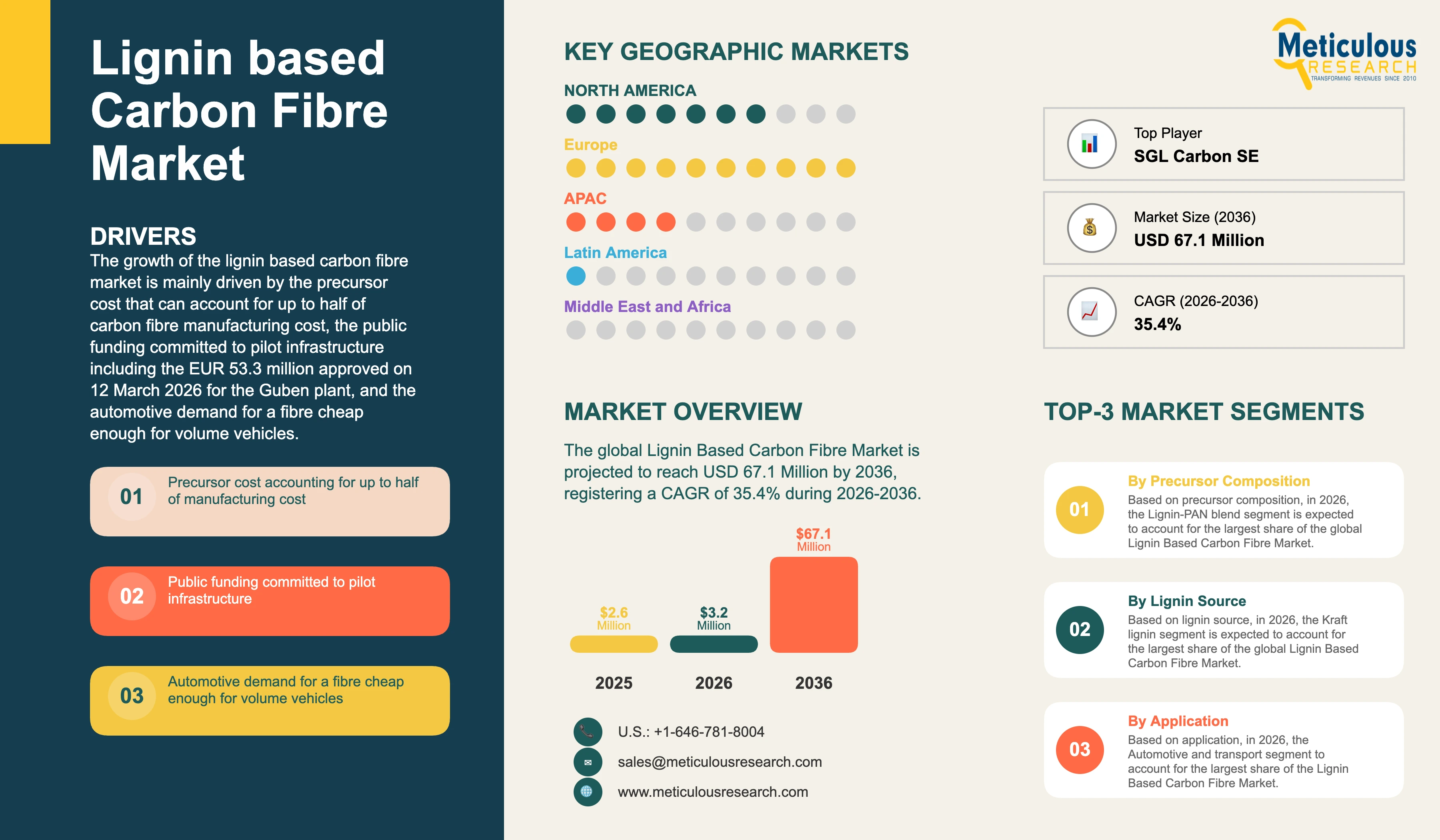
The global lignin based carbon fibre market was valued at USD 2.6 million in 2025. This market is expected to reach USD 67.1 million by 2036 from an estimated USD 3.2 million in 2026, registering a CAGR of 35.4% during the forecast period (2026-2036).
- Published
- Nov 2026
- Pages
- 259
- Format
- PDF + Excel
- Report ID
- MRCHM - 1042810
- Base year
- 2025
- 2025 · BASELINE
- $2.6M
- 2036
- $67.1M
- CAGR 2026–2036
- 35.4%
2025 baseline · 2026–2036 forecast at 35.4% CAGR · hover a bar for the value
Key highlights
The global lignin based carbon fibre market is estimated at USD 3.2 million in 2026 and is projected to reach USD 67.1 million by 2036.
Market volume is estimated at 95.00 tonnes in 2026 and is projected to reach 4, 790.06 tonnes by 2036 at a CAGR of 48.0%, measured as finished carbon fibre supplied from lignin-containing precursors.
The average selling price is estimated at USD 34.00 per kg in 2026 and is projected to reach USD 14.00 per kg by 2036 as pilot quantities give way to production volumes.
Lignin-PAN blends are expected to account for the largest precursor composition share in 2026, while lignin-cellulose blends are projected to register the highest CAGR of 58.0%.
Kraft lignin is expected to be the largest lignin source in 2026, while organosolv lignin is projected to grow fastest at a CAGR of 54.0%.
Automotive and transport are expected to be the largest application in 2026, while energy storage and conversion components are projected to register the highest CAGR of 52.0%.
Europe is expected to hold the largest regional share in 2026, while North America is projected to register the highest CAGR of 38.4%.
The Interministerial Working Group made a positive funding decision on 12 March 2026 for the Guben pilot plant of the Carbon Lab Factory Lausitz, led by the Fraunhofer Institute for Applied Polymer Research IAP.
Funding of EUR 53.3 million comes from the Brandenburg Ministry of Science, Research and Culture via Wirtschaftsregion Lausitz GmbH together with the federal government, with the City of Guben investing about EUR 20 million in the building in the Guben Industrial Park.
A further EUR 5 million in personnel funding runs through June 2027 under reference 46SKD154A/B, provided by the Federal Ministry under the STARK programme, while the Chemnitz carbonisation plant carries a project budget of over EUR 62 million from Saxon state ministries.
The Guben plant will produce precursor fibres at up to the ton scale, with carbonisation at the kilogram scale in a laboratory facility, and carbon fibre at ton scale at the Chemnitz pilot plant which can process both conventional and institute precursor fibres.
Partners named include the Technical University of Chemnitz Institute for Lightweight Structure and the Brandenburg University of Technology Cottbus-Senftenberg, with operation of the Guben plant expected at the end of 2029.
In that programme the feedstock is cellulose with lignin described as an additive derived from wood, and the lignin type or grade is not specified.
Researchers at Washington University in St. Louis published work in Matter on 18 September 2026 reporting carbon fibre meeting automotive standards for tensile strength and elastic modulus from a lignin precursor.
That approach blends lignin with polyacrylonitrile using single-walled carbon nanotubes to align crystallisation, followed by wet spinning, tension-assisted heat treatment and one round of optimised carbonisation.
The reported results cut polyacrylonitrile use by half and production costs by 25%, with carbon emissions described as substantially reduced and no figure given.
Neither programme reports lignin serving as a sole precursor, so the material is currently a partial precursor component rather than a complete substitute for the incumbent polymer.
No company operates commercial-scale lignin based carbon fibre capacity, so supply in 2026 consists of pilot, sample and development quantities.
Report summary
| Particulars | Details |
|---|---|
| Base Year | 2025 |
| Forecast Period | 2026-2036 |
| Market Size in 2025 | USD 2.6 million |
| Market Size in 2026 | USD 3.2 million |
| Market Size by 2036 | USD 67.1 million |
| Value CAGR (2026-2036) | 35.4% |
| Format | PDF, Excel & Cloud Portal · 259 pages |
| Volume in 2026 | 95.00 tonnes |
| Volume by 2036 | 4,790.06 tonnes |
| Volume CAGR (2026-2036) | 48.0% |
| Volume Basis | Finished carbon fibre supplied from lignin-containing precursors |
| Average Selling Price in 2026 | USD 34.00 per kg |
| Average Selling Price by 2036 | USD 14.00 per kg |
| Price Direction | Average selling price falls sharply across the forecast period as pilot, sample and development quantities give way to production volumes and the precursor cost advantage the route is being developed for is realised |
| Market Maturity Note | This market is pre-commercial in 2026. No company operates commercial-scale lignin based carbon fibre capacity, the best-funded Western programme expects pilot operation at the Guben plant at the end of 2029, and carbonisation in that programme currently runs at kilogram scale, so the growth rates in this report describe a technology reaching first production rather than a market taking share |
| Scope Definition Note | Lignin is a partial rather than sole precursor component in every result published to date, so a tonne counted here is not a tonne of lignin-derived carbon and the lignin proportion varies by route; finished fibre mass is nonetheless the basis on which the material is sold, qualified and compared against the incumbent product, and the partial substitution is stated rather than implied |
| Measurement Basis | Carbon fibre from lignin-PAN blends, lignin-cellulose blends and lignin-dominant precursors, by precursor composition, lignin source, application and geography, and excluding conventional polyacrylonitrile and pitch-based carbon fibre, lignin sold as a chemical or dispersant, lignin-derived battery anode carbon that is not fibre, recycled carbon fibre, and the composites and components into which the fibre is converted |
| Relationship to Adjacent Markets | This market is a fraction of the carbon fibre market rather than an addition to it, since every tonne counted here is fibre that would otherwise be made from a fossil precursor, and it is not additive to the lignin based chemicals market, which measures lignin converted into chemical products rather than into a structural material; the lignin feedstock sits upstream of both, so reading a lignin availability figure as potential fibre supply would overstate this market substantially |
| Largest Precursor Composition | Lignin-PAN blend |
| Fastest-Growing Precursor Composition | Lignin-cellulose blend (CAGR 58.0%) |
| Largest Lignin Source | Kraft lignin |
| Fastest-Growing Lignin Source | Organosolv lignin (CAGR 54.0%) |
| Largest Application | Automotive and transport |
| Fastest-Growing Application | Energy storage and conversion components (CAGR 52.0%) |
| Largest Region | Europe |
| Fastest-Growing Region | North America (CAGR 38.4%) |
| Segments Covered | Precursor Composition, Lignin Source, Application, and Geography |
| Geographies Covered | Europe, North America, Asia-Pacific, Latin America, and Middle East & Africa |
| Companies Profiled | 5 companies, including SGL Carbon SE, Toray Industries, Inc., Stora Enso Oyj, Borregaard ASA, and Suzano S.A. |
| Note on Profiled Share | The profiled share and the top-five share are the same figure because five companies are profiled, and both describe participation in a development market rather than command of a commercial one; the leading technical positions are held by research institutions rather than companies |
Report overview
Segments covered: precursor composition, lignin source, application.
The growth of this market is mainly driven by the precursor cost that accounts for up to half of conventional carbon fibre manufacturing cost, the public funding now committed to pilot infrastructure including the EUR 53.3 million approved for the Guben plant, the automotive demand for a fibre cheap enough for volume vehicles, and the energy storage and fuel cell components that need carbon felts and gas diffusion layers rather than structural fibre. However, factors such as the absence of any commercial-scale production, the inability of lignin to serve as a sole precursor in the results published to date, the heterogeneity of lignin as a feedstock, and the qualification burden in the automotive and aerospace markets are expected to restrain the growth of this market to some extent.
Lignin based carbon fibre is carbon fibre produced from a precursor in which lignin, the aromatic biopolymer separated from wood during pulping and biorefining, replaces part or all of the polyacrylonitrile conventionally used. Market sizing in this report is on both a value basis in USD and a volume basis in tonnes measured as finished carbon fibre supplied from lignin-containing precursors, with average selling price derived from the two. The measurement basis covers fibre from lignin-PAN blends, lignin-cellulose blends and lignin-dominant precursors, and it excludes conventional polyacrylonitrile and pitch-based carbon fibre, lignin sold as a chemical or dispersant, lignin-derived battery anode carbon that is not fibre, recycled carbon fibre, and the composites and components into which the fibre is converted.
Measuring finished fibre mass rather than the lignin within it requires a caution the reader should carry through the report. In the results published to date lignin is a partial precursor component, so a tonne counted here is not a tonne of lignin-derived carbon, and the proportion of lignin in the precursor varies by route. Finished fibre mass is nonetheless the basis on which the material is sold, qualified and compared against the incumbent product, so it is the basis used here, with the partial substitution stated rather than implied.
The Interministerial Working Group made a positive funding decision on 12 March 2026 for the Guben pilot plant of the Carbon Lab Factory Lausitz, led by the Fraunhofer Institute for Applied Polymer Research IAP in Potsdam. Funding of EUR 53.3 million comes from the Brandenburg Ministry of Science, Research and Culture via Wirtschaftsregion Lausitz GmbH together with the federal government, with the City of Guben investing about EUR 20 million in the building, a further EUR 5 million in personnel funding through June 2027 under the STARK programme, and a Chemnitz carbonisation plant carrying a project budget of over EUR 62 million from Saxon state ministries. Precursor fibres will be produced at up to the ton scale in Guben, carbonisation at kilogram scale in a laboratory facility, and carbon fibre at ton scale at Chemnitz. Operation of the Guben plant is expected at the end of 2029.
What that programme is building is a cellulose precursor line in which lignin is an additive, and the distinction matters for a report on this market. The institute describes the feedstock as cellulose with lignin as an additive derived from wood, does not specify the lignin type or grade, and does not name the spinning method for the Guben plant, noting only that cellulose can be spun by the established viscose or Lyocell processes. A reader looking for confirmation that Europe is funding a lignin precursor at scale will find instead that it is funding a bio-based precursor platform in which lignin plays a supporting part.
Researchers at Washington University in St. Louis, led by Joshua Yuan with Weiwei Li as first author, published work in Matter on 18 September 2026 reporting carbon fibre that reaches the tensile strength and elastic modulus standards used in automobile manufacturing. Lignin is blended with polyacrylonitrile using single-walled carbon nanotubes that align crystallisation, the solution is wet spun, given a tension-assisted heat treatment and carbonised in one optimised round. Polyacrylonitrile use was cut by half and production costs by 25%, with carbon emissions described as substantially reduced. The work was funded by United States Department of Energy and National Science Foundation projects.
Read together, the two leading 2026 results say the same thing about where the technology stands. Neither uses lignin as a sole precursor: the German programme treats it as an additive to cellulose, and the American result halves rather than eliminates polyacrylonitrile. Lignin is therefore a partial substitute that lowers cost and fossil content rather than a replacement precursor, and a market defined as fibre made wholly from lignin would be close to empty.
Cost rather than performance is what the route is for. Polyacrylonitrile can account for up to half of carbon fibre manufacturing cost, which is why the material has stayed in aerospace, wind and premium applications rather than reaching volume vehicles, and a precursor derived from a pulping byproduct attacks that half directly. The reported 25% reduction in production cost from halving polyacrylonitrile use is consistent with that arithmetic and indicates how much is available from complete substitution.
Lignin heterogeneity is the technical reason complete substitution has not been achieved. The molecule is a randomly crosslinked aromatic network whose structure depends on the tree species, the pulping chemistry and the separation route, so a precursor made from it lacks the chain alignment that gives carbon fibre its strength, and the resulting fibre carries voids and defects. The nanotube approach reported in September 2026 addresses alignment directly by providing a template for crystallisation rather than relying on the lignin to align itself.
Automotive is the application the economics are aimed at and the largest share of this market. A fibre at a price that supports volume vehicle body and structural parts would open a market that the incumbent product has never reached, and the Fraunhofer programme names cars among its lightweight construction targets while the Washington University work was validated against automotive strength and modulus standards. Automotive and transport accordingly account for the largest application share throughout the period.
Energy storage and conversion is the fastest-growing application and the requirements there are easier to meet. Redox-flow battery carbon felts and fuel cell gas diffusion layers need conductivity, porosity and chemical stability rather than the tensile strength and modulus a structural part demands, so a fibre that would fail a body panel specification can serve them, and the Fraunhofer programme names both explicitly. Energy storage and conversion components consequently register the highest application CAGR at 52.0%.
The absence of commercial capacity is the fact that governs every number in this report. No company operates commercial-scale lignin based carbon fibre production, the best-funded Western programme expects pilot operation at the end of 2029, and carbonisation in that programme currently runs at kilogram scale. Supply in 2026 therefore consists of pilot, sample and development quantities, and the growth rates here describe a technology reaching first production rather than a market taking share.
This market is a fraction of the carbon fibre market rather than an addition to it, since every tonne counted here is carbon fibre that would otherwise be made from a fossil precursor, and it is not additive to the lignin based chemicals market, which measures lignin converted into chemical products rather than into a structural material. The lignin feedstock sits upstream of both, so reading a lignin availability figure as potential fibre supply would overstate this market substantially.
Europe is expected to account for the largest share in 2026, on the public funding committed to pilot infrastructure, the Nordic pulp industry that separates lignin at scale, and the research institutions leading the technical work. Germany is projected to grow at 36.0%, Sweden at 33.0% and Finland at 32.0%.
North America is projected to register the highest CAGR of 38.4% during the forecast period, with the United States at 39.0% and Canada at 34.0%.
Europe holds the largest share, with Germany growing at 36.0%, on the EUR 53.3 million approved on 12 March 2026 for the Guben plant, over EUR 62 million from Saxon ministries for the Chemnitz carbonisation plant, the Nordic pulp industry, and the automotive and wind industries that would consume the output.
The Middle East & Africa is projected to grow at a CAGR of 26.0% from a negligible base. Latin America is projected to grow at a CAGR of 30.0%, with Brazil at 30.0%, on the eucalyptus pulp industry that is among the largest sources of lignin globally.
The companies profiled in this report together accounted for an estimated 61.4% of supply in 2026, which is also the top-five share since five companies are profiled. Both figures describe participation in a development market rather than command of a commercial one, and the leading technical positions are held by research institutions including Fraunhofer IAP, the Technical University of Chemnitz, the Brandenburg University of Technology Cottbus-Senftenberg and the McKelvey School of Engineering at Washington University in St. Louis.
Report infographic
Market dynamics
15 factors across 5 forcesPrecursor Cost Accounting for Up to Half of Manufacturing Cost
Polyacrylonitrile can account for up to half of carbon fibre manufacturing cost, which is why the material has remained in aerospace, wind and premium applications rather than reaching volume manufacturing, and the Washington University work published on 18 September 2026 reported production costs down 25% from halving polyacrylonitrile use. A precursor derived from a pulping byproduct attacks the largest single cost element directly.
That arithmetic also indicates the scale of the prize from further substitution, since halving the polymer delivered a quarter of the cost and the remaining half is still in the precursor.
Lignin is also available as a byproduct in quantities far exceeding any plausible fibre demand, so the feedstock carries none of the supply risk that a dedicated crop or a petrochemical intermediate would bring to the same calculation.
Pulp producers also already hold the lignin, so the feedstock arrives from an industry with the scale and the logistics to supply it rather than from one that would have to be created.
Public Funding Committed to Pilot Infrastructure
The Interministerial Working Group approved EUR 53.3 million on 12 March 2026 for the Guben pilot plant of the Carbon Lab Factory Lausitz led by Fraunhofer IAP, alongside about EUR 20 million from the City of Guben for the building, EUR 5 million in personnel funding through June 2027 under the STARK programme, and over EUR 62 million from Saxon state ministries for the Chemnitz carbonisation plant.
Funding at that level builds the precursor and carbonisation capacity that no company has been willing to finance commercially, which is the step this technology has been missing rather than further laboratory results.
Public money also underwrites the step where private investment has consistently stopped, namely a carbonisation line sized between a laboratory and a plant, which is expensive, energy-intensive and difficult to justify against an unproven product.
Automotive Demand for a Fibre Cheap Enough for Volume Vehicles
Vehicle lightweighting targets have been constrained by carbon fibre cost rather than by its properties, so a fibre that meets automotive tensile strength and elastic modulus standards at lower cost addresses a demand that already exists, and the September 2026 work was validated against those standards while the Fraunhofer programme names cars among its lightweight construction targets.
Automotive volumes are also large enough to support a dedicated production line, which is what turns a pilot into a plant, and the application accounts for the largest share of this market throughout the forecast period.
A renewable precursor additionally helps vehicle manufacturers with the embodied carbon reporting that now accompanies lightweighting targets, so the material answers a cost question and a disclosure question with the same substitution.
Volume vehicle programmes also run for years at steady rates once launched, which is the demand profile a dedicated line needs to recover its capital.
Energy Storage and Fuel Cell Components With Lower Property Requirements
Redox-flow battery carbon felts and fuel cell gas diffusion layers require conductivity, porosity and chemical stability rather than the tensile strength and modulus a structural part demands, so a fibre that would fail a body panel specification can serve them, and the Fraunhofer programme names both applications explicitly.
Those uses therefore offer a route to early revenue while the structural grades are still being qualified, and energy storage and conversion components register the highest application CAGR at 52.0%.
Felts and diffusion layers are also replaced on service intervals rather than designed in once, so a qualified position there generates repeating volume on a far shorter cycle than a structural part.
Growth in redox-flow storage and fuel cells is also independent of vehicle lightweighting, so the two largest applications in this market are not exposed to the same cycle.
Table of contents
11 chapters · 128 sections · 259 pages · click to expandSegmental analysis
| Segment | Largest share (2026) | Fastest growth (2026–2036) |
|---|---|---|
| By Precursor Composition | Lignin-PAN blend | Lignin-cellulose blend |
| By Lignin Source | Kraft lignin | Organosolv lignin |
| By Application | Automotive and transport | Energy storage and conversion components |
| Other segments | Kraft lignin | Organosolv lignin |
By Precursor Composition
- Lignin Based Carbon Fibre Market Analysis by Precursor Composition
- The lignin-PAN blend segment is expected to account for the largest share of the global lignin based carbon fibre market.
- The large share of this segment is mainly due to it being the composition in which automotive strength and modulus standards have been met, as reported in the Matter paper of 18 September 2026, and to the blend being spinnable and carbonisable on equipment and process windows already established for the incumbent polymer.
- However, the lignin-cellulose blend segment is projected to register the highest CAGR of 58.0% during the forecast period.
- The rapid growth of this segment is attributed to the funded pilot infrastructure in Brandenburg and Saxony being built around a cellulose feedstock with lignin as an additive, which gives the route ton-scale precursor and carbonisation capacity that the alternatives cannot call on.
- Lignin-dominant precursors remain at research scale, since the alignment and defect problems that limit lignin as a sole precursor have not been resolved at the loadings required.
- Composition therefore determines both the properties achievable and the equipment on which the precursor can be processed, so the choice is made against a target application and an available production route together rather than on lignin content alone.
- Composition also determines how much of the cost benefit is captured.
- A blend that halves the incumbent polymer captures roughly a quarter of manufacturing cost according to the September 2026 result, so the remaining benefit is held back behind the same alignment and defect problems that limit lignin-dominant precursors.
- Progress along this axis is therefore progress in cost rather than in volume, which is why the price assumption in this market falls so sharply.
- Lignin content in the precursor is also not disclosed in either programme, so the composition segments describe the route rather than a measured loading.
- Lignin-PAN blends are expected to account for the largest share in 2026, being the composition in which automotive strength and modulus standards have been met and which can be processed on established equipment.
- Lignin-cellulose blends are projected to register the highest CAGR of 58.0% during the forecast period.
By Lignin Source
- Lignin Based Carbon Fibre Market Analysis by Lignin Source
- The kraft lignin segment is expected to account for the largest share of the global lignin based carbon fibre market.
- The large share of this segment is mainly due to the volume separated from kraft pulping being far greater than that available from any other route, the established commercial supply of kraft lignin, and the low cost at which it is available as a pulping byproduct.
- However, the organosolv lignin segment is projected to register the highest CAGR of 54.0% during the forecast period.
- The rapid growth of this segment is attributed to the organosolv route delivering a less condensed and more uniform molecule than kraft pulping, which is what a spinnable precursor requires, so precursor quality rather than feedstock cost drives the choice as property requirements tighten.
- Lignosulphonates are the most readily available in commercial quantity but carry sulphonate groups and inorganic content that complicate carbonisation.
- Biorefinery residue lignin arrives with the composition left by the process that preceded it, which varies widely.
- Source therefore sets the variability a fibre producer must manage, and the Fraunhofer programme does not specify the lignin type or grade it will use.
- Source also determines who holds the feedstock position.
- Kraft lignin is separated by integrated pulp producers in very large quantities, lignosulphonates by a small number of specialist producers, and organosolv and biorefinery lignins by operators whose primary product is something else, so the commercial relationships a fibre producer must build differ by route as much as the chemistry does.
- Cost and availability pull in opposite directions on this axis, since the most abundant and cheapest lignin is the hardest to spin and the most spinnable is the least available.
By Application
- Lignin Based Carbon Fibre Market Analysis by Application
- The automotive and transport segment is expected to account for the largest share of the global lignin based carbon fibre market.
- The large share of this segment is mainly due to vehicle lightweighting having been constrained by fibre cost rather than by properties, the validation of the September 2026 result against automotive strength and modulus standards, and the naming of cars among the lightweight construction targets of the Fraunhofer programme.
- However, the energy storage and conversion components segment is projected to register the highest CAGR of 52.0% during the forecast period.
- The rapid growth of this segment is attributed to redox-flow battery carbon felts and fuel cell gas diffusion layers requiring conductivity, porosity and chemical stability rather than structural properties, so they can accept fibre that does not yet meet automotive specifications.
- Wind energy takes large volumes of fibre in spar caps where cost matters more than ultimate property, though blade qualification is long.
- Construction and infrastructure use the fibre in reinforcement and strengthening systems where corrosion resistance is the argument.
- Sporting goods and consumer applications absorb smaller volumes with shorter qualification cycles.
- Application therefore determines how soon the fibre can be sold, which at this stage of development matters more than the size of the end market.
- Application also sets the volume per qualification.
- A wind blade or a vehicle structure consumes far more fibre per programme than a felt or a diffusion layer, so the applications that are hardest to qualify are also the ones that would convert this market from a development activity into an industry, which is the asymmetry that shapes the forecast.
- Property requirements rather than end-market size therefore set the order in which applications open, which is unusual and specific to a material at this stage.
- That ordering is also unlikely to change, because it follows from the physics of the material rather than from any commercial choice a supplier could make.
Other segments
- Kraft lignin is expected to hold the largest share in 2026, on the volume separated from kraft pulping far exceeding that from any other route and the low cost at which it is available.
- Organosolv lignin is projected to register the highest CAGR of 54.0% during the forecast period.
- Automotive and transport are expected to account for the largest share in 2026, since vehicle lightweighting has been constrained by fibre cost rather than by properties and the September 2026 result was validated against automotive standards.
- Energy storage and conversion components are projected to register the highest CAGR of 52.0% during the forecast period.
Geographic analysis
Europe
Largest shareIn 2026, Europe is expected to account for the largest share of the global lignin based carbon fibre market. The large share of this region is mainly due to the public funding committed to pilot infrastructure, including the EUR 53.3 million approved on 12 March 2026 for the Guben plant and over EUR 62 million from Saxon ministries for the Chemnitz carbonisation plant, the Nordic pulp industry that separates lignin at scale, the research institutions leading the technical work, and the automotive and wind industries that would consume the output. Germany is projected to register a CAGR of 36.0%, Sweden a CAGR of 33.0% and Finland a CAGR of 32.0% during the forecast period.
North America
Fastest growthHowever, North America is projected to register the highest CAGR of 38.4% during the forecast period. The rapid growth of this region is attributed to the Department of Energy and National Science Foundation funding behind the September 2026 Matter result, the automotive manufacturing base that the cost argument is aimed at, the pulp and biorefinery capacity that can supply lignin, and the carbon fibre converting industry already established there. The United States is projected to register a CAGR of 39.0% and Canada a CAGR of 34.0%.
Asia-Pacific
Asia-Pacific is projected to grow at 35.0%, with China at 36.0% and Japan at 35.0%, on the carbon fibre manufacturing capacity concentrated in the region and on the vehicle and battery industries that would use the material, though the technical programmes are less visible than those in Europe and North America. Asia-Pacific holds the carbon fibre converting capacity that any commercial route would eventually need, so its position may change faster than its visible research activity suggests once a precursor route is proven elsewhere.
Latin America
Latin America is projected to grow at 30.0%, with Brazil at 30.0%, on the eucalyptus pulp industry that is among the largest sources of lignin globally. Brazil holds one of the largest lignin positions globally through its eucalyptus pulp industry, without the carbonisation capacity that would convert it into fibre supply.
Middle East & Africa
The Middle East & Africa is projected to grow at 26.0% from a negligible base. Where this material gets made will be decided by where carbonisation capacity is funded rather than by where lignin is available, which is the reverse of the pattern in most bio-based materials. Lignin is separated in large quantities wherever kraft pulping operates, so feedstock is not the constraint; carbonisation lines are expensive, energy-intensive and few, and the Chemnitz plant able to process both conventional and institute precursor fibres is the kind of asset that determines regional position.
Competitive landscape
The global lignin based carbon fibre market is pre-commercial, and the competitive position reflects that. No company operates commercial-scale production, so supply in 2026 consists of pilot, sample and development quantities, and the leading technical positions are held by research institutions rather than companies, including the Fraunhofer Institute for Applied Polymer Research IAP, the Technical University of Chemnitz, the Brandenburg University of Technology Cottbus-Senftenberg and the McKelvey School of Engineering at Washington University in St. Louis. The companies profiled in this report together accounted for an estimated 61.4% of supply in 2026, which is also the share held by the top five, since five companies are profiled.
That share describes participation in a development market rather than command of a commercial one, and it is stated on that basis. The participants divide into carbon fibre producers that hold the carbonisation and spinning competence and lignin producers that hold the feedstock position, and no participant currently spans both at scale. The balance of supply sits with the research institutions named above and with smaller development programmes.
Pilot infrastructure and precursor development rather than capacity or commercial supply accounted for all significant activity through 2026. The Interministerial Working Group approved EUR 53.3 million on 12 March 2026 for the Guben pilot plant of the Carbon Lab Factory Lausitz, with precursor production at up to the ton scale, laboratory carbonisation at kilogram scale, ton-scale carbon fibre at Chemnitz and operation expected at the end of 2029, while researchers at Washington University in St. Louis reported in Matter on 18 September 2026 a lignin-polyacrylonitrile blend meeting automotive strength and modulus standards with polyacrylonitrile use halved and production costs reduced 25%. Some of the key players operating in the lignin based carbon fibre market are SGL Carbon SE (Germany), Toray Industries, Inc. (Japan), Stora Enso Oyj (Finland), Borregaard ASA (Norway), and Suzano S.A. (Brazil), among others.
Participation rather than share is therefore the useful way to read the competitive position in this market, and it will remain so until a commercial line operates.
No participant currently spans both the feedstock and the carbonisation position at scale, which is the combination a commercial route would require and the clearest indication of how early this market remains.
- —
The Interministerial Working Group made a positive funding decision on 12 March 2026 for the Guben pilot plant of the Carbon Lab Factory Lausitz, led by the Fraunhofer Institute for Applied Polymer Research IAP, with EUR 53.3 million from the Brandenburg Ministry of Science, Research and Culture via Wirtschaftsregion Lausitz GmbH together with the federal government, about EUR 20 million from the City of Guben for the building, EUR 5 million in personnel funding through June 2027 under the STARK programme, and over EUR 62 million from Saxon state ministries for the Chemnitz carbonisation plant. Precursor fibres will be produced at up to the ton scale in Guben, carbonisation at kilogram scale in a laboratory facility and carbon fibre at ton scale at Chemnitz, with operation expected at the end of 2029; the feedstock is cellulose with lignin described as an additive derived from wood, and the lignin type or grade is not specified. Researchers at Washington University in St. Louis published work in Matter on 18 September 2026 reporting carbon fibre meeting automotive tensile strength and elastic modulus standards from lignin blended with polyacrylonitrile using single-walled carbon nanotubes to align crystallisation, followed by wet spinning, tension-assisted heat treatment and one round of optimised carbonisation, cutting polyacrylonitrile use by half and production costs by 25%, with carbon emissions described as substantially reduced and no figure given.
- SGL Carbon SE
- Toray Industries, Inc.
- Stora Enso Oyj
- Borregaard ASA
- Suzano S.A
Expert perspectives
Volume grows at 48.0% against 35.4% in value over the forecast period, and the average selling price falls from USD 34.00 per kg in 2026 to USD 14.00 per kg by 2036. Price falling while volume multiplies is what a technology reaching first production looks like, and it is the opposite of a mature market where price carries the growth.
The most important finding on this market in 2026 is what the two leading programmes have in common. The Fraunhofer work treats lignin as an additive to a cellulose feedstock, and the Washington University result halves rather than eliminates polyacrylonitrile. Neither uses lignin as a sole precursor, so a market defined as fibre made wholly from lignin would be close to empty.
That is a finding about value rather than only about chemistry. Because the fossil polymer remains in the precursor, its price continues to set much of the cost of the finished fibre, and the cost and emissions benefit available is partial. The reported 25% cost reduction from halving polyacrylonitrile use is both the evidence that the route works and the measure of how much is still unclaimed.
Cost rather than performance is what the technology is for, and the arithmetic is straightforward. Polyacrylonitrile can account for up to half of manufacturing cost, which is why carbon fibre has stayed in aerospace, wind and premium applications rather than reaching volume vehicles, and a precursor from a pulping byproduct attacks that half. Automotive accordingly holds the largest application share.
The constraint that governs every figure here is the absence of commercial capacity. The best-funded Western programme expects pilot operation at Guben only at the end of 2029, its carbonisation currently runs at kilogram scale, and the capacity being built is funded by regional and federal government rather than by fibre producers or their customers. That is a judgement by the private sector about the economics, not an accident of timing.
The practical route to early revenue is the one both programmes point at. Redox-flow carbon felts and fuel cell gas diffusion layers need conductivity, porosity and chemical stability rather than tensile strength, so they can absorb fibre that would fail a structural specification, and they grow fastest at 52.0%. This market is a fraction of the carbon fibre market rather than an addition to it, and it is not additive to lignin based chemicals, which measures lignin converted into chemical products.
Customer perspectives
Vehicle lightweighting has been constrained by fibre cost rather than by properties, so the demand exists ahead of the material, while qualification cannot begin in earnest against pilot supply, which delays the market beyond the technology.
Structural qualification also runs against a specific fibre from a specific line, so it cannot be transferred from a pilot to a plant without repetition.
A structural programme also consumes far more fibre per qualification than a non-structural one, so the applications that are hardest to enter are the ones that would make this an industry.
Carbon felts for redox-flow batteries and gas diffusion layers for fuel cells require conductivity, porosity and chemical stability rather than structural properties, which allows them to absorb fibre during scale-up and generate revenue before structural grades are qualified.
Lignin is a randomly crosslinked aromatic network whose structure depends on species, pulping chemistry and separation route, so feedstock variability is an operational problem a conventional precursor does not present.
Specifying a narrow lignin grade is the available response, which moves cost back into the feedstock the route was chosen to make cheap.
“Cost is why we are not using carbon fibre, not performance. If the precursor gets cheaper we have parts waiting. But I cannot start a qualification against material that comes out of a pilot in kilograms.”
“Our felts need conductivity and porosity, not stiffness. That makes us a realistic first customer for a fibre that is not ready for a body panel, and we have told the developers so.”
“What worries me is consistency. Two batches called the same thing can behave differently in the line, because the lignin depends on where it came from and how it was separated.”
Frequently asked questions
This market was valued at USD 1.9 million in 2024 and USD 2.6 million in 2025, and is estimated at USD 3.2 million in 2026. In volume terms it is estimated at 95.00 tonnes in 2026 as finished carbon fibre supplied from lignin-containing precursors, consisting of pilot, sample and development quantities.
This market is projected to reach USD 67.1 million by 2036 in value and 4,790.06 tonnes in volume.
This market is projected to register a value CAGR of 35.4% and a volume CAGR of 48.0% during the forecast period 2026-2036. The average selling price is projected to move from USD 34.00 per kg in 2026 to USD 14.00 per kg by 2036 as pilot quantities give way to production volumes.
Growth is driven by the precursor cost that can account for up to half of carbon fibre manufacturing cost, the public funding committed to pilot infrastructure including the EUR 53.3 million approved on 12 March 2026 for the Guben plant, the automotive demand for a fibre cheap enough for volume vehicles, and the energy storage and fuel cell components whose property requirements are easier to meet.
No company operates commercial-scale production, and the Guben pilot plant is expected to begin operation only at the end of 2029. Lignin does not serve as a sole precursor in any published result, lignin heterogeneity makes the feedstock variable, and automotive and aerospace qualification runs over years against a specific fibre from a specific line.
Crystallisation alignment using single-walled carbon nanotubes raised achievable properties to automotive strength and modulus standards, and cellulose-lignin precursor platforms have funded ton-scale scale-up. Organosolv and biorefinery lignins offer controlled structure, and non-structural carbon products such as redox-flow felts and gas diffusion layers can absorb output during scale-up.
Lignin-PAN blends are expected to account for the largest share in 2026, being the composition in which automotive strength and modulus standards have been met and which can be processed on established equipment.
Lignin-cellulose blends are projected to register the highest CAGR of 58.0% during the forecast period.
Kraft lignin is expected to hold the largest share in 2026, on the volume separated from kraft pulping far exceeding that from any other route and the low cost at which it is available.
Organosolv lignin is projected to register the highest CAGR of 54.0% during the forecast period.
Automotive and transport are expected to account for the largest share in 2026, since vehicle lightweighting has been constrained by fibre cost rather than by properties and the September 2026 result was validated against automotive standards.
Energy storage and conversion components are projected to register the highest CAGR of 52.0% during the forecast period.
Europe is expected to account for the largest share in 2026, on the public funding committed to pilot infrastructure, the Nordic pulp industry that separates lignin at scale, and the research institutions leading the technical work. Germany is projected to grow at 36.0%, Sweden at 33.0% and Finland at 32.0%.
North America is projected to register the highest CAGR of 38.4% during the forecast period, with the United States at 39.0% and Canada at 34.0%.
Europe holds the largest share, with Germany growing at 36.0%, on the EUR 53.3 million approved on 12 March 2026 for the Guben plant, over EUR 62 million from Saxon ministries for the Chemnitz carbonisation plant, the Nordic pulp industry, and the automotive and wind industries that would consume the output.
The Middle East & Africa is projected to grow at a CAGR of 26.0% from a negligible base. Latin America is projected to grow at a CAGR of 30.0%, with Brazil at 30.0%, on the eucalyptus pulp industry that is among the largest sources of lignin globally.
The companies profiled in this report together accounted for an estimated 61.4% of supply in 2026, which is also the top-five share since five companies are profiled. The leading technical positions are held by research institutions including Fraunhofer IAP, the Technical University of Chemnitz, the Brandenburg University of Technology Cottbus-Senftenberg and the McKelvey School of Engineering at Washington University in St. Louis.
The Interministerial Working Group made a positive funding decision on 12 March 2026 for the Guben pilot plant of the Carbon Lab Factory Lausitz, led by Fraunhofer IAP, with EUR 53.3 million in funding and over EUR 62 million from Saxon ministries for the Chemnitz carbonisation plant, with operation expected at the end of 2029. Researchers at Washington University in St. Louis published work in Matter on 18 September 2026 reporting carbon fibre meeting automotive tensile strength and elastic modulus standards from a lignin-polyacrylonitrile blend, cutting polyacrylonitrile use by half and production costs by 25%.
Cite this report
Meticulous Research. (2026). Lignin Based Carbon Fibre Market - Global Opportunity Analysis and Industry Forecast (2026-2036) (Report No. MRCHM - 1042810). Meticulous Market Research Pvt. Ltd. https://www.meticulousresearch.com/product/lignin-based-carbon-fibre-market-7493