Carbon Fiber Market (2026-2036)
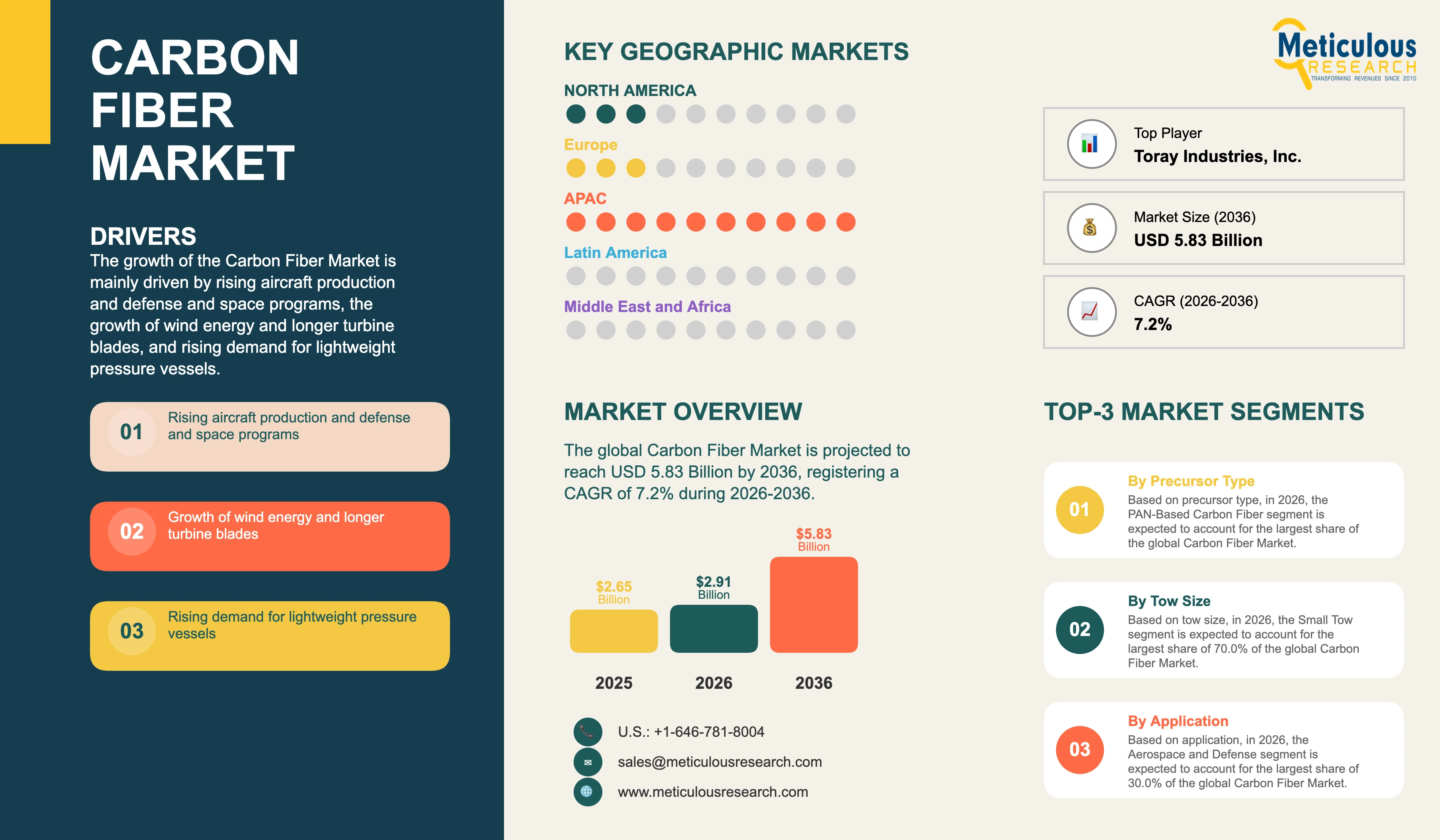
The global carbon fiber market was valued at USD 2.65 billion in 2025. This market is expected to reach USD 5.83 billion by 2036 from an estimated USD 2.91 billion in 2026, registering a CAGR of 7.2% during the forecast period (2026-2036). In terms of volume, this market is expected to reach 315.3 thousand tons by 2036 from an estimated 153.0 thousand tons in 2026, registering a CAGR of 7.5% during the forecast period.
- Published
- Nov 2026
- Pages
- 305
- Format
- PDF + Excel
- Report ID
- MRCHM - 1042498
- Base year
- 2025
- 2025 · BASELINE
- $2.65B
- 2036
- $5.83B
- CAGR 2026–2036
- 7.2%
2025 baseline · 2026–2036 forecast at 7.2% CAGR · hover a bar for the value
Key highlights
Toray, the world's largest carbon fiber producer, estimates that global carbon fiber demand was about 138,000 tons in 2025 and will reach about 153,000 tons in 2026 and 179,000 tons in 2028, growing at about 9% per year, driven by aircraft, space and defense, wind turbine blades, pressure vessels, and other industrial uses.
Toray's Carbon Fiber Composite Materials segment reported revenue of about 300.0 billion yen in the fiscal year ended March 2025, and aerospace accounted for about 41% of the segment's sales in fiscal 2025, with industrial applications accounting for about 50%.
Hexcel reported 2025 net sales of USD 1.89 billion, with commercial aerospace sales down 4.0% because of lower sales for certain Airbus and Boeing programs and defense, space, and other sales up 5.4%, driven partly by higher sales for launchers.
Chinese producers, such as Zhongfu Shenying, Jilin Chemical Fiber, Guangwei Composites, Jiangsu Hengshen, and Sinofibers Technology, have expanded capacity rapidly, making China the largest carbon fiber producing country and putting pressure on prices for industrial grades.
Aircraft makers have large order backlogs for the Airbus A350 and A220 and the Boeing 787, which use carbon fiber composites for most of their structures, and production rates are expected to rise over the forecast period.
Wind turbine makers are using carbon fiber spar caps in their longest blades, which now exceed 100 meters for some offshore turbines, making wind energy one of the largest uses of carbon fiber by volume.
Demand for Type III and Type IV pressure vessels for natural gas and hydrogen storage and transport is growing, although the adoption of hydrogen fuel cell cars has been slower than expected.
Producers are developing lower-cost precursors, recycled carbon fiber, and low-carbon production processes to reduce costs and meet customer sustainability requirements.
Toray reported that its Carbon Fiber Composite Materials segment returned to stronger profits in fiscal 2025, supported by aerospace demand and long-term contracts with major customers in fields that do not compete directly with Chinese producers.
By precursor type, PAN-based carbon fiber accounts for the largest share in 2026, while rayon, lignin, and other precursors register the highest CAGR.
By tow size, small tow accounts for the largest share of 70.0% in 2026, while large tow registers the highest CAGR.
By application, aerospace and defense accounts for the largest share of 30.0% in 2026, while pressure vessels register the highest CAGR.
By geography, Asia-Pacific accounts for the largest share of 58.0% in 2026 and also registers the highest CAGR of 7.9%.
Report summary
| Particulars | Details |
|---|---|
| Base Year | 2025 |
| Estimated Year | 2026 |
| Forecast Period | 2026-2036 |
| Market Size in 2025 | USD 2.65 billion |
| Market Size in 2026 | USD 2.91 billion |
| Market Size by 2036 | USD 5.83 billion |
| CAGR (2026-2036), Value | 7.2% |
| Format | PDF, Excel & Cloud Portal · 305 pages |
| Market Volume (2026 to 2036) | 153.0 thousand tons to 315.3 thousand tons (CAGR 7.5%) |
| Largest Segment by Tow Size (2026) | Small Tow (70.0%) |
| Largest Segment by Application (2026) | Aerospace and Defense (30.0%) |
| Largest Region (2026) | Asia-Pacific (58.0%) |
| Fastest-Growing Region | Asia-Pacific (CAGR 7.9%) |
| Segments Covered | Precursor Type, Tow Size, Application, and Geography |
| Geographic Scope | Asia-Pacific, North America, Europe, Middle East and Africa, and Latin America |
| Key Companies Profiled | Toray, Teijin, Mitsubishi Chemical, Hexcel, SGL Carbon, Syensqo, Hyosung Advanced Materials, DowAksa, Zhongfu Shenying, Jilin Chemical Fiber, Guangwei Composites, Jiangsu Hengshen, Sinofibers Technology, and Nippon Graphite Fiber |
Report overview
Segments covered: precursor type, tow size, application.
The growth of this market is mainly driven by rising aircraft production and defense and space programs, the growth of wind energy and the use of longer turbine blades, rising demand for lightweight pressure vessels for hydrogen and natural gas storage, and growing use of carbon fiber in automotive, drones, robotics, construction, and industrial applications. However, factors such as the high cost of carbon fiber compared with glass fiber and metals, overcapacity and falling prices in China, and challenges in recycling carbon fiber composites are expected to restrain the growth of this market to some extent. Value is expected to grow slightly more slowly than volume because the rapid growth of lower-cost large tow fiber and Chinese capacity is expected to keep average prices under pressure.
Carbon fiber is a material made of very thin, strong fibers consisting mainly of carbon atoms, produced by heating precursor fibers, most commonly polyacrylonitrile (PAN), at high temperatures in an oxygen-free environment. Carbon fiber is about five times stronger than steel by weight and much lighter, and it is also stiff, resistant to fatigue and corrosion, and stable at high temperatures. It is usually combined with resins, such as epoxy, vinyl ester, or thermoplastics, to form carbon fiber reinforced plastics, which are used in aircraft, wind turbine blades, pressure vessels, cars, sporting goods, drones, robots, and many industrial products.
This market covers the global consumption of carbon fiber, measured in value and in thousand tons, including PAN-based, pitch-based, and other carbon fibers in small tow and large tow forms, sold as continuous fiber, chopped fiber, and fiber used to make fabrics and prepregs. It is segmented by precursor type, tow size, application, and geography. The value of resins and finished composite parts is not included.
Carbon fiber production is capital-intensive and technically complex, as PAN precursor is first spun into fibers, which are then stabilized in air at about 200 to 300 degrees Celsius, carbonized at about 1,000 to 1,500 degrees Celsius, and in some cases graphitized at higher temperatures to increase stiffness. The fibers are then surface-treated and coated with sizing to improve their bonding with resins. Producers can control the strength and stiffness of the fiber by adjusting the precursor, temperatures, and tension during production, which allows them to make grades for very different applications. The cost of precursor and energy accounts for a large share of production costs, which is why large-scale, efficient plants and low-cost precursor are key to competitiveness.
The industry was historically led by Japanese companies, such as Toray, Teijin, and Mitsubishi Chemical, along with Hexcel in the U.S., SGL Carbon in Germany, and a few other producers. In the past decade, Chinese producers have expanded capacity rapidly, supported by government policies and domestic demand from wind energy, sporting goods, pressure vessels, and other industrial uses, and China has become the largest carbon fiber producing country. This rapid expansion has created overcapacity in industrial grades and reduced prices, which has affected the profitability of producers around the world. Many Chinese plants have operated at low utilization rates, and some producers have reported losses, while producers in Japan, the U.S., and Europe have focused more on aerospace, high-performance industrial, and specialty grades where qualification and performance requirements limit competition.
Carbon fiber demand is divided between aerospace and defense, which uses high-performance small tow fibers that must meet strict qualification requirements and sell at high prices, and industrial applications, such as wind energy, pressure vessels, automotive, and construction, which increasingly use lower-cost large tow fibers. Sporting goods, such as golf shafts, fishing rods, rackets, and bicycles, form another important market. Aerospace and defense accounts for a large share of market value, while industrial applications account for most of the volume. Because of this difference in prices, the market's value depends heavily on aerospace production rates, while its volume depends mainly on wind energy, pressure vessels, sporting goods, and other industrial uses.
Over the forecast period, carbon fiber demand is expected to grow strongly, supported by rising aircraft production, the growth of wind energy and hydrogen, defense and space programs, and new uses in drones, robots, electric vehicles, and infrastructure. Producers are expected to continue reducing costs through larger plants, lower-cost precursors, and new production technologies, which will make carbon fiber more competitive with glass fiber and metals in industrial applications. Recycling, thermoplastic composites, and faster composite manufacturing processes are also expected to support adoption, particularly in automotive and industrial markets where cost and production speed are critical. As a result, the industry is expected to become larger and more diverse, with a greater share of demand coming from industrial and energy applications.
Report infographic
Market dynamics
15 factors across 5 forcesRising aircraft production and defense and space programs
Commercial aircraft, such as the Boeing 787 and Airbus A350, use carbon fiber composites for about half of their structural weight, including the fuselage and wings, and the Airbus A220 and many other aircraft use composites for wings, tails, and other parts. Carbon fiber reduces aircraft weight, which lowers fuel consumption and emissions, and it resists fatigue and corrosion better than aluminum.
Aircraft makers have large order backlogs, and Airbus and Boeing plan to increase production rates over the forecast period, although supply chain problems have slowed the pace. Defense programs for fighter jets, helicopters, drones, missiles, and military vehicles also use carbon fiber composites, and space launchers and satellites increasingly use carbon fiber for structures and rocket motor cases. Hexcel reported that its defense, space, and other sales grew in 2025, driven partly by higher sales for launchers. Business jets, regional aircraft, and helicopters also use carbon fiber composites in growing amounts. Aerospace and defense accounts for the largest share of the market by application. Engine makers also use carbon fiber composites in fan blades and fan cases, such as those on GE Aerospace's GE9X and CFM International's LEAP engines, which adds to demand.
Growth of wind energy and longer turbine blades
Wind turbine blades are becoming longer to capture more energy, with offshore blades now exceeding 100 meters, and longer blades need stiffer and lighter materials to avoid bending and touching the tower. Carbon fiber is used in the spar caps, the main load-bearing parts of the blade, often in the form of pultruded carbon fiber planks, which allows blades to be longer without becoming too heavy.
Global wind installations, particularly in China, Europe, and offshore markets in Asia and the North Sea, continue to grow, and more turbine makers are using carbon fiber spar caps in their largest blades. Wind energy is one of the largest applications for carbon fiber by volume and uses mainly large tow fibers. Toray expects wind turbine blades to be one of the main drivers of carbon fiber demand growth. Chinese turbine makers, such as Goldwind, Envision, Mingyang, and Windey, along with Vestas, Siemens Gamesa, and GE Vernova, are among the users of carbon fiber in blades.
Rising demand for lightweight pressure vessels
Carbon fiber is used to wrap Type III and Type IV pressure vessels for storing compressed natural gas, hydrogen, and other gases, because it provides very high strength at low weight. These vessels are used in natural gas vehicles, hydrogen fuel cell vehicles, hydrogen refueling stations, gas transport trailers, and industrial gas storage, and each vessel can use large amounts of carbon fiber.
Although the adoption of hydrogen fuel cell cars has been slower than expected, demand for pressure vessels is growing for natural gas trucks and buses in China and other countries, hydrogen buses and trucks, hydrogen transport trailers, and storage. Pressure vessels form the fastest-growing application in this market, and they use mainly small tow and large tow fibers with high strength. Hydrogen refueling stations, tube trailers that transport hydrogen and natural gas, and stationary storage systems for industrial and energy applications also use large carbon fiber vessels.
Growing use in automotive, drones, robotics, and industrial applications
Carbon fiber is used in high-performance and luxury cars, electric vehicle battery enclosures, structural parts, and drive shafts, where it reduces weight and increases range and performance. It is also used in drones, robots, eVTOL aircraft, industrial rollers, medical devices, electronics, and construction, where its strength, stiffness, and low weight offer advantages over metals.
The rapid growth of drones for defense, inspection, and delivery, humanoid and industrial robots, and electric vertical take-off and landing aircraft is creating new demand for carbon fiber. Construction applications, such as strengthening bridges and buildings with carbon fiber plates and wraps, are also growing. Defense drones, in particular, have become a fast-growing source of demand because of their widespread use in recent conflicts. These applications are expected to support strong growth in carbon fiber demand, particularly for lower-cost industrial grades. Industrial applications, such as rollers for printing and film production, robotic arms, and machine parts, also benefit from carbon fiber's low weight and stiffness, which allow faster and more precise movement.
Table of contents
11 chapters · 121 sections · 305 pages · click to expandGeographic analysis
Asia-Pacific
Largest shareIn 2026, Asia-Pacific is expected to account for the largest share of 58.0% of the global carbon fiber market and is also projected to register the highest CAGR of 7.9% during the forecast period. The large share and fast growth of this region are mainly due to China's position as the largest producer and consumer of carbon fiber, along with large production and consumption in Japan, South Korea, and Taiwan. China uses carbon fiber in wind turbine blades, pressure vessels, sporting goods, construction, automotive, drones, and aerospace, and its producers, such as Zhongfu Shenying, Jilin Chemical Fiber, Guangwei Composites, Jiangsu Hengshen, and Sinofibers Technology, have expanded capacity rapidly. Japan is home to Toray, Teijin, and Mitsubishi Chemical, which are among the world's leading producers, and it has large aerospace, automotive, and industrial markets. South Korea has carbon fiber production through Hyosung Advanced Materials and growing demand for hydrogen pressure vessels, while Taiwan is a major center for sporting goods and bicycle manufacturing. India is emerging as a growing market, supported by wind energy, aerospace, defense, and infrastructure programs, and by plans for domestic carbon fiber production. Asia-Pacific is expected to remain the dominant and fastest-growing region throughout the forecast period. Southeast Asian countries, such as Vietnam and Thailand, are also growing as locations for sporting goods and composite parts manufacturing. Australia also has growing demand for carbon fiber in defense, mining equipment, and infrastructure repair.
North America
North America holds a significant share of the market, supported by its large aerospace and defense industry, including Boeing, Lockheed Martin, Northrop Grumman, and the space industry, along with pressure vessels, wind energy, and automotive applications. Carbon fiber is produced in the U.S. by Hexcel, Toray, Syensqo, Mitsubishi Chemical, and others. Space companies, such as SpaceX, Rocket Lab, and Blue Origin, use carbon fiber in launch vehicles and spacecraft, and defense programs for drones and missiles are increasing demand. Canada and Mexico also have aerospace and automotive industries that use carbon fiber composites.
Europe
Europe also holds a significant share, supported by Airbus, wind energy, automotive, and industrial applications, and by production from Toray in France and Hungary, SGL Carbon in Germany, and other producers.
Latin America
Latin America and the Middle East and Africa hold smaller shares, although DowAksa's production in Turkey and growing aerospace and energy investments in the Middle East support demand.
Competitive landscape
The carbon fiber market is moderately concentrated, with a group of large producers in Japan, the U.S., Europe, South Korea, Turkey, and China. Leading companies in the market include Toray, Teijin, Mitsubishi Chemical, Hexcel, SGL Carbon, Syensqo, Hyosung Advanced Materials, DowAksa, and Chinese producers, such as Zhongfu Shenying, Jilin Chemical Fiber, Guangwei Composites, Jiangsu Hengshen, and Sinofibers Technology.
Toray is the world's largest carbon fiber producer by capacity and sales, with plants in Japan, the U.S., Mexico, France, Hungary, and South Korea, including its Zoltek large tow business. Japanese and Western producers dominate the aerospace market, where qualification requirements create high barriers to entry, while Chinese producers have gained a large share of industrial markets through rapid capacity expansion and low prices. Several producers are integrated downstream into prepregs, fabrics, and composite parts, which allows them to capture more value and work closely with customers. Hexcel, for example, uses most of its carbon fiber in its own prepregs and composite materials for aerospace customers.
The top five players are estimated to account for 48.0% of the carbon fiber market in 2025, reflecting the strong position of Toray and other leading producers in aerospace and industrial markets and the growing share of Chinese producers.
Players use several strategies to grow and defend their positions in this market, including expanding capacity for large tow and aerospace grades, developing lower-cost and low-carbon production technologies, integrating downstream into prepregs, intermediate materials, and composite parts, signing long-term supply agreements with aircraft makers, wind turbine makers, and pressure vessel makers, and developing recycled carbon fiber. Some producers outside China have also restructured their industrial carbon fiber businesses in response to price pressure.
Competition is expected to center on cost, product performance, qualification in aerospace programs, capacity, and sustainability. Producers with low-cost large-scale production and strong positions in aerospace and high-value industrial markets are expected to perform best. Chinese producers are expected to continue gaining share in industrial markets. Consolidation and partnerships are also likely, as producers seek scale and access to new markets.
Some of the key players operating in the carbon fiber market are Toray Industries, Inc., Teijin Limited, Mitsubishi Chemical Group Corporation, Hexcel Corporation, SGL Carbon SE, Syensqo SA, Hyosung Advanced Materials Corporation, DowAksa Advanced Composites Holdings B.V., Zhongfu Shenying Carbon Fiber Co., Ltd., Jilin Chemical Fiber Co., Ltd., Weihai Guangwei Composites Co., Ltd., Jiangsu Hengshen Co., Ltd., Sinofibers Technology Co., Ltd., and Nippon Graphite Fiber Corporation.
- —
Toray launched its IGNITION 2028 medium-term program, forecasting about 9% annual growth in carbon fiber demand, Hexcel reported growth in defense and space sales in 2025, and Chinese producers continued to expand capacity.
- Toray
- Teijin
- Mitsubishi Chemical
- Hexcel
- SGL Carbon
- Syensqo
- Hyosung Advanced Materials
- DowAksa
- Zhongfu Shenying
- Jilin Chemical Fiber
- Guangwei Composites
- Jiangsu Hengshen
- Sinofibers Technology
- Nippon Graphite Fiber
Expert perspectives
The carbon fiber market is entering a period of strong volume growth, supported by aircraft production, wind energy, pressure vessels, and new industrial applications. At the same time, the rapid expansion of Chinese capacity has created overcapacity in industrial grades and reduced prices, which has changed the competitive landscape and put pressure on producers outside China.
Over the forecast period, carbon fiber volume is expected to grow at about 7.5% per year, and value at about 7.2% per year, as lower-cost large tow fibers and Chinese production grow faster than aerospace grades. Toray's estimate of about 9% annual demand growth between 2025 and 2028 indicates strong near-term momentum, while growth is expected to moderate later in the forecast period as markets mature. Prices for industrial grades are expected to remain under pressure while Chinese overcapacity persists, but prices for aerospace grades are expected to remain more stable because of qualification requirements and long-term contracts.
Rayon, lignin, and other precursors form the fastest-growing precursor type, large tow is the fastest-growing tow size, and pressure vessels form the fastest-growing application, reflecting the push for lower costs and the growth of hydrogen and gas storage. PAN-based fiber, small tow, and aerospace and defense remain the largest segments.
Asia-Pacific is both the largest and the fastest-growing region, with a CAGR of 7.9%, supported by China's production and demand. The main swing factors that could change this outlook are aircraft production rates, wind installations and blade designs, the pace of hydrogen adoption, Chinese capacity and pricing, and progress in reducing carbon fiber costs.
For carbon fiber users, the key decisions are how to balance cost and performance, which suppliers to qualify, and how to manage recycling and sustainability requirements. For producers, success depends on cost reduction, qualification in high-value markets, and the ability to compete with Chinese producers in industrial markets. Producers that can combine low-cost large tow production with strong aerospace positions and recycling capabilities are expected to be best placed. Partnerships with wind turbine makers, pressure vessel makers, and automakers will also be important for growth in industrial markets. Producers that develop low-carbon and recycled products are also expected to gain an advantage as customers set stricter sustainability targets.
Overall, carbon fiber is expected to remain one of the most important advanced materials for lightweighting and energy applications, with its market increasingly shaped by cost reduction and Chinese competition. Next-generation aircraft programs and the hydrogen economy could become major sources of new demand later in the forecast period.
Customer perspectives
Director of Composite Materials - aircraft structures manufacturer, Europe
Aircraft production rates are rising again, and carbon fiber is the backbone of our wing and fuselage work. We rely on long-term contracts with qualified suppliers, because qualifying a new fiber takes years.
Long qualification times and strict performance requirements support stable prices for aerospace-grade fiber, even as industrial grades face price pressure.
Strong aerospace demand is why aerospace and defense account for 30.0% of the market and small tow accounts for 70.0%.
Pressure vessel makers are working with fiber producers to develop lower-cost, high-strength fibers, which supports the growth of large tow in this application.
Growing demand for hydrogen and natural gas storage is why pressure vessels form the fastest-growing application in this market.
Blade Materials Manager - wind turbine manufacturer, China
Our largest offshore blades need carbon fiber spar caps to stay light and stiff. Lower prices for large tow fiber have made carbon fiber much easier to justify in our designs.
Lower large tow prices are encouraging more wind turbine makers to use carbon fiber spar caps, which supports volume growth in this application.
The use of carbon fiber in wind blades and other industrial applications in China contributes to Asia-Pacific's 58.0% share and the fast growth of large tow.
“Carbon fiber is the biggest cost in our tanks, so we are working with suppliers on lower-cost grades. Demand from hydrogen buses, trucks, and transport trailers is growing, and we are expanding our production.”
Frequently asked questions
The global carbon fiber market was valued at USD 2.65 billion in 2025 and USD 2.58 billion in 2024, and is estimated at USD 2.91 billion in 2026.
The market is expected to reach USD 5.83 billion by 2036, supported by aerospace and defense, wind energy, pressure vessels, automotive, and industrial applications.
The market is expected to register a CAGR of 7.2% from 2026 to 2036 in value terms and 7.5% in volume terms, with volume rising from 153.0 thousand tons in 2026 to 315.3 thousand tons in 2036.
Lower-cost large tow fibers and Chinese production are growing faster than higher-priced aerospace grades, and overcapacity in China is keeping prices for industrial grades under pressure, which reduces the average price of carbon fiber.
Growth is driven by rising aircraft production and defense and space programs, the growth of wind energy and longer turbine blades, rising demand for lightweight pressure vessels, and growing use in automotive, drones, robotics, and industrial applications.
High cost compared with glass fiber and metals and overcapacity and falling prices in China restrain growth, while recycling and end-of-life management and long qualification times in aerospace remain key challenges.
Key opportunities include lower-cost carbon fiber for industrial and automotive applications, the hydrogen economy and energy storage, thermoplastic composites and next-generation aircraft, and recycled carbon fiber.
Toray estimates that global carbon fiber demand was about 138,000 tons in 2025 and will reach about 153,000 tons in 2026, growing at about 9% per year to 2028.
Toray is the world's largest carbon fiber producer, followed by other major producers such as Teijin, Mitsubishi Chemical, Hexcel, SGL Carbon, Hyosung Advanced Materials, and Chinese producers, such as Zhongfu Shenying and Jilin Chemical Fiber.
Carbon fiber is used mainly in the spar caps of wind turbine blades, often as pultruded planks, which allows blades to be longer, lighter, and stiffer, particularly for large offshore turbines with blades over 100 meters long.
PAN-based carbon fiber is expected to account for the largest share of the market in 2026, while rayon, lignin, and other precursors are projected to register the highest CAGR.
Small tow is expected to account for the largest share of 70.0% of the market in 2026, while large tow is projected to register the highest CAGR.
Aerospace and defense is expected to account for the largest share of 30.0% of the market in 2026, while pressure vessels are projected to register the highest CAGR.
Asia-Pacific is expected to account for the largest share of 58.0% of the market in 2026, led by China and Japan.
Asia-Pacific is projected to register the highest CAGR of 7.9% during the forecast period.
The report profiles 14 companies, including Toray, Teijin, Mitsubishi Chemical, Hexcel, SGL Carbon, and Zhongfu Shenying. The top five players account for an estimated 48.0% of the market in 2025.
Toray launched its IGNITION 2028 medium-term program, forecasting about 9% annual growth in carbon fiber demand, Hexcel reported growth in defense and space sales in 2025, and Chinese producers continued to expand capacity.
Cite this report
Meticulous Research. (2026). Carbon Fiber Market - Global Opportunity Analysis and Industry Forecast (2026-2036) (Report No. MRCHM - 1042498). Meticulous Market Research Pvt. Ltd. https://www.meticulousresearch.com/product/carbon-fiber-market-7181