Glass Fibre Yarns for Electronics Market (2026-2036)
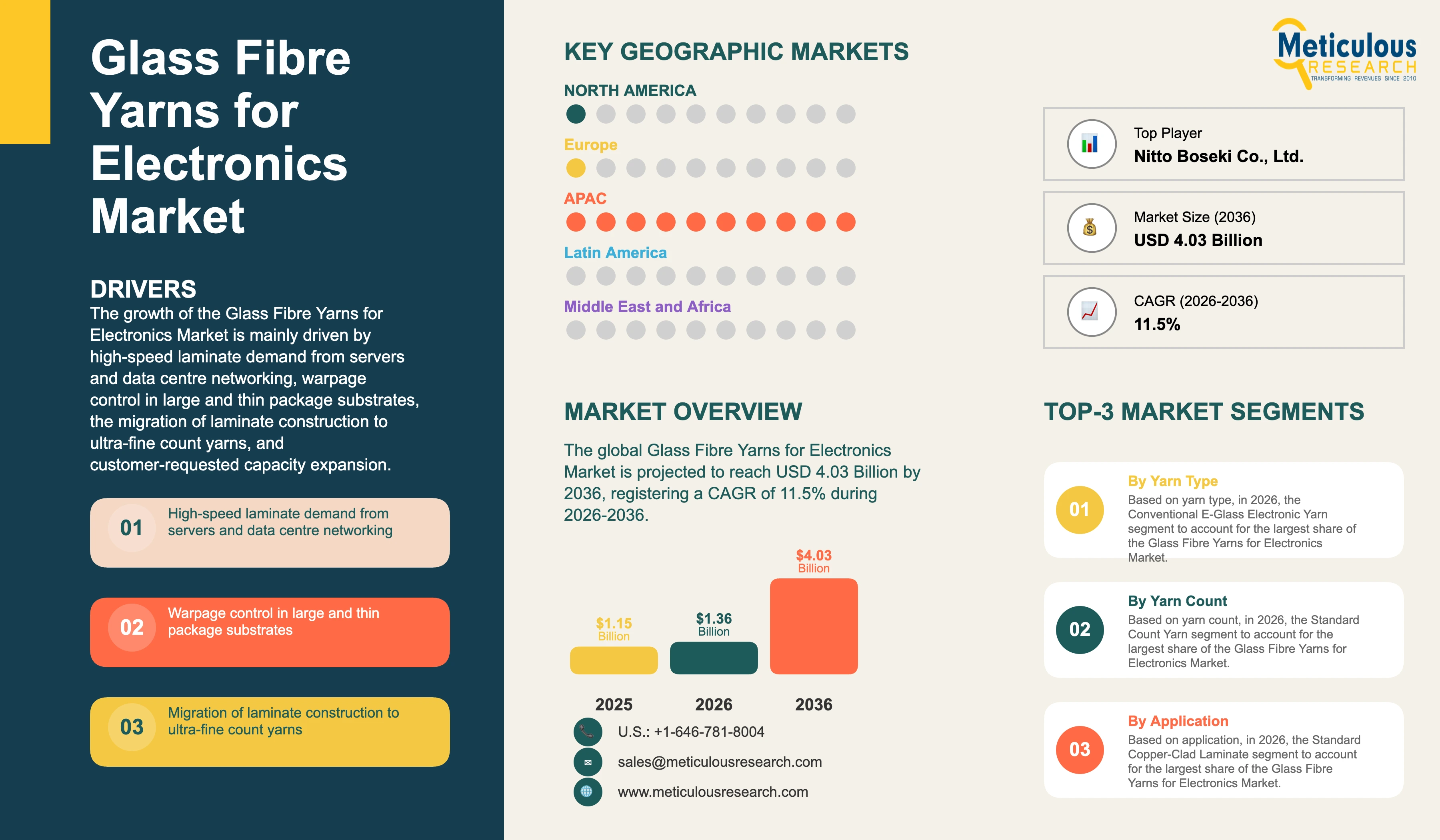
The glass fibre yarns for electronics market is valued at USD 1.36 billion in 2026 and is projected to reach USD 4.03 billion by 2036, at a CAGR of 11.5% during the forecast period. The market was valued at USD 1.15 billion in 2025 and at USD 1.01 billion in 2024.
- Published
- Nov 2026
- Pages
- 252
- Format
- PDF + Excel
- Report ID
- MRCHM - 1042763
- Base year
- 2025
- 2024 · HISTORICAL
- $1.01B
- 2036
- $4.03B
- CAGR 2026–2036
- 11.5%
2024–2025 baseline · 2026–2036 forecast at 11.5% CAGR · hover a bar for the value
Key highlights
This market measures electronic-grade glass fibre yarn at the spinning stage, before weaving, covering conventional E-glass electronic yarn, low dielectric yarn, low thermal expansion and high modulus yarn, and quartz and high silica yarn.
Woven glass cloth, prepreg, copper-clad laminate and the finished board are counted downstream and are not additive. Where a producer is integrated from yarn through cloth, the yarn is measured at an internal transfer basis.
Glass fibre roving and chopped strand for composite reinforcement are excluded, including the chopped strand measured in the glass fibre reinforced polypropylene title in this series. Filament diameter, sizing chemistry and count are different products made on different lines.
Insulation glass fibre is excluded, as are aramid, carbon and liquid crystal polymer reinforcement yarns, which compete in the same laminates on a different basis. The resin system is counted separately.
Value growth at 11.5% runs at close to twice volume growth at 6.4%, because the mix moves toward specialty compositions and finer counts and because prices are rising on the grades in short supply.
Nitto Boseki Co., Ltd. reported first half results on 5 November 2026 showing group revenue up 19.4% to 68.52 billion yen and operating profit up 71.5% to 16.21 billion yen, attributed to strong special glass sales and to price increases.
Within that, electronic materials revenue rose 27.9% and operating profit 63.1%. Profit growing at more than twice the rate of revenue is a price and mix outcome, and the clearest available measure of how tight this market has become.
Full year guidance was raised for the second time since August, to 143.0 billion yen of group revenue and 34.0 billion yen of operating profit.
Electronic materials guidance was raised to 80.2 billion yen of revenue, up 31% year on year, and 31.9 billion yen of operating profit, up 64%.
That was attributed to T-Glass, NE-Glass and NER-Glass demand, with T-Glass growing for servers and edge devices and NE-Glass and NER-Glass strong for data centres.
Chief executive Toshinobu Hayashi stated that T-Glass demand is already short of supply, with lines running at full capacity, and that customers had requested more output.
The company announced about 20 billion yen to expand its Taiwan and Fukushima sites, targeting T-Glass capacity in the year to March 2029 at 3.6 times the level of the year to March 2025.
That supersedes an earlier plan for three times capacity by the year to March 2028, which included a 15 billion yen glass cloth plant in Fukushima Prefecture with shipments planned from July 2027.
The timing of that first shipment is the operative fact for buyers. A supplier multiplying capacity 3.6 times is not responding to a cyclical movement, but the earliest new output arrives in the second half of 2027, so the shortage persists through the current financial year at least.
A separate disclosure of 12 May 2026 revised the medium term plan targets for the four years to March 2027, raising net sales to 155.0 billion yen, operating profit to 36.0 billion yen and EBITDA to 51.0 billion yen.
It also raised four year capital investment from about 80.0 billion yen to about 120.0 billion yen, noting that operating profit in the year to March 2026 had already reached the original final year target.
It identified the investment being brought forward as special glass capacity and in particular low thermal expansion glass, with artificial intelligence servers named as the application seeing rapid expansion of demand.
Low thermal expansion is a dimensional stability requirement, distinct from the low dielectric constant and loss tangent that signal integrity requires. Artificial intelligence hardware creates two separate glass requirements, and the product split follows that division.
Report summary
| Particulars | Details |
|---|---|
| Base Year | 2025 |
| Actual Years | 2024-2025 |
| Forecast Period | 2026-2036 |
| Market Size in 2024 | USD 1.01 billion |
| Market Size in 2025 | USD 1.15 billion |
| Market Size in 2026 | USD 1.36 billion |
| Market Size in 2036 | USD 4.03 billion |
| Value CAGR (2026-2036) | 11.5% |
| Format | PDF, Excel & Cloud Portal · 252 pages |
| Volume in 2025 | 90.00 kilotons |
| Volume in 2026 | 95.00 kilotons |
| Volume in 2036 | 176.66 kilotons |
| Volume CAGR (2026-2036) | 6.4% |
| Average Selling Price, 2026 | USD 14.30 per kg |
| Average Selling Price, 2036 | USD 22.80 per kg |
| Units | Value in USD million; volume in kilotons of yarn; price in USD per kg |
| Measurement Basis | Electronic-grade glass fibre yarn at the spinning stage, before weaving; integrated producers measured at an internal transfer basis |
| Exclusions | Woven glass cloth, prepreg, copper-clad laminate and the finished board; glass fibre roving and chopped strand for composite reinforcement; insulation glass fibre; aramid, carbon and liquid crystal polymer yarns; the resin system |
| Segments: Yarn Type | Conventional E-Glass Electronic Yarn; Low Dielectric Yarn; Low Thermal Expansion and High Modulus Yarn; Quartz and High Silica Yarn |
| Segments: Yarn Count | Standard Count; Fine Count; Ultra-Fine Count |
| Segments: Application | Standard Copper-Clad Laminate; High-Speed Laminate for Servers and Networking; Integrated Circuit and Package Substrate; Automotive and High-Reliability PCB; Other Electronic and Insulation Duty |
| Largest Segment by Yarn Type, 2026 | Conventional E-Glass Electronic Yarn |
| Fastest-Growing Segment by Yarn Type | Low Thermal Expansion and High Modulus Yarn, at 22.0% |
| Largest Segment by Yarn Count, 2026 | Standard Count |
| Fastest-Growing Segment by Yarn Count | Ultra-Fine Count, at 20.0% |
| Largest Segment by Application, 2026 | Standard Copper-Clad Laminate |
| Fastest-Growing Segment by Application | Integrated Circuit and Package Substrate, at 22.0% |
| Largest Region, 2026 | Asia-Pacific |
| Fastest-Growing Region | North America, at 14.0% |
| Fastest-Growing Country | U.S., at 14.0% |
| Slowest-Growing Country | Germany, at 8.0% |
| Regions Covered | Asia-Pacific; North America; Europe; Rest of the World |
| Countries Covered | Japan; Taiwan; China; South Korea; U.S.; Germany |
| Key Players | Nitto Boseki Co., Ltd.; Asahi Kasei Corporation; Nan Ya Plastics Corporation; Taiwan Glass Industry Corporation; China Jushi Co., Ltd.; Shin-Etsu Chemical Co., Ltd. |
| Top Five Share, 2026 | 56.8% |
| Profiled Companies Share, 2026 | 62.4% |
| Currency | USD |
Report overview
Market value is measured in in USD million; volume in kilotons of yarn; price in USD per kg. Segments covered: yarn type, yarn count, application.
In volume terms, the market is estimated at 95.00 kilotons of yarn in 2026, rising to 176.66 kilotons by 2036, at a CAGR of 6.4%. The average selling price is estimated at USD 14.30 per kg in 2026 and USD 22.80 per kg in 2036, the increase reflecting a shift from conventional E-glass yarn toward low dielectric, low thermal expansion and ultra-fine count yarns, which sell at several times the price of standard electronic yarn, together with price realisation on grades where supply is short of demand.
The growth of this market is mainly driven by high-speed laminate demand from artificial intelligence servers and data centre networking, the warpage control requirement in large and thin package substrates, the migration of laminate construction to ultra-fine count yarns, and capacity additions that are being requested by customers rather than initiated by suppliers. However, factors such as the commodity position of conventional E-glass yarn, the long lead time for fine filament drawing and weaving capacity, competition from resin systems and organic reinforcements that reduce glass content, and the cyclicality of consumer electronics board demand are expected to restrain the growth of this market to some extent.
Among yarn types, conventional E-glass electronic yarn is expected to hold the largest share of this market in 2026, while low thermal expansion and high modulus yarn is expected to record the highest CAGR during the forecast period. Geographically, Asia-Pacific is expected to account for the largest share of this market in 2026, while North America is expected to register the highest CAGR during the forecast period.
Electronic-grade glass yarn is drawn from molten glass through a platinum alloy bushing into continuous filaments of a few microns diameter, gathered into a strand, sized, and then twisted and plied into a yarn of a specified count. The yarn is woven into a thin cloth, the cloth is impregnated with resin to make prepreg, and the prepreg is pressed with copper foil into copper-clad laminate from which a printed circuit board is made. This market measures the first of those steps.
What distinguishes the product from glass fibre generally is the combination of filament fineness and composition control. A reinforcement roving for a moulding compound is drawn at perhaps 13 to 17 microns and sold by the tonne. An electronic yarn for a thin laminate style is drawn at 4 to 7 microns, held to a filament count and twist specification, and must be free of the inclusions and diameter variation that would show as a weave defect or a dielectric discontinuity in a finished board.
That is why the capacity constraint in this market sits in drawing and weaving rather than in glass melting. A furnace can be built; a bushing that draws several hundred filaments at five microns without breakage, and a loom that weaves the resulting yarn into cloth tens of microns thick without distortion, are the scarce assets. The industry expresses its capacity plans in glass cloth plants rather than in melting tonnes for that reason.
Composition divides the market into families serving different requirements. Conventional E-glass, a calcium alumino-borosilicate, carries the great majority of the tonnage and serves standard laminate styles for consumer, industrial and automotive boards. It is adequate wherever signal rates are modest and the board is small enough that dimensional movement does not matter.
Low dielectric compositions reduce the dielectric constant and the loss tangent of the glass, which matters because a laminate is a composite and the glass sets a floor on how low the combined dielectric properties can go however good the resin is. As data rates rise, insertion loss across a long trace becomes the limit on channel length, and the glass becomes the component that has to change.
Low thermal expansion and high modulus compositions solve a different problem. A package substrate is thin, large in area and built up in layers against a silicon die whose expansion coefficient is far below that of the organic build-up. Mismatch produces warpage, and warpage at the scale of a modern accelerator package causes assembly yield loss rather than electrical failure.
Nitto Boseki Co., Ltd. names T-Glass, NE-Glass and NER-Glass as the products driving its electronic materials business, with T-Glass demand expected to grow significantly for servers and edge devices and NE-Glass and NER-Glass demand remaining strong for data centres. The split in that statement maps onto the split in requirement: the high modulus, low expansion family and the low dielectric family are being bought for different reasons by different parts of the same supply chain.
Accounts of this market commonly treat the whole of artificial intelligence related glass demand as a low dielectric story. The company disclosure of 12 May 2026 identified the investment being brought forward as special glass capacity and in particular low thermal expansion glass, with artificial intelligence servers named as the application. Dimensional stability, not signal speed, was the stated reason for accelerating capital spending.
Quartz and high silica yarns sit above both families. Drawn from fused silica, they offer the lowest dielectric loss and the lowest thermal expansion available in a woven reinforcement, at a price per kilogram an order above specialty E-glass derivatives. They serve radar, aerospace and the most demanding test and measurement boards, and they remain a small fraction of the tonnage of this market.
Yarn count runs alongside composition as the second axis of specification. Heavier laminate styles are woven from standard count yarn and carry most of the tonnage. Thinner styles require progressively finer counts, and the thinnest cloth used in build-up substrates is woven from yarns that only a few producers can draw consistently. Finer counts command a higher price per kilogram while contributing less mass per unit of board area.
The commercial consequence is that board area and yarn tonnage have decoupled. A board built in thinner styles consumes less glass by weight than one built in heavier styles of the same area, so the tonnage of this market grows at 6.4% while its value grows at 11.5%. Volume forecasts built from board area alone overstate the tonnage and understate the value.
The evidence that the market is supply constrained rather than demand constrained is in the margin. Nitto Boseki Co., Ltd. reported first half electronic materials revenue up 27.9% to 29.95 billion yen with operating profit up 63.1% to 14.66 billion yen, and raised full year segment guidance to 80.2 billion yen of revenue, up 31% year on year, and 31.9 billion yen of operating profit, up 64% year on year. Profit growing at twice the rate of revenue reflects price and mix, and the company attributed its first half gains to strong special glass sales and to price increases.
The chief executive stated that T-Glass demand is very strong and already short of supply, with production lines running at full capacity, and that customers had requested more output. Demand arriving as a customer request for capacity rather than as an order is the characteristic signature of allocation.
The capacity response sets the duration. The company announced about 20 billion yen to expand Taiwan and Fukushima, targeting T-Glass capacity in the year to March 2029 at 3.6 times the level of the year to March 2025, superseding a plan for three times capacity by the year to March 2028 that included a 15 billion yen glass cloth plant in Fukushima Prefecture shipping from July 2027.
A supplier does not multiply capacity 3.6 times against a cyclical movement, so the demand is understood as structural. Equally, the first new output arrives in the second half of 2027 and the full expansion not until the year to March 2029, so tightness in the specialty grades persists across the near term regardless of how much capital is committed now.
Beneath that, conventional E-glass electronic yarn behaves as an entirely different market. Supply is ample, capacity is widely held across Asia, and price is set by cost rather than by scarcity. The segment is forecast at 6.0% while low dielectric yarn grows at 19.6% and low thermal expansion and high modulus yarn at 22.0%, and that divergence is the defining structural feature of this market over the forecast period.
Report infographic
Market dynamics
22 factors across 5 forcesHigh-Speed Laminate Demand from Servers and Data Centre Networking
As data rates rise, insertion loss across a trace becomes the limit on channel length, and because a laminate is a composite the glass sets a floor on how low the combined dielectric properties can go whatever the resin does. The glass therefore becomes the component that has to change rather than an inert carrier, and Nitto Boseki Co., Ltd. reports NE-Glass and NER-Glass demand remaining strong for data centres.
Low dielectric yarn is forecast at 19.6% and high-speed laminate for servers and networking at 17.6%, against 6.0% for conventional E-glass yarn. Because the specialty grades sell at several times the price of standard electronic yarn, this driver contributes to the value of this market far ahead of its tonnage.
Warpage Control in Large and Thin Package Substrates
A package substrate is thin, large in area and built against a silicon die whose expansion coefficient is far below that of the organic build-up, so mismatch produces warpage, and warpage at the scale of a modern accelerator package causes assembly yield loss rather than electrical failure. Low thermal expansion, high modulus glass is the reinforcement that answers it.
The company disclosure of 12 May 2026 identified the capacity being brought forward as special glass and in particular low thermal expansion glass, with artificial intelligence servers named as the application seeing rapid expansion of demand. Dimensional stability rather than signal speed was the stated reason for accelerating capital spending.
Low thermal expansion and high modulus yarn is forecast at 22.0%, the fastest yarn type in this report, and integrated circuit and package substrate applications at the same rate. This is a requirement that did not exist at volume a decade ago and now sets the direction of the industry capital plan.
Migration of Laminate Construction to Ultra-Fine Count Yarns
Thinner laminate styles require progressively finer yarn counts, and the thinnest cloth used in build-up substrates is woven from yarns only a few producers draw consistently. Each step finer raises the difficulty of drawing without filament breakage and of weaving without distortion.
Finer counts command a higher price per kilogram while contributing less mass per unit of board area, which is why ultra-fine count yarn is forecast at 20.0% while the tonnage of this market grows at 6.4%. The driver raises value and suppresses volume at the same time, and it concentrates supply, because a buyer moving to a thinner construction moves from a contested supply base to a short one.
Customer-Requested Capacity Expansion
Nitto Boseki Co., Ltd. announced about 20 billion yen to expand production at Taiwan and Fukushima, targeting T-Glass capacity in the year to March 2029 at 3.6 times the year to March 2025 level, superseding an earlier plan for three times capacity by the year to March 2028 that included a 15 billion yen Fukushima glass cloth plant shipping from July 2027.
The chief executive stated that customers had requested more output because T-Glass supply is tight, with lines at full capacity, and said larger investment may be needed beyond the year to March 2030. Capacity requested by customers rather than initiated by the supplier is demand underwritten before it is built, and the medium term plan revision raised four year capital investment to about 120.0 billion yen against it.
Price Realisation on Supply-Constrained Grades
Where output is allocated rather than sold, price moves with scarcity, and the company attributed its first half gains to strong special glass sales and to price increases, with group operating profit up 71.5% on revenue up 19.4%.
That differential between profit and revenue growth is what price realisation looks like in a reported result, and it is why average selling price in this market rises from USD 14.30 per kg to USD 22.80 per kg. The effect moderates as the announced capacity arrives from the second half of 2027, which is why the value rate in this forecast sits below the current run rate.
Table of contents
11 chapters · 118 sections · 252 pages · click to expandSegmental analysis
| Segment | Largest share (2026) | Fastest growth (2026–2036) |
|---|---|---|
| By Yarn Type | Conventional E-glass electronic yarn | Low thermal expansion and high modulus yarn |
| By Yarn Count | Standard count yarn | Ultra-fine count yarn |
| By Application | Standard copper-clad laminate | Integrated circuit and package substrate |
| By Geography | Asia-Pacific | North America |
By Yarn Type
- Glass Fibre Yarns for Electronics Market Analysis by Yarn Type
- This market is segmented by yarn type into conventional E-glass electronic yarn, low dielectric yarn, low thermal expansion and high modulus yarn, and quartz and high silica yarn.
- Conventional E-glass electronic yarn is expected to hold the largest share of this market in 2026.
- The segment leads because standard laminate styles for consumer, industrial and automotive boards carry the great majority of world board area and are adequately served by a calcium alumino-borosilicate composition wherever signal rates are modest and the board is small enough that dimensional movement does not matter.
- Supply is widely held across Asia and price is set by cost rather than scarcity, which holds the segment to 6.0% and, because it dominates the volume base, holds total tonnage growth to 6.4%.
- Low thermal expansion and high modulus yarn is expected to record the highest CAGR of 22.0% during the forecast period.
- A package substrate is thin, large in area and built against a silicon die whose expansion coefficient is far below that of the organic build-up, so mismatch produces warpage that costs assembly yield rather than electrical performance.
- Nitto Boseki Co., Ltd. identified low thermal expansion glass as the special glass capacity being brought forward in its disclosure of 12 May 2026, naming artificial intelligence servers as the application, and reports T-Glass demand expected to grow significantly for servers and edge devices.
- Low dielectric yarn grows at 19.6%.
- Because a laminate is a composite, the glass sets a floor on how low the combined dielectric constant and loss tangent can go whatever the resin achieves, so as data rates rise and insertion loss limits channel length the glass becomes the component that must change.
- The company reports NE-Glass and NER-Glass demand remaining strong for data centres.
- Quartz and high silica yarn grows at 16.0%.
- Drawn from fused silica, it offers the lowest dielectric loss and lowest thermal expansion available in a woven reinforcement at a price per kilogram an order above specialty E-glass derivatives, serving radar, aerospace and the most demanding test and measurement boards, and contributing value out of proportion to its tonnage.
By Yarn Count
- Glass Fibre Yarns for Electronics Market Analysis by Yarn Count
- This market is segmented into standard count yarn for heavier laminate styles, fine count yarn for intermediate styles, and ultra-fine count yarn for the thinnest styles.
- Standard count yarn is expected to account for the largest share of this market in 2026, on the tonnage carried by heavier laminate styles in conventional boards.
- The segment grows at 7.0%, held back because laminate construction is thinning across most end applications and each step thinner moves mass out of this count band.
- Ultra-fine count yarn is expected to register the highest CAGR of 20.0% during the forecast period, serving the thinnest cloth used in build-up substrates.
- Filament breakage and diameter variation rise sharply as count falls, and a defect that would pass in a reinforcement roving becomes a weave fault or a dielectric discontinuity in a finished board, so only a few producers draw these counts consistently.
- The segment commands a price per kilogram several times standard electronic yarn while contributing less mass per unit of board area, which is why it raises the value of this market while suppressing its tonnage.
- Fine count yarn for intermediate styles grows at 12.6%, taking volume from standard count as construction thins while losing its finest applications upward.
- The band carries the largest part of the transition under way in laminate design and is where most qualification activity sits.
By Application
- Glass Fibre Yarns for Electronics Market Analysis by Application
- This market is segmented into standard copper-clad laminate for consumer and industrial printed circuit boards, high-speed laminate for servers and networking, integrated circuit and package substrate, automotive and high-reliability printed circuit board, and other electronic and insulation duty.
- Standard copper-clad laminate is expected to account for the largest share of this market in 2026, on the board area consumed by consumer electronics, industrial controls and general purpose assemblies.
- The application grows at 5.4%, the slowest in this report, because its volume moves with handset, personal computer and appliance cycles rather than with data centre investment and because it is served by commodity yarn.
- Integrated circuit and package substrate is expected to register the highest CAGR of 22.0% during the forecast period.
- The application requires both the finest counts and the low thermal expansion compositions, because a build-up substrate is thin, large and dimensionally constrained by the die it carries, and the buyer is comparing the glass price against scrapped packages rather than against a cheaper reinforcement.
- High-speed laminate for servers and networking grows at 17.6%, drawing on low dielectric compositions as insertion loss becomes the limit on channel length.
- Nitto Boseki Co., Ltd. raised electronic materials guidance for the year to March 2027 to 80.2 billion yen of revenue, up 31% year on year, and 31.9 billion yen of operating profit, up 64% year on year, attributing the gains to strong special glass sales and to price increases.
- Automotive and high-reliability printed circuit board applications grow at 8.0%, on electronic content per vehicle and on the thermal cycling and insulation resistance requirements that under-bonnet and traction inverter boards impose.
- Other electronic and insulation duty grows at 5.0%, covering electrical insulation tape and sleeving and specialty industrial fabrics.
By Geography
- Glass Fibre Yarns for Electronics Market Analysis by Geography
- Geographically, this market is segmented into Asia-Pacific, North America, Europe, and the Rest of the World, with individual country sizing within each region.
- Asia-Pacific is expected to account for the largest share of this market in 2026, because yarn drawing, cloth weaving, laminate pressing and board fabrication are all concentrated there and a yarn is qualified through the chain that follows it.
- North America is expected to register the highest CAGR of 14.0%, as domestic advanced packaging and substrate capability is built out.
- Europe is expected to record the lowest regional CAGR of 9.0%, holding specialty positions in aerospace, radar and high-reliability boards rather than volume laminate capacity, so its growth comes from composition rather than from board area.
Geographic analysis
Asia-Pacific
Largest shareAsia-Pacific is expected to account for the largest share of this market in 2026. Yarn drawing, cloth weaving, prepreg and laminate pressing and board fabrication are all concentrated in the region, and because a yarn is qualified through the whole of that chain rather than on its own, supply sits where the chain sits. Taiwan is expected to grow at 13.0%, the fastest country in the region, and is where Nitto Boseki Co., Ltd. is directing part of the approximately 20 billion yen expansion that targets T-Glass capacity in the year to March 2029 at 3.6 times the year to March 2025 level. The island combines laminate and substrate capacity with the advanced packaging operations that consume low thermal expansion glass. South Korea grows at 12.0% and Japan at 11.0%. Japan holds the specialty compositions and the finest counts, with the new 15 billion yen glass cloth plant in Fukushima Prefecture planned to ship from July 2027, while South Korea draws on substrate and memory packaging demand. China grows at 10.6%, holding most of the conventional E-glass electronic yarn capacity and competing on cost in standard laminate styles.
North America
North America is expected to register the highest regional CAGR at 14.0%, with the United States at the same rate. Domestic advanced packaging and substrate capability is being built out and buyers are seeking supply that does not depend entirely on East Asian capacity, while the announced specialty expansions are in Taiwan and Fukushima rather than in the region, so demand growth is not matched by local supply.
Europe
Europe is expected to record the lowest regional CAGR at 9.0%, with Germany at 8.0%. The region holds specialty positions in aerospace, radar, automotive and high-reliability boards rather than volume laminate capacity, and quartz and high silica yarn carries a larger share of its consumption than of any other region, so growth comes from composition rather than from board area. The Rest of the World grows at 12.0%, covering board and laminate capacity being established outside the three principal regions as supply chains diversify. The base is small enough that individual laminate plants move the rate. The geographic pattern of this market is set by qualification rather than by freight. Yarn is light and valuable enough to ship anywhere, but a laminator qualifies a yarn and cloth through to finished board performance, so supply follows the fabrication base and moves only when that base moves.
Competitive landscape
The global glass fibre yarns for electronics market is moderately concentrated overall and highly concentrated in the specialty compositions and finest counts, because the scarce capability is drawing several hundred filaments at a few microns from a high-viscosity glass and weaving the result into cloth tens of microns thick. Some of the key players operating in the glass fibre yarns for electronics market are Nitto Boseki Co., Ltd. (Japan), Asahi Kasei Corporation (Japan), Nan Ya Plastics Corporation (Taiwan), Taiwan Glass Industry Corporation (Taiwan), China Jushi Co., Ltd. (China), and Shin-Etsu Chemical Co., Ltd. (Japan), among others.
Nitto Boseki Co., Ltd. holds the leading position in the specialty compositions, reporting first half electronic materials revenue for the year to March 2027 up 27.9% to 29.95 billion yen and operating profit up 63.1% to 14.66 billion yen, and raising full year segment guidance to 80.2 billion yen of revenue and 31.9 billion yen of operating profit. Its chief executive has stated that T-Glass demand is short of supply with lines at full capacity, and the company is investing about 20 billion yen across Taiwan and Fukushima toward 3.6 times the year to March 2025 capacity by the year to March 2029.
Asahi Kasei Corporation competes in electronic glass cloth and yarn from a Japanese base, and like Nitto Boseki Co., Ltd. is integrated from yarn through woven cloth, which matters because the laminate qualification runs through both steps and an integrated supplier controls the whole of what the customer tests. Shin-Etsu Chemical Co., Ltd. holds the quartz and high silica position, where the price per kilogram runs an order above specialty E-glass derivatives and the qualification base is narrowest.
Nan Ya Plastics Corporation and Taiwan Glass Industry Corporation compete from Taiwan alongside the laminate and substrate capacity concentrated there, which gives both proximity to the qualification chain and exposure to the advanced packaging demand driving low thermal expansion grades. China Jushi Co., Ltd. holds the largest conventional E-glass electronic yarn position, competing on cost and delivery in standard laminate styles where supply is ample and price is set by cost rather than by scarcity.
The five largest participants are estimated to hold 56.8% of this market in 2026, and the six companies profiled in this report 62.4%. The remainder is held by regional yarn and cloth producers across China, Taiwan and South Korea serving standard laminate styles, whose individual positions are not separately quantified in this report. Competitive movement over the forecast period is expected to come from qualification at the finest counts and in the specialty compositions rather than from conventional capacity, which is not a constraint.
- Nitto Boseki Co., Ltd.
- Asahi Kasei Corporation
- Nan Ya Plastics Corporation
- Taiwan Glass Industry Corporation
- China Jushi Co., Ltd.
- Shin-Etsu Chemical Co., Ltd
Expert perspectives
The named driver for this market is circuit board substrate demand, and it is correct without being informative, because it describes both halves of a market whose halves now have opposite economics. Conventional E-glass electronic yarn is amply supplied and priced on cost at 6.0% growth, while low dielectric yarn grows at 19.6% and low thermal expansion yarn at 22.0% with lines at full capacity and prices rising.
The evidence for that split is unusually direct. Nitto Boseki Co., Ltd. reported first half electronic materials revenue up 27.9% with operating profit up 63.1%, and raised full year segment guidance to revenue up 31% and operating profit up 64% year on year. Profit growing at twice the rate of revenue is price and mix, and the company named price increases as a cause.
The second correction concerns what the specialty demand is for. Accounts of this market treat artificial intelligence related glass as a low dielectric story, but the disclosure of 12 May 2026 identified the capacity being brought forward as low thermal expansion glass, with artificial intelligence servers as the named application. Dimensional stability rather than signal speed was the stated reason for accelerating capital spending.
That distinction matters commercially because the two requirements are bought by different parts of the chain. Low dielectric glass is specified by a board designer against insertion loss and channel length. Low thermal expansion glass is specified by a substrate maker against warpage and assembly yield, so the comparison is against scrapped packages rather than against a cheaper reinforcement, which is a far stronger pricing position.
The duration of the current tightness is set by physical capacity rather than by demand. The plan is about 20 billion yen across Taiwan and Fukushima toward 3.6 times the year to March 2025 T-Glass capacity by the year to March 2029, with the first new output from July 2027. A supplier does not multiply capacity 3.6 times against a cyclical movement, but the first shipments are still more than a year away.
The forecast value rate of 11.5% therefore sits deliberately below the current run rate, because price realisation of that order is a function of allocation and allocation ends when the announced capacity commissions. The second half of the forecast period depends on specification advancing fast enough to keep the specialty grades scarce; should resin systems and organic reinforcements close part of the performance gap instead, the mix shift slows while tonnage, held to 6.4% by the commodity base, does not accelerate to compensate.
Customer perspectives
Laminators qualify a yarn through cloth, prepreg, laminate and finished board, so the performance that decides the purchase is measured at the end of the chain rather than at the spinning frame.
We do not qualify a yarn. We qualify a board, and the yarn is the part of it we are least able to change once the board is approved.
Buyers of specialty grades report being on allocation rather than on order, with volume determined by the supplier capacity position rather than by their own forecast.
Substrate makers specify low thermal expansion glass against warpage and assembly yield, and compare the glass price against the cost of scrapped packages rather than against a cheaper reinforcement.
Board designers specify low dielectric glass against insertion loss and channel length, and treat the glass as the floor on what the laminate can achieve whatever the resin contributes.
Buyers moving to thinner constructions report that the supply base narrows sharply with each step finer in count, and plan qualification well ahead of the design that will need it.
Purchasers report accepting price increases on supply-constrained grades where the alternative is no allocation, and separating those negotiations entirely from standard laminate yarn purchasing.
Standard laminate buyers report sourcing conventional E-glass yarn on price and delivery across several qualified suppliers, with switching treated as routine.
Buyers report tracking supplier capacity announcements as a planning input, because a stated commissioning date determines when allocation is likely to ease.
North American substrate and packaging operations report concern that specialty supply remains concentrated in East Asia and that announced expansions are sited there.
Buyers in aerospace, radar and high-reliability applications report specifying quartz or high silica yarn where E-glass derivatives reach their composition limits, and accepting the order of magnitude price difference as the cost of the specification.
Frequently asked questions
The glass fibre yarns for electronics market is valued at USD 1.36 billion in 2026 and is projected to reach USD 4.03 billion by 2036, at a CAGR of 11.5% during the forecast period. In volume terms the market is estimated at 95.00 kilotons of yarn in 2026, rising to 176.66 kilotons by 2036 at a CAGR of 6.4%.
High-speed laminate demand from servers and data centre networking, the warpage control requirement in large and thin package substrates, the migration of laminate construction to ultra-fine count yarns, capacity expansion requested by customers rather than initiated by suppliers, and price realisation on grades where supply is short of demand.
The restraints are the commodity position of conventional E-glass electronic yarn, the lead time for fine filament drawing and weaving capacity, resin systems and organic reinforcements that reduce glass content, and the cyclicality of consumer electronics board demand. The principal challenges are drawing fine filaments from high-viscosity specialty compositions, qualifying a yarn through laminate and finished board, and matching capacity timing to a fast-moving specification.
Electronic-grade glass fibre yarn at the spinning stage, before weaving, covering conventional E-glass electronic yarn, low dielectric yarn, low thermal expansion and high modulus yarn, and quartz and high silica yarn. Woven cloth, prepreg, copper-clad laminate and the finished board are counted downstream and are not additive, and integrated producers are measured at an internal transfer basis.
The two do not overlap. That title measures compound containing chopped strand for composite reinforcement, which is excluded here, because filament diameter, sizing chemistry and count are different products made on different lines. Insulation glass fibre is also excluded, as are aramid, carbon and liquid crystal polymer yarns.
Because the mix moves toward specialty compositions and finer counts while prices rise on the grades in short supply. Average selling price rises from USD 14.30 per kg to USD 22.80 per kg while tonnage grows at only 6.4%.
Conventional E-glass electronic yarn is expected to hold the largest share in 2026, because standard laminate styles carry the great majority of world board area and are adequately served by it. Low thermal expansion and high modulus yarn is projected to grow fastest at 22.0%, because warpage in thin, large-area package substrates costs assembly yield.
Standard count yarn is expected to hold the largest share in 2026, on the tonnage carried by heavier laminate styles. Ultra-fine count yarn is projected to grow fastest at 20.0%, because the thinnest cloth used in build-up substrates requires counts that only a few producers draw consistently.
Standard copper-clad laminate for consumer and industrial boards is expected to hold the largest share in 2026, on board area, and grows at 5.4%, the slowest in this report. Integrated circuit and package substrate is projected to grow fastest at 22.0%, because it requires both the finest counts and the low thermal expansion compositions.
First half results for the year to March 2027 showed group revenue up 19.4% to 68.52 billion yen and operating profit up 71.5% to 16.21 billion yen, attributed to strong special glass sales and to price increases. Electronic materials revenue rose 27.9% to 29.95 billion yen and operating profit 63.1% to 14.66 billion yen, and full year guidance was raised for the second time since August.
Chief executive Toshinobu Hayashi stated that T-Glass demand is very strong and already short of supply, with lines running at full capacity, and that customers had requested more output. Full year electronic materials guidance was raised to 80.2 billion yen of revenue, up 31% year on year, and 31.9 billion yen of operating profit, up 64%.
About 20 billion yen to expand Taiwan and Fukushima, targeting T-Glass capacity in the year to March 2029 at 3.6 times the year to March 2025 level. That supersedes an earlier plan for three times capacity by the year to March 2028, which included a 15 billion yen Fukushima glass cloth plant shipping from July 2027.
Only in part. The disclosure of 12 May 2026 identified the special glass capacity being brought forward as low thermal expansion glass, with artificial intelligence servers as the named application, so dimensional stability rather than signal speed was the stated reason for accelerating capital spending.
Because the binding constraint is drawing several hundred filaments at a few microns from a high-viscosity glass without breakage, and weaving the yarn into cloth tens of microns thick without distortion. A furnace can be built; those capabilities cannot be added inside a product cycle.
It raised the targets for the four years to March 2027: net sales from 135.0 billion yen to 155.0 billion yen, operating profit from 20.0 billion yen to 36.0 billion yen and EBITDA from 32.0 billion yen to 51.0 billion yen, with four year capital investment rising from about 80.0 billion yen to about 120.0 billion yen.
Asia-Pacific is expected to account for the largest share in 2026, while North America is expected to grow fastest at 14.0% and Europe records the lowest regional rate at 9.0%. Key players include Nitto Boseki Co., Ltd. (Japan), Asahi Kasei Corporation (Japan), Nan Ya Plastics Corporation (Taiwan), Taiwan Glass Industry Corporation (Taiwan), China Jushi Co., Ltd. (China), and Shin-Etsu Chemical Co., Ltd. (Japan).
Cite this report
Meticulous Research. (2026). Glass Fibre Yarns for Electronics Market - Global Opportunity Analysis and Industry Forecast (2026-2036) (Report No. MRCHM - 1042763). Meticulous Market Research Pvt. Ltd. https://www.meticulousresearch.com/product/glass-fibre-yarns-for-electronics-market-7446