Oxide Ceramic Fibres Market (2026-2036)
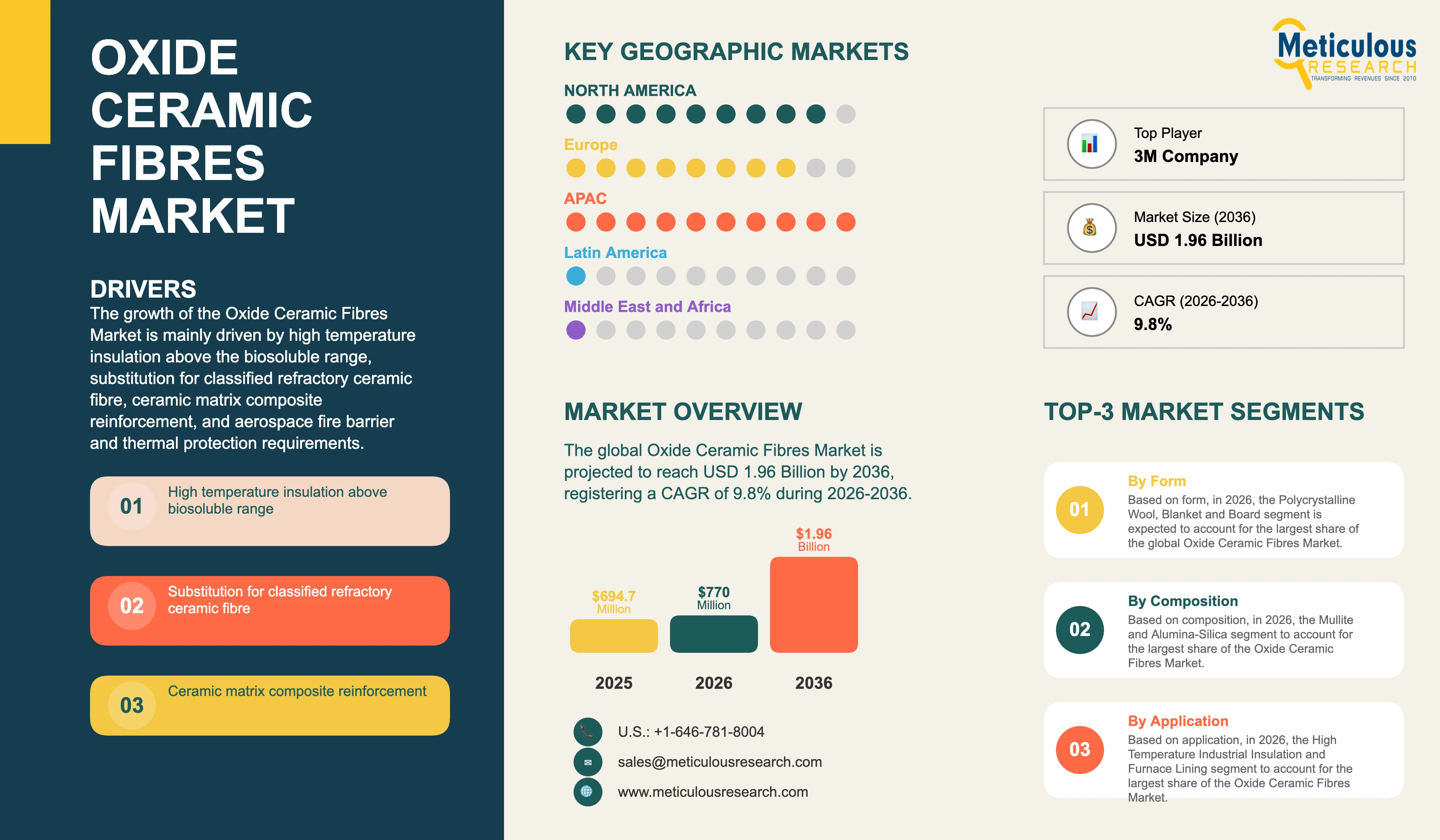
The oxide ceramic fibres market is valued at USD 770.0 million in 2026 and is projected to reach USD 1.96 billion by 2036, at a CAGR of 9.8% during the forecast period. The market was valued at USD 694.7 million in 2025 and at USD 640.8 million in 2024.
- Published
- Nov 2026
- Pages
- 253
- Format
- PDF + Excel
- Report ID
- MRCHM - 1042756
- Base year
- 2025
- 2024 · HISTORICAL
- $640.8M
- 2036
- $1.96B
- CAGR 2026–2036
- 9.8%
2024–2025 baseline · 2026–2036 forecast at 9.8% CAGR · hover a bar for the value
Key highlights
This market measures polycrystalline oxide ceramic fibre on a fibre mass basis, covering wool, blanket and board, continuous filament, and the textiles woven directly from it.
Amorphous aluminosilicate refractory ceramic fibre and alkaline earth silicate biosoluble wool are excluded as different, amorphous fibre classes. The regulatory position of the first is the principal driver of this market rather than part of it.
Non-oxide ceramic fibres, including silicon carbide, silicon nitride and boron, are a separate family and are excluded.
Glass, quartz, aramid and carbon fibre are counted in their own markets. 3M Company positions its oxide textiles as outperforming aramids, carbon, quartz and glass, which makes them competitors rather than the same product.
The ceramic matrix composite part and the finished insulation module are counted downstream.
Value growth at 9.8% runs above volume growth at 6.6%, because the mix moves from wool toward filament and woven forms rather than because fibre prices rise.
3M Company supplies four oxide fibre grades of distinct composition: Nextel 312 at 62.5% alumina, 24.5% silica and 13% boria; Nextel 440 at 70% alumina, 28% silica and 2% boria; Nextel 610 at above 99% alumina; and Nextel 720 at 85% alumina and 15% silica.
Filament diameters run from 8 to 14 microns, and all four grades hold a crystal size below 500 nanometres, which is what distinguishes a polycrystalline fibre from the amorphous wools it competes against.
Phases differ by grade: distorted mullite with an amorphous phase in 312, gamma alumina with an amorphous phase in 440, alpha alumina in 610, and alpha alumina with mullite in 720.
Tensile strength rises with alumina content, from 1,630 MPa for 312 to 2,800 MPa for 610, with tensile modulus rising from 150 GPa to 370 GPa across the same sequence.
Temperature capability does not follow the same order. Continuous use is stated at 1, 200 degrees Celsius for 312 and 1,300 for 440 on 40% strength retention after a 100 hour soak, and at 1,000 for 610 and 1,150 for 720 on a limit of 1% strain under 69 MPa for 1,000 hours.
The two pairs rest on different criteria and are not directly comparable, but within each pair the lower alumina grade holds the higher temperature, and the strongest grade in the family carries the lowest stated continuous use temperature of the four.
Pure alumina creeps under load at temperature while mullite and residual silica resist it, so strength and temperature capability run in opposite directions here. More alumina is not a better fibre, which is why four grades coexist rather than converging.
Available forms are rovings, yarns, sewing threads, fabrics, woven tapes, braided sleevings and braider packs, with textiles retaining flexibility and temperature resistance to 1,300 degrees Celsius.
Named applications include aviation firewalls, fan cowls, engine struts and wiring insulation, firewalls being cited as meeting the Federal Aviation Administration requirement of 2,000 degrees Fahrenheit for 15 minutes of flame penetration resistance.
Further named duty covers rocket engine blankets, Whipple shields for the International Space Station and satellites, infrared gas burners, furnace linings, float glass furnace door seals, reformer tube seals and radiant coil heat shields that reduce coke formation.
Composite duty spans ceramic matrix reinforcement for jet engines, gas turbines and kiln rollers, polymer matrix radomes and ducting, and metal matrix brake calipers and power transmission cable.
The substitution driver usually attributed to this market is weaker than assumed. Zirconia aluminosilicate refractory ceramic fibre sits on the REACH Candidate List as a carcinogen under Article 57(a) and was recommended for the Authorisation List in the fifth recommendation round, but has never been included, so no sunset date applies.
Report summary
| Particulars | Details |
|---|---|
| Base Year | 2025 |
| Actual Years | 2024-2025 |
| Forecast Period | 2026-2036 |
| Market Size (Value) in 2024 | USD 640.8 million |
| Market Size (Value) in 2025 | USD 694.7 million |
| Market Size (Value) in 2026 | USD 770.0 million |
| Market Size (Value) in 2036 | USD 1.96 billion |
| CAGR (Value) | 9.8% |
| Format | PDF, Excel & Cloud Portal · 253 pages |
| Volume in 2025 | 20.80 kilotons |
| Volume in 2026 | 22.00 kilotons |
| Volume in 2036 | 41.69 kilotons |
| Volume CAGR (2026-2036) | 6.6% |
| Average Selling Price, 2026 | USD 35.00 per kg |
| Average Selling Price, 2036 | USD 47.00 per kg |
| Units | Value in USD million; volume in kilotons of fibre; price in USD per kg |
| Measurement Basis | Polycrystalline oxide ceramic fibre on a fibre mass basis, covering wool, blanket and board, continuous filament, and textiles woven or needled directly from that filament |
| Exclusions | Amorphous aluminosilicate refractory ceramic fibre and alkaline earth silicate biosoluble wool; non-oxide ceramic fibres including silicon carbide, silicon nitride and boron; glass, quartz, aramid and carbon fibre; the ceramic matrix composite part and the finished insulation module |
| Segments: Form | Polycrystalline Wool, Blanket and Board; Continuous Filament Roving and Yarn; Woven Fabric, Tape and Sleeving |
| Segments: Composition | Mullite and Alumina-Silica; High Alumina Above 95%; Alumina-Boria-Silica |
| Segments: Application | High Temperature Industrial Insulation and Furnace Lining; Ceramic Matrix Composite Reinforcement; Aerospace Thermal Protection and Fire Barrier; Petrochemical Seals, Gaskets and Expansion Joints; Metal and Polymer Matrix Composite and Other |
| Largest Segment by Form, 2026 | Polycrystalline Wool, Blanket and Board |
| Fastest-Growing Segment by Form | Continuous Filament Roving and Yarn, at 14.0% |
| Largest Segment by Composition, 2026 | Mullite and Alumina-Silica |
| Fastest-Growing Segment by Composition | High Alumina Above 95%, at 13.0% |
| Largest Segment by Application, 2026 | High Temperature Industrial Insulation and Furnace Lining |
| Fastest-Growing Segment by Application | Ceramic Matrix Composite Reinforcement, at 16.0% |
| Largest Region, 2026 | Asia-Pacific |
| Fastest-Growing Region | Middle East & Africa, at 11.4% |
| Fastest-Growing Country | India, at 12.0% |
| Slowest-Growing Country | France, at 8.0% |
| Regions Covered | Asia-Pacific; North America; Europe; Middle East & Africa; Latin America |
| Countries Covered | China; India; Japan; South Korea; U.S.; Canada; Germany; U.K.; France; Saudi Arabia; U.A.E.; Brazil |
| Key Companies | 3M Company; Morgan Advanced Materials plc; Sumitomo Chemical Company, Limited; Nichias Corporation; Shandong Luyang Energy-Saving Materials Co., Ltd.; Rath AG |
| Top Five Share, 2026 | 52.4% |
| Profiled Companies Share, 2026 | 57.2% |
| Currency | USD |
Report overview
Market value is measured in in USD million; volume in kilotons of fibre; price in USD per kg. Segments covered: form, composition, application.
In volume terms, the market is estimated at 22.00 kilotons of fibre in 2026, rising to 41.69 kilotons by 2036, at a CAGR of 6.6%. The average selling price is estimated at USD 35.00 per kg in 2026 and USD 47.00 per kg in 2036, the increase reflecting a shift in the mix from polycrystalline wool toward continuous filament and woven textile forms, which sell at an order above wool on the same contained fibre.
The growth of this market is mainly driven by high temperature insulation duty above the range that biosoluble wools reach, the substitution of oxide fibre for classified amorphous refractory ceramic fibre, ceramic matrix composite reinforcement in gas turbines and industrial furnaces, and aerospace fire barrier requirements. However, factors such as the absence of any authorisation requirement on the classified fibre being substituted, the cost of oxide fibre against biosoluble wool at intermediate temperatures, the creep limit that constrains the strongest grades, and the small scale of continuous filament capacity are expected to restrain the growth of this market to some extent.
Among forms, polycrystalline wool, blanket and board are expected to hold the largest share of this market in 2026, while continuous filament roving and yarn are expected to record the highest CAGR during the forecast period. Geographically, Asia-Pacific is expected to account for the largest share of this market in 2026, while the Middle East & Africa is expected to register the highest CAGR during the forecast period.
An oxide ceramic fibre is a polycrystalline alumina or alumina-silica filament made by spinning a solution or sol of aluminium and silicon precursors, drying the green fibre and firing it to crystallise the oxide. What distinguishes it from the amorphous wools used in the same furnaces is the crystal structure: 3M Company states a crystal size below 500 nanometres across its range, and crystallinity is what gives the fibre strength at temperature and resistance to devitrification and shrinkage over long soaks.
Composition within the family varies more than the name suggests. 3M Company supplies Nextel 312 at 62.5% alumina, 24.5% silica and 13% boria, Nextel 440 at 70% alumina, 28% silica and 2% boria, Nextel 720 at 85% alumina and 15% silica, and Nextel 610 at above 99% alumina. The phases follow the chemistry, running from distorted mullite with an amorphous phase, through gamma alumina with an amorphous phase, to alpha alumina with mullite and finally alpha alumina alone.
Mechanical performance tracks alumina content closely. Tensile strength rises from 1,630 MPa for 312 and 1,840 MPa for 440 to 1,940 MPa for 720 and 2,800 MPa for 610, and tensile modulus from 150 GPa to 370 GPa across the same sequence. On strength alone the conclusion would be that more alumina is better and that the family should converge on the near-pure grade.
Temperature capability contradicts that conclusion. Continuous use is stated at 1,200 degrees Celsius for 312 and 1,300 degrees Celsius for 440 against 40% strength retention after a 100 hour soak, and at 1,000 degrees Celsius for 610 and 1,150 degrees Celsius for 720 against a single filament limit of 1% strain under 69 MPa for 1,000 hours. The two pairs are measured on different criteria and cannot be compared directly, but within each pair the lower alumina grade holds the higher temperature, and the strongest grade in the family carries the lowest figure of the four.
The reason is creep. Alpha alumina is strong but deforms under sustained load at temperature as grain boundaries slide, while mullite and residual silica pin those boundaries and resist it. A fibre is therefore selected against the specific failure mode of the application, strength in a short exposure or dimensional stability over a long one, and that is why four grades coexist commercially rather than one displacing the rest.
That distinction also separates the two halves of this market. Insulation duty is a long soak under little load, where shrinkage and thermal conductivity matter and the wool form is adequate. Composite and textile duty is a load-bearing application where strength and modulus matter and the continuous filament is required, at an order more per kilogram.
Wool, blanket and board account for 72.0% of this market because furnace lining is where the tonnage sits. A polycrystalline wool holds its dimensions and insulating value above the range an alkaline earth silicate biosoluble wool can reach, which is what justifies its cost in the hottest zones of a kiln, a reformer or a glass furnace.
Continuous filament is 20.0% of the market and grows at 14.0%, supplied as rovings, yarns, sewing threads, fabrics, woven tapes, braided sleevings and braider packs, and converted into heat shields, pads and ropes. 3M Company states that its textiles retain flexibility and temperature resistance to 1,300 degrees Celsius and outperform aramids, carbon, quartz and glass as high-temperature textiles.
Aerospace is where that textile position is most firmly held. Named duty includes aviation firewalls, fan cowls, engine struts and wiring insulation, with firewalls cited as meeting the Federal Aviation Administration requirement of 2,000 degrees Fahrenheit for 15 minutes of flame penetration resistance, a qualification that is written into the airframe certification rather than negotiated with a buyer.
Space and defence duty extends the same properties further, covering blankets protecting rocket engines, Whipple shields for the International Space Station and satellites, and reinforcement for re-entry structures. These are small volumes at the highest prices in the market and they carry qualification that persists for a programme life.
Industrial and petrochemical duty is where the volume of the textile forms sits. Named applications cover infrared gas burners, cable and thermocouple covering, furnace linings and zone dividers, float glass furnace door seals and gaskets, process heater and reformer tube seals, expansion joints, and radiant coil heat shields that reduce coke formation.
That last application is instructive about how the fibre is actually bought. A heat shield that reduces coke formation in a radiant coil extends the interval between decoking shutdowns, so the operator compares the fibre cost against lost production rather than against a cheaper insulation, which is the pricing position the whole market aspires to and achieves only in specific duties.
Composite reinforcement is the fastest application at 16.0%. Ceramic matrix duty covers jet engines, gas turbines, industrial furnaces, kiln rollers and charge carrier supports in metal treating, while polymer matrix duty covers radomes, ducting and rotor blades and metal matrix duty covers aluminium brake calipers, pushrods and power transmission cable.
The regulatory position of the fibre class being displaced is the part of this market most often misread. Zirconia aluminosilicate refractory ceramic fibre is on the REACH Candidate List as a substance of very high concern, classified as carcinogenic under Article 57(a) and falling under index number 650-017-00-8 of Annex VI to the CLP Regulation subject to three conditions on composition and fibre diameter, with the aluminosilicate refractory fibre group member carrying EC number 604-314-4 and CAS number 142844-00-6.
It was recommended for inclusion in the Authorisation List in the fifth recommendation round, and it has not been included. The European Commission takes the final decision on Annex XIV entries and has not made one here, so there is no sunset date, no authorisation requirement and no prohibition on continued use.
The substitution driving this market therefore runs on classification rather than on compliance. Candidate List status brings communication duties down the supply chain, occupational exposure management obligations and liability exposure, and customers increasingly specify against the classified fibre on those grounds, but none of that is a deadline. Growth of 9.8% in value on 6.6% in volume follows specification and temperature capability, not a mandated phase-out, and it would accelerate materially if the Commission ever acted on the recommendation.
Report infographic
Market dynamics
22 factors across 5 forcesHigh Temperature Insulation Above the Biosoluble Range
An alkaline earth silicate biosoluble wool serves the lower and middle part of the furnace temperature range but shrinks and devitrifies above it, while a polycrystalline oxide wool holds its dimensions and insulating value in the hottest zones. The crystal size below 500 nanometres that 3M Company states across its range is what delivers that stability.
Furnace lining is where the tonnage of this market sits, which is why wool, blanket and board hold 72.0% of it in 2026. The duty is a long soak under little load, so the wool form is adequate and the buyer is purchasing dimensional stability and thermal conductivity rather than strength.
High temperature industrial insulation and furnace lining grows at 7.2%, below the market value rate because it is the commodity end of this market, but it anchors the volume base and is the reason tonnage compounds at 6.6%.
Substitution for Classified Refractory Ceramic Fibre
Zirconia aluminosilicate refractory ceramic fibre is on the REACH Candidate List as carcinogenic under Article 57(a), falling under index number 650-017-00-8 of Annex VI to the CLP Regulation, with the aluminosilicate refractory fibre group member at EC number 604-314-4 and CAS number 142844-00-6.
Candidate List status brings communication duties down the supply chain, obligations on occupational exposure management and liability exposure, and buyers increasingly specify against the classified fibre on those grounds even where continued use remains lawful.
The driver is real but it is a specification driver rather than a deadline, because the fibre was recommended for the Authorisation List in the fifth recommendation round and has never been included. Substitution therefore proceeds at the pace of customer policy rather than of regulation, and that is the single largest variable in the value path of this market.
Ceramic Matrix Composite Reinforcement
Oxide fibre reinforces ceramic matrix composites in jet engines, gas turbines, industrial furnaces, kiln rollers and charge carrier supports in metal treating, where the part must carry load at a temperature that would soften a metal and must survive thermal cycling that would crack a monolithic ceramic.
An oxide matrix with an oxide fibre is inherently stable in an oxidising atmosphere, which is the property that distinguishes it from non-oxide systems and removes the need for the environmental barrier coatings those systems require. The comparison the buyer makes is against a cooled metal part or a coated non-oxide composite rather than against insulation.
Ceramic matrix composite reinforcement is forecast at 16.0%, the fastest application in this report. Because it consumes continuous filament rather than wool, it carries the highest price per kilogram and contributes to value well ahead of its tonnage.
Aerospace Fire Barrier and Thermal Protection Requirements
3M Company names aviation firewalls, fan cowls, engine struts and wiring insulation among its applications, and cites firewalls as meeting the Federal Aviation Administration requirement of 2,000 degrees Fahrenheit for 15 minutes of flame penetration resistance.
A requirement written into airframe certification is not negotiated with a procurement department, so the qualification persists for the life of the programme and the supplier position with it. Space duty extends the same properties to rocket engine blankets and Whipple shields for the International Space Station and satellites.
Aerospace thermal protection and fire barrier duty is forecast at 12.0%. Volumes are small and prices the highest in the market, and the certification basis makes the position more durable than any commercial advantage could.
Petrochemical Sealing and Coke Reduction Duty
Named petrochemical applications include process heater and furnace reformer tube seals, expansion joints and radiant coil heat shields that reduce coke formation, all requiring a textile that holds flexibility and strength at the operating temperature of a fired heater.
A heat shield that reduces coking extends the interval between decoking shutdowns, so the operator compares the fibre against lost production rather than against a cheaper insulation. That is the strongest pricing position available in this market, and petrochemical seals, gaskets and expansion joints are forecast at 9.4%, close to the market value rate.
Table of contents
11 chapters · 127 sections · 253 pages · click to expandSegmental analysis
| Segment | Largest share (2026) | Fastest growth (2026–2036) |
|---|---|---|
| By Form | Polycrystalline wool, blanket and board | Continuous filament roving and yarn |
| By Composition | Mullite and alumina-silica fibre | High alumina fibre above 95% |
| By Application | High temperature industrial insulation and furnace lining | Ceramic matrix composite reinforcement |
| By Geography | Asia-Pacific | Middle East & Africa |
By Form
- Oxide Ceramic Fibres Market Analysis by Form
- This market is segmented by form into polycrystalline wool, blanket and board, continuous filament roving and yarn, and woven fabric, tape and sleeving.
- Polycrystalline wool, blanket and board are expected to hold the largest share of this market in 2026.
- The form leads because furnace lining is where the tonnage sits, and because insulation duty is a long soak under little load in which dimensional stability and thermal conductivity matter rather than strength.
- A crystal size below 500 nanometres is what lets the fibre hold its dimensions and insulating value above the range an alkaline earth silicate biosoluble wool can reach, and that is the whole of the justification for its cost.
- The form grows at 8.4%, below the market value rate, and it anchors the volume base.
- Continuous filament roving and yarn are expected to record the highest CAGR of 14.0% during the forecast period.
- The form is required wherever the fibre must carry load rather than merely insulate, which is the case in every composite application and in woven textiles that must hold strength and flexibility at temperature. 3M Company supplies it as rovings, yarns and sewing threads across four compositions, and because the spinning, drying and firing process operates at a fraction of the scale of wool production the form sells at an order above wool on the same contained fibre.
- Woven fabric, tape and sleeving grow at 12.0%, converted from the same filament into braided sleevings, braider packs, heat shields, pads and ropes. 3M Company states that its textiles retain flexibility and temperature resistance to 1,300 degrees Celsius and outperform aramids, carbon, quartz and glass, which positions the form against other high-temperature textiles rather than against insulation.
By Composition
- Oxide Ceramic Fibres Market Analysis by Composition
- This market is segmented into mullite and alumina-silica fibre, high alumina fibre above 95%, and alumina-boria-silica fibre.
- Mullite and alumina-silica fibre is expected to account for the largest share of this market in 2026.
- The composition leads because it resists creep: alpha alumina deforms under sustained load at temperature as grain boundaries slide, while mullite and residual silica pin those boundaries.
- The 85% alumina and 15% silica grade in the 3M Company range carries a stated continuous use temperature of 1,150 degrees Celsius against 1,000 degrees Celsius for the grade above 99% alumina on the same test basis, which is why the mullite-bearing compositions hold the long-soak duty.
- It grows at 8.0%.
- High alumina fibre above 95% is expected to register the highest CAGR of 13.0% during the forecast period.
- The grade above 99% alumina reaches 2, 800 MPa tensile strength and 370 GPa tensile modulus, the highest in the family and comfortably above the 1,630 MPa and 150 GPa of the lowest alumina grade, which is what composite and metal matrix duty requires.
- Its creep behaviour confines it to applications where exposure is shorter or load lower, so it grows fastest without displacing the mullite grades from the duties they hold.
- Alumina-boria-silica fibre grows at 11.0%, covering the 62.5% alumina grade with 13% boria and the 70% alumina grade with 2% boria.
- Boria assists crystallisation at lower firing temperatures and these grades retain an amorphous phase alongside distorted mullite or gamma alumina, which suits textile and insulation duty where cost matters more than ultimate strength.
By Application
- Oxide Ceramic Fibres Market Analysis by Application
- This market is segmented into high temperature industrial insulation and furnace lining, ceramic matrix composite reinforcement, aerospace thermal protection and fire barrier, petrochemical seals, gaskets and expansion joints, and metal and polymer matrix composite and other applications.
- High temperature industrial insulation and furnace lining is expected to account for the largest share of this market in 2026, covering furnace linings, zone dividers, infrared gas burners, float glass furnace door seals and kiln furniture duty.
- The application leads on tonnage and grows at 7.2%, the slowest in this report, because it is the part of the market where oxide fibre competes most directly on cost against cheaper wools and is specified only above the range where those wools shrink.
- Ceramic matrix composite reinforcement is expected to register the highest CAGR of 16.0% during the forecast period, covering jet engines, gas turbines, industrial furnaces, kiln rollers and charge carrier supports in metal treating.
- An oxide fibre in an oxide matrix is inherently stable in an oxidising atmosphere where a non-oxide system requires an environmental barrier coating, so the oxide route removes a process step, a cost and a failure mode.
- The application consumes continuous filament at the highest price per kilogram in this market and the comparison the designer makes is against a cooled metal part rather than against insulation.
- Aerospace thermal protection and fire barrier duty grows at 12.0%, covering firewalls, fan cowls, engine struts and wiring insulation, with firewalls cited as meeting the Federal Aviation Administration requirement of 2,000 degrees Fahrenheit for 15 minutes of flame penetration resistance, alongside rocket engine blankets and Whipple shields for the International Space Station and satellites.
- A requirement written into airframe certification cannot be renegotiated by procurement, so the qualification persists for the programme life.
- Petrochemical seals, gaskets and expansion joints grow at 9.4% in process heater and reformer tube seals, expansion joints and radiant coil heat shields that reduce coke formation.
- Metal and polymer matrix composite and other applications grow at 9.0%, covering radomes, ducting and rotor blades, aluminium brake calipers and pushrods, power transmission cable and cable and thermocouple covering.
By Geography
- Oxide Ceramic Fibres Market Analysis by Geography
- Geographically, this market is segmented into Asia-Pacific, North America, Europe, the Middle East & Africa, and Latin America, with individual country sizing within each region.
- Asia-Pacific is expected to account for the largest share of this market in 2026, on steel, glass, ceramic and petrochemical furnace capacity across China, Japan, India and South Korea.
- The Middle East & Africa is expected to register the highest CAGR of 11.4%, on refining and petrochemical capacity where fired heater duty is the governing application, from a small base.
- Europe is expected to record the lowest regional CAGR of 8.4%, despite originating the classification that drives substitution in this market, because the absence of an authorisation requirement leaves the transition to customer policy and because its furnace base is not expanding.
Geographic analysis
Asia-Pacific
Largest shareAsia-Pacific is expected to account for the largest share of this market in 2026. The region holds the majority of world steel, glass, ceramic and petrochemical furnace capacity, and oxide fibre demand follows installed high-temperature process capacity rather than general industrial activity. India is expected to record the highest country CAGR in this report at 12.0%, on refining, petrochemical and steel capacity additions that create both initial lining demand and a replacement cycle. China follows at 11.0%, where the installed furnace base is largest and where domestic polycrystalline wool production has grown alongside it. Japan grows at 9.4% and South Korea at 10.0%. Japan holds continuous filament capability alongside wool production, with Sumitomo Chemical Company, Limited and Nichias Corporation both established in oxide fibre, and its growth comes from the filament and composite forms rather than from furnace tonnage.
North America
North America is expected to grow at 10.0%, with the United States at the same rate and Canada at 9.4%. The region carries the aerospace fire barrier and ceramic matrix composite duty that consumes the highest-value filament, including the certification-backed firewall applications, and 3M Company holds the principal continuous oxide filament position here.
Europe
Europe is expected to record the lowest regional CAGR at 8.4%, with Germany at 8.6%, the United Kingdom at 8.4% and France at 8.0%, the slowest country rate in this report. The region originates the Candidate List classification that drives substitution, and Morgan Advanced Materials plc and Rath AG hold established thermal ceramic positions, but the absence of an authorisation requirement leaves the transition to customer policy and the furnace base is not expanding.
Middle East & Africa
The Middle East & Africa is expected to register the highest regional CAGR at 11.4%, led by Saudi Arabia at 11.4% and the United Arab Emirates at 11.0%. Refining and petrochemical capacity is the governing application, with reformer tube seals, expansion joints and radiant coil heat shields the specific duties, from a base small enough that individual projects move the regional rate.
Latin America
Latin America is expected to grow at 9.0%, with Brazil at the same rate, on steel, cement and refining furnace capacity where replacement lining demand rather than new construction drives consumption.
Competitive landscape
The global oxide ceramic fibres market is concentrated, and more so in continuous filament than in wool, because spinning a polycrystalline filament from solution and firing it to a crystal size below 500 nanometres is a capability held by few producers at a fraction of the scale of wool production. Some of the key players operating in the oxide ceramic fibres market are 3M Company (U.S.), Morgan Advanced Materials plc (U.K.), Sumitomo Chemical Company, Limited (Japan), Nichias Corporation (Japan), Shandong Luyang Energy-Saving Materials Co., Ltd. (China), and Rath AG (Austria), among others.
3M Company holds the leading continuous filament position through a four-grade range spanning 62.5% to above 99% alumina, with tensile strength from 1,630 MPa to 2,800 MPa and modulus from 150 GPa to 370 GPa, supplied as rovings, yarns, sewing threads, fabrics, woven tapes, braided sleevings and braider packs. Holding four compositions rather than one allows the company to match the fibre to the failure mode of each application, which is decisive because strength and temperature capability run in opposite directions across the family.
That breadth also underpins the most defensible revenue in this market. The company cites firewall duty as meeting the Federal Aviation Administration requirement of 2,000 degrees Fahrenheit for 15 minutes of flame penetration resistance, and names rocket engine blankets and Whipple shields for the International Space Station and satellites among its applications, all qualifications written into certification rather than negotiated with procurement.
Morgan Advanced Materials plc and Rath AG compete principally in the wool, blanket and board forms from European thermal ceramics positions, where the decisive variables are shrinkage, thermal conductivity and the occupational profile of the fibre rather than strength. Sumitomo Chemical Company, Limited and Nichias Corporation hold Japanese positions spanning both forms, with Sumitomo Chemical Company, Limited established in alumina continuous fibre, and Shandong Luyang Energy-Saving Materials Co., Ltd. holds the largest Chinese polycrystalline wool position serving the regional furnace base on cost and delivery.
The five largest participants are estimated to hold 52.4% of this market in 2026, and the six companies profiled in this report 57.2%. The remainder is held by regional wool producers across China, India and Europe serving local furnace capacity, whose individual positions are not separately quantified in this report. Competitive movement over the forecast period is expected to come from continuous filament qualification in composite and aerospace duty rather than from wool capacity, which is widely held.
- 3M Company
- Morgan Advanced Materials plc
- Sumitomo Chemical Company, Limited
- Nichias Corporation
- Shandong Luyang Energy-Saving Materials Co., Ltd.
- Rath AG
Expert perspectives
The named driver for this market is high temperature insulation duty, and it describes the tonnage correctly. Wool, blanket and board are 72.0% of this market and furnace lining is where the volume sits, which is why tonnage compounds at 6.6% and why the insulation application grows at 7.2%, the slowest rate in this report.
It does not describe the value. Continuous filament grows at 14.0% and woven textile at 12.0% against 8.4% for wool, and ceramic matrix composite reinforcement at 16.0% against 7.2% for insulation, because load-bearing duty requires a filament that wool cannot supply and sells at an order above it. Average selling price rises from USD 35.00 per kg to USD 47.00 per kg on that shift alone.
The substitution story usually told about this market needs correcting. Zirconia aluminosilicate refractory ceramic fibre is on the REACH Candidate List as carcinogenic under Article 57(a), under index number 650-017-00-8 of Annex VI to the CLP Regulation, and was recommended for inclusion in the Authorisation List in the fifth recommendation round. It has never been included, the European Commission having taken no decision, so there is no sunset date and no authorisation requirement.
That distinction matters because it changes the mechanism and the pace. Substitution is proceeding on communication duties, occupational exposure management, customer specification and liability rather than on a prohibition, which is slower and less predictable than a mandated phase-out and is why the value path of this market carries a wider range of outcomes than its volume path. An Annex XIV entry would compress that transition sharply, and the asymmetry of that possibility is the strongest reason to hold capacity ahead of demand.
The second correction is technical and runs against intuition. Tensile strength rises with alumina content from 1,630 MPa to 2,800 MPa, yet the grade above 99% alumina carries the lowest stated continuous use temperature of the four at 1,000 degrees Celsius, while an 85% alumina grade reaches 1,150 degrees Celsius on the same test basis. Alpha alumina creeps under sustained load as grain boundaries slide, and mullite and residual silica pin them.
More alumina is therefore not a better fibre, and the four grades coexist because each answers a different failure mode rather than because the range has not yet been rationalised. Comparison is further complicated because the stated temperatures rest on two different criteria, 40% strength retention after 100 hours for two grades and 1% strain under 69 MPa for 1,000 hours for the other two, and the property table is marked as not for specification purposes. A designer cannot rank the family on a single figure, which is why application testing rather than data sheets governs selection in this market.
Customer perspectives
Furnace operators specify oxide fibre only above the temperature at which a cheaper biosoluble wool begins to shrink, and treat the two as serving different zones of the same furnace.
We line the hot face with oxide and the back-up with biosoluble. Paying oxide prices for the whole lining would be specifying against a problem we do not have there.
Buyers report moving away from classified refractory ceramic fibre on occupational exposure and liability grounds rather than because continued use is prohibited.
Procurement teams report that the absence of an authorisation deadline makes the substitution a matter of internal policy, which means timing varies widely between operators in the same industry.
Composite designers report comparing an oxide system against a cooled metal part rather than against a non-oxide composite, because removing the environmental barrier coating removes a process step and a failure mode.
Designers report that they cannot rank fibre grades on a single temperature figure, because the stated values rest on different test criteria and the property data is marked as not for specification purposes.
Buyers report testing against the specific duty rather than selecting from a data sheet, and expect the producer to support that testing.
Airframe suppliers report that fire barrier qualification is written into certification, so the fibre cannot be changed without revisiting the approval and the switching cost falls on them.
Fired heater operators value coke-reducing heat shields against the interval between decoking shutdowns, and compare the fibre cost with lost production rather than with cheaper insulation.
Buyers of continuous filament report concern that the supply base is narrow and difficult to second-source, and some report specifying a metal they can buy anywhere for that reason alone.
Buyers report that creep rather than strength governs selection in long-soak duty, and specify mullite-bearing grades over higher alumina ones where exposure is measured in thousands of hours.
Frequently asked questions
The oxide ceramic fibres market is valued at USD 770.0 million in 2026 and is projected to reach USD 1.96 billion by 2036, at a CAGR of 9.8% during the forecast period. In volume terms the market is estimated at 22.00 kilotons of fibre in 2026, rising to 41.69 kilotons by 2036 at a CAGR of 6.6%.
High temperature insulation duty above the range that biosoluble wools reach, substitution for classified amorphous refractory ceramic fibre, and ceramic matrix composite reinforcement in gas turbines and industrial furnaces. Aerospace fire barrier requirements written into certification and petrochemical sealing and coke reduction duty also drive growth.
Restraints are the absence of any authorisation requirement on the classified fibre being substituted, the cost of oxide fibre against biosoluble wool at intermediate temperatures, the creep limit on the strongest grades, and the small scale of continuous filament capacity. The principal challenges are comparing grades whose temperatures are stated on different criteria, qualification length against programme timescales, and committing capacity under regulatory uncertainty.
Polycrystalline oxide ceramic fibre on a fibre mass basis, covering wool, blanket and board, continuous filament roving and yarn, and the woven fabric, tape and sleeving made directly from that filament. The ceramic matrix composite part and the finished insulation module are counted downstream.
Amorphous aluminosilicate refractory ceramic fibre and alkaline earth silicate biosoluble wool are excluded as amorphous, different classes. Non-oxide ceramic fibres are a separate family, and glass, quartz, aramid and carbon fibre are counted in their own markets.
Because the mix moves from wool toward filament and woven forms rather than because fibre prices rise. Filament sells at an order above wool on the same contained fibre, so average selling price rises from USD 35.00 per kg to USD 47.00 per kg.
Polycrystalline wool, blanket and board are expected to hold the largest share in 2026, because furnace lining is where the tonnage sits. Continuous filament roving and yarn are projected to grow fastest at 14.0%, because composite and load-bearing textile applications require filament that wool cannot supply.
Mullite and alumina-silica fibre is expected to hold the largest share in 2026, because mullite and residual silica resist creep where alpha alumina does not. High alumina fibre above 95% is projected to grow fastest at 13.0%, on the strength and modulus that composite and metal matrix duty requires.
High temperature industrial insulation and furnace lining is expected to hold the largest share in 2026 and grows at 7.2%, the slowest in this report. Ceramic matrix composite reinforcement is projected to grow fastest at 16.0%, because an oxide fibre in an oxide matrix is stable in air at temperature without an environmental barrier coating.
3M Company supplies four: Nextel 312 at 62.5% alumina, 24.5% silica and 13% boria; Nextel 440 at 70% alumina, 28% silica and 2% boria; Nextel 720 at 85% alumina and 15% silica; and Nextel 610 at above 99% alumina. Filament diameters run from 8 to 14 microns and all four hold a crystal size below 500 nanometres.
No. Tensile strength rises from 1,630 MPa to 2,800 MPa with alumina content, yet the grade above 99% alumina carries the lowest stated continuous use temperature of the four at 1,000 degrees Celsius, while an 85% alumina grade reaches 1,150 degrees Celsius. Alpha alumina creeps under sustained load, so strength and temperature capability run in opposite directions.
They cannot. Continuous use is stated for two grades against 40% strength retention after a 100 hour soak and for the other two against 1% strain under 69 MPa for 1,000 hours, and the property table is marked as not for specification purposes. Application testing rather than data sheets governs selection.
Zirconia aluminosilicate refractory ceramic fibre is on the REACH Candidate List as a substance of very high concern, classified as carcinogenic under Article 57(a) and falling under index number 650-017-00-8 of Annex VI to the CLP Regulation. The aluminosilicate refractory fibre group member carries EC number 604-314-4 and CAS number 142844-00-6.
No. It was recommended for the REACH Authorisation List in the fifth recommendation round and has not been included, so no sunset date and no authorisation requirement applies. Substitution proceeds on communication duties, exposure management, customer specification and liability rather than on a prohibition.
Asia-Pacific is expected to account for the largest share in 2026, while the Middle East & Africa is expected to grow fastest at 11.4%. Key players include 3M Company (U.S.), Morgan Advanced Materials plc (U.K.), Sumitomo Chemical Company, Limited (Japan), Nichias Corporation (Japan), Shandong Luyang Energy-Saving Materials Co., Ltd. (China), and Rath AG (Austria).
Cite this report
Meticulous Research. (2026). Oxide Ceramic Fibres Market - Global Opportunity Analysis and Industry Forecast (2026-2036) (Report No. MRCHM - 1042756). Meticulous Market Research Pvt. Ltd. https://www.meticulousresearch.com/product/oxide-ceramic-fibres-market-7439