Carbon Fibre Recycling Market (2026-2036)
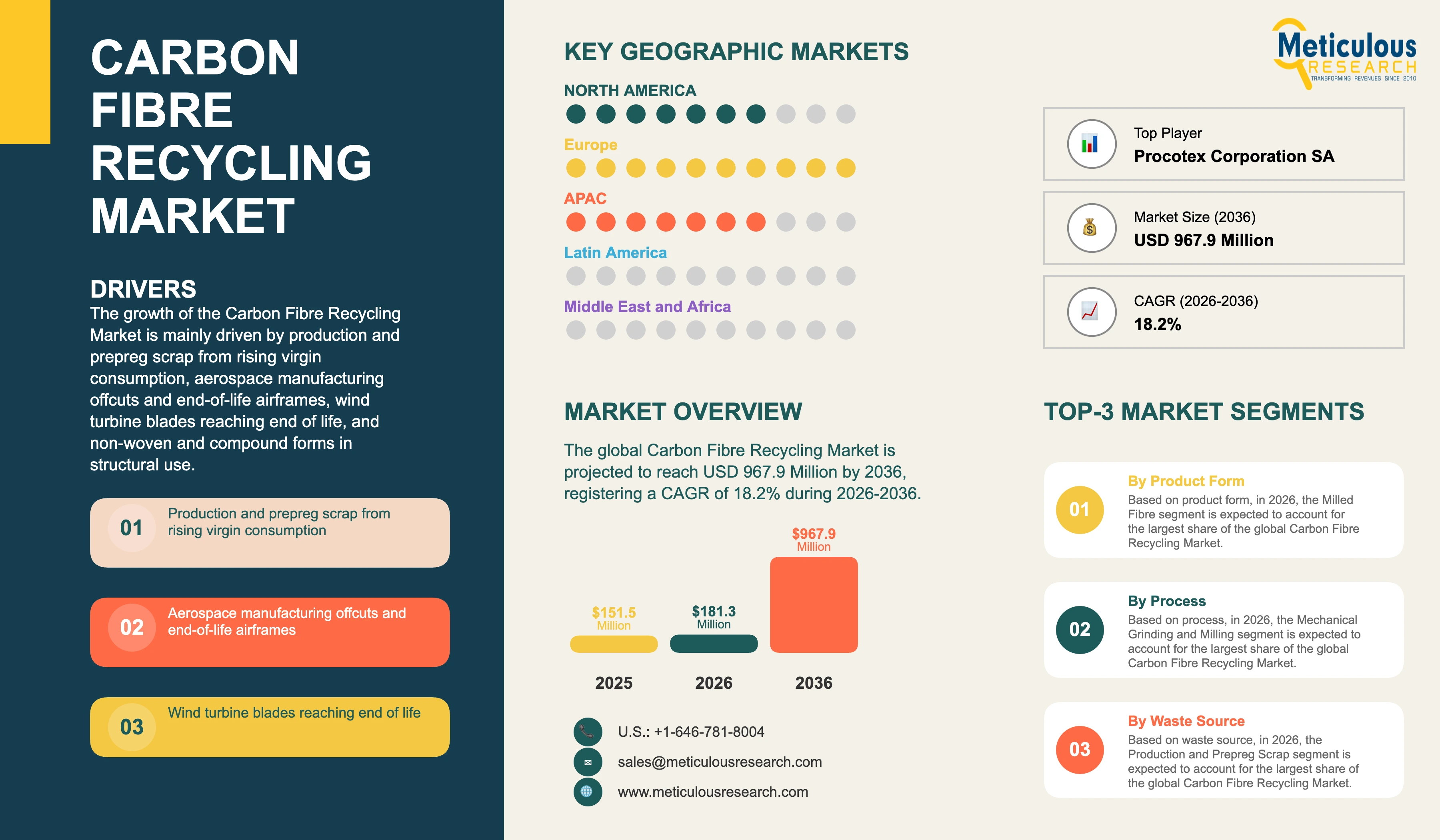
The carbon fibre recycling market is valued at USD 181.3 million in 2026 and is projected to reach USD 967.9 million by 2036, at a CAGR of 18.2% during the forecast period. The market was valued at USD 151.5 million in 2025 and at USD 127.4 million in 2024.
- Published
- Nov 2026
- Pages
- 255
- Format
- PDF + Excel
- Report ID
- MRCHM - 1042776
- Base year
- 2025
- 2024 · HISTORICAL
- $127.4M
- 2036
- $967.9M
- CAGR 2026–2036
- 18.2%
2024–2025 baseline · 2026–2036 forecast at 18.2% CAGR · hover a bar for the value
Key highlights
This market measures recycled carbon fibre produced and sold at the recycler gate, covering milled fibre, chopped fibre, non-woven mat and veil, and pelletised compound, on a tonne of recycled carbon fibre basis.
Gate fees on composite waste received are excluded, as is the value of glass fibre, foam, metal and oil recovered alongside carbon fibre.
Apply Carbon, the carbon fibre business of Procotex, commissioned a fully automated mass production plant for recycled carbon fibre at Plouay in France on a 16,500 square metre site, with nameplate capacity above 4,000 tonnes a year.
It was running at more than 2, 500 tonnes a year of combined recycled carbon and aramid fibre, including over 700 tonnes of para-aramid, against about 3,000 tonnes of raw material stock.
The process is mainly low-temperature mechanical recycling, with milling, granulation, sizing, cutting and packaging almost entirely automated, and reported embedded carbon dioxide 85% below virgin equivalents.
One MWp of solar supplies about a third of that site energy demand, which matters because conversion energy is the main cost in mechanical recycling.
Gjenkraft is building the first commercial-scale wind blade recycling plant at Hoyanger in Norway at 2,800 tonnes a year, using proprietary pyrolysis that the company states can recycle close to 100% of blade materials including glass fibre, carbon fibre, oils, foams and metals.
That project was funded with about NOK 60 million in total, combining an EU Horizon grant awarded in December 2022, two Innovation Norway contributions and a final tranche of NOK 8.6 million from debt and a share issue.
The same company targets multiple European plants with combined capacity of 100, 000 tonnes a year by 2035, although that figure counts whole blade material throughput rather than recycled carbon fibre, of which blades yield only a small fraction.
EnergyLoop operates a Spanish blade recycling plant of 10, 000 tonnes a year, with a further treatment plant under construction in Castilla y Leon.
The European wind industry has committed to a landfill ban for decommissioned blades and aims to reuse, repurpose, recycle or recover 100% of blades within Europe, with WindEurope calling on policy makers to write that commitment into law and ensure consistent implementation across member states.
That the commitment still requires legislation is the central qualification on the composite waste regulation case, because a voluntary undertaking carries no compliance deadline against which capacity can be financed.
Up to 90% of the mass of a wind turbine is already recyclable through established practice, since towers, nacelles and foundations are steel and concrete, so the residual blade is the problem and it is predominantly glass fibre rather than carbon.
Cement co-processing can save up to one tonne of carbon dioxide per tonne of end-of-life composite waste against traditional incineration, which makes it the cheapest compliant route and a direct competitor to fibre recovery even though it destroys the fibre entirely.
Recycling destroys fibre continuity, so recycled carbon fibre is milled or chopped and cannot re-enter the continuous fibre prepreg structures it came from, which places it in competition with chopped glass and virgin chopped carbon fibre on price rather than with virgin continuous fibre.
Gen 2 Carbon was formed in May 2021 when ELG Carbon Fibre at Coseley in the United Kingdom was bought out by its management, with the short fibre business sold to Procotex, leaving a long fibre and non-woven portfolio aimed at composites.
Among processes, mechanical grinding and milling is expected to hold the largest share in 2026, while solvolysis and chemical recycling is expected to grow fastest.
Among waste sources, production and prepreg scrap is expected to hold the largest share in 2026, while wind turbine blades are expected to grow fastest.
Report summary
| Particulars | Details |
|---|---|
| Base Year | 2025 |
| Actual Years | 2024-2025 |
| Forecast Period | 2026-2036 |
| Market Size in 2024 | USD 127.4 million |
| Market Size in 2025 | USD 151.5 million |
| Market Size in 2026 | USD 181.3 million |
| Market Size in 2036 | USD 967.9 million |
| Value CAGR (2026-2036) | 18.2% |
| Format | PDF, Excel & Cloud Portal · 255 pages |
| Volume in 2025 | 12.52 kilotons |
| Volume in 2026 | 14.50 kilotons |
| Volume in 2036 | 62.85 kilotons |
| Volume CAGR (2026-2036) | 15.8% |
| Average Selling Price, 2026 | USD 12,500 per tonne |
| Average Selling Price, 2036 | USD 15,400 per tonne |
| Units | Value in USD million; volume in kilotons of recycled carbon fibre; price in USD per tonne |
| Measurement Basis | Recycled carbon fibre produced and sold at the recycler gate, covering milled fibre, chopped fibre, non-woven mat and veil, and pelletised compound, on a tonne of recycled carbon fibre basis |
| Exclusions | Gate fees charged on composite waste received; glass fibre, foam, metal and oil recovered alongside carbon fibre; cement co-processing and energy recovery, which destroy the fibre; virgin carbon fibre and virgin chopped fibre; recyclable thermoset resins, which are counted in their own title in this series; finished composite parts containing recycled fibre |
| Segments: Product Form | Milled Fibre; Chopped Fibre; Non-Woven Mat and Veil; Pelletised Compound |
| Segments: Process | Mechanical Grinding and Milling; Pyrolysis; Solvolysis and Chemical Recycling; Other Recovery |
| Segments: Waste Source | Production and Prepreg Scrap; Aerospace End-of-Life and Manufacturing Offcuts; Wind Turbine Blades; Automotive and Pressure Vessels; Sporting Goods and Other |
| Largest Segment by Product Form, 2026 | Milled Fibre |
| Fastest-Growing Segment by Product Form | Pelletised Compound, at 24.2% |
| Largest Segment by Process, 2026 | Mechanical Grinding and Milling |
| Fastest-Growing Segment by Process | Solvolysis and Chemical Recycling, at 25.6% |
| Largest Segment by Waste Source, 2026 | Production and Prepreg Scrap |
| Fastest-Growing Segment by Waste Source | Wind Turbine Blades, at 23.8% |
| Largest Region, 2026 | Europe, at 41.0% |
| Fastest-Growing Region | Europe, at 19.4% |
| Fastest-Growing Country | Spain, at 21.6% |
| Slowest-Growing Country | Japan, at 15.4% |
| Regions Covered | Europe; North America; Asia-Pacific; Latin America; Middle East & Africa |
| Countries Covered | Germany; France; U.K.; Spain; Norway; U.S.; Canada; Japan; China; South Korea; Mexico; Brazil |
| Key Players | Procotex Corporation SA; Gen 2 Carbon Limited; Toray Industries, Inc.; Gjenkraft AS; Vartega Inc.; Carbon Conversions, Inc. |
| Top Five Share, 2026 | 46.2% |
| Profiled Companies Share, 2026 | 49.8% |
| Currency | USD |
Report overview
Market value is measured in in USD million; volume in kilotons of recycled carbon fibre; price in USD per tonne. Segments covered: product form, process, waste source.
In volume terms, the market is estimated at 14.50 kilotons of recycled carbon fibre in 2026, rising to 62.85 kilotons by 2036, at a CAGR of 15.8%. The average selling price is estimated at USD 12,500 per tonne in 2026 and USD 15,400 per tonne in 2036, the increase reflecting a shift in the mix from milled fibre toward non-woven mat and pelletised compound, which carry substantially more conversion value per tonne.
The growth of this market is mainly driven by production and prepreg scrap arising from rising virgin carbon fibre consumption, aerospace manufacturing offcuts, wind turbine blades reaching end of life, and non-woven and compound forms that place recycled fibre into structural applications. However, factors such as a blade landfill ban that remains an industry commitment rather than law, cement co-processing that satisfies recovery obligations while destroying the fibre, recycling that destroys fibre continuity and therefore caps the price achievable, and an installed base measured in a few thousand tonnes are expected to restrain the growth of this market to some extent.
Among product forms, milled fibre is expected to hold the largest share of this market in 2026, while pelletised compound is expected to record the highest CAGR during the forecast period. Geographically, Europe is expected to account for the largest share of this market in 2026 and is also expected to register the highest CAGR during the forecast period.
Carbon fibre reaches a recycler in three conditions that behave very differently. Dry fibre and uncured prepreg trimmings arrive clean, of known grade and still in continuous form, so they can be rewound or chopped with little processing. Cured composite offcuts and end-of-life parts arrive with the fibre locked in a crosslinked resin matrix that has to be removed before the fibre can be reused. Mixed composite waste, such as a wind blade, arrives with glass fibre, foam, adhesive and metal fittings alongside any carbon.
The resin is the whole technical problem. An epoxy matrix is crosslinked and cannot be melted off, so it must be broken down thermally, chemically or mechanically, and each route trades fibre quality against cost and throughput. The same chemistry that makes a composite durable in service is what makes it expensive to take apart afterwards, which is why composite recycling lags metal recycling by decades rather than by years.
Collection logistics compound that difficulty. Cured composite has a low bulk density, so a lorry carries little mass per load, and a blade or an airframe section must be cut down before it can travel at all, which places a practical radius around any recycling plant and explains why capacity is sited near where composite parts are made rather than near where they are used.
Mechanical grinding and milling is the simplest route and the largest. Cured composite is size reduced into a powder or short fibre product containing both fibre and resin, which suits compounding and filler duty but does not deliver clean fibre. Apply Carbon runs mainly low-temperature mechanical recycling at Plouay in France, with nameplate capacity above 4,000 tonnes a year and output of more than 2,500 tonnes a year of combined recycled carbon and aramid fibre.
Pyrolysis heats the composite in a controlled low-oxygen atmosphere so the resin decomposes and leaves bare fibre, which gives a cleaner product at the cost of furnace energy and some loss of tensile strength. Gjenkraft is commissioning a 2,800 tonne a year pyrolysis plant at Hoyanger in Norway, aimed at wind blades and stated to recycle close to 100% of blade materials.
Solvolysis and chemical recycling dissolve the matrix in a solvent or supercritical fluid at moderate temperature, which preserves fibre properties most fully and can recover the resin decomposition products as chemicals, but it carries the highest reagent and containment cost and the smallest installed base.
Whatever route is used, recycling destroys fibre continuity. The fibre leaves as discontinuous filaments of a few millimetres to a few tens of millimetres, so it cannot re-enter the unidirectional tapes and woven prepregs that primary aerospace and pressure vessel structures are built from.
That single physical fact sets the ceiling on price in this market. Recycled carbon fibre competes against chopped glass fibre, virgin chopped carbon fibre and mineral fillers in compounds and non-wovens, not against virgin continuous fibre, so it is sold on a stiffness, conductivity and weight argument rather than on a strength-per-cost argument.
Product form is therefore where value is created. Milled fibre is the cheapest output and the largest by tonnage, chopped fibre carries more conversion, non-woven mat and veil deliver a handleable reinforcement that a moulder can lay up and infuse, and pelletised compound arrives ready for injection moulding with the sizing, dispersion and fibre length already solved. The progression roughly doubles revenue per tonne of recovered fibre without recovering any more of it.
Demand regulation is the stated driver for this market, and it is weaker than it appears in the largest prospective waste stream. The European wind industry has committed to a landfill ban for decommissioned blades and aims to reuse, repurpose, recycle or recover 100% of blades within Europe, but WindEurope is still calling on policy makers to write that commitment into law and to ensure consistent implementation across member states.
A voluntary undertaking carries no compliance date, so it cannot be used to underwrite a plant in the way a statutory recovery threshold can, and that distinction separates this market from battery recycling where recovery rates are fixed in regulation.
The competing disposal route is also compliant and cheaper. Cement co-processing can save up to one tonne of carbon dioxide per tonne of end-of-life composite waste against traditional incineration, using the organic fraction as fuel and the mineral fraction as a raw material, which satisfies recovery obligations while destroying the fibre entirely.
Blade waste is also less carbon-rich than the attention it receives suggests. Up to 90% of the mass of a wind turbine is already recyclable through established practice because towers, nacelles and foundations are steel and concrete, and the residual blade is predominantly glass fibre with carbon confined to spar caps on larger machines.
Gjenkraft targets multiple European plants with combined capacity of 100,000 tonnes a year by 2035, but that figure counts whole blade throughput rather than recycled carbon fibre output, so it cannot be read as a capacity figure for this market.
Scale across the industry remains small. The first fully automated mass production plant has nameplate capacity above 4,000 tonnes a year, the first commercial blade pyrolysis plant is 2,800 tonnes a year and was funded with about NOK 60 million including an EU Horizon grant, and EnergyLoop operates a Spanish blade plant of 10,000 tonnes a year.
Ownership has reorganised around those forms rather than consolidating. Gen 2 Carbon was formed in May 2021 when ELG Carbon Fibre at Coseley was bought out by its management and sold its short fibre business to Procotex, which placed long fibre and non-woven products with one owner and milled and chopped short fibre with another.
That separation is informative, because it indicates the two forms serve different customers through different sales channels rather than sitting on one product ladder, and it is the reason product form rather than process is the primary segmentation in this market.
Europe is expected to account for 41.0% of this market in 2026 and is also the fastest growing region at 19.4%, holding the largest operating plant in France, the first commercial blade pyrolysis plant in Norway and a Spanish blade plant of 10,000 tonnes a year. Spain is the fastest growing country at 21.6%.
Europe is both the largest and the fastest growing region at 19.4%, holding the capacity and the only collective landfill commitment of consequence. The Middle East & Africa grows at 16.0% and Latin America at 15.0%, both from very small bases, with activity limited to collection and export of composite waste since neither holds significant composite manufacture or a mature wind fleet.
Not as legislation where it matters most. The European wind industry has committed to a landfill ban for decommissioned blades and aims to reuse, repurpose, recycle or recover 100% of blades within Europe, and WindEurope is calling on policy makers to write that commitment into law and ensure consistent implementation across member states. A voluntary undertaking carries no compliance date or penalty.
Every recycling route leaves the fibre discontinuous, in lengths from a few millimetres to a few tens of millimetres, so it cannot re-enter the unidirectional tapes and woven prepregs that primary aerospace and pressure vessel structures are built from. It competes instead against chopped glass, virgin chopped carbon fibre and mineral fillers, which caps the price achievable.
Cement co-processing can save up to one tonne of carbon dioxide per tonne of end-of-life composite waste against traditional incineration, using the resin as fuel and the mineral fraction as raw material. It diverts waste from landfill at low cost and counts as recovery, so it satisfies the same obligation while producing no recycled fibre at all.
Up to 90% of the mass of a turbine is already recyclable as steel and concrete in towers, nacelles and foundations, and the residual blade is predominantly glass fibre with carbon confined to spar caps on larger machines. Blade capacity figures expressed in tonnes of throughput, such as 100,000 tonnes a year by 2035, therefore overstate the carbon fibre available by a wide margin.
Growth comes from product form rather than from fibre. Pelletised compound grows at 24.2% and non-woven mat and veil at 22.7% against 13.5% for milled fibre, and the progression roughly doubles revenue per tonne of recovered fibre, so the average selling price rises from USD 12,500 per tonne to USD 15,400 per tonne while volume grows at 15.8%.
Procotex Corporation SA, Gen 2 Carbon Limited, Toray Industries, Inc., Gjenkraft AS, Vartega Inc. and Carbon Conversions, Inc. The top five hold 46.2% of this market in 2026 and the six profiled companies hold 49.8%.
What comes next: Carbon Fibre Recycling and the Circular Composites Economy, a Meticulous Next™ foresight brief.
Report infographic
Market dynamics
20 factors across 5 forcesProduction and prepreg scrap arising from rising virgin consumption
Carbon fibre composite manufacture is subtractive at the layup stage, so every part generates trimmings, and uncured prepreg has a limited shelf life that converts unused rolls into waste on a fixed clock. That material arrives clean, of known grade and in continuous form, which makes it the cheapest feedstock to process and the easiest to sell forward.
Apply Carbon held about 3,000 tonnes of raw material stock against output of more than 2,500 tonnes a year, which indicates feedstock availability is not the constraint at current processing scale.
Production scrap holds 48% of waste source in 2026, the largest share, and it grows at 15.8% with virgin carbon fibre consumption rather than with any end-of-life cycle, which gives a recycler a base load independent of fleet retirements.
Aerospace manufacturing offcuts and end-of-life airframes
Composite content in current generation airframes runs to roughly half of structural weight, and the buy-to-fly ratio on machined and trimmed composite parts leaves a substantial share of purchased material as offcut. Aerospace scrap is also the most traceable stream, with grade, batch and certification history documented, which is what allows recycled output to be qualified.
That traceability is why aerospace feedstock commands the attention it does despite its modest tonnage, and why the segment grows at 18.4% against 15.8% for general production scrap.
End-of-life airframes add a second, slower stream as composite-intensive aircraft from the early 2010s approach retirement, bringing larger structures with mixed metallic fittings that require disassembly before any recycling route can be applied.
Wind turbine blades reaching end of life
The European wind industry has committed to reuse, repurpose, recycle or recover 100% of blades within Europe and to a landfill ban for decommissioned blades, and dedicated capacity is being built against that commitment. Gjenkraft is commissioning 2,800 tonnes a year of pyrolysis capacity at Hoyanger in Norway, and EnergyLoop operates a Spanish plant of 10,000 tonnes a year.
Blade pyrolysis recovers glass fibre, carbon fibre, oils, foams and metals together, with Gjenkraft stating that close to 100% of blade materials can be recycled, so carbon fibre arrives as one output of a plant justified by the whole blade rather than by the carbon alone.
That shared economics is why blades grow fastest among waste sources at 23.8%, even though carbon is confined to spar caps on larger machines and the blade is predominantly glass fibre.
Non-woven and compound forms placing recycled fibre into structural use
Milled fibre sells as a filler and conductive additive, which is a low value duty. Non-woven mat and veil give a moulder a handleable reinforcement that can be laid up and infused, and pelletised compound arrives ready for injection moulding with sizing and dispersion already resolved, so both reach applications that pay for mechanical performance.
Gen 2 Carbon holds a long fibre and non-woven portfolio aimed at composites following the May 2021 management buyout, and Apply Carbon supplies electronics, automotive components, hydrogen fuel cells and dust-free brake pads.
Pelletised compound grows at 24.2% and non-woven at 22.7%, against 13.5% for milled fibre, and that mix shift is the reason average selling price rises from USD 12,500 per tonne to USD 15,400 per tonne across the forecast.
Table of contents
11 chapters · 124 sections · 255 pages · click to expandSegmental analysis
| Segment | Largest share (2026) | Fastest growth (2026–2036) |
|---|---|---|
| By Product Form | Milled fibre | Pelletised compound |
| By Process | Mechanical grinding and milling | Solvolysis and chemical recycling |
| By Waste Source | Production and prepreg scrap | Wind turbine blades |
| Other segments | Production and prepreg scrap | Wind turbine blades |
By Product Form
- Carbon Fibre Recycling Market Analysis by Product Form
- Milled fibre is expected to account for the largest share of this market in 2026.
- Size reducing cured composite into a powder or very short fibre product is the cheapest conversion available, it tolerates contaminated and mixed feedstock, and the output sells as a filler and conductive additive into compounds, coatings and friction materials.
- The segment grows slowest at 13.5%, because filler duty is priced against mineral alternatives and carries none of the mechanical premium that justifies carbon fibre in the first place.
- Chopped fibre holds the second position at 17.5%, offering defined fibre length and cleaner surface chemistry for compounding and for sheet moulding compound, and it is the form in which most pyrolysis output is sold because pyrolysis leaves bare fibre that can be cut to a specified length and resized for a named matrix.
- Non-woven mat and veil grow at 22.7%, converting discontinuous fibre into a handleable sheet that a moulder can lay up and infuse, which is what moves recycled fibre from additive duty into reinforcement duty, and Gen 2 Carbon holds a long fibre and non-woven portfolio aimed at composites.
- Pelletised compound is projected to register the highest CAGR of 24.2% during the forecast period, arriving ready for injection moulding with sizing, dispersion and fibre length already resolved, so the moulder buys a qualified material rather than a raw fibre to formulate.
- The progression from milled fibre to compound roughly doubles revenue per tonne of recovered fibre, and that mix shift rather than any change in feedstock is why average selling price rises from USD 12,500 per tonne to USD 15,400 per tonne.
- Milled fibre is expected to hold the largest share in 2026 as the cheapest conversion, selling as filler and conductive additive.
- Pelletised compound is projected to grow fastest at 24.2%, followed by non-woven mat and veil at 22.7%.
By Process
- Carbon Fibre Recycling Market Analysis by Process
- Mechanical grinding and milling is expected to hold the largest share of this market in 2026.
- It needs no furnace, no solvent and no containment, it accepts contaminated and mixed input, and it is the route behind the largest operating plant, where Apply Carbon runs mainly low-temperature mechanical recycling at nameplate capacity above 4,000 tonnes a year.
- Its limitation is that the resin is retained in the product rather than removed, so the output is a fibre and resin composite powder rather than clean fibre, which restricts it to filler and conductive duty and rules out any application specified on fibre-matrix adhesion.
- The segment grows at 14.0%, the slowest of the four.
- Pyrolysis grows at 20.2%, decomposing the matrix in a controlled low-oxygen atmosphere to leave bare fibre, and it is the route chosen for mixed blade waste because it handles glass fibre, foams, oils and metals in the same pass, with Gjenkraft commissioning 2,800 tonnes a year at Hoyanger in Norway.
- Solvolysis and chemical recycling is projected to register the highest CAGR of 25.6% during the forecast period.
- Dissolving the matrix at moderate temperature preserves fibre tensile properties more fully than pyrolysis and allows the resin decomposition products to be recovered as chemicals rather than burned.
- Fibre quality is the only lever that lifts the price ceiling imposed by discontinuity, which is why the highest cost route grows fastest from the smallest base, and the recovered resin stream provides the second revenue line that carries its reagent cost.
- Other recovery routes grow at 19.6%, covering high voltage fragmentation, fluidised bed processing and steam-assisted separation, each of which is at pilot or single-plant scale and is specified for a particular waste geometry rather than for general duty.
- Mechanical grinding and milling is expected to hold the largest share in 2026, being the route behind the largest operating plant.
- Solvolysis and chemical recycling is projected to grow fastest at 25.6%, followed by pyrolysis at 20.2%.
By Waste Source
- Carbon Fibre Recycling Market Analysis by Waste Source
- Production and prepreg scrap is expected to account for the largest share of this market in 2026 at 48%.
- Composite layup is subtractive, uncured prepreg has a limited shelf life that converts unused stock into waste on a fixed clock, and the material arrives clean, of known grade and in continuous form, which makes it the cheapest feedstock and the easiest to qualify forward.
- The segment grows at 15.8%, tracking virgin carbon fibre consumption rather than any retirement cycle, and Apply Carbon holding about 3,000 tonnes of raw material stock against output of more than 2,500 tonnes indicates feedstock is not the binding constraint at current scale.
- Aerospace end-of-life and manufacturing offcuts hold 22% and grow at 18.4%, carrying the most traceable pedigree of any stream because grade, batch and certification history are documented, which is what permits recycled output to be qualified into a named application.
- Wind turbine blades are projected to register the highest CAGR of 23.8% during the forecast period, on dedicated capacity being built against the European industry landfill commitment, although carbon is confined to spar caps on larger machines and the blade is predominantly glass fibre.
- Automotive and pressure vessels grow at 20.8% as hydrogen tanks and structural components from the first wave of composite-intensive vehicles reach replacement, and type IV hydrogen cylinders carry a mandated service life that creates a dated retirement stream rather than an uncertain one.
- Sporting goods and other sources grow slowest at 16.8% from a dispersed base that is costly to collect relative to its value, since a bicycle frame or a racket carries a few hundred grams of fibre and arrives through consumer channels rather than industrial ones.
Other segments
- Production and prepreg scrap is expected to hold the largest share in 2026 at 48% of feedstock, arriving clean and of known grade.
- Wind turbine blades are projected to grow fastest at 23.8%, followed by automotive and pressure vessels at 20.8%.
Geographic analysis
Europe
Largest shareEurope is expected to account for the largest share of this market in 2026, at 41%, and is also projected to register the highest CAGR of 19.4% during the forecast period. The region holds the largest operating plant at Plouay in France with nameplate capacity above 4,000 tonnes a year, the first commercial blade pyrolysis plant at Hoyanger in Norway at 2,800 tonnes a year, and a Spanish blade plant of 10,000 tonnes a year. It also holds the only collective commitment of consequence, with the wind industry undertaking to reuse, repurpose, recycle or recover 100% of blades within Europe and WindEurope calling for that landfill ban to be written into law and implemented consistently across member states. Germany and France hold the largest national positions, built on automotive and aerospace production scrap generated close to the recycling capacity that treats it, while Norway and Spain hold the blade capacity and the United Kingdom holds the long fibre and non-woven position established at Coseley. Spain is the fastest growing country in this market at 21.6%, on blade capacity in operation and under construction.
North America
North America grows at 17.6% on aerospace manufacturing offcuts from composite-intensive airframe programmes and on a large wind fleet approaching repowering, with recycling capacity dispersed across smaller specialist operators rather than concentrated in flagship plants.
Asia-Pacific
Asia-Pacific grows at 17.4% and holds 27% of this market, anchored on Japan where the largest virgin carbon fibre producers are based and where production scrap is generated and processed close to the fibre plants, with China adding capacity on automotive and pressure vessel feedstock.
Middle East & Africa
The Middle East & Africa grows at 16.0% and Latin America at 15.0%, both from very small bases, with activity limited to collection and export of composite waste rather than to recovery, since neither region holds significant composite manufacture or a mature wind fleet. Regional shares in this market follow where composite parts are made rather than where they are used, because production scrap is 48% of feedstock, cured composite has a low bulk density and scrap does not travel far relative to its value.
Competitive landscape
This market is concentrated among a small number of operators, with the six companies profiled holding 49.8% of it in 2026 and the top five 46.2%. Scale is measured in thousands of tonnes rather than tens of thousands, so a single plant commissioning moves share materially, and position currently depends on product form and qualified applications rather than on cost leadership.
Procotex Corporation SA holds the largest position through Apply Carbon, which commissioned a fully automated mass production plant at Plouay in France on a 16,500 square metre site with nameplate capacity above 4,000 tonnes a year, running at more than 2,500 tonnes a year of combined recycled carbon and aramid fibre and supplying electronics, automotive components, hydrogen fuel cells and dust-free brake pads. It acquired the short fibre business of ELG Carbon Fibre in 2021.
Gen 2 Carbon Limited was formed in May 2021 when ELG Carbon Fibre at Coseley in the United Kingdom was bought out by its management, retaining a long fibre product portfolio aimed mainly at composites including carbon fibre and carbon fibre thermoplastic non-wovens, and stating an intent to develop next generation recycling technologies.
Gjenkraft AS holds the blade pyrolysis position, building the first commercial-scale wind blade recycling plant at Hoyanger in Norway at 2,800 tonnes a year on about NOK 60 million of funding, and targeting multiple European plants totalling 100,000 tonnes a year of blade throughput by 2035. Toray Industries, Inc. participates as the largest virgin carbon fibre producer handling its own production scrap, while Vartega Inc. and Carbon Conversions, Inc. hold specialist North American positions in reclaimed fibre and non-woven products.
Competitive activity has run along product form and process rather than along price. One operator automated a mechanical plant to mass production scale, a second retained long fibre and non-woven products through a management buyout while divesting short fibre, and a third built blade pyrolysis on grant funding, so the three leading positions do not compete directly for the same customer or the same feedstock.
Some of the key players operating in the carbon fibre recycling market are Procotex Corporation SA, Gen 2 Carbon Limited, Toray Industries, Inc., Gjenkraft AS, Vartega Inc., and Carbon Conversions, Inc., among others.
- —
Apply Carbon, the carbon fibre business of Procotex, commissioned a fully automated mass production plant at Plouay in France with nameplate capacity above 4,000 tonnes a year; Gjenkraft secured about NOK 60 million including an EU Horizon grant to build the first commercial-scale wind blade pyrolysis plant at Hoyanger in Norway at 2,800 tonnes a year; and Gen 2 Carbon was formed in May 2021 when ELG Carbon Fibre was bought out by its management and sold its short fibre business to Procotex.
- Procotex Corporation SA
- Gen 2 Carbon Limited
- Toray Industries, Inc.
- Gjenkraft AS
- Vartega Inc.
- Carbon Conversions, Inc
Expert perspectives
The stated demand driver for this market is composite waste regulation, and the regulation is not yet in place where it matters most. The European wind industry has committed to a landfill ban for decommissioned blades and to recovering 100% of blades within Europe, but WindEurope is still calling on policy makers to write that commitment into law and ensure consistent implementation, so the obligation carries no date and no penalty.
That is the difference between this market and battery recycling, where Annex XII recovery thresholds are fixed in regulation with deadlines attached. Capacity here is being built on grants and on commercial judgement rather than on compliance, which is why the first commercial blade pyrolysis plant was funded with about NOK 60 million including an EU Horizon grant.
The competing route is also compliant and cheaper. Cement co-processing saves up to one tonne of carbon dioxide per tonne of end-of-life composite waste against incineration and counts as recovery while destroying the fibre, so a recycler competes for feedstock against an alternative that needs no fibre market at all.
The ceiling on this market is physical rather than commercial. Every recycling route leaves the fibre discontinuous, so recycled carbon fibre cannot re-enter the continuous fibre structures it came from and is sold instead against chopped glass, virgin chopped fibre and mineral fillers. No improvement in recovery yield lifts that ceiling.
Growth therefore comes from form rather than from fibre. Pelletised compound grows at 24.2% and non-woven at 22.7% against 13.5% for milled fibre, and the progression roughly doubles revenue per tonne recovered, which is why value grows at 18.2% against 15.8% of volume.
Blade capacity figures should be read with care. A target of 100,000 tonnes a year by 2035 counts whole blade throughput, and up to 90% of a turbine mass is already recyclable as steel and concrete while the residual blade is predominantly glass fibre, so the carbon fibre available from that tonnage is a small fraction of it.
On balance the better position in this market is downstream of recovery rather than in it. The capital that lifts revenue per tonne is compounding and web-forming equipment, not another furnace, and the buyers that pay a premium are buying a specified material rather than a recovered fibre.
Customer perspectives
Compounders
Compounders buy recycled carbon fibre on fibre length distribution, residual resin content and sizing compatibility, because a fibre that does not disperse or bond in their matrix delivers none of the stiffness it was bought for.
They compare price per kilogram of delivered stiffness rather than per kilogram of fibre, which is why milled fibre competes against mineral filler and chopped fibre against glass.
Automotive part makers
Automotive part makers ask for a compound rather than a fibre, because qualifying dispersion and moulding behaviour themselves adds a development programme they have not budgeted.
Their second question is supply continuity, since one plant of a few thousand tonnes cannot offer the multi-site assurance a vehicle programme expects.
Electronics and friction material buyers
Electronics and friction material buyers come for conductivity and wear behaviour rather than structural performance, and for them recycled fibre is a first choice rather than a substitute, which is why dust-free brake pads consume much of the recycled aramid output.
Aerospace buyers
Aerospace buyers ask whether recycled fibre can enter a certified structure, and the answer for primary structure is that it cannot, so the conversation moves to interior panels, brackets and tooling where qualification is lighter.
They also ask who carries the qualification cost, since the effort falls on the part maker and is not recovered in the fibre price.
Corporate sustainability teams
Corporate sustainability teams now specify recycled content directly and ask for the carbon figure rather than the mechanical data, which is why embedded carbon dioxide 85% below virgin equivalents has become a selling specification.
Wind farm owners and decommissioning contractors
Wind farm owners and decommissioning contractors approach from the waste side, asking for a gate fee and a certificate of treatment and comparing a recycler against cement co-processing on cost per tonne removed.
They ask whether the route satisfies their own landfill commitment, and a process that recovers fibre and one that burns it both answer yes, which is the commercial difficulty at the heart of this market.
All buyer groups
Across every buyer group, the request that recurs is for a specification sheet a designer can use rather than a description of a waste stream, and the suppliers that have grown fastest are those that supply a material rather than a recovered fibre.
Frequently asked questions
The market is valued at USD 181.3 million in 2026, having stood at USD 151.5 million in 2025 and USD 127.4 million in 2024, and is projected to reach USD 967.9 million by 2036.
A CAGR of 18.2% in value terms and 15.8% in volume terms between 2026 and 2036, with the average selling price rising from USD 12,500 per tonne to USD 15,400 per tonne.
Production and prepreg scrap arising from rising virgin consumption, which is 48% of feedstock; aerospace manufacturing offcuts and end-of-life airframes; wind turbine blades reaching end of life against the European industry landfill commitment; and non-woven and compound forms that place recycled fibre into reinforcement rather than filler duty.
A blade landfill ban that remains an industry commitment rather than law, cement co-processing that satisfies recovery obligations while destroying the fibre, recycling that leaves the fibre discontinuous and so caps achievable price, an installed base measured in a few thousand tonnes, and grant-dependent project economics.
Writing the landfill commitment into law, qualifying recycled fibre into applications that pay for mechanical performance, solvolysis preserving fibre properties and recovering resin as chemicals, and shared economics with glass fibre in blade plants financed on whole blade throughput.
Milled fibre is expected to hold the largest share in 2026 as the cheapest conversion, selling as filler and conductive additive. Pelletised compound is projected to grow fastest at 24.2%, followed by non-woven mat and veil at 22.7%.
Mechanical grinding and milling is expected to hold the largest share in 2026, being the route behind the largest operating plant. Solvolysis and chemical recycling is projected to grow fastest at 25.6%, followed by pyrolysis at 20.2%.
Production and prepreg scrap is expected to hold the largest share in 2026 at 48% of feedstock, arriving clean and of known grade. Wind turbine blades are projected to grow fastest at 23.8%, followed by automotive and pressure vessels at 20.8%.
Europe is expected to account for 41.0% of this market in 2026 and is also the fastest growing region at 19.4%, holding the largest operating plant in France, the first commercial blade pyrolysis plant in Norway and a Spanish blade plant of 10,000 tonnes a year. Spain is the fastest growing country at 21.6%.
Europe is both the largest and the fastest growing region at 19.4%, holding the capacity and the only collective landfill commitment of consequence. The Middle East & Africa grows at 16.0% and Latin America at 15.0%, both from very small bases, with activity limited to collection and export of composite waste.
Not as legislation where it matters most. The European wind industry has committed to a landfill ban for decommissioned blades, and WindEurope is calling on policy makers to write that commitment into law; a voluntary undertaking carries no compliance date or penalty.
Every recycling route leaves the fibre discontinuous, in lengths from a few millimetres to a few tens of millimetres, so it cannot re-enter the unidirectional tapes and woven prepregs used in primary aerospace and pressure vessel structures. It competes instead against chopped glass, virgin chopped carbon fibre and mineral fillers, which caps the price achievable.
Cement co-processing can save up to one tonne of carbon dioxide per tonne of end-of-life composite waste against traditional incineration, using the resin as fuel and the mineral fraction as raw material. It diverts waste from landfill at low cost and counts as recovery, so it satisfies the same obligation while producing no recycled fibre.
Up to 90% of the mass of a turbine is already recyclable as steel and concrete, and the residual blade is predominantly glass fibre with carbon confined to spar caps on larger machines. Blade capacity figures expressed in tonnes of throughput, such as 100,000 tonnes a year by 2035, therefore overstate the carbon fibre available by a wide margin.
Growth comes from product form rather than from fibre: pelletised compound grows at 24.2% and non-woven mat and veil at 22.7% against 13.5% for milled fibre, roughly doubling revenue per tonne recovered. The average selling price therefore rises from USD 12,500 to USD 15,400 per tonne while volume grows at 15.8%.
Procotex Corporation SA, Gen 2 Carbon Limited, Toray Industries, Inc., Gjenkraft AS, Vartega Inc. and Carbon Conversions, Inc. The top five hold 46.2% of this market in 2026 and the six profiled companies hold 49.8%.
Apply Carbon, the carbon fibre business of Procotex, commissioned a fully automated mass production plant at Plouay in France with nameplate capacity above 4,000 tonnes a year, and Gjenkraft secured about NOK 60 million including an EU Horizon grant for the first commercial-scale wind blade pyrolysis plant in Norway. Gen 2 Carbon was formed in May 2021 when ELG Carbon Fibre was bought out by its management and sold its short fibre business to Procotex.
Cite this report
Meticulous Research. (2026). Carbon Fibre Recycling Market - Global Opportunity Analysis and Industry Forecast (2026-2036) (Report No. MRCHM - 1042776). Meticulous Market Research Pvt. Ltd. https://www.meticulousresearch.com/product/carbon-fibre-recycling-market-7459