Insurtech Market (2026-2036)
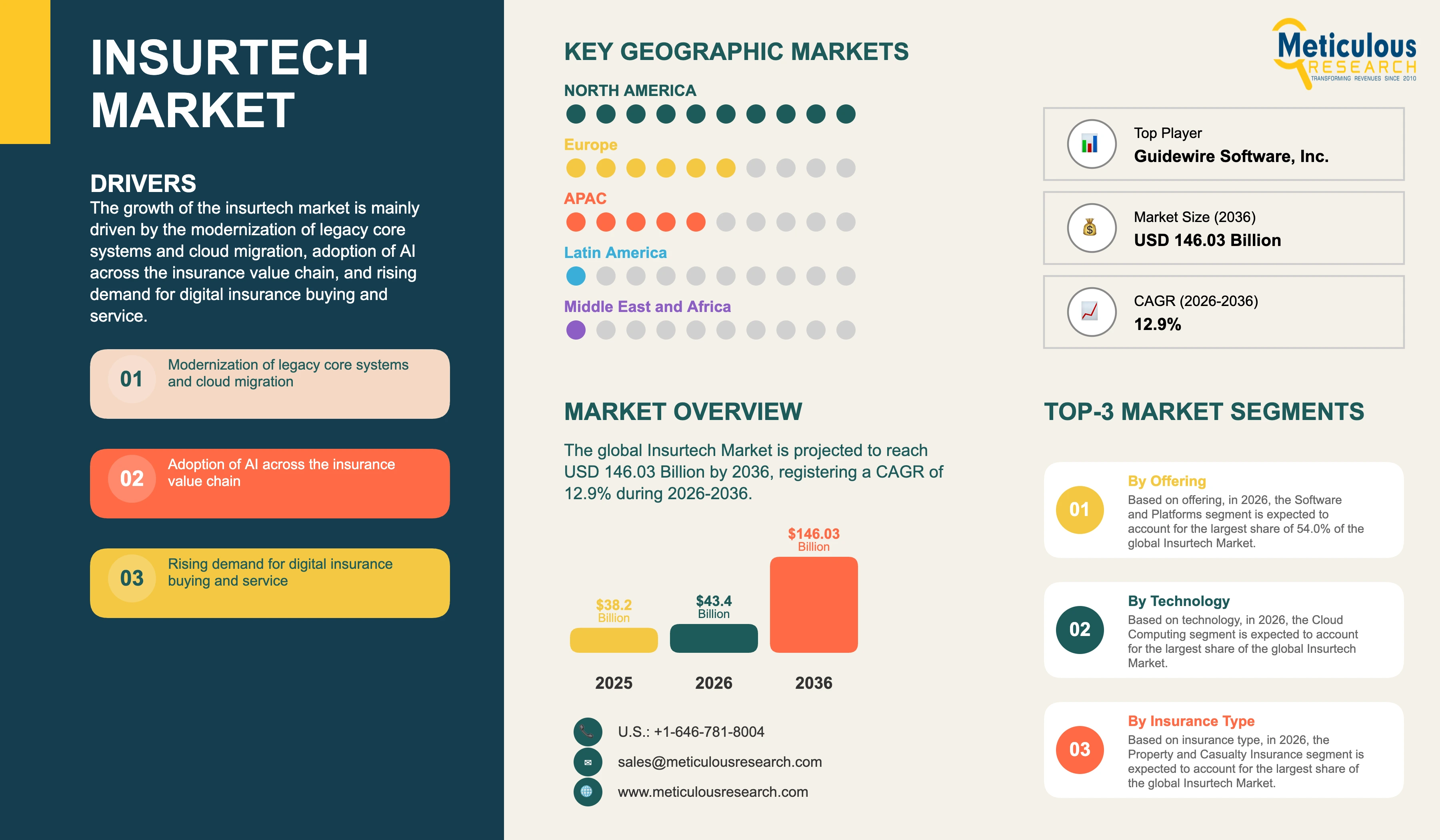
The global insurtech market was valued at USD 38.20 billion in 2025. This market is expected to reach USD 146.03 billion by 2036 from an estimated USD 43.40 billion in 2026, registering a CAGR of 12.9% during the forecast period (2026-2036).
- Published
- Nov 2026
- Pages
- 305
- Format
- PDF + Excel
- Report ID
- MRICT - 1042486
- Base year
- 2025
- 2025 · BASELINE
- $38.20B
- 2036
- $146.0B
- CAGR 2026–2036
- 12.9%
2025 baseline · 2026–2036 forecast at 12.9% CAGR · hover a bar for the value
Key highlights
Global insurtech funding rose 19.5% to USD 5.08 billion in 2025, the first annual increase since 2021, according to Gallagher Re, and insurers and reinsurers made a record 162 venture investments in insurtech companies during the year.
AI-focused companies raised about USD 3.35 billion, or 66% of insurtech funding, in 2025, and their share reached a record 95.2% of funding in the first quarter of 2026, according to Gallagher Re, showing that AI has become the central theme of insurance technology investment.
Property and casualty insurtech funding increased 34.9% to USD 3.49 billion in 2025, while life and health insurtech funding declined 4.6% to USD 1.59 billion, according to Gallagher Re.
Guidewire, the largest provider of core systems for property and casualty insurers, reported total revenue of USD 1,475.4 million for the fiscal year ended July 31, 2026, up 23%, with subscription and support revenue up 33% as insurers moved to its cloud platform.
Guidewire reported annual recurring revenue of about USD 1.24 billion at the end of its fiscal year 2026 and guided for total revenue of more than USD 1.7 billion in fiscal year 2027, showing continued strong demand for cloud core systems among property and casualty insurers.
Private equity remains a major owner of insurance software, with Advent International acquiring Sapiens in 2025, while Duck Creek, Majesco, Vertafore, Applied Systems, and Insurity are also backed by private equity investors.
Insured natural catastrophe losses reached about USD 108 billion in 2025, according to Munich Re, adding to pressure on insurers to invest in better catastrophe modeling, risk data, and claims technology.
The EU AI Act classifies AI systems used for risk assessment and pricing in life and health insurance as high-risk, and U.S. insurance regulators have adopted the NAIC model bulletin on the use of AI by insurers, increasing the need for governance and explainability tools.
By offering, software and platforms account for the largest share of 54.0% in 2026, while data, analytics, and AI solutions register the highest CAGR.
By technology, cloud computing accounts for the largest share in 2026, while AI and machine learning register the highest CAGR.
By insurance type, property and casualty insurance accounts for the largest share in 2026, while health insurance registers the highest CAGR.
By end user, insurance carriers account for the largest share of 62.0% in 2026, while managing general agents register the highest CAGR.
By geography, North America accounts for the largest share of 44.0% in 2026, while Asia-Pacific registers the highest CAGR of 16.2%.
Report summary
| Particulars | Details |
|---|---|
| Base Year | 2025 |
| Estimated Year | 2026 |
| Forecast Period | 2026-2036 |
| Market Size in 2025 | USD 38.20 billion |
| Market Size in 2026 | USD 43.40 billion |
| Market Size by 2036 | USD 146.03 billion |
| CAGR (2026-2036) | 12.9% |
| Format | PDF, Excel & Cloud Portal · 305 pages |
| Largest Segment by Offering (2026) | Software and Platforms (54.0%) |
| Largest Segment by End User (2026) | Insurance Carriers (62.0%) |
| Largest Region (2026) | North America (44.0%) |
| Fastest-Growing Region | Asia-Pacific (CAGR 16.2%) |
| Segments Covered | Offering, Technology, Insurance Type, End User, and Geography |
| Geographic Scope | North America, Europe, Asia-Pacific, Latin America, and Middle East and Africa |
| Key Companies Profiled | Guidewire, Duck Creek, Sapiens, Majesco, EIS Group, Applied Systems, Vertafore, CCC Intelligent Solutions, Verisk, Insurity, Socotra, Shift Technology, Cambridge Mobile Telematics, and PB Fintech (Policybazaar) |
Report overview
Segments covered: offering, technology, insurance type, end user.
The growth of this market is mainly driven by the modernization of legacy core systems by insurers and their move to the cloud, the rapid adoption of artificial intelligence in underwriting, claims, and customer service, rising customer demand for digital insurance buying and service, the growth of embedded insurance and digital distribution, and the need for better risk data and analytics as natural catastrophe losses and other risks increase. However, factors such as the complexity and cost of replacing legacy systems, data privacy and cybersecurity concerns, regulatory requirements for the use of AI and data in insurance, and the slow pace of technology adoption in parts of the insurance industry are expected to restrain the growth of this market to some extent.
Insurtech refers to the use of technology to improve and transform how insurance is designed, sold, underwritten, administered, and claimed. It includes modern core insurance systems for policy administration, billing, and claims, data and analytics platforms, artificial intelligence tools for underwriting and claims, digital distribution and comparison platforms, embedded insurance platforms that allow insurance to be sold within other products and services, telematics and Internet of Things solutions, and the services needed to implement and run these technologies.
This market covers the global revenue generated from insurance technology solutions and services, measured in value. It includes software licenses and subscriptions, cloud platforms, data, analytics, and AI solutions, consulting, implementation, and managed services sold to insurance carriers, brokers and agents, managing general agents, and reinsurers, as well as the commission and fee revenue of digital insurance distribution platforms. It is segmented by offering, technology, insurance type, end user, and geography. Insurance premiums written by digital insurers and general IT infrastructure spending by insurers, such as hardware and generic office software, are not included.
The insurance industry has historically relied on legacy mainframe systems, manual processes, and paper documents, which make it slow and expensive to launch new products, process claims, and serve customers. Over the past decade, insurers have increasingly replaced these systems with modern, cloud-based core platforms from vendors such as Guidewire, Duck Creek, Sapiens, Majesco, and EIS, and have adopted digital tools for customer self-service, agent portals, and data analytics. Many insurers are still in the middle of multi-year modernization programs, which provides a steady base of demand for insurtech solutions.
The insurtech ecosystem includes several types of companies, as established software vendors provide core systems and specialist solutions for carriers, brokers, and agents, such as Guidewire, Duck Creek, Sapiens, Applied Systems, and Vertafore. Data and analytics firms, such as Verisk and CCC Intelligent Solutions, provide risk data, catastrophe models, and claims solutions. Newer insurtech companies offer AI-based underwriting, claims automation, fraud detection, telematics, embedded insurance, and cloud-native core platforms, while digital distribution platforms, such as Policybazaar in India and comparison sites in Europe, allow consumers to compare and buy insurance online.
Artificial intelligence has become the main focus of insurance technology, as insurers are using machine learning for pricing, risk selection, fraud detection, and claims triage, and generative AI for processing documents, summarizing claims files, assisting underwriters, and answering customer questions. According to Gallagher Re, AI-focused companies accounted for about two-thirds of insurtech funding in 2025, and insurers are increasingly building AI into their core platforms and operations.
Insurance technology spending is driven by both cost and growth goals, and on the cost side, insurers want to lower expense ratios, which often account for a large share of premiums, by automating processes and reducing manual work in underwriting, policy servicing, and claims. On the growth side, insurers want to launch new products faster, enter new distribution channels, and improve pricing accuracy to win profitable business. Technology vendors that can show measurable improvements in both areas are best placed to win contracts.
The market is also shaped by changes in the risk environment, because rising natural catastrophe losses, inflation in claims costs, cyber risks, and changing mobility patterns are pushing insurers to improve their risk models and data, while competition and customer expectations are pushing them to offer faster, more digital service. These pressures support continued investment in insurance technology.
Business models in the market are also changing, as insurance software vendors are moving from perpetual licenses and large upfront implementation fees to cloud subscriptions, usage-based pricing, and outcome-based contracts, while digital distribution platforms earn commissions on policies sold and data providers charge subscriptions and per-use fees. These changes are making revenue more recurring and predictable for vendors, while lowering the upfront cost of modernization for insurers.
Over the forecast period, the insurtech market is expected to grow strongly, supported by core system modernization, AI adoption, cloud migration, digital distribution, embedded insurance, and growth in emerging insurance markets in Asia-Pacific, Latin America, and the Middle East and Africa.
Report infographic
Market dynamics
17 factors across 5 forcesModernization of legacy core systems and cloud migration
Many insurers still run their policy administration, billing, and claims processes on legacy systems that are decades old, expensive to maintain, and difficult to change. These systems slow down product launches, limit the use of data, and make it difficult to offer digital services. Insurers are replacing them with modern core platforms that are configurable, connected through APIs, and increasingly delivered as cloud software-as-a-service.
Cloud core platforms reduce infrastructure costs, allow insurers to receive regular upgrades, and make it easier to integrate data, analytics, and AI. Guidewire reported that its subscription and support revenue grew 33% in its fiscal year 2026 as more insurers moved to its cloud platform, and other core vendors report similar shifts toward subscription models. Software and platforms account for the largest share of the market by offering, and cloud computing accounts for the largest share by technology.
The move to cloud also changes how insurers work with vendors, because instead of large, customized implementations that are upgraded rarely, insurers increasingly adopt standard cloud platforms with regular updates, which reduces the cost of keeping systems current and allows them to benefit from new features, such as AI tools, more quickly. Smaller insurers and mutuals, which could not previously afford modern core systems, can now adopt them through subscription pricing.
Adoption of artificial intelligence across the insurance value chain
Insurers are adopting AI across the value chain, from marketing and distribution to underwriting, pricing, claims, fraud detection, and customer service. In underwriting, AI tools extract information from submissions, assess risks using external data, and recommend prices, allowing underwriters to handle more business. In claims, AI is used to triage claims, estimate damage from photos, detect fraud, and automate simple claims, which reduces costs and speeds up payments.
Generative AI is expanding the range of tasks that can be automated, such as reading policy documents, summarizing medical records, drafting correspondence, and assisting agents and customer service staff. According to Gallagher Re, AI-focused companies raised about USD 3.35 billion in 2025, and investors and insurers see AI as the main source of productivity gains in insurance. AI and machine learning form the fastest-growing technology in this market.
Large insurers are already reporting results from AI programs, such as faster claims settlement, lower fraud losses, and higher underwriting productivity, which is encouraging further investment. Insurers are also using AI to analyze external data, such as satellite imagery, telematics, and public records, to improve risk assessment without asking customers for more information.
Rising demand for digital insurance buying and service
Customers increasingly expect to research, compare, buy, and manage insurance online and through mobile apps, in the same way they use other financial services. Younger customers, in particular, prefer digital channels and expect fast, simple processes for quotes, policy changes, and claims. Insurers, brokers, and agents are investing in digital portals, mobile apps, chatbots, and online quoting to meet these expectations.
Digital distribution platforms have grown rapidly in markets such as India, where Policybazaar has become one of the largest channels for health and life insurance, and in Europe, where comparison sites are a major channel for motor and home insurance. Digital buying also generates data that insurers can use to improve pricing and customer experience.
Agents and brokers remain the main distribution channel for many insurance products, particularly commercial and life insurance, and they are also investing in digital tools, such as agency management systems, quoting platforms, and customer portals, to serve clients more efficiently. Applied Systems and Vertafore are the leading providers of management systems for agents and brokers in North America.
Growth of embedded insurance and new distribution models
Embedded insurance, which offers insurance at the point of sale within other products and services, such as car purchases, travel bookings, e-commerce, mobility services, and software platforms, is creating new distribution channels for insurers. Embedded insurance platforms provide the APIs, product configuration, and administration needed for partners to offer insurance seamlessly to their customers.
Managing general agents, which underwrite and distribute insurance on behalf of carriers, are also growing rapidly, particularly in specialty and commercial lines, and they depend on modern technology platforms to launch products quickly and manage their business. Managing general agents are the fastest-growing end user in this market.
Embedded insurance and managing general agents both rely on modern, API-based platforms that can launch products quickly, connect to many partners, and handle high volumes of small policies, which supports demand for cloud-native core systems and embedded insurance platforms.
Table of contents
12 chapters · 135 sections · 305 pages · click to expandGeographic analysis
North America
Largest shareIn 2026, North America is expected to account for the largest share of 44.0% of the global insurtech market. The large share of this region is mainly due to the size of the U.S. insurance market, which is the largest in the world, high technology spending by U.S. insurers, the presence of leading insurance software vendors and insurtech companies, and strong venture capital investment in insurtech. The U.S. is home to Guidewire, Duck Creek, Applied Systems, Vertafore, Verisk, CCC Intelligent Solutions, Insurity, and many AI and insurtech companies, and U.S. insurers are among the most active adopters of cloud core systems, AI claims tools, and telematics. The large U.S. managing general agent and specialty insurance markets also support demand. North America is expected to remain the largest region throughout the forecast period.
Asia-Pacific
Fastest growthAsia-Pacific is projected to register the highest CAGR of 16.2% during the forecast period. Growth is driven by low insurance penetration and rising demand in India, China, and Southeast Asia, digital distribution platforms such as Policybazaar, government initiatives such as India's Bima Sugam, and modernization by insurers in Japan, Australia, and South Korea. In Asia-Pacific, India is one of the most dynamic markets, with digital distribution platforms, such as Policybazaar, accounting for a growing share of health and term life insurance sales, and with regulators supporting digital public infrastructure for insurance. China has large online insurance platforms connected to digital ecosystems, Japan and South Korea have insurers investing heavily in core modernization and AI, and Southeast Asian countries, such as Indonesia, Vietnam, and the Philippines, have large uninsured populations that digital insurance can reach.
Europe
Europe holds a significant share, led by the U.K., Germany, France, and the Netherlands, where comparison sites, Lloyd's market modernization, and insurers' digital programs support demand. In Europe, the U.K. is a major hub for insurtech companies and for the Lloyd's and London specialty insurance market, which is modernizing its trading and data processes. Germany, France, and the Netherlands have large insurers investing in core modernization and AI, and comparison sites are a major channel for motor and home insurance across the region.
Latin America
Latin America and the Middle East and Africa are growing from smaller bases. In Latin America, Brazil and Mexico lead adoption, supported by open insurance initiatives in Brazil, while the UAE and Saudi Arabia are investing in digital insurance as part of wider financial sector modernization.
Competitive landscape
The insurtech market is fragmented, with established insurance software vendors, data and analytics companies, broker and agency software providers, AI and insurtech startups, digital distribution platforms, and IT services firms. Leading companies include Guidewire, Duck Creek Technologies, Sapiens, Majesco, EIS Group, Applied Systems, Vertafore, CCC Intelligent Solutions, Verisk Analytics, Insurity, Socotra, Shift Technology, Cambridge Mobile Telematics, and PB Fintech (Policybazaar).
Vendors compete on the breadth and depth of their insurance functionality, cloud capabilities, AI features, implementation track record, security, ecosystem of partners, and total cost of ownership. Established vendors benefit from long-term relationships with insurers and the high switching costs of core systems, while newer companies compete on speed, modern architecture, and specialized AI capabilities.
The market can be divided into several groups of providers, as core system vendors, such as Guidewire, Duck Creek, Sapiens, Majesco, EIS, and Insurity, compete for carriers' policy, billing, and claims systems. Broker and agency software providers, such as Applied Systems and Vertafore, serve distribution. Data and analytics providers, such as Verisk and CCC Intelligent Solutions, supply risk data, catastrophe models, and claims solutions. AI specialists, such as Shift Technology, focus on fraud detection and claims automation, and digital distribution platforms, such as Policybazaar, sell insurance directly to consumers.
The top five players are estimated to account for 18.0% of the insurtech market in 2025, reflecting the fragmented nature of the market across many solution areas, insurance lines, and regions.
Players use several strategies to grow in this market, including moving customers to cloud subscriptions, embedding AI into their platforms, acquiring complementary solutions, expanding partner ecosystems, and entering new regions and insurance lines. Private equity ownership and acquisitions are reshaping the vendor landscape, as seen in Advent International's acquisition of Sapiens.
Competition is expected to center on AI, cloud platforms, data, and ecosystem integration. Vendors that combine core platforms with data and AI capabilities are expected to gain share, while point-solution providers may be acquired or partner with larger platforms. Private equity investors are expected to remain active buyers, combining complementary vendors to build broader insurance software groups with wider product ranges and larger customer bases.
Some of the key players operating in the insurtech market are Guidewire Software, Inc., Duck Creek Technologies, Sapiens International Corporation, Majesco, EIS Group, Applied Systems, Inc., Vertafore, Inc., CCC Intelligent Solutions Holdings Inc., Verisk Analytics, Inc., Insurity, LLC, Socotra, Inc., Shift Technology, Cambridge Mobile Telematics, and PB Fintech Limited (Policybazaar).
- —
Insurtech funding rose in 2025 for the first time since 2021, Advent International acquired Sapiens, Guidewire reported 23% revenue growth in fiscal 2026, and AI-focused companies took a record 95.2% of insurtech funding in the first quarter of 2026.
- Guidewire
- Duck Creek
- Sapiens
- Majesco
- EIS Group
- Applied Systems
- Vertafore
- CCC Intelligent Solutions
- Verisk
- Insurity
- Socotra
- Shift Technology
- Cambridge Mobile Telematics
- PB Fintech · Policybazaar
Expert perspectives
Insurtech has moved from a wave of startups trying to disrupt insurers to a broader transformation in which insurers, established vendors, and newer technology companies work together to modernize the industry. The focus has shifted from new digital insurers to technology that helps existing insurers, brokers, and managing general agents operate more efficiently.
Over the forecast period, the market is expected to grow at about 12.9% per year, supported by core system modernization, cloud migration, AI adoption, digital and embedded distribution, and growth in emerging markets. AI is expected to be the most important driver of new spending, while core modernization provides a steady base of demand.
Software and platforms remain the largest offering, while data, analytics, and AI solutions grow fastest. Cloud computing is the largest technology, and AI and machine learning are the fastest-growing technology. Property and casualty insurance remains the largest insurance type, while health insurance grows fastest. Insurance carriers are the largest end user, while managing general agents grow fastest.
North America remains the largest region, while Asia-Pacific is the fastest-growing region at a CAGR of 16.2%. The main swing factors are the pace of AI adoption, AI and data regulation, insurers' technology budgets, and catastrophe losses.
For insurers, the key priorities are modernizing core systems, building a strong data foundation, deploying AI responsibly, and expanding digital distribution. For vendors, success depends on cloud platforms, embedded AI, proven implementations, and strong partner ecosystems.
The most important near-term change is the move from AI pilots to large-scale deployment. Insurers have tested AI in many areas, and the next few years will show which use cases deliver measurable results at scale. Underwriting and claims are expected to see the largest benefits, while regulation will shape how quickly AI is used in pricing and customer decisions, particularly in life and health insurance in Europe.
Emerging markets are another important source of growth, as digital distribution and mobile insurance allow insurers to reach customers who have never had insurance. Vendors that can serve these markets with affordable, cloud-based solutions are expected to grow faster than the overall market. On the downside, a slowdown in insurer profitability or tighter AI regulation could delay technology budgets and slow growth below the base case over the next few years, while faster AI adoption could lift growth above it.
Overall, technology is expected to become central to insurance competitiveness over the forecast period, and the insurtech market is expected to grow steadily as insurers invest to improve efficiency, risk selection, and customer experience.
Customer perspectives
Chief Information Officer - Property and casualty insurer, U.S.
We are moving our policy and claims systems to the cloud in stages, line by line. It takes time, but it is the only way we can use our data properly and add AI tools without rebuilding everything each time.
Core modernization explains why software and platforms account for 54.0% of the market and why insurance carriers account for 62.0%.
Head of Underwriting - Commercial insurer, U.K.
Our underwriters used to spend most of their time reading and keying in broker submissions, but AI now extracts the key data and flags the risks, so they can focus on decisions and quote faster.
Productivity gains from AI explain why data, analytics, and AI solutions are the fastest-growing offering.
Founder - Managing general agent, U.S.
We launched a new specialty program in a few months on a cloud platform. Ten years ago, it would have taken years and a large IT team.
Cloud platforms are enabling the rapid growth of managing general agents, which need to launch and change products quickly and at low cost.
Digital distribution in emerging markets is a key reason why Asia-Pacific is the fastest-growing region and why health insurance is the fastest-growing insurance type.
“Most of our customers are buying health or term insurance for the first time, and they want to compare plans on their phones, understand what is covered in simple language, and get help from an advisor when they need it, including during claims.”
Frequently asked questions
The market was valued at USD 38.20 billion in 2025 and USD 33.50 billion in 2024, and is estimated at USD 43.40 billion in 2026, measured as revenue from insurance technology solutions and services.
The market is expected to reach USD 146.03 billion by 2036, supported by core system modernization, cloud migration, AI adoption, digital and embedded distribution, and emerging market growth.
The market is expected to register a CAGR of 12.9% from 2026 to 2036.
Insurtech refers to the use of technology, such as cloud core systems, data analytics, AI, digital distribution, embedded insurance platforms, and telematics, to improve how insurance is designed, sold, underwritten, administered, and claimed.
Growth is driven by the modernization of legacy core systems and cloud migration, adoption of AI across the insurance value chain, rising demand for digital insurance buying and service, and the growth of embedded insurance and new distribution models.
The complexity and cost of legacy system replacement and data privacy, cybersecurity, and AI regulation restrain growth, while integration and data quality and the profitability and scale of insurtech companies remain key challenges.
Key opportunities include generative and agentic AI for underwriting and claims, climate risk and catastrophe analytics, insurance growth in emerging markets, and embedded insurance and partnerships.
Global insurtech funding rose 19.5% to USD 5.08 billion in 2025, according to Gallagher Re, with AI-focused companies accounting for about 66% of the total.
Software and platforms are expected to account for the largest share of 54.0% of the market in 2026, while data, analytics, and AI solutions are projected to register the highest CAGR.
AI and machine learning are projected to register the highest CAGR, while cloud computing holds the largest share.
Property and casualty insurance is expected to account for the largest share of the market in 2026, while health insurance is projected to register the highest CAGR.
Insurance carriers are expected to account for the largest share of 62.0% of the market in 2026, while managing general agents are projected to register the highest CAGR.
North America is expected to account for the largest share of 44.0% of the market in 2026, led by the U.S.
Asia-Pacific is projected to register the highest CAGR of 16.2% during the forecast period.
The report profiles 14 companies, including Guidewire, Duck Creek, Sapiens, Majesco, Applied Systems, and Verisk. The top five players account for an estimated 18.0% of the market in 2025.
Embedded insurance is insurance offered at the point of sale within another product or service, such as a car purchase, travel booking, or e-commerce checkout, using APIs that connect insurers with partners.
AI is used in insurance for underwriting and pricing, claims triage and damage estimation, fraud detection, document processing, customer service chatbots, and assisting agents and underwriters, with generative AI expanding the range of tasks that can be automated.
Insurtech funding rose in 2025 for the first time since 2021, Advent International acquired Sapiens, Guidewire reported 23% revenue growth in fiscal 2026, and AI-focused companies took a record 95.2% of insurtech funding in the first quarter of 2026.
Cite this report
Meticulous Research. (2026). Insurtech Market - Global Opportunity Analysis and Industry Forecast (2026-2036) (Report No. MRICT - 1042486). Meticulous Market Research Pvt. Ltd. https://www.meticulousresearch.com/product/insurtech-market-7169