Hydraulic Fracturing Equipment Market (2026-2036)
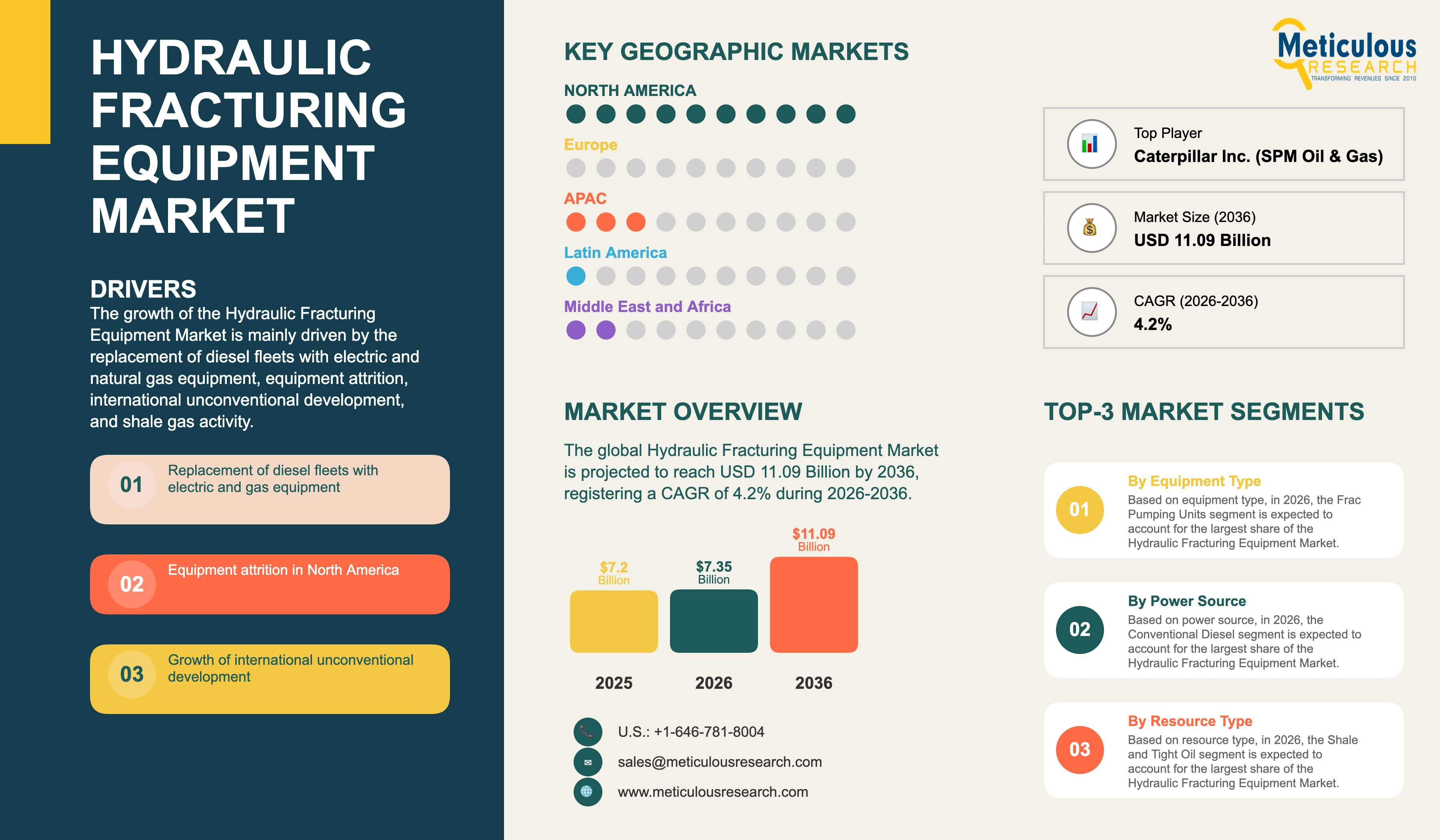
The global hydraulic fracturing equipment market was valued at USD 7.20 billion in 2025. This market is expected to reach USD 11.09 billion by 2036 from an estimated USD 7.35 billion in 2026, registering a CAGR of 4.2% during the forecast period (2026-2036).
- Published
- Nov 2026
- Pages
- 264
- Format
- PDF + Excel
- Report ID
- MREP - 1042714
- Base year
- 2025
- 2025 · BASELINE
- $7.20B
- 2036
- $11.09B
- CAGR 2026–2036
- 4.2%
2025 baseline · 2026–2036 forecast at 4.2% CAGR · hover a bar for the value
Key highlights
Diamondback Energy, Halliburton, and VoltaGrid agreed in 2026 to deploy four electric simul-frac fleets across the Permian Basin, combining Halliburton's ZEUS 6,000-horsepower all-electric fracturing technology with VoltaGrid's power generation systems.
Liberty Energy reported first-quarter 2026 revenue of about USD 1 billion and said it has a path to upgrade engine control software so that more than 70% of its digiPrime direct-drive natural gas fleet will have variable speed capability and increased horsepower. Liberty has reported that digiFleet power ends last about twice as long as conventional power ends while managing significantly higher loads.
SPM Oil & Gas, a Caterpillar company, reported that its WS 335 frac pump achieved more than 13,000 pumping hours in the Permian Basin before its first overhaul, compared with conventional frac pumps that are commonly rebuilt at 3,000 hours and discarded at 6,000 hours.
ProPetro reported that about 75% of its fleet consists of next-generation natural gas burning units, taking advantage of a large discount of natural gas to diesel prices in the Permian Basin, and estimated the Permian frac fleet count in the mid-70s in 2026.
Yantai Jereh Oilfield Services Group reported 2025 revenue of about CNY 16.2 billion and has supplied more than 300 electric fracturing units globally since 2022, including a 7,000-horsepower electric fracturing fleet delivered to a U.S. oilfield service company.
In China's Sichuan Basin, Jereh's AI-enabled fracturing system coordinated 18 electric-driven 6,000-horsepower fracturing units along with electric blending and hydration units, illustrating the scale of electric fracturing in China's shale gas development and the use of AI-based control.
Halliburton and Liberty Energy launched the first U.S. hydraulic fracturing fleet operating under certified carbon intensity tracking, powered by fully electric pumps, reflecting operator demand for measurable emissions reductions in completions.
By equipment type, frac pumping units account for the largest share of 44.0% in 2026, while data vans, controls, and automation registers the highest CAGR.
By power source, conventional diesel accounts for the largest share of 30.0% in 2026, while electric registers the highest CAGR.
By sales type, new equipment accounts for the larger share in 2026 and also registers the higher CAGR.
By resource type, shale and tight oil accounts for the largest share in 2026, while shale and tight gas register the highest CAGR.
By geography, North America accounts for the largest share of 62.0% in 2026, while Middle East & Africa registers the highest CAGR of 7.4%.
Report summary
| Particulars | Details |
|---|---|
| Base Year | 2025 |
| Estimated Year | 2026 |
| Forecast Period | 2026-2036 |
| Market Size in 2025 | USD 7.20 billion |
| Market Size in 2026 | USD 7.35 billion |
| Market Size by 2036 | USD 11.09 billion |
| CAGR (2026-2036) | 4.2% |
| Format | PDF, Excel & Cloud Portal · 264 pages |
| Largest Segment by Equipment Type (2026) | Frac Pumping Units (44.0%) |
| Largest Segment by Power Source (2026) | Conventional Diesel (30.0%) |
| Largest Region (2026) | North America (62.0%) |
| Fastest-Growing Region | Middle East & Africa (CAGR 7.4%) |
| Companies Profiled | 12 companies and other companies |
| Segments Covered | Equipment Type, Power Source, Sales Type, Resource Type, Geography |
| Countries Covered | U.S., Canada, China, Australia, India, Rest of Asia-Pacific, Saudi Arabia, UAE, Oman, Algeria, Rest of Middle East & Africa, Argentina, Mexico, Rest of Latin America, U.K., Rest of Europe |
Report overview
Segments covered: equipment type, power source.
The growth of this market is mainly driven by the replacement of aging diesel frac fleets with electric and natural gas-powered equipment that lowers fuel costs and emissions, the attrition of older equipment that keeps the North American market structurally tight, rising fracturing activity in international unconventional plays such as Argentina's Vaca Muerta, China's Sichuan Basin, Saudi Arabia's Jafurah field, the UAE, and Algeria, growing shale gas activity to supply LNG exports and power generation, and the steady demand for fluid ends, valves, seats, and other expendable parts that wear out quickly under high pressure. However, factors such as consolidation and capital discipline among U.S. shale producers, volatile oil prices, pricing pressure in the pressure pumping industry, longer equipment life from improved designs, and the high capital cost of electric fleets and their power generation are expected to restrain the growth of this market to some extent.
Hydraulic fracturing is the process of pumping fluid, typically water mixed with sand and chemicals, into a well at high pressure to create fractures in the rock that allow oil and gas to flow. It is essential for producing oil and gas from shale and other tight reservoirs, and it is also used to stimulate conventional wells. A frac fleet, or spread, consists of multiple high-pressure pumping units, blenders that mix water, sand, and chemicals, hydration units that prepare gel or friction reducer, sand handling equipment, manifolds and high-pressure flow iron that connect the pumps to the wellhead, and a data van or control center that monitors and controls the operation. A typical modern North American fleet may include 15 to 25 pumping units with total capacity of 40,000 to 60,000 horsepower or more.
This report covers global revenue from hydraulic fracturing equipment, including frac pumping units with their pumps, power ends, prime movers, and transmissions, fluid ends and expendable parts such as valves, seats, packing, and plungers, manifolds and high-pressure flow iron, blenders and hydration units, data vans, controls, and automation systems, and sand and proppant handling equipment. Revenue includes sales of new equipment and aftermarket and remanufacturing revenue. Pressure pumping services revenue, standalone power generation equipment used to supply electric fleets, proppant, fracturing chemicals, coiled tubing, and wireline equipment are excluded from the scope of this report, as they are covered in separate studies.
The hydraulic fracturing equipment market is undergoing a major technology transition in its power sources. Traditional frac pumps were powered by diesel engines, and many fleets were upgraded to dual-fuel engines that burn a mix of diesel and natural gas. Newer fleets use electric motors powered by natural gas turbines, gas reciprocating generators, or the grid, or direct-drive natural gas engines or turbines that power pumps without a transmission. These next-generation fleets reduce fuel costs by using field gas or pipeline gas instead of diesel, lower emissions, reduce noise, and often require less maintenance. In the Permian Basin, where natural gas is cheap relative to diesel, the savings can be substantial. Electric fleets also allow finer control of pump rates and pressures, which can improve completion quality and reduce equipment stress, which helps extend component life and reduce maintenance.
North America is by far the largest market, driven by the U.S. shale industry, which uses hundreds of frac fleets and consumes very large quantities of fluid ends and expendable parts. U.S. pressure pumping companies such as Halliburton, Liberty Energy, ProPetro, and others have invested heavily in electric and natural gas-powered fleets, while retiring older diesel equipment. Halliburton's ZEUS electric fleets and Liberty's digiFleet and digiPrime systems are examples of next-generation technology, and some pressure pumpers design and manufacture their own equipment.
Outside North America, China is the second-largest market, with large shale gas fracturing operations in the Sichuan Basin and tight oil and gas development in other basins. Chinese manufacturers such as Jereh and Honghua supply electric fracturing equipment to Chinese national oil companies and increasingly to international customers. Argentina's Vaca Muerta, Saudi Arabia's Jafurah unconventional gas field, the UAE, Oman, and Algeria are also growing fracturing markets.
The market includes pump and equipment manufacturers, pressure pumping companies that build their own equipment, Chinese equipment manufacturers, and suppliers of fluid ends, flow iron, and expendable parts. Leading companies include Caterpillar through SPM Oil & Gas, Ingersoll Rand through Gardner Denver, Halliburton, Liberty Energy, NOV, Kirby Corporation through Stewart & Stevenson, Jereh, Honghua, Kerr Pumps, Vulcan Industrial Holdings, Evolution Well Services, and Cummins.
Over the forecast period, the market is expected to grow steadily, driven by fleet replacement with electric and natural gas equipment, international unconventional development, and aftermarket demand. Electric fleets are expected to be the fastest-growing power source, while conventional diesel equipment declines. North America remains the largest region, and the Middle East & Africa is expected to grow fastest.
Our unconventional gas program requires modern frac fleets with high pressure capability, and we are working with several suppliers to expand capacity.
This comment explains why the Middle East & Africa is the fastest-growing region and why shale and tight gas are growing fastest.
Fluid ends and valves are our biggest maintenance cost, so we choose suppliers whose parts last longer under high pressure and long pumping hours.
This comment shows why fluid ends and expendable parts account for a large share of the market and why durability matters.
In 2026, the new equipment segment is expected to account for the larger share of the hydraulic fracturing equipment market, and it is also projected to register the higher CAGR during the forecast period.
Report infographic
Market dynamics
20 factors across 5 forcesReplacement of diesel fleets with electric and natural gas equipment
Pressure pumping companies are replacing older diesel fleets with electric and natural gas-powered equipment because these fleets lower fuel costs, reduce emissions, and are increasingly demanded by operators. In the Permian Basin, natural gas is much cheaper than diesel, so fleets that burn field gas or pipeline gas can save operators millions of dollars per fleet per year. ProPetro has reported that about 75% of its fleet consists of next-generation natural gas burning units to take advantage of this price discount.
Electric fleets, such as Halliburton's ZEUS 6,000-horsepower all-electric pumps, are powered by natural gas turbines, reciprocating generators, or grid power. Diamondback, Halliburton, and VoltaGrid agreed in 2026 to deploy four electric simul-frac fleets in the Permian Basin. Direct-drive natural gas systems, such as Liberty's digiPrime, use natural gas engines to power pumps directly, and Liberty is upgrading these units to variable speed. Operators and pressure pumpers have also retired or written down large amounts of older diesel equipment, which creates replacement demand.
The transition is expected to continue throughout the forecast period, as most of the remaining diesel and dual-fuel fleets will need to be replaced or upgraded as they reach the end of their useful lives. Pressure pumpers have stated that they will not reinvest in diesel-only equipment, and some older diesel horsepower is being retired or moved to international markets. Each new electric or direct-drive fleet represents a significant investment in pumping units, controls, and auxiliary equipment.
Equipment attrition and structural tightness in North America
Frac equipment operates under extreme conditions, pumping fluids at pressures of 9,000 pounds per square inch or more for many hours per day, which causes rapid wear and attrition. Many fleets now operate for 15 to 20 hours per day using simultaneous fracturing and continuous pumping techniques, which increases wear. As older equipment wears out and is retired, the available supply of frac horsepower declines, which keeps the market structurally tight even when activity is flat.
ProPetro has described a constructive supply-demand environment driven by ongoing equipment attrition and limited spare capacity, and has indicated that structural barriers make it difficult to increase the Permian frac fleet count above the mid-80s without significant growth capital. This tightness supports demand for new equipment and for remanufacturing of existing equipment. Even if the number of active fleets remains flat, the replacement of worn-out horsepower and the consumption of expendable parts create a large and recurring market. Higher pumping hours per day also mean that equipment reaches its end of life faster than in the past.
Growth of international unconventional development
Unconventional oil and gas development is expanding outside North America, creating new demand for fracturing equipment. China is developing shale gas in the Sichuan Basin and tight oil and gas in other basins, using large electric fracturing fleets supplied mainly by Chinese manufacturers. Argentina's Vaca Muerta is one of the fastest-growing shale plays, using North American-style multistage completions. Saudi Arabia is developing the Jafurah unconventional gas field, and the UAE, Oman, Algeria, and other countries are developing tight and unconventional resources.
Jereh has reported strong growth in overseas business and has secured significant international orders, including a large project in Algeria. International fracturing markets are expected to grow faster than North America, supported by national oil companies seeking to increase gas production for domestic use and exports. China's national oil companies have adopted electric fracturing on a large scale, and Jereh has supplied more than 300 electric fracturing units globally since 2022.
Rising shale gas activity for LNG and power
Demand for natural gas is growing to supply new LNG export terminals in the U.S., Canada, and other countries, as well as gas-fired power plants serving data centers and industrial users. This is expected to increase drilling and fracturing activity in gas-focused basins such as the Haynesville, the Marcellus, and Canada's Montney, which require large frac fleets with high pressure and horsepower capability.
Gas basins often have higher pressures and deeper wells than oil basins, which increases equipment wear and the demand for high-pressure pumps and fluid ends. In China and the Middle East, gas development is also the main driver of fracturing activity. Rising gas prices for LNG exports and power demand from data centers are expected to support gas-focused fracturing in North America over the forecast period.
Table of contents
12 chapters · 128 sections · 264 pages · click to expandSegmental analysis
| Segment | Largest share (2026) | Fastest growth (2026–2036) |
|---|---|---|
| By Equipment Type | Frac pumping units | Automation |
| By Power Source | Conventional diesel | Electric |
| By Sales Type | New equipment | New equipment |
| By Resource Type | Shale and tight oil | Shale and tight gas |
By Equipment Type
- Hydraulic Fracturing Equipment Market Analysis by Equipment Type
- The frac pumping units segment is expected to account for the largest share of 44.0% of the global hydraulic fracturing equipment market.
- The large share of this segment is mainly attributed to the high value of pumping units, which include the pump, power end, prime mover, transmission or electric motor, and trailer, and which account for the largest part of the cost of a frac fleet.
- The transition from diesel to electric and natural gas-powered pumping units is driving significant investment in new units, and remanufacturing and upgrades of existing units also contribute.
- Electric pumping units, such as Halliburton's 6,000-horsepower ZEUS units and Jereh's 6,000 and 7,000-horsepower electric units, have higher capacity per unit than older diesel pumps, which reduces the number of units needed per fleet but increases the value per unit.
- Natural gas direct-drive units with variable speed capability are also adding value to this segment.
- However, the data vans, controls, and automation segment is projected to register the highest CAGR during the forecast period.
- The rapid growth of this segment is primarily driven by the adoption of automated frac control systems, real-time monitoring, digital pump health management, and integrated control of electric fleets, which improve efficiency, consistency, and safety.
- Halliburton's Octiv Auto Frac service and Jereh's AI-enabled fracturing system show how automation is becoming a standard part of new fleets.
- Meanwhile, the fluid ends and expendable parts, manifolds and high-pressure flow iron, blenders and hydration units, and sand and proppant handling equipment segments are expected to witness steady growth, supported by the frequent replacement of fluid ends, valves, seats, packing, and plungers, regular recertification of high-pressure flow iron, electric blenders and hydration units for new electric fleets, and containerized proppant systems for higher proppant volumes per well.
By Power Source
- Hydraulic Fracturing Equipment Market Analysis by Power Source
- The conventional diesel segment is expected to account for the largest share of 30.0% of the global hydraulic fracturing equipment market.
- The large share of this segment is mainly attributed to the large installed base of diesel-powered pumping units in North America and international markets, which continue to require fluid ends, expendable parts, and remanufacturing.
- Its share is expected to decline over the forecast period as pressure pumpers retire diesel equipment and replace it with electric and natural gas-powered fleets.
- However, the electric segment is projected to register the highest CAGR during the forecast period.
- The rapid growth of this segment is primarily driven by the lower fuel costs and emissions of electric fleets, operator demand for low-emission completions, partnerships between pressure pumpers and power providers, and large electric fleet deployments in North America and China.
- In China, national oil companies have made electric fracturing a standard for new shale gas developments, which supports strong demand.
- Meanwhile, the natural gas direct-drive and dual-fuel segments are expected to witness steady growth, supported by Liberty's digiPrime platform and other direct-drive systems that avoid separate power generation, while dual-fuel equipment is expected to grow slowly as a transitional technology.
By Sales Type
- Hydraulic Fracturing Equipment Market Analysis by Sales Type
- The new equipment segment is expected to account for the largest share of 55.0% of the global hydraulic fracturing equipment market.
- The large share of this segment is mainly attributed to the replacement of diesel fleets with new electric and natural gas-powered fleets in North America, the construction of new fleets for international markets, and investment in new automation and control systems.
- New electric pumping units, power generation equipment, and automated control systems carry higher prices than the diesel units they replace.
- The new equipment segment is also projected to register the highest CAGR during the forecast period, driven by continued fleet replacement in North America and the addition of new fleets in China, the Middle East, and Argentina.
- Meanwhile, the aftermarket and remanufacturing segment is expected to witness steady growth, supported by the high pumping hours of modern fleets, the large installed base, and the remanufacturing of power ends and pumps, although longer equipment life from improved designs moderates growth.
By Resource Type
- Hydraulic Fracturing Equipment Market Analysis by Resource Type
- The shale and tight oil segment is expected to account for the largest share of 52.0% of the global hydraulic fracturing equipment market.
- The large share of this segment is mainly attributed to the dominance of oil-focused basins such as the Permian, Bakken, and Eagle Ford in U.S. fracturing activity, as well as Argentina's Vaca Muerta.
- Oil-focused fracturing accounts for the largest number of frac fleets and the largest consumption of expendable parts.
- The shale and tight oil segment will remain the largest throughout the forecast period because of the scale of activity in the Permian Basin and other oil basins.
- However, the shale and tight gas segment is projected to register the highest CAGR during the forecast period.
- The rapid growth of this segment is primarily driven by rising gas demand for LNG exports and power generation, which supports activity in the Haynesville, Marcellus, and Montney, China's shale gas development in the Sichuan Basin, Saudi Arabia's Jafurah field, and unconventional gas development in the UAE and Algeria.
- Meanwhile, the conventional reservoirs segment is expected to witness steady growth, supported by the fracturing of tight conventional reservoirs in the Middle East, Russia, and other regions, and possible refracturing of older shale wells later in the forecast period.
Geographic analysis
North America
Largest shareIn 2026, North America is expected to account for the largest share of 62.0% of the global hydraulic fracturing equipment market. The large share of this region is mainly due to the large U.S. and Canadian shale industry, which operates hundreds of frac fleets, the rapid transition from diesel to electric and natural gas-powered equipment, the high consumption of fluid ends and expendable parts, and the presence of leading equipment manufacturers and pressure pumpers. The Permian Basin alone had a frac fleet count in the mid-70s in 2026, according to ProPetro. Growth in North America is expected to be slower than the global average, as activity remains flat and equipment demand is driven mainly by replacement.
Asia-Pacific
Asia-Pacific is the second-largest market, driven by China's large shale gas and tight oil and gas development, which uses electric fracturing fleets supplied mainly by Chinese manufacturers, and by activity in Australia and India. China's domestic market is served mainly by Jereh, Honghua, and other Chinese manufacturers, and its electric fracturing adoption is among the fastest in the world. Australia's Beetaloo Basin and India's tight gas resources may also create demand later in the forecast period.
Middle East & Africa
Fastest growthThe Middle East & Africa is projected to register the highest CAGR of 7.4% during the forecast period. The rapid growth of this region is mainly due to unconventional gas development in Saudi Arabia's Jafurah field, tight and unconventional development in the UAE and Oman, large projects in Algeria, and national oil company investments in gas production. Jereh has secured a large project in Algeria, and international service companies are expanding fracturing capacity in the region. Saudi Arabia's Jafurah development is one of the largest unconventional gas projects outside North America and requires large fracturing fleets.
Latin America
Latin America is supported by the rapid growth of Argentina's Vaca Muerta. Argentina's growing activity is served by both international and local service companies, and new fleets are being added to support Vaca Muerta growth and rising oil exports from Argentina to other countries in the region and beyond.
Europe
Europe is a very small market, as hydraulic fracturing for shale is restricted in many European countries, although conventional stimulation continues.
Competitive landscape
The global hydraulic fracturing equipment market is moderately consolidated, with the top five players estimated to account for about 40% of the market in 2025. The market includes pump and equipment manufacturers, pressure pumping companies that design and build their own equipment, Chinese manufacturers, and suppliers of fluid ends and expendable parts.
Caterpillar, through SPM Oil & Gas, and Ingersoll Rand, through Gardner Denver, are leading manufacturers of frac pumps, power ends, fluid ends, and flow iron. Halliburton and Liberty Energy design and build their own electric and natural gas-powered equipment, including Halliburton's ZEUS and Liberty's digiFleet and digiPrime systems. NOV and Kirby Corporation, through Stewart & Stevenson, manufacture and remanufacture frac equipment.
Jereh and Honghua are leading Chinese manufacturers of electric fracturing equipment, supplying Chinese national oil companies and international customers. Kerr Pumps and Vulcan Industrial Holdings supply pumps, fluid ends, and expendables, Evolution Well Services is an electric fracturing pioneer, and Cummins supplies dual-fuel and natural gas engines used in frac equipment. Companies compete on equipment reliability, efficiency, emissions performance, durability, price, and service support. Key strategies include developing electric and natural gas direct-drive equipment, extending equipment life, adding automation and digital monitoring, expanding international sales, and offering remanufacturing and aftermarket services.
The competitive landscape is expected to evolve as electric fleets become standard and as Chinese manufacturers expand internationally. Pressure pumpers that build their own equipment, such as Halliburton and Liberty, reduce the addressable market for third-party manufacturers in North America, while independent pressure pumpers rely on equipment manufacturers. Tariffs and trade restrictions may limit Chinese equipment sales in the U.S., but Chinese manufacturers are gaining share in the Middle East, Latin America, and other regions. Aftermarket businesses for fluid ends and expendables are competitive, with many suppliers competing on durability and price. Long-term supply agreements between pressure pumpers and component suppliers are common. Caterpillar's ownership of SPM gives it a strong position in both engines and pumps, and Cummins supplies engines to many pump packagers. Gardner Denver, part of Ingersoll Rand, is another long-established pump supplier with a large installed base.
Some of the key players operating in the hydraulic fracturing equipment market are Caterpillar Inc. (SPM Oil & Gas), Ingersoll Rand Inc. (Gardner Denver), Halliburton Company, Liberty Energy Inc., NOV Inc., Kirby Corporation (Stewart & Stevenson), Yantai Jereh Oilfield Services Group Co., Ltd., Honghua Group Limited, Kerr Pumps, Vulcan Industrial Holdings, LLC, Evolution Well Services, and Cummins Inc., among others.
- —
Diamondback, Halliburton, and VoltaGrid agreed to deploy four electric simul-frac fleets in 2026, Liberty is upgrading its digiPrime fleet to variable speed, SPM's WS 335 pump exceeded 13,000 hours before first overhaul, and Jereh expanded international electric fracturing sales.
- Caterpillar Inc. (SPM Oil & Gas)
- Ingersoll Rand Inc. · Gardner Denver
- Halliburton Company
- Liberty Energy Inc.
- NOV Inc.
- Kirby Corporation (Stewart & Stevenson)
- Yantai Jereh Oilfield Services Group Co., Ltd.
- Honghua Group Limited
- Kerr Pumps
- Vulcan Industrial Holdings, LLC
- Evolution Well Services
- Cummins Inc.
Expert perspectives
The hydraulic fracturing equipment market is in the middle of a major technology transition from diesel to electric and natural gas-powered fleets, which is driving replacement demand even as North American activity remains flat. We expect steady growth over the forecast period, led by electric fleets, automation, and international markets.
Over the forecast period, the market is expected to grow at a CAGR of 4.2%, from USD 7.35 billion in 2026 to USD 11.09 billion in 2036. Growth will be supported by fleet replacement, equipment attrition, international unconventional development, and gas activity, while shale producer consolidation, efficiency gains, longer equipment life, and high capital costs will moderate growth.
In terms of segments, frac pumping units remain the largest equipment type, while data vans, controls, and automation grow fastest. Conventional diesel remains the largest power source in 2026 but declines, while electric grows fastest. New equipment remains the largest and fastest-growing sales type. Shale and tight oil remain the largest resource type, while shale and tight gas grow fastest. North America remains the largest region, while the Middle East & Africa grows fastest at a CAGR of 7.4%.
For manufacturers, the key priorities are to develop reliable, long-life electric and natural gas equipment, to integrate automation and digital monitoring, to expand in international markets, and to build aftermarket and remanufacturing businesses. Partnerships with power providers will be increasingly important for electric fleets. Manufacturers that can offer lower total cost per pumping hour will be best positioned. We also expect consolidation among smaller component suppliers and pressure pumpers in North America, as weaker players exit the market or sell their fleets to larger competitors. We note that our estimates exclude pressure pumping services and standalone power generation equipment. In our view, the pace of diesel fleet retirement and the availability of gas turbines and engines will be the key factors determining the speed of the electric transition.
Our estimates are based on the active frac fleet and horsepower base by region, fleet replacement and new build rates, the share of electric and natural gas equipment in new deployments, consumption rates of fluid ends and expendables, and the reported activity of leading manufacturers and pressure pumpers. We note that 2025 equipment spending declined compared with 2024 because of lower North American activity, and we expect a gradual recovery from 2026 supported by fleet replacement and international growth. In addition, we expect the share of electric and natural gas equipment in new fleet deployments to keep rising throughout the forecast period.
Customer perspectives
Buyers of hydraulic fracturing equipment include pressure pumping companies, integrated oilfield service companies, national oil companies, and some operators that own their own fleets. Their decisions depend mainly on reliability, fuel efficiency, emissions, durability, capital cost, and service support. Many buyers also evaluate total cost per pumping hour and the availability of spare parts and field service, especially for new electric and natural gas equipment, where field experience is still limited and downtime can be costly to both the pressure pumper and the operator during completion programs.
Vice President of Equipment - pressure pumping company, U.S.
We are replacing our diesel horsepower with electric and natural gas fleets because our customers want lower fuel costs and emissions. Equipment reliability and long component life are critical to our returns.
This comment explains why electric fleets are the fastest-growing power source and why diesel equipment is declining in North America.
Frequently asked questions
The global hydraulic fracturing equipment market was valued at USD 7.20 billion in 2025, down from USD 7.40 billion in 2024 because of lower North American activity, and is estimated at USD 7.35 billion in 2026. The market includes frac pumping units, fluid ends and expendables, flow iron, blenders, controls, and sand handling equipment.
The global hydraulic fracturing equipment market is expected to reach USD 11.09 billion by 2036, supported by fleet replacement, international development, and aftermarket demand.
The market is expected to register a CAGR of 4.2% from 2026 to 2036, with the fastest growth in electric equipment, automation, and the Middle East & Africa.
Pressure pumpers in North America are rapidly adopting electric and natural gas-powered fleets. Diamondback, Halliburton, and VoltaGrid agreed in 2026 to deploy four electric simul-frac fleets in the Permian Basin using Halliburton's ZEUS 6,000-horsepower electric pumps, and ProPetro reports that about 75% of its fleet uses next-generation natural gas equipment.
Market growth is mainly driven by the replacement of diesel fleets with electric and natural gas equipment, equipment attrition and structural tightness in North America, the growth of international unconventional development, and rising shale gas activity for LNG and power.
Consolidation and capital discipline among shale producers, longer equipment life, and high capital costs restrain growth, while supply chain constraints and emissions regulations are key challenges.
Key opportunities include electric fleet expansion and power integration, automation and digital frac control, advanced fluid ends and expendable parts, and international market expansion.
Frac pumping units are expected to account for the largest share of 44.0% of the market in 2026, while data vans, controls, and automation are projected to register the highest CAGR.
Electric equipment is projected to register the highest CAGR, driven by lower fuel costs and emissions, while conventional diesel equipment accounts for the largest share of 30.0% in 2026 but is expected to decline.
Shale and tight gas is projected to register the highest CAGR, driven by LNG and power demand and international gas development, while shale and tight oil accounts for the largest share of 52.0%.
North America is expected to account for the largest share of 62.0% of the market in 2026, mainly due to its large shale industry and the transition to electric and natural gas fleets.
The Middle East & Africa is projected to register the highest CAGR of 7.4% during the forecast period, driven by unconventional gas development in Saudi Arabia, the UAE, and Algeria.
The report profiles 12 companies, including Caterpillar Inc. (SPM Oil & Gas), Ingersoll Rand Inc. (Gardner Denver), Halliburton Company, Liberty Energy Inc., NOV Inc., Kirby Corporation (Stewart & Stevenson), Yantai Jereh Oilfield Services Group Co., Ltd., Honghua Group Limited, Kerr Pumps, Vulcan Industrial Holdings, LLC, Evolution Well Services, and Cummins Inc.
Diamondback, Halliburton, and VoltaGrid agreed to deploy four electric simul-frac fleets in 2026, Liberty is upgrading its digiPrime fleet to variable speed, SPM's WS 335 pump exceeded 13,000 hours before first overhaul, and Jereh expanded international electric fracturing sales.
In 2026, the new equipment segment is expected to account for the larger share of the hydraulic fracturing equipment market, and it is also projected to register the higher CAGR during the forecast period.
Cite this report
Meticulous Research. (2026). Hydraulic Fracturing Equipment Market - Global Opportunity Analysis and Industry Forecast (2026-2036) (Report No. MREP - 1042714). Meticulous Market Research Pvt. Ltd. https://www.meticulousresearch.com/product/hydraulic-fracturing-equipment-market-7397