High-Purity Alumina Market (2026-2036)
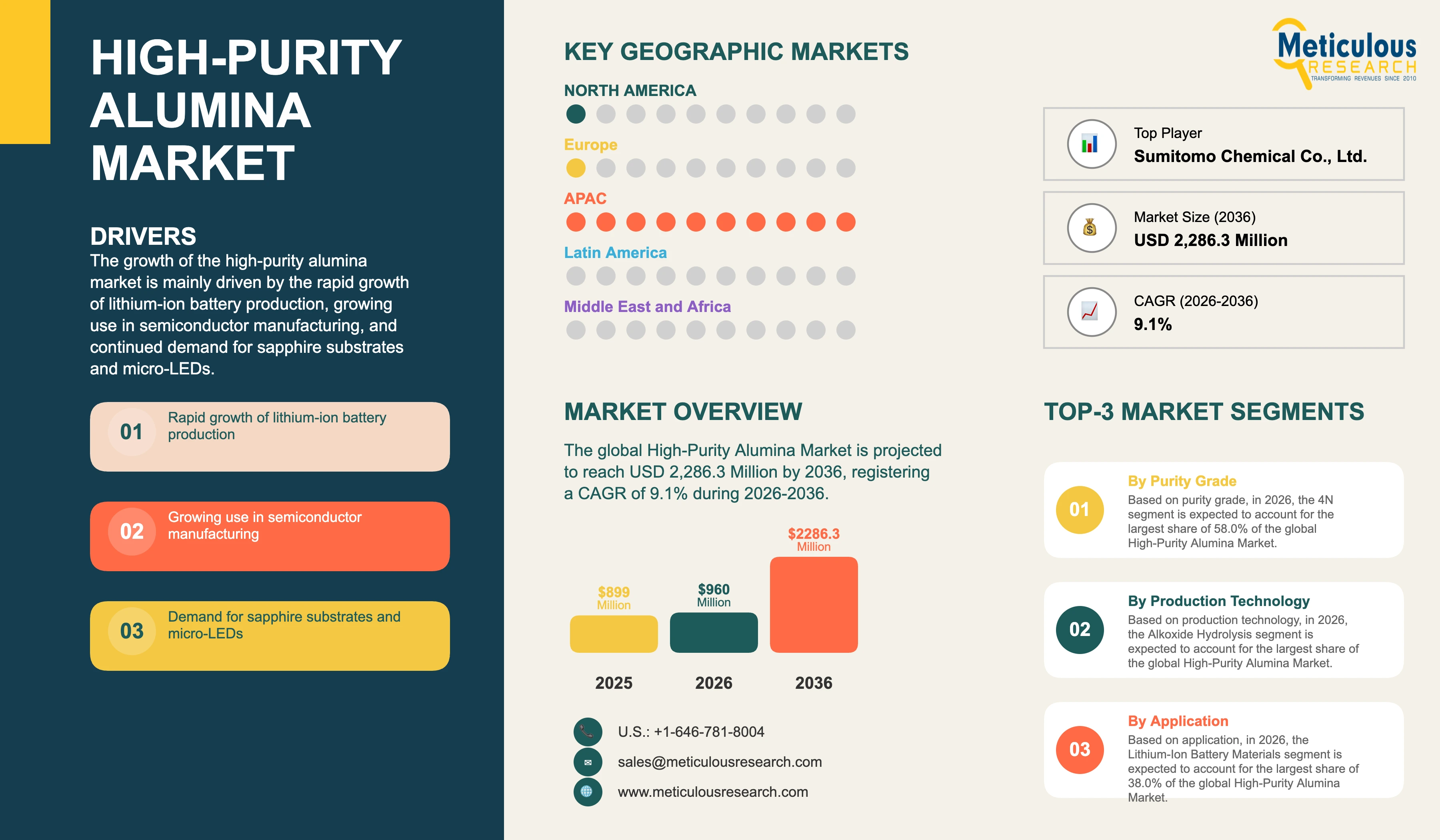
The global high-purity alumina market was valued at USD 899.0 million in 2025. This market is expected to reach USD 2,286.3 million by 2036 from an estimated USD 960.0 million in 2026, registering a CAGR of 9.1% during the forecast period (2026-2036). In terms of volume, this market is expected to reach 144.7 thousand tons by 2036 from an estimated 64.0 thousand tons in 2026, registering a CAGR of 8.5% during the forecast period.
- Published
- Nov 2026
- Pages
- 294
- Format
- PDF + Excel
- Report ID
- MRCHM - 1042487
- Base year
- 2025
- 2025 · BASELINE
- $899.0M
- 2036
- $2.29B
- CAGR 2026–2036
- 9.1%
2025 baseline · 2026–2036 forecast at 9.1% CAGR · hover a bar for the value
Key highlights
High-purity alumina, defined as aluminum oxide with a purity of 99.99% (4N) or higher, sells at many times the price of smelter-grade alumina used to make aluminum, and its price increases sharply with each additional level of purity.
Lithium-ion battery materials have become the largest application for high-purity alumina, as battery makers use it to coat separators and cathode particles to improve safety, thermal stability, and cycle life.
Alpha HPA is building one of the world's largest single-site ultra-high-purity alumina refineries in Gladstone, Australia, with a planned capacity of 10,000 tons per year of high-purity aluminum products, supported by an Australian government-backed loan facility, and has reported letters of intent from end users covering more than 13,800 tons.
Sumitomo Chemical is one of the world's leading producers of high-purity alumina and has commercialized ultra-fine grades for semiconductors, batteries, and other advanced applications.
China accounts for most of the world's high-purity alumina production capacity for 4N grades, and new capacity additions have increased competition and reduced prices, while Japan, Europe, and Australia focus on higher-purity and specialty grades.
Semiconductor manufacturers are increasing their use of high-purity alumina in plasma-resistant ceramic components, wafer handling parts, and advanced packaging materials, which require 5N and 6N grades.
Battery makers in South Korea and Japan often specify high-purity alumina for premium electric vehicle cells, while many Chinese separator makers use boehmite for standard cells, which has made purity and particle size key factors in supplier selection.
New production technologies based on solvent extraction and hydrochloric acid leaching aim to produce high-purity alumina without using expensive high-purity aluminum metal, which could lower costs and carbon emissions compared with traditional processes.
Micro-LED displays, UV-C LEDs, and automotive lighting are creating new demand for high-quality sapphire substrates, even as the general LED lighting market has matured.
Japanese and European producers, such as Sumitomo Chemical, Nippon Light Metal, Taimei Chemicals, Sasol, and Baikowski, supply most of the world's 5N and 6N grades for semiconductor and premium sapphire applications.
By purity grade, 4N accounts for the largest share of 58.0% in 2026, while 6N registers the highest CAGR.
By production technology, alkoxide hydrolysis accounts for the largest share in 2026, while solvent extraction and other methods register the highest CAGR.
By application, lithium-ion battery materials account for the largest share of 38.0% in 2026, while semiconductors register the highest CAGR.
By geography, Asia-Pacific accounts for the largest share of 80.0% in 2026, while North America registers the highest CAGR of 11.0%.
Report summary
| Particulars | Details |
|---|---|
| Base Year | 2025 |
| Estimated Year | 2026 |
| Forecast Period | 2026-2036 |
| Market Size in 2025 | USD 899.0 million |
| Market Size in 2026 | USD 960.0 million |
| Market Size by 2036 | USD 2,286.3 million |
| CAGR (2026-2036), Value | 9.1% |
| Format | PDF, Excel & Cloud Portal · 294 pages |
| Market Volume (2026 to 2036) | 64.0 thousand tons to 144.7 thousand tons (CAGR 8.5%) |
| Largest Segment by Purity Grade (2026) | 4N (58.0%) |
| Largest Segment by Application (2026) | Lithium-Ion Battery Materials (38.0%) |
| Largest Region (2026) | Asia-Pacific (80.0%) |
| Fastest-Growing Region | North America (CAGR 11.0%) |
| Segments Covered | Purity Grade, Production Technology, Application, and Geography |
| Geographic Scope | Asia-Pacific, Europe, North America, Middle East and Africa, and Latin America |
| Key Companies Profiled | Sumitomo Chemical, Sasol, Baikowski, Nippon Light Metal, Taimei Chemicals, Aluminum Corporation of China, Hebei Pengda New Materials Technology, Zibo Honghe Chemical, Xuancheng Jingrui New Material, Alpha HPA, Polar Sapphire, Advanced Energy Minerals, and Altech Advanced Materials |
Report overview
Segments covered: purity grade, technology, application.
The growth of this market is mainly driven by the rapid growth of lithium-ion battery production for electric vehicles and energy storage, which use high-purity alumina in separator coatings and cathode materials, the growing use of high-purity alumina in semiconductor manufacturing equipment, wafers, and advanced packaging, continued demand for sapphire substrates for LEDs and micro-LEDs, and efforts to build supply chains for critical materials outside China. However, factors such as competition from boehmite and lower-purity alumina in battery separators, overcapacity and falling prices for 4N grades in China, and high production costs for 5N and 6N grades are expected to restrain the growth of this market to some extent.
High-purity alumina is a premium, highly refined form of aluminum oxide with a purity of 99.99% or higher, produced through specialized chemical and thermal processes that remove almost all impurities, such as sodium, iron, silicon, and calcium. It is a fine white powder that is very hard, chemically stable, electrically insulating, and resistant to high temperatures. These properties, which ordinary alumina cannot match because of its impurities, make it essential for synthetic sapphire used in LED substrates and optical components, for coatings on lithium-ion battery separators and cathode materials, for semiconductor equipment parts and packaging, for phosphors in lighting and displays, and for technical ceramics.
This market covers the global consumption of high-purity alumina of 4N purity and above by all end users, measured in value and in thousand tons, including 4N, 5N, and 6N grades in powder, granule, tablet, and other forms. It is segmented by purity grade, production technology, application, and geography. Boehmite and alumina grades below 4N purity, which are also used in some battery separator coatings and ceramics, are not included.
High-purity alumina is produced by several methods, of which the most common is the hydrolysis of aluminum alkoxide, in which high-purity aluminum metal is reacted with alcohol to form an alkoxide, which is then purified and converted into alumina. Other methods include the thermal decomposition of ammonium alum or ammonium aluminum carbonate, which is widely used in China, and newer processes based on hydrochloric acid leaching of clays or solvent extraction and purification of aluminum salts, which can avoid the use of expensive aluminum metal and reduce energy use and emissions. Each method produces material with different impurity profiles, particle sizes, and costs, and customers often qualify products from specific processes for their applications.
Demand for high-purity alumina was historically driven by sapphire substrates for LEDs, which grew rapidly in the 2010s as LED lighting replaced traditional bulbs. As the LED market matured and prices fell, lithium-ion batteries became the main source of growth, as battery makers began using high-purity alumina to coat separators and improve battery safety. More recently, semiconductors have become an important growth market, as chipmakers and equipment makers use high-purity alumina in ceramic parts that must resist plasma and chemicals in wafer processing tools. This shift has changed what customers expect from suppliers, with greater focus on consistency, impurity control, and technical support.
China has become the largest producer of 4N high-purity alumina, with many producers using ammonium alum and other low-cost processes, and new capacity additions have increased competition and reduced prices for standard grades. Japanese and European producers, such as Sumitomo Chemical, Nippon Light Metal, Taimei Chemicals, Sasol, and Baikowski, focus on high-quality 4N, 5N, and 6N grades for demanding applications, while new producers in Australia and Canada are developing lower-cost, lower-carbon processes.
Over the forecast period, high-purity alumina demand is expected to grow strongly, supported by lithium-ion batteries, semiconductors, micro-LEDs, and advanced ceramics. Demand is expected to shift toward higher-purity grades, as semiconductor and battery customers require 5N and 6N materials with very low levels of impurities, which is expected to increase the average value of the market. At the same time, prices for standard 4N grades are expected to remain under pressure because of Chinese overcapacity, which means that producers will need to move up the purity curve and develop specialty products to grow their revenues. Governments in Australia, the U.S., and Europe are also supporting new high-purity alumina production as part of their critical minerals and battery materials strategies. Customers are also paying more attention to the carbon footprint of their materials, as battery makers and chipmakers set targets to reduce emissions across their supply chains, and this is creating interest in high-purity alumina produced with renewable energy and lower-emission processes. Producers that can combine high purity, consistent quality, and low carbon emissions are expected to be best placed to win long-term contracts.
Report infographic
Market dynamics
15 factors across 5 forcesRapid growth of lithium-ion battery production
Lithium-ion batteries use a thin porous polymer separator between the cathode and anode, and many battery makers coat this separator with a layer of ceramic particles, such as high-purity alumina, to improve its resistance to heat and shrinkage and reduce the risk of short circuits and thermal runaway. High-purity alumina is also used to coat cathode particles, which improves the stability and cycle life of high-nickel cathodes, and as a precursor for other battery materials.
Global battery production for electric vehicles and energy storage systems has grown rapidly over the past five years, and battery makers in China, South Korea, Japan, Europe, and North America are expanding capacity. Battery safety standards and the move to higher energy density cells, which are more sensitive to heat, are increasing the use of ceramic-coated separators. Lithium-ion battery materials account for the largest share of the market by application, and battery customers are increasingly requiring higher-purity grades. Energy storage systems for grids, data centers, and renewable energy projects are growing particularly fast, and these systems use large numbers of lithium iron phosphate cells, many of which use ceramic-coated separators. Battery makers are also developing thinner separators to increase energy density, which makes ceramic coatings even more important for maintaining safety.
Growing use in semiconductor manufacturing
Semiconductor manufacturing equipment uses ceramic parts made from high-purity alumina, such as chamber walls, liners, rings, electrostatic chucks, and wafer handling components, because they resist plasma, corrosive gases, and high temperatures without contaminating wafers. As chips become more advanced, with smaller features and more process steps, equipment makers require ceramics with fewer impurities, which increases demand for 5N and 6N high-purity alumina.
High-purity alumina is also used in advanced packaging materials, thermal interface materials, and substrates for power electronics and RF devices. The expansion of semiconductor manufacturing capacity in Taiwan, South Korea, Japan, the U.S., Europe, and China, driven by AI chips and government incentives, is supporting demand. Semiconductors form the fastest-growing application in this market, and 6N is the fastest-growing purity grade. Leading semiconductor equipment makers, such as Applied Materials, Lam Research, and Tokyo Electron, and their ceramic component suppliers, such as Kyocera, CoorsTek, Ferrotec, and NGK Insulators, are among the users of high-purity alumina for these parts. Equipment makers are also increasing the use of ceramic coatings and sprayed alumina layers on chamber parts, which adds demand.
Continued demand for sapphire substrates and micro-LEDs
Synthetic sapphire, which is grown from high-purity alumina at temperatures above 2,000 degrees Celsius, is the main substrate for gallium nitride LEDs and is also used in smartphone camera covers, watch faces, optical windows, and semiconductor wafers. Although the general LED lighting market has matured, demand remains significant, and new applications, such as automotive lighting, horticultural lighting, UV-C LEDs for disinfection, and micro-LED displays, are supporting growth.
Micro-LED displays, which could be used in smartwatches, augmented reality glasses, televisions, and automotive displays, require very high-quality sapphire substrates, which use high-purity alumina of 5N purity or higher. LEDs and sapphire substrates remain one of the largest applications of high-purity alumina, accounting for a large share of 4N and 5N demand. Sapphire is also increasingly used as a substrate for gallium nitride power devices and as a carrier wafer in advanced semiconductor packaging, which could add demand from the semiconductor industry.
Efforts to build critical material supply chains outside China
Governments in Australia, the U.S., Europe, Japan, and South Korea are supporting the production of high-purity alumina and other battery and semiconductor materials outside China to reduce supply chain risks. Australia has listed high-purity alumina as a critical mineral, and its government has supported Alpha HPA's Stage 2 project in Gladstone through a loan facility managed by Export Finance Australia.
Battery makers and semiconductor companies in North America and Europe are seeking local or allied suppliers to meet sourcing requirements and reduce risks. New projects in Australia, Canada, and the U.S. are expected to add supply outside China, which is one of the main reasons North America is the fastest-growing region in this market. Japan and South Korea are also supporting domestic production of battery materials and semiconductor materials, and some companies are signing supply agreements with Australian producers to diversify their sources.
Table of contents
11 chapters · 119 sections · 294 pages · click to expandSegmental analysis
| Segment | Largest share (2026) | Fastest growth (2026–2036) |
|---|---|---|
| By Purity Grade | — | Rapid growth of this |
| By Production Technology | Alkoxide hydrolysis | Solvent extraction and other methods |
| By Application | Lithium-ion battery materials | Semiconductors |
By Purity Grade
- High-Purity Alumina Market Analysis by Purity Grade
- The 4N segment is expected to account for the largest share of 58.0% of the market.
- The large share of this segment is mainly due to its wide use in lithium-ion battery separator coatings, sapphire substrates for LEDs, phosphors, and technical ceramics, where 99.99% purity provides the required performance at a lower cost than higher-purity grades.
- 4N high-purity alumina is produced in large volumes, accounting for more than half of total market volume, mainly in China, by producers using ammonium alum, ammonium aluminum carbonate, and alkoxide processes, as well as by producers in Japan, Europe, and Australia.
- Battery separator makers and LED sapphire producers in China, South Korea, Japan, and Taiwan are its largest users, and its price has declined in recent years because of new Chinese capacity and competition from boehmite in battery separators.
- Producers are differentiating their 4N products from lower-cost competitors through particle size control, low sodium content, and consistent quality, which allows them to earn higher prices for premium battery and sapphire grades.
- Many battery customers use 4N grades for separator coatings, while sapphire growers often use 4N grades in pressed or tablet form for crystal growth. 4N is expected to remain the largest purity grade over the forecast period, although its share will decline as customers move to higher-purity grades.
- Chinese 4N producers are also exporting more material to battery and sapphire makers in Southeast Asia and other regions, which adds to price competition in international markets.
- However, the 6N segment is projected to register the highest CAGR during the forecast period.
- The rapid growth of this segment is driven by semiconductor equipment and packaging applications, micro-LED substrates, and advanced optical components, which require extremely low levels of impurities. 5N grades make up the rest of the market and are also growing faster than 4N grades. 5N high-purity alumina is used for premium sapphire substrates, micro-LEDs, semiconductor equipment ceramics, and high-performance battery materials, and it is produced by a smaller number of companies, mainly in Japan, Europe, and China. 6N grades are produced in even smaller volumes by a few specialized producers and command the highest prices.
By Production Technology
- High-Purity Alumina Market Analysis by Production Technology
- The alkoxide hydrolysis segment is expected to account for the largest share of the market.
- The large share of this segment is mainly due to its long use by leading producers, such as Sumitomo Chemical and Sasol, and its ability to produce consistent, high-quality 4N, 5N, and 6N grades with controlled particle sizes.
- In the alkoxide process, high-purity aluminum metal is reacted with alcohol to form aluminum alkoxide, which is purified by distillation and then hydrolyzed and calcined to produce high-purity alumina.
- This process, which has been used commercially for decades, can achieve very high purity and is well suited for semiconductor, sapphire, and battery applications, but it depends on high-purity aluminum metal, which is energy-intensive and expensive to produce.
- Producers are improving process efficiency and developing new grades to meet the needs of battery and semiconductor customers.
- Alkoxide hydrolysis is expected to remain the largest production technology over the forecast period, although its share will decline as newer processes grow.
- Sumitomo Chemical, Sasol, and Nippon Light Metal are among the leading producers using alkoxide-based processes, and their long experience gives them an advantage in quality and consistency.
- Alkoxide-based production also generates by-products, such as alcohols, that must be recovered and recycled.
- However, the solvent extraction and other methods segment is projected to register the highest CAGR during the forecast period.
- The rapid growth of this segment is driven by new projects in Australia and other countries that use solvent extraction and purification of aluminum salts to produce high-purity alumina at lower cost and with lower carbon emissions.
- Ammonium alum and carbonate pyrolysis and hydrochloric acid leaching make up the rest of the market.
- Ammonium alum and carbonate pyrolysis is widely used by Chinese producers of 4N grades because of its low cost, while hydrochloric acid leaching of clays and other aluminum-bearing materials is being developed by several companies in Canada and Australia as a lower-cost route to high purity.
By Application
- High-Purity Alumina Market Analysis by Application
- The lithium-ion battery materials segment is expected to account for the largest share of 38.0% of the market.
- The large share of this segment is mainly due to the large and growing use of high-purity alumina in separator coatings and cathode coatings for lithium-ion batteries used in electric vehicles, energy storage systems, and consumer electronics.
- Ceramic-coated separators are now standard in many electric vehicle batteries, because they improve resistance to heat and shrinkage and help prevent short circuits.
- Separator makers, such as SEMCORP (Yunnan Energy New Material), Senior Technology Material, SK IE Technology, Asahi Kasei, Toray, and W-Scope, are among the largest users of high-purity alumina, along with cathode makers that use alumina coatings to improve the stability of high-nickel cathodes.
- Battery makers in South Korea and Japan, in particular, often specify high-purity alumina for premium cells, while some Chinese producers use boehmite for standard cells.
- The growth of battery production in North America and Europe is also creating demand for high-purity alumina outside Asia.
- Lithium-ion battery materials are expected to remain the largest application over the forecast period.
- However, the growth of this application depends on how much battery makers use high-purity alumina compared with boehmite, which varies by region, cell type, and customer requirements.
- Cathode coatings represent a smaller but growing use, as cathode makers adopt alumina and other coatings to improve the stability of high-nickel and high-voltage cathodes.
- However, the semiconductors segment is projected to register the highest CAGR during the forecast period.
- The rapid growth of this segment is driven by the expansion of semiconductor manufacturing, the use of high-purity alumina in plasma-resistant ceramic parts for wafer processing equipment, and growing use in advanced packaging and thermal management materials.
- LEDs and sapphire substrates, phosphors, optical components and sapphire glass, and technical ceramics and other applications make up the rest of the market.
- LEDs and sapphire substrates are the second-largest application, supported by LED lighting, automotive lighting, micro-LEDs, and optical windows, while phosphors, optical components, and technical ceramics provide steady demand from lighting, displays, and industrial uses.
Geographic analysis
Asia-Pacific
Largest shareIn 2026, Asia-Pacific is expected to account for the largest share of 80.0% of the global high-purity alumina market. The large share of this region is mainly due to the concentration of lithium-ion battery, LED, sapphire, and semiconductor manufacturing in China, South Korea, Japan, and Taiwan, along with large high-purity alumina production in China and Japan. China is the largest producer and consumer of high-purity alumina, with many producers of 4N grades and the world's largest battery, separator, LED, and sapphire industries. Japan is home to leading producers of high-quality grades, such as Sumitomo Chemical, Nippon Light Metal, and Taimei Chemicals, and has large semiconductor equipment, ceramics, and battery materials industries. South Korea has large battery, separator, display, and semiconductor industries, and Taiwan is a major center for semiconductor manufacturing, LEDs, and sapphire substrates. Australia is emerging as an important producer of high-purity alumina through Alpha HPA's Gladstone project. Asia-Pacific is expected to remain the dominant region throughout the forecast period. India is also emerging as a market for high-purity alumina, supported by plans to build battery cell and semiconductor manufacturing plants under government incentive programs.
North America
Fastest growthNorth America is projected to register the highest CAGR of 11.0% during the forecast period. Growth is driven by the expansion of battery production for electric vehicles and energy storage, the growth of semiconductor manufacturing supported by government incentives, and the development of high-purity alumina production in Canada. The U.S. Inflation Reduction Act and other policies have encouraged battery and battery materials production in the U.S., and the CHIPS and Science Act has supported new semiconductor fabs, both of which increase demand for high-purity alumina. Canadian producers, such as Polar Sapphire and Advanced Energy Minerals, are developing production to supply North American customers. Mexico is also emerging as a location for battery and electronics manufacturing that could use high-purity alumina.
Europe
Europe holds a significant share of the market, led by Germany and France, and is supported by high-purity alumina production by Sasol in Germany and Baikowski in France, and by its battery, semiconductor equipment, and technical ceramics industries. Europe's battery industry, with plants in Germany, Poland, Hungary, Sweden, and France, and its semiconductor equipment industry are expected to support steady demand for high-purity alumina over the forecast period.
Latin America
Latin America and the Middle East and Africa hold smaller shares of the market.
Competitive landscape
The high-purity alumina market is moderately concentrated, with a small number of established producers in Japan and Europe supplying high-quality grades and a larger number of Chinese producers supplying 4N grades. Leading companies in the market include Sumitomo Chemical, Sasol, Baikowski, Nippon Light Metal, Taimei Chemicals, and Chinese producers, such as Aluminum Corporation of China, Hebei Pengda New Materials Technology, and Zibo Honghe Chemical.
Established producers, most of which have decades of experience, compete on purity, consistency, particle size control, and technical support, which are critical for semiconductor, sapphire, and premium battery customers. Chinese producers compete mainly on cost, scale, and delivery for 4N grades. New producers, such as Alpha HPA in Australia and Polar Sapphire and Advanced Energy Minerals in Canada, are developing new production technologies and seeking to supply customers that want lower-carbon and non-Chinese supply. Several earlier high-purity alumina projects outside China failed to reach commercial production, which has made customers cautious about new suppliers until they demonstrate consistent quality at scale.
The top five players are estimated to account for 42.0% of the high-purity alumina market in 2025, reflecting the strong position of established Japanese and European producers in higher-purity grades and the large number of Chinese producers in 4N grades.
Players use several strategies to grow in this market, including expanding production capacity, developing higher-purity and specialty grades, developing low-cost and low-carbon production technologies, signing long-term supply agreements and letters of intent with battery and semiconductor customers, and integrating downstream into sapphire and specialty products.
Competition is expected to center on product purity and consistency, cost, carbon footprint, and the ability to supply customers in different regions. Producers that can offer high-quality 5N and 6N grades at competitive costs are expected to capture most of the value growth. Chinese producers are expected to remain dominant in 4N grades, while Japanese and European producers are expected to remain strong in higher-purity grades. New producers in Australia and Canada could gain share if they reach commercial scale and complete customer qualification.
Some of the key players operating in the high-purity alumina market are Sumitomo Chemical Co., Ltd., Sasol Limited, Baikowski SAS, Nippon Light Metal Holdings Company, Ltd., Taimei Chemicals Co., Ltd., Aluminum Corporation of China Limited, Hebei Pengda New Materials Technology Co., Ltd., Zibo Honghe Chemical Co., Ltd., Xuancheng Jingrui New Material Co., Ltd., Alpha HPA Limited, Polar Sapphire Ltd., Advanced Energy Minerals Inc., and Altech Advanced Materials AG.
- —
Alpha HPA advanced construction of its 10,000-ton-per-year Stage 2 facility in Gladstone, Australia, with end-user letters of intent exceeding 13,800 tons, and producers have introduced ultra-fine and higher-purity grades for semiconductor and battery applications.
- Sumitomo Chemical
- Sasol
- Baikowski
- Nippon Light Metal
- Taimei Chemicals
- Aluminum Corporation of China
- Hebei Pengda New Materials Technology
- Zibo Honghe Chemical
- Xuancheng Jingrui New Material
- Alpha HPA
- Polar Sapphire
- Advanced Energy Minerals
- Altech Advanced Materials
Expert perspectives
The high-purity alumina market has moved from a market driven mainly by LED sapphire substrates to one driven by lithium-ion batteries and semiconductors. Battery materials are now the largest application, and semiconductors are the fastest-growing application, which is changing the requirements for purity, particle size, and consistency. At the same time, new production technologies and new producers in Australia and Canada are changing the competitive landscape, which has long been dominated by a few Japanese and European companies and many Chinese producers.
Over the forecast period, high-purity alumina volume is expected to grow at about 8.5% per year, and value at about 9.1% per year, as demand shifts toward higher-purity grades. Prices for 4N grades are expected to remain under pressure because of Chinese overcapacity and competition from boehmite, while prices for 5N and 6N grades are expected to remain firm because of strong semiconductor and premium battery demand. As a result, the value of the market is expected to grow slightly faster than volume.
6N is the fastest-growing purity grade, solvent extraction and other methods are the fastest-growing production technology, and semiconductors is the fastest-growing application, reflecting the move to higher purity and new production methods. 4N, alkoxide hydrolysis, and lithium-ion battery materials remain the largest segments.
Asia-Pacific remains the dominant region, while North America is the fastest-growing region at a CAGR of 11.0%, supported by battery and semiconductor investment. The main swing factors are electric vehicle and energy storage battery production, the use of boehmite in separators, semiconductor equipment demand, and the success of new production projects outside China.
For high-purity alumina users, the key decisions are which purity grades and suppliers to qualify, and how to balance cost with supply security. For producers, success depends on achieving consistent high purity, lowering production costs, and securing long-term contracts with battery and semiconductor customers. New producers will also need to demonstrate that they can produce consistently at commercial scale, which has been a challenge for many projects in the past. Government support and partnerships with established chemical companies could help reduce this risk. Producers with low-carbon processes and secure, traceable supply are also expected to benefit as customers place more weight on sustainability and supply security.
Overall, high-purity alumina is expected to remain an important specialty material for batteries, semiconductors, and optoelectronics, with growth increasingly driven by higher-purity grades. Semiconductors and battery materials are expected to be the main sources of value growth, while LEDs and sapphire provide a stable base of demand.
Customer perspectives
Head of Materials Procurement - battery separator manufacturer, South Korea
Our electric vehicle customers demand higher safety, so ceramic-coated separators are now standard for us. We use high-purity alumina for premium cells and are qualifying new suppliers outside China to support our new plants in North America and Europe, where customers want local supply.
Battery makers outside China are seeking local and allied suppliers, which supports investment in high-purity alumina production in Australia, Japan, and North America.
Strong demand from separator makers is why lithium-ion battery materials account for 38.0% of the market and 4N accounts for 58.0%.
Director of Ceramics Engineering - semiconductor equipment manufacturer, U.S.
Every new process node pushes us to use ceramics with fewer impurities in our etch and deposition chambers. We now specify 5N and 6N alumina for critical parts, and we work closely with suppliers to guarantee consistency.
Semiconductor equipment makers are willing to pay premium prices for consistent ultra-high-purity grades, which supports investment in 5N and 6N capacity.
The need for ultra-high purity in semiconductor equipment is why semiconductors form the fastest-growing application and 6N is the fastest-growing purity grade.
Procurement Manager - sapphire substrate producer, China
The LED market is mature, but micro-LED and automotive lighting projects need higher-quality sapphire. We are using more 5N material and asking suppliers for tighter specifications.
The shift toward micro-LEDs and high-performance sapphire products is increasing demand for 5N grades among sapphire producers.
Demand from sapphire producers in China and other Asian countries contributes to Asia-Pacific's 80.0% share of the market.
Frequently asked questions
The market was valued at USD 899.0 million in 2025 and USD 858.0 million in 2024, and is estimated at USD 960.0 million in 2026.
The market is expected to reach USD 2,286.3 million by 2036, supported by demand from lithium-ion batteries, semiconductors, and sapphire substrates.
The market is expected to register a CAGR of 9.1% from 2026 to 2036 in value terms and 8.5% in volume terms, with volume rising from 64.0 thousand tons in 2026 to 144.7 thousand tons in 2036.
High-purity alumina is aluminum oxide with a purity of 99.99% (4N) or higher, much purer than the smelter-grade alumina used to make aluminum metal, produced through specialized chemical processes. It is used in battery materials, sapphire substrates, semiconductors, phosphors, and advanced ceramics.
Growth is driven by the rapid growth of lithium-ion battery production, growing use in semiconductor manufacturing, continued demand for sapphire substrates and micro-LEDs, and efforts to build critical material supply chains outside China.
Competition from boehmite and lower-purity alumina and overcapacity and price pressure for 4N grades restrain growth, while high production costs and technical complexity and long customer qualification times remain key challenges.
Key opportunities include the shift to higher-purity grades, low-carbon and lower-cost production technologies, growth of battery production in North America and Europe, and advanced ceramics and thermal management materials.
Battery makers use high-purity alumina to coat separators and cathode particles, which improves resistance to heat, reduces the risk of short circuits and thermal runaway, and improves the stability and cycle life of high-nickel cathodes.
Boehmite is an aluminum oxide hydroxide that is softer and often cheaper than high-purity alumina, and it is widely used in standard battery separator coatings in China. High-purity alumina is preferred for premium cells, sapphire substrates, and semiconductor applications that require very high purity.
It is produced mainly through the hydrolysis of aluminum alkoxide made from high-purity aluminum metal, through the thermal decomposition of ammonium alum or ammonium aluminum carbonate, and through newer processes based on hydrochloric acid leaching or solvent extraction and purification of aluminum salts.
4N is expected to account for the largest share of 58.0% of the market in 2026, while 6N is projected to register the highest CAGR.
Solvent extraction and other methods are projected to register the highest CAGR, while alkoxide hydrolysis holds the largest share.
Lithium-ion battery materials are expected to account for the largest share of 38.0% of the market in 2026, while semiconductors are projected to register the highest CAGR.
Asia-Pacific is expected to account for the largest share of 80.0% of the market in 2026, led by China, Japan, and South Korea.
North America is projected to register the highest CAGR of 11.0% during the forecast period.
The report profiles 13 companies, including Sumitomo Chemical, Sasol, Baikowski, Nippon Light Metal, and Alpha HPA. The top five players account for an estimated 42.0% of the market in 2025.
Alpha HPA advanced construction of its 10,000-ton-per-year Stage 2 facility in Gladstone, Australia, with end-user letters of intent exceeding 13,800 tons, and producers have introduced ultra-fine and higher-purity grades for semiconductor and battery applications.
Cite this report
Meticulous Research. (2026). High-Purity Alumina Market - Global Opportunity Analysis and Industry Forecast (2026-2036) (Report No. MRCHM - 1042487). Meticulous Market Research Pvt. Ltd. https://www.meticulousresearch.com/product/high-purity-alumina-market-7170