Long Glass Fibre Thermoplastics Market (2026-2036)
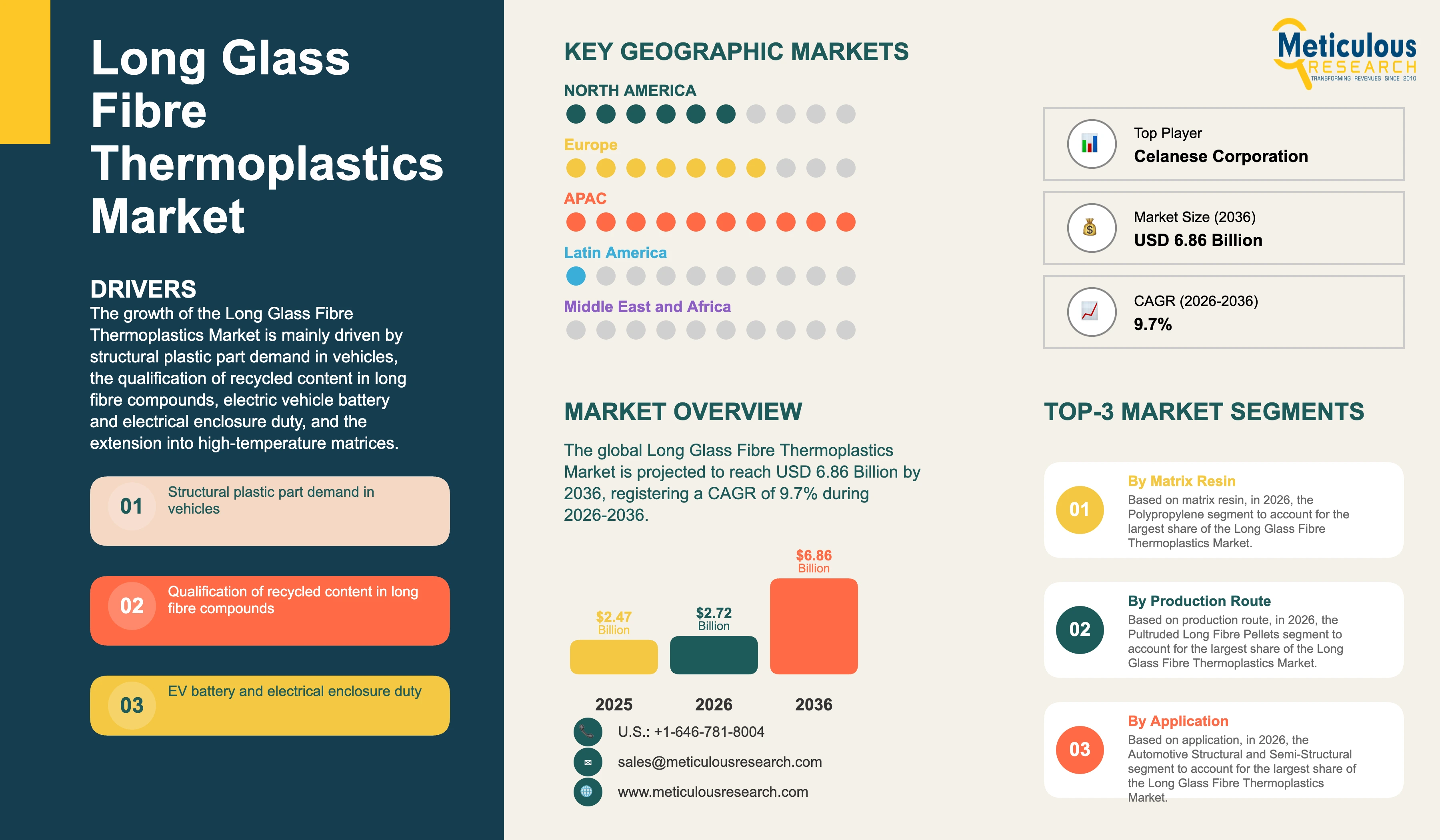
The long glass fibre thermoplastics market is valued at USD 2.72 billion in 2026 and is projected to reach USD 6.86 billion by 2036, at a CAGR of 9.7% during the forecast period. The market was valued at USD 2.47 billion in 2025 and at USD 2.29 billion in 2024.
- Published
- Nov 2026
- Pages
- 268
- Format
- PDF + Excel
- Report ID
- MRCHM - 1042761
- Base year
- 2025
- 2024 · HISTORICAL
- $2.29B
- 2036
- $6.86B
- CAGR 2026–2036
- 9.7%
2024–2025 baseline · 2026–2036 forecast at 9.7% CAGR · hover a bar for the value
Key highlights
This market measures long glass fibre thermoplastic material on a total mass basis including the glass, the matrix resin and the additive package, across all thermoplastic matrices.
Long glass fibre polypropylene is counted both here and in the glass fibre reinforced polypropylene title in this series, which measures that polymer across all fibre lengths. The two titles are not additive.
The overlap is exact and checkable. Polypropylene is 68.0% of this market in 2026, or USD 1.85 billion, and long fibre is 38.0% of that title in the same year, the same USD 1.85 billion. Either title may be used, but not both together.
Short glass fibre compounds are excluded here and are measured in that title. The two are made on different equipment and sold as separate products.
Carbon, aramid and stainless steel long fibre thermoplastics are excluded. The Celstran range of Celanese Corporation covers glass, carbon, aramid and stainless steel reinforcement, and only the glass-reinforced part is measured here.
Glass mat thermoplastic sheet and continuous glass fibre tape or organosheet are excluded as semi-finished forms, consistent with the polypropylene title, although both compete for the largest structural parts.
Direct in-line compounded material is included but measured at a different point. No pellet is sold, so the segment is measured as the resin and roving consumed at the press rather than as a compound at a compounder gate.
The moulded part is counted in component markets and the glass roving in glass fibre markets. The electronic yarn measured in the glass fibre yarns for electronics title is a different product drawn on different lines.
Value growth at 9.7% runs above volume growth at 6.8%, because the mix moves toward engineering and high-temperature matrices and higher glass loadings rather than because material prices rise.
Celanese Corporation describes its Celstran long fibre range as usable with both amorphous and semi-crystalline matrices, spanning standard through high-performance plastics, processed mainly by injection moulding with blow and compression moulding also possible.
The same range is described as having a lower tendency to shrink and warp than short fibre reinforced thermoplastics, alongside high fibre wetting, thermal stability at elevated temperature and humidity, high surface quality, chemical and corrosion resistance and high impact strength.
That dimensional claim runs against the common moulder concern that longer fibre worsens orientation driven warpage, and both hold at different scales. An entangled network reduces differential shrinkage provided it survives the gate, which is why fibre length retention decides whether the advantage is realised.
Named industries are automotive, aviation, construction, the electrical and electronic sector and the processing industry, with electric cars, building materials and fifth generation communication technology as examples.
The question that decides this market is not demand but whether a long fibre compound can carry post-consumer recycled content, because European vehicle circularity rules make recycled content mandatory from 1 September 2032 and fibre length falls with every melt history.
Polyplastics Co., Ltd., the engineering thermoplastics business of Daicel Corporation, announced on 25 February 2026 two developmental PLASTRON long fibre grades, RSG20011 and RSG20013, on post-consumer recycled polypropylene.
Those grades carry 30% to 40% glass fibre with more than 30% post-consumer recycled content, and their mechanical properties are described as equivalent to the commercial products of the company made from virgin raw materials, with high rigidity and impact strength.
The company states a carbon footprint reduction of more than 20% against virgin material products under the GHG Protocol and ISO 14067, noting that those figures are not guaranteed values.
The grades are in sample production and evaluation rather than commercial supply, so the capability is demonstrated rather than proven at scale. That is the single largest uncertainty here, because structural duty moves to whichever material can carry the obligation.
Report summary
| Particulars | Details |
|---|---|
| Base Year | 2025 |
| Actual Years | 2024-2025 |
| Forecast Period | 2026-2036 |
| Market Size in 2024 | USD 2.29 billion |
| Market Size in 2025 | USD 2.47 billion |
| Market Size in 2026 | USD 2.72 billion |
| Market Size in 2036 | USD 6.86 billion |
| Value CAGR (2026-2036) | 9.7% |
| Format | PDF, Excel & Cloud Portal · 268 pages |
| Volume in 2025 | 745.00 kilotons |
| Volume in 2026 | 790.00 kilotons |
| Volume in 2036 | 1,525.25 kilotons |
| Volume CAGR (2026-2036) | 6.8% |
| Average Selling Price, 2026 | USD 3.44 per kg |
| Average Selling Price, 2036 | USD 4.50 per kg |
| Units | Value in USD million; volume in kilotons; price in USD per kg |
| Measurement Basis | Long glass fibre thermoplastic material on a total mass basis including glass, matrix and additives; pultruded pellets at the compounder gate and direct in-line compounded material as resin and roving consumed at the press |
| Exclusions | Short glass fibre compounds; carbon, aramid and stainless steel long fibre thermoplastics; glass mat thermoplastic sheet and continuous fibre tape or organosheet; the moulded part; glass roving as sold into the material |
| Overlap Note | Long glass fibre polypropylene is counted both here, at 68.0% of this market in 2026, and in the glass fibre reinforced polypropylene title at 38.0% of that market; the overlap is USD 1.85 billion and the two titles are not additive |
| Segments: Matrix Resin | Polypropylene; Polyamide; Polybutylene Terephthalate and Other Polyester; High-Temperature and Other Matrices |
| Segments: Production Route | Pultruded Long Fibre Pellets; Direct In-Line Compounded Material |
| Segments: Application | Automotive Structural and Semi-Structural; Electric Vehicle Battery and Electrical Enclosures; Appliances and Power Tools; Industrial and Transport; Building and Infrastructure |
| Largest Segment by Matrix Resin, 2026 | Polypropylene |
| Fastest-Growing Segment by Matrix Resin | High-Temperature and Other Matrices, at 14.0% |
| Largest Segment by Production Route, 2026 | Pultruded Long Fibre Pellets |
| Fastest-Growing Segment by Production Route | Direct In-Line Compounded Material, at 11.8% |
| Largest Segment by Application, 2026 | Automotive Structural and Semi-Structural |
| Fastest-Growing Segment by Application | Electric Vehicle Battery and Electrical Enclosures, at 17.0% |
| Largest Region, 2026 | Asia-Pacific |
| Fastest-Growing Region | Middle East & Africa, at 13.0% |
| Fastest-Growing Country | India, at 13.4% |
| Slowest-Growing Country | France, at 6.4% |
| Regions Covered | Asia-Pacific; Europe; North America; Latin America; Middle East & Africa |
| Countries Covered | China; India; Japan; South Korea; Germany; France; Czech Republic; U.S.; Canada; Mexico; Brazil; Saudi Arabia; Morocco |
| Key Players | Celanese Corporation; Saudi Basic Industries Corporation; Avient Corporation; Borealis AG; Daicel Corporation; Kingfa Sci. & Tech. Co., Ltd. |
| Top Five Share, 2026 | 44.6% |
| Profiled Companies Share, 2026 | 49.8% |
| Currency | USD |
Report overview
Market value is measured in in USD million; volume in kilotons; price in USD per kg. Segments covered: matrix resin, production route, application.
In volume terms, the market is estimated at 790.00 kilotons in 2026, rising to 1,525.25 kilotons by 2036, at a CAGR of 6.8%. The average selling price is estimated at USD 3.44 per kg in 2026 and USD 4.50 per kg in 2036, the increase reflecting a shift from polypropylene toward polyamide and high-temperature matrices and toward higher glass loadings, both of which carry a premium over commodity long glass fibre polypropylene.
The growth of this market is mainly driven by structural plastic part demand in vehicles, the qualification of long fibre compounds carrying post-consumer recycled content, electric vehicle battery and electrical enclosure duty, and the extension of long fibre technology into high-temperature matrices. However, factors such as the loss of fibre length through moulding, the cost of pultrusion against short fibre compounding, competition from glass mat thermoplastic and continuous fibre forms in the largest structures, and the press-side capital that direct in-line compounding requires are expected to restrain the growth of this market to some extent.
Among matrix resins, polypropylene is expected to hold the largest share of this market in 2026, while high-temperature and other matrices are expected to record the highest CAGR during the forecast period. Geographically, Asia-Pacific is expected to account for the largest share of this market in 2026, while the Middle East & Africa is expected to register the highest CAGR during the forecast period.
A long glass fibre thermoplastic is made by drawing continuous glass roving through a melt impregnation die, wetting each filament with polymer, and chopping the impregnated strand to pellet length, so the fibre in the pellet is as long as the pellet itself. A short fibre compound is made instead by feeding chopped strand into a twin screw extruder, where shear reduces the fibre to a fraction of a millimetre. The difference in fibre length is the whole of the difference in performance.
Longer fibre carries load across a greater distance and forms an entangled network in the moulded part rather than a dispersion of discrete rods. That network raises stiffness and notched impact strength, resists creep at temperature, and holds residual strength after failure initiates, which is what allows a moulded part to take a structural load rather than merely a stiffness requirement.
Celanese Corporation describes its Celstran range as having a lower tendency to shrink and warp than short fibre reinforced thermoplastics, together with high fibre wetting, thermal stability at elevated temperature and humidity, high surface quality, chemical and corrosion resistance and high impact strength. The dimensional claim is the commercially important one, because warpage is what disqualifies a plastic part from a structural position.
That claim sits awkwardly beside the standard moulder objection that longer fibre worsens orientation driven warpage, and the two are reconciled by scale. Short fibre aligns almost completely with flow, so shrinkage differs sharply along and across it; a long fibre network is entangled and therefore more isotropic, which reduces differential shrinkage. The condition is that the network survives the gate, and fibre length retention through moulding is what determines whether the advantage appears in the part or only in the pellet.
That condition is also the main qualification burden in this market. A long fibre pellet cannot be dropped into a tool designed for short fibre, because gate geometry, screw design and injection speed all break fibre down, and the compounder is therefore required to support tool design and process settings at the moulder rather than simply to ship a specification.
The matrix choice sets the temperature and chemical envelope. Celanese Corporation states that both amorphous and semi-crystalline polymers can be used, spanning standard, engineering and high-performance plastics, and that the material is processed mainly by injection moulding with blow moulding and compression moulding also possible. Polypropylene carries most of the volume because it is cheapest and flows well; polyamide takes under-bonnet duty where temperature and stiffness at temperature matter; and high-temperature matrices take electrical duty that polypropylene cannot reach at all.
Reinforcement is not confined to glass. The same range covers glass, carbon, aramid and stainless steel fibre, which matters for reading this market correctly: a glass-only measure understates the long fibre platform, and carbon long fibre in particular takes the highest stiffness duty where the mass saving justifies the cost. Only the glass-reinforced material is measured here.
Production divides into two routes with different economics. Pultruded pellets are bought from a compounder and moulded conventionally, which suits parts made in volume on existing injection machines. Direct in-line compounding feeds resin and roving into an extruder at the press, compounds the material in line and delivers it straight into a mould, usually for compression moulding of large parts.
The direct route removes a compounding margin and a reheat cycle, so the material cost per kilogram is lower and the fibre entering the part is longer than any pellet can deliver. It requires press-side extrusion and handling capital, and it ties the moulder to a process rather than to a purchased specification, which is why it is used for large parts in programmes of sufficient volume to amortise the equipment.
Because no pellet changes hands on that route, part of the long fibre thermoplastic consumed in the world never passes through the compound market at all. This report measures it as the resin and roving consumed at the press, which is a different measurement point from the compound gate used for pellets, and the basis is stated so the two are not confused.
Named industries for the material are automotive, aviation, construction, the electrical and electronic sector and the processing industry, with electric cars, building construction materials and fifth generation communication technology given as examples. Automotive structural and semi-structural duty is the largest of those at 44.0% of this market in 2026.
The condition that will decide the market over the forecast period is regulatory rather than technical. European vehicle circularity rules require vehicles type-approved from 1 September 2032 to carry at least 15% post-consumer recycled plastic by weight, rising to 25% from 1 September 2036, with at least 20% of that recovered from end-of-life vehicles.
Those obligations are calculated across the whole vehicle by weight, which makes a structural part that cannot carry recyclate a liability rather than a neutral choice. The standard objection to reinforced compounds is that glass fibre length falls with every melt history, so a long fibre compound built on recovered material should not reproduce the stiffness that justified it.
Polyplastics Co., Ltd., the engineering thermoplastics business of Daicel Corporation, published the first direct evidence against that objection on 25 February 2026, announcing two developmental PLASTRON long fibre grades, RSG20011 and RSG20013, built on post-consumer recycled polypropylene at 30% to 40% glass fibre with more than 30% post-consumer recycled content.
The company describes the mechanical properties of those grades as equivalent to its commercial products made from virgin raw materials, with high rigidity and impact strength, and states a carbon footprint reduction of more than 20% against virgin material products calculated under the GHG Protocol and ISO 14067, while noting that those figures are not guaranteed values.
The grades are in sample production and evaluation rather than commercial supply, so the position is that the capability has been demonstrated and not yet proven at scale. The forecast here assumes it qualifies, which is why value compounds at 9.7% on volume of 6.8%; were it to fail, structural duty would move to the materials that can carry the obligation and this market would grow materially more slowly.
Report infographic
Market dynamics
22 factors across 5 forcesStructural Plastic Part Demand in Vehicles
A long fibre network holds residual strength after failure initiates and resists creep at temperature, which is what allows a moulded part to take a structural load rather than only a stiffness requirement. Celanese Corporation describes its range as having a lower tendency to shrink and warp than short fibre reinforced thermoplastics, and warpage is what disqualifies a plastic part from a structural position.
The commercial case is part consolidation rather than material substitution, because a single moulding with integrated mounting points, ribs and clip features replaces a stamped, welded and painted metal assembly and removes the tooling, joining and finishing that went with it.
Automotive structural and semi-structural duty is 44.0% of this market in 2026 and grows at 7.8%. The driver sustains the volume base of this market rather than accelerating it, which is why total tonnage grows at 6.8% while the value rate is carried by matrix and loading mix.
Qualification of Recycled Content in Long Fibre Compounds
European vehicle circularity rules require vehicles type-approved from 1 September 2032 to carry at least 15% post-consumer recycled plastic by weight, rising to 25% from 1 September 2036, with at least 20% recovered from end-of-life vehicles, calculated across the whole vehicle. A structural part unable to carry recyclate becomes a liability on that calculation.
Polyplastics Co., Ltd. announced on 25 February 2026 two developmental PLASTRON long fibre grades at 30% to 40% glass fibre on post-consumer recycled polypropylene with more than 30% recycled content, describing their mechanical properties as equivalent to its virgin material commercial products and stating a carbon footprint reduction of more than 20% calculated under the GHG Protocol and ISO 14067.
If grades of that kind qualify, long fibre compounds keep structural duty and gain a compliance argument on top of a performance one. The grades remain in sample production and evaluation, so this is the driver carrying the most forecast weight and the least certainty in this market.
Electric Vehicle Battery and Electrical Enclosure Duty
Battery enclosures, module covers, cell carriers and electrical housings are large parts where mass sits low in the vehicle and affects range directly, and where the part must hold dimensional stability through thermal cycling without corroding.
Long fibre compounds reach the stiffness and impact performance those parts require while allowing mounting features and sealing geometry to be moulded in, and high-temperature matrices extend the same approach to power electronics housings that polypropylene cannot serve.
Electric vehicle battery and electrical enclosures are forecast at 17.0%, the fastest application in this report. The segment is small in 2026 but carries higher loadings and more demanding matrices than automotive structural duty, so it contributes to value ahead of its share.
Extension into High-Temperature Matrices
Celanese Corporation states that both amorphous and semi-crystalline polymers can be used as long fibre matrices, spanning standard, engineering and high-performance plastics, with thermal stability at elevated temperature and humidity among the stated properties.
That breadth moves long fibre technology into electric motor components, power electronics housings and fifth generation communication hardware, where the requirement is dimensional and electrical stability at temperature rather than mass reduction, and where the alternative is a metal or a thermoset rather than a cheaper plastic.
High-temperature and other matrices are forecast at 14.0%, the fastest matrix in this report, against 8.6% for polypropylene. Because these matrices cost several times a polyolefin, the segment raises the average selling price of this market from USD 3.44 per kg to USD 4.50 per kg while contributing modest tonnage.
Direct In-Line Compounding for Large Parts
Feeding resin and roving into an extruder at the press removes a compounding margin and a reheat cycle, so material cost per kilogram falls and the fibre entering the part is longer than any pellet can deliver. The route suits compression moulding of large parts such as underbody shields, load floors and front-end carriers.
Direct in-line compounded material is forecast at 11.8% against 9.0% for pultruded pellets. The route grows because part sizes are increasing with battery enclosures and underbody structures, and because a moulder with the press-side capital installed can quote a part no pellet buyer can match on material cost.
Table of contents
11 chapters · 130 sections · 268 pages · click to expandSegmental analysis
| Segment | Largest share (2026) | Fastest growth (2026–2036) |
|---|---|---|
| By Matrix Resin | Polypropylene | High-temperature and other matrices |
| By Production Route | Pultruded long fibre pellets | — |
| By Application | Automotive structural and semi-structural | Electric vehicle battery and electrical enclosures |
| By Geography | Asia-Pacific | Middle East & Africa |
By Matrix Resin
- Long Glass Fibre Thermoplastics Analysis by Matrix Resin
- This market is segmented by matrix resin into polypropylene, polyamide, polybutylene terephthalate and other polyester, and high-temperature and other matrices.
- Polypropylene is expected to hold the largest share of this market in 2026.
- The matrix leads because it is the cheapest thermoplastic that will accept a long fibre network, flows well enough to fill a large part without breaking the fibre down, and serves the automotive structural and semi-structural duty that is the largest application here.
- It grows at 8.6%, and because it dominates the volume base it sets the tonnage rate of this market at 6.8%.
- High-temperature and other matrices are expected to record the highest CAGR of 14.0% during the forecast period, covering polyphenylene sulphide, polyphthalamide and other high-performance polymers.
- Celanese Corporation states that both amorphous and semi-crystalline polymers can serve as long fibre matrices, spanning standard through high-performance plastics, with thermal stability at elevated temperature and humidity among the stated properties, and names the electrical and electronic sector and fifth generation communication technology among its applications.
- Because these polymers cost several times a polyolefin, the segment lifts the average selling price of this market while contributing modest tonnage.
- Polyamide grows at 12.0%, taking under-bonnet and powertrain-adjacent duty where stiffness at temperature and resistance to oils and coolants are required and polypropylene cannot hold the specification.
- The matrix is also the principal route into electric motor structural components.
- Polybutylene terephthalate and other polyester matrices grow at 11.0%, serving electrical connectors, housings and components where dimensional stability and electrical properties matter more than impact strength, and where the part is smaller than the automotive structures that polypropylene and polyamide serve.
By Production Route
- Long Glass Fibre Thermoplastics Analysis by Production Route
- This market is segmented into pultruded long fibre pellets and direct in-line compounded material.
- Pultruded long fibre pellets are expected to account for the largest share of this market in 2026.
- The route leads because a moulder buys a specified pellet and runs it on existing injection machinery without installing compounding equipment, which suits parts made in volume across multiple sites.
- It grows at 9.0%, and the pellets command a price reflecting the melt impregnation step that produces them.
- Direct in-line compounded material is expected to record the higher CAGR of 11.8% during the forecast period.
- Feeding resin and roving into an extruder at the press removes a compounding margin and a reheat cycle, so material cost per kilogram is lower and the fibre entering the part is longer than any pellet can deliver, which suits compression moulding of large parts such as underbody shields, load floors and front-end carriers.
- The route requires press-side extrusion, roving handling and metering capital and ties the moulder to operating a process rather than buying a specification, which is why it remains the smaller share despite the cost advantage.
- Because no pellet changes hands, this segment is measured as the resin and roving consumed at the press rather than as a compound at a compounder gate.
By Application
- Long Glass Fibre Thermoplastics Analysis by Application
- This market is segmented into automotive structural and semi-structural, electric vehicle battery and electrical enclosures, appliances and power tools, industrial and transport, and building and infrastructure.
- Automotive structural and semi-structural applications are expected to account for the largest share of this market in 2026, covering front-end modules, instrument panel carriers, door modules, seat structures and tailgate frames.
- The application leads because these are the parts where a single moulding replaces a stamped, welded and painted metal assembly and the saving is in tooling, joining and finishing rather than in material cost, and because the lower shrink and warp tendency that Celanese Corporation attributes to its long fibre range is what qualifies a plastic part for a structural position at all.
- It grows at 7.8%.
- Electric vehicle battery and electrical enclosures are expected to register the highest CAGR of 17.0% during the forecast period, covering enclosures, module covers, cell carriers and power electronics housings.
- These are large parts where mass sits low in the vehicle and affects range directly, where moulded sealing geometry and mounting features replace separate components, and where dimensional stability through thermal cycling without corrosion is the governing requirement.
- The segment carries higher glass loadings and more demanding matrices than general automotive structural duty, so it contributes to value ahead of its share.
- Industrial and transport applications grow at 10.6% in pallets, materials handling equipment, rail interior structures, agricultural machinery components and pump and valve bodies, where stiffness, impact strength and chemical resistance are required and qualification is lighter than in automotive.
- Appliances and power tools grow at 9.4% in washing machine structures, power tool housings and garden equipment, where the long fibre network resists the impact and torsional loading that short fibre compounds fail under.
- Building and infrastructure applications grow at 7.0% in formwork, structural profiles, cable management and water management components.
By Geography
- Long Glass Fibre Thermoplastics Analysis by Geography
- Geographically, this market is segmented into Asia-Pacific, Europe, North America, Latin America, and the Middle East & Africa, with individual country sizing within each region.
- Asia-Pacific is expected to account for the largest share of this market in 2026, on vehicle and appliance assembly concentrated in China, India, Japan and South Korea and on compounding capacity built alongside it.
- The Middle East & Africa is expected to register the highest CAGR of 13.0%, on vehicle assembly growth in Morocco and resin-integrated compounding in the Gulf, from a small base.
- Europe is expected to record the lowest regional CAGR of 7.4%.
- The region originates the vehicle circularity rules that will decide whether long fibre compounds keep structural duty, but the uplift lands on a vehicle production base that is not expanding, so growth comes from content per vehicle rather than from vehicle count.
Geographic analysis
Asia-Pacific
Largest shareAsia-Pacific is expected to account for the largest share of this market in 2026. Long fibre material is bulky relative to its value and is qualified per part programme, so pultrusion and direct compounding capacity has been built alongside the vehicle, appliance and industrial equipment assembly concentrated in the region rather than supplying it by trade. India is expected to record the highest country CAGR in this report at 13.4%, on vehicle and appliance production growth together with industrial equipment manufacturing for domestic use and export. China follows at 11.6%, where electric vehicle production volume makes the country the largest single outlet for battery and electrical enclosure compounds as well as for conventional structural grades. Japan grows at 7.0% and South Korea at 9.0%. Japan holds the engineering and high-temperature matrix capability, and Polyplastics Co., Ltd., the engineering thermoplastics business of Daicel Corporation, announced its recycled content long fibre grades there on 25 February 2026, while South Korea draws on battery and electronics assembly demand.
Europe
Europe is expected to record the lowest regional CAGR at 7.4%, with the Czech Republic at 9.0%, Germany at 7.0% and France at 6.4%, the slowest country rate in this report. The region sets the recycled content obligation that will decide whether long fibre keeps structural duty, and the eastern assembly base grows faster than the western one, but the vehicle production base is not expanding so growth comes from content per vehicle.
North America
North America is expected to grow at 9.4%, with the United States at the same rate and Canada at 8.6%. Light truck and sport utility production supports the large structural mouldings where part consolidation delivers the greatest saving, and the scale of those parts favours direct in-line compounding more than in any other region. Mexico grows on vehicle assembly serving North American programmes, which brings compounding and moulding capacity with it, while Brazil draws on a domestic vehicle, appliance and agricultural equipment base that is stable rather than expanding.
Latin America
Latin America is expected to grow at 10.0%, with Mexico at 10.6% and Brazil at 8.6%.
Middle East & Africa
The Middle East & Africa is expected to register the highest regional CAGR at 13.0%, led by Morocco at 12.6% and Saudi Arabia at 13.0%. Morocco grows on vehicle assembly built for European export, which brings local compounding with it, while Gulf growth draws on polypropylene production integrated into compounding, from a base small enough that individual plants move the regional rate.
Competitive landscape
The global long glass fibre thermoplastics market is moderately concentrated, because melt impregnation pultrusion is a specialised process and because serving it requires application engineering at the moulder rather than only a formulation. Some of the key players operating in the long glass fibre thermoplastics market are Celanese Corporation (U.S.), Saudi Basic Industries Corporation (Saudi Arabia), Avient Corporation (U.S.), Borealis AG (Austria), Daicel Corporation (Japan), and Kingfa Sci. & Tech. Co., Ltd. (China), among others.
Celanese Corporation holds the broadest position through its Celstran range, which it describes as usable with both amorphous and semi-crystalline matrices spanning standard, engineering and high-performance plastics, reinforced with glass, carbon, aramid or stainless steel fibre, and processed mainly by injection moulding with blow and compression moulding also possible. That breadth across matrix and reinforcement lets the company contest duty from commodity structural parts through to electrical and communication hardware.
Saudi Basic Industries Corporation and Borealis AG compete from integrated polypropylene production, which gives both a matrix cost position in the segment that carries most of the volume and matters increasingly as recycled content obligations put a premium on controlling the polymer stream. Avient Corporation competes as a specialty compounder without an upstream resin position, differentiating on long fibre technology and on application development support at the moulder.
Daicel Corporation competes through the engineering thermoplastics business of Polyplastics Co., Ltd., which announced on 25 February 2026 two developmental PLASTRON long fibre grades at 30% to 40% glass fibre on post-consumer recycled polypropylene with more than 30% recycled content, describing their mechanical properties as equivalent to its virgin material commercial products. Kingfa Sci. & Tech. Co., Ltd. holds the largest Chinese position, where electric vehicle production volume makes the domestic market the single largest outlet for structural and enclosure compounds.
The five largest participants are estimated to hold 44.6% of this market in 2026, and the six companies profiled in this report 49.8%. The remainder is held by regional compounders and by moulders operating direct in-line compounding on their own account, whose individual positions are not separately quantified in this report. Competitive movement over the forecast period is expected to come from recycled content qualification and from high-temperature matrix capability rather than from pultrusion capacity, which is not the binding constraint.
- Celanese Corporation
- Saudi Basic Industries Corporation
- Avient Corporation
- Borealis AG
- Daicel Corporation
- Kingfa Sci. & Tech. Co., Ltd
Expert perspectives
The named driver for this market is structural plastic part demand, and it is accurate. Long fibre exists to make structural plastic parts, automotive structural and semi-structural duty is 44.0% of this market in 2026, and the commercial case is part consolidation rather than material substitution, because a single moulding removes the tooling, joining and finishing that a stamped and welded metal assembly required.
What the driver does not capture is that demand is not the variable in question. The volume base is established and grows at 6.8%, while the value rate of 9.7% comes from matrix and loading mix, with high-temperature matrices at 14.0% and polyamide at 12.0% against polypropylene at 8.6%. The question that decides this market is whether long fibre compounds remain eligible for structural duty at all.
That question is regulatory. European vehicle circularity rules require vehicles type-approved from 1 September 2032 to carry at least 15% post-consumer recycled plastic by weight, rising to 25% from 1 September 2036, calculated across the whole vehicle. A structural part unable to carry recyclate does not merely fail to contribute; it consumes an allowance that other parts must then make up, which turns a performance advantage into a procurement liability.
The standard objection is that glass fibre length falls with every melt history, so a long fibre compound built on recovered material should not reproduce the stiffness that justified specifying it. On that reasoning long fibre would lose structural duty to mineral filled and unfilled grades that recycle readily, whatever its mechanical advantage.
Polyplastics Co., Ltd. published the first direct evidence against that reasoning on 25 February 2026, announcing two developmental PLASTRON grades at 30% to 40% glass fibre on post-consumer recycled polypropylene with more than 30% recycled content, mechanical properties described as equivalent to its virgin material commercial products, and a carbon footprint reduction of more than 20% calculated under the GHG Protocol and ISO 14067.
The qualification matters as much as the claim. Those grades are in sample production and evaluation rather than commercial supply, and the company states that its carbon figures are not guaranteed values, so the capability is demonstrated and not yet proven at scale. The forecast here assumes it qualifies; were the recovered feedstock to prove too variable for a structural specification, the value rate in this market would fall well below 9.7% and the tonnage would move to materials that can carry the obligation.
Frequently asked questions
The long glass fibre thermoplastics market is valued at USD 2.72 billion in 2026 and is projected to reach USD 6.86 billion by 2036, at a CAGR of 9.7% during the forecast period. In volume terms the market is estimated at 790.00 kilotons in 2026, rising to 1,525.25 kilotons by 2036 at a CAGR of 6.8%.
Structural plastic part demand in vehicles, the qualification of long fibre compounds carrying post-consumer recycled content, electric vehicle battery and electrical enclosure duty, the extension of long fibre technology into high-temperature matrices, and direct in-line compounding for increasing part sizes.
The restraints are the loss of fibre length through moulding, the cost of pultrusion against short fibre compounding, competition from glass mat thermoplastic and continuous fibre forms, and the press-side capital that direct in-line compounding requires. The principal challenges are guaranteeing part properties rather than pellet properties, proving recycled content grades at scale, and matrix proliferation against qualification capacity.
Long glass fibre polypropylene is counted in both and the two titles are not additive. Polypropylene is 68.0% of this market in 2026, or USD 1.85 billion, and long fibre is 38.0% of that market, the same USD 1.85 billion; either title may be used, but not both together.
Long glass fibre thermoplastic material on a total mass basis including glass, matrix and additives. Pultruded pellets are measured at the compounder gate, and direct in-line compounded material as the resin and roving consumed at the press; short glass fibre compounds, glass mat thermoplastic sheet, continuous fibre tape and the moulded part are excluded.
Because this title measures glass reinforcement only. The Celstran range of Celanese Corporation covers glass, carbon, aramid and stainless steel fibre, so a glass-only measure understates the long fibre platform.
Because the mix moves toward engineering and high-temperature matrices and higher glass loadings rather than because material prices rise. High-temperature matrices grow at 14.0% and polyamide at 12.0% against 8.6% for polypropylene, and average selling price rises from USD 3.44 per kg to USD 4.50 per kg.
Polypropylene is expected to hold the largest share in 2026, because it is the cheapest thermoplastic that will accept a long fibre network and flows well enough to fill a large part. High-temperature and other matrices are projected to grow fastest at 14.0%.
Pultruded long fibre pellets are expected to hold the largest share in 2026, because a moulder buys a specified pellet and runs it on existing machinery. Direct in-line compounded material is projected to grow faster at 11.8%.
Automotive structural and semi-structural applications are expected to hold the largest share in 2026. Electric vehicle battery and electrical enclosures are projected to grow fastest at 17.0%.
That both amorphous and semi-crystalline polymers can serve as matrices, spanning standard through high-performance plastics, with glass, carbon, aramid or stainless steel reinforcement, processed mainly by injection moulding. The range is described as having a lower tendency to shrink and warp than short fibre reinforced thermoplastics.
Both claims hold at different scales. Short fibre aligns almost completely with flow, while a long fibre network is entangled and more isotropic, which reduces differential shrinkage, provided the network survives the gate.
Whether a long fibre compound can carry post-consumer recycled content at structural specification. European rules require vehicles type-approved from 1 September 2032 to carry at least 15% post-consumer recycled plastic by weight, rising to 25% from 1 September 2036.
Polyplastics Co., Ltd., the engineering thermoplastics business of Daicel Corporation, announced on 25 February 2026 two developmental PLASTRON grades, RSG20011 and RSG20013, at 30% to 40% glass fibre with more than 30% post-consumer recycled content. Their mechanical properties are described as equivalent to its virgin material commercial products, with a carbon footprint reduction of more than 20%.
Not settled. The grades are in sample production and evaluation rather than commercial supply, and the carbon footprint figures are not guaranteed values, so the capability is demonstrated rather than proven at scale.
Asia-Pacific is expected to account for the largest share in 2026, while the Middle East & Africa is expected to grow fastest at 13.0%. Key players include Celanese Corporation (U.S.), Saudi Basic Industries Corporation (Saudi Arabia), Avient Corporation (U.S.), Borealis AG (Austria), Daicel Corporation (Japan), and Kingfa Sci. & Tech. Co., Ltd. (China).
Cite this report
Meticulous Research. (2026). Long Glass Fibre Thermoplastics Market - Global Opportunity Analysis and Industry Forecast (2026-2036) (Report No. MRCHM - 1042761). Meticulous Market Research Pvt. Ltd. https://www.meticulousresearch.com/product/long-glass-fibre-thermoplastics-market-7444