Glass Fibre Reinforced Polypropylene Market (2026-2036)
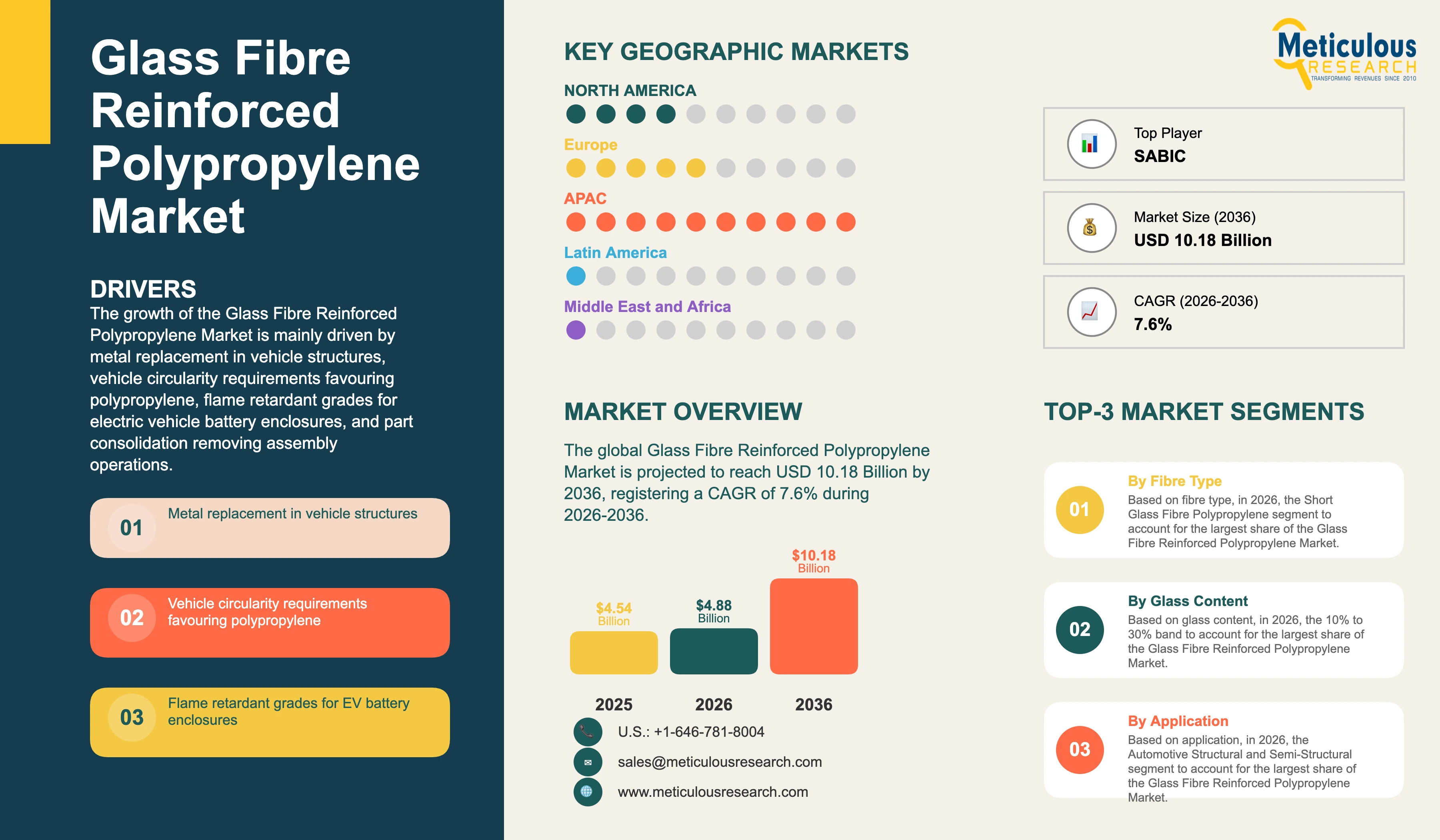
The glass fibre reinforced polypropylene market is valued at USD 4.88 billion in 2026 and is projected to reach USD 10.18 billion by 2036, at a CAGR of 7.6% during the forecast period. The market was valued at USD 4.54 billion in 2025 and at USD 4.26 billion in 2024.
- Published
- Nov 2026
- Pages
- 260
- Format
- PDF + Excel
- Report ID
- MRCHM - 1042764
- Base year
- 2025
- 2024 · HISTORICAL
- $4.26B
- 2036
- $10.18B
- CAGR 2026–2036
- 7.6%
2024–2025 baseline · 2026–2036 forecast at 7.6% CAGR · hover a bar for the value
Key highlights
This market measures glass fibre reinforced polypropylene compound as supplied by the compounder, on a total compound mass basis including the glass fibre, the polypropylene matrix, the coupling agent and the additive package.
The polypropylene matrix resin is also counted in polyolefin resin markets, and the catalyst that makes it in the Ziegler Natta catalysts title in this series. Neither is additive to this market, which measures value added at the compounder gate.
The glass fibre itself, as sold into the compound, is counted in glass fibre markets and is measured here only as part of the compound mass.
Glass mat thermoplastic sheet and continuous glass fibre tape or organosheet are semi-finished forms rather than compounds and are excluded, although both compete for the same structural duty.
Talc and mineral filled polypropylene carrying no glass is excluded. It is the principal competitor at the lower loadings and the material most able to absorb recyclate.
The moulded part is counted in automotive and appliance component markets. This market ends at the pellet.
Value growth at 7.6% runs above volume growth at 5.2%, because the mix moves toward long fibre, higher loadings and flame retardant grades rather than because compound price rises.
Regulation (EU) 2026/1738 of 8 July 2026, on circularity requirements for vehicle design and on management of end-of-life vehicles, was published in the Official Journal on 24 July 2026 and entered into force on 13 August 2026.
It repeals Directive 2000/53/EC and Directive 2005/64/EC and amends four further regulations, applying in full to passenger cars and light commercial vehicles.
Vehicles type-approved from 1 September 2032 must contain at least 15% post-consumer recycled plastic by weight, rising to 25% from 1 September 2036, with at least 20% of that recovered from end-of-life vehicles or parts removed during use.
The same vehicles must be 85% reusable or recyclable and 95% reusable or recoverable, and a digital circularity vehicle passport is required from 1 September 2032.
Waste treatment operators must recycle at least 30% of end-of-life vehicle plastics by weight from 1 January 2032, and the Commission is to set the recycled plastics calculation methodology by 31 August 2028.
For this market that works in two directions. Polypropylene is the largest plastic stream recovered from a scrapped vehicle and the most established to recycle, so the requirement favours it over polyamide and polybutylene terephthalate wherever it can be specified.
Against that, glass fibre is what makes the stream hard to reuse. Fibre length degrades on each reprocessing pass, and separating a glass filled grade from unfilled polypropylene in a mixed stream is not practical at scale.
The resolution runs through part size. Large single-material mouldings are identifiable and removable at dismantling, which makes them the addressable source for the 20% sub-target, while small short fibre parts dispersed through an interior are not.
Saudi Basic Industries Corporation supplies long glass fibre polypropylene at 20%, 30% and 40% loadings as injection moulding grades, with variants for non-halogenated flame retardance, ultraviolet stabilisation, odour control and higher heat performance.
Two of those grades are rated UL 94 V-0, one at 1.5 mm and one at 3.0 mm. Flame retardance at that thickness is what opens electric vehicle battery enclosure duty to a polypropylene compound, and the company names battery covers, enclosures, trays and plates as replacements for steel and aluminium.
The same supplier names instrument panels, front-end and door modules and inner tailgate structures as semi-structural applications, and puts the case for metal replacement as weight reduction, design freedom, part consolidation and no corrosion.
Report summary
| Particulars | Details |
|---|---|
| Base Year | 2025 |
| Actual Years | 2024-2025 |
| Forecast Period | 2026-2036 |
| Market Size in 2024 | USD 4.26 billion |
| Market Size in 2025 | USD 4.54 billion |
| Market Size in 2026 | USD 4.88 billion |
| Market Size in 2036 | USD 10.18 billion |
| Value CAGR (2026-2036) | 7.6% |
| Format | PDF, Excel & Cloud Portal · 260 pages |
| Volume in 2025 | 2.13 million tonnes |
| Volume in 2026 | 2.22 million tonnes |
| Volume in 2036 | 3.69 million tonnes |
| Volume CAGR (2026-2036) | 5.2% |
| Average Selling Price, 2026 | USD 2.20 per kg |
| Average Selling Price, 2036 | USD 2.76 per kg |
| Units | Value in USD million; volume in million tonnes of compound; price in USD per kg |
| Measurement Basis | Glass fibre reinforced polypropylene compound as supplied by the compounder, on a total compound mass basis including glass fibre, polypropylene matrix, coupling agent and additives |
| Exclusions | Glass mat thermoplastic sheet and continuous fibre tape or organosheet; glass fibre sold into the compound; talc and mineral filled polypropylene carrying no glass; the moulded part |
| Segments: Fibre Type | Short Glass Fibre Polypropylene; Long Glass Fibre Polypropylene |
| Segments: Glass Content | Below 10%; 10% to 30%; Above 30% |
| Segments: Application | Automotive Structural and Semi-Structural; Automotive Under-Bonnet and Underbody; Electric Vehicle Battery Enclosures and Covers; Appliances and Electrical; Industrial and Building |
| Largest Segment by Fibre Type, 2026 | Short Glass Fibre Polypropylene |
| Fastest-Growing Segment by Fibre Type | Long Glass Fibre Polypropylene, at 10.6% |
| Largest Segment by Glass Content, 2026 | 10% to 30% |
| Fastest-Growing Segment by Glass Content | Above 30%, at 9.6% |
| Largest Segment by Application, 2026 | Automotive Structural and Semi-Structural |
| Fastest-Growing Segment by Application | Electric Vehicle Battery Enclosures and Covers, at 16.0% |
| Largest Region, 2026 | Asia-Pacific |
| Fastest-Growing Region | Middle East & Africa, at 9.0% |
| Fastest-Growing Country | India, at 10.4% |
| Slowest-Growing Country | Japan, at 4.4% |
| Regions Covered | Asia-Pacific; Europe; North America; Latin America; Middle East & Africa |
| Countries Covered | China; India; Japan; South Korea; Germany; France; Spain; Czech Republic; U.S.; Mexico; Brazil; Saudi Arabia; Morocco |
| Key Players | Saudi Basic Industries Corporation; Borealis AG; LyondellBasell Industries N.V.; Celanese Corporation; Avient Corporation; Kingfa Sci. & Tech. Co., Ltd. |
| Top Five Share, 2026 | 38.4% |
| Profiled Companies Share, 2026 | 43.6% |
| Currency | USD |
Report overview
Market value is measured in in USD million; volume in million tonnes of compound; price in USD per kg. Segments covered: fibre type, glass content, application.
In volume terms, the market is estimated at 2.22 million tonnes of compound in 2026, rising to 3.69 million tonnes by 2036, at a CAGR of 5.2%. The average selling price is estimated at USD 2.20 per kg in 2026 and USD 2.76 per kg in 2036, the increase reflecting a shift from short fibre grades toward long glass fibre, higher glass loadings and flame retardant battery enclosure compounds, each of which carries a premium over commodity reinforced polypropylene.
The growth of this market is mainly driven by metal replacement in vehicle structures, the substitution of polypropylene for engineering polymers under new vehicle circularity requirements, the emergence of flame retardant long glass fibre grades for electric vehicle battery enclosures, and part consolidation that removes assembly operations. However, factors such as the difficulty of carrying post-consumer recyclate in a reinforced compound, competition from talc and mineral filled polypropylene at lower loadings, the loss of fibre length through reprocessing, and competition from glass mat thermoplastic and continuous fibre forms in the most demanding structures are expected to restrain the growth of this market to some extent.
Among fibre types, short glass fibre polypropylene is expected to hold the largest share of this market in 2026, while long glass fibre polypropylene is expected to record the highest CAGR during the forecast period. Geographically, Asia-Pacific is expected to account for the largest share of this market in 2026, while the Middle East & Africa is expected to register the highest CAGR during the forecast period.
Glass fibre reinforced polypropylene is made by melt compounding chopped or continuous glass strand into a polypropylene matrix with a maleic anhydride grafted coupling agent. The coupling agent is the part that matters commercially: polypropylene is non-polar and glass is not, so without a graft to bridge them the fibre carries no load and the compound is merely filled rather than reinforced. Everything that distinguishes a structural grade from a commodity one follows from how well that interface is built.
The second variable is the fibre length that survives processing. Short glass fibre compounds are made on a twin screw extruder where chopped strand is fed into the melt and broken down further by shear, leaving residual fibre in the fractions of a millimetre. Long glass fibre compounds are made by pultrusion, drawing continuous roving through a melt impregnation die and chopping the impregnated strand to pellet length, so the fibre is as long as the pellet.
That difference is why the two are priced and specified as separate products. Longer fibre carries load across a greater distance and forms an entangled network in the moulded part, which raises stiffness, notched impact strength and resistance to creep at temperature. Short fibre grades reach none of that but mould more easily, hold tighter tolerances and cost less, which is why they remain the larger share of this market.
Saudi Basic Industries Corporation supplies long glass fibre polypropylene at 20%, 30% and 40% loadings, all as injection moulding grades, with an easy flow characteristic for thin walls and with grade variants offering non-halogenated flame retardance, ultraviolet stabilisation, emission optimisation for odour control and higher heat performance. The portfolio spans both homopolymer and copolymer matrices, the copolymer grades carrying the improved flow and impact combinations.
The commercial argument for the material is set out by the same supplier as weight reduction, design freedom, part consolidation, the elimination of corrosion and the avoidance of costly secondary operations. Part consolidation is the one that usually decides the business case, because a single moulding that replaces a stamped, welded and painted steel assembly removes tooling, joining and finishing operations rather than simply substituting a material.
Named applications follow that logic. Instrument panel carriers, front-end modules, door modules and inner tailgate structures are semi-structural parts where a metal assembly of several pieces becomes one moulding with integrated mounting points, ribs and clip features. These are the volume applications of long glass fibre polypropylene and the reason the automotive structural segment holds the largest application share in this market.
Electric vehicle battery enclosures are the newer and faster duty. The same supplier names battery covers, enclosures, trays and plates as replacements for steel and aluminium, and it is flame retardance that makes this accessible: two grades in the range carry a UL 94 V-0 rating, one at 1.5 mm and one at 3.0 mm, achieved on a non-halogenated basis.
Without that rating the application is closed, because a battery enclosure must contain a thermal event rather than merely resist ignition. Reaching V-0 at 1.5 mm on a polypropylene matrix without halogen is the technical threshold that moved battery enclosure duty from polyamide, polyphenylene sulphide and sheet moulding compound into reach of a polyolefin, and it is why the segment is forecast at 16.0% while the rest of the market grows at single digits.
The regulatory position changed materially with Regulation (EU) 2026/1738 of 8 July 2026 on circularity requirements for vehicle design and on management of end-of-life vehicles, published in the Official Journal on 24 July 2026 and in force from 13 August 2026. It repeals Directive 2000/53/EC and Directive 2005/64/EC and amends Regulations (EU) No 168/2013, (EU) 2018/858, (EU) 2019/1020 and (EU) 2023/1542, applying in full to passenger cars and light commercial vehicles.
Its central requirement for materials is a recycled content mandate. Vehicles type-approved from 1 September 2032 must contain at least 15% post-consumer recycled plastic by weight, rising to 25% from 1 September 2036, and at least 20% of that recycled content must come from plastics recovered from end-of-life vehicles or from parts removed during the use phase.
Around that sit a set of supporting obligations: 85% reusability or recyclability and 95% reusability or recoverability for vehicles type-approved from 1 September 2032, a requirement on waste treatment operators to recycle at least 30% of end-of-life vehicle plastics by weight from 1 January 2032, a circularity strategy from each manufacturer by 1 September 2029 updated every five years, extended producer responsibility with eco-modulated fees by the same date, and a digital circularity vehicle passport from 1 September 2032.
The first consequence favours polypropylene unambiguously. A vehicle maker obliged to hit a recycled content figure across the whole vehicle by weight will take it wherever recyclate is available and qualified, and polypropylene is both the largest plastic stream recovered from a scrapped car and the one with the most established mechanical recycling route. Where a part can be made in polypropylene at all, the regulation makes the case for doing so rather than specifying polyamide.
The second consequence works against reinforcement. Glass fibre length falls with every melt history, so a compound built on recovered reinforced polypropylene cannot reproduce the stiffness of a virgin grade, and separating a 30% glass filled bumper bracket from unfilled fascia material in a shredded stream is not achievable at the purity a structural grade requires.
What reconciles the two is part size and identifiability. A front-end module, an underbody shield or a battery tray is a large, single-material moulding that a dismantler can remove whole and route to a known compound, which is precisely the condition the 20% end-of-life vehicle sub-target requires. The digital circularity vehicle passport reinforces this by obliging material composition to be declared, which rewards an all-polypropylene module over a multi-material assembly.
The flame retardant battery enclosure grades sit awkwardly within this. A compound carrying both glass fibre and a non-halogenated flame retardant package cannot absorb post-consumer recyclate without putting both its mechanical rating and its UL 94 rating at risk, and the regulation gives the European Chemicals Agency a role in evaluating substances of concern. The recycled content burden therefore falls on unfilled and mineral filled polypropylene elsewhere in the vehicle while the reinforced grades take the structural growth.
The result is a market growing in volume at 5.2% on metal replacement and electric vehicle content, and in value at 7.6% because the mix shifts toward long fibre, higher loadings and flame retardant grades. Average selling price rises from USD 2.20 per kg to USD 2.76 per kg on that shift rather than on compound price inflation.
Report infographic
Market dynamics
22 factors across 5 forcesMetal Replacement in Vehicle Structures
Replacing a steel assembly with a single moulding removes mass, and Saudi Basic Industries Corporation sets out the case as weight reduction together with design freedom, part consolidation, the elimination of corrosion and the avoidance of costly secondary operations. Part consolidation usually decides the business case, because the saving is in tooling, joining and finishing rather than in the material.
Long glass fibre polypropylene reaches the stiffness and notched impact performance that semi-structural duty requires, which is why instrument panel carriers, front-end modules, door modules and inner tailgate structures are the volume applications. Automotive structural duty grows at 6.6% and long fibre as a type at 10.6% against 5.8% for short fibre, so metal replacement moves the mix as well as the volume.
Vehicle Circularity Requirements Favouring Polypropylene
Regulation (EU) 2026/1738 requires vehicles type-approved from 1 September 2032 to contain at least 15% post-consumer recycled plastic by weight, rising to 25% from 1 September 2036, with at least 20% of that recovered from end-of-life vehicles or parts removed during the use phase.
Polypropylene is the largest plastic stream recovered from a scrapped vehicle and has the most established mechanical recycling route, so a manufacturer obliged to hit a whole-vehicle figure has a direct incentive to specify it wherever a part can be made in it, against polyamide, polybutylene terephthalate and polycarbonate blends.
The effect is a substitution driver with no connection to metal at all. It arrives on a fixed timetable, with the Commission methodology due by 31 August 2028 and manufacturer circularity strategies by 1 September 2029, so specification decisions are being taken well before the 2032 compliance date.
Flame Retardant Grades for Electric Vehicle Battery Enclosures
Battery enclosure duty was closed to polyolefins until flame retardance could be reached at moulding thickness. Saudi Basic Industries Corporation offers long glass fibre polypropylene grades rated UL 94 V-0, one at 1.5 mm and one at 3.0 mm, on a non-halogenated basis, and names battery covers, enclosures, trays and plates as replacements for steel and aluminium.
The parts are large, which suits a material sold on part consolidation, and the mass saved sits low in the vehicle where it affects range directly. Electric vehicle battery enclosures and covers are forecast at 16.0%, by a wide margin the fastest application here, and they carry the highest price per kilogram in the market.
Part Consolidation Removing Assembly Operations
A moulded reinforced polypropylene part can carry ribs, bosses, clip features and mounting points formed in the tool, which a stamped metal equivalent cannot, and each feature moulded in is a fastener, a weld or a bracket removed from the assembly line.
The value accrues beyond the material price, because the vehicle maker avoids a press tool, a welding station and a paint pass, and corrosion protection becomes unnecessary. This driver supports price rather than volume, since the compound displaces assembly cost rather than competing on cost per kilogram.
Single-Material Design for Dismantling and Declaration
Regulation (EU) 2026/1738 requires vehicles type-approved from 1 September 2032 to be 85% reusable or recyclable and 95% reusable or recoverable, and introduces a digital circularity vehicle passport from the same date that obliges material composition to be declared.
A module built entirely in polypropylene can be removed whole and routed to a known compound stream, which a multi-material assembly cannot. Declaring composition rewards that architecture and also makes the part a credible source for the 20% end-of-life vehicle recycled content sub-target.
Table of contents
11 chapters · 131 sections · 260 pages · click to expandSegmental analysis
| Segment | Largest share (2026) | Fastest growth (2026–2036) |
|---|---|---|
| By Fibre Type | Short glass fibre polypropylene | Long glass fibre polypropylene |
| By Glass Content | 10% to 30% band | Glass contents above 30% |
| By Application | Automotive structural and semi-structural | Electric vehicle battery enclosures and covers |
| By Geography | Asia-Pacific | Middle East & Africa |
By Fibre Type
- Glass Fibre Reinforced Polypropylene Analysis by Fibre Type
- This market is segmented by fibre type into short glass fibre polypropylene and long glass fibre polypropylene.
- Short glass fibre polypropylene is expected to hold the largest share of this market in 2026.
- The segment leads because chopped strand compounding on a twin screw extruder is established, inexpensive and available from a wide supply base, and because the residual fibre length of a fraction of a millimetre is sufficient for the stiffness most parts require.
- Short fibre grades also mould more easily and hold closer tolerances, since less fibre means less orientation driven warpage, and that is decisive wherever dimensional control matters more than structural performance.
- Growth is held to 5.8% by the migration of semi-structural duty to long fibre.
- Long glass fibre polypropylene is expected to record the highest CAGR of 10.6% during the forecast period.
- The segment grows because pultrusion through a melt impregnation die leaves fibre as long as the pellet, which forms an entangled network in the moulded part and delivers the stiffness, notched impact strength and creep resistance that semi-structural metal replacement requires.
- Saudi Basic Industries Corporation supplies these grades at 20%, 30% and 40% loadings with variants for flame retardance, ultraviolet stabilisation, emission optimisation and higher heat performance, and names instrument panels, front-end and door modules and inner tailgate structures among their applications.
By Glass Content
- Glass Fibre Reinforced Polypropylene Analysis by Glass Content
- This market is segmented into below 10%, 10% to 30%, and above 30% glass by weight.
- The 10% to 30% band is expected to account for the largest share of this market in 2026.
- The band leads because it covers the great majority of automotive and appliance duty, delivering a substantial modulus gain over unfilled polypropylene while remaining mouldable in conventional tooling at acceptable cycle times.
- It grows at 6.8%, close to the market average, since it gains volume from metal replacement while losing the lower end of its range to mineral filled grades.
- Glass contents above 30% are expected to register the highest CAGR of 9.6% during the forecast period, growing where a part is replacing a metal assembly rather than another plastic and the comparison is therefore against a stamped and welded structure rather than against a cheaper compound.
- The Saudi Basic Industries Corporation range extends to 40% long glass fibre with variants for high strength and stiffness and for high temperature resistance, and higher loadings carry a higher price per kilogram, so the band contributes to value growth ahead of its tonnage.
- Glass contents below 10% grow at 7.0%.
- The band is the most exposed in this market, because at those loadings talc and calcium carbonate filled polypropylene delivers comparable modulus at lower cost with better surface finish, and mineral filled grades absorb post-consumer recyclate far more readily, which the recycled content requirement now rewards directly.
By Application
- Glass Fibre Reinforced Polypropylene Analysis by Application
- This market is segmented into automotive structural and semi-structural, automotive under-bonnet and underbody, electric vehicle battery enclosures and covers, appliances and electrical, and industrial and building.
- Automotive structural and semi-structural applications are expected to account for the largest share of this market in 2026, covering instrument panel carriers, front-end modules, door modules and inner tailgate structures.
- The segment leads because these are the parts where a single moulding replaces a stamped, welded and painted steel assembly, so the saving is in tooling, joining and finishing rather than in material cost.
- It grows at 6.6%.
- Electric vehicle battery enclosures and covers are expected to register the highest CAGR of 16.0% during the forecast period.
- The segment was closed to polyolefins until flame retardance could be reached at moulding thickness, and Saudi Basic Industries Corporation now offers long glass fibre polypropylene rated UL 94 V-0 at 1.5 mm and at 3.0 mm on a non-halogenated basis, naming battery covers, enclosures, trays and plates as replacements for steel and aluminium.
- The parts are large, which suits a material sold on part consolidation, the mass saved sits low in the vehicle where it affects range directly, and the compounds carry the highest price per kilogram in this market.
- Automotive under-bonnet and underbody applications grow at 5.6%, the slowest in this report, covering air intake components, fan shrouds, battery trays for conventional vehicles and underbody shields.
- The segment is mature and partly exposed to the contraction of internal combustion content, with underbody shielding also contested by glass mat thermoplastic.
- Appliances and electrical applications grow at 7.4% in washing machine tubs and drums, dishwasher components and electrical enclosures, where stiffness, chemical resistance and dimensional stability in wet or warm service are required.
- Industrial and building applications grow at 8.0% in pump and valve bodies, power tool housings and water management components.
By Geography
- Glass Fibre Reinforced Polypropylene Analysis by Geography
- Geographically, this market is segmented into Asia-Pacific, Europe, North America, Latin America, and the Middle East & Africa, with individual country sizing within each region.
- Asia-Pacific is expected to account for the largest share of this market in 2026, on the concentration of vehicle and appliance assembly in China, India, Japan and South Korea and on local compounding capacity built alongside it.
- The Middle East & Africa is expected to register the highest CAGR of 9.0%, on vehicle assembly growth in Morocco and on resin integrated compounding in the Gulf, from a small base.
- Europe is expected to grow at 6.2% despite originating the circularity requirements that drive polymer substitution in this market, because the uplift lands on a vehicle production base that is not expanding.
- The regulation raises the polypropylene share of each vehicle rather than the number of vehicles built.
Geographic analysis
Asia-Pacific
Largest shareAsia-Pacific is expected to account for the largest share of this market in 2026. Compound is bulky relative to its value and is qualified per vehicle platform, so compounding capacity has been built alongside the vehicle and appliance assembly concentrated in the region rather than supplying it by trade. India is expected to record the highest country CAGR in this report at 10.4%, on passenger and commercial vehicle production growth together with appliance manufacturing for both domestic consumption and export. China follows at 9.4%, where electric vehicle production volume makes the country the largest single market for flame retardant battery enclosure compounds as well as for conventional structural grades. Japan grows at 4.4%, the slowest country rate in this report, and South Korea at 6.0%. Both host substantial compounding capability serving export vehicle programmes rather than expanding domestic assembly, so growth comes from the shift to long fibre and higher loadings rather than from volume.
Europe
Europe is expected to grow at 6.2%, with the Czech Republic at 7.4%, Spain at 6.4%, Germany at 6.0% and France at 5.4%. The region originates the circularity requirements that are moving specification from engineering polymers to polypropylene, and the eastern assembly base grows faster than the western one, but the uplift lands on a vehicle production base that is not expanding.
North America
North America is expected to grow at 7.0%, with the United States at the same rate. Light truck and sport utility production supports large structural mouldings where part consolidation delivers the greatest saving, and electric vehicle battery enclosure programmes add the highest value duty in the region. Mexico grows on vehicle assembly serving North American programmes, which brings compounding capacity with it, while Brazil draws on a domestic vehicle and appliance base that is stable rather than expanding.
Latin America
Latin America is expected to grow at 6.4%, with Mexico at 8.0% and Brazil at 6.0%.
Middle East & Africa
The Middle East & Africa is expected to register the highest regional CAGR at 9.0%, led by Morocco at 9.4% and Saudi Arabia at 9.0%. Morocco grows on vehicle assembly built for European export, which brings local compounding with it, while Gulf growth draws on polypropylene production integrated into compounding, from a base small enough that individual plants move the regional rate.
Competitive landscape
The global glass fibre reinforced polypropylene market is moderately fragmented, because short fibre compounding on a twin screw extruder is widely available while long glass fibre pultrusion and flame retardant formulation are held by a smaller group. Some of the key players operating in the glass fibre reinforced polypropylene market are Saudi Basic Industries Corporation (Saudi Arabia), Borealis AG (Austria), LyondellBasell Industries N.V. (Netherlands), Celanese Corporation (U.S.), Avient Corporation (U.S.), and Kingfa Sci. & Tech. Co., Ltd. (China), among others.
Saudi Basic Industries Corporation holds the leading position in long glass fibre polypropylene, supplying 20%, 30% and 40% loadings across homopolymer and copolymer matrices with variants for non-halogenated flame retardance, ultraviolet stabilisation, emission optimisation for odour control and higher heat performance, two of them rated UL 94 V-0 at 1.5 mm and 3.0 mm. That flame retardant capability is what gives the company access to battery enclosure duty, the fastest application in this market.
Borealis AG and LyondellBasell Industries N.V. compete from integrated polypropylene production, which gives both a matrix cost position that independent compounders cannot match and matters increasingly as recycled content obligations put a premium on controlling the polymer stream as well as the compound. LyondellBasell Industries N.V. is also a party to the catalyst and resin steps measured separately in this series.
Celanese Corporation and Avient Corporation compete as specialty compounders without upstream resin positions, differentiating on long fibre technology, formulation breadth and application development support at the moulder, which matters because fibre length is realised in the moulding shop rather than sold in the pellet. Kingfa Sci. & Tech. Co., Ltd. holds the largest position in China, where electric vehicle production volume makes the domestic market the single largest outlet for both structural and battery enclosure compounds.
The five largest participants are estimated to hold 38.4% of this market in 2026, and the six companies profiled in this report 43.6%. The remainder is held by regional compounders across Asia, Europe and North America serving local platform awards, whose individual positions are not separately quantified in this report. Competitive movement over the forecast period is expected to come from flame retardant battery enclosure qualification and from securing closed-loop recyclate streams rather than from compounding capacity, which is not a constraint.
- Saudi Basic Industries Corporation
- Borealis AG
- LyondellBasell Industries N.V.
- Celanese Corporation
- Avient Corporation
- Kingfa Sci. & Tech. Co., Ltd
Expert perspectives
The named driver for this market is metal replacement in vehicles, and it holds. Automotive structural and semi-structural duty is the largest application at 46.0% and grows at 6.6%, long glass fibre polypropylene grows at 10.6% against 5.8% for short fibre, and the case Saudi Basic Industries Corporation sets out of weight reduction with design freedom, part consolidation, no corrosion and the avoidance of costly secondary operations is the argument that actually wins platform awards.
What the named driver misses is that the most consequential development in this market is not about metal at all. Regulation (EU) 2026/1738, adopted on 8 July 2026 and in force from 13 August 2026, requires vehicles type-approved from 1 September 2032 to carry at least 15% post-consumer recycled plastic by weight, rising to 25% from 1 September 2036, with at least 20% of that recovered from end-of-life vehicles.
Set across the whole vehicle by weight, that obligation forces a manufacturer toward the polymer with the largest recovered stream and the most established recycling route, which is polypropylene. Every application that could be specified in either polypropylene or an engineering polymer now resolves toward polypropylene on compliance rather than on properties, and that is a substitution driver operating against polyamide and polybutylene terephthalate independently of any metal.
The same regulation cuts the other way on the reinforcement. Fibre length falls with each melt history, so recovered reinforced polypropylene cannot reproduce virgin stiffness, and separating a glass filled bracket from unfilled fascia material in a shredded stream is not achievable at structural purity. A compound carrying both glass and a non-halogenated flame retardant package is harder still, since recyclate puts both the mechanical and the UL 94 rating at risk.
What reconciles those two is part size. A front-end module, underbody shield or battery tray is large, single-material and removable whole, which is the only practical route to the 20% end-of-life vehicle sub-target, and the digital circularity vehicle passport required from 1 September 2032 makes that composition declarable. The recycled content burden lands on unfilled and mineral filled polypropylene elsewhere in the vehicle while the reinforced grades take the structural growth, which is a comfortable position but one worth understanding rather than assuming.
The fastest duty in this market rests on a narrower technical fact than the growth rate suggests. Battery enclosures opened to polyolefins only when flame retardance reached moulding thickness, and the two grades rated UL 94 V-0 at 1.5 mm and 3.0 mm on a non-halogenated basis are what carry the 16.0% forecast. Since the regulation also gives the European Chemicals Agency a role in evaluating substances of concern, the additive package behind that rating is under continuing review, and the fastest segment in this report is the one whose enabling chemistry is least settled.
Customer perspectives
Vehicle makers evaluate a reinforced compound against the metal assembly it replaces rather than against another plastic, counting the tooling, welding and paint operations removed.
The compound is never the cheapest way to make the part on a cost per kilogram basis. It is the cheapest way to make the assembly, and that is the number we approve.
Moulders report that long fibre grades cannot be dropped into a tool built for short fibre, because gate geometry and injection speed determine how much fibre length survives into the part.
Buyers treat fibre length in the finished moulding as the specification that matters, and expect the compounder to support tool design and process settings rather than only supply a datasheet.
Battery enclosure buyers treat the UL 94 rating as a gate rather than a feature, since the part must contain a thermal event, and will not consider a compound that does not carry it at the moulded thickness.
Purchasers report that recycled content is now specified at programme level across the whole vehicle, and that a structural part exempt in practice must be offset by parts that can carry recyclate.
Buyers report asking compounders where the recyclate will come from rather than whether it is available, with closed-loop return from their own end-of-life parts treated as the credible answer.
Specifiers of parts below about 10% glass report evaluating mineral filled polypropylene alongside glass, on surface finish and warpage as much as on cost.
Appliance buyers report shorter qualification programmes than automotive and more willingness to change compound between model years, which makes the segment competitive on price and delivery.
Buyers report sourcing compound close to the moulding plant, because the material is bulky relative to its value and platform qualification ties the supply to a specific site.
Design teams report that single-material module architecture is now assessed at concept stage, because declaring composition and demonstrating dismantling are becoming type-approval matters rather than sustainability reporting ones.
Frequently asked questions
The glass fibre reinforced polypropylene market is valued at USD 4.88 billion in 2026 and is projected to reach USD 10.18 billion by 2036, at a CAGR of 7.6% during the forecast period. In volume terms the market is estimated at 2.22 million tonnes of compound in 2026, rising to 3.69 million tonnes by 2036 at a CAGR of 5.2%.
Metal replacement in vehicle structures, the substitution of polypropylene for engineering polymers under new vehicle circularity requirements, flame retardant long glass fibre grades opening electric vehicle battery enclosure duty, part consolidation that removes assembly operations, and single-material design driven by dismantling and material declaration obligations.
The difficulty of carrying post-consumer recyclate in a reinforced compound, competition from talc and mineral filled polypropylene at low loadings, competition from glass mat thermoplastic and continuous fibre forms, and fibre orientation effects on dimensional control. The principal challenges are preserving fibre length through moulding, reaching flame retardance without halogen in a reinforced matrix, and qualifying recyclate before the calculation methodology exists.
Glass fibre reinforced polypropylene compound as supplied by the compounder, on a total compound mass basis including the glass fibre, the polypropylene matrix, the coupling agent and the additive package. Glass mat thermoplastic sheet, continuous fibre tape and organosheet are semi-finished forms and are excluded, as is talc and mineral filled polypropylene carrying no glass, and the moulded part.
It is not additive to them. The polypropylene matrix resin is counted in polyolefin resin markets and the catalyst that makes it in the Ziegler Natta catalysts title, while this market measures the value added at the compounder gate. The glass fibre is likewise counted in glass fibre markets and is measured here only as part of the compound mass.
Because the mix moves toward long glass fibre, higher glass loadings and flame retardant battery enclosure grades, each of which carries a premium over commodity reinforced polypropylene. Average selling price rises from USD 2.20 per kg to USD 2.76 per kg on that shift rather than on compound price inflation.
Short glass fibre polypropylene is expected to hold the largest share in 2026, because chopped strand compounding is inexpensive and widely available and the grades mould more easily with closer tolerances. Long glass fibre polypropylene is projected to grow fastest at 10.6%, because pultrusion leaves fibre as long as the pellet and delivers the stiffness, notched impact strength and creep resistance semi-structural metal replacement requires.
The 10% to 30% band is expected to hold the largest share in 2026, covering most automotive and appliance duty while remaining mouldable in conventional tooling. Glass contents above 30% are projected to grow fastest at 9.6%, specified where a part replaces a metal assembly rather than another plastic and the comparison is against a stamped and welded structure.
Automotive structural and semi-structural applications are expected to hold the largest share in 2026, covering instrument panel carriers, front-end modules, door modules and inner tailgate structures. Electric vehicle battery enclosures and covers are projected to grow fastest at 16.0%, because non-halogenated flame retardant grades have brought the duty within reach of a polypropylene compound for the first time.
Adopted on 8 July 2026, published in the Official Journal on 24 July 2026 and in force from 13 August 2026, it requires vehicles type-approved from 1 September 2032 to contain at least 15% post-consumer recycled plastic by weight, rising to 25% from 1 September 2036, with at least 20% of that recovered from end-of-life vehicles. The same vehicles must be 85% reusable or recyclable and 95% reusable or recoverable, and a digital circularity vehicle passport is required from 1 September 2032.
It repeals Directive 2000/53/EC on end-of-life vehicles and Directive 2005/64/EC on type-approval for reusability, recyclability and recoverability, and amends Regulations (EU) No 168/2013, (EU) 2018/858, (EU) 2019/1020 and (EU) 2023/1542. It applies in full to passenger cars and light commercial vehicles and partially to L-category vehicles, heavy-duty vehicles and their trailers.
The recycled content obligation is set across the whole vehicle by weight, which obliges a manufacturer to find qualified recyclate wherever it can. Polypropylene is the largest plastic stream recovered from a scrapped vehicle and has the most established mechanical recycling route, so every application that could be specified in either polypropylene or an engineering polymer now resolves toward polypropylene on compliance rather than on properties.
It does. Fibre length falls with each melt history, so recovered reinforced polypropylene cannot reproduce virgin stiffness, and separating a glass filled part from unfilled polypropylene in a shredded stream is not achievable at structural purity. The reconciliation runs through part size: large single-material mouldings can be removed whole at dismantling, which is the practical route to the 20% sub-target, so the recycled content burden falls on unfilled and mineral filled polypropylene while the reinforced grades take the structural growth.
Flame retardance at moulded thickness. Saudi Basic Industries Corporation offers long glass fibre polypropylene grades rated UL 94 V-0, one at 1.5 mm and one at 3.0 mm, on a non-halogenated basis, and names battery covers, enclosures, trays and plates as replacements for steel and aluminium. A battery enclosure must contain a thermal event rather than merely resist ignition, so the rating is the gate rather than a feature.
Asia-Pacific is expected to account for the largest share in 2026, because compound is bulky relative to its value and qualified per platform, so compounding capacity has been built alongside the vehicle and appliance assembly concentrated in the region. The Middle East & Africa is expected to grow fastest at 9.0% from a small base, while India records the highest country CAGR at 10.4%.
Europe is expected to grow at 6.2%, with the Czech Republic at 7.4%, Spain at 6.4%, Germany at 6.0% and France at 5.4%. Key players include Saudi Basic Industries Corporation (Saudi Arabia), Borealis AG (Austria), LyondellBasell Industries N.V. (Netherlands), Celanese Corporation (U.S.), Avient Corporation (U.S.), and Kingfa Sci. & Tech. Co., Ltd. (China), among others.
Cite this report
Meticulous Research. (2026). Glass Fibre Reinforced Polypropylene Market - Global Opportunity Analysis and Industry Forecast (2026-2036) (Report No. MRCHM - 1042764). Meticulous Market Research Pvt. Ltd. https://www.meticulousresearch.com/product/glass-fibre-reinforced-polypropylene-market-7447