Gas Metering and Pressure Regulation Market (2026-2036)
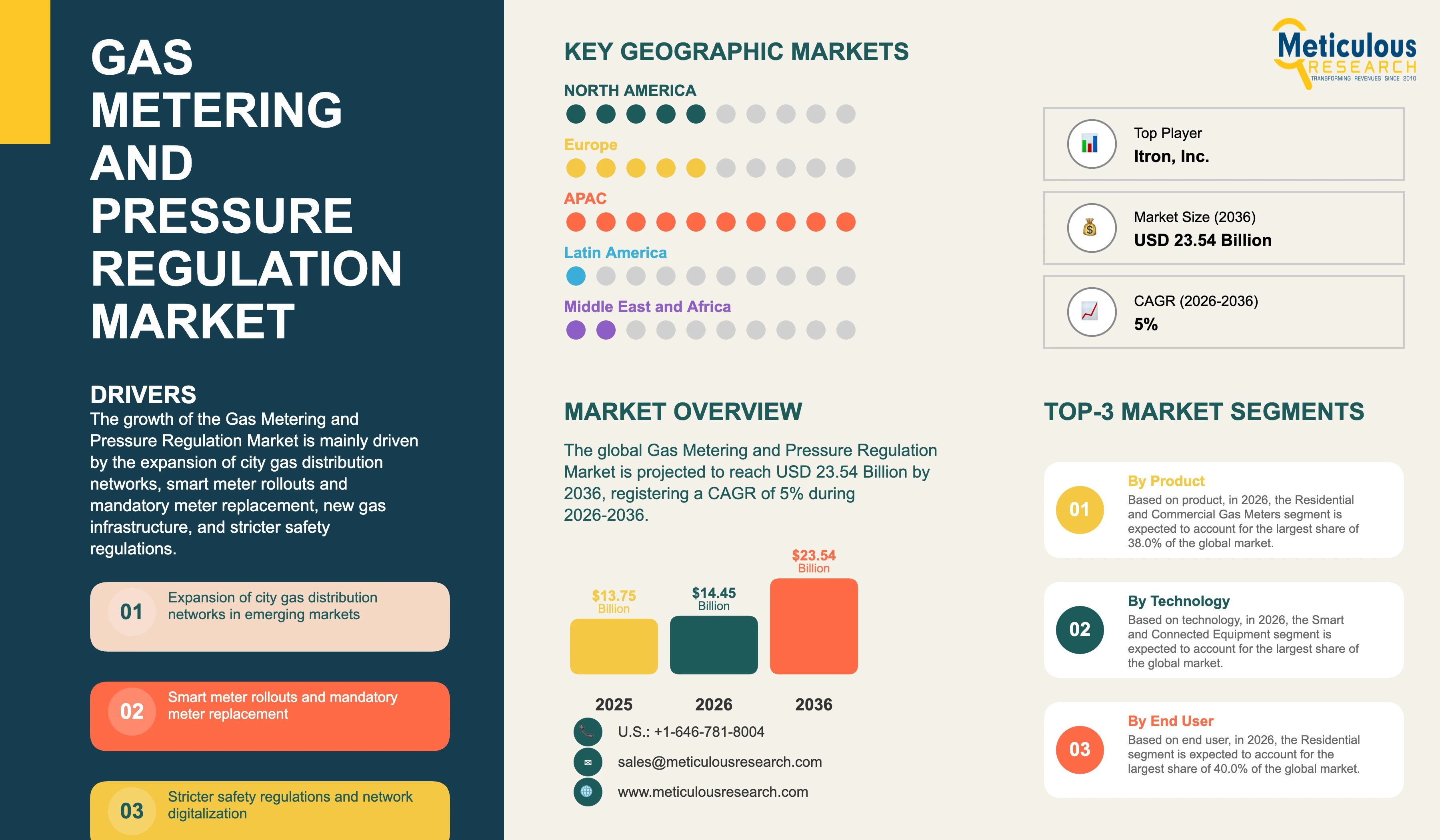
The global gas metering and pressure regulation market was valued at USD 13.75 billion in 2025. This market is expected to reach USD 23.54 billion by 2036 from an estimated USD 14.45 billion in 2026, registering a CAGR of 5.0% during the forecast period (2026-2036).
- Published
- Nov 2026
- Pages
- 280
- Format
- PDF + Excel
- Report ID
- MREP - 1042712
- Base year
- 2025
- 2025 · BASELINE
- $13.75B
- 2036
- $23.54B
- CAGR 2026–2036
- 5.0%
2025 baseline · 2026–2036 forecast at 5.0% CAGR · hover a bar for the value
Key highlights
India had about 1.74 crore (17.4 million) domestic piped natural gas connections as of August 18, 2026, with city gas distribution entities authorized across 309 geographical areas covering the entire mainland. The Petroleum and Natural Gas Regulatory Board has set a Minimum Work Programme target of 12.63 crore domestic connections and 18,336 CNG stations by 2034.
India added about 21 lakh (2.1 million) new domestic PNG connections in FY 2024-25, and under the National PNG Drive 2.0 from January to June 2026, about 12.10 lakh new domestic connections were added. The government launched an Incentive Scheme for Promotion of Domestic PNG Connections on August 18, 2026, effective from September 1, 2026.
Goldcard Smart Group, a leading Chinese smart gas meter manufacturer, reported 2025 revenue of RMB 3.227 billion, up 5.26%, with sales of smart residential gas terminals up 16.28% and sales of residential ultrasonic gas meters up 74.15%, supported by the renovation of old residential communities and cyclical mandatory gas meter replacement in China. Its overseas revenue rose 62.12%.
Itron reported that more than 3 million of its Intelis ultrasonic smart gas meters have been deployed, including a contract with CenterPoint Energy for 3 million Intelis meters, and the meters can automatically shut off gas flow when they detect high-flow conditions.
Landis+Gyr partnered with Origin Energy in Australia to deploy smart IoT modules on existing gas meters over 18 months, and the success of the rollout could support deployment across about two million Landis+Gyr gas meters already installed in Australia.
The EU Hydrogen and Decarbonised Gas Market Package requires transmission operators to accept blends of up to 2% hydrogen at cross-border interconnection points, which is driving demand for hydrogen-ready meters, gas quality analyzers, and regulators in European gas networks.
By product, residential and commercial gas meters account for the largest share of 38.0% in 2026, while flow computers, gas analyzers, and software registers the highest CAGR.
By network segment, end-user premises account for the largest share in 2026 and also register the highest CAGR.
By technology, smart and connected equipment accounts for the larger share in 2026 and also registers the higher CAGR.
By end user, residential accounts for the largest share of 40.0% in 2026, while CNG and LNG fueling stations register the highest CAGR.
By geography, Asia-Pacific accounts for the largest share of 44.0% in 2026 and also registers the highest CAGR of 5.9%.
Report summary
| Particulars | Details |
|---|---|
| Base Year | 2025 |
| Estimated Year | 2026 |
| Forecast Period | 2026-2036 |
| Market Size in 2025 | USD 13.75 billion |
| Market Size in 2026 | USD 14.45 billion |
| Market Size by 2036 | USD 23.54 billion |
| CAGR (2026-2036) | 5.0% |
| Format | PDF, Excel & Cloud Portal · 280 pages |
| Largest Segment by Product (2026) | Residential and Commercial Gas Meters (38.0%) |
| Largest Segment by End User (2026) | Residential (40.0%) |
| Largest Region (2026) | Asia-Pacific (44.0%) |
| Fastest-Growing Region | Asia-Pacific (CAGR 5.9%) |
| Companies Profiled | 12 companies and other companies |
| Segments Covered | Product, Network Segment, Technology, End User, Geography |
| Countries Covered | China, India, Japan, South Korea, Australia, Indonesia, Thailand, Rest of Asia-Pacific, U.K., Germany, Italy, France, Netherlands, Poland, Turkey, Rest of Europe, U.S., Canada, Mexico, Saudi Arabia, UAE, Iran, Egypt, Rest of Middle East & Africa, Brazil, Argentina, Colombia, Rest of Latin America |
Report overview
Segments covered: product, network segment, technology, end user.
The growth of this market is mainly driven by the rapid expansion of city gas distribution networks and household piped gas connections in India and other emerging economies, the large-scale replacement of mechanical gas meters with smart, prepaid, and ultrasonic meters in China, Europe, North America, and Australia, mandatory periodic meter replacement and the renovation of old residential communities in China, the construction of new transmission pipelines, city gate stations, and LNG and CNG infrastructure that require metering and pressure regulation, stricter safety regulations that require automatic shut-off, leak detection, and remote monitoring, the need for accurate custody transfer measurement as gas trade grows, and the preparation of gas networks for hydrogen and biomethane. However, factors such as declining residential gas demand and restrictions on new gas connections in parts of Europe and North America, price competition in the residential meter segment, and the high cost of smart meter rollouts are expected to restrain the growth of this market to some extent.
Gas metering and pressure regulation equipment measures the volume and energy of natural gas as it moves through gas networks and reduces gas pressure safely from high transmission pressures to the low pressures used by homes, businesses, and industrial equipment. Meters are installed at transmission entry and exit points, city gate stations, district stations, and every customer premises, while pressure regulators are installed at city gate stations, district regulating stations, and service connections. Together, these systems are essential for billing, safety, network balancing, and regulatory compliance. Because gas networks serve hundreds of millions of customers worldwide, the installed base of meters and regulators is very large, and replacement demand forms a stable foundation for the market.
This report covers global revenue from gas metering and pressure regulation equipment, including residential and commercial gas meters, industrial and custody transfer meters such as ultrasonic, turbine, rotary, and Coriolis meters, pressure regulators and associated safety devices such as slam-shut and relief valves, metering and regulating stations including city gate, district, and industrial skids, and flow computers, gas analyzers, and metering software. Pipeline construction, compressor stations, gas distribution pipe, and LNG terminals are excluded from the scope of this report, as they are covered in separate studies.
Residential and commercial gas meters account for the largest share of the market by value, because hundreds of millions of meters are installed worldwide and must be replaced periodically. Most residential meters are diaphragm meters, but smart meters with electronic registers, communication modules, prepaid functions, and automatic shut-off valves are rapidly replacing mechanical meters in China, Europe, North America, and other regions. Ultrasonic residential meters, which have no moving parts and can measure flow electronically, are gaining share in China, the U.S., and Europe. Smart meters typically cost several times more than mechanical meters, so the shift to smart metering increases market value even where the number of meters installed each year is stable.
Industrial and custody transfer meters are used to measure large volumes of gas at transmission points, power plants, industrial sites, LNG terminals, and cross-border interconnections, where measurement accuracy has significant financial value. Ultrasonic meters are the standard for high-volume custody transfer, while turbine and rotary meters are widely used for medium-sized industrial and commercial customers. Flow computers and gas chromatographs calculate energy content and support billing based on energy rather than volume. Measurement errors of even a fraction of a percent at a large custody transfer station can be worth millions of dollars a year, which justifies investment in high-accuracy equipment and regular calibration.
Pressure regulators and metering and regulating stations are critical for safety, because they protect downstream networks and appliances from overpressure. City gate stations reduce pressure from transmission to distribution levels, district stations reduce pressure further within distribution networks, and service regulators reduce pressure at individual customer premises. Stations typically include filters, heaters, regulators, slam-shut valves, relief valves, meters, and remote monitoring and control systems. Many stations are supplied as prefabricated skids that are designed, assembled, and tested in factories before installation, which reduces site work and improves quality. Station suppliers often also provide commissioning, maintenance, and calibration services.
The market includes manufacturers of gas meters, regulators, metering stations, flow computers, and analyzers, as well as system integrators and software providers. Leading companies include Itron, Honeywell (Elster), Landis+Gyr, Emerson, Pietro Fiorentini, Goldcard Smart Group, Apator, Diehl Metering, SICK, Endress+Hauser, Dresser Utility Solutions, and Romet, along with many regional manufacturers in China, India, Europe, and Latin America.
Over the forecast period, the gas metering and pressure regulation market is expected to grow steadily across all regions, supported by new gas connections in India and other emerging markets, smart meter replacement programs, new infrastructure for pipelines, LNG, and CNG, stricter safety rules, and network preparation for hydrogen and biomethane. Smart and connected equipment, flow computers, analyzers, and software are expected to account for a growing share of market value.
Asia-Pacific is expected to account for the largest share of 44.0% of the market in 2026, mainly due to large and growing gas distribution networks in China and India.
Asia-Pacific is also projected to register the highest CAGR of 5.9% during the forecast period, driven by India's city gas expansion and smart meter replacement in China.
The report profiles 12 companies, including Itron, Inc., Honeywell International Inc. (Elster), Landis+Gyr Group AG, Emerson Electric Co., Pietro Fiorentini S.p.A., Goldcard Smart Group Co., Ltd., Apator S.A., Diehl Metering GmbH, SICK AG, Endress+Hauser Group, Dresser Utility Solutions, and Romet Limited.
Report infographic
Market dynamics
16 factors across 5 forcesExpansion of city gas distribution networks in emerging markets
The rapid expansion of city gas distribution networks in India, China, Southeast Asia, the Middle East, Africa, and Latin America is creating large demand for gas meters, service regulators, district stations, and city gate stations. Every new household, commercial, or industrial connection requires a meter and regulator, and every new network requires district and city gate stations to reduce pressure and measure gas.
India is currently one of the fastest-growing markets for gas meters and regulators in the world. The country had about 1.74 crore domestic piped natural gas connections as of August 2026, and the Petroleum and Natural Gas Regulatory Board has set a Minimum Work Programme target of 12.63 crore domestic connections and 18,336 CNG stations by 2034. India added about 21 lakh new domestic connections in FY 2024-25, and the government launched the National PNG Drive and a new incentive scheme in 2026 to accelerate connections, which supports strong demand for residential meters, regulators, and district stations.
In China, gas distribution networks continue to expand into smaller cities and rural areas, while in Southeast Asia, Africa, and Latin America, new urban gas networks are being developed to replace liquefied petroleum gas, coal, and biomass. These developments ensure a steady flow of new meter and regulator installations over the forecast period. Many emerging markets also prefer prepaid smart meters, which help gas distributors manage collections and reduce bad debt.
Smart meter rollouts and mandatory meter replacement
Utilities in many countries are replacing mechanical gas meters with smart meters that allow remote reading, prepaid billing, leak and tamper detection, automatic shut-off, and better data for network management. In China, the renovation of old residential communities and cyclical mandatory gas meter replacement have supported strong demand for smart and ultrasonic meters, with Goldcard Smart Group reporting a 16.28% increase in sales of smart residential gas terminals and a 74.15% increase in residential ultrasonic gas meter sales in 2025.
In the U.S., utilities such as CenterPoint Energy are deploying millions of ultrasonic smart meters, and Itron reports that more than 3 million Intelis smart gas meters have been deployed. In Europe, the U.K., Italy, France, the Netherlands, and other countries have completed or are carrying out smart gas meter programs, and in Australia, Landis+Gyr is deploying smart modules on existing meters for Origin Energy. Meter replacement cycles, which typically range from 10 to 20 years depending on regulations, ensure recurring demand. Large smart meter rollouts also create demand for communication networks, head-end systems, and meter data management software, which increases the value of each installation compared with traditional meters.
New gas infrastructure for pipelines, LNG, and CNG
New transmission pipelines, LNG import and export terminals, gas-fired power plants, and CNG and LNG fueling stations require metering and regulating stations, custody transfer meters, and analyzers. The wave of new pipelines in the U.S., the Middle East, India, and China, and the construction of new LNG terminals worldwide, are creating demand for large ultrasonic metering systems, city gate stations, and pressure reduction stations.
India's target of 18,336 CNG stations by 2034 and the growth of CNG and LNG fueling infrastructure in China and other countries also require compressors, dispensers, meters, and regulators. Gas-fired power plants being built to meet growing electricity demand require custody transfer metering and pressure regulation at plant connections. Large metering stations for LNG terminals and cross-border pipelines are high-value projects that often involve several ultrasonic meters in series for redundancy.
Stricter safety regulations and network digitalization
Gas safety incidents in residential buildings and distribution networks have led regulators to tighten requirements for overpressure protection, leak detection, automatic shut-off, and remote monitoring. In China, government campaigns to improve urban gas safety have accelerated the replacement of old meters and regulators and the installation of safety devices and alarms. Goldcard reported that sales of its household gas alarm business increased by about 100% in 2025, reflecting this focus on safety.
Gas distribution operators are also digitalizing their networks with remote monitoring of district stations, pressure sensors, smart regulators, and analytics platforms that detect anomalies and optimize pressure. These investments improve safety, reduce gas losses, and support regulatory compliance, which creates demand for connected regulators, sensors, flow computers, and software.
Table of contents
12 chapters · 146 sections · 280 pages · click to expandSegmental analysis
| Segment | Largest share (2026) | Fastest growth (2026–2036) |
|---|---|---|
| By Product | Residential and commercial gas meters | Station monitoring systems |
By Product
- Smart and connected equipment, including smart and ultrasonic meters, smart regulators, and station monitoring systems, is expected to be both the largest and the fastest-growing technology segment.
- The end-user premises segment is expected to account for the largest share of the gas metering and pressure regulation market, and it is also projected to register the highest CAGR during the forecast period.
Geographic analysis
Asia-Pacific
Largest shareIn 2026, Asia-Pacific is expected to account for the largest share of 44.0% of the global gas metering and pressure regulation market and is also projected to register the highest CAGR of 5.9% during the forecast period. The large share and rapid growth of this region are mainly due to the very large and growing gas distribution networks in China and India, the rapid expansion of household piped gas connections in India, which reached about 1.74 crore in August 2026 with a target of 12.63 crore by 2034, the renovation of old residential communities and mandatory meter replacement in China, the expansion of CNG and LNG fueling stations, and the presence of large domestic manufacturers such as Goldcard Smart Group. Australia, Japan, South Korea, and Southeast Asian countries are also investing in smart metering and network upgrades. Japan has one of the highest rates of smart gas meter adoption in the world, built up over several decades, with meters that include seismic shut-off and safety functions.
Europe
Europe is the second-largest regional market, supported by smart gas meter programs in the U.K., Italy, France, the Netherlands, and other countries, the preparation of gas networks for hydrogen and biomethane, energy-based billing, and the replacement of aging regulators and stations. However, declining residential gas demand and restrictions on new gas connections in some countries are expected to limit growth. Italy and the U.K. have among the largest installed bases of smart gas meters in Europe.
North America
North America is the third-largest market, driven by large smart meter deployments by utilities such as CenterPoint Energy and Con Edison, the replacement of aging meters and regulators, safety regulations, and new metering and regulating stations for pipelines and LNG terminals. Policies that restrict new gas connections in some states are expected to moderate residential demand. Canada also offers steady demand from network replacement and new connections. Mexico is also expanding its natural gas distribution networks and power plant connections.
Latin America
The Middle East & Africa and Latin America currently account for smaller shares of the global market, but they are growing as countries expand gas distribution networks, CNG fueling infrastructure, and transmission pipelines, and as utilities adopt prepaid smart meters. Argentina, Brazil, Colombia, Saudi Arabia, Iran, and Egypt have large and long-established gas distribution networks that require ongoing meter and regulator replacement.
Competitive landscape
The global gas metering and pressure regulation market is moderately fragmented and highly competitive, with the top five players estimated to account for about 30% of the market in 2025. The market includes large global metering and flow measurement companies, specialized regulator and station manufacturers, and many regional manufacturers, particularly in China and India.
Itron, Honeywell (Elster), and Landis+Gyr are among the leading global suppliers of residential and commercial gas meters, smart metering systems, and software in North America, Europe, and Australia. Goldcard Smart Group is a leading supplier of smart gas meters in China and is expanding overseas, while Apator and Diehl Metering are important suppliers in Europe and other regions.
Emerson and Pietro Fiorentini are among the leading global suppliers of pressure regulators, metering and regulating stations, and related equipment, while SICK and Endress+Hauser supply ultrasonic and Coriolis meters and gas analyzers for custody transfer and industrial applications. Dresser Utility Solutions supplies rotary meters and other gas utility products, and Romet supplies rotary meters and electronic volume correctors. Many regional manufacturers in China, India, Turkey, Eastern Europe, and Latin America supply residential meters and regulators to local utilities at competitive prices. In India, several domestic companies supply meters and regulators for city gas distribution networks, and international companies are expanding local manufacturing to compete.
Companies in this market compete on accuracy, reliability, safety features, battery life, communication capabilities, certifications, price, and service support. Key strategies include developing ultrasonic and hydrogen-ready products, obtaining international certifications, expanding smart metering and software offerings, winning large utility contracts, expanding manufacturing in India and other growth markets, and pursuing export opportunities in emerging markets.
Over the forecast period, the competitive landscape is expected to evolve as smart and ultrasonic meters gain share, as software and services become more important, and as Chinese and Indian manufacturers expand internationally. Global suppliers with strong measurement technology and software capabilities will remain well positioned in mature markets, while price-competitive regional suppliers will remain strong in emerging markets. Partnerships between meter manufacturers and communication technology providers are also becoming more important, as utilities seek integrated end-to-end smart metering solutions.
Some of the key players operating in the gas metering and pressure regulation market are Itron, Inc., Honeywell International Inc. (Elster), Landis+Gyr Group AG, Emerson Electric Co., Pietro Fiorentini S.p.A., Goldcard Smart Group Co., Ltd., Apator S.A., Diehl Metering GmbH, SICK AG, Endress+Hauser Group, Dresser Utility Solutions, and Romet Limited, among others.
- —
India launched the National PNG Drive and an incentive scheme for domestic connections in 2026, Goldcard Smart Group reported strong growth in smart and ultrasonic residential meter sales and overseas revenue in 2025, and Landis+Gyr began a smart gas deployment with Origin Energy in Australia.
- Itron, Inc.
- Honeywell International Inc. · Elster
- Landis+Gyr Group AG
- Emerson Electric Co.
- Pietro Fiorentini S.p.A
- Goldcard Smart Group Co., Ltd.
- Apator S.A.
- Diehl Metering GmbH
- SICK AG
- Endress+Hauser Group
- Dresser Utility Solutions
- Romet Limited
Expert perspectives
The gas metering and pressure regulation market offers steady growth, supported by new gas connections in emerging markets, smart meter replacement in mature markets, and network digitalization. We see India and China as the most important growth markets over the next decade, while Europe and North America remain large markets driven mainly by replacement, safety, and digitalization.
Over the forecast period, the gas metering and pressure regulation market is expected to grow at a CAGR of 5.0%, from USD 14.45 billion in 2026 to USD 23.54 billion in 2036. Growth will be supported by city gas expansion, smart meter rollouts, new infrastructure for pipelines, LNG, and CNG, stricter safety regulations, and hydrogen and biomethane readiness, while declining residential gas demand in mature markets, price competition, and the cost of smart meter rollouts will moderate growth.
In terms of segments, residential and commercial gas meters remain the largest product segment, while flow computers, gas analyzers, and software grow fastest. End-user premises remain the largest and fastest-growing network segment. Smart and connected equipment is the largest and fastest-growing technology segment. Residential customers remain the largest end user, while CNG and LNG fueling stations grow fastest. Asia-Pacific remains the largest region and is also the fastest-growing region at a CAGR of 5.9%.
For gas metering and regulation suppliers, the key priorities over the forecast period are to develop cost-effective smart and ultrasonic meters, to offer hydrogen-ready and biomethane-compatible products, to expand software and analytics offerings, and to build manufacturing and service capabilities in India and other growth markets. Long battery life, reliable communications, and strong cybersecurity will be essential for winning smart meter contracts. Suppliers should also prepare for more demanding certification requirements for hydrogen-ready products.
We expect India's city gas distribution expansion to be one of the most important growth drivers for residential meters and regulators over the forecast period. In our view, the pace of connection growth in India will depend mainly on the success of the National PNG Drive and the new incentive scheme, as well as on the conversion of registered connections into billed customers.
In mature markets in Europe and North America, we expect demand to shift gradually from new connections to replacement, digitalization, and hydrogen readiness. Suppliers that can help utilities manage declining volumes, improve safety, and prepare for future gases will be best positioned. We also expect software and services to account for a growing share of supplier revenue, and we expect hydrogen readiness to become a standard requirement in European tenders.
Customer perspectives
Head of Metering - Gas distribution utility, U.S.
Our new ultrasonic smart meters give us remote reads and automatic shut-off for customer safety. The data from the meters and our district stations helps us manage the network much more effectively.
“We are adding thousands of domestic connections every month, and each one needs a reliable meter and regulator. We are also starting to deploy smart meters to improve billing and reduce losses.”
“With LNG, biomethane, and hydrogen blends in the network, gas quality varies more than before. Accurate energy measurement at our stations is essential for fair billing and safe operation.”
Frequently asked questions
The global gas metering and pressure regulation market was valued at USD 13.75 billion in 2025, up from USD 13.10 billion in 2024, and is estimated at USD 14.45 billion in 2026. The market includes residential, commercial, industrial, and custody transfer meters, pressure regulators, metering and regulating stations, and flow computers, analyzers, and software.
The global gas metering and pressure regulation market is expected to reach USD 23.54 billion by 2036, supported by city gas expansion, smart meter rollouts, new gas infrastructure, and safety and digitalization investments.
The market is expected to register a CAGR of 5.0% from 2026 to 2036, with faster growth in smart and connected equipment and in Asia-Pacific.
India had about 1.74 crore domestic piped natural gas connections as of August 2026, added about 21 lakh connections in FY 2024-25, and is targeting 12.63 crore connections and 18,336 CNG stations by 2034.
Market growth is mainly driven by the expansion of city gas distribution networks in emerging markets, smart meter rollouts and mandatory meter replacement, new gas infrastructure for pipelines, LNG, and CNG, and stricter safety regulations and network digitalization.
Declining residential gas demand in mature markets, price competition, and the cost of smart meter rollouts restrain growth, while communication, battery life, interoperability, and certification requirements are key challenges.
Key opportunities include hydrogen-ready and biomethane-compatible equipment, ultrasonic and static residential meters, digital network management and analytics, and export markets for Chinese and Indian manufacturers.
Residential and commercial gas meters are expected to account for the largest share of 38.0% of the market in 2026, while flow computers, gas analyzers, and software are projected to register the highest CAGR.
Residential customers are expected to account for the largest share of 40.0% of the market in 2026, while CNG and LNG fueling stations are projected to register the highest CAGR.
Smart and connected equipment, including smart and ultrasonic meters, smart regulators, and station monitoring systems, is expected to be both the largest and the fastest-growing technology segment.
Asia-Pacific is expected to account for the largest share of 44.0% of the market in 2026, mainly due to large and growing gas distribution networks in China and India.
Asia-Pacific is also projected to register the highest CAGR of 5.9% during the forecast period, driven by India's city gas expansion and smart meter replacement in China.
The report profiles 12 companies, including Itron, Inc., Honeywell International Inc. (Elster), Landis+Gyr Group AG, Emerson Electric Co., Pietro Fiorentini S.p.A., Goldcard Smart Group Co., Ltd., Apator S.A., Diehl Metering GmbH, SICK AG, Endress+Hauser Group, Dresser Utility Solutions, and Romet Limited.
India launched the National PNG Drive and an incentive scheme for domestic connections in 2026, Goldcard Smart Group reported strong growth in smart and ultrasonic residential meter sales and overseas revenue in 2025, and Landis+Gyr began a smart gas deployment with Origin Energy in Australia.
In 2026, the end-user premises segment is expected to account for the largest share of the gas metering and pressure regulation market, and it is also projected to register the highest CAGR during the forecast period.
Cite this report
Meticulous Research. (2026). Gas Metering and Pressure Regulation Market - Global Opportunity Analysis and Industry Forecast (2026-2036) (Report No. MREP - 1042712). Meticulous Market Research Pvt. Ltd. https://www.meticulousresearch.com/product/gas-metering-and-pressure-regulation-market-7395