Advanced Metering Infrastructure (AMI) Market (2026-2036)
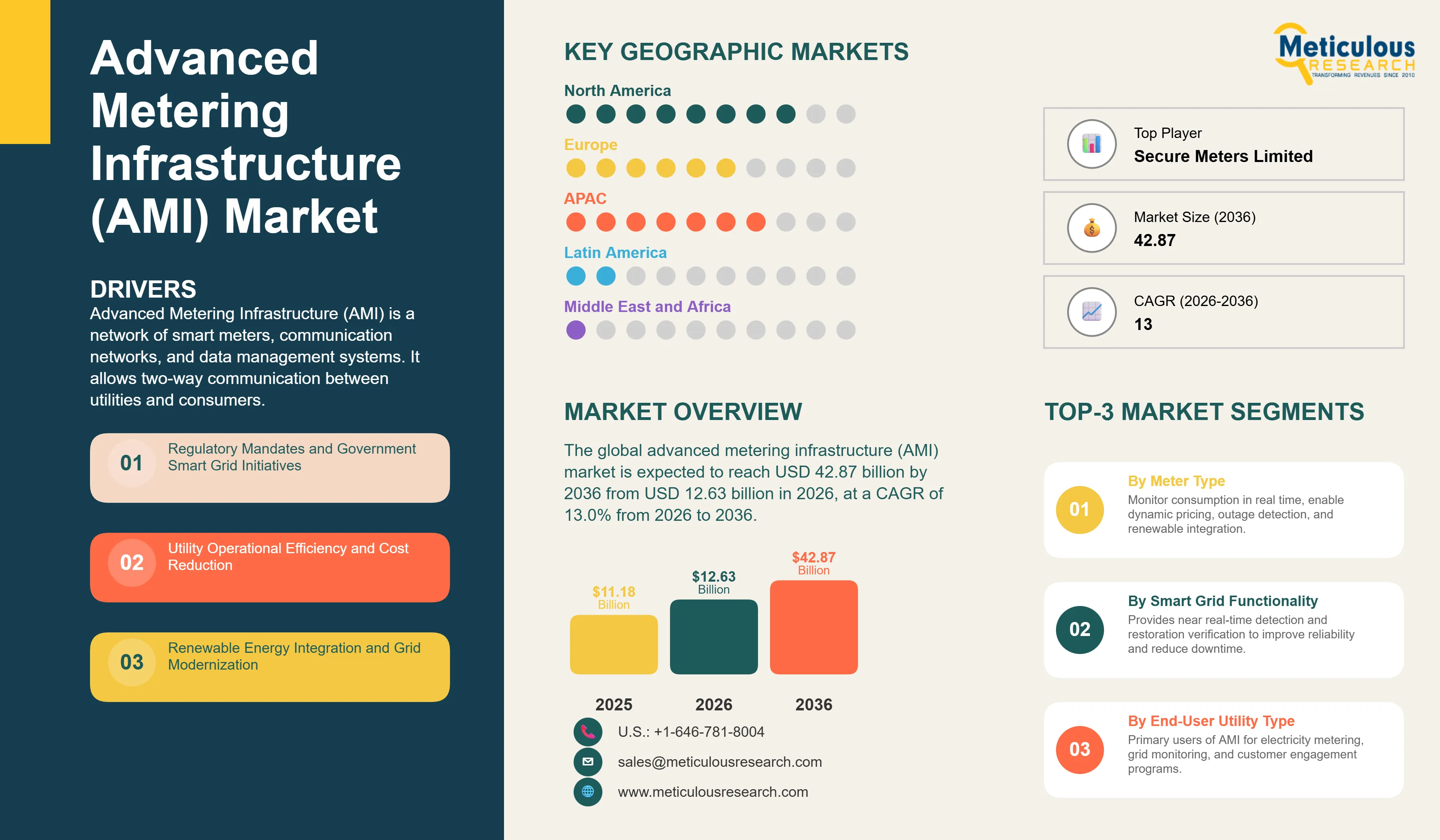
The global advanced metering infrastructure (AMI) market is expected to reach USD 42.87 billion by 2036 from USD 12.63 billion in 2026, at a CAGR of 13.0% from 2026 to 2036.
- Published
- Jan 2026
- Pages
- 285
- Format
- PDF + Excel
- Report ID
- MREP - 1041681
- Base year
- 2025
- 2026 · ESTIMATED
- $12.63B
- 2036
- $42.87B
- CAGR 2026–2036
- 13.0%
2025 baseline · 2026–2036 forecast at 13.0% CAGR · hover a bar for the value
Key highlights
In 2026, North America is estimated to account for the largest share of the global AMI market, driven by mature smart meter deployments, regulatory mandates for grid modernization, extensive utility investments, and advanced smart grid infrastructure.
Asia-Pacific is projected to register the highest CAGR during the forecast period, fueled by massive electricity demand growth, government smart city initiatives, utility modernization programs, and large-scale smart meter rollouts in China, India, and Japan.
Based on meter type, the electricity smart meter segment is estimated to hold the largest share of the market in 2026, driven by widespread deployment mandates, mature technology, and critical role in grid management and renewable integration.
Based on communication technology, the RF mesh networking segment is estimated to dominate the market in 2026, owing to proven reliability, scalability, self-healing capabilities, and extensive North American deployments.
Based on smart grid functionality, the demand response management segment is expected to witness significant growth during the forecast period, driven by grid stability requirements, renewable energy integration, and peak demand reduction needs.
Based on deployment model, the utility-owned AMI segment is expected to account for the largest share of the market in 2026, fueled by utilities prioritizing control over critical infrastructure and data.
The managed services segment is expected to grow at a significant CAGR during the forecast period, driven by smaller utilities seeking to avoid capital expenditure and leverage specialized expertise.
The U.S. AMI market is projected to grow at a CAGR of around 11% during the forecast period 2026 to 2036, driven by aging infrastructure replacement, grid resilience investments, and state-level clean energy mandates.
China is expected to lead the Asia-Pacific AMI market, driven by State Grid Corporation's massive smart meter deployment, urbanization driving electricity demand, and government smart grid policies.
In 2026, Germany is projected to account for the largest share of the European AMI market, driven by Energiewende energy transition policies, federal smart meter rollout mandates, and renewable energy integration requirements.
Report summary
| Particulars | Details |
|---|---|
| Market Size Value in 2026 | USD 12.63 Billion |
| Revenue Forecast in 2036 | USD 42.87 Billion |
| Growth Rate | CAGR of 13.0% from 2026 to 2036 |
| Format | PDF, Excel & Cloud Portal · 285 pages |
| Base Year for Estimation | 2025 |
| Historical Data | 2021–2025 |
| Forecast Period | 2026–2036 |
| Quantitative Units | Revenue in USD Billion and CAGR from 2026 to 2036 |
| Report Coverage | Revenue forecast, company ranking, competitive landscape, growth factors, and trends |
| Segments Covered | Meter Type, Communication Technology, Smart Grid Functionality, Deployment Model, End-User Utility Type, Data Analytics, Region |
| Regional Scope | North America, Europe, Asia-Pacific, Latin America, Middle East & Africa |
| Countries Covered | U.S., Canada, Germany, U.K., France, Italy, Spain, Sweden, China, Japan, South Korea, India, Australia, Brazil, Mexico, Saudi Arabia, UAE, South Africa |
| Key Companies Profiled | Itron Inc., Landis+Gyr Group AG, Sensus (Xylem Inc.), Honeywell International Inc., Siemens AG, Schneider Electric SE, Cisco Systems Inc., Oracle Corporation (Oracle Utilities), Trilliant Holdings Inc., Silver Spring Networks (Itron), Aclara Technologies LLC (Hubbell), Badger Meter Inc., Kamstrup A/S, Wasion Group Holdings Limited, Holley Technology Ltd., Secure Meters Limited, Sagemcom Energy & Telecom SAS, Neptune Technology Group Inc., Diehl Metering GmbH, Elster Group GmbH (Honeywell) |
Report overview
Segments covered: meter type, communication technology, smart grid functionality.
Advanced Metering Infrastructure (AMI) is a network of smart meters, communication networks, and data management systems. It allows two-way communication between utilities and consumers. This system offers real-time energy monitoring, remote meter reading, outage detection, and demand response features. Its goal is to modernize utility grids, improve efficiency, cut costs, enable dynamic pricing, boost customer interaction, and support grid reliability and renewable energy integration.
The integrated systems use advanced technologies, such as smart meters with built-in communication modules that measure consumption every 15 minutes or hourly. They include two-way communication networks that send meter data to utilities and receive commands, meter data management systems (MDMS) that process billions of readings, customer information systems that provide insights into consumption, and grid management applications for demand response and outage management.
AMI systems can remove the need for manual meter reading, find energy theft and meter tampering, support time-of-use and dynamic pricing programs, provide near real-time outage detection, and verify restoration efforts. They also help integrate distributed energy resources and offer detailed consumption data to empower consumers in managing their energy use. This system gives utilities savings on operational costs, better revenue collection, increased grid visibility, and enhancements in customer service. At the same time, it helps consumers understand and manage their energy usage. Overall, AMI assists utilities in transitioning to smart grids, integrating renewable energy, increasing reliability, lowering operational costs, and meeting regulatory requirements for grid modernization.
Advanced Metering Infrastructure is the base technology that allows utility grids to shift from passive one-way distribution to active, smart grids. Traditional utility metering depended on electromechanical meters that field staff read manually each month or quarter. This system offered limited visibility into consumption and lacked real-time operational data. Such limitations led to high costs for meter readings, slow detection of outages and service problems, challenges in implementing dynamic pricing, and a poor understanding of consumption patterns. There was also no support for distributed energy resources or demand response. AMI addresses these issues by using smart meters that provide detailed consumption data, allowing for two-way communication and remote control. It also includes data analytics to deliver operational insights. By integrating metering devices, communication networks, and data management platforms, AMI builds a smart infrastructure that transforms utility operations, customer interactions, and grid functions.
Several key trends are changing the AMI market. These trends include moving from simple automated meter reading to full smart grid platforms with analytics and automation. Communication technologies, such as cellular IoT and low-power wide-area networks, are advancing quickly. We are also seeing AMI integrate with distributed energy resources and electric vehicle charging systems. Furthermore, AMI is expanding beyond electricity to include gas and water metering. Regulatory mandates for updating grids, operational pressures on utilities, challenges with integrating renewable energy that requires grid flexibility, and technological advancements that allow for cost-effective rollout have all sped up AMI adoption. This is true for both advanced and developing markets.
Report infographic
Market dynamics
7 factors across 3 forcesRegulatory Mandates and Government Smart Grid Initiatives
Government regulations requiring smart meter deployment and utility grid modernization are driving market demand in both developed and developing regions. The European Union's Clean Energy Package mandates that member states achieve 80% smart meter penetration when cost-benefit analyses support it. Countries including Germany, France, Italy, Spain, and the UK are implementing mandatory rollouts. In the U.S., there are no federal mandates, but state-level regulations in California, Texas, New York, and others require utilities to invest in smart grids. Federal funding through the Infrastructure Investment and Jobs Act also supports billions for grid modernization. In China, the State Grid Corporation and Southern Power Grid have deployed over 500 million smart meters with government backing. India's government initiated the Smart Grid Mission and the Revamped Distribution Sector Scheme, which mandates smart metering for all consumers. Japan, South Korea, Australia, and various other countries have established national smart meter programs. These regulatory actions set mandatory deployment schedules regardless of utility choices, ensuring continued market growth. Utilities must implement Advanced Metering Infrastructure (AMI) within specified timeframes or face penalties, regulatory scrutiny, or limitations in implementing approved rate structures that depend on smart meters. This global regulatory push for grid modernization guarantees ongoing expansion of AMI across all areas.
Utility Operational Efficiency and Cost Reduction
AMI deployment results in significant operational cost savings, making a strong business case for utilities even without regulatory pressure. Traditional manual meter reading requires a large field workforce to visit each meter monthly or quarterly. This method is labor-intensive, expensive, and prone to errors such as estimated reads, missed readings, and data entry issues. AMI removes all manual reading costs through automated data collection, usually resulting in payback within 7 to 10 years just from labor savings. Other operational advantages include cutting down on truck rolls for service connections and disconnections through remote switching, detecting theft and non-technical losses via anomaly analytics, improving billing accuracy by eliminating estimated reads and customer disputes, allowing remote firmware updates to avoid truck rolls for meter maintenance, and optimizing field operations through data-driven workforce management. Utilities report a 50-70% reduction in meter reading costs, a 20-40% decrease in truck rolls, a 1-3% revenue recovery from theft detection, and a 30-50% improvement in resolving customer inquiries on the first call. These operational enhancements create robust financial reasons for investing in AMI, especially for utilities facing rising labor costs and efficiency goals. As labor costs increase and recruitment becomes tougher, the operational advantages of AMI become even more valuable.
Table of contents
15 chapters · 177 sections · 285 pages · click to expandGeographic analysis
North America
Largest shareIn 2026, North America is expected to have the largest share of the global AMI market. This leadership comes from early smart meter adoption starting in the early 2000s. North America has more than 100 million meters deployed in the U.S. and Canada, along with state-level support for utility investments, established smart grid infrastructure, and ongoing deployments of second-generation meters. The United States is particularly strong, with investor-owned utilities, municipal utilities, and cooperatives deploying smart meters for the majority of customers. Leading utilities like Pacific Gas & Electric, Southern California Edison, Florida Power & Light, and Duke Energy manage extensive AMI networks. American Electric Power, Dominion Energy, and others are also working on next-generation systems. Canadian utilities such as BC Hydro and Hydro-Québec have made significant deployments. North American utilities focus on applications such as demand response, integration of distributed energy resources, grid analytics, and customer engagement. The mature market is now shifting towards replacing meters, upgrading communication infrastructure, and improving analytics capabilities.
Asia-Pacific
Fastest growthAsia-Pacific is expected to grow at the fastest rate during the forecast period. This growth is driven by high electricity demand, urbanization that requires infrastructure expansion, government smart city initiatives, and large-scale smart meter rollouts. China leads the region with the State Grid Corporation and Southern Power Grid deploying over 500 million smart meters, marking the largest AMI deployment in the world. India is speeding up its deployment through the Smart Grid Mission and the RDSS, which requires smart meters for all consumers, targeting over 250 million meters. Japan has finished a nationwide rollout of smart meters for major utilities. South Korea, Australia, and countries in Southeast Asia are also implementing significant programs. The vast scale of deployments in Asia, along with infrastructure opportunities and government policy support, ensure continued rapid growth.
Europe
Europe represents a sizable market driven by regulatory mandates, renewable energy integration, and specific rollout programs in different countries. Germany's federal smart meter gateway program is speeding up deployment for large consumers and distributed generation. Italy has completed an early rollout and is now working on second-generation meters. France, Spain, the UK, and others have mandatory programs in place. The focus in Europe on data privacy, interoperability standards, and renewable integration shapes AMI implementations, emphasizing strong data protection and flexibility needs.
Competitive landscape
- Itron Inc. (U.S.)
- Landis+Gyr Group AG · Switzerland
- Sensus (Xylem Inc.) (U.S.)
- Honeywell International Inc. (U.S.)
- Siemens AG · Germany
- Schneider Electric SE · France
- Cisco Systems Inc. (U.S.)
- Oracle Corporation (Oracle Utilities) (U.S.)
- Trilliant Holdings Inc. (U.S.)
- Silver Spring Networks (Itron) (U.S.)
- Aclara Technologies LLC (Hubbell) (U.S.)
- Badger Meter Inc. (U.S.)
- Kamstrup A/S · Denmark
- Wasion Group Holdings Limited · China
- Holley Technology Ltd. · China
- Secure Meters Limited · India
- Sagemcom Energy & Telecom SAS · France
- Neptune Technology Group Inc. (U.S.)
- Diehl Metering GmbH · Germany
- Elster Group GmbH (Honeywell) · Germany
Frequently asked questions
The advanced metering infrastructure market is expected to grow from USD 12.63 billion in 2026 to USD 42.87 billion by 2036.
Cite this report
Meticulous Research. (2026). Advanced Metering Infrastructure (AMI) Market - Global Opportunity Analysis and Industry Forecast (2026-2036) (Report No. MREP - 1041681). Meticulous Market Research Pvt. Ltd. https://www.meticulousresearch.com/product/advanced-metering-infrastructure-market-6364