Coal-to-Gas Conversion Services Market (2026-2036)
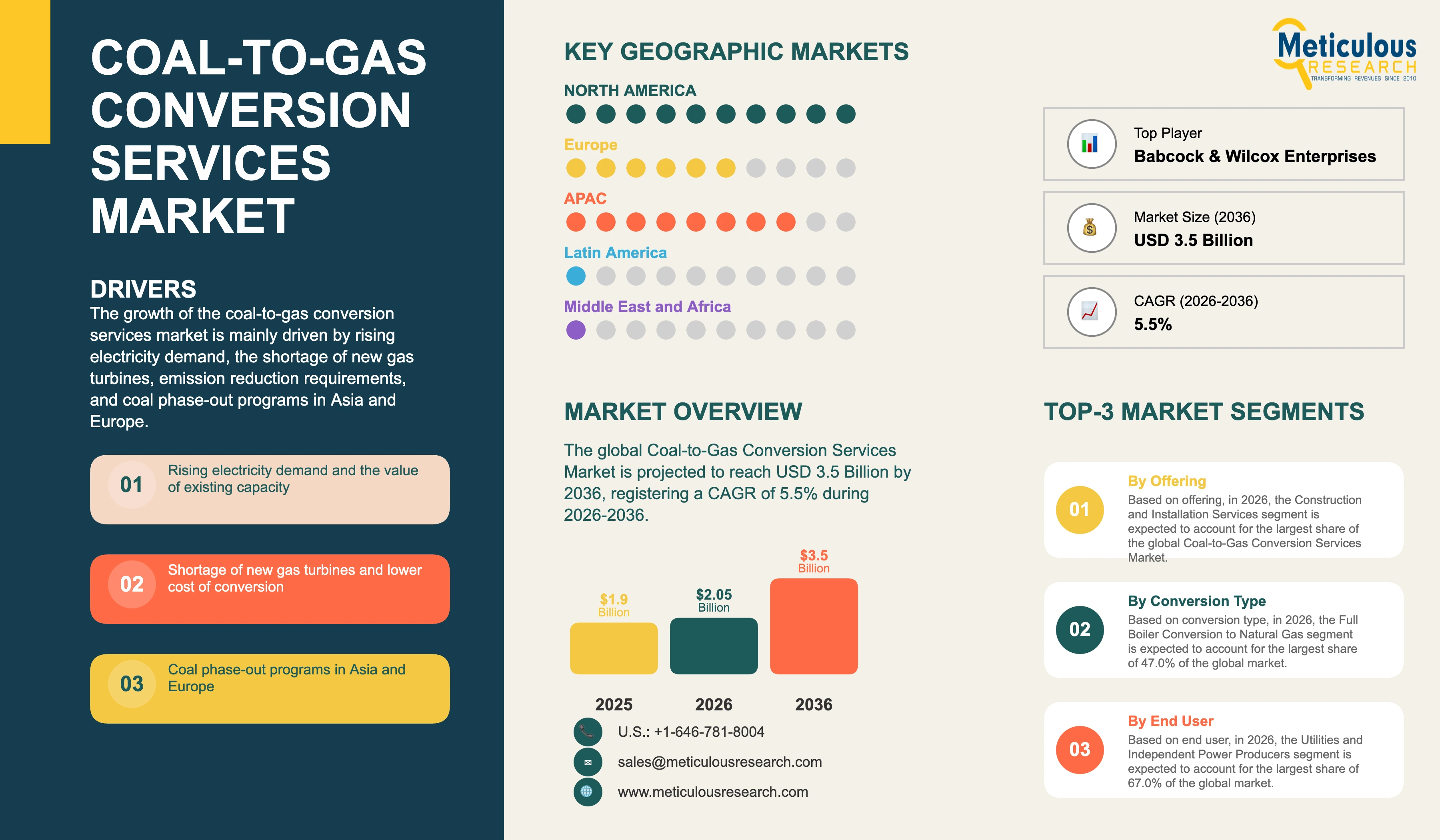
The global coal-to-gas conversion services market was valued at USD 1.90 billion in 2025. This market is expected to reach USD 3.50 billion by 2036 from an estimated USD 2.05 billion in 2026, registering a CAGR of 5.5% during the forecast period (2026-2036).
- Published
- Nov 2026
- Pages
- 251
- Format
- PDF + Excel
- Report ID
- MREP - 1042696
- Base year
- 2025
- 2025 · BASELINE
- $1.90B
- 2036
- $3.50B
- CAGR 2026–2036
- 5.5%
2025 baseline · 2026–2036 forecast at 5.5% CAGR · hover a bar for the value
Key highlights
According to the U.S. Energy Information Administration (EIA), 121 U.S. coal-fired power plants were repurposed to burn other fuels between 2011 and 2019, and 103 of them were converted to or replaced by natural gas-fired plants. Over that period, 14.3 GW of coal capacity had its boilers converted to burn natural gas, while 15.3 GW of new combined cycle capacity replaced coal plants.
In March 2026, the Arizona Corporation Commission approved the conversion of the Springerville and Coronado coal plants to natural gas, covering 787 MW at TEP's Springerville Units 1 and 2 and the 762 MW Coronado plant owned by SRP. TEP estimated the cost of its boiler conversion at USD 170 million, while SRP expects its conversion to save customers about USD 300 million compared with a new gas plant.
Industrial Info Resources reported in August 2026 that dozens of U.S. coal-to-gas conversion projects are in planning and engineering, and that boiler conversions are generally much cheaper than sourcing new gas turbines, which face a supply crunch in the U.S.
TransAlta signed a tolling agreement with Puget Sound Energy in December 2025 to support the conversion of Centralia Unit 2 in Washington from coal to natural gas, with construction planned for 2027 to 2028, while Arizona Public Service plans to convert two retired coal units at its Cholla plant to natural gas, starting construction in 2028.
South Korea's Ministry of Climate, Energy and Environment presented a 2040 coal phase-out roadmap in September 2026 under which 19 coal units are scheduled for conversion to LNG power by 2030 and 39 coal units whose service life ends by 2038 will be replaced with LNG or pumped storage, after South Korea joined the Powering Past Coal Alliance at COP30.
AES Indiana is converting its remaining two 670 MW coal units at Petersburg Generating Station to natural gas, a plan the utility said would save customers USD 280 million over 20 years by avoiding coal-related upgrade costs.
By offering, construction and installation services account for the largest share in 2026, while commissioning and post-conversion services register the highest CAGR.
By conversion type, full boiler conversion to natural gas account for the largest share of 47.0% in 2026, while repowering and site conversion registers the highest CAGR.
By unit capacity, 100 MW to 500 MW accounts for the largest share in 2026 and also registers the highest CAGR.
By end user, utilities and independent power producers account for the largest share of 67.0% in 2026, while district heating and CHP operators register the highest CAGR.
By geography, North America accounts for the largest share of 40.0% in 2026, while Asia-Pacific registers the highest CAGR of 6.6%.
Report summary
| Particulars | Details |
|---|---|
| Base Year | 2025 |
| Estimated Year | 2026 |
| Forecast Period | 2026-2036 |
| Market Size in 2025 | USD 1.90 billion |
| Market Size in 2026 | USD 2.05 billion |
| Market Size by 2036 | USD 3.50 billion |
| CAGR (2026-2036) | 5.5% |
| Format | PDF, Excel & Cloud Portal · 251 pages |
| Largest Segment by Conversion Type (2026) | Full Boiler Conversion to Natural Gas (47.0%) |
| Largest Segment by End User (2026) | Utilities and Independent Power Producers (67.0%) |
| Largest Region (2026) | North America (40.0%) |
| Fastest-Growing Region | Asia-Pacific (CAGR 6.6%) |
| Companies Profiled | 16 companies and other companies |
| Segments Covered | Offering, Conversion Type, Unit Capacity, End User, Geography |
| Countries Covered | U.S., Canada, Poland, Germany, Czech Republic, Romania, Bulgaria, Serbia, Rest of Europe, South Korea, China, Japan, Taiwan, India, Australia, Rest of Asia-Pacific, Chile, Mexico, Brazil, Rest of Latin America, Israel, Turkey, Morocco, South Africa, Rest of Middle East & Africa |
Report overview
Segments covered: offering, conversion type, unit capacity, end user.
The growth of this market is mainly driven by the large number of aging coal-fired units in the U.S. that utilities are converting to natural gas instead of retiring, as rising electricity demand from data centers and industry makes existing capacity more valuable, the shortage of new gas turbines, which makes boiler conversions a faster and lower-cost way to keep capacity on the grid, South Korea's plan to convert or replace dozens of coal units with LNG-fired plants as part of its 2040 coal phase-out, coal-to-gas conversions of district heating and industrial boilers in China and Europe, and the lower emissions of gas-fired units, which help plant owners meet air quality and carbon targets. However, factors such as higher and more volatile natural gas prices, the need for new gas pipeline connections at many coal sites, the lower efficiency of converted boilers compared with new combined cycle plants, and the rollback of some environmental regulations that reduces pressure to convert are expected to restrain the growth of this market to some extent.
Coal-to-gas conversion services include the engineering, equipment, construction, and commissioning work required to convert coal-fired power plants and industrial or district heating boilers so that they burn natural gas instead of coal, either fully or as part of a dual-fuel or co-firing configuration, and to repower coal sites by integrating gas turbines with existing steam cycles or converting sites to gas-fired operation. This report covers global revenue from feasibility studies and engineering, equipment such as gas burners, gas supply and conditioning systems, burner management and control systems, and boiler modifications, construction and installation services, and commissioning and post-conversion services. Revenue from new gas turbines, steam turbines, and gas pipelines is excluded, although engineering and integration services for repowering projects are included.
A typical boiler conversion replaces coal burners with gas burners, installs a new gas supply train and pressure regulation system, upgrades the burner management system and controls, and modifies heat transfer surfaces, fans, and other equipment to account for the different combustion characteristics of natural gas. Coal handling, pulverizers, and some emission control equipment may be removed or retired. A converted unit usually has lower capacity and efficiency than a new combined cycle plant, but it costs much less, can be completed in a shorter time, and reuses the existing steam turbine, generator, grid connection, and site.
Coal-to-gas conversion became common in the U.S. in the 2010s, when low natural gas prices from shale production and stricter environmental regulations made many older coal units uneconomic. According to the EIA, 14.3 GW of U.S. coal capacity had its boilers converted to natural gas between 2011 and 2019, mainly smaller units more than 50 years old in the Eastern and Southern U.S. Alabama Power converted 10 generators at four plants totaling 1.9 GW, the most of any utility during that period.
A new wave of coal-to-gas conversions has started in the U.S. in the mid-2020s, driven by different factors than the first wave. Rising electricity demand from data centers, manufacturing, and electrification has made existing generating capacity more valuable, while a shortage of large gas turbines has pushed delivery dates for new gas plants into 2029 and 2030. Utilities in Arizona, Indiana, Washington, and other states are now choosing to convert coal units to gas rather than retire them, and Industrial Info Resources reports that dozens of conversion projects are in planning and engineering in the U.S.
Outside the U.S., coal-to-gas conversions are taking place in South Korea, where the government plans to convert or replace many coal units with LNG-fired plants as part of its 2040 coal phase-out, in China, where many industrial and district heating boilers have been converted from coal to gas to improve air quality, and in Europe, where district heating companies and industrial plants in Poland, Germany, the Czech Republic, and other countries are switching from coal to gas-fired boilers and combined heat and power plants. Israel, Chile, and other countries have also converted or replaced coal units with gas-fired capacity. Japan and Taiwan are also evaluating gas and co-firing options for older coal units.
The market is served by boiler manufacturers and their service businesses, power plant engineering firms, construction contractors, burner and combustion system suppliers, and control system suppliers. Leading companies include Babcock & Wilcox, GE Vernova, Mitsubishi Heavy Industries, Siemens Energy, Doosan Enerbility, Andritz, Valmet, Sumitomo SHI FW, Sargent & Lundy, Burns & McDonnell, Black & Veatch, Kiewit, Zachry Group, KEPCO Engineering & Construction, John Zink Hamworthy Combustion, and Fives.
Over the forecast period, the coal-to-gas conversion services market is expected to grow steadily, supported by the U.S. conversion pipeline, South Korea's coal-to-LNG program, conversions in Europe and China, and continued demand for dual-fuel and co-firing capability that gives operators fuel flexibility. Conversions are also expected to be used as a bridge strategy that keeps sites and grid connections in use while owners plan for future options such as hydrogen co-firing, battery storage, or small modular reactors at former coal sites.
Report infographic
Market dynamics
16 factors across 5 forcesRising electricity demand and the value of existing capacity
Electricity demand in the U.S. is growing after more than a decade of little change, driven by data centers for artificial intelligence and cloud computing, new manufacturing plants, and electrification of transport and buildings. Grid operators in several regions have warned of capacity shortfalls, and capacity prices have risen sharply in some markets. In this environment, utilities are reluctant to retire existing coal units without replacement capacity, and converting them to gas allows them to keep generating capacity on the grid while reducing emissions.
Converted units can provide firm capacity during peak demand and periods of low renewable output, and they can be dispatched flexibly. TransAlta's Centralia Unit 2 conversion, for example, is designed to support reliable power during periods of high demand and low renewable generation under a tolling agreement with Puget Sound Energy. As electricity demand continues to grow, more utilities are expected to evaluate conversions as part of their integrated resource plans. Converted units also help utilities maintain grid stability by providing inertia and voltage support from large synchronous generators, which are becoming scarcer as coal plants retire and inverter-based renewables grow. This adds to the value of keeping existing generators in service through conversion.
Shortage of new gas turbines and lower cost of conversion
The large gas turbine manufacturers have record backlogs, with GE Vernova targeting a gas turbine backlog of about 100 GW by the end of 2026 and delivery slots stretching into 2029 and 2030. This shortage makes it difficult for utilities to build new gas plants quickly, and it has increased the cost of new gas capacity. Boiler conversions, which reuse existing steam turbines and generators, can be completed in a few years and do not depend on new gas turbine deliveries.
Boiler conversions are also much cheaper than new gas-fired plants of similar capacity, which matters to regulators focused on customer bills. TEP estimated the cost of converting the 787 MW Springerville Units 1 and 2 at USD 170 million, and SRP expects its Coronado conversion to save customers about USD 300 million compared with a new gas facility and about USD 1.2 billion compared with new long-duration batteries over the same period. AES Indiana said its Petersburg conversion would save customers USD 280 million over 20 years. These economics make conversion an attractive option for utilities facing rising capacity needs and constrained budgets.
Emission reduction and regulatory compliance
Burning natural gas instead of coal reduces carbon dioxide emissions by roughly half per unit of fuel energy and nearly eliminates emissions of sulfur dioxide, mercury, and particulate matter, while also reducing nitrogen oxide emissions and eliminating coal ash. Converting a coal unit to gas can therefore help owners meet air quality regulations, carbon reduction targets, and coal ash and wastewater rules without the cost of installing new emission control equipment on aging coal units.
In the U.S., many conversions in the 2010s were driven by mercury and air toxics standards and other rules, and current conversions are often motivated by the need to avoid costly upgrades to coal plants. In South Korea, Europe, and China, coal-to-gas conversions are part of national policies to reduce air pollution and carbon emissions, and South Korea's commitment to phase out coal power by 2040 under the Powering Past Coal Alliance is expected to drive a large number of conversion and replacement projects.
Coal phase-out programs in Asia and Europe
South Korea has one of the largest coal fleets in the developed world, and its government has set out a roadmap to phase out coal power by 2040. Under the roadmap presented in September 2026, 19 coal units are scheduled for conversion to LNG power by 2030, and 39 units whose service life ends by 2038 will be replaced with LNG or pumped storage. These projects, carried out mainly by KEPCO's generation subsidiaries, will create demand for engineering, construction, and integration services at existing coal sites.
In Europe, coal phase-out policies in Germany, Poland, the Czech Republic, and other countries are leading district heating companies and industrial plants to replace coal-fired boilers and combined heat and power plants with gas-fired units, often at the same sites and using existing heat networks and grid connections. China has also converted large numbers of industrial and heating boilers from coal to gas in northern cities to reduce winter air pollution, and it continues to promote clean heating in rural and urban areas.
Table of contents
12 chapters · 145 sections · 251 pages · click to expandSegmental analysis
| Segment | Largest share (2026) | Fastest growth (2026–2036) |
|---|---|---|
| By Offering | 100 MW to 500 MW | Commissioning and post-conversion services |
By Offering
- The 100 MW to 500 MW segment is expected to account for the largest share of the coal-to-gas conversion services market, and it is also projected to register the highest CAGR during the forecast period.
Geographic analysis
North America
Largest shareIn 2026, North America is expected to account for the largest share of 40.0% of the global coal-to-gas conversion services market. The large share of this region is mainly due to the large number of aging coal units in the U.S. that are being converted to natural gas, the availability of low-cost domestic natural gas and an extensive pipeline network, rising electricity demand from data centers and manufacturing, the shortage of new gas turbines, and the long track record of conversions in the U.S., where 14.3 GW of coal capacity was converted to gas between 2011 and 2019. Recent approvals in Arizona, Indiana, and Washington show that the conversion pipeline remains strong, and Industrial Info Resources reports that dozens more projects are in planning and engineering.
Asia-Pacific
Asia-Pacific is the second-largest market and is projected to register the highest CAGR of 6.6% during the forecast period. The rapid growth of this region is mainly driven by South Korea's 2040 coal phase-out roadmap, under which 19 coal units are scheduled for conversion to LNG by 2030 and many more will be replaced with LNG or pumped storage by 2038, coal-to-gas conversions of industrial and heating boilers in China, and plans in Japan and Taiwan to reduce coal use through gas and co-firing. KEPCO Engineering & Construction, Doosan Enerbility, and other Korean companies are expected to play a major role in the Korean program.
Europe
Europe is the third-largest market, with demand centered on coal-to-gas conversions in district heating and industrial plants, especially in Poland, the Czech Republic, Germany, and the Balkans, where coal phase-out policies and EU carbon pricing are leading owners to switch to gas-fired combined heat and power plants. The U.K. and Italy have already largely phased out coal, while Germany's coal exit and Poland's energy transition are expected to drive continued demand. EU support for clean district heating and the rising cost of carbon allowances under the EU Emissions Trading System strengthen the case for switching from coal to gas in these markets.
Latin America
The Middle East & Africa and Latin America account for smaller shares of the market. In Latin America, Chile's coal phase-out plan has led owners to retire or convert several coal units, and some units in Mexico and Brazil have also been evaluated for conversion to gas.
Middle East & Africa
Israel has converted or replaced coal units with gas-fired capacity as part of its plan to end coal use, and Morocco and Turkey are evaluating options for some coal units.
Competitive landscape
The global coal-to-gas conversion services market is fragmented, with the top five players estimated to account for about 30% of the market in 2025. The market includes boiler manufacturers and their service businesses, power plant engineering firms, construction contractors, gas burner and combustion system suppliers, and control system suppliers, which often work together in project teams.
Babcock & Wilcox, GE Vernova, Mitsubishi Heavy Industries, Doosan Enerbility, Andritz, Valmet, and Sumitomo SHI FW provide boiler conversion engineering, equipment, and services, drawing on their experience as original equipment manufacturers of coal-fired boilers. Siemens Energy, GE Vernova, and Mitsubishi Heavy Industries also offer repowering solutions that integrate gas turbines with existing steam cycles.
Sargent & Lundy, Burns & McDonnell, Black & Veatch, Kiewit, and Zachry Group are leading engineering and construction firms for conversion projects in the U.S., while KEPCO Engineering & Construction plays a central role in South Korea. John Zink Hamworthy Combustion and Fives supply gas burners and combustion systems for conversion projects in power and industrial applications.
Companies compete on engineering capability, experience with similar conversions, cost, schedule, combustion and emission performance, safety, and long-term service capability. Several firms have created dedicated teams for coal plant repurposing that evaluate conversion, storage, and other options for utilities. Key strategies include building integrated engineering, equipment, and construction teams, developing low-NOx and hydrogen-capable burners, offering feasibility studies and integrated resource planning support to utilities, and expanding into repowering and site conversion projects.
The competitive landscape is expected to remain fragmented, as conversion projects vary widely in size and complexity and often involve local contractors. Companies with strong relationships with utilities, experience with the specific boiler designs being converted, and the ability to manage complex brownfield projects are expected to win the largest share of work, while specialized burner and control suppliers will benefit from the growing number of projects. Partnerships between engineering firms and original boiler manufacturers are also expected to become more common, since access to original design data can reduce risk in conversion projects.
Some of the key players operating in the coal-to-gas conversion services market are Babcock & Wilcox Enterprises, Inc., GE Vernova Inc., Mitsubishi Heavy Industries, Ltd., Siemens Energy AG, Doosan Enerbility Co., Ltd., Andritz AG, Valmet Oyj, Sumitomo Heavy Industries, Ltd. (Sumitomo SHI FW), Sargent & Lundy, L.L.C., Burns & McDonnell, Black & Veatch Holding Company, Kiewit Corporation, Zachry Group, KEPCO Engineering & Construction Company, Inc., John Zink Hamworthy Combustion (Koch Engineered Solutions), and Fives Group, among others.
- —
Arizona regulators approved the conversion of the Springerville and Coronado coal plants to gas in March 2026, TransAlta signed a tolling agreement to convert Centralia Unit 2, Arizona Public Service announced plans to convert two Cholla units, and South Korea presented a 2040 coal phase-out roadmap with 19 coal units scheduled for conversion to LNG by 2030.
- Babcock & Wilcox
- GE Vernova
- Mitsubishi Heavy Industries
- Doosan Enerbility
- Andritz
- Valmet
- Sumitomo SHI FW provide boiler conversion engineering
- Mitsubishi Heavy Industries also
Expert perspectives
The coal-to-gas conversion services market is entering a new phase of growth after a quieter period in the early 2020s. We see the combination of rising electricity demand, a shortage of new gas turbines, and the need to replace aging coal capacity as the main reasons why utilities in the U.S. are once again choosing to convert coal units to gas, while South Korea's coal phase-out and European heating transitions add significant demand outside the U.S.
Over the forecast period, the market is expected to grow at a CAGR of 5.5%, from USD 2.05 billion in 2026 to USD 3.50 billion in 2036. Growth will be supported by the U.S. conversion pipeline, South Korea's coal-to-LNG program, conversions of district heating and industrial boilers, and repowering projects, while natural gas price volatility, pipeline constraints, and regulatory uncertainty will moderate growth.
In terms of segments, construction and installation services remain the largest offering, while commissioning and post-conversion services grow fastest. Full boiler conversion remains the largest conversion type, while repowering and site conversion grows fastest. Utilities and independent power producers remain the largest end user, while district heating and CHP operators grow fastest. North America remains the largest region, and Asia-Pacific is the fastest-growing region at a CAGR of 6.6%.
For service providers, the key priorities are to build integrated teams that can deliver conversions quickly and reliably, to develop low-NOx and hydrogen-capable combustion solutions, to support utilities in integrated resource planning and regulatory processes, and to position themselves for repowering and site conversion projects as gas turbine supply improves.
We expect conversions to remain a cost-effective option for utilities that need to keep capacity on the grid during the energy transition. In our view, the strongest demand in the U.S. will come in the late 2020s and early 2030s, when many coal units reach the end of their planned lives and gas turbine shortages persist, while South Korea's program will provide a large and relatively predictable pipeline in Asia through the mid-2030s. Conversions that are designed with future hydrogen use or site repurposing in mind are likely to win regulatory approval more easily.
Natural gas prices and policy decisions will remain the key uncertainties for this market. Sharp increases in gas prices or major changes in environmental policies could slow conversions, while continued demand growth and capacity shortages could accelerate them, and service providers will need to remain flexible as these conditions change. Long-term contracts with utilities and clear regulatory approvals reduce this risk for the largest projects.
Customer perspectives
Vice President of Generation Planning - Regulated utility, U.S.
We need every megawatt we have, and a new gas plant would take years longer and cost far more. Converting our coal units to gas keeps the capacity on the grid, lowers our emissions, and fits within our budget.
“Our coal units must be replaced as the country moves toward its coal phase-out, and using the existing sites and grid connections for new LNG plants is the most practical solution. These projects need careful engineering because we must keep supplying power during the transition.”
“Our coal boilers are becoming too expensive because of carbon costs, so we are replacing them with gas-fired combined heat and power units at the same sites. Using our existing heat network saves us a great deal of money.”
Frequently asked questions
The global coal-to-gas conversion services market was valued at USD 1.90 billion in 2025, up from USD 1.78 billion in 2024, and is estimated at USD 2.05 billion in 2026. The market includes engineering, equipment, construction, and commissioning services for converting coal-fired units and boilers to natural gas and for repowering coal sites, and excludes new gas turbines, steam turbines, and pipelines.
Cite this report
Meticulous Research. (2026). Coal-to-Gas Conversion Services Market - Global Opportunity Analysis and Industry Forecast (2026-2036) (Report No. MREP - 1042696). Meticulous Market Research Pvt. Ltd. https://www.meticulousresearch.com/product/coal-to-gas-conversion-services-market-7379