Flare Gas Recovery Systems Market (2026-2036)
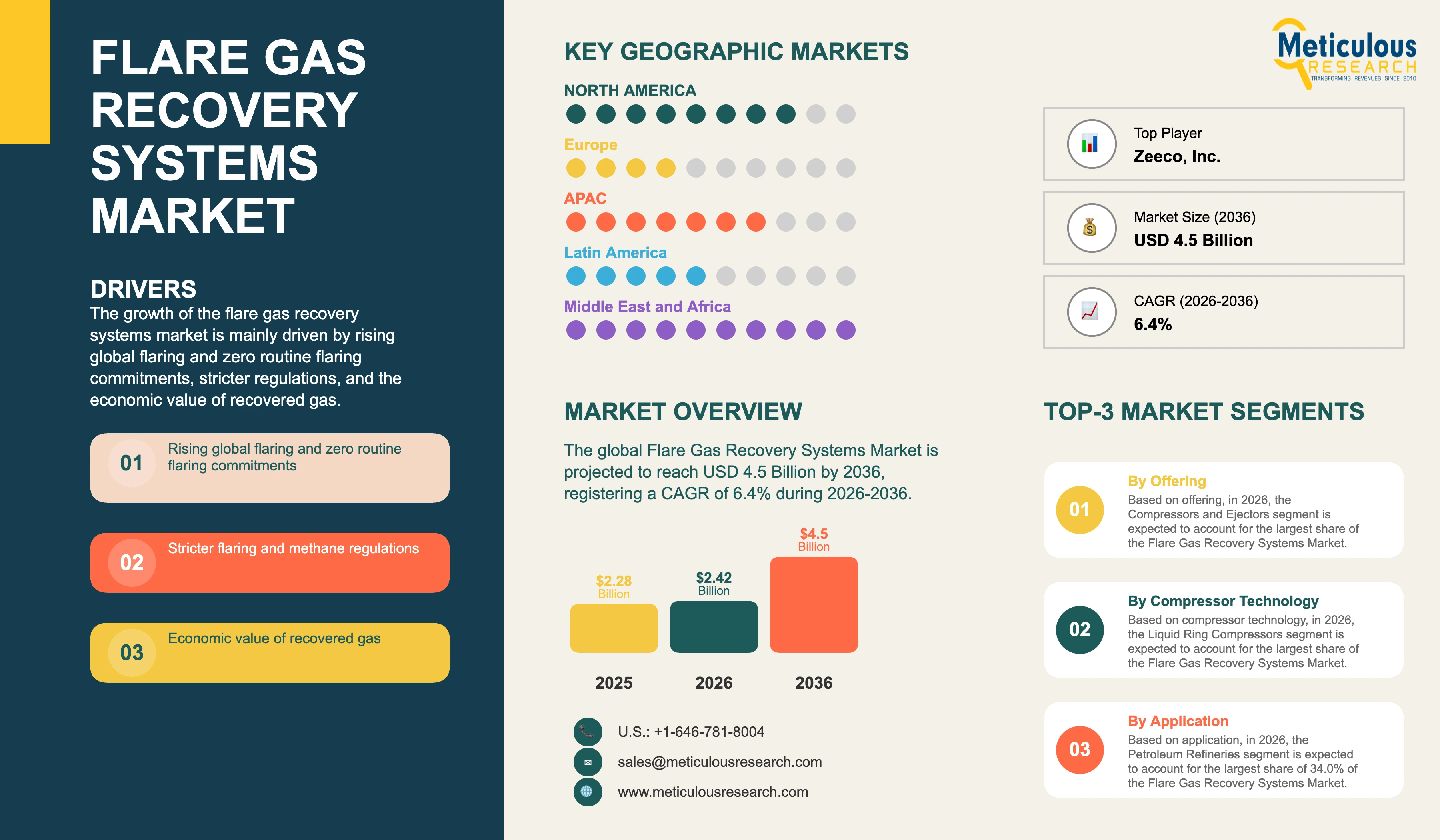
The global flare gas recovery systems market was valued at USD 2.28 billion in 2025. This market is expected to reach USD 4.50 billion by 2036 from an estimated USD 2.42 billion in 2026, registering a CAGR of 6.4% during the forecast period (2026-2036).
- Published
- Nov 2026
- Pages
- 281
- Format
- PDF + Excel
- Report ID
- MREP - 1042708
- Base year
- 2025
- 2025 · BASELINE
- $2.28B
- 2036
- $4.50B
- CAGR 2026–2036
- 6.4%
2025 baseline · 2026–2036 forecast at 6.4% CAGR · hover a bar for the value
Key highlights
According to the World Bank's 2026 Global Gas Flaring Tracker, global gas flaring increased for the third consecutive year in 2025, rising 6% from a revised 157 billion cubic meters in 2024 to 167 billion cubic meters, the highest level since 2019. The flared gas had an estimated market value of USD 54 billion.
The World Bank estimated that flaring generated 429 million tonnes of carbon dioxide equivalent emissions in 2025, including about 50 million tonnes from unburned methane, and that eliminating routine flaring worldwide would require USD 70 billion to USD 100 billion in upfront investment using commercially available technologies.
Russia, Iran, and Iraq together flared about 84 billion cubic meters in 2025, nearly half of the global total, and nine countries accounted for more than 83% of global flaring while producing only 46% of the world's oil, according to the World Bank.
In Iraq, TotalEnergies and its partners Basra Oil Company and QatarEnergy are developing the Gas Growth Integrated Project, which includes the ArtawiGas25 facility to process 50 million cubic feet per day of previously flared associated gas from the Ratawi field and a 300 million cubic feet per day Gas Midstream Project that will also capture gas previously flared at two other southern fields.
Zeeco completed the acquisition of Oil & Gas Technologies in May 2026, expanding its portfolio of combustion and environmental technologies, which include flare gas recovery units that capture flare gases and return them to the plant for reuse as fuel or process gas.
In the U.S., the EPA's 2024 oil and gas methane rule phased out routine flaring of associated gas from new oil wells, and in October 2026 the EPA proposed significant revisions to the rule, creating uncertainty about the pace of U.S. flaring regulation.
By offering, compressors and ejectors account for the largest share of 38.0% in 2026, while controls, metering, and monitoring registers the highest CAGR.
By compressor technology, liquid ring compressors account for the largest share in 2026, while screw compressors register the highest CAGR.
By recovered gas use, fuel gas for on-site use accounts for the largest share in 2026, while on-site power generation registers the highest CAGR.
By application, petroleum refineries account for the largest share of 34.0% in 2026, while onshore oil production facilities register the highest CAGR.
By geography, Middle East & Africa accounts for the largest share of 30.0% in 2026 and also registers the highest CAGR of 7.7%.
Report summary
| Particulars | Details |
|---|---|
| Base Year | 2025 |
| Estimated Year | 2026 |
| Forecast Period | 2026-2036 |
| Market Size in 2025 | USD 2.28 billion |
| Market Size in 2026 | USD 2.42 billion |
| Market Size by 2036 | USD 4.50 billion |
| CAGR (2026-2036) | 6.4% |
| Format | PDF, Excel & Cloud Portal · 281 pages |
| Largest Segment by Offering (2026) | Compressors and Ejectors (38.0%) |
| Largest Segment by Application (2026) | Petroleum Refineries (34.0%) |
| Largest Region (2026) | Middle East & Africa (30.0%) |
| Fastest-Growing Region | Middle East & Africa (CAGR 7.7%) |
| Companies Profiled | 12 companies and other companies |
| Segments Covered | Offering, Compressor Technology, Recovered Gas Use, Application, Geography |
| Countries Covered | Saudi Arabia, Iraq, Iran, UAE, Kuwait, Algeria, Nigeria, Libya, Rest of Middle East & Africa, U.S., Canada, China, India, Indonesia, Malaysia, Australia, Rest of Asia-Pacific, Mexico, Venezuela, Brazil, Argentina, Rest of Latin America, Russia, Norway, U.K., Rest of Europe |
Report overview
Segments covered: offering, compressor technology, recovered gas use, application, gas use.
The growth of this market is mainly driven by rising global gas flaring, which reached its highest level since 2019 in 2025, government and industry commitments to end routine flaring, including the World Bank's Zero Routine Flaring by 2030 initiative, stricter regulations on flaring and methane emissions in many oil-producing countries, the economic value of recovered gas as fuel, feedstock, or sales gas, and the need for refineries and petrochemical plants to reduce emissions and fuel costs. However, factors such as the high capital cost of recovery systems at remote and small sites, the lack of gas gathering and processing infrastructure in many oil-producing regions, and low local gas prices that weaken project economics are expected to restrain the growth of this market to some extent.
Flare gas recovery systems capture gas that would otherwise be burned in flares and return it to productive use. Flares are safety devices used at refineries, petrochemical plants, gas processing plants, LNG plants, and oil and gas production facilities to safely burn gas released during normal operations, process upsets, maintenance, and emergencies. In addition, in many oil-producing regions, associated gas produced with oil is routinely flared because there is no infrastructure to gather, process, or sell it. Flaring wastes valuable energy, emits carbon dioxide, methane, and other pollutants, and is increasingly restricted by regulations and company policies.
A typical flare gas recovery system collects gas from the flare header, separates liquids, compresses the gas using liquid ring, screw, or reciprocating compressors or ejectors, conditions it by removing liquids and contaminants such as hydrogen sulfide, and sends it back to the plant as fuel gas or process feedstock, or to a pipeline, power generator, or reinjection well. Liquid seal drums or fast-opening valves ensure that the flare remains available for safe disposal of large gas releases during emergencies, so recovery systems handle normal, continuous flows while the flare handles upsets.
This report covers global revenue from flare gas recovery systems, including compressors and ejectors, liquid seals, separators, and gas conditioning equipment, controls, metering, and monitoring systems, and engineering, installation, and services, including rental units. The scope includes flare gas recovery units at petroleum refineries, petrochemical and chemical plants, gas processing and LNG plants, and offshore platforms and FPSOs, as well as associated gas and flare gas capture systems and vapor recovery units at onshore oil production facilities. Flare systems themselves, large-scale gas processing plants, gas gathering pipelines, small-scale LNG plants, and stand-alone power plants are excluded from the scope of this report, as they are covered in separate studies.
Flare gas recovery is a mature technology in refining, where many refineries in North America, Europe, and the Middle East have installed recovery units to comply with air quality rules and reduce fuel costs. Recovery units can often pay back their cost within a few years when recovered gas replaces purchased natural gas or fuel oil. In upstream oil production, flare gas capture is more challenging, because flaring sites are often remote, gas volumes vary, and there may be no nearby market for the gas. Solutions include gathering and compressing gas for delivery to processing plants, using gas to generate power on site, reinjecting gas into reservoirs, converting gas to compressed natural gas or liquefied products, and recovering natural gas liquids.
Global flaring remains very large and has been rising rather than falling in recent years. According to the World Bank, 167 billion cubic meters of gas were flared in 2025, an amount roughly equal to Africa's annual gas consumption. Most flaring occurs in a small number of countries, including Russia, Iran, Iraq, Venezuela, the U.S., Algeria, Libya, Nigeria, and Mexico, which creates a large potential market for flare gas recovery, although actual investment depends on regulations, gas prices, infrastructure, and the financial capacity of operators. The World Bank has noted that the flared volume in 2025 exceeded the volume of LNG that transited the Persian Gulf that year.
The market includes manufacturers of flare and combustion systems that offer flare gas recovery units, compressor manufacturers, vapor recovery and wellsite compression companies, and engineering companies. Leading companies include Zeeco, John Zink (Koch Engineered Solutions), Ingersoll Rand through its Nash brand, Kobe Steel, Baker Hughes, Burckhardt Compression, Atlas Copco, Aereon, Cimarron, Flogistix, UnitBirwelco, and Transvac Systems.
Over the forecast period, the market is expected to grow steadily, driven by flaring reduction programs in the Middle East, Africa, and Latin America, regulations and methane reduction commitments, the replacement and expansion of recovery systems at refineries and petrochemical plants, and the use of recovered gas for on-site power generation. Onshore oil production facilities are expected to be the fastest-growing application, and the Middle East & Africa is expected to remain both the largest and fastest-growing region.
Our flare gas recovery units recover gas that we use as refinery fuel, which reduces both emissions and our fuel purchases. Reliability is critical, because any downtime shows up immediately as flaring.
This comment explains why petroleum refineries are the largest application and why fuel gas for on-site use is the largest use of recovered gas. It also reflects the importance of system reliability and uptime.
We are under strong pressure to end routine flaring at our oil fields. Modular capture and gas-to-power units let us reduce flaring now while larger gas processing projects are completed.
This comment explains why onshore oil production facilities and on-site power generation are growing fastest and why the Middle East & Africa is the fastest-growing region in this market.
Operations Director - independent oil producer, U.S.
We use rented vapor recovery and gas capture units at many of our well sites, because they are flexible and can be moved as production changes.
This comment shows the importance of rental and service models in North America and why modular units are gaining popularity among independent producers.
Report infographic
Market dynamics
17 factors across 5 forcesRising global flaring and zero routine flaring commitments
Global gas flaring has increased for three consecutive years, reaching 167 billion cubic meters in 2025, the highest level since 2019, according to the World Bank. The report found that flaring has been growing faster than global oil production, which shows that more associated gas is being wasted. The World Bank estimates that the gas flared in 2025 had a market value of USD 54 billion, and that eliminating routine flaring would require USD 70 billion to USD 100 billion in investment using technologies that are already commercially available.
More than 100 governments, oil companies, and development institutions have endorsed the World Bank's Zero Routine Flaring by 2030 initiative, and many national oil companies and international oil companies have set targets to end routine flaring and reduce methane emissions. The Oil and Gas Decarbonization Charter, launched at COP28, also committed signatories to near-zero methane emissions and zero routine flaring by 2030. These commitments create strong pressure on operators to invest in flare gas recovery and associated gas utilization.
The large gap between current flaring and these targets means that significant investment is needed over the next decade, which supports long-term demand for flare gas recovery systems. Satellite monitoring of flaring by the World Bank and the Payne Institute has also made flaring by individual countries and fields more visible, which increases public and investor pressure on operators to act.
Stricter flaring and methane regulations
Many countries have introduced or tightened regulations on flaring and venting in recent years, and penalties are rising. In the U.S., the EPA's 2024 methane rule phased out routine flaring of associated gas from new oil wells and strengthened requirements for flares and leak detection, and several oil-producing states have their own flaring limits. In Europe, the EU methane regulation restricts routine venting and flaring in oil and gas operations. Nigeria, Iraq, Kazakhstan, and other countries have introduced flaring penalties, gas utilization requirements, or programs to commercialize flare gas.
Regulations on refinery and petrochemical flares, such as U.S. refinery flare standards and air quality permits in Europe and Asia, also require operators to minimize flaring and monitor flare performance, which encourages the installation of flare gas recovery units. Even where regulations are changing, such as the EPA's proposed revisions to its oil and gas methane rule in October 2026, international commitments and investor pressure continue to support flaring reduction. Importers of oil and gas, particularly in Europe, are also increasingly scrutinizing the methane and flaring intensity of their supplies, which gives exporting countries an additional reason to reduce flaring.
Economic value of recovered gas
Recovered flare gas has significant economic value for both downstream and upstream operators. At refineries and petrochemical plants, recovered gas can replace purchased natural gas or fuel oil in furnaces and boilers, and it can also be used as feedstock or hydrogen source in some processes. Flare gas recovery units at refineries often pay back their cost within a few years, depending on gas volumes and fuel prices.
In upstream operations, recovered associated gas can be sold, used to generate electricity for oil field operations, or used to reduce imports of gas and electricity. Iraq, for example, flared 24 billion cubic meters of gas in 2025 while importing gas and electricity, according to the World Bank, and the Gas Growth Integrated Project is designed to capture flared gas to supply power plants. Higher natural gas and LNG prices since 2022 have improved the economics of capturing flare gas in many countries. Recovered gas can also provide natural gas liquids such as propane and butane, which can be sold at higher prices than dry gas and improve project returns.
Emissions reduction goals of refiners and petrochemical producers
Refiners and petrochemical producers are under pressure from regulators, investors, and customers to reduce greenhouse gas and air pollutant emissions. Flaring is a visible source of emissions and community complaints, and reducing flaring is often one of the most cost-effective ways to reduce emissions at a plant. Many companies have set targets to reduce scope 1 emissions, and flare gas recovery contributes to these targets while also reducing fuel costs.
New refineries and petrochemical complexes in Asia and the Middle East increasingly include flare gas recovery as part of their original design, and existing plants are adding or upgrading recovery systems to meet new targets. Older recovery units installed in the 1990s and 2000s are also reaching the end of their life and being replaced with more efficient and reliable systems.
Table of contents
12 chapters · 137 sections · 281 pages · click to expandSegmental analysis
| Segment | Largest share (2026) | Fastest growth (2026–2036) |
|---|---|---|
| By Offering | Fuel gas for on-site use | On-site power generation |
By Offering
- The fuel gas for on-site use segment is expected to account for the largest share of the flare gas recovery systems market, while the on-site power generation segment is projected to register the highest CAGR during the forecast period.
Geographic analysis
Middle East & Africa
Largest shareIn 2026, the Middle East & Africa is expected to account for the largest share of 30.0% of the global flare gas recovery systems market, and the region is also projected to register the highest CAGR of 7.7% during the forecast period. The large share and rapid growth of this region are mainly due to the large volumes of associated gas flared in Iraq, Iran, Algeria, Libya, Nigeria, and other countries, major flaring reduction programs such as Iraq's Gas Growth Integrated Project and the expansion of the Basrah Gas Company, long-standing zero-flaring programs in Saudi Arabia, Kuwait, and the UAE, and new refineries and petrochemical complexes in the Gulf region. Iraq alone flared 24 billion cubic meters of gas in 2025, according to the World Bank. TotalEnergies has said that the early production facility at Ratawi will treat 50 million cubic feet per day of gas from 2026.
North America
North America is the second-largest market, supported by flare gas recovery at refineries and petrochemical plants, regulations on flaring in the U.S. and Canada, and the use of vapor recovery units, wellsite gas capture, and flare gas to power solutions in shale basins such as the Permian and Bakken. The U.S. is also among the countries with the largest flaring volumes, although its flaring intensity has declined over the past decade. Canada's provinces, especially Alberta, have long-standing flaring and venting rules that support the use of recovery systems. Mexico is also a significant flaring country, and its national oil company faces pressure to reduce flaring at its fields. Venezuela flared about 13.5 billion cubic meters in 2025, making it one of the largest flaring countries.
Asia-Pacific
Asia-Pacific is the third-largest market, supported by new refineries and petrochemical complexes in China, India, and Southeast Asia that include flare gas recovery. In Asia-Pacific, Indonesia and Malaysia have national programs to reduce upstream flaring and utilize associated gas for domestic power and industry.
Latin America
Latin America is supported by flaring reduction in Venezuela, Mexico, Brazil, and Argentina, and by new FPSOs offshore Brazil and Guyana, which are designed with flare gas recovery and gas reinjection systems.
Europe
Europe is expected to grow slowly, as most refineries have already installed flare gas recovery and the region has limited upstream flaring outside Russia, where investment is constrained by sanctions.
Competitive landscape
The global flare gas recovery systems market is fragmented, with the top five players estimated to account for about 30% of the market in 2025. The market includes flare and combustion system suppliers, compressor manufacturers, vapor recovery and wellsite compression companies, and engineering firms.
Zeeco and John Zink, part of Koch Engineered Solutions, are leading suppliers of flare systems and flare gas recovery units for refineries, petrochemical plants, and upstream facilities, and they offer integrated flare, recovery, and monitoring solutions. Ingersoll Rand, through its Nash brand, is a leading supplier of liquid ring compressor systems for flare gas recovery, while Kobe Steel, Burckhardt Compression, Atlas Copco, and Baker Hughes supply screw, reciprocating, and other compressors used in recovery systems.
Aereon, Cimarron, and Flogistix supply vapor recovery, flare gas capture, and emissions control solutions for upstream operations in North America, often on a rental or service basis. These companies have built large fleets of vapor recovery and gas capture units in the Permian and other shale basins, and they compete mainly on equipment availability, field service, and pricing. Baker Hughes also offers flare monitoring and emissions management technologies that complement its compression equipment. UnitBirwelco and Transvac Systems supply flare gas recovery packages and ejector-based systems for refineries, gas plants, and offshore platforms. Companies compete on engineering expertise, reliability, safety, project experience, equipment range, and cost. Key strategies include offering integrated flare management solutions, building local fabrication and service capabilities in key markets, developing modular and rental units, expanding digital monitoring and analytics, and acquiring complementary businesses.
The competitive landscape is expected to evolve as upstream flaring reduction projects grow and as digital monitoring becomes more important. Suppliers with strong project experience in the Middle East and Africa and with modular solutions for upstream operators will be best positioned to win new projects. Large engineering contractors also play an important role in integrating flare gas recovery into new refineries, petrochemical plants, and gas projects, and they often select equipment suppliers. Regional suppliers in China and India are also competing for projects in their domestic markets, often at lower prices than international suppliers.
Some of the key players operating in the flare gas recovery systems market are Zeeco, Inc., Koch Engineered Solutions (John Zink), Ingersoll Rand Inc. (Nash), Kobe Steel, Ltd., Baker Hughes Company, Burckhardt Compression AG, Atlas Copco AB, Aereon, Cimarron Energy, Inc., Flogistix, LP, UnitBirwelco Ltd., and Transvac Systems Ltd., among others.
- —
The World Bank reported that flaring rose to 167 billion cubic meters in 2025, TotalEnergies advanced Iraq's Gas Growth Integrated Project to capture flared gas, Zeeco acquired Oil & Gas Technologies in 2026, and the U.S. EPA proposed revisions to its oil and gas methane rule in October 2026.
- Zeeco, Inc.
- Koch Engineered Solutions · John Zink
- Ingersoll Rand Inc. · Nash
- Kobe Steel, Ltd.
- Baker Hughes Company
- Burckhardt Compression AG
- Atlas Copco AB
- Aereon
- Cimarron Energy, Inc.
- Flogistix
- LP
- UnitBirwelco Ltd.
- Transvac Systems Ltd.
Expert perspectives
The flare gas recovery systems market is supported by a clear and growing problem: global flaring reached 167 billion cubic meters in 2025, the highest level since 2019, despite widespread commitments to end routine flaring by 2030. We expect steady growth in investment in flare gas recovery as operators and governments try to close this gap.
Over the forecast period, the market is expected to grow at a CAGR of 6.4%, from USD 2.42 billion in 2026 to USD 4.50 billion in 2036. Growth will be supported by flaring reduction programs, regulations, the value of recovered gas, and emissions targets, while high costs at remote sites, a lack of gas infrastructure, and weak enforcement will moderate growth.
In terms of segments, compressors and ejectors remain the largest offering, while controls, metering, and monitoring grow fastest. Liquid ring compressors remain the largest technology, while screw compressors grow fastest. Fuel gas for on-site use remains the largest use of recovered gas, while on-site power generation grows fastest. Petroleum refineries remain the largest application, while onshore oil production facilities grow fastest. The Middle East & Africa is both the largest and the fastest-growing region, with a CAGR of 7.7%.
For suppliers, the key priorities are to develop modular and mobile recovery units for upstream applications, to offer integrated flare management solutions that combine recovery, monitoring, and use of recovered gas, and to build project experience and local partnerships in high-flaring countries. Flexible business models such as rental and gas-as-a-service can help overcome capital constraints. Partnerships with gas buyers, power developers, and financing institutions will also be important for upstream projects.
We note that our market estimates deliberately cover only a small fraction of the USD 70 billion to USD 100 billion of investment that the World Bank estimates is needed to end routine flaring, because most of that investment goes to gas gathering, processing, and transport infrastructure that is outside the scope of this report. In our view, the pace of flaring reduction will depend mainly on regulations, gas prices, and financing in a small number of high-flaring countries. We expect refinery and petrochemical demand to remain relatively stable over the forecast period, while upstream demand will be more variable and will depend heavily on large project awards in a few countries. In addition, our estimates are based mainly on the installed base of refinery and petrochemical flare gas recovery units, replacement cycles, announced upstream flaring reduction projects, and the rental fleets of North American vapor recovery and gas capture providers.
Customer perspectives
Buyers of flare gas recovery systems include refineries, petrochemical producers, national and international oil companies, independent oil producers, offshore operators, and gas processors. Their decisions depend mainly on safety, reliability, project economics, regulatory compliance, and supplier experience. Many buyers, especially independent producers, also value flexible commercial models, local service support, and proven references at similar facilities.
Frequently asked questions
The global flare gas recovery systems market was valued at USD 2.28 billion in 2025, up from USD 2.15 billion in 2024, and is estimated at USD 2.42 billion in 2026. The market includes compressors and ejectors, liquid seals and gas conditioning equipment, controls and monitoring, and engineering, installation, and services.
The global flare gas recovery systems market is expected to reach USD 4.50 billion by 2036, supported by flaring reduction programs, regulations, and the value of recovered gas.
The market is expected to register a CAGR of 6.4% from 2026 to 2036, with the fastest growth in upstream oil production and on-site power generation.
According to the World Bank's 2026 Global Gas Flaring Tracker, global gas flaring rose for the third consecutive year to 167 billion cubic meters in 2025, the highest level since 2019, with an estimated market value of USD 54 billion.
Market growth is mainly driven by rising global flaring and zero routine flaring commitments, stricter flaring and methane regulations, the economic value of recovered gas, and the emissions reduction goals of refiners and petrochemical producers.
High capital costs at remote and small sites and a lack of gas infrastructure and markets restrain growth, while safety and reliability requirements, regulatory uncertainty, and weak enforcement are key challenges.
Key opportunities include flaring reduction programs in the Middle East and Africa, flare gas to power and off-grid applications, modular and mobile recovery units, and digital flare monitoring and optimization.
Compressors and ejectors are expected to account for the largest share of 38.0% of the market in 2026, while controls, metering, and monitoring are projected to register the highest CAGR.
Screw compressors are projected to register the highest CAGR, driven by their flexibility and growing use in upstream and petrochemical applications, while liquid ring compressors account for the largest share.
Petroleum refineries are expected to account for the largest share of 34.0% of the market in 2026, while onshore oil production facilities are projected to register the highest CAGR.
The Middle East & Africa is expected to account for the largest share of 30.0% of the market in 2026 and to register the highest CAGR of 7.7%, driven by large flaring volumes and major flaring reduction programs.
Russia, Iran, and Iraq together flared about 84 billion cubic meters in 2025, nearly half of the global total, and nine countries accounted for more than 83% of global flaring, according to the World Bank.
The report profiles 12 companies, including Zeeco, Inc., Koch Engineered Solutions (John Zink), Ingersoll Rand Inc. (Nash), Kobe Steel, Ltd., Baker Hughes Company, Burckhardt Compression AG, Atlas Copco AB, Aereon, Cimarron Energy, Inc., Flogistix, LP, UnitBirwelco Ltd., and Transvac Systems Ltd.
The World Bank reported that flaring rose to 167 billion cubic meters in 2025, TotalEnergies advanced Iraq's Gas Growth Integrated Project to capture flared gas, Zeeco acquired Oil & Gas Technologies in 2026, and the U.S. EPA proposed revisions to its oil and gas methane rule in October 2026.
In 2026, the fuel gas for on-site use segment is expected to account for the largest share of the flare gas recovery systems market, while the on-site power generation segment is projected to register the highest CAGR during the forecast period.
Cite this report
Meticulous Research. (2026). Flare Gas Recovery Systems Market - Global Opportunity Analysis and Industry Forecast (2026-2036) (Report No. MREP - 1042708). Meticulous Market Research Pvt. Ltd. https://www.meticulousresearch.com/product/flare-gas-recovery-systems-market-7391