Gas Compression Stations Market (2026-2036)
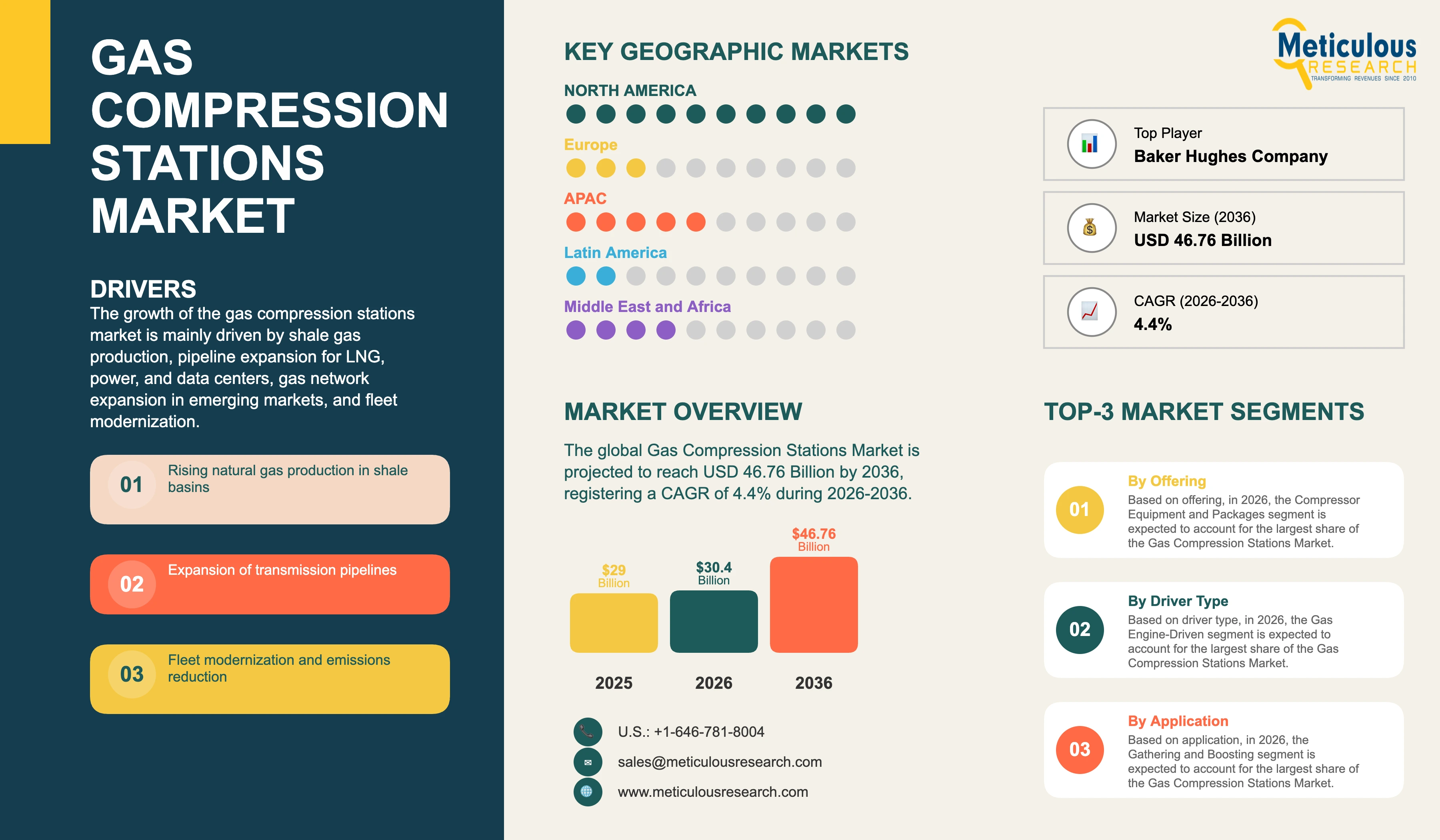
The global gas compression stations market was valued at USD 29.00 billion in 2025. This market is expected to reach USD 46.76 billion by 2036 from an estimated USD 30.40 billion in 2026, registering a CAGR of 4.4% during the forecast period (2026-2036).
- Published
- Nov 2026
- Pages
- 267
- Format
- PDF + Excel
- Report ID
- MREP - 1042711
- Base year
- 2025
- 2024 · HISTORICAL
- $1.16B
- 2036
- $46.76B
- CAGR 2026–2036
- 4.4%
2024–2025 baseline · 2026–2036 forecast at 4.4% CAGR · hover a bar for the value
Key highlights
Archrock, one of the largest U.S. contract compression providers, reported 2025 revenue of USD 1,489.8 million, up from USD 1,157.6 million in 2024, and ended 2025 with 4.6 million operating horsepower, up from 4.2 million a year earlier, with fleet utilization of 95.5%.
Kodiak Gas Services reported record 2025 revenue of about USD 1.3 billion, up 13%, ended 2025 with 4.35 million revenue-generating horsepower at an average of 970 horsepower per unit, and plans to deploy more than 750,000 new large horsepower through 2030.
USA Compression Partners reported 2025 revenue of USD 998.1 million and expanded its active fleet to about 4.4 million horsepower after closing the acquisition of J-W Power in January 2026, while budgeting about 105,000 new horsepower for 2026.
Baker Hughes reported a record USD 39.4 billion backlog in its Industrial & Energy Technology segment in the third quarter of 2026, with gas technology equipment orders up 43%, and cited a record quarter for compressor upgrade awards.
Siemens Energy reported record quarterly orders of about EUR 10 billion in its Gas Services segment in 2026, up about 62% on a comparable basis, joining Baker Hughes and GE Vernova in reporting a record turbomachinery quarter as demand for gas turbines and compression equipment surged.
Williams is phasing out more than 180 legacy reciprocating compressor engines and turbines on its Transco and Northwest pipelines and replacing them with modern gas turbines and electric motor-driven compression. The company replaced 112 compression units under its emissions reduction program, 92 of them in 2024.
Aramco's Master Gas System expansion includes multiple booster gas compression stations, and Baker Hughes secured a contract through CPECC to deploy its Cordant asset performance management software across four of these stations, while Canada approved Enbridge's USD 4 billion Sunrise expansion, which adds compression and looping on the Westcoast system.
By offering, compressor equipment and packages account for the largest share of 34.5% in 2026, while station engineering, construction, and balance of plant registers the highest CAGR.
By driver type, gas engine-driven accounts for the largest share in 2026, while electric motor-driven registers the highest CAGR.
By application, gathering and boosting accounts for the largest share of 38.0% in 2026, while transmission pipelines register the highest CAGR.
By geography, North America accounts for the largest share of 44.0% in 2026, while Middle East & Africa registers the highest CAGR of 5.9%.
Report summary
| Particulars | Details |
|---|---|
| Base Year | 2025 |
| Estimated Year | 2026 |
| Forecast Period | 2026-2036 |
| Market Size in 2025 | USD 29.00 billion |
| Market Size in 2026 | USD 30.40 billion |
| Market Size by 2036 | USD 46.76 billion |
| CAGR (2026-2036) | 4.4% |
| Format | PDF, Excel & Cloud Portal · 267 pages |
| Largest Segment by Offering (2026) | Compressor Equipment and Packages (34.5%) |
| Largest Segment by Application (2026) | Gathering and Boosting (38.0%) |
| Largest Region (2026) | North America (44.0%) |
| Fastest-Growing Region | Middle East & Africa (CAGR 5.9%) |
| Companies Profiled | 12 companies and other companies |
| Segments Covered | Offering, Compressor Type, Driver, Application, Geography |
| Countries Covered | U.S., Canada, China, India, Australia, Indonesia, Malaysia, Rest of Asia-Pacific, Saudi Arabia, Qatar, UAE, Iraq, Egypt, Algeria, Nigeria, Rest of Middle East & Africa, Russia, Germany, Italy, U.K., Netherlands, Norway, Rest of Europe, Argentina, Brazil, Mexico, Rest of Latin America |
Report overview
Segments covered: offering, compressor type, driver type, application, driver.
The growth of this market is mainly driven by rising natural gas production in the U.S. Permian Basin and other shale basins, which requires large volumes of gathering, boosting, and processing compression, the expansion of gas transmission pipelines to supply LNG export terminals, gas-fired power plants, and data centers, large gas network expansion programs in the Middle East, China, and other emerging markets, and the modernization of aging compressor fleets to reduce methane and nitrogen oxide emissions and improve efficiency. However, factors such as the high capital cost and long lead times of compression equipment, permitting delays for new pipelines and compressor stations, and the long-term uncertainty of natural gas demand in Europe are expected to restrain the growth of this market to some extent.
Gas compression stations increase the pressure of natural gas so that it can be gathered from wells, processed, transported through pipelines, and injected into storage. Compression is required at almost every stage of the natural gas value chain. In the field, gathering and boosting compressors collect low-pressure gas from wells and move it to processing plants. At processing plants, inlet and residue gas compressors move gas through treating and separation units and deliver it to transmission pipelines. Along transmission pipelines, compressor stations located every 50 to 150 miles maintain pipeline pressure and flow. At underground storage facilities, compressors inject gas into storage during periods of low demand and, in some cases, help withdraw it during periods of high demand. Without compression, natural gas could not be moved efficiently over long distances, and production from many wells would decline quickly as reservoir pressure falls.
This report covers global revenue from onshore natural gas compression stations, including compressor equipment and packages with their drivers, station engineering, construction, and balance of plant, contract compression services, in which third-party companies own and operate compression under contract, and aftermarket and maintenance services such as parts, overhauls, field services, and upgrades. The scope includes transmission pipeline, gathering and boosting, gas processing and treating, and underground gas storage applications. Refrigerant compressors for LNG liquefaction, compressors for CNG fueling stations, refinery and petrochemical process compressors, and offshore platform compression are excluded from the scope of this report, as are pipelines themselves and metering and regulating stations, which are covered in separate studies.
Compression stations use two main types of compressors, which differ in design, operating range, and typical applications. Reciprocating compressors, which use pistons, are widely used in gathering, boosting, gas lift, and storage applications, where flexibility and high compression ratios are needed. They are typically driven by natural gas engines or electric motors and range from a few hundred to several thousand horsepower. Centrifugal compressors, which use rotating impellers, are used on large transmission pipelines and at gas processing plants, where large volumes must be moved at relatively steady conditions. They are typically driven by gas turbines or large electric motors and can exceed 30,000 horsepower per unit.
North America is the largest market, driven by shale gas production in the Permian, Haynesville, Marcellus, and other basins, a large network of interstate and intrastate pipelines, and a large contract compression industry. U.S. contract compression providers such as Archrock, Kodiak Gas Services, USA Compression Partners, and Enerflex operate large fleets of compression units under contract for producers and midstream companies, and they have reported record revenue, high utilization, and rising pricing in 2025 and 2026.
Outside North America, large compression investments are being made in the Middle East, where Saudi Arabia, Qatar, the UAE, and other countries are expanding gas networks and processing capacity, in China, which continues to build trunk pipelines and storage, and in Latin America, Africa, and Central Asia. Europe is a smaller and slower-growing market, with investment focused on modernization, emissions reduction, and adapting networks to new supply routes, such as the shift from Russian pipeline gas to LNG imports. Russia and Central Asia maintain large compressor fleets on their export pipelines, but investment there depends heavily on export routes and sanctions.
The market includes manufacturers of compressors, gas turbines, and gas engines, packagers that assemble compressors and drivers into skid-mounted units, engineering and construction contractors that build stations, contract compression companies, and service providers. Leading equipment suppliers include Baker Hughes, Siemens Energy, Solar Turbines (Caterpillar), Everllence, Ariel, Mitsubishi Heavy Industries, Atlas Copco, and INNIO, while Archrock, Kodiak Gas Services, USA Compression Partners, and Enerflex are leading contract compression and packaging companies.
Over the forecast period, the market is expected to grow steadily, supported by rising gas demand for power generation, LNG exports, and industry, as well as fleet modernization. Electric motor-driven compression is expected to grow fastest among driver types, and transmission pipelines are expected to be the fastest-growing application, as new pipeline capacity is built to serve LNG terminals, power plants, and data centers.
Report infographic
Market dynamics
16 factors across 5 forcesRising natural gas production in shale basins
Natural gas production from shale basins in the U.S., particularly the Permian, Haynesville, and Marcellus, continues to grow, and every additional unit of production requires compression for gathering, boosting, processing, and transport. Associated gas production in the Permian is particularly compression-intensive, because wells produce gas at low pressure and the gas must be gathered from many wells and compressed several times before it reaches transmission pipelines. USA Compression Partners noted that Permian natural gas production ended 2025 about 9% higher year-on-year even as oil production flattened.
This growth has driven strong demand for contract compression, as producers and midstream companies prefer to outsource compression rather than own it. Archrock grew its operating horsepower from 4.2 million to 4.6 million in 2025, and Kodiak Gas Services plans to deploy more than 750,000 new large horsepower through 2030, including 150,000 horsepower in 2026 at an average of about 1,700 horsepower per unit. Contract compression providers have reported utilization above 94%, which shows that the market is tight and that new capacity is needed. The trend toward larger compression units, which are more efficient and require fewer units per station, also supports investment in new equipment, as providers replace small units with larger ones.
Expansion of transmission pipelines for LNG, power, and data centers
Natural gas demand is growing for LNG exports, gas-fired power generation, and data centers, which requires new and expanded transmission pipelines and compressor stations. In the U.S., several large LNG export terminals are under construction, and gas demand from power plants serving data centers is rising rapidly. Pipeline companies are expanding capacity by adding new compressor stations, upgrading existing ones, and building loops along existing routes.
Williams' Southside Reliability Enhancement added 423,400 dekatherms per day of capacity to the Transco pipeline, including a new all-electric compressor station in Virginia, and its Northeast Supply Enhancement project, which broke ground in 2026, will add 400,000 dekatherms per day of capacity using electric motor-driven compressors. In Canada, Enbridge's USD 4 billion Sunrise expansion adds compression and looping to the Westcoast system to support domestic demand and LNG growth.
Compression is often the fastest and least expensive way to expand pipeline capacity, because adding horsepower at existing stations or building new stations along existing routes requires less land and fewer permits than building new pipelines. Several Transco projects, for example, combine short pipeline loops with new or upgraded compressor units to increase capacity for power plants and utilities in the Southeast.
Gas network expansion in the Middle East and emerging markets
Countries in the Middle East, Asia, Africa, and Latin America are investing in gas networks to increase domestic gas use for power generation and industry, reduce oil burning, and support economic development. Saudi Arabia is expanding its Master Gas System to supply gas to the central and western regions of the country, and Aramco has announced a strategic gas expansion of more than 60% by 2030 compared with 2021. The second phase of the Master Gas System expansion increased the network's capacity from 8.4 to 12.5 billion cubic feet per day, and the third phase includes new booster gas compression stations.
Other countries, including Qatar, the UAE, Iraq, Egypt, Algeria, India, China, Argentina, and Brazil, are also investing in gas processing, pipelines, and compression. These projects create demand for large centrifugal compressors, gas turbines, station EPC services, and long-term maintenance. Aramco awarded EPC contracts worth about USD 25 billion covering Jafurah phase two, the third phase of the Master Gas System expansion, and related work, including gas compression facilities and pipelines.
Fleet modernization and emissions reduction
Many compressor stations in North America and Europe use older reciprocating engines and turbines that are less efficient and emit more methane and nitrogen oxides than modern equipment. Pipeline operators are replacing these units with modern gas turbines with low-emission combustion, electric motor-driven compressors, and vent gas capture systems. Williams is phasing out more than 180 legacy reciprocating engines and turbines, and it has reported nitrogen oxide reductions of about 98% at modernized stations. Modernization projects also improve efficiency and reliability, reduce fuel use, and lower maintenance costs, which helps operators improve returns. Baker Hughes cited a record quarter for compressor upgrade awards in the third quarter of 2026, which shows the strength of modernization demand.
Table of contents
12 chapters · 134 sections · 267 pages · click to expandSegmental analysis
| Segment | Largest share (2026) | Fastest growth (2026–2036) |
|---|---|---|
| By Offering | Reciprocating compressors | Centrifugal compressors |
By Offering
- The reciprocating compressors segment is expected to account for the largest share of the gas compression stations market, while the centrifugal compressors segment is projected to register the highest CAGR during the forecast period.
Geographic analysis
North America
Largest shareIn 2026, North America is expected to account for the largest share of 44.0% of the global gas compression stations market. The large share of this region is mainly due to the large volume of shale gas production in the U.S., a large network of interstate and intrastate pipelines with many compressor stations, a large contract compression industry with several companies operating fleets of millions of horsepower, and new pipeline projects to supply LNG terminals, power plants, and data centers. Canada also contributes, with projects such as Enbridge's Sunrise expansion.
Asia-Pacific
Asia-Pacific is the second-largest market, driven by pipeline and storage expansion in China, the development of the national gas grid in India, and gas processing and compression in Australia, Indonesia, and Malaysia. China continues to expand its national pipeline network and underground storage capacity, which requires large compressor stations, and domestic suppliers play a growing role. India is also expanding its national gas grid, which requires new compressor stations.
Middle East & Africa
Fastest growthThe Middle East & Africa is projected to register the highest CAGR of 5.9% during the forecast period. The rapid growth of this region is mainly due to large gas network expansions in Saudi Arabia, including the Master Gas System and Jafurah developments, gas processing and compression projects in Qatar, the UAE, Oman, Iraq, and Kuwait, and gas infrastructure development in Egypt, Algeria, Nigeria, Mozambique, and other African countries. Many of these projects use large centrifugal compressors driven by gas turbines, and Chinese, European, and Middle Eastern EPC contractors compete for station construction contracts.
Latin America
Latin America is supported by gas production growth in Argentina's Vaca Muerta, Brazil, and Mexico. Argentina is building new pipelines and compression to move Vaca Muerta gas to domestic markets and future LNG export projects.
Europe
Europe is expected to grow slowly, as gas demand declines in the long term. Investment in Europe is focused on modernizing existing stations, reducing emissions, adapting networks to new LNG import routes, and preparing pipelines for hydrogen blending. Some European operators are also replacing gas turbine drivers with electric motors to reduce emissions.
Competitive landscape
The global gas compression stations market is fragmented, with the top five players estimated to account for about 25% of the market in 2025. The market includes compressor and driver manufacturers, packagers, EPC contractors, contract compression providers, and service companies.
Baker Hughes, Siemens Energy, Solar Turbines, Everllence, and Mitsubishi Heavy Industries are leading suppliers of centrifugal compressors and gas turbines for transmission and processing applications. Baker Hughes reported a record backlog in its Industrial & Energy Technology segment in 2026, and Siemens Energy has also reported record orders in its gas services business.
Ariel is the leading manufacturer of reciprocating compressors for gathering, boosting, and processing, while Caterpillar and INNIO supply gas engines for compressor drivers. Atlas Copco supplies compressors for gas processing and other applications. Everllence, formerly MAN Energy Solutions, supplies centrifugal compressors for pipelines, storage, and processing, and it recently won orders for compressor trains for upstream projects.
Archrock, Kodiak Gas Services, USA Compression Partners, and Enerflex are leading contract compression providers in the U.S., and Enerflex also provides engineered compression systems and build-own-operate-maintain services internationally. These companies have reported record revenue and high utilization in 2025, supported by Permian gas production growth. Enerflex has agreed to sell most of its Asia-Pacific operations to INNIO Group, which reflects the reshaping of the industry around core regions.
Companies compete on equipment efficiency, reliability, emissions performance, delivery time, service capabilities, and total cost of ownership. Key strategies include expanding manufacturing capacity, developing electric and low-emission solutions, offering digital monitoring and predictive maintenance, and consolidating contract compression fleets through acquisitions. Partnerships between equipment manufacturers and contract compression providers, such as the strategic agreement between Kodiak Gas Services and Baker Hughes, are also becoming more common. Chinese manufacturers, such as Shenyang Blower Works, are increasingly competitive in domestic and export markets for pipeline compressors. Siemens Energy, which is rebranding as Omterra, is also reported to be exploring the sale of a majority stake in its steam turbine and compressor business, which could change the competitive landscape for large compressors. Competition is strongest in contract compression in the Permian, where several large providers compete for long-term contracts with major producers.
Some of the key players operating in the gas compression stations market are Baker Hughes Company, Siemens Energy AG, Caterpillar Inc. (Solar Turbines), Everllence SE, Ariel Corporation, Mitsubishi Heavy Industries, Ltd., Atlas Copco AB, INNIO Group, Archrock, Inc., Kodiak Gas Services, Inc., USA Compression Partners, LP, and Enerflex Ltd., among others.
- —
Baker Hughes reported a record USD 39.4 billion IET backlog and a record quarter for compressor upgrade awards in 2026, USA Compression Partners acquired J-W Power, Williams broke ground on its Northeast Supply Enhancement project with electric compressors, and Canada approved Enbridge's Sunrise expansion.
- Baker Hughes Company
- Siemens Energy AG
- Caterpillar Inc. · Solar Turbines
- Everllence SE
- Ariel Corporation
- Mitsubishi Heavy Industries, Ltd.
- Atlas Copco AB
- INNIO Group
- Archrock, Inc.
- Kodiak Gas Services, Inc.
- USA Compression Partners
- LP
- Enerflex Ltd.
Expert perspectives
The gas compression stations market is benefiting from a strong cycle of natural gas investment, driven by shale production growth, LNG exports, rising power demand, and gas network expansion in emerging markets. We expect steady growth over the forecast period.
Over the forecast period, the market is expected to grow at a CAGR of 4.4%, from USD 30.40 billion in 2026 to USD 46.76 billion in 2036. Growth will be supported by new pipelines, gathering and boosting, and modernization, while high costs, long lead times, permitting delays, and methane regulations will moderate growth.
In terms of segments, compressor equipment and packages remain the largest offering, while station engineering, construction, and balance of plant grow fastest. Reciprocating compressors remain the largest compressor type, while centrifugal compressors grow fastest. Gas engine-driven compression remains the largest driver type, while electric motor-driven compression grows fastest. Gathering and boosting remains the largest application, while transmission pipelines grow fastest. North America remains the largest region, while the Middle East & Africa grows fastest at a CAGR of 5.9%.
For suppliers, the key priorities are to expand manufacturing capacity to reduce lead times, to develop electric and low-emission solutions, and to offer digital monitoring and predictive maintenance. For contract compression providers, the key priorities are to grow large-horsepower fleets in the Permian and other basins and to maintain high utilization and pricing.
We expect electrification to be one of the most important trends over the next decade, particularly in North America, as operators seek to reduce emissions and maintenance costs. In our view, grid capacity will be a key constraint on the pace of electrification in shale basins.
Our estimates are based on contract compression revenue reported by leading providers, horsepower additions and pricing, compressor and turbine order trends, announced pipeline, processing, and storage projects, and typical station costs and service spending. We believe the market is in a strong cycle in North America and the Middle East, but growth may slow after 2030 as large pipeline projects are completed, while modernization and electrification will provide steady long-term demand.
We also expect consolidation among contract compression providers to continue, and we expect equipment suppliers to benefit from strong pricing as long as lead times remain long. Suppliers that can deliver standardized, modular, and electric compression packages quickly will be best positioned to win share in the next cycle. We see the Middle East as the most important growth market outside North America, followed by China, India, Argentina, and several African gas producers.
Customer perspectives
Vice President of Operations - Midstream company, U.S.
Gas production in our basins keeps growing, and we need more compression every year. We prefer contract compression for gathering and boosting because it gives us flexibility and avoids large capital commitments.
Director of Engineering - Interstate pipeline company, U.S.
For new compressor stations and upgrades near populated areas, we increasingly choose electric motor-driven compression. It reduces emissions and noise, and it helps us obtain permits.
“Our gas network expansion requires new booster compressor stations, and we expect long-term reliability and strong service support from our suppliers and contractors.”
Frequently asked questions
The global gas compression stations market was valued at USD 29.00 billion in 2025, up from USD 27.60 billion in 2024, and is estimated at USD 30.40 billion in 2026. The market includes compressor equipment and packages, station engineering and construction, contract compression services, and aftermarket services.
The global gas compression stations market is expected to reach USD 46.76 billion by 2036, supported by shale gas production, pipeline expansion, gas network growth in emerging markets, and fleet modernization.
The market is expected to register a CAGR of 4.4% from 2026 to 2036, supported by pipeline expansion, gathering and boosting, and modernization.
Archrock reported 2025 revenue of USD 1,489.8 million with 4.6 million operating horsepower, Kodiak Gas Services reported about USD 1.3 billion with 4.35 million revenue-generating horsepower, and USA Compression Partners reported USD 998.1 million and expanded to about 4.4 million active horsepower after acquiring J-W Power.
Market growth is mainly driven by rising natural gas production in shale basins, the expansion of transmission pipelines for LNG, power, and data centers, gas network expansion in the Middle East and emerging markets, and fleet modernization and emissions reduction.
High capital costs, long equipment lead times, and permitting delays restrain growth, while methane emissions regulations and skilled workforce shortages are key challenges.
Key opportunities include the electrification of compression, compression for gas-fired power and data centers, digital monitoring and predictive maintenance, and gas storage expansion and modernization.
Compressor equipment and packages are expected to account for the largest share of 34.5% of the market in 2026, while station engineering, construction, and balance of plant is projected to register the highest CAGR.
Electric motor-driven compression is projected to register the highest CAGR, driven by emissions reduction goals, lower maintenance costs, and all-electric pipeline compressor stations, while gas engine-driven compression remains the largest segment.
Gathering and boosting is expected to account for the largest share of 38.0% of the market in 2026, while transmission pipelines are projected to register the highest CAGR.
North America is expected to account for the largest share of 44.0% of the market in 2026, mainly due to shale gas production, a large pipeline network with many compressor stations, and a large contract compression industry.
The Middle East & Africa is projected to register the highest CAGR of 5.9% during the forecast period, driven by gas network expansion in Saudi Arabia and other countries.
The report profiles 12 companies, including Baker Hughes Company, Siemens Energy AG, Caterpillar Inc. (Solar Turbines), Everllence SE, Ariel Corporation, Mitsubishi Heavy Industries, Ltd., Atlas Copco AB, INNIO Group, Archrock, Inc., Kodiak Gas Services, Inc., USA Compression Partners, LP, and Enerflex Ltd.
Baker Hughes reported a record USD 39.4 billion IET backlog and a record quarter for compressor upgrade awards in 2026, USA Compression Partners acquired J-W Power, Williams broke ground on its Northeast Supply Enhancement project with electric compressors, and Canada approved Enbridge's Sunrise expansion.
In 2026, the reciprocating compressors segment is expected to account for the largest share of the gas compression stations market, while the centrifugal compressors segment is projected to register the highest CAGR during the forecast period.
Cite this report
Meticulous Research. (2026). Gas Compression Stations Market - Global Opportunity Analysis and Industry Forecast (2026-2036) (Report No. MREP - 1042711). Meticulous Market Research Pvt. Ltd. https://www.meticulousresearch.com/product/gas-compression-stations-market-7394