Hydrogen Refueling Stations Market (2026-2036)
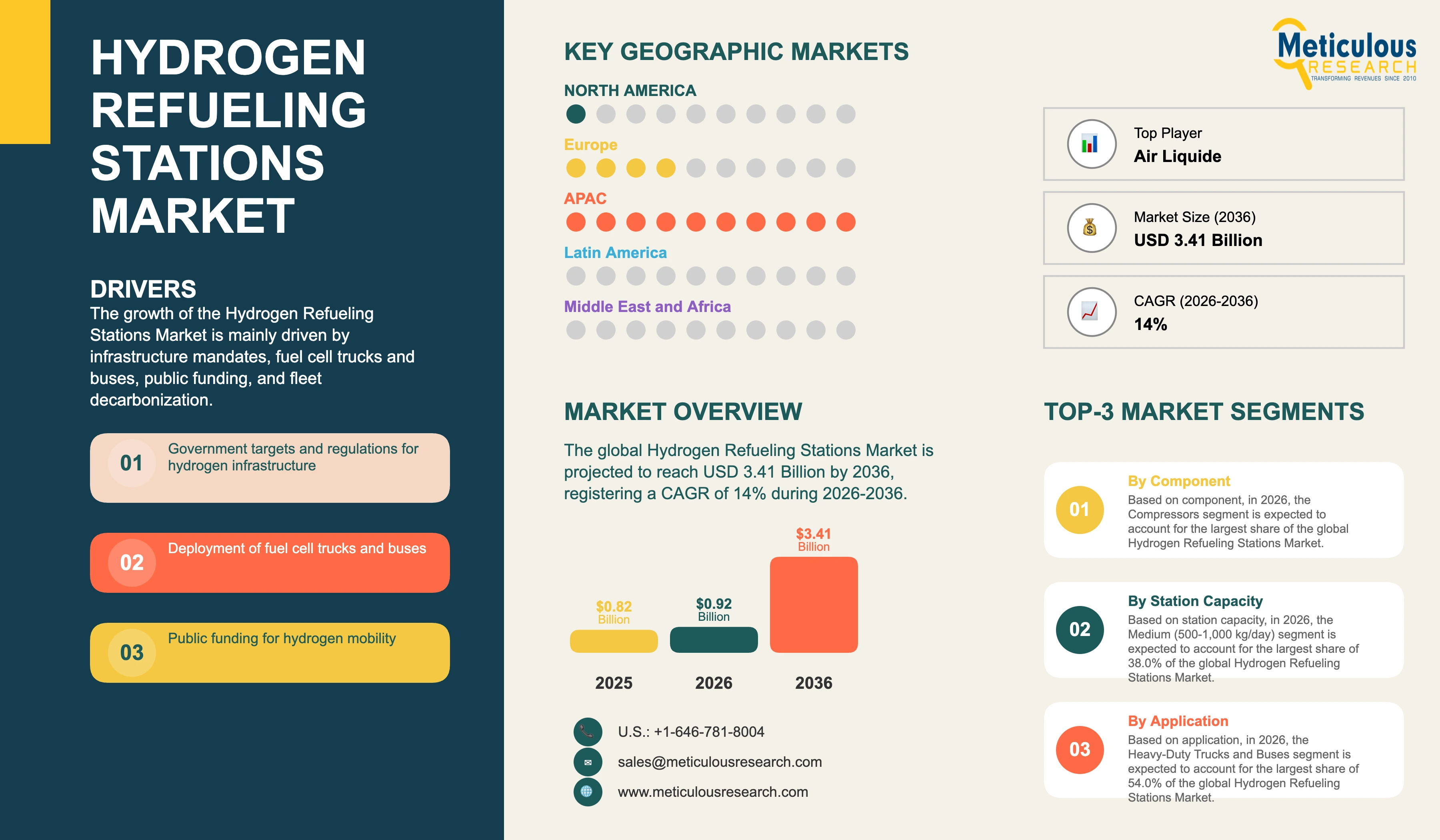
The global hydrogen refueling stations market was valued at USD 0.82 billion in 2025. This market is expected to reach USD 3.41 billion by 2036 from an estimated USD 0.92 billion in 2026, registering a CAGR of 14.0% during the forecast period (2026-2036).
- Published
- Nov 2026
- Pages
- 271
- Format
- PDF + Excel
- Report ID
- MREP - 1042576
- Base year
- 2025
- 2025 · BASELINE
- $820.0M
- 2036
- $3.41B
- CAGR 2026–2036
- 14.0%
2025 baseline · 2026–2036 forecast at 14.0% CAGR · hover a bar for the value
Key highlights
Around 1,160 hydrogen refueling stations were in operation worldwide at the end of 2024, including 384 in China, according to the 17th annual evaluation of H2stations.org by Ludwig-Bölkow-Systemtechnik (LBST), published by TÜV SÜD in February 2025. About 125 new stations opened in 2024, including 42 in Europe, around 30 in China, 25 in South Korea, 8 in Japan, and 13 in North America.
LBST reported that Asia had 748 hydrogen refueling stations in operation at the end of 2024 and Europe had 294, of which 113 were in Germany, 65 in France, 25 in the Netherlands, and 19 in Switzerland. Forty-five countries had hydrogen refueling infrastructure in operation or under construction, and there were concrete plans for at least 377 additional station locations outside China.
The EU's Alternative Fuels Infrastructure Regulation requires publicly accessible hydrogen refueling stations along the core Trans-European Transport Network by the end of 2030, with a maximum distance of 200 kilometers between stations, and in November 2025 the European Commission awarded more than EUR 600 million to 70 alternative fuel infrastructure projects, including support for 38 hydrogen refueling stations, according to the Hydrogen Fuel Cell Partnership.
Germany's H2 MOBILITY closed 14 smaller stations at the end of 2025 to focus on high-capacity stations for buses, trucks, and other commercial vehicles, and in November 2025 six European station operators formed the H2 Infrastructure Alliance to urge vehicle manufacturers to accelerate vehicle rollout. In June 2026, H2 MOBILITY cut hydrogen prices by about 10% at five new high-capacity stations.
In California, Chevron opened its third hydrogen station in Carson in February 2026, bringing the state's listed retail network to 52 open stations, and average monthly station availability increased from 60% in 2024 to more than 90% by the end of 2025, according to the Hydrogen Fuel Cell Partnership. In May 2026, the EU's Clean Hydrogen Partnership launched the H2-Stations platform to improve the availability and transparency of European station data.
By component, compressors account for the largest share in 2026, while on-site production units register the highest CAGR.
By station capacity, medium (500-1, 000 kg/day) accounts for the largest share of 38.0% in 2026, while large (above 1,000 kg/day) registers the highest CAGR.
By hydrogen supply, off-site gaseous hydrogen delivery accounts for the largest share in 2026, while on-site electrolysis register the highest CAGR.
By application, heavy-duty trucks and buses account for the largest share of 54.0% in 2026 and also register the highest CAGR.
By geography, Asia-Pacific accounts for the largest share of 66.0% in 2026, while Europe registers the highest CAGR of 16.9%.
Report summary
| Particulars | Details |
|---|---|
| Base Year | 2025 |
| Estimated Year | 2026 |
| Forecast Period | 2026-2036 |
| Market Size in 2025 | USD 0.82 billion |
| Market Size in 2026 | USD 0.92 billion |
| Market Size by 2036 | USD 3.41 billion |
| CAGR (2026-2036) | 14.0% |
| Format | PDF, Excel & Cloud Portal · 271 pages |
| Largest Segment by Station Capacity (2026) | Medium (500-1,000 kg/day) (38.0%) |
| Largest Segment by Application (2026) | Heavy-Duty Trucks and Buses (54.0%) |
| Largest Region (2026) | Asia-Pacific (66.0%) |
| Fastest-Growing Region | Europe (CAGR 16.9%) |
| Companies Profiled | 15 companies and other companies |
| Segments Covered | Component, Station Capacity, Hydrogen Supply, Application, Geography |
| Countries Covered | China, Japan, South Korea, Australia, India, New Zealand, Rest of Asia-Pacific, Germany, France, Netherlands, Switzerland, U.K., Austria, Belgium, Italy, Spain, Poland, Sweden, Rest of Europe, U.S., Canada, Brazil, Chile, Mexico, Rest of Latin America, Saudi Arabia, U.A.E., Oman, South Africa, Rest of Middle East & Africa |
Report overview
Segments covered: component, station capacity, hydrogen supply, application.
The growth of this market is mainly driven by government targets and regulations for hydrogen refueling infrastructure, such as the European Union's Alternative Fuels Infrastructure Regulation, the rapid deployment of fuel cell trucks and buses in China, South Korea, and Europe, public funding programs for hydrogen mobility and infrastructure, the decarbonization goals of fleet operators and logistics companies, and improvements in station capacity, reliability, and refueling performance for heavy-duty vehicles. However, factors such as the high capital and operating costs of refueling stations, the high price of hydrogen at the pump, low utilization at many stations, the closure of stations for passenger vehicles in some markets, and slow growth in fuel cell passenger car sales are expected to restrain the growth of this market to some extent.
A hydrogen refueling station is a facility that stores, compresses, cools, and dispenses hydrogen to fuel cell electric vehicles, such as passenger cars, buses, trucks, forklifts, and other vehicles. A typical station includes a hydrogen supply system, which may be delivered hydrogen in gaseous or liquid form or hydrogen produced on site by electrolysis or reforming, compressors or pumps that raise the pressure of the hydrogen, high-pressure storage vessels, precooling systems that chill the hydrogen before fueling, dispensers that deliver hydrogen to vehicles at 350 bar or 700 bar, and control, safety, and metering systems. Stations designed for heavy-duty vehicles are generally much larger than stations for passenger cars and must deliver large quantities of hydrogen quickly and reliably.
This report covers the hydrogen refueling stations market, including compressors, storage systems, dispensers, precooling and chilling units, on-site hydrogen production units, and engineering, construction, installation, and other services for new stations and station upgrades. The market is analyzed by component, station capacity, hydrogen supply, application, and geography. Spending on the hydrogen sold at stations, fuel cell vehicles, and large hydrogen production plants not integrated with refueling stations is analyzed in separate reports. The market is measured on a revenue basis.
The global hydrogen refueling network has grown steadily but remains small compared with networks for gasoline, diesel, and electric vehicles. According to LBST's H2stations.org, around 1,160 hydrogen refueling stations were in operation worldwide at the end of 2024, compared with 921 at the end of 2023, and about 125 new stations opened in 2024. Asia had 748 stations, including 384 in China, while Europe had 294 stations, led by Germany with 113, France with 65, the Netherlands with 25, and Switzerland with 19. North America had about 89 stations, of which 74 were in California, while Canada had 12. LBST noted that the actual number of stations is uncertain, partly because closures are not always announced publicly.
The market is shifting from small stations for passenger cars toward larger stations for heavy-duty vehicles. In Europe, most new stations can now refuel trucks and buses, and operators such as H2 MOBILITY in Germany have closed smaller stations designed for cars to focus on high-capacity stations for commercial vehicles. In China, government support for fuel cell vehicle demonstration city clusters has led to the deployment of large numbers of fuel cell trucks and buses and the stations to serve them, and in December 2025, Chinese manufacturers, logistics operators, and regional governments delivered 700 fuel cell trucks and buses and ordered 1,400 more, according to Engineering News. South Korea continues to expand its station network to support fuel cell buses and passenger cars.
At the same time, the passenger vehicle market for hydrogen has faced challenges. Sales of fuel cell passenger cars have been weak in most markets, and station operators in California and Europe have faced low utilization, high hydrogen prices, and reliability problems. Shell closed its light-duty hydrogen stations in California in 2024, and H2 MOBILITY closed 14 stations in Germany at the end of 2025. However, station reliability in California has improved significantly, with average monthly availability rising from 60% in 2024 to more than 90% by the end of 2025, and new operators such as Chevron have opened stations.
Policy support from national governments and the European Union is a major factor in the development of the market. The EU's Alternative Fuels Infrastructure Regulation requires hydrogen refueling stations at least every 200 kilometers along the core Trans-European Transport Network and in every urban node by the end of 2030, and the European Commission continues to fund stations through the Alternative Fuels Infrastructure Facility. China, Japan, and South Korea have national hydrogen strategies with targets for vehicles and stations, and the U.S. Department of Energy is preserving nearly USD 5 billion in funding for five hydrogen hubs, according to the Fuel Cell & Hydrogen Energy Association.
Compressors account for the largest share of the market by component, while on-site production units are the fastest-growing component, supported by the integration of electrolyzers with stations. Medium-capacity stations account for the largest share by station capacity, while large stations above 1,000 kilograms per day are growing fastest. Heavy-duty trucks and buses are the largest and fastest-growing application. Asia-Pacific accounts for the largest share of the market, led by China, Japan, and South Korea, while Europe is the fastest-growing region, supported by the AFIR mandate and growth in hydrogen trucks and buses.
Over the forecast period, the hydrogen refueling stations market is expected to grow strongly, supported by the deployment of heavy-duty fuel cell vehicles, policy mandates, and public funding. At the same time, the market's growth will depend on reductions in station and hydrogen costs, improvements in utilization and reliability, and the pace of fuel cell vehicle adoption relative to battery electric alternatives.
We are moving away from small car stations and investing in high-capacity stations for buses and trucks. Reliability and a competitive hydrogen price matter more to our customers than the number of stations.
This comment explains why heavy-duty trucks and buses account for 54.0% of the market, why large stations are the fastest-growing capacity class, and why Europe is the fastest-growing region.
Our fuel cell trucks run on fixed routes, so we need a few large stations with reliable supply rather than a dense network. Government support helped us start, but costs must keep falling.
This comment explains why Asia-Pacific accounts for 66.0% of the market and why medium and large stations serving commercial fleets dominate demand. It also highlights the importance of cost reductions for long-term growth.
Our bus depot station has to refuel dozens of buses every night without failure, so we chose a supplier with strong service support and proven equipment.
This comment explains why reliability and service are key purchase criteria and why compressors and services account for large shares of station spending.
Medium-capacity stations with 500 to 1,000 kilograms per day are expected to account for the largest share of 38.0% of the market in 2026, while large stations above 1,000 kilograms per day are projected to register the highest CAGR.
Heavy-duty trucks and buses are expected to account for the largest share of 54.0% of the market in 2026 and are also projected to register the highest CAGR.
Asia-Pacific is expected to account for the largest share of 66.0% of the market in 2026, mainly due to the large station networks in China, Japan, and South Korea and the deployment of fuel cell trucks and buses in China.
Europe is projected to register the highest CAGR of 16.9% during the forecast period, driven by the AFIR requirement for stations every 200 kilometers on the core TEN-T network by 2030, public funding, and the growth of fuel cell buses and trucks.
The report profiles 15 companies, including Air Liquide, Linde, Air Products, Iwatani, ENEOS, Sinopec, TotalEnergies, Nel, Hydrogen Refueling Solutions, Houpu Clean Energy, Chart Industries, Burckhardt Compression, Maximator, PDC Machines, and Hyundai Rotem.
Heavy-duty trucks and buses consume much more hydrogen than passenger cars, which improves station utilization and economics, and policies such as the AFIR require stations capable of serving heavy-duty vehicles, while weak fuel cell car sales have led to closures of smaller car stations.
Report infographic
Market dynamics
18 factors across 5 forcesGovernment targets and regulations for hydrogen infrastructure
Government policies are the most important driver of the hydrogen refueling stations market. In the European Union, the Alternative Fuels Infrastructure Regulation requires member states to deploy publicly accessible hydrogen refueling stations along the core Trans-European Transport Network at intervals of no more than 200 kilometers and in every urban node by the end of 2030, with stations capable of serving both light-duty and heavy-duty vehicles. This regulation creates a binding requirement for hundreds of new stations across Europe, particularly in countries that currently have few or no stations.
In Asia, China's national and provincial hydrogen policies, including the fuel cell vehicle demonstration city clusters in Beijing, Shanghai, Guangdong, Henan, and Hebei, support the construction of stations alongside vehicle deployment. Japan and South Korea have set targets for hydrogen stations and fuel cell vehicles in their national hydrogen strategies, and South Korea in particular has expanded its network rapidly, with 25 new stations in 2024, according to LBST.
Industry groups such as H2Accelerate have urged the European Commission to maintain the ambition of the AFIR hydrogen targets during its review of the regulation, reflecting the importance of these targets for investment decisions by station operators and vehicle manufacturers.
Deployment of fuel cell trucks and buses
Heavy-duty vehicles are becoming the main source of demand for hydrogen refueling stations. Fuel cell trucks and buses offer long range, fast refueling, and high payload capacity, which make them attractive for long-haul freight, regional logistics, and intensive bus operations where battery electric vehicles may face limitations. China has deployed tens of thousands of fuel cell commercial vehicles, mainly trucks and buses, supported by government demonstration programs, and Chinese manufacturers and operators delivered 700 fuel cell trucks and buses in December 2025 alone, according to Engineering News.
In Europe, fuel cell buses are operating in many cities, and truck manufacturers are testing and deploying fuel cell trucks with logistics companies. Heavy-duty vehicles consume much more hydrogen than passenger cars, which improves station utilization and economics, and fleets with predictable routes can be served by a small number of high-capacity stations. This shift is increasing demand for large stations with high compression capacity, large storage, and fast-fill dispensers.
Bus operators often build depot-based stations that serve their own fleets, which provide high and predictable utilization and are an important part of the market in China, Europe, and South Korea.
Public funding for hydrogen mobility and infrastructure
Public funding programs reduce the high capital cost of hydrogen refueling stations and are essential for early-stage network development. In November 2025, the European Commission awarded more than EUR 600 million to 70 alternative fuel infrastructure projects under the Alternative Fuels Infrastructure Facility, including support for 38 hydrogen refueling stations for cars, trucks, and buses. National programs in Germany, France, the Netherlands, and other countries also fund stations and vehicles.
In Asia, China's central and local governments provide subsidies for stations and vehicles in demonstration cities, and Japan and South Korea subsidize station construction and operation. In the U.S., state programs in California have funded most of the existing stations, and federal funding for hydrogen hubs supports hydrogen production and end uses, including transportation. Public funding is expected to remain important until hydrogen mobility becomes commercially self-sustaining.
Decarbonization goals of fleet operators
Logistics companies, bus operators, ports, and industrial fleet operators are setting targets to reduce greenhouse gas emissions from their vehicles, driven by regulations, customer requirements, and corporate sustainability commitments. Hydrogen fuel cell vehicles are one of the main zero-emission options for heavy-duty, long-range, and high-utilization applications, and fleet operators are working with station operators and energy companies to develop refueling infrastructure along their routes and at their depots.
Emission standards for heavy-duty vehicles in the EU and China, and low-emission zones in cities, further encourage fleets to adopt zero-emission vehicles. Ports and logistics hubs are also emerging as early locations for high-capacity hydrogen stations serving trucks, cargo handling equipment, and other vehicles.
Improvements in station capacity and reliability
Station technology has improved significantly, with higher-capacity compressors, larger storage, improved precooling, and dispensers capable of refueling heavy-duty vehicles quickly. Station reliability, which was a major problem in early networks, is improving as operators gain experience, standardize designs, and invest in maintenance. In California, average monthly station availability increased from 60% in 2024 to more than 90% by the end of 2025, according to the Hydrogen Fuel Cell Partnership.
New technologies such as liquid hydrogen pumps, subcooled liquid hydrogen refueling, and ionic compressors are increasing station capacity and reducing energy use, which makes high-capacity stations for trucks more practical. Standardized refueling protocols for heavy-duty vehicles are also improving interoperability between stations and vehicles from different manufacturers.
Table of contents
12 chapters · 153 sections · 271 pages · click to expandSegmental analysis
| Segment | Largest share (2026) | Fastest growth (2026–2036) |
|---|---|---|
| By Component | Compressors | On-site production units |
By Component
- The compressors segment is expected to account for the largest share of the hydrogen refueling stations market, while the on-site production units segment is projected to register the highest CAGR during the forecast period.
- The off-site gaseous hydrogen delivery segment is expected to account for the largest share of the hydrogen refueling stations market, while the on-site electrolysis segment is projected to register the highest CAGR during the forecast period.
Geographic analysis
Asia-Pacific
Largest shareIn 2026, Asia-Pacific is expected to account for the largest share of 66.0% of the global hydrogen refueling stations market. The large share of this region is mainly due to the large and growing station networks in China, Japan, and South Korea, which together accounted for most of the 748 stations in operation in Asia at the end of 2024, according to LBST. China had 384 stations at the end of 2024 and continues to build stations for fuel cell trucks and buses in its demonstration city clusters, supported by central and local government subsidies. South Korea opened 25 new stations in 2024 and continues to expand its network for buses and passenger cars, while Japan has one of the most established networks for passenger cars. Australia, India, and New Zealand are also developing their first stations and hydrogen mobility projects.
Europe
Fastest growthEurope is projected to register the highest CAGR of 16.9% during the forecast period. The rapid growth of this region is mainly driven by the AFIR's requirement for hydrogen stations every 200 kilometers along the core TEN-T network and in urban nodes by the end of 2030, funding from the Alternative Fuels Infrastructure Facility and national programs, the growth of fuel cell bus fleets and truck deployments, and the shift of operators toward high-capacity stations for heavy-duty vehicles. Germany, France, the Netherlands, and Switzerland have the largest networks, and countries with few stations today, such as Italy, Spain, Poland, and Austria, will need to build stations to meet AFIR requirements. Europe had 294 stations at the end of 2024, and 42 new stations opened in Europe that year, more than in any other region.
North America
North America accounts for a smaller share of the market, mainly driven by California, which had 52 open retail stations in February 2026 and improved station availability significantly in 2025, as well as stations for buses, trucks, and forklifts. Canada had 12 stations at the end of 2024, and federal funding for hydrogen hubs in the U.S. supports hydrogen production and use in transport.
Latin America
Latin America and the Middle East & Africa account for the smallest shares of the market, with early projects in Brazil, Chile, Saudi Arabia, the U.A.E., Oman, and South Africa, supported by national hydrogen strategies and large planned hydrogen production projects. Regional differences in policy support, vehicle deployment, hydrogen costs, and the role of heavy-duty vehicles will shape the growth of station networks over the forecast period. Regions with binding infrastructure mandates and large fleets of fuel cell commercial vehicles are expected to see the strongest growth.
Competitive landscape
The global hydrogen refueling stations market is moderately consolidated, with the top five players estimated to account for about 40% of the market in 2025. The market includes industrial gas companies, energy and oil companies, specialized hydrogen refueling equipment manufacturers, compressor and storage suppliers, electrolyzer manufacturers, and engineering and construction companies. Station ownership and operation is often separate from equipment supply, and many stations are developed by joint ventures between energy companies, industrial gas companies, and vehicle manufacturers.
Industrial gas companies such as Air Liquide, Linde, Air Products, and Iwatani are leading suppliers of hydrogen and station technology and operate stations in many countries. Energy companies such as ENEOS, Sinopec, and TotalEnergies, through TEAL Mobility, operate station networks, with Sinopec being the largest station operator in China. Specialized equipment companies such as Nel, Hydrogen Refueling Solutions, and Houpu Clean Energy supply complete stations, while Burckhardt Compression, PDC Machines, and Maximator supply compressors and Chart Industries supplies liquid hydrogen equipment. Hyundai Rotem builds stations in South Korea.
Companies in this market compete on station capacity and performance, reliability and availability, capital and operating costs, hydrogen supply capabilities, safety, service and maintenance networks, and experience with heavy-duty refueling. Key strategies include the development of high-capacity stations for trucks and buses, integration of on-site electrolysis, investment in liquid hydrogen refueling technologies, partnerships with vehicle manufacturers and fleet operators, participation in publicly funded projects, and expansion of service capabilities.
Chinese equipment suppliers have grown rapidly with the domestic market and offer competitive prices, while European and Japanese suppliers have strong technology and experience in high-pressure systems. Industrial gas companies benefit from integrated hydrogen production, distribution, and station operation. We expect the market to consolidate further as smaller equipment suppliers face financial pressure and as station operators focus on fewer, larger stations. Reliability and the ability to deliver high-capacity stations for heavy-duty vehicles are expected to become the most important competitive factors. Partnerships along the value chain, from hydrogen production to vehicle fleets, are likely to become more common. Companies that can offer long-term service agreements will also have an advantage.
Some of the key players operating in the hydrogen refueling stations market are Air Liquide S.A., Linde plc, Air Products and Chemicals, Inc., Iwatani Corporation, ENEOS Holdings, Inc., China Petroleum & Chemical Corporation (Sinopec), TotalEnergies SE, Nel ASA, Hydrogen Refueling Solutions S.A., Houpu Clean Energy Group Co., Ltd., Chart Industries, Inc., Burckhardt Compression Holding AG, Maximator GmbH, PDC Machines Inc., and Hyundai Rotem Company, among others.
- —
The Clean Hydrogen Partnership launched the H2-Stations platform in May 2026, Chevron opened its third California station in February 2026, H2 MOBILITY closed 14 smaller stations at the end of 2025 to focus on heavy-duty stations, and the European Commission funded 38 hydrogen stations in November 2025.
- Air Liquide
- Linde
- Air Products
- Iwatani
Expert perspectives
The hydrogen refueling stations market is at a turning point in its development after years of uneven progress. After two decades focused largely on passenger cars, the market is shifting toward high-capacity stations for trucks and buses, supported by policy mandates in Europe, large vehicle deployments in China, and the decarbonization goals of fleet operators. At the same time, station closures in the passenger car segment have shown the risks of building infrastructure ahead of vehicle demand.
Over the forecast period, the market is expected to grow at a CAGR of 14.0%, from USD 0.92 billion in 2026 to USD 3.41 billion in 2036. Growth will be supported by government targets and regulations, heavy-duty fuel cell vehicles, public funding, fleet decarbonization, and improvements in station technology.
Among the market segments, compressors are the largest component, while on-site production units grow fastest. Medium-capacity stations are the largest capacity class, while large stations grow fastest, off-site gaseous hydrogen delivery is the largest supply method, while on-site electrolysis grows fastest, and heavy-duty trucks and buses are the largest and fastest-growing application. Asia-Pacific is the largest region, and Europe is the fastest-growing region at a CAGR of 16.9%.
In our view, the most important factor for the market over the forecast period will be the pace of fuel cell truck adoption relative to battery electric trucks. Where fuel cell trucks gain traction, such as in China and on selected European corridors, high-capacity stations will see strong demand and better economics. Where battery electric trucks dominate, hydrogen station growth will be slower and concentrated on specific applications, such as intensive bus operations, heavy equipment, and long-haul routes with limited charging infrastructure.
We expect China to remain the largest market for new stations in the near term, supported by government programs and large fleets of fuel cell commercial vehicles, while Europe will grow fastest as countries build stations to meet AFIR requirements. In North America, growth will depend on state policies in California and the development of hydrogen hubs. The cost of hydrogen at the pump will be critical for all markets, and station operators will need to combine lower-cost hydrogen supply, higher utilization, and improved reliability to achieve sustainable economics.
Technology developments, including liquid hydrogen refueling, ionic and advanced compressors, and integrated on-site electrolysis, will increase station capacity and reduce costs. Overall, we believe the hydrogen refueling stations market will grow strongly over the forecast period, but its growth will be more concentrated on heavy-duty applications and policy-supported regions than early forecasts for passenger car networks suggested.
Customer perspectives
Buyers of hydrogen refueling stations include energy and oil companies, industrial gas companies, independent station operators, public transit agencies, logistics companies and fleet operators, ports and industrial sites, and governments. Their purchase decisions depend mainly on station capacity and refueling performance, reliability and availability, capital and operating costs, hydrogen supply options, the availability of public funding, safety and permitting, service and maintenance support, and compatibility with current and future vehicles.
Frequently asked questions
The global hydrogen refueling stations market was valued at USD 0.82 billion in 2025, up from USD 0.74 billion in 2024, and is estimated at USD 0.92 billion in 2026. The market includes compressors, storage systems, dispensers, precooling and chilling units, on-site production units, and engineering, construction, and other services for hydrogen refueling stations.
Cite this report
Meticulous Research. (2026). Hydrogen Refueling Stations Market - Global Opportunity Analysis and Industry Forecast (2026-2036) (Report No. MREP - 1042576). Meticulous Market Research Pvt. Ltd. https://www.meticulousresearch.com/product/hydrogen-refueling-stations-market-7259