Flue Gas Desulfurization Systems Market (2026-2036)
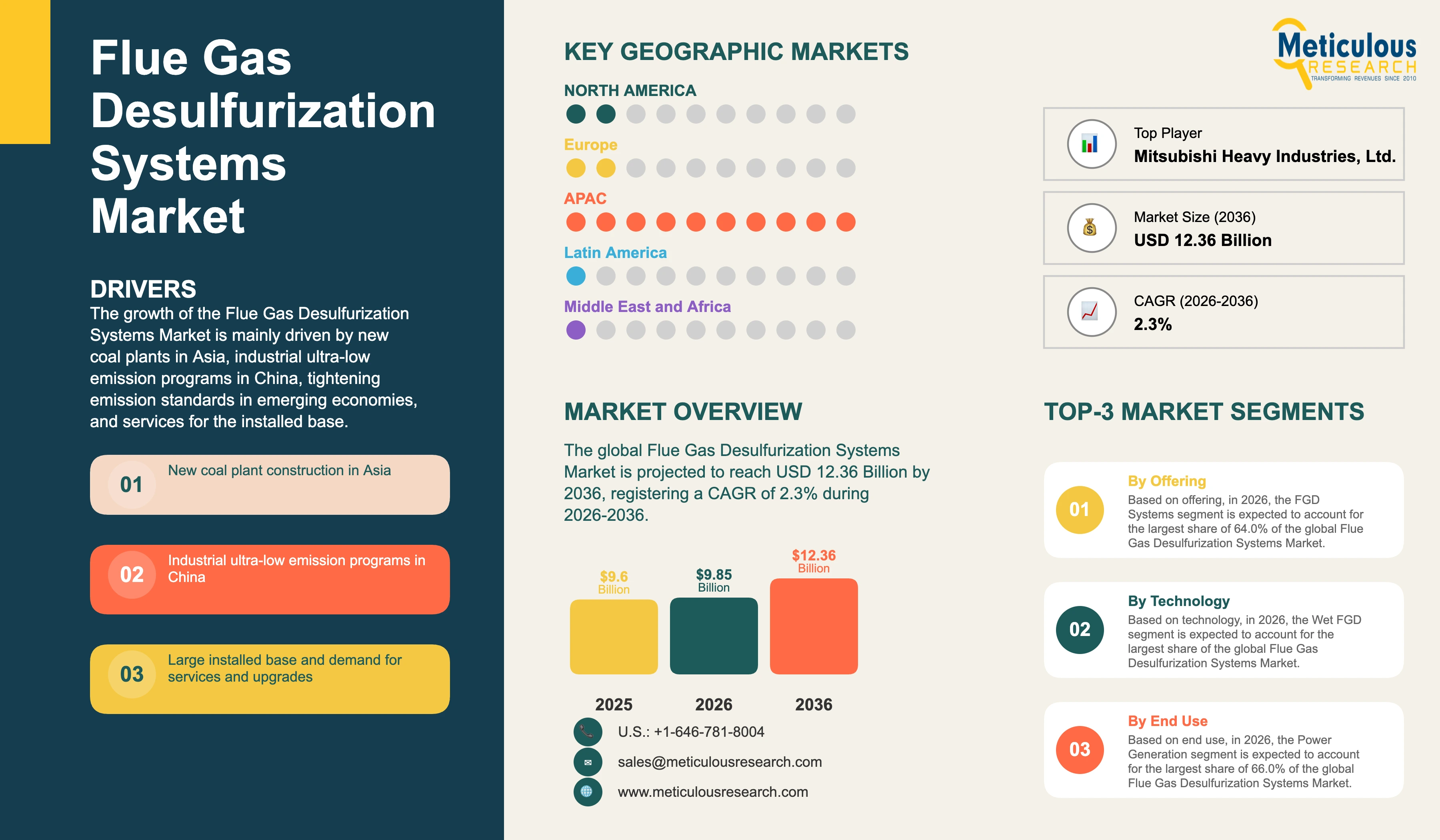
The global flue gas desulfurization systems market was valued at USD 9.60 billion in 2025. This market is expected to reach USD 12.36 billion by 2036 from an estimated USD 9.85 billion in 2026, registering a CAGR of 2.3% during the forecast period (2026-2036).
- Published
- Nov 2026
- Pages
- 268
- Format
- PDF + Excel
- Report ID
- MREP - 1042710
- Base year
- 2025
- 2025 · BASELINE
- $9.60B
- 2036
- $12.36B
- CAGR 2026–2036
- 2.3%
2025 baseline · 2026–2036 forecast at 2.3% CAGR · hover a bar for the value
Key highlights
According to the Centre for Research on Energy and Clean Air (CREA) and Global Energy Monitor (GEM), China commissioned 78 GW of new coal power capacity in 2025 and had about 291 GW permitted or under construction at the end of the year, and new coal units in China are built with desulfurization systems designed to meet the country's ultra-low emission standards for sulfur dioxide.
India's Ministry of Environment, Forest and Climate Change issued a notification on July 11, 2025, that exempted Category C coal-fired plants, about 78% of coal-fired units according to CREA, from mandatory sulfur dioxide emission limits, while Category A plants near large cities must still comply by 2027 and Category B plants are assessed case by case. The change has slowed new FGD tenders in India, although many systems already ordered remain under construction.
CREA analysis published in July 2026 found that 81% of estimated sulfur dioxide emissions from coal plants within 300 kilometers of Delhi-NCR came from Category C plants exempted by the 2025 notification, which shows that pressure to restore wider FGD requirements in India remains strong.
China's Action Plan for Continuous Improvement of Air Quality, issued by the State Council in December 2023, called for about 80% of the country's steel production capacity to complete ultra-low emission retrofits by the end of 2025 and promoted similar retrofits in cement, coking, and other industries, which has created a large market for desulfurization systems in industrial plants.
Global Energy Monitor reports that coal plant commissioning outside China and India was only 9.2 GW in 2025, which means that new FGD demand in power generation is concentrated in Asia, while demand in Europe and North America comes mainly from services, upgrades, and industrial applications.
Leading suppliers such as Mitsubishi Heavy Industries, Babcock & Wilcox, Andritz, Doosan Enerbility, Fujian Longking, Beijing SPC Environment Protection Tech, Zhejiang Feida, BHEL, Larsen & Toubro, Thermax, and Tata Projects continue to supply wet limestone-gypsum, seawater, and dry FGD systems for power and industrial plants in Asia, the Middle East, and other regions.
By offering, FGD systems account for the larger share of 64.0% in 2026, while aftermarket services register the higher CAGR.
By technology, wet FGD accounts for the larger share in 2026, while dry and semi-dry FGD registers the higher CAGR.
By reagent, limestone accounts for the largest share in 2026, while sodium bicarbonate, trona, and others register the highest CAGR.
By installation, new installations account for the larger share in 2026, while retrofits register the higher CAGR.
By end use, power generation accounts for the largest share of 66.0% in 2026, while cement registers the highest CAGR.
By geography, Asia-Pacific accounts for the largest share of 62.0% in 2026, while Middle East & Africa registers the highest CAGR of 3.9%.
Report summary
| Particulars | Details |
|---|---|
| Base Year | 2025 |
| Estimated Year | 2026 |
| Forecast Period | 2026-2036 |
| Market Size in 2025 | USD 9.60 billion |
| Market Size in 2026 | USD 9.85 billion |
| Market Size by 2036 | USD 12.36 billion |
| CAGR (2026-2036) | 2.3% |
| Format | PDF, Excel & Cloud Portal · 268 pages |
| Largest Segment by Offering (2026) | FGD Systems (64.0%) |
| Largest Segment by End Use (2026) | Power Generation (66.0%) |
| Largest Region (2026) | Asia-Pacific (62.0%) |
| Fastest-Growing Region | Middle East & Africa (CAGR 3.9%) |
| Companies Profiled | 17 companies and other companies |
| Segments Covered | Offering, Technology, Reagent, Installation, End Use, Geography |
| Countries Covered | U.S., Canada, Germany, Poland, Czech Republic, U.K., Italy, Spain, Rest of Europe, China, India, Japan, South Korea, Indonesia, Vietnam, Taiwan, Bangladesh, Philippines, Australia, Rest of Asia-Pacific, Chile, Mexico, Brazil, Colombia, Peru, Rest of Latin America, South Africa, Turkey, Saudi Arabia, U.A.E., Morocco, Egypt, Rest of Middle East & Africa |
Report overview
Segments covered: offering, technology, reagent, installation, end use.
The growth of this market is mainly driven by the large number of new coal-fired units under construction in China, India, and Southeast Asia that must be equipped with desulfurization systems, the ultra-low emission programs for steel, cement, coking, and non-ferrous metal plants in China, tightening sulfur dioxide limits for industrial plants in many emerging economies, rising demand for operation and maintenance, spare parts, and performance upgrades from a very large installed base of FGD units, and the growth of dry and semi-dry systems for waste incineration, biomass, and smaller industrial plants. However, factors such as the July 2025 notification in India that exempted most coal-fired units from mandatory FGD installation, coal phase-out policies in Europe and North America, regulatory rollbacks in some markets, and the high capital and operating cost of FGD systems are expected to restrain the growth of this market to some extent.
Flue gas desulfurization (FGD) systems remove sulfur dioxide from the exhaust gases of power plants and industrial facilities that burn coal, oil, petroleum coke, or other sulfur-containing fuels, or that process sulfur-containing raw materials. Sulfur dioxide causes acid rain and is a major precursor of fine particulate matter, which harms human health, and governments around the world regulate its emissions from large combustion sources. This report covers global revenue from new FGD systems, including engineering, equipment, and installation, and from aftermarket services such as operation and maintenance, spare parts, upgrades, and performance improvements, across wet and dry technologies, reagents, installation types, and end uses. Marine exhaust gas scrubbers are excluded from the scope of this report.
Wet FGD systems, mainly limestone-gypsum systems, are the most widely used technology for large coal-fired power plants. They spray a slurry of limestone into the flue gas in a large absorber tower, where the limestone reacts with sulfur dioxide to form gypsum, which can be sold for use in wallboard and cement. A typical large wet FGD system also includes limestone grinding, gypsum dewatering, wastewater treatment, and large booster fans, which together make it one of the most complex systems in a coal plant. Wet systems can remove more than 98% of sulfur dioxide and are suitable for very large units, but they require large amounts of water and reagent, produce wastewater, and have high capital costs. Seawater FGD, which uses the natural alkalinity of seawater, is used at coastal plants, and ammonia-based systems that produce ammonium sulfate fertilizer are used at some plants in China.
Dry and semi-dry FGD systems, including spray dryer absorbers, circulating fluidized bed scrubbers, and dry sorbent injection, use lime, hydrated lime, sodium bicarbonate, or trona to capture sulfur dioxide and produce a dry by-product that is collected in a fabric filter or electrostatic precipitator. These systems use less water, have lower capital costs, and are well suited for smaller units, plants with lower-sulfur fuels, waste incineration, biomass plants, and many industrial applications.
The FGD market grew rapidly in the 2000s and 2010s as China, the U.S., and Europe installed systems on most of their coal fleets, and China's ultra-low emission program for coal plants created another wave of upgrades in the late 2010s. Today, new power sector demand is concentrated in China, India, and Southeast Asia, while China's industrial ultra-low emission programs have made steel, cement, coking, and non-ferrous metals important sources of demand. In mature markets, operators spend mainly on maintaining, upgrading, and optimizing existing systems.
Business models include engineering, procurement, and construction contracts for complete FGD systems, technology licensing to local contractors, supply of key equipment such as absorbers, pumps, nozzles, and mist eliminators, and long-term operation and maintenance contracts. In China, many FGD systems are built and operated by environmental engineering companies under build-operate or concession models, while in India, EPC contractors such as BHEL, Larsen & Toubro, and Tata Projects often use licensed technology from international suppliers.
The market is fragmented, with international technology providers, large Chinese environmental engineering companies, Indian EPC contractors, and specialized dry FGD suppliers all competing. Leading companies include Mitsubishi Heavy Industries, Babcock & Wilcox, Andritz, Doosan Enerbility, Fujian Longking, Beijing SPC Environment Protection Tech, Zhejiang Feida, BHEL, Larsen & Toubro, Thermax, Tata Projects, KC Cottrell, Chiyoda, Valmet, Ducon Technologies, Marsulex Environmental Technologies, and Steinmüller Engineering.
Over the forecast period, the FGD market is expected to grow at a modest pace, as continued demand from new coal plants in Asia, industrial ultra-low emission programs, and service and upgrade spending offsets the effects of coal phase-out policies and India's 2025 exemption. The market is also expected to shift gradually from new power plant systems toward industrial applications, dry and semi-dry technologies, and aftermarket services, which together offer more stable long-term demand than new coal plant construction. Rising awareness of the health effects of fine particulate matter in South and Southeast Asia is also expected to keep pressure on governments to enforce sulfur dioxide limits.
Every new unit we build must meet ultra-low emission limits from the first day, and our older units need regular upgrades and maintenance on their desulfurization systems. Reliability and low operating cost are now as important as removal efficiency.
This comment explains why Asia-Pacific accounts for 62.0% of the market, why power generation accounts for 66.0% of the market, and why FGD systems account for 64.0% of the market. It also shows why aftermarket services are the faster-growing offering.
Emission rules for our kilns are getting stricter, and we are also using more alternative fuels. We are installing desulfurization at several plants, and we prefer compact dry or semi-dry systems that use little water.
This comment explains why cement is the fastest-growing end use and why dry and semi-dry FGD is the faster-growing technology.
We are retrofitting desulfurization at a large coal station to meet our emission license, and the project is complex because the plant must keep running. We chose a supplier with experience in difficult retrofits.
This comment shows why the Middle East & Africa is the fastest-growing region and why retrofits are the faster-growing installation segment.
Market growth is mainly driven by new coal plant construction in Asia, industrial ultra-low emission programs in China, tightening emission standards in emerging economies, and the large installed base that needs services and upgrades.
India's 2025 exemption, regulatory rollbacks, and coal phase-out restrain growth, while high capital and operating costs, intense price competition, and project execution risk are key challenges.
Key opportunities include desulfurization for steel, cement, and non-ferrous metals, dry and semi-dry FGD for waste incineration and biomass, wastewater treatment and by-product utilization, and digital optimization and performance upgrades.
FGD systems are expected to account for the larger share of 64.0% of the market in 2026, while aftermarket services are projected to register the higher CAGR.
Power generation is expected to account for the largest share of 66.0% of the market in 2026, while cement is projected to register the highest CAGR.
Dry and semi-dry FGD is projected to register the higher CAGR during the forecast period, driven by industrial, waste incineration, and biomass applications and its lower water use.
Asia-Pacific is expected to account for the largest share of 62.0% of the market in 2026, mainly due to coal construction in China and India and China's industrial ultra-low emission programs.
The Middle East & Africa is projected to register the highest CAGR of 3.9% during the forecast period, driven by retrofits in South Africa and Turkey, desulfurization at Gulf refineries and smelters, and waste incineration projects.
The report profiles 17 companies, including Mitsubishi Heavy Industries, Ltd., Babcock & Wilcox Enterprises, Inc., Andritz AG, Doosan Enerbility Co., Ltd., Fujian Longking Co., Ltd., Beijing SPC Environment Protection Tech Co., Ltd., Zhejiang Feida Environmental Science & Technology Co., Ltd., Bharat Heavy Electricals Limited, Larsen & Toubro Limited, Thermax Limited, Tata Projects Limited, KC Cottrell Co., Ltd., Chiyoda Corporation, Valmet Oyj, Ducon Technologies Inc., Marsulex Environmental Technologies, and Steinmüller Engineering GmbH.
Report infographic
Market dynamics
16 factors across 5 forcesNew coal plant construction in Asia
The largest source of new FGD demand in the power sector is the construction of coal-fired units in China, India, Indonesia, Vietnam, Bangladesh, and other Asian countries. China commissioned 78 GW of new coal capacity in 2025, the highest annual total in a decade, and about 291 GW remained permitted or under construction at the end of the year, according to CREA and Global Energy Monitor. New coal units in China must meet ultra-low emission standards, so they are built with high-efficiency wet FGD systems, usually limestone-gypsum systems with double-tray or dual-loop absorbers.
India plans to add at least 80 GW of coal-based capacity by 2031-32, and many new projects, especially those developed by NTPC and state utilities, include FGD systems in their scope even after the 2025 notification, as developers seek to avoid future retrofit costs and to meet the requirements that apply to plants near large cities. Vietnam, Indonesia, and the Philippines also have emission standards that require desulfurization on new coal units, which supports demand in Southeast Asia.
Because each large coal unit requires an FGD system worth tens of millions of dollars, the coal construction pipelines in China and India provide a significant base of demand through the end of the decade. The installed systems will also create service and spare parts demand for the next 25 to 30 years.
Industrial ultra-low emission programs in China
China's government has extended ultra-low emission requirements from coal power plants to major industrial sectors, starting with steel and then expanding to cement, coking, glass, non-ferrous metals, and other industries. The State Council's Action Plan for Continuous Improvement of Air Quality, issued in December 2023, called for about 80% of steel production capacity to complete ultra-low emission retrofits by the end of 2025 and promoted retrofits in cement, coking, and other sectors. These programs require plants to install or upgrade desulfurization, denitrification, and dust removal systems to meet very strict emission limits.
Industrial desulfurization projects are often more complex than power plant projects because gas flows and compositions vary widely. Steel plant sintering and pelletizing machines, coke ovens, cement kilns, and industrial boilers each need desulfurization systems designed for their specific gas conditions, which creates a large and diverse market for wet, semi-dry, and dry FGD technologies. Chinese environmental engineering companies such as Fujian Longking, Beijing SPC, and Zhejiang Feida have built large businesses serving these industries, and the experience they have gained is helping them win projects in other countries.
Tightening emission standards in emerging economies
Many emerging economies are tightening sulfur dioxide emission standards for power plants and industrial facilities as air pollution becomes a major public health and political issue. Countries such as Vietnam, Indonesia, Thailand, Turkey, South Africa, Egypt, and several Latin American countries have adopted or updated emission standards that require desulfurization on new plants and, in some cases, on existing plants.
International financing institutions and export credit agencies also require projects they finance to meet international emission guidelines, which often means installing FGD systems on new coal, oil-fired, and industrial plants. Refineries and petrochemical plants in the Middle East and Asia are also installing desulfurization on units that burn high-sulfur fuel oil or petroleum coke. These standards support demand outside China and India, although enforcement varies widely between countries.
Large installed base and demand for services and upgrades
The global installed base of FGD systems is very large, with systems in operation on most of the coal-fired capacity in China, the U.S., Europe, Japan, and South Korea and on a growing share of capacity in India and Southeast Asia. These systems contain large slurry pumps, agitators, spray nozzles, mist eliminators, linings, and other components that wear out and must be replaced regularly, and they need skilled operation to maintain performance and reliability. Corrosion and erosion in absorbers, ducts, and stacks also require regular inspection and repair.
Many systems installed in the 2000s and 2010s are also being upgraded to meet stricter standards, improve removal efficiency, reduce power and reagent consumption, or treat wastewater to meet new discharge rules. Operators are also using digital monitoring and optimization tools to reduce operating costs. These activities support a stable and growing aftermarket that is less dependent on new plant construction than the systems segment.
Table of contents
13 chapters · 167 sections · 268 pages · click to expandSegmental analysis
By Offering
- The new installations segment is expected to account for the larger share of the flue gas desulfurization systems market, while the retrofits segment is projected to register the higher CAGR during the forecast period.
Geographic analysis
Asia-Pacific
Largest shareIn 2026, Asia-Pacific is expected to account for the largest share of 62.0% of the global flue gas desulfurization systems market. The large share of this region is mainly due to the very large coal power construction programs in China and India, China's ultra-low emission programs for steel, cement, coking, and other industries, the very large installed base of FGD systems in China, Japan, South Korea, and Taiwan, the FGD projects still being completed in India, and new coal and industrial plants with desulfurization in Indonesia, Vietnam, Bangladesh, and the Philippines. Chinese and Indian suppliers such as Fujian Longking, Beijing SPC, Zhejiang Feida, BHEL, Larsen & Toubro, Thermax, and Tata Projects have large businesses in the region.
North America
North America and Europe are the next-largest markets, and both are mature markets where most coal-fired capacity already has FGD systems and where coal plants are closing. Demand in these regions comes mainly from services, spare parts, upgrades, wastewater treatment retrofits, and dry and semi-dry systems for waste incineration, biomass, and industrial plants. In the U.S., some coal plants are now expected to operate longer than planned because of rising electricity demand, which supports spending on existing FGD systems.
Europe
Germany, Poland, and the Czech Republic still operate large lignite fleets with FGD systems, while waste incineration and industrial applications support demand across the region.
Middle East & Africa
Fastest growthThe Middle East & Africa is projected to register the highest CAGR of 3.9% during the forecast period. The rapid growth of this region is mainly driven by FGD retrofits and new systems at coal-fired plants in South Africa and Morocco, lignite and coal plants in Turkey, desulfurization at refineries, petrochemical plants, and oil-fired power plants in the Gulf countries, new aluminum, copper, and other smelters, and waste incineration projects in Saudi Arabia, the U.A.E., and Qatar. Eskom's long-running FGD retrofit work at its newest coal stations is one of the largest projects of its kind in Africa.
Latin America
Latin America accounts for a smaller share of the market, with demand from coal-fired plants in Chile, Mexico, Brazil, and Colombia, copper smelters in Chile and Peru, cement and steel plants, and refineries. Several countries in the region are tightening emission standards for industrial plants, and Chile's environmental regulations for thermal power plants and smelters have created demand for desulfurization systems and upgrades. Brazil and Mexico also have growing cement and steel industries that are expected to adopt stricter emission controls over the forecast period. The July 2025 notification exempted Category C plants, about 78% of India's coal-fired units according to CREA, from mandatory sulfur dioxide limits, which has reduced the size of India's FGD retrofit market. Category A plants near large cities must still comply by 2027.
Competitive landscape
The global flue gas desulfurization systems market is fragmented, with the top five players estimated to account for about 30% of the market in 2025. The market includes international technology providers, large Chinese environmental engineering companies, Indian EPC contractors, Korean and Japanese engineering companies, and specialized suppliers of dry FGD and industrial flue gas treatment systems.
Mitsubishi Heavy Industries, Babcock & Wilcox, Andritz, Doosan Enerbility, and Chiyoda are leading international technology providers for wet FGD systems, and they supply systems directly or license their technology to local contractors. In China, Fujian Longking, Beijing SPC Environment Protection Tech, Zhejiang Feida, and other environmental engineering companies dominate the domestic market for power and industrial desulfurization and are expanding abroad. In India, BHEL, Larsen & Toubro, Tata Projects, and Thermax have won most of the large FGD contracts, often using licensed technology.
In dry and semi-dry FGD and industrial applications, Andritz, Valmet, Babcock & Wilcox, Steinmüller Engineering, Ducon Technologies, Marsulex Environmental Technologies, KC Cottrell, and Chinese suppliers offer circulating fluidized bed scrubbers, spray dryer absorbers, and dry sorbent injection systems for industrial plants, waste incineration, and biomass plants.
Companies compete on removal efficiency, reliability, capital and operating costs, water and reagent consumption, project execution capability, local presence and content, and service capability. Key strategies include technology licensing and partnerships with local contractors, development of dry and semi-dry and multi-pollutant control technologies, expansion into industrial applications, growth of operation and maintenance and upgrade services, and expansion into export markets by Chinese and Indian suppliers.
The competitive landscape has changed significantly as several Western companies have reduced their exposure to coal and as Chinese suppliers have become leaders in both power and industrial desulfurization. Further consolidation is possible as the market for new power plant systems slows, while companies with strong industrial and service businesses are expected to gain share. Suppliers are also broadening their portfolios to include wastewater treatment, carbon capture, and other environmental technologies to reduce their dependence on coal power.
Some of the key players operating in the flue gas desulfurization systems market are Mitsubishi Heavy Industries, Ltd., Babcock & Wilcox Enterprises, Inc., Andritz AG, Doosan Enerbility Co., Ltd., Fujian Longking Co., Ltd., Beijing SPC Environment Protection Tech Co., Ltd., Zhejiang Feida Environmental Science & Technology Co., Ltd., Bharat Heavy Electricals Limited, Larsen & Toubro Limited, Thermax Limited, Tata Projects Limited, KC Cottrell Co., Ltd., Chiyoda Corporation, Valmet Oyj, Ducon Technologies Inc., Marsulex Environmental Technologies, and Steinmüller Engineering GmbH, among others.
- —
India exempted most coal-fired units from mandatory FGD installation in July 2025, CREA reported in July 2026 that exempted plants account for most sulfur dioxide emissions around Delhi-NCR, China commissioned 78 GW of coal capacity in 2025, and China's industrial ultra-low emission programs continued to drive desulfurization projects in steel, cement, and coking.
- Andritz
- Valmet
- Babcock & Wilcox
- Steinmüller Engineering
- Ducon Technologies
- Marsulex Environmental Technologies
- KC Cottrell
- Chinese suppliers
Expert perspectives
The flue gas desulfurization systems market is a mature market that is being reshaped by changes in coal power and industrial policy. We see continued demand from new coal plants in China, India, and Southeast Asia and from China's industrial ultra-low emission programs, while India's 2025 exemption and coal phase-out policies in mature markets limit growth in the power sector retrofit market.
Over the forecast period, the market is expected to grow at a CAGR of 2.3%, from USD 9.85 billion in 2026 to USD 12.36 billion in 2036. Growth will be supported by industrial desulfurization, dry and semi-dry systems for waste incineration and biomass, services and upgrades for the large installed base, and new coal plants in Asia, while the decline of coal power in mature markets and the limited Indian retrofit program will hold back overall growth.
In terms of segments, FGD systems remain the larger offering, while aftermarket services grow faster. Wet FGD remains the larger technology, while dry and semi-dry FGD grows faster. Power generation remains the largest end use, while cement grows fastest. Asia-Pacific remains the largest region, and the Middle East & Africa is the fastest-growing region at a CAGR of 3.9%.
For suppliers, the key priorities are to build positions in industrial desulfurization in China, India, Southeast Asia, and the Middle East, to offer cost-effective dry and semi-dry and multi-pollutant control technologies, to grow service and upgrade businesses for the installed base, and to manage the risks of fixed-price retrofit projects in competitive markets.
We expect the industrial and service segments to become the main sources of value in this market over time. In our view, the July 2025 notification in India may not be the final word on FGD requirements in that country, as public health evidence and court challenges continue to put pressure on the government, and a partial restoration of requirements would create a significant upside for the market. We also see opportunities for suppliers that can bundle desulfurization with other emission controls in a single offering. Suppliers that maintain their capability in India while diversifying into other segments will be best placed to benefit if policy changes again.
Regulation will remain the most important factor for this market over the next decade, since FGD systems are installed mainly to meet legal requirements rather than to generate a financial return. Emission standards for industrial sectors in emerging economies, wastewater rules, and the pace of coal phase-out will determine how demand develops in each region.
Customer perspectives
Buyers of flue gas desulfurization systems include utilities and independent power producers, steel, cement, non-ferrous metals, chemical, and refining companies, waste-to-energy operators, and engineering, procurement, and construction contractors. Their decisions depend mainly on removal efficiency, compliance certainty, capital and operating costs, reliability, water and reagent use, and the supplier's track record and service support.
Frequently asked questions
The global flue gas desulfurization systems market was valued at USD 9.60 billion in 2025, up from USD 9.30 billion in 2024, and is estimated at USD 9.85 billion in 2026. The market includes new wet, dry, and semi-dry FGD systems and aftermarket services such as operation and maintenance, spare parts, and upgrades, and excludes marine scrubbers.
The global flue gas desulfurization systems market is expected to reach USD 12.36 billion by 2036, supported by industrial desulfurization, waste incineration and biomass plants, services for the installed base, and new coal plants in Asia.
The market is expected to register a CAGR of 2.3% from 2026 to 2036, as growth in industrial applications and services offsets the effects of coal phase-out and India's 2025 exemption.
The July 2025 notification exempted Category C plants, about 78% of India's coal-fired units according to CREA, from mandatory sulfur dioxide limits, which has reduced the size of India's FGD retrofit market. Category A plants near large cities must still comply by 2027.
Market growth is mainly driven by new coal plant construction in Asia, industrial ultra-low emission programs in China, tightening emission standards in emerging economies, and the large installed base that needs services and upgrades.
India's 2025 exemption, regulatory rollbacks, and coal phase-out restrain growth, while high capital and operating costs, intense price competition, and project execution risk are key challenges.
Key opportunities include desulfurization for steel, cement, and non-ferrous metals, dry and semi-dry FGD for waste incineration and biomass, wastewater treatment and by-product utilization, and digital optimization and performance upgrades.
FGD systems are expected to account for the larger share of 64.0% of the market in 2026, while aftermarket services are projected to register the higher CAGR.
Power generation is expected to account for the largest share of 66.0% of the market in 2026, while cement is projected to register the highest CAGR.
Dry and semi-dry FGD is projected to register the higher CAGR during the forecast period, driven by industrial, waste incineration, and biomass applications and its lower water use.
Asia-Pacific is expected to account for the largest share of 62.0% of the market in 2026, mainly due to coal construction in China and India and China's industrial ultra-low emission programs.
The Middle East & Africa is projected to register the highest CAGR of 3.9% during the forecast period, driven by retrofits in South Africa and Turkey, desulfurization at Gulf refineries and smelters, and waste incineration projects.
The report profiles 17 companies, including Mitsubishi Heavy Industries, Ltd., Babcock & Wilcox Enterprises, Inc., Andritz AG, Doosan Enerbility Co., Ltd., Fujian Longking Co., Ltd., Beijing SPC Environment Protection Tech Co., Ltd., Zhejiang Feida Environmental Science & Technology Co., Ltd., Bharat Heavy Electricals Limited, Larsen & Toubro Limited, Thermax Limited, Tata Projects Limited, KC Cottrell Co., Ltd., Chiyoda Corporation, Valmet Oyj, Ducon Technologies Inc., Marsulex Environmental Technologies, and Steinmüller Engineering GmbH.
India exempted most coal-fired units from mandatory FGD installation in July 2025, CREA reported in July 2026 that exempted plants account for most sulfur dioxide emissions around Delhi-NCR, China commissioned 78 GW of coal capacity in 2025, and China's industrial ultra-low emission programs continued to drive desulfurization projects in steel, cement, and coking.
In 2026, the new installations segment is expected to account for the larger share of the flue gas desulfurization systems market, while the retrofits segment is projected to register the higher CAGR during the forecast period.
Cite this report
Meticulous Research. (2026). Flue Gas Desulfurization Systems Market - Global Opportunity Analysis and Industry Forecast (2026-2036) (Report No. MREP - 1042710). Meticulous Market Research Pvt. Ltd. https://www.meticulousresearch.com/product/flue-gas-desulfurization-systems-market-7393