EV Tires Market (2026-2036)
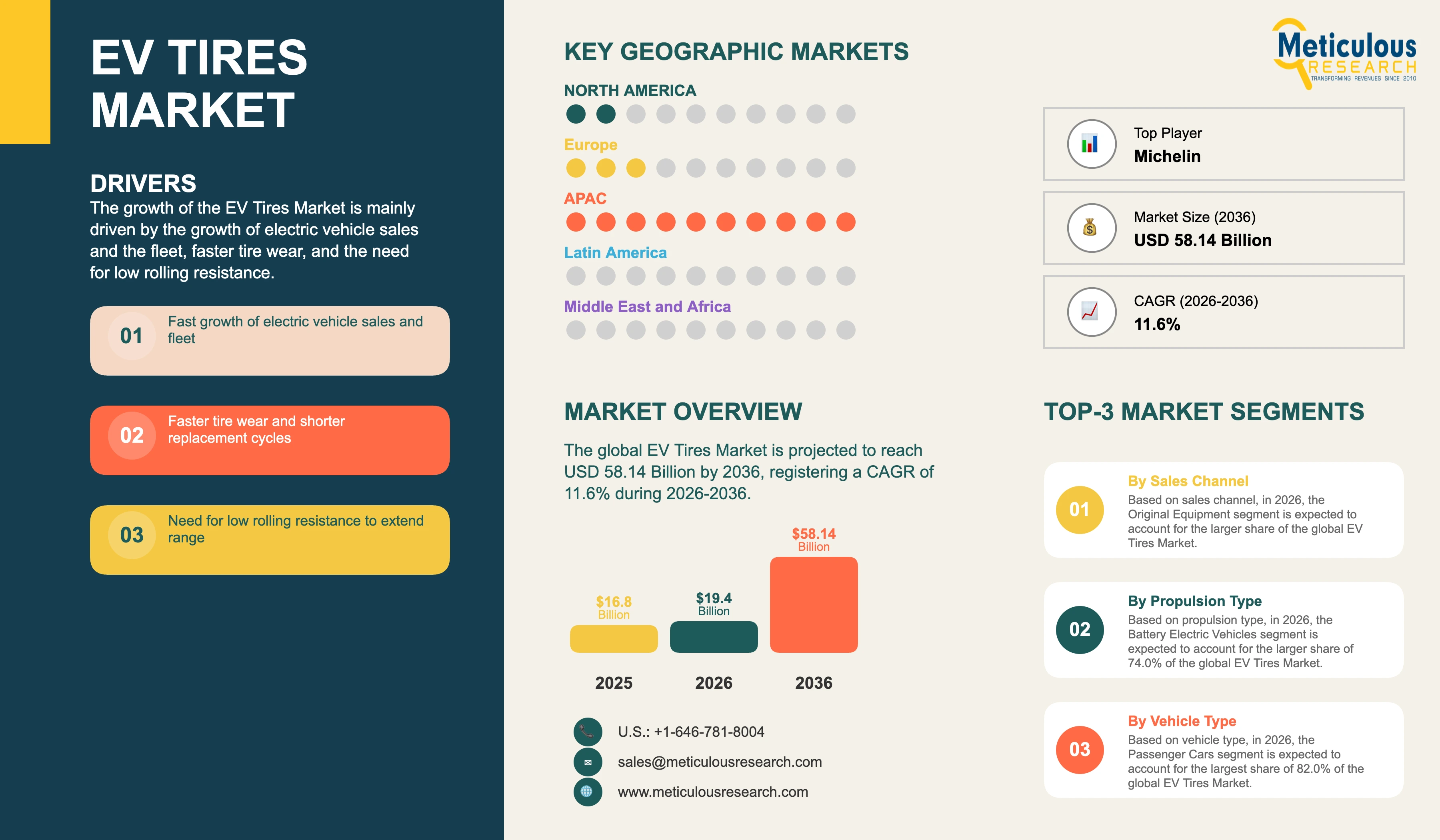
The global EV tires market was valued at USD 16.80 billion in 2025. This market is expected to reach USD 58.14 billion by 2036 from an estimated USD 19.40 billion in 2026, registering a CAGR of 11.6% during the forecast period (2026-2036).
- Published
- Nov 2026
- Pages
- 248
- Format
- PDF + Excel
- Report ID
- MRAUTO - 1042867
- Base year
- 2025
- 2025 · BASELINE
- $16.80B
- 2036
- $58.14B
- CAGR 2026–2036
- 11.6%
2025 baseline · 2026–2036 forecast at 11.6% CAGR · hover a bar for the value
Key highlights
Global electric car sales grew by 20% to more than 20 million units in 2025, accounting for one in four new cars sold, according to the IEA, and electric trucks reached 9% of all truck sales worldwide. Every one of these vehicles needs tires at the factory and replacement tires over its life, and the fast-growing electric vehicle fleet is expanding replacement demand each year.
Electric vehicles accounted for 25.2% of Hankook's original equipment tire revenue worldwide in 2025, up from 21.5% in 2024, and 30.4% in Europe, according to Hankook. China accounted for 62% of global electric vehicle sales with an electric vehicle share of 46.9% in March 2026, while the U.S. electric vehicle share fell to 4.2% after federal tax credits ended, according to Hankook.
The European Union's Euro 7 regulation will introduce limits on tire abrasion for passenger car tires from 2028 and for light commercial vehicle tires from 2030, according to published analysis of the regulation, making Europe the first region to regulate tire wear particles. Heavy electric vehicles tend to wear tires faster, so these limits are especially important for EV tires.
Leading tire makers have launched EV-specific tire lines, such as Michelin's e.Primacy and Pilot Sport EV, Hankook's iON range, Goodyear's ElectricDrive, Pirelli's Elect-marked tires, Continental's EcoContact tires, and Bridgestone's Enliten technology. Hankook added iON evo and iON evo SUV tires to its EV range in 2023, according to Modern Tire Dealer.
Tire dealers in the U.S. expect long-term growth in EV tire demand despite the end of federal electric vehicle incentives, as the existing fleet of electric vehicles needs replacement tires, according to Modern Tire Dealer. Michelin North America said it does not see EV tire sales declining, in part because of demand from vehicles already on the road.
Leading suppliers include Michelin, Bridgestone, Goodyear, Continental, Pirelli, Hankook, Sumitomo Rubber, Yokohama, Toyo, Nokian Tyres, Shandong Linglong, Sailun, Zhongce Rubber (ZC Rubber), and Giti. Tire makers are also adding capacity for large-rim tires and noise-reducing foam to meet electric vehicle demand.
By sales channel, original equipment accounts for the larger share in 2026, while replacement registers the higher CAGR.
By propulsion type, battery electric vehicles account for the larger share of 74.0% in 2026 and also register the higher CAGR.
By vehicle type, passenger cars account for the largest share of 82.0% in 2026, while trucks and buses register the highest CAGR.
By rim size, 18 to 19 inches account for the largest share in 2026, while 20 inches and above registers the highest CAGR.
By geography, Asia-Pacific accounts for the largest share of 62.0% in 2026, while Europe registers the highest CAGR of 13.4%.
Report summary
| Particulars | Details |
|---|---|
| Base Year | 2025 |
| Estimated Year | 2026 |
| Forecast Period | 2026-2036 |
| Market Size in 2025 | USD 16.80 billion |
| Market Size in 2026 | USD 19.40 billion |
| Market Size by 2036 | USD 58.14 billion |
| CAGR (2026-2036) | 11.6% |
| Format | PDF, Excel & Cloud Portal · 248 pages |
| Largest Segment by Propulsion Type (2026) | Battery Electric Vehicles (74.0%) |
| Largest Segment by Vehicle Type (2026) | Passenger Cars (82.0%) |
| Largest Region (2026) | Asia-Pacific (62.0%) |
| Fastest-Growing Region | Europe (CAGR 13.4%) |
| Companies Profiled | 14 companies and other companies |
| Segments Covered | Sales Channel, Propulsion Type, Vehicle Type, Rim Size, Geography |
| Countries Covered | U.S., Canada, Germany, France, U.K., Italy, Spain, Norway, Sweden, Netherlands, Belgium, Denmark, Switzerland, Austria, Poland, Czech Republic, Hungary, Rest of Europe, China, Japan, South Korea, India, Thailand, Indonesia, Vietnam, Malaysia, Taiwan, Australia, Rest of Asia-Pacific, Mexico, Brazil, Argentina, Chile, Colombia, Peru, Rest of Latin America, Turkey, Saudi Arabia, U.A.E., Israel, Morocco, South Africa, Rest of Middle East & Africa |
Report overview
Segments covered: sales channel, propulsion type, vehicle type, rim size.
EV tires are tires fitted to or sold for battery electric, plug-in hybrid, and range-extended electric vehicles, including tires designed specifically for electric vehicles and tires approved by vehicle makers for electric models. They are built to carry the higher weight of electric vehicles, handle the instant torque of electric motors, reduce rolling resistance to extend driving range, lower road noise in quiet cabins, and resist the faster wear that heavy and powerful electric vehicles cause.
The growth of this market is mainly driven by the fast growth of electric vehicle sales and of the global electric vehicle fleet, which creates both original equipment and replacement demand, the faster tire wear of electric vehicles, which shortens replacement cycles, the use of larger and more expensive tires on electric SUVs and premium vehicles, the need for low rolling resistance tires to extend range, and the electrification of trucks and buses. In addition, new rules on tire wear particles, such as the European Union's Euro 7 tire abrasion limits from 2028, are pushing tire makers to develop longer-lasting tires. However, slower electric vehicle sales in some markets, the higher cost of EV tires, and price competition from Asian tire makers are expected to restrain the growth of this market to some extent.
Electric vehicles place very different demands on their tires than combustion engine vehicles of a similar size. They are heavier because of their battery packs, often by 15% to 30% for a similar model, which requires tires with higher load capacity and stronger construction. Electric motors deliver full torque instantly, which increases tread wear, especially during fast acceleration. Electric vehicles are quiet, so tire noise becomes the main source of cabin noise at many speeds, and rolling resistance has a direct effect on driving range. As a result, tire makers have developed tires that combine high load capacity, low rolling resistance, low noise, and high wear resistance for electric vehicles.
This report covers the global EV tires market, including tires fitted to new battery electric, plug-in hybrid, and range-extended electric vehicles at the factory and replacement tires sold for these vehicles. It includes EV-specific tire lines, tires marked or approved for electric vehicles by vehicle makers, and standard tires sold as replacements for electric vehicles. The market is valued at the selling price of tires sold to vehicle makers and through replacement channels. The market is analyzed by sales channel, propulsion type, vehicle type, rim size, and geography. Tires for hybrid electric vehicles without a plug, two-wheelers, and off-highway vehicles are not included.
EV tires use a range of materials and design technologies to meet these combined needs. Tread compounds with special silica and polymers reduce rolling resistance while keeping grip and wear life, reinforced casings and higher load ratings carry the extra weight, and optimized tread patterns reduce noise. Many EV tires also include foam layers inside the tire that absorb cavity noise, a key source of cabin noise in electric vehicles. Some tires also include sensors or are designed for easy monitoring of pressure, temperature, and wear.
The original equipment market is driven by electric vehicle production, while the replacement market is driven by the size of the electric vehicle fleet and the rate at which tires wear out. Electric vehicles tend to wear tires faster than combustion engine vehicles because of their weight and torque, which shortens replacement cycles. As the global electric vehicle fleet grows, replacement demand for EV tires is rising quickly, and in many markets it is expected to overtake original equipment demand within the forecast period.
The market is served by global premium tire makers, such as Michelin, Bridgestone, Goodyear, Continental, and Pirelli, Asian tire makers, such as Hankook, Sumitomo Rubber, Yokohama, and Toyo, the Nordic specialist Nokian Tyres, and fast-growing Chinese tire makers, such as Shandong Linglong, Sailun, Zhongce Rubber, and Giti. Premium tire makers hold strong positions in original equipment fitments for electric vehicles in Europe and North America, while Chinese tire makers have grown quickly by supplying Chinese electric vehicle makers and by selling replacement tires at competitive prices.
Electric vehicles also tend to use larger tires than similar combustion engine vehicles. Many electric SUVs and premium electric vehicles use 19-inch, 20-inch, and 21-inch wheels with wide, low-profile tires, which are more expensive than smaller tires. The growth of electric SUVs and premium electric vehicles is therefore increasing the average value of EV tires. At the same time, lower-priced electric vehicles from Chinese makers often use smaller tires, which balances the mix in some markets.
In 2026, original equipment accounts for the larger share of the market by sales channel, while replacement is the faster-growing sales channel. Battery electric vehicles account for the larger share by propulsion type and are also the faster-growing propulsion type. Passenger cars account for the largest share by vehicle type, while trucks and buses are the fastest-growing vehicle type. Tires for 18-inch to 19-inch rims account for the largest share by rim size, while tires for 20-inch and larger rims are the fastest-growing rim size. Asia-Pacific accounts for the largest share of the market, while Europe is the fastest-growing region.
Market growth over the forecast period will depend mainly on electric vehicle sales and the size of the electric vehicle fleet, the rate of tire wear on electric vehicles, the mix of vehicle sizes and tire sizes, and policies such as tire wear rules and electric vehicle incentives. Price competition from Chinese tire makers and the growing use of standard tires on electric vehicles in the replacement market will also affect market value. Overall, the rapid growth of the electric vehicle fleet is expected to drive strong growth.
Battery electric vehicles are expected to account for the larger share of 74.0% of the market in 2026 and are also projected to register the higher CAGR, driven by their growing sales share and fleet.
Passenger cars are expected to account for the largest share of 82.0% of the market in 2026, while trucks and buses are projected to register the highest CAGR, driven by fast truck and bus electrification in China and Europe.
Asia-Pacific is expected to account for the largest share of 62.0% of the market in 2026, mainly due to China's position as the largest electric vehicle market and the presence of fast-growing Chinese tire makers.
Europe is projected to register the highest CAGR of 13.4% during the forecast period, driven by strong electric vehicle growth, EU emission rules, Euro 7 tire abrasion limits, and truck and bus electrification.
The report profiles 14 companies, including Michelin, Bridgestone, Goodyear, Continental, Pirelli, Hankook, Sumitomo Rubber, Yokohama, Toyo, Nokian Tyres, Shandong Linglong, Sailun, Zhongce Rubber, and Giti.
Electric vehicles are heavier, deliver instant torque, and are quiet, so they need tires with higher load capacity, low rolling resistance to extend range, high wear resistance, and noise-reducing features.
Euro 7 will limit tire abrasion for passenger car tires from 2028 and light commercial vehicle tires from 2030, pushing tire makers to develop longer-lasting, low-abrasion tires, which is especially important for heavy electric vehicles.
Report infographic
Market dynamics
17 factors across 5 forcesFast growth of electric vehicle sales and the electric vehicle fleet
The main driver of this market is the growth of electric vehicle sales and the growing number of electric vehicles on the road. Global electric car sales grew by 20% to more than 20 million units in 2025, according to the IEA, and every new electric vehicle needs a set of original equipment tires. Each year's sales also add to the electric vehicle fleet, which needs replacement tires over the life of the vehicles. Because the fleet keeps growing as long as sales continue, replacement demand grows faster than sales.
China is by far the largest electric vehicle market, accounting for 62% of global electric vehicle sales with an electric vehicle share of 46.9% in March 2026, according to Hankook, and Europe and other markets are also growing. As electric vehicles take a larger share of new vehicle sales, the share of EV tires in the overall tire market is rising. Hankook reported that electric vehicles accounted for 25.2% of its original equipment tire revenue worldwide in 2025, up from 21.5% in 2024.
Faster tire wear and shorter replacement cycles
Electric vehicles tend to wear tires faster than similar combustion engine vehicles because they are heavier and deliver instant torque, which increases tread wear during acceleration. Regenerative braking also places different forces on the tires. As a result, many electric vehicle owners replace their tires more often than owners of combustion engine vehicles, which increases replacement tire demand per vehicle.
Faster wear also creates demand for EV tires with special compounds and constructions that resist wear, which are more valuable than standard tires. Tire makers are developing new compounds and tread designs to extend tire life on electric vehicles, partly in response to new rules on tire wear particles. Replacement is the faster-growing sales channel in this market, supported by both the growing fleet and shorter replacement cycles.
Need for low rolling resistance to extend range
Rolling resistance accounts for a significant share of the energy used by an electric vehicle, especially at lower speeds, so tires with low rolling resistance can extend driving range noticeably. Range is one of the most important factors for electric vehicle buyers, so vehicle makers work closely with tire makers to develop low rolling resistance tires for their models. Tire makers use special silica compounds, optimized constructions, and lighter materials to reduce rolling resistance without reducing grip or wear life.
Low rolling resistance tires are more complex and more valuable than standard tires, and vehicle makers often specify tires approved for each model, marked with special symbols on the sidewall. Many owners choose the same tires as replacements to keep their vehicle's range, which supports demand for EV-specific tires in the replacement market. This need for range-optimized tires increases the value of the market beyond the number of tires sold.
Larger tires on electric SUVs and premium vehicles
Many electric vehicles, especially SUVs and premium models, use large wheels of 19, 20, or 21 inches with wide, low-profile tires. These tires are needed to carry the vehicle's weight, fit larger brakes, and provide sporty handling and appearance, and they are significantly more expensive than smaller tires. The growth of electric SUVs and premium electric vehicles is increasing demand for these larger and more valuable tires.
Tires for 20-inch and larger rims are the fastest-growing rim size in this market, and tires for 18-inch to 19-inch rims account for the largest share. Tire makers are adding capacity for large-rim tires and developing EV-specific tires in these sizes. This trend increases the average value of EV tires and supports market growth beyond the growth in tire volumes.
Electrification of trucks and buses
Trucks and buses are being electrified quickly in China and Europe, driven by emission rules, low-emission zones, and falling battery costs. Electric trucks reached 9% of all truck sales worldwide in 2025, according to the IEA. Electric trucks and buses are heavy, deliver high torque, and often operate in cities with frequent stops and starts, which increases tire wear. They also need tires with low rolling resistance to extend range and high load capacity to carry heavy batteries. Truck and bus tires are much more expensive than passenger car tires, and fleets replace them often, which makes this a valuable market for tire makers. Tire makers are developing EV-specific truck and bus tires with stronger casings, wear-resistant compounds, and low rolling resistance. Trucks and buses are the fastest-growing vehicle type in this market, and electric delivery vans and city buses are among the most important early applications.
Table of contents
12 chapters · 190 sections · 248 pages · click to expandSegmental analysis
| Segment | Largest share (2026) | Fastest growth (2026–2036) |
|---|---|---|
| By Sales Channel | 18 to 19 inches | 20 inches and above |
By Sales Channel
- The original equipment segment is expected to account for the larger share of the EV tires market, while the replacement segment is projected to register the higher CAGR during the forecast period.
- The 18 to 19 inches segment is expected to account for the largest share of the EV tires market, while the 20 inches and above segment is projected to register the highest CAGR during the forecast period.
Geographic analysis
Asia-Pacific
Largest shareIn 2026, Asia-Pacific is expected to account for the largest share of 62.0% of the global EV tires market. The large share of this region is mainly due to China's position as by far the largest electric vehicle market, accounting for 62% of global electric vehicle sales with an electric vehicle share of 46.9% in March 2026 according to Hankook, the large and fast-growing electric vehicle fleet in China, the presence of fast-growing Chinese tire makers, such as Shandong Linglong, Sailun, Zhongce Rubber, and Giti, and the strong positions of Hankook, Bridgestone, Sumitomo Rubber, Yokohama, and Toyo in the region. Electric vehicle sales are also growing in South Korea, Japan, Thailand, Indonesia, Vietnam, and India. Chinese tire makers are also building plants in Thailand, Vietnam, and Cambodia to serve export markets, which adds to tire production in the region. China's large fleet of electric taxis and ride-hailing vehicles also creates strong replacement demand, as these vehicles drive long distances and wear tires quickly.
Europe
Fastest growthEurope is projected to register the highest CAGR of 13.4% during the forecast period. The rapid growth of this region is mainly driven by strong electric vehicle sales growth, with electric vehicles accounting for 30.4% of Hankook's original equipment tire revenue in Europe in 2025, according to Hankook, the European Union's carbon dioxide emission rules for new cars and vans, the Euro 7 tire abrasion limits from 2028, which favor higher-value long-life tires, the growing electric vehicle fleet, which drives replacement demand, and the electrification of trucks and buses. Europe is also home to leading tire makers, such as Michelin, Continental, Pirelli, and Nokian Tyres. Norway, the Netherlands, and Germany have among the largest electric vehicle fleets in Europe, which supports replacement demand, and winter tire rules in Nordic and Central European countries add demand for EV-specific winter tires.
North America
North America accounts for a significant share of the market, supported by a large electric vehicle fleet, the use of large tires on electric SUVs and pickup trucks, and the presence of Goodyear, Michelin, Bridgestone, and other tire makers. However, the end of federal electric vehicle tax credits slowed electric vehicle sales, with the U.S. electric vehicle share falling to 4.2% in March 2026 according to Hankook. Tire dealers still expect long-term growth in EV tire demand as the existing fleet needs replacement tires, according to Modern Tire Dealer. Large electric SUVs and pickup trucks in North America also use large and costly tires, which supports high tire value per vehicle.
Latin America
Latin America and the Middle East & Africa account for small shares of the market, but they are expected to grow as electric vehicle sales rise in Brazil, Mexico, Turkey, the Gulf countries, and other markets, often led by affordable Chinese electric vehicles. Electric car sales in many countries across Latin America, Asia-Pacific, and the Middle East have now reached a sales share of more than 10%, according to the IEA. Growing electric vehicle fleets in these regions will create replacement demand for EV tires over the forecast period.
Competitive landscape
The global EV tires market includes global premium tire makers, Asian tire makers, Nordic specialists, and fast-growing Chinese tire makers. The original equipment market is concentrated among tire makers with strong engineering capabilities and relationships with vehicle makers, while the replacement market is more fragmented and price-competitive. Tire makers compete to win original equipment fitments on new electric vehicle platforms, which also drive replacement sales.
Michelin, Bridgestone, Goodyear, Continental, and Pirelli are the leading global premium tire makers, with strong positions in original equipment fitments for electric vehicles in Europe and North America and dedicated EV tire lines. Hankook, Sumitomo Rubber, Yokohama, and Toyo are leading Asian tire makers, and Hankook reported that electric vehicles accounted for 25.2% of its original equipment tire revenue in 2025. Nokian Tyres is a leading supplier of winter tires for electric vehicles, and Shandong Linglong, Sailun, Zhongce Rubber, and Giti are leading Chinese tire makers.
Companies in this market compete on rolling resistance, wear life, grip, noise, load capacity, brand strength, price, original equipment relationships, and distribution networks. Key strategies include developing EV-specific tire lines, winning original equipment fitments on new electric vehicle platforms, developing long-life and low-abrasion compounds, adding capacity for large-rim tires, expanding production in low-cost countries, and offering smart tires and fleet services.
Recent competitive activity in the EV tire market has focused on new EV tire lines and original equipment fitments. Tire makers have expanded their EV-specific ranges into more sizes, Hankook increased the share of electric vehicles in its original equipment business in 2025, according to Hankook, and Chinese tire makers continue to build plants abroad to serve export markets and avoid trade duties.
We expect competition to increase over the forecast period as Chinese tire makers grow in original equipment and replacement markets, as Euro 7 tire abrasion rules raise technical requirements, and as replacement demand becomes a larger share of the market. Tire makers with strong technology, original equipment relationships, and replacement brands are expected to strengthen their positions, while price competition will remain strong in the replacement market.
Some of the key players operating in the EV tires market are Compagnie Générale des Établissements Michelin, Bridgestone Corporation, The Goodyear Tire & Rubber Company, Continental AG, Pirelli & C. S.p.A., Hankook Tire & Technology Co., Ltd., Sumitomo Rubber Industries, Ltd., The Yokohama Rubber Co., Ltd., Toyo Tire Corporation, Nokian Tyres plc, Shandong Linglong Tyre Co., Ltd., Sailun Group Co., Ltd., Zhongce Rubber Group Co., Ltd., and Giti Tire, among others.
- —
Electric vehicles reached 25.2% of Hankook's original equipment tire revenue in 2025, tire makers expanded their EV-specific tire lines, and the European Union confirmed Euro 7 tire abrasion limits for passenger car tires from 2028.
- Compagnie Générale des Établissements Michelin
- Bridgestone Corporation
- Goodyear Tire & Rubber Company
- Continental AG
- Pirelli & C. S.p.A
- Hankook Tire & Technology Co., Ltd.
- Sumitomo Rubber Industries, Ltd.
- Yokohama Rubber Co., Ltd.
- Toyo Tire Corporation
- Nokian Tyres plc
- Shandong Linglong Tyre Co., Ltd.
- Sailun Group Co., Ltd.
- Zhongce Rubber Group Co., Ltd.
- Giti Tire
Expert perspectives
EV tires are one of the fastest-growing parts of the tire industry, driven by the growth of electric vehicle sales and the electric vehicle fleet. Electric vehicles need tires that combine low rolling resistance, high load capacity, low noise, and high wear resistance, which increases their value, and they wear tires faster, which increases replacement demand. New rules on tire wear particles in Europe add further technical requirements.
Over the forecast period, the market is expected to grow at a CAGR of 11.6%, from USD 19.40 billion in 2026 to USD 58.14 billion in 2036. Growth will be driven by the growth of electric vehicle sales and the electric vehicle fleet, faster tire wear and shorter replacement cycles, the need for low rolling resistance tires, larger tires on electric SUVs and premium vehicles, and the electrification of trucks and buses.
Among the market segments, original equipment is the larger sales channel, while replacement grows faster. Battery electric vehicles are both the larger and the faster-growing propulsion type. Passenger cars are the largest vehicle type, while trucks and buses grow fastest. Tires for 18-inch to 19-inch rims are the largest rim size, while tires for 20-inch and larger rims grow fastest. Asia-Pacific is the largest region, while Europe is the fastest-growing region at a CAGR of 13.4%.
In our view, the replacement market will become the most important part of the EV tire market over the forecast period. As the electric vehicle fleet grows and ages, replacement demand will rise quickly and become larger than original equipment demand in many markets. Tire makers that build strong replacement brands and distribution for electric vehicles, and that win original equipment fitments that drive replacement choices, are expected to gain share.
We also see Euro 7 tire abrasion rules and price competition from Chinese tire makers as key factors shaping the market. The new rules favor tire makers with strong technology and are likely to raise the value of tires in Europe, while Chinese tire makers will continue to compete strongly on price, especially in the replacement market. Slower electric vehicle sales in the U.S. are a short-term risk, but the growing global fleet supports long-term growth in all major regions over the forecast period.
Overall, we believe the EV tires market will grow strongly over the forecast period, with replacement tires, battery electric vehicles, trucks and buses, tires for 20-inch and larger rims, and Europe providing the fastest growth. Companies with strong EV tire technology, original equipment relationships, replacement brands, and competitive costs will be best positioned to capture this growth.
Customer perspectives
Customers in the EV tires market include vehicle makers, which buy original equipment tires for new electric vehicles, fleet operators of electric trucks, buses, vans, and ride-hailing vehicles, and electric vehicle owners, who buy replacement tires through tire dealers, retailers, and online channels. Vehicle makers focus on rolling resistance, noise, grip, wear, load capacity, weight, and cost, and they work closely with tire makers on tires for each new model. Fleet operators focus on tire life, rolling resistance, total cost of ownership, and tire services. Electric vehicle owners focus on range, wear life, noise, safety, and price, and many choose the same tires fitted by the vehicle maker to keep their vehicle's performance, while others choose lower-cost alternatives when their first tires wear out.
This comment explains why original equipment is the larger sales channel, why battery electric vehicles account for 74.0% of the market, and why tires for 20-inch and larger rims are the fastest-growing rim size.
This comment explains why trucks and buses are the fastest-growing vehicle type and why Europe is the fastest-growing region.
This comment explains why replacement is the faster-growing sales channel and why passenger cars account for 82.0% of the market.
“Range is everything for our customers, so we work with tire makers on every new model to cut rolling resistance and noise. Our SUVs now use 20-inch tires.”
“Our electric vans and buses wear tires much faster than our diesel fleet did. We want longer-lasting tires that keep rolling resistance low.”
“More electric vehicles are coming in for their first tire change, and they come in sooner than gas cars. Most owners ask for EV tires to keep their range.”
Frequently asked questions
The global EV tires market was valued at USD 16.80 billion in 2025, up from USD 14.20 billion in 2024, and is estimated at USD 19.40 billion in 2026. The market includes original equipment and replacement tires for battery electric, plug-in hybrid, and range-extended vehicles.
The global EV tires market is expected to reach USD 58.14 billion by 2036, driven by the growth of electric vehicle sales and the electric vehicle fleet, faster tire wear, low rolling resistance needs, larger tires, and truck and bus electrification.
The market is expected to register a CAGR of 11.6% from 2026 to 2036, with the fastest growth in replacement tires, battery electric vehicles, trucks and buses, tires for 20-inch and larger rims, and Europe.
Market growth is mainly driven by the fast growth of electric vehicle sales and the electric vehicle fleet, faster tire wear and shorter replacement cycles, the need for low rolling resistance to extend range, larger tires on electric SUVs, and the electrification of trucks and buses.
Slower electric vehicle sales in some markets and the higher cost of EV tires restrain growth, while balancing range, wear, grip, and noise and price competition and trade barriers are key challenges.
Key growth opportunities include replacement tires for the growing electric vehicle fleet, long-life and low-abrasion tires for Euro 7, tires for electric trucks, buses, and delivery vans, and smart tires and sustainable materials.
In 2026, the original equipment segment is expected to account for the larger share of the EV tires market, while the replacement segment is projected to register the higher CAGR during the forecast period.
Battery electric vehicles are expected to account for the larger share of 74.0% of the market in 2026 and are also projected to register the higher CAGR, driven by their growing sales share and fleet.
Passenger cars are expected to account for the largest share of 82.0% of the market in 2026, while trucks and buses are projected to register the highest CAGR, driven by fast truck and bus electrification in China and Europe.
In 2026, the 18 to 19 inches segment is expected to account for the largest share of the EV tires market, while the 20 inches and above segment is projected to register the highest CAGR during the forecast period.
Asia-Pacific is expected to account for the largest share of 62.0% of the market in 2026, mainly due to China's position as the largest electric vehicle market and the presence of fast-growing Chinese tire makers.
Europe is projected to register the highest CAGR of 13.4% during the forecast period, driven by strong electric vehicle growth, EU emission rules, Euro 7 tire abrasion limits, and truck and bus electrification.
The report profiles 14 companies, including Michelin, Bridgestone, Goodyear, Continental, Pirelli, Hankook, Sumitomo Rubber, Yokohama, Toyo, Nokian Tyres, Shandong Linglong, Sailun, Zhongce Rubber, and Giti.
Electric vehicles reached 25.2% of Hankook's original equipment tire revenue in 2025, tire makers expanded their EV-specific tire lines, and the European Union confirmed Euro 7 tire abrasion limits for passenger car tires from 2028.
Electric vehicles are heavier, deliver instant torque, and are quiet, so they need tires with higher load capacity, low rolling resistance to extend range, high wear resistance, and noise-reducing features.
Euro 7 will limit tire abrasion for passenger car tires from 2028 and light commercial vehicle tires from 2030, pushing tire makers to develop longer-lasting, low-abrasion tires, which is especially important for heavy electric vehicles.
Cite this report
Meticulous Research. (2026). EV Tires Market - Global Opportunity Analysis and Industry Forecast (2026-2036) (Report No. MRAUTO - 1042867). Meticulous Market Research Pvt. Ltd. https://www.meticulousresearch.com/product/ev-tires-market-7550