Electroless Nickel Plating Chemicals Market (2026-2036)
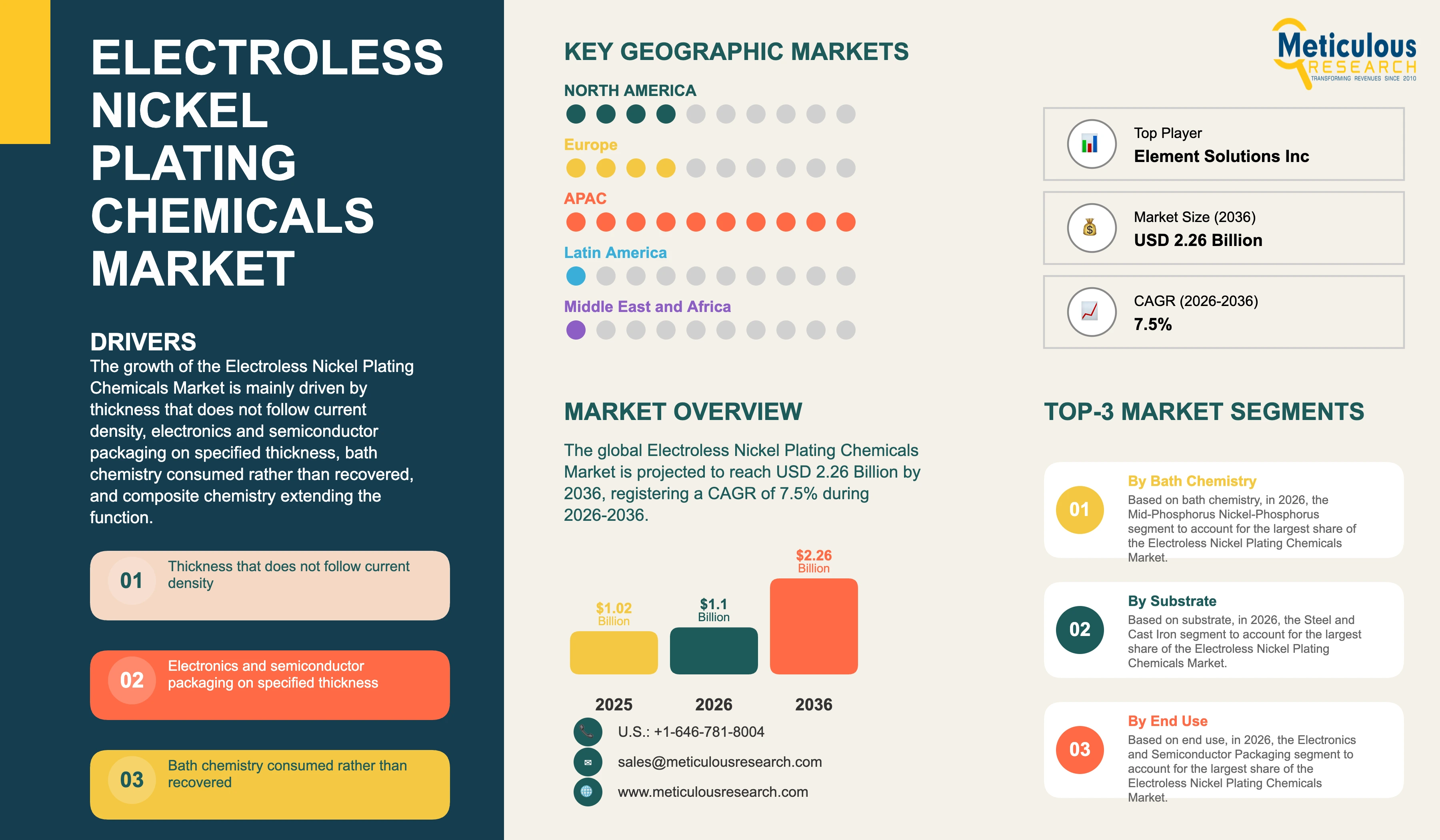
The electroless nickel plating chemicals market is valued at USD 1.10 billion in 2026 and is projected to reach USD 2.26 billion by 2036, at a CAGR of 7.5% during the forecast period. The market was valued at USD 1.02 billion in 2025 and at USD 944.2 million in 2024.
- Published
- Nov 2026
- Pages
- 270
- Format
- PDF + Excel
- Report ID
- MRCHM - 1042766
- Base year
- 2025
- 2024 · HISTORICAL
- $944.2M
- 2036
- $2.26B
- CAGR 2026–2036
- 7.5%
2024–2025 baseline · 2026–2036 forecast at 7.5% CAGR · hover a bar for the value
Key highlights
This market measures the chemistry consumed in autocatalytic nickel plating, covering bath make-up and replenishment concentrates, stabiliser, complexant and additive packages, and pre-treatment and activation chemistry, taken at the chemical supplier gate on a tonne basis as supplied.
Excluded are refined nickel metal and nickel anodes, electrolytic nickel plating chemistry, the immersion gold stage of an electroless nickel immersion gold finish, plating equipment and waste treatment chemistry.
Deposition is autocatalytic rather than current-driven, so thickness does not follow current density and the deposit covers sharp edges, deep recesses and blind holes at the same thickness as an exposed face, while electroplated nickel builds up at edges and projections.
ISO 4527 covers autocatalytic nickel-phosphorus coatings as a supersaturated solid solution containing up to 14% phosphorus by mass fraction, with corrosion performance generally improving at 8% and above and wear resistance improving at lower phosphorus levels.
Phosphorus content divides the market into low at 3% to 5%, medium at 6% to 9% and high at 10% to 14%, with boron deposits classed between 0.1% and 10%.
As-deposited hardness runs at about 650 Vickers for 2% to 3% phosphorus, about 620 for 6% to 9% and about 520 for 10% to 12%, so the chemistry that resists corrosion is the one that starts softest.
Heat treatment at 400 degrees Celsius for one hour raises those figures to about 1, 200, 1,100 and 1,050 Vickers respectively, and treatment above 220 degrees Celsius causes volumetric shrinkage of up to 6%.
Corrosion rates separate the chemistries sharply, with an 11% to 12% phosphorus deposit losing 0.8 micron a year in glacial acetic acid against 84 microns for a 4% to 5% boron deposit.
Low-phosphorus deposits hold up better in strong alkali, recording 0.2 micron a year in 50% sodium hydroxide at 95 degrees Celsius, so the phosphorus choice is made against the service environment rather than against a ranking.
Acid nickel-phosphorus baths operate at 85 degrees to 95 degrees Celsius and pH 5 to 6 at 10 to 25 microns per hour, while cool alkaline baths run at 30 degrees to 40 degrees Celsius at 8 microns per hour.
A typical acid bath carries 33 grams per litre of nickel sulphate, 20 grams per litre of sodium hypophosphite, lactic acid and sodium succinate as complexants and 0.003 gram per litre of lead as stabiliser.
Lead and cadmium stabilisers sit against the 0.1% lead and 0.01% cadmium limits in homogeneous materials under Directive 2011/65/EU, and hot alkaline nickel-boron baths carry 0.07 gram per litre of thallium nitrate.
Orthophosphite accumulates as a reaction by-product and in excess produces rough deposits and spontaneous bath decomposition, which is why bath chemistry is consumed and discarded rather than recovered.
Composite chemistry adds silicon carbide at 20% to 25% by volume for hardness, reaching 1,365 Vickers after heat treatment, or polytetrafluoroethylene at the same loading for friction reduction.
Fine particle dispersion raises bath surface loading by roughly 700 to 800 times, which is the stability constraint that keeps composite baths a specialist route rather than a general one.
IPC-4552 specifies electroless nickel at 3 microns to 6 microns with immersion gold at a default minimum of 0.05 micron, and 0.04 micron for soldering-only applications by stated exception, which fixes chemistry consumption per unit of circuit board area.
Chromium trioxide carries a sunset date of 21 September 2017 under Annex XIV of the European chemicals regime, which puts the chromic acid etch used before plating on plastics under authorisation and has brought chromium-free etch chemistry into the pre-treatment segment.
Mid-phosphorus chemistry is expected to hold the largest bath chemistry share of this market in 2026 at 44.0% and to grow at 7.0%, while composite and other chemistry grows fastest at 9.2% and nickel-boron slowest at 6.0%.
Report summary
| Particulars | Details |
|---|---|
| Base Year | 2025 |
| Actual Years | 2024-2025 |
| Forecast Period | 2026-2036 |
| Market Size in 2024 | USD 944.2 million |
| Market Size in 2025 | USD 1.02 billion |
| Market Size in 2026 | USD 1.10 billion |
| Market Size in 2036 | USD 2.26 billion |
| Value CAGR (2026-2036) | 7.5% |
| Format | PDF, Excel & Cloud Portal · 270 pages |
| Volume in 2025 | 174.00 kilotons |
| Volume in 2026 | 182.00 kilotons |
| Volume in 2036 | 310.00 kilotons |
| Volume CAGR (2026-2036) | 5.5% |
| Average Selling Price, 2026 | USD 6,040 per tonne |
| Average Selling Price, 2036 | USD 7,300 per tonne |
| Units | Value in USD million; volume in kilotons of plating chemistry as supplied; price in USD per tonne |
| Measurement Basis | Chemistry consumed in autocatalytic nickel plating, covering bath make-up and replenishment concentrates, stabiliser, complexant and additive packages, and pre-treatment and activation chemistry, taken at the chemical supplier gate on a tonne basis as supplied |
| Historical Value Growth | Value grew at 7.9% a year between 2024 and 2026 on volume growth of 4.7% a year and price growth of 3.0% a year; the forecast of 7.5% carries volume growth of 5.5% and price growth of 1.9%, with volume accelerating on electronics and composite demand while the price effect moderates |
| Price Increase Note | The average selling price rises on mix rather than on repricing, because composite, high-phosphorus and additive-intensive systems are priced above standard mid-phosphorus concentrate, so a shift of share toward them lifts the blended figure without either repricing |
| Deposition Basis | Deposition is autocatalytic rather than current-driven, so the rate is independent of current density and the deposit covers sharp edges, deep recesses and blind holes at the same thickness as an exposed face, while electroplated nickel builds up at edges and projections |
| Alloy Classification Basis | ISO 4527 covers autocatalytic nickel-phosphorus coatings as a supersaturated solid solution containing up to 14% phosphorus by mass fraction, with corrosion performance generally improving at 8% and above and wear resistance improving at lower levels; phosphorus classes run 3% to 5% low, 6% to 9% medium and 10% to 14% high, and boron classes 0.1% to 2%, 2% to 5% and 5% to 10% |
| Hardness Basis | As-deposited hardness is about 650 Vickers at 2% to 3% phosphorus, about 620 at 6% to 9% and about 520 at 10% to 12%, rising to about 1,200, 1,100 and 1,050 respectively after one hour at 400 degrees Celsius; treatment above 220 degrees Celsius causes volumetric shrinkage of up to 6%, and nickel-boron ductility is about 0.2%, roughly one-fifth that of high-phosphorus deposits |
| Corrosion Basis | An 11% to 12% phosphorus deposit loses 0.8 micron a year in glacial acetic acid, 13 microns in 88% formic acid and 7 microns in saturated citric acid, against 84 microns, 90 microns and 42 microns for a 4% to 5% boron deposit; a 3% to 4% phosphorus deposit loses 0.2 micron a year in 50% sodium hydroxide at 95 degrees Celsius |
| Bath Operating Basis | Acid nickel-phosphorus baths operate at 85 degrees to 95 degrees Celsius and pH 5 to 6 at 10 to 25 microns per hour, hot alkaline baths at 80 degrees to 90 degrees Celsius and pH 8 to 10 at 10 microns per hour, and cool alkaline baths at 30 degrees to 40 degrees Celsius at 8 microns per hour; a published lead-free and cadmium-free bath runs at 6.0 grams per litre of nickel, 80 degrees to 90 degrees Celsius and pH 4.6 to 5.2 at 6.0% to 8.0% phosphorus and 550 to 600 Vickers as plated, rising to 950 to 1,050 after nickel phosphide crystallisation |
| Bath Life Basis | Published bath life for lead and cadmium stabilised systems is six to eight metal turnovers on steel, equivalent to 36 to 48 grams per litre of nickel plated, with plating on aluminium reducing that by about 50%; orthophosphite accumulates as a reaction by-product and in excess produces rough deposits and spontaneous decomposition, which is why baths are discarded rather than regenerated |
| Stabiliser Restriction Basis | A typical acid bath carries 0.003 gram per litre of lead as stabiliser, cadmium has been used in the same role and hot alkaline nickel-boron baths carry 0.07 gram per litre of thallium nitrate, against limits of 0.1% lead and 0.01% cadmium by weight in homogeneous materials under Directive 2011/65/EU and the corresponding vehicle and waste electrical equipment legislation |
| Composite Basis | Silicon carbide at 20% to 25% by volume gives 530 Vickers as-deposited and 1,365 after heat treatment and polytetrafluoroethylene at the same loading 340 Vickers and 421 after treatment; fine particle dispersion raises bath surface loading by roughly 700 to 800 times, which is the stability constraint, and surfactant choice has raised silicon carbide incorporation from 19% to 53% by volume |
| Electronics Specification Basis | IPC-4552 specifies electroless nickel at 3 microns to 6 microns and immersion gold at a default minimum of 0.05 micron measured at minus four sigma from the mean on a 1.5 millimetre square pad or equivalent area, with 0.04 micron permitted for soldering-only applications by exception stated on procurement documentation; phosphorus or boron content is reported for reference with no testing required |
| Pre-Treatment Regulation Basis | Chromium trioxide was included in Annex XIV of the European chemicals regime with a latest application date of 21 March 2016 and a sunset date of 21 September 2017, which places the chromic acid etch used before plating on plastics under authorisation; chromium-free etch chemistry was patented in 2013 and first installed industrially in 2015 |
| Overlap Note | The immersion gold stage of an electroless nickel immersion gold finish and electrolytic nickel chemistry are counted in separate titles, so any sizing reconciliation against plating chemical or printed circuit board chemistry titles has to be made on the autocatalytic nickel boundary |
| Exclusions | Refined nickel metal, nickel anodes and nickel salts sold as commodities outside a plating process package; electrolytic nickel plating chemistry; the immersion gold and palladium stages of multilayer electronics finishes; plating equipment, tanks, filtration and heating; waste treatment and metal recovery chemistry; electroless copper and electroless palladium chemistry |
| Segments: Bath Chemistry | Mid-Phosphorus Nickel-Phosphorus; High-Phosphorus Nickel-Phosphorus; Low-Phosphorus Nickel-Phosphorus; Nickel-Boron; Composite and Other Chemistry |
| Segments: Substrate | Steel and Cast Iron; Aluminium and Aluminium Alloys; Copper and Copper Alloys; Plastics and Other Substrates |
| Segments: End Use | Electronics and Semiconductor Packaging; Automotive; Oil, Gas and Chemical Processing; Aerospace and Defence; Industrial Machinery and General Engineering; Other End Uses |
| Segments: Product Form | Bath Make-Up and Replenishment Concentrates; Stabiliser, Complexant and Additive Packages; Pre-Treatment and Activation Chemistry |
| Largest Segment by Bath Chemistry, 2026 | Mid-Phosphorus Nickel-Phosphorus, at 44.0% |
| Fastest-Growing Segment by Bath Chemistry | Composite and Other Chemistry, at 9.2% |
| Slowest-Growing Segment by Bath Chemistry | Nickel-Boron, at 6.0% |
| Largest Segment by Substrate, 2026 | Steel and Cast Iron, at 46.0% |
| Fastest-Growing Segment by Substrate | Copper and Copper Alloys, at 8.8% |
| Largest Segment by End Use, 2026 | Electronics and Semiconductor Packaging, at 29.0% |
| Fastest-Growing Segment by End Use | Electronics and Semiconductor Packaging, at 9.4% |
| Slowest-Growing Segment by End Use | Industrial Machinery and General Engineering, at 6.2% |
| Largest Segment by Product Form, 2026 | Bath Make-Up and Replenishment Concentrates, at 71.0% |
| Fastest-Growing Segment by Product Form | Stabiliser, Complexant and Additive Packages, at 9.0% |
| Largest Region, 2026 | Asia-Pacific, at 52.0% |
| Fastest-Growing Region | Middle East & Africa, at 8.8% |
| Fastest-Growing Country | India, at 10.2% |
| Slowest-Growing Country | Japan, at 5.0% |
| Regions Covered | Asia-Pacific; Europe; North America; Latin America; Middle East & Africa |
| Countries Covered | China; Japan; South Korea; Taiwan; India; Germany; Italy; France; U.S.; Canada; Mexico; Brazil |
| Key Players | Element Solutions Inc; MKS Instruments, Inc.; C. Uyemura & Co., Ltd.; DuPont de Nemours, Inc.; JCU Corporation; Okuno Chemical Industries Co., Ltd.; Technic Inc. |
| Supply Structure Note | Suppliers sell a process rather than a product, since a bath is bought as a make-up charge, a replenishment schedule, an additive package and the technical service that keeps it inside its window; consolidation has placed the MacDermid Enthone and Coventya businesses inside Element Solutions Inc and Atotech inside MKS Instruments, Inc. |
| Top Five Share, 2026 | 56.0% |
| Profiled Companies Share, 2026 | 70.0% |
| Currency | USD |
Report overview
Market value is measured in in USD million; volume in kilotons of plating chemistry as supplied; price in USD per tonne. Segments covered: bath chemistry, substrate, end use, product form.
In volume terms, the market is estimated at 182.00 kilotons of plating chemistry as supplied in 2026, rising to 310.00 kilotons by 2036, at a CAGR of 5.5%. The average selling price is estimated at USD 6,040 per tonne in 2026 and USD 7,300 per tonne in 2036, the increase reflecting a mix shift toward composite, high-phosphorus and additive-intensive systems rather than any repricing of standard mid-phosphorus chemistry.
The growth of this market is mainly driven by deposit thickness that does not vary with current density and therefore reaches recesses, blind holes and internal surfaces that electroplating cannot, electronics and semiconductor packaging demand growing at 9.4%, composite chemistry growing at 9.2%, and bath chemistry that is consumed and discarded rather than recovered. However, factors such as bath operation at 85 degrees to 95 degrees Celsius against deposition rates of 10 to 25 microns per hour, spontaneous bath decomposition and orthophosphite accumulation driving hazardous waste, lead, cadmium and thallium stabiliser chemistry under restriction, and a hardness, corrosion and ductility trade-off that no single phosphorus level resolves are expected to restrain the growth of this market to some extent.
Among end uses, electronics and semiconductor packaging are expected to hold the largest share of this market in 2026 and to record the highest CAGR during the forecast period. Geographically, Asia-Pacific is expected to account for the largest share of this market in 2026, while the Middle East & Africa is expected to register the highest CAGR during the forecast period.
Nickel is deposited here by chemical reduction on a catalytic surface rather than by current, so the reaction proceeds at the same rate wherever the solution reaches. Thickness therefore does not vary with current density, and a deposit covers sharp edges, deep recesses and blind holes at the same thickness as an exposed face.
That is the whole commercial basis of the process. Electroplated nickel builds up at edges and projections and thins in recesses, which forces either excess thickness everywhere or machining afterwards, and neither is available on a valve body, a hydraulic manifold or a printed circuit board.
Published bath life runs at six to eight metal turnovers on steel, equivalent to 36 to 48 grams per litre of nickel plated, and plating on aluminium reduces that by about 50%, so the chemistry consumed per square metre depends on the substrate as much as on the thickness specified.
The reducing agent sets the alloy. Sodium hypophosphite produces a nickel-phosphorus deposit that ISO 4527 describes as a supersaturated solid solution containing up to 14% phosphorus by mass fraction, while borohydride and dimethylamine borane produce nickel-boron at 0.1% to 10% boron.
Phosphorus content then governs everything the deposit does. Corrosion performance generally improves at 8% phosphorus and above while wear resistance improves at lower levels, so the specification is a choice between the two rather than a single optimum.
As-deposited hardness falls as phosphorus rises, from about 650 Vickers at 2% to 3% phosphorus to about 520 at 10% to 12%, and heat treatment at 400 degrees Celsius for one hour lifts those to about 1,200 and about 1,050 respectively. Treatment above 220 degrees Celsius brings volumetric shrinkage of up to 6%.
Corrosion data separate the alloys by an order of magnitude. An 11% to 12% phosphorus deposit loses 0.8 micron a year in glacial acetic acid and 13 microns in 88% formic acid, against 84 microns and 90 microns for a 4% to 5% boron deposit, while a 3% to 4% phosphorus deposit loses 0.2 micron a year in 50% sodium hydroxide at 95 degrees Celsius.
Ductility runs the other way again, with nickel-boron at about 0.2%, roughly one-fifth that of high-phosphorus deposits, and electrical resistivity of nickel-phosphorus at 30 to 100 microhm centimetres against 7.8 for pure nickel, which matters wherever the coating carries signal.
Bath chemistry is where the market sits. A typical acid bath carries 33 grams per litre of nickel sulphate, 20 grams per litre of sodium hypophosphite, 28 grams per litre of lactic acid and 16 grams per litre of sodium succinate, with 0.003 gram per litre of lead as stabiliser, operating at 85 degrees to 95 degrees Celsius and pH 5 to 6.
Deposition runs at 10 to 25 microns per hour in acid baths, 10 microns per hour in hot alkaline baths and 8 microns per hour in cool alkaline baths at 30 degrees to 40 degrees Celsius, so a 25-micron engineering coating occupies a plating tank for one to three hours at close to boiling temperature.
The bath is consumed rather than recovered. Orthophosphite accumulates as a reaction by-product, in excess it produces rough deposits and spontaneous decomposition, and sudden decomposition is the principal operating problem, which raises cost and produces hazardous waste.
That consumption is what makes this a chemicals market rather than an equipment one. Replenishment chemistry is dosed continuously against nickel and hypophosphite depletion, and the bath is eventually discarded, so demand tracks the area plated and the thickness specified rather than the installed tank capacity.
Stabiliser chemistry is where regulation bites. The classic acid bath is stabilised with lead and the alternatives have included cadmium and thallium, with hot alkaline nickel-boron baths carrying 0.07 gram per litre of thallium nitrate, against limits of 0.1% lead and 0.01% cadmium in homogeneous materials under Directive 2011/65/EU.
A published lead-free and cadmium-free bath runs at 6.0 grams per litre of nickel, 80 degrees to 90 degrees Celsius and pH 4.6 to 5.2, deposits 6.0% to 8.0% phosphorus at 550 to 600 Vickers as plated and 950 to 1,050 after nickel phosphide crystallisation, and holds aluminium adhesion through at least six metal turnovers where a generic mid-phosphorus product failed at three.
Composite chemistry extends the process into functions a nickel alloy cannot deliver alone. Silicon carbide at 20% to 25% by volume reaches 530 Vickers as-deposited and 1,365 after heat treatment, while polytetrafluoroethylene at the same loading reduces friction at 340 Vickers and 421 after treatment.
Those baths are harder to run, because fine particle dispersion raises bath surface loading by roughly 700 to 800 times and that loading destabilises the solution, and a surfactant that raises incorporation from 19% to 53% by volume also changes the deposition rate.
Electronics consumes the process on a specification rather than on a performance argument. IPC-4552 sets electroless nickel at 3 microns to 6 microns with immersion gold at a default minimum of 0.05 micron, and 0.04 micron for soldering-only work by stated exception, with phosphorus content reported for reference and not tested.
Deposition rate also falls as a bath ages, because complexing agents accumulate with each replenishment, so a plater is buying consistency across the life of the charge rather than a single rate figure.
Plating on plastics carries its own regulatory position, because the etch that prepares the surface has typically used chromic acid, chromium trioxide carries a sunset date of 21 September 2017 under Annex XIV of the European chemicals regime, and chromium-free etch chemistry has been commercially installed since 2015.
On mix rather than on repricing. Composite, high-phosphorus and additive-intensive systems are priced above standard mid-phosphorus concentrate, so as they take share the blended figure rises from USD 6,040 per tonne to USD 7,300 per tonne. Volume grows at 5.5% against value growth of 7.5%.
Asia-Pacific holds 52.0% of this market in 2026 and grows at 8.4%, with circuit board, semiconductor packaging and component plating capacity concentrated there. Europe follows at 20.0% and 6.2%, the slowest region, and North America at 19.0% and 6.4%. The Middle East and Africa grows fastest among regions at 8.8% on oil and gas component work, and India fastest among countries at 10.2% while Japan grows slowest at 5.0%.
Specialty chemistry houses that sell a bath as a process package with technical service, with consolidation placing the MacDermid Enthone and Coventya businesses inside Element Solutions Inc and Atotech inside MKS Instruments, Inc. Some of the key players operating in the electroless nickel plating chemicals market are Element Solutions Inc, MKS Instruments, Inc., C. Uyemura & Co., Ltd., DuPont de Nemours, Inc., JCU Corporation, Okuno Chemical Industries Co., Ltd., and Technic Inc., among others. The top five hold 56.0% of this market in 2026 and the profiled companies 70.0%.
By selling bath life, stabiliser chemistry and the phosphorus window rather than nickel content, since those are what a plater cannot formulate and what the restriction lists are forcing to change. Lead-free, cadmium-free and thallium-free baths that hold deposition rate and brightness through six or more metal turnovers, chromium-free pre-treatment, and composite systems stable at production scale are where the growth sits.
Report infographic
Market dynamics
17 factors across 5 forcesThickness That Does Not Follow Current Density
Deposition proceeds by chemical reduction on a catalytic surface, so the rate is the same wherever the solution reaches and a coating covers blind holes, internal bores, threads and deep recesses at the thickness specified on an exposed face.
Electroplated nickel builds up at edges and projections and thins in recesses, which leaves a designer choosing between excess thickness across the part and machining the coating after deposition, neither of which suits a valve body, a hydraulic manifold or a fuel system component.
That advantage is structural rather than incremental, which is why oil, gas and chemical processing applications hold 17.0% of this market in 2026 and aerospace and defence 12.0%, both specifying the process on geometry the alternative cannot reach.
Electronics and Semiconductor Packaging on Specified Thickness
IPC-4552 fixes electroless nickel at 3 microns to 6 microns with immersion gold at a default minimum of 0.05 micron, so chemistry consumption per unit of circuit board area is set by specification and rises with board area and layer count rather than with any plater decision.
The same chemistry carries into semiconductor packaging, where nickel acts as a diffusion barrier and solderable surface on bump and pad metallisation, and where the surfaces are too fine and too numerous for a current-driven process.
Electronics and semiconductor packaging hold the largest end use share of this market in 2026 at 29.0% and record the highest end use CAGR at 9.4%, against 6.4% for automotive and 6.2% for industrial machinery and general engineering.
Substitution is also limited at the design stage, because a part specified for autocatalytic nickel on geometry grounds cannot be re-specified for electroplating without a drawing change and a requalification of the coating thickness in the recesses.
Bath Chemistry Consumed Rather Than Recovered
Nickel and hypophosphite are consumed in the reduction and replenished continuously, orthophosphite accumulates as a by-product, and in excess it produces rough deposits and spontaneous bath decomposition, so the bath is eventually discarded rather than regenerated.
Demand therefore tracks area plated and thickness specified rather than installed tank capacity, which gives this market the consumption profile of a reagent rather than that of a capital good.
Bath make-up and replenishment concentrates hold 71.0% of this market by product form in 2026 and grow at 7.0%, while stabiliser, complexant and additive packages grow at 9.0%.
Aluminium work consumes chemistry faster still, since published bath life on aluminium is about half that on steel, so the same plated area draws roughly twice the make-up and replenishment charge.
Composite Chemistry Extending the Function
Silicon carbide at 20% to 25% by volume takes a deposit to 530 Vickers as-deposited and 1,365 after heat treatment, above what the nickel-phosphorus alloy reaches alone, and polytetrafluoroethylene at the same loading delivers friction reduction that no alloy composition provides.
Those systems need surfactant and dispersion control because fine particles raise bath surface loading by roughly 700 to 800 times, and the additive package rather than the nickel salt is what the plater is buying.
Composite and other chemistry records the highest bath chemistry CAGR in this market at 9.2% from a 13.0% share in 2026, and copper substrates, which carry most electronics work, grow at 8.8%.
Table of contents
12 chapters · 133 sections · 270 pages · click to expandSegmental analysis
| Segment | Largest share (2026) | Fastest growth (2026–2036) |
|---|---|---|
| By Bath Chemistry | Mid-phosphorus chemistry | Composite and other chemistry |
| By Substrate | Steel and cast iron | Copper and copper alloys |
| By End Use | Electronics and semiconductor packaging | Electronics and semiconductor packaging |
| By Product Form | Bath make-up and replenishment concentrates | Stabiliser, complexant and additive packages |
By Bath Chemistry
- Electroless Nickel Plating Chemicals Market Analysis by Bath Chemistry
- This market is segmented into mid-phosphorus nickel-phosphorus, high-phosphorus nickel-phosphorus, low-phosphorus nickel-phosphorus, nickel-boron, and composite and other chemistry.
- Mid-phosphorus chemistry is expected to account for the largest share of this market in 2026.
- The 6% to 9% phosphorus range sits between the corrosion resistance that appears above 8% and the hardness that improves below it, which makes it the general engineering default where the service environment is mixed or imperfectly known.
- A bath in that range plating steel delivers six to eight metal turnovers of life, equivalent to 36 to 48 grams per litre of nickel plated, which is the longest of any chemistry and substrate combination in this market and part of why the segment holds its position.
- The range is also the one most plating shops are set up to run, with bath temperatures of 80 degrees to 90 degrees Celsius and pH between 4.6 and 5.2, and it is where lead-free and cadmium-free reformulation has been commercialised first because the volume justifies the development.
- Composite and other chemistry is expected to record the highest CAGR during the forecast period, at 9.2%.
- Silicon carbide loadings of 20% to 25% by volume reach 1, 365 Vickers after heat treatment and polytetrafluoroethylene at the same loading delivers friction reduction, and neither function is available from an alloy composition alone.
- High-phosphorus chemistry grows at 8.6% on corrosion service, where an 11% to 12% phosphorus deposit loses 0.8 micron a year in glacial acetic acid, and low-phosphorus chemistry at 6.4% on alkaline and wear service, holding 0.2 micron a year in 50% sodium hydroxide at 95 degrees Celsius.
- Nickel-boron grows slowest at 6.0% on thallium stabiliser exposure and lower corrosion resistance.
- Mid-phosphorus chemistry holds the largest bath chemistry share in 2026 at 44.0% and grows at 7.0%, with composite and other chemistry fastest at 9.2% and nickel-boron slowest at 6.0%.
- Electronics and semiconductor packaging are both the largest end use at 29.0% and the fastest at 9.4%.
- Steel and cast iron hold the largest substrate share at 46.0% while copper grows fastest at 8.8%, and bath make-up concentrates hold 71.0% by product form while additive packages grow fastest at 9.0%.
By Substrate
- Electroless Nickel Plating Chemicals Market Analysis by Substrate
- This market is segmented into steel and cast iron, aluminium and aluminium alloys, copper and copper alloys, and plastics and other substrates.
- Steel and cast iron are expected to hold the largest share of this market in 2026, reflecting engineering components in oil and gas, chemical processing, automotive and general machinery, where the geometry argument for an autocatalytic deposit is strongest and bath life is longest at six to eight metal turnovers.
- Copper and copper alloys are expected to record the highest CAGR during the forecast period, at 8.8%, carried by printed circuit board and semiconductor packaging work where the nickel layer acts as a barrier and solderable surface under immersion gold.
- Steel work also carries the thickest deposits, since engineering coatings of 25 microns and above are specified there rather than the few microns an electronics finish requires, so the segment consumes more chemistry per square metre plated than any other.
- Aluminium grows at 8.2% and carries the most pre-treatment chemistry of any substrate, since activation is required before plating and aluminium work reduces bath life by about half against steel, while plastics and other substrates grow at 7.6%.
By End Use
- Electroless Nickel Plating Chemicals Market Analysis by End Use
- This market is segmented into electronics and semiconductor packaging, automotive, oil, gas and chemical processing, aerospace and defence, industrial machinery and general engineering, and other end uses.
- Electronics and semiconductor packaging are expected to account for the largest share of this market in 2026 and to record the highest CAGR during the forecast period, at 9.4%.
- Nickel thickness of 3 microns to 6 microns is specified under IPC-4552 rather than chosen, so chemistry consumption follows board area and feature count directly.
- Oil, gas and chemical processing hold the third-largest share and grow at 6.8%, with the high-phosphorus corrosion data behind the specification, and aerospace and defence grow at 7.2% on geometry and weight-saving substitution for harder coatings.
- Aerospace specification is also the slowest to change, because a stabiliser substitution is a requalification against a process standard and a heat treatment schedule rather than a like-for-like replacement.
- Automotive grows at 6.4% and industrial machinery and general engineering slowest at 6.2%, both mature applications where the process is specified on established drawings rather than newly adopted.
By Product Form
- Electroless Nickel Plating Chemicals Market Analysis by Product Form
- This market is segmented into bath make-up and replenishment concentrates, stabiliser, complexant and additive packages, and pre-treatment and activation chemistry.
- Bath make-up and replenishment concentrates are expected to hold the largest share of this market in 2026, since nickel and hypophosphite are consumed in the reduction itself and dosed continuously against depletion, and a bath plating 36 to 48 grams per litre of nickel over six to eight metal turnovers consumes several times the make-up charge.
- Stabiliser, complexant and additive packages are expected to record the highest CAGR during the forecast period, at 9.0%.
- Bath life, deposition rate, brightness and the phosphorus window are set by the package rather than by the nickel salt, and the removal of lead, cadmium and thallium has moved that formulation work to the centre of the purchase.
- Pre-treatment and activation chemistry grows at 8.4%, carried by aluminium activation, where the zincate or alternative step is unavoidable, and by chromium-free etch chemistry replacing the chromic acid step in plating on plastics, which has been in industrial installation since 2015.
Geographic analysis
Asia-Pacific
Largest shareAsia-Pacific is expected to account for the largest share of this market in 2026, at 52.0%. Printed circuit board and semiconductor packaging capacity, automotive component production and general engineering plating are all concentrated in the region, and the principal Japanese chemistry houses supply from inside it. China holds the largest country position on circuit board, connector and automotive component plating volumes. Japan carries the highest-value chemistry development and is expected to record the lowest country CAGR in this market at 5.0%, with a mature domestic plating base and growth carried by exported chemistry rather than by local consumption. India is expected to register the highest country CAGR in this market at 10.2%, on electronics assembly, automotive component manufacture and oil and gas service work, with South Korea and Taiwan growing on semiconductor packaging and circuit board finishing.
Europe
Europe is expected to hold the second-largest regional share in 2026, at 20.0%, and to grow at 6.2%, the slowest of the five regions. The chromium trioxide sunset date of 21 September 2017 and the lead and cadmium limits that reach plated parts through electrical, electronic and vehicle legislation both originate in the region, so specification there is set by compliance. Germany anchors the European position on automotive and machinery component plating, with Italy and France on general engineering and France additionally on aerospace work, and the U.K. on aerospace and oil and gas components. European demand is also weighted toward engineering rather than electronics work, which keeps the regional mix on mid and high-phosphorus chemistry and makes the restriction position on stabilisers the main variable in specification.
North America
North America is expected to account for 19.0% of this market in 2026 and to grow at 6.4%, with the U.S. holding most of that position on oil and gas, aerospace and defence and semiconductor packaging work, and Canada following on a smaller base.
Middle East & Africa
The Middle East & Africa is expected to register the highest regional CAGR in this market at 8.8% from a 4.0% share in 2026, carried by oil, gas and chemical processing component plating.
Latin America
Latin America grows at 6.8% on 5.0%, with Brazil holding the regional automotive and machinery base and Mexico supplying plated components into North American assembly.
Competitive landscape
Supply is held by specialty chemistry houses that sell a process rather than a product, since a bath is bought as a make-up charge, a replenishment schedule, an additive package and the technical service that keeps it inside its window. A plater that mixes its own chemistry from commodity salts loses the bath life and the deposit consistency that the package delivers.
Consolidation has concentrated the position. Element Solutions Inc holds the MacDermid Enthone and Coventya businesses and MKS Instruments, Inc. holds Atotech, which places two of the largest positions inside groups whose surface finishing portfolios span electrolytic, electroless and pre-treatment chemistry.
The Japanese houses compete on process rather than on scale, with C. Uyemura & Co., Ltd. publishing lead-free and cadmium-free bath data including six to eight metal turnovers of bath life on steel and about half that on aluminium, and with JCU Corporation and Okuno Chemical Industries Co., Ltd. supplying circuit board and component plating lines.
Electronics and industrial work are served by partly different suppliers. DuPont de Nemours, Inc. carries electroless nickel for circuit board and plastic metallisation together with the chromium-free etch chemistry that has been in industrial installation since 2015, while Technic Inc. supplies low, mid and high-phosphorus industrial processes alongside an electroless nickel immersion gold line.
Entry is difficult for the same reason. A new supplier has to demonstrate bath life, phosphorus window and deposit consistency on the parts of a shop already in production, and a failed trial costs that shop more than the chemistry under test is worth.
Competition turns on bath life, stabiliser chemistry and qualification support rather than on price per tonne, because a bath that decomposes or drifts out of its phosphorus window costs the plater more than the chemistry saved.
Industrial and electronics positions are also priced differently, because an engineering coating of 25 microns and above is sold on chemistry consumed per square metre while a 3 micron to 6 micron electronics finish is sold on defect rate and gold consumption downstream of the nickel bath.
Some of the key players operating in the electroless nickel plating chemicals market are Element Solutions Inc, MKS Instruments, Inc., C. Uyemura & Co., Ltd., DuPont de Nemours, Inc., JCU Corporation, Okuno Chemical Industries Co., Ltd., and Technic Inc., among others.
- Element Solutions Inc
- MKS Instruments, Inc.
- C. Uyemura & Co., Ltd.
- DuPont de Nemours, Inc.
- JCU Corporation
- Okuno Chemical Industries Co., Ltd.
- Technic Inc
Expert perspectives
The named demand driver for this title is uniform coating on complex parts, and it is accurate in a way that few driver statements are. Deposition is autocatalytic, the rate does not follow current density, and a blind hole or an internal bore receives the same thickness as an exposed face, which electroplating cannot deliver at any cost.
What the driver does not carry is the price of that uniformity. Acid baths run at 85 degrees to 95 degrees Celsius and deposit at 10 to 25 microns per hour, so a 25-micron coating occupies a tank at near-boiling temperature for one to three hours, and the cool alkaline alternative deposits at 8 microns per hour.
The bath is also a consumable rather than an asset. Orthophosphite accumulates, rough deposits and spontaneous decomposition follow, and published bath life runs at six to eight metal turnovers on steel and about half that on aluminium, which is what makes this a chemicals market with the demand profile of a reagent.
The deposit itself resolves nothing on its own. Corrosion performance improves above 8% phosphorus while hardness improves below it, as-deposited hardness falls from about 650 Vickers at 2% to 3% phosphorus to about 520 at 10% to 12%, nickel-boron ductility is about one-fifth that of high-phosphorus deposits, and heat treatment that lifts hardness above 1,000 Vickers brings volumetric shrinkage of up to 6%.
Regulation is reshaping the formulation rather than the process. Lead at 0.003 gram per litre, cadmium in the same role and thallium nitrate at 0.07 gram per litre have to leave baths whose parts enter electrical, electronic and vehicle assemblies, and the chromic acid etch ahead of plating on plastics has been under authorisation since the sunset date of 21 September 2017.
A supplier positioning here should sell bath life, stabiliser chemistry and the phosphorus window rather than nickel content, because those are what the plater cannot formulate and what the restriction list is forcing to change. The fastest growth sits in the additive package at 9.0%, in composite chemistry at 9.2% and in electronics work at 9.4%, where thickness is specified under IPC-4552 and consumption follows area rather than judgement.
Customer perspectives
An oil and gas component manufacturer buys corrosion life on a geometry that cannot be electroplated, and reads the specification against service fluid rather than against a hardness figure, because an 11% to 12% phosphorus deposit and a 4% to 5% boron deposit differ by two orders of magnitude in acetic acid.
That buyer also needs thickness confirmed inside bores and threads rather than on a witness panel, since the whole reason for selecting the process is the surface that cannot be inspected easily.
A circuit board fabricator buys to a published thickness window of 3 microns to 6 microns of nickel and 0.05 micron of immersion gold, so the chemistry is bought on bath stability, gold consumption and defect rate rather than on any coating property the supplier can claim.
A captive automotive plating shop buys bath life, because six to eight metal turnovers on steel against about half that on aluminium decides how often the tank is dumped, and the dump is both the waste cost and the lost production.
An aerospace component buyer specifies against a process standard and a heat treatment schedule, and a change of stabiliser chemistry is a requalification rather than a substitution, which makes that buyer the slowest to move and the most valuable to hold.
A general engineering job shop buys one bath to cover many customers and therefore buys mid-phosphorus chemistry, since the service environment of the next order is unknown.
An electronics assembler further down the chain never buys the chemistry at all but carries the restriction exposure, which is why lead-free and cadmium-free bath data is published for the buyer two steps away from the plating tank.
A plastics metallisation shop buys the etch as much as the nickel, because the chromic acid step carries the authorisation question while the nickel bath does not, and a chromium-free line removes a compliance exposure from the whole process.
Across every buyer the purchase is of a process that stays inside its window rather than of a chemistry, and the supplier that can hold deposition rate, phosphorus content and brightness as the bath ages is the one that holds the account.
Frequently asked questions
The market is valued at USD 1.10 billion in 2026 and is projected to reach USD 2.26 billion by 2036, at a CAGR of 7.5%. It was valued at USD 1.02 billion in 2025 and USD 944.2 million in 2024.
The chemistry consumed in autocatalytic nickel plating, covering bath make-up and replenishment concentrates, stabiliser, complexant and additive packages, and pre-treatment and activation chemistry, taken at the chemical supplier gate on a tonne basis as supplied. Refined nickel metal and anodes, electrolytic nickel chemistry, the immersion gold stage, plating equipment and waste treatment chemistry are excluded.
Because deposition is autocatalytic rather than current-driven, so thickness does not follow current density and sharp edges, deep recesses and blind holes receive the same thickness as an exposed face. Electroplated nickel builds up at edges and projections and thins in recesses.
Everything the deposit does. Corrosion performance generally improves at 8% and above and wear resistance improves at lower levels, while as-deposited hardness falls from about 650 Vickers at 2% to 3% phosphorus to about 520 at 10% to 12%.
By up to two orders of magnitude. An 11% to 12% phosphorus deposit loses 0.8 micron a year in glacial acetic acid, while a 4% to 5% boron deposit loses 84 microns; a 3% to 4% phosphorus deposit holds up in strong alkali at 0.2 micron a year.
Acid nickel-phosphorus baths run at 85 degrees to 95 degrees Celsius and pH 5 to 6 at 10 to 25 microns per hour, hot alkaline baths at 10 microns per hour, and cool alkaline baths at 8 microns per hour. A 25-micron engineering coating occupies a tank for one to three hours.
Because the bath is consumed rather than recovered. Nickel and hypophosphite are replenished continuously, orthophosphite accumulates, and published bath life runs at six to eight metal turnovers on steel, with aluminium work cutting that by about half.
The restrictions on lead and cadmium that apply to electrical, electronic and vehicle assemblies, with limits of 0.1% lead and 0.01% cadmium by weight in homogeneous materials under Directive 2011/65/EU. A typical acid bath carries 0.003 gram per litre of lead, and hot alkaline nickel-boron baths carry 0.07 gram per litre of thallium nitrate.
The etch has typically used chromic acid, and chromium trioxide was included in Annex XIV of the European chemicals regime with a sunset date of 21 September 2017, after which use requires authorisation. Chromium-free etch chemistry was patented in 2013 and first installed industrially in 2015.
It is set by specification rather than by judgement. IPC-4552 fixes electroless nickel at 3 microns to 6 microns and immersion gold at a default minimum of 0.05 micron, so chemistry consumption follows board area and feature count directly.
Silicon carbide at 20% to 25% by volume takes a deposit to 1,365 Vickers after heat treatment, and polytetrafluoroethylene delivers friction reduction. Fine particle dispersion raises bath surface loading by roughly 700 to 800 times, which destabilises the solution.
Mid-phosphorus chemistry holds the largest bath chemistry share in 2026 at 44.0%, with composite and other chemistry fastest at 9.2%. Electronics and semiconductor packaging are both the largest end use at 29.0% and the fastest at 9.4%, steel and cast iron hold the largest substrate share at 46.0% while copper grows fastest at 8.8%, and bath make-up concentrates hold 71.0% by product form while additive packages grow fastest at 9.0%.
On mix rather than on repricing. Composite, high-phosphorus and additive-intensive systems are priced above standard mid-phosphorus concentrate, so the blended figure rises from USD 6,040 per tonne to USD 7,300 per tonne.
Asia-Pacific holds 52.0% of this market in 2026 and grows at 8.4%, followed by Europe at 20.0% and North America at 19.0%. The Middle East and Africa grows fastest among regions at 8.8%, and India fastest among countries at 10.2% while Japan grows slowest at 5.0%.
Specialty chemistry houses that sell a bath as a process package, including Element Solutions Inc, MKS Instruments, Inc., C. Uyemura & Co., Ltd., DuPont de Nemours, Inc., JCU Corporation, Okuno Chemical Industries Co., Ltd., and Technic Inc. The top five hold 56.0% of this market in 2026 and the profiled companies 70.0%.
By selling bath life, stabiliser chemistry and the phosphorus window rather than nickel content, since those are what a plater cannot formulate and what the restriction lists are forcing to change. Lead-free, cadmium-free and thallium-free baths, chromium-free pre-treatment, and composite systems stable at production scale are where the growth sits.
Cite this report
Meticulous Research. (2026). Electroless Nickel Plating Chemicals Market - Global Opportunity Analysis and Industry Forecast (2026-2036) (Report No. MRCHM - 1042766). Meticulous Market Research Pvt. Ltd. https://www.meticulousresearch.com/product/electroless-nickel-plating-chemicals-market-7449