Network as a Service Market (2026-2036)
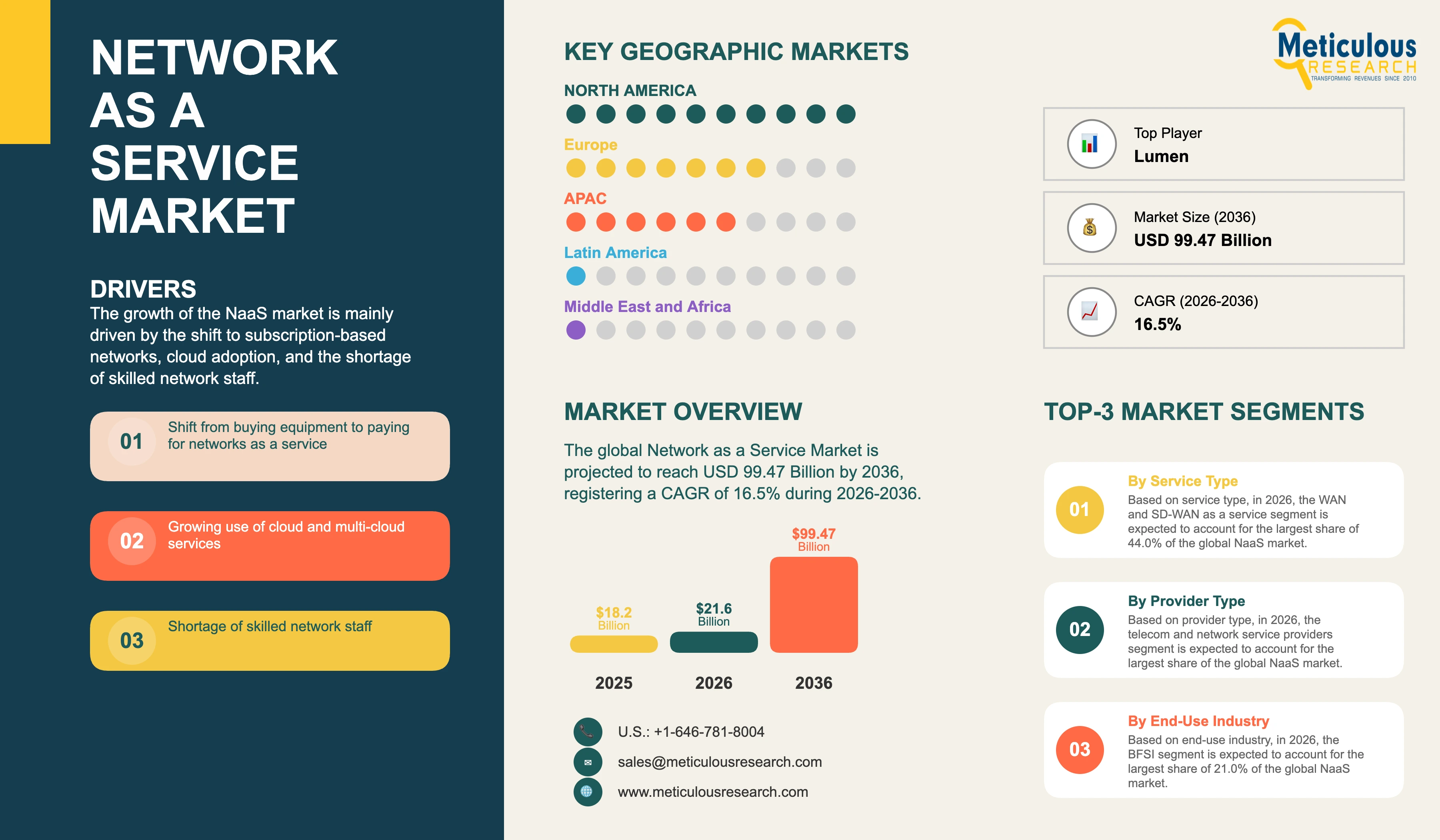
The global network as a service (NaaS) market was valued at USD 18.20 billion in 2025. This market is expected to reach USD 99.47 billion by 2036 from an estimated USD 21.60 billion in 2026, registering a CAGR of 16.5% during the forecast period (2026-2036).
- Published
- Nov 2026
- Pages
- 235
- Format
- PDF + Excel
- Report ID
- MRICT - 1042609
- Base year
- 2025
- 2025 · BASELINE
- $18.20B
- 2036
- $99.47B
- CAGR 2026–2036
- 16.5%
2025 baseline · 2026–2036 forecast at 16.5% CAGR · hover a bar for the value
Key highlights
Lumen Technologies reported more than 3, 000 NaaS customers in the second quarter of 2026, with new customer adoption up 22%, active ports up 34%, and active services up 29% from the previous quarter, according to Lumen. The company had doubled its NaaS customer base to more than 2,000 businesses between the third quarter of 2025 and February 2026, and it closed its acquisition of cloud networking company Alkira in 2026.
A survey conducted in April 2026, covering mainly large enterprises in the Americas and Europe, found that 60% had broadly or partially adopted NaaS and 31% were running pilots or evaluations, according to ISG's 2026 Network as a Service report. Most respondents preferred to share control of the network with their NaaS provider rather than hand it over completely.
GTT reported in 2026 that 78% of enterprises it surveyed already use a combination of NaaS and managed network services, and that 37% of respondents named talent shortages as the biggest external factor shaping their next network upgrade, according to GTT and Channel Insider.
Hewlett Packard Enterprise completed its USD 14 billion acquisition of Juniper Networks in July 2025, doubling the size of its networking business, and plans to deliver the combined portfolio through its GreenLake platform, according to HPE and Converge Digest.
Gartner published its Market Guide for CSP Network-as-a-Service Providers in January 2026, and Mplify (formerly MEF), which publishes the NaaS Industry Blueprint and Lifecycle Service Orchestration APIs used by more than 155 service providers, added support for the Model Context Protocol to its LSO APIs in March 2026, according to Lumen, Telecom Drive, and Converge Digest.
Nile, a campus NaaS provider founded by former Cisco executives, has raised more than USD 300 million, including a USD 175 million Series C round, to offer wired and wireless campus networks as a subscription with performance guarantees, according to SecurityWeek and Nile. These figures show that NaaS is becoming a regular part of enterprise network planning.
By service type, WAN and SD-WAN as a service accounts for the largest share of 44.0% in 2026, while LAN and wi-fi as a service registers the highest CAGR.
By provider type, telecom and network service providers account for the largest share in 2026, while specialist NaaS providers register the highest CAGR.
By organization size, large enterprises account for the larger share in 2026, while small and medium-sized enterprises register the higher CAGR.
By end-use industry, BFSI accounts for the largest share of 21.0% in 2026, while education registers the highest CAGR.
By geography, North America accounts for the largest share of 41.0% in 2026, while Asia-Pacific registers the highest CAGR of 19.8%.
Report summary
| Particulars | Details |
|---|---|
| Base Year | 2025 |
| Estimated Year | 2026 |
| Forecast Period | 2026-2036 |
| Market Size in 2025 | USD 18.20 billion |
| Market Size in 2026 | USD 21.60 billion |
| Market Size by 2036 | USD 99.47 billion |
| CAGR (2026-2036) | 16.5% |
| Format | PDF, Excel & Cloud Portal · 235 pages |
| Largest Segment by Service Type (2026) | WAN and SD-WAN as a Service (44.0%) |
| Largest Segment by End-Use Industry (2026) | BFSI (21.0%) |
| Largest Region (2026) | North America (41.0%) |
| Fastest-Growing Region | Asia-Pacific (CAGR 19.8%) |
| Companies Profiled | 16 companies and other companies |
| Segments Covered | Service Type, Provider Type, Organization Size, End-Use Industry, Geography |
| Countries Covered | U.S., Canada, Germany, U.K., France, Italy, Spain, Netherlands, Switzerland, Belgium, Sweden, Denmark, Norway, Finland, Austria, Poland, Ireland, Rest of Europe, Japan, China, India, Australia, South Korea, Singapore, Indonesia, Thailand, Malaysia, Vietnam, Philippines, Taiwan, New Zealand, Rest of Asia-Pacific, Brazil, Mexico, Argentina, Colombia, Chile, Peru, Rest of Latin America, Saudi Arabia, U.A.E., Israel, South Africa, Turkey, Egypt, Rest of Middle East & Africa |
Report overview
Segments covered: service type, provider type, organization size, end-use industry.
The growth of this market is mainly driven by the shift of enterprises from buying network equipment to paying for networks through subscriptions, the growing use of cloud services and multi-cloud setups that need flexible connections, the shortage of skilled network staff in many companies, the rising traffic from AI applications and video, and the need to add sites, users, and bandwidth quickly. In addition, the rollout of digital ordering portals and standard APIs by telecom operators and the launch of campus NaaS offers by equipment vendors and specialist providers are making NaaS easier to buy. However, concerns about long-term costs, loss of control over the network, difficult migration from existing networks, and limited visibility into provider-managed networks are expected to restrain the growth of this market to some extent.
Network as a service (NaaS) is a way of buying and running a company network in which the customer pays a regular fee for network services instead of buying and managing its own equipment. The NaaS provider supplies the hardware, software, monitoring, security, and support, and often guarantees performance levels in a service agreement. Customers can usually add or remove sites, users, ports, and bandwidth through an online portal or APIs, and they pay based on what they use or on a fixed subscription. NaaS can cover wide area networks connecting branch offices, campus and branch local area networks and Wi-Fi, on-demand connections to data centers and cloud providers, and network security services.
This report covers the global NaaS market, including WAN and SD-WAN as a service, LAN and Wi-Fi as a service, on-demand connectivity and cloud interconnect, and network security as a service, delivered by telecom and network service providers, networking equipment vendors, cloud and hyperscale providers, and specialist NaaS providers. The market is analyzed by service type, provider type, organization size, end-use industry, and geography. Market size is measured on a revenue basis and includes subscription and usage-based fees paid by enterprises and public sector organizations for networks delivered as a service. Traditional one-time sales of network equipment and fixed-term circuit contracts without on-demand features are not included.
NaaS adoption is moving from early trials into regular use at many large companies. ISG's 2026 survey found that 60% of large enterprises in the Americas and Europe had broadly or partially adopted NaaS, while only a small share still ran fully traditional networks. Futurum Research reported in 2026 that 62% of enterprises had moved NaaS into production or evaluation. Companies cite simpler network management, lower upfront spending, faster setup of new sites, and access to skills they do not have in-house as the main reasons for adopting NaaS.
Telecom operators are building NaaS offers on top of their fiber and IP networks. Lumen Technologies has made NaaS a central part of its business, offering on-demand connectivity that customers can order and change through its Lumen Connect portal. Lumen reported more than 3,000 NaaS customers in mid-2026, with more than 20% of new adopters being entirely new to the company. AT&T, Verizon, Orange Business, NTT DATA, BT, and other operators also offer on-demand and subscription-based network services, often combined with SD-WAN, security, and managed services.
Equipment vendors and new specialist providers are focusing on campus and branch networks. HPE offers networking as a service through GreenLake and has strengthened its portfolio with the acquisition of Juniper Networks, while Cisco and Extreme Networks offer subscription-based networking. Specialist providers, such as Nile and Meter, deliver complete wired and wireless campus networks as a service, including equipment, installation, monitoring, and performance guarantees, and they target schools, universities, mid-sized companies, and offices with small IT teams.
Industry groups are working to make NaaS easier to buy across providers. Mplify, formerly MEF, publishes a NaaS Industry Blueprint and a set of Lifecycle Service Orchestration APIs that allow service providers to automate ordering, quoting, and service management with each other, and it has aligned its APIs with those of TM Forum. More than 155 service providers are at various stages of adopting these APIs. Common standards are important because many enterprise networks span several countries and several providers.
In 2026, WAN and SD-WAN as a service accounts for the largest share of the market by service type, while LAN and Wi-Fi as a service is the fastest-growing service type. Telecom and network service providers are the largest provider type, while specialist NaaS providers grow fastest. Large enterprises account for most of the market, while small and medium-sized enterprises grow faster. BFSI is the largest end-use industry, while education is the fastest-growing end-use industry. North America accounts for the largest share of the market, while Asia-Pacific is the fastest-growing region.
Over the forecast period, the NaaS market is expected to grow rapidly as more companies replace aging networks with subscription-based services, as AI and cloud applications increase network demands, and as telecom operators and vendors make NaaS easier to order and manage. The pace of growth will depend on how quickly providers can address customer concerns about cost, control, visibility, and migration.
BFSI is expected to account for the largest share of 21.0% of the market in 2026, while education is projected to register the highest CAGR, driven by campus network replacement and limited IT staff.
North America is expected to account for the largest share of 41.0% of the market in 2026, mainly due to early adoption of as-a-service models, leading NaaS providers, and a large number of multi-site enterprises.
Asia-Pacific is projected to register the highest CAGR of 19.8% during the forecast period, driven by rapid cloud and data center growth, regional operator investments, and growing adoption by smaller companies.
The report profiles 16 companies, including AT&T, Verizon, Lumen, Orange Business, NTT DATA, BT, Tata Communications, Telstra, Cisco, HPE, Extreme Networks, Nile, Meter, Equinix, Megaport, and Aryaka.
Managed network services usually involve a provider running a network that the customer owns or leases under a fixed contract. NaaS delivers the network as a subscription that includes equipment and support and can be changed on demand. GTT found that 78% of enterprises use a combination of both.
Schools and universities often have aging campus networks, limited budgets for large equipment purchases, and small IT teams. Campus NaaS delivers complete wired and wireless networks for a regular fee with installation, monitoring, and performance guarantees included.
In 2026, the large enterprises segment is expected to account for the larger share of the NaaS market, while the small and medium-sized enterprises segment is projected to register the higher CAGR during the forecast period.
Report infographic
Market dynamics
18 factors across 5 forcesShift from buying equipment to paying for networks as a service
Many companies want to move network spending from large upfront purchases to regular operating costs that match their use. Traditional enterprise networks require companies to buy switches, routers, access points, and security equipment every few years, and to employ staff to design, install, and run them. NaaS replaces this model with a subscription that includes equipment, software, support, and upgrades. This approach frees up capital, makes costs more predictable, and ensures that equipment is replaced on time rather than kept in service after it becomes outdated or unsupported.
The shift is part of a broader move to as-a-service models in IT, following the earlier adoption of cloud computing and software as a service. Equipment vendors are supporting this shift with subscription offers, and specialist NaaS providers are building their entire business around it. ISG's 2026 survey found that most enterprises see NaaS as a fundamental change in how networks will be built and run.
Growing use of cloud and multi-cloud services
Enterprises are running more applications in public clouds and using several cloud providers at the same time. This creates a need for flexible, high-performance connections between offices, data centers, and cloud platforms that can be set up and changed quickly. Traditional circuits can take weeks or months to install and are often fixed in capacity, which does not fit the way companies use cloud services.
NaaS providers offer on-demand connections to major cloud providers that can be ordered and resized through a portal or API, often within minutes. Lumen's Multi-Cloud Gateway, for example, adds a self-service routing layer on top of its fiber network to move data between clouds and business locations. The growth of multi-cloud setups is a key reason why on-demand connectivity and cloud interconnect is an important part of the NaaS market.
Shortage of skilled network staff
Many companies find it hard to hire and keep skilled network engineers, especially as networks become more complex with cloud connections, security requirements, and remote work. GTT found that 37% of enterprises it surveyed named talent shortages as the biggest external factor shaping their next network upgrade. Smaller companies and public sector organizations, such as schools and local governments, are particularly affected.
NaaS reduces the need for in-house network skills because the provider handles design, installation, monitoring, and troubleshooting. Specialist providers, such as Nile, target organizations with lean IT teams, and telecom operators combine NaaS with managed services. The shortage of skilled staff is expected to remain a strong driver of NaaS adoption throughout the forecast period, as networks become more complex and security threats increase.
Rising network traffic from AI applications and video
Enterprise network traffic is growing quickly, driven by video calls, cloud applications, data backups, and, more recently, AI applications that move large amounts of data between sites, data centers, and cloud platforms. Lumen has said that enterprises are rebuilding their networks to support AI and multi-cloud workloads, which require more flexibility and scale. Many existing networks were not designed for these traffic patterns, and upgrading them through traditional purchasing takes time and capital.
NaaS allows companies to increase bandwidth when they need it and reduce it when they do not, without buying new equipment or signing long contracts. This flexibility is especially useful for traffic that varies by time or season. The Seattle Sounders FC, for example, adopted Lumen NaaS to scale its network for game days without paying for peak capacity all year.
Need to add sites, users, and bandwidth quickly
Companies need networks that can keep up with business changes, such as opening new stores, offices, or warehouses, integrating acquired companies, and supporting temporary sites. With traditional networks, adding a site can take months because of equipment purchasing, circuit installation, and configuration. NaaS providers can often bring new sites online much faster using standard designs, pre-configured equipment, and digital ordering. A large logistics firm, for example, is deploying Lumen NaaS at 300 sites to speed up the activation of acquired service centers, according to Lumen. This ability to scale quickly is a key benefit for retailers, logistics companies, healthcare providers, and other businesses with many locations. It also helps companies close sites or reduce capacity without being tied to equipment they no longer need.
Table of contents
12 chapters · 181 sections · 235 pages · click to expandSegmental analysis
| Segment | Largest share (2026) | Fastest growth (2026–2036) |
|---|---|---|
| By Service Type | WAN and SD-WAN as a service | LAN and Wi-Fi as a service |
| By Provider Type | Telecom and network service providers | Specialist NaaS providers |
| By Organization Size | — | Rapid growth of this |
| By End-Use Industry | BFSI | Education |
| Other segments | Telecom and network service providers | Specialist NaaS providers |
By Service Type
- The WAN and SD-WAN as a service segment is expected to account for the largest share of 44.0% of the global NaaS market.
- The large share of this segment is mainly due to the large number of enterprises with branch offices, stores, and remote sites that need secure connections to headquarters, data centers, and cloud platforms, the replacement of older MPLS networks with SD-WAN, the long experience of telecom operators in selling managed WAN services, and the strong demand for flexible bandwidth to support cloud applications.
- Telecom operators, such as AT&T, Verizon, Lumen, Orange Business, NTT DATA, and BT, are major providers of WAN and SD-WAN as a service.
- However, the LAN and Wi-Fi as a service segment is projected to register the highest CAGR during the forecast period.
- The rapid growth of this segment is driven by the aging of campus networks in schools, universities, hospitals, and offices, the need to support Wi-Fi 7, more devices, and stronger security, the shortage of IT staff to run campus networks, and the growth of specialist providers, such as Nile and Meter, and vendor subscription offers from HPE, Cisco, and Extreme Networks.
- The on-demand connectivity and cloud interconnect segment includes connections between sites, data centers, and cloud providers that can be ordered and resized on demand, while the network security as a service segment includes firewall, secure access, and attack protection services delivered with NaaS.
- Each service type in the NaaS market serves a different part of the enterprise network and a different buyer.
- WAN services connect sites to each other and to the internet, LAN and Wi-Fi services connect users and devices inside buildings, cloud interconnect services connect sites and data centers to cloud platforms, and security services protect all of these connections.
- Many customers start with one service type and add others over time, which allows providers to grow revenue from existing customers.
By Provider Type
- The telecom and network service providers segment is expected to account for the largest share of the global NaaS market.
- The large share of this segment is mainly due to the large fiber and IP networks owned by operators, their long relationships with enterprise customers, the large WAN and connectivity component of NaaS spending, and the investments made by operators, such as Lumen, AT&T, Verizon, Orange Business, and NTT DATA, in digital ordering portals and on-demand services.
- Lumen's growth to more than 3, 000 NaaS customers by mid-2026 shows the strength of operator-led NaaS.
- However, the specialist NaaS providers segment is projected to register the highest CAGR during the forecast period.
- The rapid growth of this segment is driven by the growing demand for complete campus networks delivered as a service, the focus of providers such as Nile and Meter on organizations with small IT teams, strong venture funding, and the performance guarantees offered by these providers.
- The networking equipment vendors segment includes companies such as HPE, Cisco, and Extreme Networks that offer subscription-based networking, while the cloud and hyperscale providers segment includes cloud companies and interconnection providers, such as Equinix and Megaport, that offer on-demand network connections between data centers and clouds.
- Each provider type in the NaaS market has different strengths that shape the services it can offer.
- Telecom operators own the networks that connect sites, equipment vendors control the hardware and software inside buildings, cloud and interconnection providers operate the data centers where many applications run, and specialist providers focus on simple, complete services for customers with limited IT staff.
By Organization Size
- The large enterprises segment is expected to account for the larger share of the global NaaS market.
- The large share of this segment is mainly due to the size and complexity of large enterprise networks, their many sites in several countries, their heavy use of cloud and multi-cloud services, their larger network budgets, and the early adoption of NaaS by large enterprises, as shown by ISG's survey of mainly large companies.
- Large enterprises also account for most spending on WAN, SD-WAN, and cloud interconnect services.
- However, the small and medium-sized enterprises segment is projected to register the higher CAGR during the forecast period.
- The rapid growth of this segment is driven by the lack of dedicated network staff in smaller companies, their limited budgets for upfront equipment purchases, the availability of simpler, standard NaaS offers that can be ordered online, and the growing role of managed service providers and channel partners in selling NaaS to smaller customers.
- Simpler online ordering and standard bundles are expected to make NaaS easier for smaller firms to buy.
- Large enterprises are also expected to expand NaaS from selected sites to their wider networks as contracts with existing suppliers come up for renewal, which will support steady growth in this segment throughout the forecast period.
By End-Use Industry
- The BFSI segment is expected to account for the largest share of 21.0% of the global NaaS market.
- The large share of this segment is mainly due to the large networks of banks, insurers, and financial services firms, which connect branches, offices, data centers, and trading platforms, their high requirements for reliability, security, and performance, their heavy use of cloud services, and their large IT budgets.
- Lumen reported winning a major NaaS deal with a financial services firm in 2026.
- However, the education segment is projected to register the highest CAGR during the forecast period.
- The rapid growth of this segment is driven by the aging campus networks of schools and universities, the growing number of devices used by students and staff, limited budgets and IT staff, and the strong focus of campus NaaS providers, such as Nile, on education customers.
- The IT and telecom segment includes technology companies and service providers, the retail and e-commerce segment includes retailers with many stores and warehouses, and the healthcare segment includes hospitals and clinics that need secure and reliable networks.
- The manufacturing segment includes factories and plants that need reliable connections for production systems, the government and public sector segment includes public agencies and local governments, and the other industries segment includes logistics, hospitality, energy, and media companies.
Other segments
- The telecom and network service providers segment is expected to account for the largest share of the NaaS market, while the specialist NaaS providers segment is projected to register the highest CAGR during the forecast period.
Geographic analysis
North America
Largest shareIn 2026, North America is expected to account for the largest share of 41.0% of the global NaaS market. The large share of this region is mainly due to the early adoption of cloud and as-a-service models by U.S. companies, the presence of leading NaaS providers, such as Lumen, AT&T, Verizon, Cisco, HPE, Extreme Networks, Nile, and Meter, the large number of enterprises with many sites, and strong venture funding for specialist NaaS providers. Lumen's growth to more than 3,000 NaaS customers in 2026 reflects strong demand in the U.S., where many large enterprises are replacing older circuits with on-demand services. The shortage of skilled network staff in the U.S. is also a strong driver of NaaS adoption. U.S. schools and universities are among the early adopters of campus NaaS, and Canadian enterprises are also adopting on-demand connectivity and SD-WAN services from regional and global providers.
Asia-Pacific
Fastest growthAsia-Pacific is projected to register the highest CAGR of 19.8% during the forecast period. The rapid growth of this region is mainly driven by the rapid growth of cloud adoption and data centers in India, Japan, Australia, Singapore, and Southeast Asia, the expansion of multinational companies across the region, the investments of regional operators, such as NTT, Telstra, Tata Communications, and Singtel, in digital network services, and the growing number of small and medium-sized enterprises adopting cloud services. Government digital programs in India and Southeast Asia are also supporting demand for flexible network services in the public sector. Japan and Australia have mature enterprise markets with strong demand for managed and cloud-based network services, while India is seeing rapid growth in new offices, data centers, and digital businesses.
Europe
Europe accounts for a significant share of the market, supported by the NaaS offers of operators such as Orange Business, BT, and Deutsche Telekom, the strong use of SD-WAN and managed network services by European companies, and the replacement of older MPLS networks. ISG's 2026 survey, which covered large companies in the Americas and Europe, showed broad interest in NaaS among European enterprises. Data protection and data residency rules in Europe also influence how NaaS services are designed and delivered. Germany, the U.K., and France are the largest markets in the region, and Nordic countries have high adoption of cloud and as-a-service models.
Latin America
Latin America and the Middle East & Africa account for smaller shares of the market but offer growth opportunities. In Latin America, Brazil and Mexico are seeing growing demand for cloud connectivity and managed network services, while in the Middle East, Saudi Arabia and the U.A.E. are investing heavily in data centers, cloud services, smart cities, and digital government, which supports demand for flexible networks. Operators in these regions, such as large incumbents in Brazil and the Gulf states, are beginning to launch digital ordering portals and on-demand services, and growth is expected to accelerate as cloud adoption increases and as more international companies expand in these regions.
Competitive landscape
The global NaaS market is moderately fragmented, with the top five players estimated to account for about 35% of the market in 2025. The market includes telecom and network service providers with large fiber networks, networking equipment vendors, cloud and interconnection providers, and specialist NaaS providers, which compete with different types of offers.
Telecom operators, such as AT&T, Verizon, Lumen, Orange Business, NTT DATA, BT, Tata Communications, and Telstra, lead the WAN, SD-WAN, and on-demand connectivity segments. Lumen has made NaaS a central part of its strategy and acquired Alkira in 2026 to add cloud networking capabilities. Among equipment vendors, Cisco, HPE, and Extreme Networks offer subscription-based networking, and HPE strengthened its position by acquiring Juniper Networks, which doubled the size of its networking business. Specialist providers, such as Nile and Meter, focus on complete campus networks with equipment, installation, and support included, while Equinix, Megaport, and Aryaka offer interconnection, cloud connectivity, and managed SD-WAN services.
Companies in this market compete on network coverage, ease of ordering and management, speed of service delivery, performance guarantees, security features, pricing, and the quality of support. Key strategies include building digital ordering portals and APIs, offering trials and simple bundles for smaller customers, adding security services to NaaS offers, offering performance-based service agreements, making acquisitions to expand capabilities, and forming partnerships with channel partners and managed service providers.
Recent competitive activity in the NaaS market has focused on acquisitions, platform launches, standards work, and customer growth. Lumen closed its acquisition of Alkira and passed 3,000 NaaS customers in 2026, HPE completed its acquisition of Juniper Networks in July 2025, and Mplify added Model Context Protocol support to its LSO APIs in March 2026.
We expect competition to increase as more telecom operators launch on-demand services and as equipment vendors and specialist providers compete for campus networks. Providers that offer simple ordering, clear pricing, strong security, and shared management tools are expected to gain share. We also expect more partnerships between telecom operators and specialist campus NaaS providers, as operators look to offer complete network services from the cloud to the office.
Some of the key players operating in the NaaS market are AT&T Inc., Verizon Communications Inc., Lumen Technologies, Inc., Orange Business, NTT DATA Group Corporation, BT Group plc, Tata Communications Limited, Telstra Group Limited, Cisco Systems, Inc., Hewlett Packard Enterprise Company, Extreme Networks, Inc., Nile Global, Inc., Meter, Inc., Equinix, Inc., Megaport Limited, and Aryaka Networks, Inc., among others.
- —
Lumen passed 3,000 NaaS customers and closed its acquisition of Alkira in 2026, ISG found that 60% of large enterprises had broadly or partially adopted NaaS, and Mplify added Model Context Protocol support to its LSO APIs in March 2026.
- AT&T
- Verizon
- Lumen
- Orange Business
- NTT DATA
- BT
- Tata Communications
- Telstra
Expert perspectives
The NaaS market is moving from early adoption to regular use, with most large enterprises in the Americas and Europe now using or evaluating NaaS for at least part of their network. Telecom operators, led by companies such as Lumen, are seeing strong growth in on-demand services, and equipment vendors and specialist providers are building complete campus networks as a service, which brings NaaS to organizations that have never used managed networks before.
Over the forecast period, the market is expected to grow at a CAGR of 16.5%, from USD 21.60 billion in 2026 to USD 99.47 billion in 2036. Growth will be driven by the replacement of aging networks in offices, schools, and hospitals with subscription-based services, the growth of cloud and AI traffic, the shortage of skilled network staff, and the growing availability of simple, digital NaaS offers for companies of all sizes.
Among the market segments, WAN and SD-WAN as a service is the largest service type, while LAN and Wi-Fi as a service grows fastest. Telecom and network service providers are the largest provider type, while specialist NaaS providers grow fastest. Large enterprises account for most of the market, while small and medium-sized enterprises grow faster, and BFSI is the largest end-use industry, while education grows fastest. North America is the largest region, and Asia-Pacific is the fastest-growing region at a CAGR of 19.8%.
In our view, the most important factor for the NaaS market over the next five years will be how well providers address customer concerns about cost, control, and visibility. Enterprises want the benefits of NaaS but are not willing to give up all control of their network. Providers that offer clear pricing, strong reporting, and shared management will win more business than those that offer only fully managed services. Phased migration plans will also be important, as most companies want to move to NaaS step by step.
We also expect campus networks to become one of the most competitive parts of the NaaS market over the forecast period. Many schools, hospitals, and offices are facing network refresh cycles, and campus NaaS offers a simpler alternative to buying new equipment. Competition between equipment vendors, specialist providers, and managed service providers in this segment is expected to be strong.
Overall, we believe the NaaS market will grow rapidly over the forecast period, with LAN and Wi-Fi as a service, specialist providers, small and medium-sized enterprises, education, and Asia-Pacific providing the fastest growth. Companies with strong networks, simple digital tools, and broad partner channels will be best positioned to capture this growth.
Customer perspectives
Chief Information Officer - Financial Services Company, U.S.
We wanted to stop buying routers every five years and get bandwidth to the cloud when we need it. Now we order new connections through a portal in minutes.
“Our campus network was old and we did not have the staff to replace it. With a network service, we pay a fee per year and the provider takes care of everything.”
“We open new stores every month. With a subscription network, each store is connected and secure from the first day without us hiring network engineers.”
Frequently asked questions
The global NaaS market was valued at USD 18.20 billion in 2025, up from USD 15.20 billion in 2024, and is estimated at USD 21.60 billion in 2026. The market includes WAN and SD-WAN, LAN and Wi-Fi, on-demand connectivity, and network security delivered as a service.
Cite this report
Meticulous Research. (2026). Network as a Service Market - Global Opportunity Analysis and Industry Forecast (2026-2036) (Report No. MRICT - 1042609). Meticulous Market Research Pvt. Ltd. https://www.meticulousresearch.com/product/network-as-a-service-market-7292