Drillships Market (2026-2036)
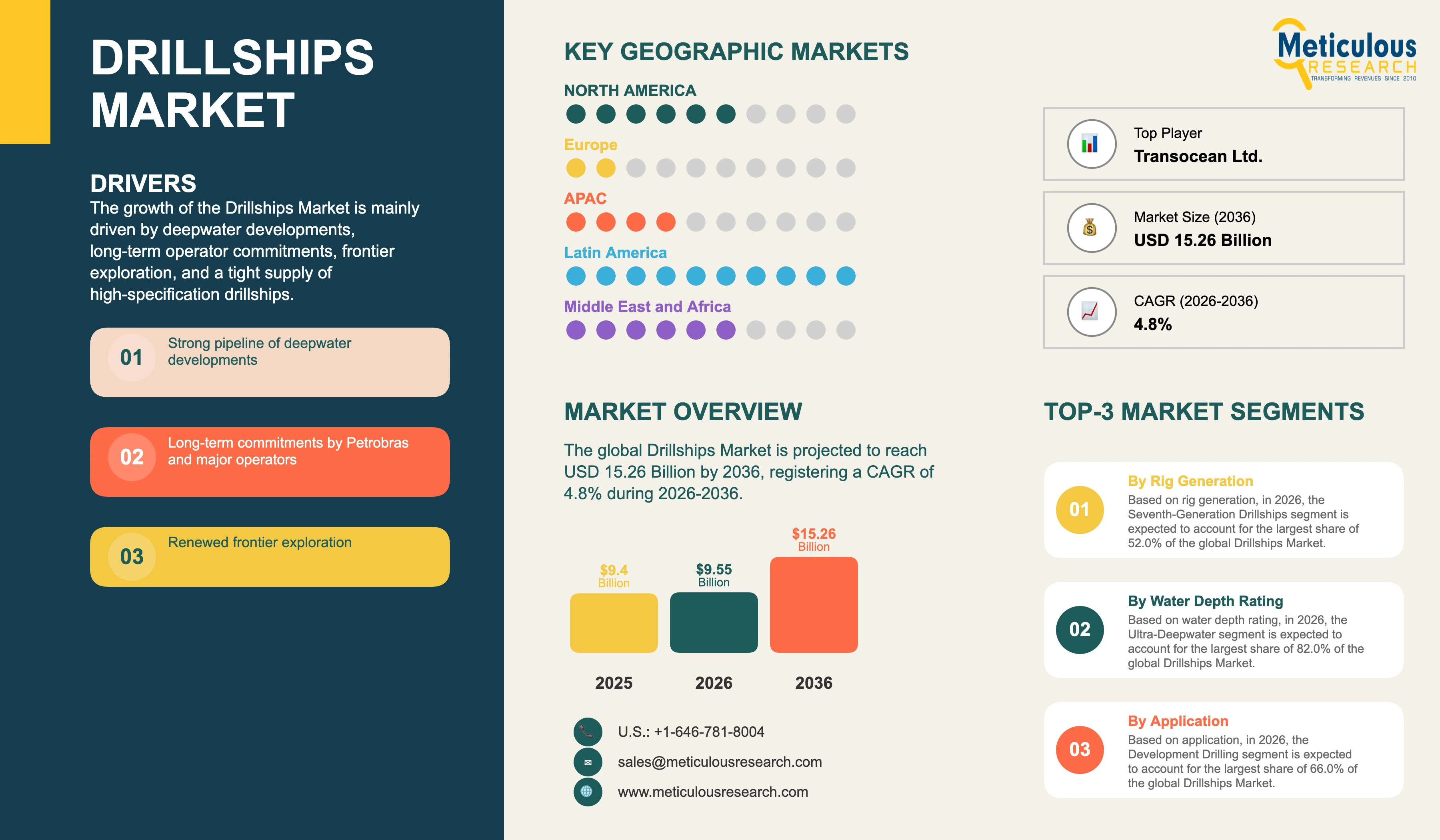
The global drillships market was valued at USD 9.40 billion in 2025. This market is expected to reach USD 15.26 billion by 2036 from an estimated USD 9.55 billion in 2026, registering a CAGR of 4.8% during the forecast period (2026-2036).
- Published
- Nov 2026
- Pages
- 248
- Format
- PDF + Excel
- Report ID
- MREP - 1042705
- Base year
- 2025
- 2024 · HISTORICAL
- $3.52B
- 2036
- $15.26B
- CAGR 2026–2036
- 4.8%
2024–2025 baseline · 2026–2036 forecast at 4.8% CAGR · hover a bar for the value
Key highlights
Transocean reported 2025 contract drilling revenue of USD 3.965 billion, up 13% from USD 3.524 billion in 2024, with revenue efficiency of 96.5%, and added USD 839 million in contract backlog at a weighted average dayrate of USD 453,000 during 2025. The company guided 2026 contract drilling revenue of USD 3.80 billion to USD 3.95 billion.
Transocean announced a definitive agreement to combine with Valaris, which would create one of the largest fleets of high-specification floating rigs in the world, and the transaction had received antitrust clearances in some jurisdictions by mid-2026.
Transocean's management said in May 2026 that it expects deepwater rig utilization to approach nearly 100% by the end of 2027, and that Petrobras had awarded about 38 rig years of work through recent blend-and-extend negotiations.
Petrobras extended Transocean's sixth-generation drillships Deepwater Orion and Deepwater Corcovado for three years each, adding about USD 845 million in backlog and committing the rigs into 2030, and extended the Deepwater Aquila for one year, adding about USD 160 million.
Petrobras awarded Valaris a 1, 064-day extension for the Valaris DS-4 drillship, adding about USD 447 million in backlog, and awarded Seadrill a 1,095-day extension for the West Polaris on the Búzios field, adding about USD 480 million, with the dayrate set at USD 409,200 from April 2026 and USD 454,700 from April 2027.
Noble Corporation reported a contract backlog of USD 7.5 billion in early 2026 and guided 2026 total revenue of USD 2.80 billion to USD 3.00 billion, while Transocean secured contracts worth about USD 550 million for two ultra-deepwater drillships in the U.S. Gulf covering a combined 15 wells.
Transocean estimates that reactivating a cold-stacked floating rig would cost USD 100 million to USD 150 million and take 12 to 15 months, and it has said that reactivations will be considered only with full cost recovery and acceptable contract terms and dayrates.
By rig generation, seventh-generation drillships account for the largest share of 52.0% in 2026 and also register the highest CAGR.
By water depth rating, ultra-deepwater accounts for the larger share in 2026 and also registers the higher CAGR.
By application, development drilling accounts for the larger share of 66.0% in 2026, while exploration and appraisal drilling registers the higher CAGR.
By geography, Latin America accounts for the largest share of 34.0% in 2026, while Middle East & Africa registers the highest CAGR of 6.3%.
Report summary
| Particulars | Details |
|---|---|
| Base Year | 2025 |
| Estimated Year | 2026 |
| Forecast Period | 2026-2036 |
| Market Size in 2025 | USD 9.40 billion |
| Market Size in 2026 | USD 9.55 billion |
| Market Size by 2036 | USD 15.26 billion |
| CAGR (2026-2036) | 4.8% |
| Format | PDF, Excel & Cloud Portal · 248 pages |
| Largest Segment by Rig Generation (2026) | Seventh-Generation Drillships (52.0%) |
| Largest Segment by Application (2026) | Development Drilling (66.0%) |
| Largest Region (2026) | Latin America (34.0%) |
| Fastest-Growing Region | Middle East & Africa (CAGR 6.3%) |
| Companies Profiled | 12 companies and other companies |
| Segments Covered | Rig Generation, Water Depth Rating, Application, Geography |
| Countries Covered | Brazil, Guyana, Suriname, Mexico, Rest of Latin America, U.S., Canada, Nigeria, Angola, Namibia, Mozambique, Egypt, Côte d'Ivoire, Rest of Middle East & Africa, India, Malaysia, Indonesia, Australia, Rest of Asia-Pacific, Norway, Cyprus, Romania, Rest of Europe |
Report overview
Segments covered: rig generation, water depth rating, application.
The growth of this market is mainly driven by a strong pipeline of deepwater and ultra-deepwater developments in Brazil, Guyana, Suriname, the U.S. Gulf of Mexico, and West Africa, long-term drilling commitments by Petrobras and other major operators, renewed deepwater exploration in frontier regions such as Namibia and the Orange Basin, the attractive breakeven costs of large deepwater reservoirs, and a tightening supply of high-specification drillships after years of fleet attrition and almost no new orders. However, factors such as the high cost of deepwater wells, the sensitivity of exploration budgets to oil price volatility, gaps in contract schedules known as white space, the high cost and long lead time of reactivating cold-stacked rigs, and contractor balance sheet constraints are expected to restrain the growth of this market to some extent.
A drillship is a ship-shaped mobile offshore drilling unit equipped with a drilling derrick, a moon pool through which drilling operations are carried out, and a dynamic positioning system that keeps the vessel on location without anchors. Drillships are self-propelled, which allows them to move quickly between regions, and they have large deck space and variable deck load capacity, which allows them to carry the equipment and consumables needed for long and complex deepwater wells. Modern drillships can operate in water depths of up to 12,000 feet and drill wells to total depths of 40,000 feet or more.
This report covers global revenue from drillship contract drilling services, measured mainly as dayrate revenue earned by drilling contractors, together with mobilization fees, reimbursable revenue, and associated services provided with the rig. It covers seventh-generation, sixth-generation, and fifth-generation and older drillships in ultra-deepwater and deepwater operations, for development drilling and exploration and appraisal drilling. The construction and sale of new drillships, semi-submersible rigs, jack-up rigs, and third-party oilfield services such as cementing, logging, completions, and directional drilling provided separately by service companies are excluded from the scope of this report.
Drillships are the preferred rig type for ultra-deepwater drilling in benign and moderate environments, such as Brazil, the U.S. Gulf of Mexico, Guyana, West Africa, and parts of Asia. Seventh-generation drillships, which were mostly delivered between 2013 and 2020, typically feature dual-activity derricks, dual blowout preventers or high-pressure blowout preventers, managed pressure drilling capability, and greater hook load and storage capacity. These features allow operators to drill wells faster and more safely, which makes seventh-generation units the most sought-after rigs in the market.
Drillships compete directly with semi-submersible rigs for many deepwater and ultra-deepwater drilling contracts. Semi-submersibles are more stable in harsh environments and are often preferred in the North Sea, offshore Norway, and other regions with severe weather, while drillships are preferred in benign environments because of their mobility, larger storage capacity, and ability to carry out long and complex well programs without frequent resupply. In Brazil, the U.S. Gulf, West Africa, and Guyana, drillships account for the majority of contracted floating rigs, and drillship utilization has generally been higher than semi-submersible utilization in recent years.
The drillship market went through a deep downturn between 2015 and 2021, when oil prices fell and operators cut deepwater spending. During this period, many older drillships were scrapped and several contractors went through financial restructuring, while newbuild drillships were delivered without contracts or remained at shipyards. The market recovered from 2022 as deepwater activity increased, and dayrates for high-specification drillships rose above USD 400,000 per day. Transocean added contract backlog at a weighted average dayrate of USD 453,000 in 2025, and Seadrill's West Polaris extension with Petrobras includes a dayrate of USD 454,700 from April 2027.
The market softened temporarily in 2025 as several operators deferred programs and some rigs faced white space between contracts. However, contracting activity picked up strongly in 2026, led by Petrobras' blend-and-extend negotiations, which secured about 38 rig years of work, and by awards in the U.S. Gulf, Nigeria, and other regions. Transocean's management expects deepwater utilization to approach nearly 100% by the end of 2027.
The market is concentrated among a small number of international drilling contractors, including Transocean, Noble, Valaris, and Seadrill, together with Saipem, Stena Drilling, Constellation Oil Services, Vantage Drilling, Ventura Offshore, and Sonadrill, a joint venture between Seadrill and Sonangol. Consolidation is reshaping the industry, as shown by Noble's acquisition of Diamond Offshore in 2024 and Transocean's agreement to combine with Valaris. Very few drillships have been ordered in the past decade, and the remaining stranded newbuilds at Asian shipyards have mostly been sold or contracted.
Over the forecast period, the market is expected to grow steadily, supported by deepwater developments, frontier exploration, and a tight supply of high-specification rigs. Seventh-generation drillships are expected to remain the largest and fastest-growing generation, ultra-deepwater the largest water depth rating, and exploration and appraisal drilling the fastest-growing application. Latin America is expected to remain the largest region, while the Middle East & Africa is expected to grow fastest.
We batch-drill our tieback wells with one drillship to reduce mobilization costs and improve efficiency.
This comment shows how operators are reducing well costs.
Across all customer groups, safety performance and drilling efficiency are critical selection criteria, as non-productive time on a deepwater well can cost hundreds of thousands of dollars per day. Operators increasingly evaluate contractors on their uptime, well delivery performance, and emissions, and they prefer contractors that can provide consistent crews and equipment over long programs. Many operators are also willing to commit to longer contracts to secure the best rigs in a tightening market. They also value contractors with local experience. Local content requirements in Brazil, Nigeria, Angola, and other countries also influence contractor selection, as operators must meet targets for local employment and services. Contractors with established local operations therefore have an advantage.
Report infographic
Market dynamics
16 factors across 5 forcesStrong pipeline of deepwater and ultra-deepwater developments
The offshore industry has a strong pipeline of deepwater and ultra-deepwater developments in Brazil, Guyana, Suriname, the U.S. Gulf of Mexico, West Africa, and other regions. These developments require large numbers of development wells, many of which are drilled with drillships. Petrobras plans to start up eight new production systems by 2030, ExxonMobil continues to sanction new developments in Guyana's Stabroek block, and operators in the U.S. Gulf are drilling new subsea tiebacks and development wells, as shown by Transocean's contracts for two drillships covering 15 wells.
Deepwater projects have become more competitive in recent years as operators have reduced costs, standardized designs, and focused on large, high-quality reservoirs. Many deepwater developments now have breakeven prices comparable to or lower than onshore shale, which supports sustained investment even when oil prices are moderate. This is expected to support stable demand for drillships over the forecast period. Large deepwater developments typically involve multi-year drilling campaigns of 10 to 30 wells or more, which provide long-term contracts and high utilization for drillships. This visibility allows contractors to plan their fleets and supports dayrates.
Guyana illustrates the scale of this demand more clearly than any other market. Each new floating production unit in the Stabroek block requires dozens of development wells, and the steady sequence of project sanctions has kept several drillships working continuously in the country. Similar sequential development programs are under way or planned in Brazil, Suriname, Nigeria, and Angola, which together provide a solid base of long-term demand for drillships throughout the forecast period.
Long-term commitments by petrobras and major operators
Petrobras is the largest single user of drillships in the world, and its long-term drilling commitments have a strong influence on the global market. In 2026, Petrobras extended contracts for several drillships through blend-and-extend agreements, including Transocean's Deepwater Orion, Deepwater Corcovado, and Deepwater Aquila, Valaris' DS-4, and Seadrill's West Polaris, securing about 38 rig years of work. These extensions keep a large number of drillships committed in Brazil into 2029 and 2030.
Other major operators, including ExxonMobil, Shell, Chevron, BP, TotalEnergies, and Equinor, also contract drillships on multi-year terms for development programs. In Nigeria, Shell, Chevron, and ExxonMobil have awarded new development programs, and TotalEnergies has issued a tender for a multi-well program. These long-term commitments improve market visibility and reduce the risk of white space for contractors.
In the U.S. Gulf of Mexico, operators such as Shell, BP, Chevron, Occidental, and Talos continue to drill development wells and subsea tiebacks, and Transocean's contracts for two drillships covering 15 wells show the scale of these programs. Long-term commitments by major operators are expected to keep a large share of the global drillship fleet contracted through the end of the decade.
Renewed deepwater exploration in frontier regions
Deepwater exploration is increasing in frontier regions such as Namibia's Orange Basin, Suriname, the Eastern Mediterranean, offshore Mozambique, and parts of Asia. Major discoveries in Namibia by Shell, TotalEnergies, and Galp, and in Suriname by TotalEnergies and APA, have attracted more exploration and appraisal drilling. Exploration wells in frontier regions are often deep and technically challenging, which requires high-specification drillships. Successful exploration leads to appraisal drilling and eventually to development programs, which create long-term demand for drillships. Transocean's management expects more activity in Namibia, and several operators are planning multi-well exploration and appraisal campaigns in frontier regions over the next few years.
Exploration success rates in deepwater frontier basins have been high in recent years, which encourages operators to increase exploration budgets. Several operators are also returning to deepwater exploration after years of focusing on shale and short-cycle projects, as they seek to replenish reserves and secure long-term production.
Tightening supply of high-specification drillships
The supply of drillships has fallen significantly since 2015 as contractors scrapped older units, and very few new drillships have been ordered over the past decade. The remaining stranded newbuilds have mostly been absorbed, and reactivating cold-stacked rigs requires large investments and long lead times. Transocean estimates that reactivating a cold-stacked floating rig would cost USD 100 million to USD 150 million and take 12 to 15 months.
As demand increases, the limited supply of high-specification drillships is expected to push utilization close to full capacity and support higher dayrates. Contractors have said that they will reactivate rigs only when contracts provide full cost recovery and acceptable dayrates, which further supports pricing discipline.
Shipyards in South Korea, such as Samsung Heavy Industries and Hanwha Ocean, have built most of the world's drillships, but they are now focused on LNG carriers and other vessels, and new drillship orders would take several years to deliver. As a result, supply growth over the forecast period is expected to come mainly from reactivations rather than newbuilds.
Table of contents
11 chapters · 121 sections · 248 pages · click to expandSegmental analysis
| Segment | Largest share (2026) | Fastest growth (2026–2036) |
|---|---|---|
| By Rig Generation | Seventh-generation drillships | Seventh-generation drillships |
| By Water Depth Rating | Ultra-deepwater | Ultra-deepwater |
| By Application | Development drilling | Exploration and appraisal drilling |
By Rig Generation
- Drillships Market Analysis by Rig Generation
- The seventh-generation drillships segment is expected to account for the largest share of 52.0% of the global drillships market.
- The large share of this segment is mainly attributed to the strong preference of operators for the most capable drillships for complex ultra-deepwater development and exploration wells, the higher dayrates that these rigs command, and their high utilization.
- Seventh-generation drillships feature dual-activity derricks, high hook loads, large storage capacity, advanced blowout preventers, and managed pressure drilling capability, which allow faster and safer drilling.
- Seventh-generation drillships are owned mainly by the largest contractors, including Transocean, Noble, Valaris, and Seadrill, and most of them were delivered between 2013 and 2020 from shipyards in South Korea.
- The seventh-generation drillships segment is also projected to register the highest CAGR during the forecast period.
- The rapid growth of this segment is primarily driven by the growing complexity of deepwater wells, the preference of major operators for high-specification rigs, the retirement of older units, and the expected increase in dayrates as utilization approaches full capacity.
- Operators drilling high-pressure wells in the U.S. Gulf of Mexico, such as wells requiring 20,000 psi blowout preventers, rely almost exclusively on seventh-generation drillships, and frontier exploration in Namibia and other regions also favors these units.
- As the most capable rigs become fully utilized, contractors are expected to be able to negotiate higher dayrates and longer contracts for seventh-generation units than for older rigs.
- Meanwhile, the sixth-generation and fifth-generation and older drillships segments are expected to witness steady growth, supported by development drilling in Brazil, West Africa, and other regions, as shown by Petrobras' extensions for sixth-generation units, although some older units are expected to require major upgrades or be retired.
By Water Depth Rating
- Drillships Market Analysis by Water Depth Rating
- The ultra-deepwater segment is expected to account for the largest share of 82.0% of the global drillships market.
- The large share of this segment is mainly attributed to the large number of ultra-deepwater developments and exploration programs in Brazil's pre-salt, Guyana, Suriname, the U.S. Gulf of Mexico, and West Africa, which require drillships rated for water depths of 7,500 feet or more.
- Brazil's pre-salt fields lie in water depths of about 2, 000 meters, or about 6,500 feet, and beyond, and many Guyana and U.S. Gulf developments lie in similar or greater water depths.
- Ultra-deepwater operations require larger blowout preventers, longer riser strings, and greater variable deck load, which favors the largest and most modern drillships.
- Operators also use ultra-deepwater rated drillships in shallower deepwater locations because these rigs offer greater capability and flexibility.
- The ultra-deepwater segment is also projected to register the highest CAGR during the forecast period.
- The rapid growth of this segment is primarily driven by new ultra-deepwater developments and frontier exploration in Namibia, Suriname, and other regions, as well as the continued expansion of Brazil's pre-salt developments.
- Frontier wells in Namibia's Orange Basin and Suriname are drilled in water depths that require the most capable ultra-deepwater units.
- Meanwhile, the deepwater segment is expected to witness steady growth, supported by developments in Southeast Asia, India, and parts of West Africa, where water depths are generally less than 7,500 feet.
- The ultra-deepwater segment is expected to account for the larger share of the drillships market, and it is also projected to register the higher CAGR during the forecast period.
By Application
- Drillships Market Analysis by Application
- The development drilling segment is expected to account for the largest share of 66.0% of the global drillships market.
- The large share of this segment is mainly attributed to multi-year development drilling programs in Brazil, Guyana, the U.S. Gulf of Mexico, and West Africa, where operators drill large numbers of production and injection wells for new floating production units and subsea tiebacks.
- Development programs typically involve long-term contracts and high utilization.
- Development drilling also includes completion and workover operations, which are often carried out by the same drillship after the wells are drilled.
- Petrobras' development programs in the Santos Basin, ExxonMobil's programs in Guyana, and development programs by Shell, Chevron, and ExxonMobil in Nigeria are among the largest sources of development drilling demand.
- However, the exploration and appraisal drilling segment is projected to register the highest CAGR during the forecast period.
- The rapid growth of this segment is primarily driven by renewed frontier exploration in Namibia, Suriname, the Eastern Mediterranean, and offshore Mozambique, appraisal of recent discoveries, and the need for operators to replenish reserves after years of low exploration spending.
- Exploration and appraisal drilling typically involves shorter contracts than development drilling, but it often requires the most capable rigs because frontier wells can be deep, high-pressure, and in remote locations.
- Major discoveries in Namibia and Suriname have led to appraisal programs, and several operators are planning new exploration campaigns in West Africa, the Eastern Mediterranean, and Asia.
Geographic analysis
Latin America
Largest shareIn 2026, Latin America is expected to account for the largest share of 34.0% of the global drillships market. The large share of this region is mainly due to Brazil, where Petrobras is the largest user of drillships in the world and has secured about 38 rig years of work through recent extensions, as well as Guyana, where ExxonMobil continues to drill development wells for new floating production units, and Suriname and Mexico. Within Latin America, Brazil is the largest country market, with Petrobras contracting a large share of the world's drillship fleet for its pre-salt development and exploration programs, as well as other operators such as Shell, Equinor, and TotalEnergies. Guyana is the second-largest market in the region, followed by Suriname, where the GranMorgu development is expected to create demand, and Mexico, where deepwater activity is expected to recover gradually.
North America
North America, mainly the U.S. Gulf of Mexico, and the Middle East & Africa are the next-largest regions. In North America, the U.S. Gulf of Mexico remains a stable market, supported by subsea tiebacks, high-pressure developments, and new projects by major operators. Operators in the U.S. Gulf of Mexico continue to contract high-specification drillships for development wells and tiebacks.
Middle East & Africa
Fastest growthThe Middle East & Africa is projected to register the highest CAGR of 6.3% during the forecast period. The rapid growth of this region is mainly due to renewed deepwater activity in Nigeria and Angola, frontier exploration and appraisal in Namibia's Orange Basin, gas developments offshore Mozambique and Egypt, and new programs in Côte d'Ivoire and other West African countries. In the Middle East & Africa, Nigeria and Angola are the largest markets, and Namibia is expected to become an important market as discoveries move toward development. Egypt's deepwater gas program in the Mediterranean also supports drillship demand in the Middle East & Africa, with operators such as Eni, BP, and Shell drilling development and exploration wells to supply the domestic market and LNG exports. In West Africa, Côte d'Ivoire's Baleine development and Angola's ongoing programs are expected to add further demand.
Asia-Pacific
Asia-Pacific is supported by deepwater gas developments in Malaysia, Indonesia, and India, as well as exploration offshore Australia, while Europe is a smaller market for drillships because semi-submersibles are preferred in the harsh environments of the North Sea.
Europe
Drillship activity in Europe is concentrated in the Mediterranean and the Black Sea, including gas projects offshore Cyprus and Romania.
Competitive landscape
The global drillships market is consolidated, with the top five players estimated to account for about 70% of the market in 2025. The market is dominated by a small number of international drilling contractors that own large fleets of high-specification drillships.
Transocean is the largest operator of ultra-deepwater and harsh-environment floating rigs, with 2025 contract drilling revenue of USD 3.965 billion, and its planned combination with Valaris would expand its fleet further. Noble operates a large fleet of drillships after acquiring Diamond Offshore and reported a backlog of USD 7.5 billion. Valaris operates drillships in Brazil, the U.S. Gulf, West Africa, and other regions, and Seadrill operates drillships in Brazil, the U.S. Gulf, and Angola, where it owns a joint venture with Sonangol called Sonadrill. Saipem operates drillships alongside its engineering and construction business, Stena Drilling operates drillships and harsh-environment semi-submersibles, Constellation Oil Services operates drillships in Brazil, Vantage Drilling and Ventura Offshore operate smaller fleets, and Samsung Heavy Industries is a leading builder of drillships. Companies compete on rig specifications, operational performance, safety, dayrates, and customer relationships. Key strategies include consolidation, long-term contracts, blend-and-extend agreements, fleet upgrades, and disciplined reactivation decisions.
The market has high barriers to entry because of the high cost of drillships, the need for operational and safety track records, and the long-term relationships required with major operators. Recent developments include Transocean's agreement to combine with Valaris, Petrobras' contract extensions with Transocean, Valaris, and Seadrill, Transocean's U.S. Gulf contracts, Noble's new contract awards, and Seadrill's new backlog in Brazil, the U.S. Gulf, and Angola. Ventura Offshore has also entered an agreement to market and operate a seventh-generation drillship owned by another company, which shows how smaller owners are seeking operating partners. Competition is expected to remain focused on performance and reliability rather than price as the market tightens.
Shipyards such as Samsung Heavy Industries and Hanwha Ocean also play a role in the market by providing maintenance, upgrades, and, in the longer term, potential new drillship construction if dayrates rise enough to justify new orders. Such orders appear unlikely before the end of the decade.
Some of the key players operating in the drillships market are Transocean Ltd., Noble Corporation plc, Valaris Limited, Seadrill Limited, Saipem S.p.A., Stena Drilling Ltd., Constellation Oil Services Holding S.A., Vantage Drilling International, Ventura Offshore Holding Ltd., Sonadrill Holding Ltd., Samsung Heavy Industries Co., Ltd., and Hanwha Ocean Co., Ltd., among others.
- —
Petrobras extended contracts for several drillships, Transocean agreed to combine with Valaris and won two U.S. Gulf contracts worth about USD 550 million, and Noble's backlog reached USD 7.5 billion. Seadrill also secured more than USD 860 million in new backlog in Brazil, the U.S. Gulf, and Angola. Sonadrill also received a contract extension for the Sonangol Quenguela drillship in Angola.
- Valaris
- Seadrill
- Transocean's U.S. Gulf contracts
- Noble's new contract awards
- Seadrill's new backlog in Brazil
- U.S. Gulf
- Angola. Ventura Offshore
Expert perspectives
The drillships market is entering a period of tightening supply and improving demand, after a softer period in 2025. We expect steady growth over the forecast period, supported by deepwater developments, frontier exploration, and limited fleet additions.
Over the forecast period, the market is expected to grow at a CAGR of 4.8%, from USD 9.55 billion in 2026 to USD 15.26 billion in 2036. Growth will be supported by deepwater developments, long-term operator commitments, frontier exploration, and rising dayrates, while high well costs, contract gaps, reactivation costs, and financial leverage will moderate growth.
In terms of segments, seventh-generation drillships remain the largest and fastest-growing generation, ultra-deepwater remains the largest and fastest-growing water depth rating, and development drilling remains the largest application, while exploration and appraisal grows fastest. Latin America remains the largest region, while the Middle East & Africa grows fastest at a CAGR of 6.3%.
For contractors, the key priorities are to maintain pricing discipline, secure long-term contracts, reduce debt, and invest in technology and emission reduction. Consolidation is expected to continue. We believe that the combination of limited newbuild orders, high reactivation costs, and improving demand will support dayrates for high-specification drillships over the forecast period.
We expect market revenue to remain broadly stable in 2026 as some rigs complete contracts and others start new programs, followed by stronger growth from 2027 as utilization approaches full capacity and dayrates rise. The pace of growth in the later years will depend on the number of new deepwater project sanctions, the success of frontier exploration, and whether contractors reactivate cold-stacked rigs. Our forecast assumes that Brent oil prices remain in a range that supports deepwater investment and that consolidation proceeds as planned.
In our view, contractors with large fleets of seventh-generation drillships, strong customer relationships, and improving balance sheets will benefit most from the market's growth. We expect Brazil, Guyana, the U.S. Gulf, and West Africa to remain the core markets for drillships, while Namibia and Suriname become important new markets later in the forecast period.
We also expect the gap between seventh-generation and older drillships to widen, with the best rigs earning premium dayrates and long contracts, while older rigs face lower utilization and potential retirement. Contractors that continue to invest in upgrades and digital tools will be better positioned to maintain high utilization. We see the main downside risk in a prolonged period of low oil prices, which could delay project sanctions and exploration programs. The upside risk lies in faster frontier development.
Customer perspectives
Buyers of drillship services include international oil companies, national oil companies, and large independent operators. Their decisions depend mainly on rig specifications, operational performance, safety record, dayrates, and availability.
This comment explains why Latin America is the largest region and why blend-and-extend contracting is growing.
This comment explains why seventh-generation drillships and exploration drilling are growing fastest.
“We secured long-term extensions for our drillships because we need guaranteed capacity for our pre-salt development program.”
“Our frontier wells are deep and high-pressure, so we need seventh-generation drillships with advanced blowout preventers.”
Frequently asked questions
The global drillships market was valued at USD 9.40 billion in 2025, up from USD 9.00 billion in 2024, and is estimated at USD 9.55 billion in 2026. The market is measured as contract drilling revenue from drillships.
The global drillships market is expected to reach USD 15.26 billion by 2036, supported by deepwater developments, frontier exploration, and a tight supply of high-specification rigs.
The market is expected to register a CAGR of 4.8% from 2026 to 2036, with the fastest growth in seventh-generation drillships, ultra-deepwater, exploration and appraisal drilling, and the Middle East & Africa.
Transocean added contract backlog at a weighted average dayrate of USD 453,000 in 2025, and Seadrill's West Polaris extension with Petrobras includes a dayrate of USD 409,200 from April 2026 and USD 454,700 from April 2027.
Market growth is mainly driven by a strong pipeline of deepwater developments, long-term commitments by Petrobras and major operators, renewed frontier exploration, and a tightening supply of high-specification drillships.
High deepwater well costs and contract gaps restrain growth, while reactivation costs, an aging fleet, and financial leverage are key challenges.
Key opportunities include rising dayrates and utilization, frontier exploration campaigns, consolidation and fleet optimization, and technology upgrades and emission reduction.
Seventh-generation drillships are expected to account for the largest share of 52.0% of the market in 2026 and are also projected to register the highest CAGR.
Exploration and appraisal drilling is projected to register the highest CAGR, driven by frontier exploration in Namibia, Suriname, and other regions, while development drilling accounts for the largest share of 66.0%.
Latin America is expected to account for the largest share of 34.0% of the market in 2026, mainly due to Petrobras' drilling programs in Brazil and ExxonMobil's developments in Guyana.
The Middle East & Africa is projected to register the highest CAGR of 6.3% during the forecast period, driven by Nigeria, Angola, Namibia, Mozambique, and Egypt.
Transocean's agreement to combine with Valaris would create one of the largest fleets of high-specification floating rigs, which is expected to generate cost synergies, improve fleet deployment, and support pricing discipline in the drillship market.
The report profiles 12 companies, including Transocean Ltd., Noble Corporation plc, Valaris Limited, Seadrill Limited, Saipem S.p.A., Stena Drilling Ltd., Constellation Oil Services Holding S.A., Vantage Drilling International, Ventura Offshore Holding Ltd., Sonadrill Holding Ltd., Samsung Heavy Industries Co., Ltd., and Hanwha Ocean Co., Ltd.
Petrobras extended contracts for several drillships, Transocean agreed to combine with Valaris and won two U.S. Gulf contracts worth about USD 550 million, and Noble's backlog reached USD 7.5 billion. Seadrill also secured more than USD 860 million in new backlog in Brazil, the U.S. Gulf, and Angola. Sonadrill also received a contract extension for the Sonangol Quenguela drillship in Angola.
In 2026, the ultra-deepwater segment is expected to account for the larger share of the drillships market, and it is also projected to register the higher CAGR during the forecast period.
Cite this report
Meticulous Research. (2026). Drillships Market - Global Opportunity Analysis and Industry Forecast (2026-2036) (Report No. MREP - 1042705). Meticulous Market Research Pvt. Ltd. https://www.meticulousresearch.com/product/drillships-market-7388