
Cranes Market (2025-2032)
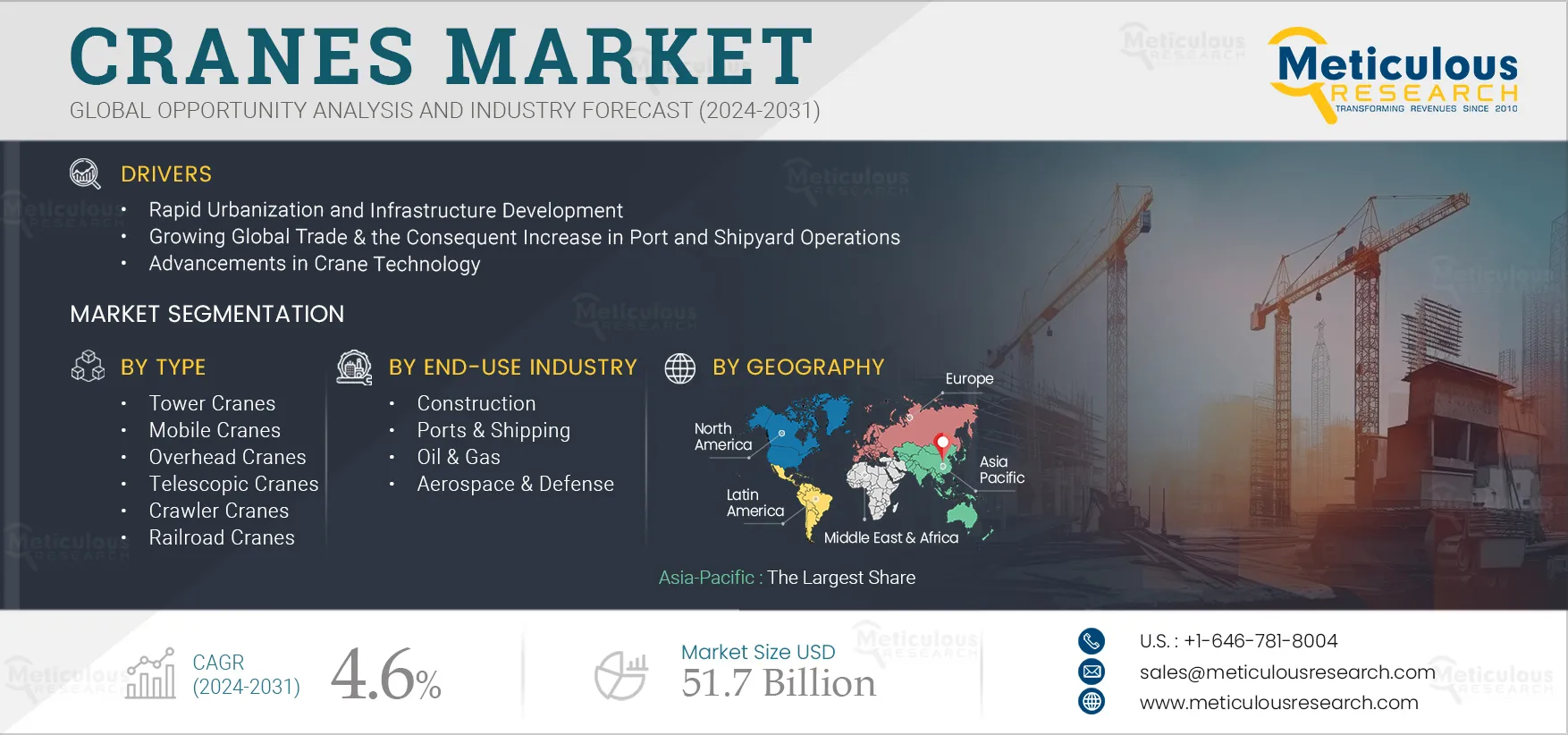
The Cranes Market is expected to reach $51.7 billion by 2032, at a CAGR of 4.6% from 2025 to 2032.
- Published
- Sep 2024
- Pages
- 250
- Format
- PDF + Excel
- Report ID
- MR-1145
- Base year
- 2024
- 2032 · FORECAST
- $51.70B
- 2032
- $51.70B
- CAGR 2025–2032
- 4.6%
2024 baseline · 2025–2032 forecast at 4.6% CAGR · hover a bar for the value
Key highlights
By Type: The Tower Cranes Segment to Dominate the Cranes Market in 2025
By Class: The Class D Segment to Dominate the Cranes Market in 2025
By Lifting Mechanism: The Hydraulic Cranes Segment to Dominate the Cranes Market in 2025
By Control Method: The Manual Cranes Segment to Dominate the Cranes Market in 2025
By End-use Industry: The Construction Segment to Dominate the Cranes Market in 2025
Report summary
| Particulars | Details |
|---|---|
| Number of Pages | 250 |
| Format | |
| Forecast Period | 2025–2032 |
| Base Year | 2024 |
| CAGR | 4.6% |
| Market Size | USD 51.7 Billion by 2032 |
| Segments Covered | By Type · Tower Cranes · Mobile Cranes · Overhead Cranes · Telescopic Cranes · Crawler Cranes · Railroad Cranes · Floating Cranes · Aerial Cranes · Jib Cranes · Gantry Cranes · Other Cranes Type · By Class · Class A (Standby or Infrequent Service) · Class B (Light Service) · Class C (Moderate Service) · Class D (Heavy Service) · Class E (Severe Service) · Class F (Continuous Severe Service) · By Lifting Mechanism · Hydraulic Cranes · Electric Cranes · Diesel Cranes · Other Lifting Mechanisms · By Control Method · Manual Cranes · Remote-controlled Cranes · Automated Cranes · By End-use Industry · Construction · Ports & Shipping · Oil & Gas · Aerospace & Defense · Other End-use Industries |
| Countries Covered | Europe (Germany, U.K., France, Italy, Spain, Netherlands, Switzerland, Sweden, Denmark, and Rest of Europe), Asia-Pacific (China, Japan, India, South Korea, Australia & New Zealand, Indonesia, Thailand, Vietnam, Malaysia, Singapore, and Rest of Asia-Pacific), North America (U.S., Canada), Latin America (Brazil, Mexico, and Rest of Latin America), and the Middle East & Africa (UAE, Israel, and Rest of Middle East & Africa) |
| Key Companies Profiled | Liebherr Group (Switzerland), Terex Corporation (U.S.), Tadano Ltd. (Japan), Caterpillar Inc. (U.S.), Gorbel Inc. (U.S.), Konecranes Plc (Finland), The Manitowoc Company, Inc. (U.S.), XCMG Group (China), Zoomlion Heavy Industry Science and Technology Co., Ltd. (China), SANY Heavy Industry Co., Ltd. (China), Pelloby Ltd. (U.K.), Demag Cranes & Components GmbH (Germany), Street Crane Company Limited (U.K.), Hitachi Construction Machinery Europe NV (Netherlands), and Komatsu Ltd. (Japan) |
Report overview
Segments covered: type, class, lifting mechanism, control method, end-use industry. Regions: Europe, Asia-Pacific, North America, Latin America, Middle East & Africa.
The growth of the cranes market is driven by rapid urbanization and infrastructure development, growing global trade & the consequent increase in port and shipyard operations, and advancements in crane technology. However, the high initial investment requirements and operational costs of cranes restrain the growth of this market.
Furthermore, growth in smart city & infrastructure projects and the rising demand for renewable energy are expected to generate significant growth opportunities for the stakeholders in this market. However, the lack of skilled operators is a major challenge impacting the market’s growth.
Market dynamics
5 factors across 3 forcesRapid Urbanization and Infrastructure Development
Urbanization and infrastructure development are major drivers for the crane market. With the expansion and development of urban areas, there has been a surge in construction projects, including high-rise buildings, bridges, roads, and other infrastructure. Cranes are essential for lifting and moving heavy materials, equipment, and prefabricated components in these projects. Urbanization and infrastructure development have driven innovation in crane technology, including automation, remote operation, real-time monitoring, and predictive maintenance, enhancing safety, efficiency, and productivity, and making cranes more versatile and cost-effective.
Also, with urbanization and infrastructure development, there is a growing need for skilled personnel capable of operating specialized equipment such as cranes to handle complex construction tasks efficiently and safely. Thus, urbanization and infrastructure development are increasing the demand for cranes as well as crane operators. Additionally, government initiatives for infrastructure development are also supporting the growth of the cranes market. For instance, in March 2024, the Government of India launched the Jawaharlal Nehru National Urban Renewal Mission (JNNURM), including two initiatives, namely the Urban Infrastructure Development Scheme for Small and Medium Towns (UIDSSMT) and Urban Infrastructure and Governance (UIG). The UIDSSMT initiative aims to accelerate infrastructure development with Central Assistance (CA) in small and medium-sized towns (UTs), whereas UIG focuses on infrastructure development with central assistance in large cities across Indian States/Union Territories.
Advancements in Crane Technology
Advancements in crane technology have significantly transformed the capabilities, safety, and efficiency of these heavy lifting machines. Cranes are increasingly being equipped with automation features and remote operation capabilities, allowing operators to control them from a safe distance. This improves safety by reducing the risk of accidents and enhances efficiency by enabling precise control of lifting operations.
Also, the integration of telematics and Internet of Things (IoT) technologies has enabled real-time monitoring of crane performance and other technical parameters. This data-driven approach helps optimize maintenance, detect potential issues before they lead to breakdowns, and improve overall operational efficiency. Some of the major advancements in crane technology are as follows:
- Advanced sensors and cameras
- Electric and hybrid power crane systems
- Enhanced safety features, including collision avoidance systems, anti-sway technology, and load moment indicators
- Modular design and customization
- Improved materials and construction techniques
- Integration with Building Information Modeling (BIM)
Table of contents
13 chapters · 133 sections · 250 pages · click to expandSegmental analysis
| Segment | Largest share (2025) | Fastest growth (2025–2032) |
|---|---|---|
| By Type | Tower Cranes | Mobile cranes |
| By Class | Class D | Class D |
| By Lifting Mechanism | Hydraulic Cranes | Electric cranes |
| By Control Method | Manual Cranes | Automated cranes |
| By End-use Industry | Construction | Construction |
By Type
- The Tower Cranes Segment to Dominate the Cranes Market in 2025
- The tower cranes segment is expected to account for the largest share of ~22.0% of the cranes market.
- This segment’s significant market share can be attributed to the various benefits of tower cranes.
- They are incredibly versatile and can handle heavy lifting tasks at construction sites, such as lifting steel, concrete, and other materials to great heights.
- Their efficiency in various construction projects, including high-rise buildings and infrastructure projects, makes them indispensable in the construction industry.
- Also, advancements in technology have led to the development of tower cranes with features such as increased lifting capacities, improved safety systems, and better energy efficiency.
- These technological innovations drive the adoption of tower cranes among construction companies looking to optimize their operations.
- Furthermore, various key players are launching advanced tower cranes.
- For instance, in January 2024, The Manitowoc Company, Inc. (U.S.) announced the launch of the Potain MCT 1005 M50, the largest topless tower crane manufactured at its Zhangjiagang facility in China.
- Also, in October 2022, KenzFigee (Netherlands) launched its first up-tower crane solution for offshore wind.
- However, the mobile cranes segment is projected to register the highest CAGR during the forecast period.
- The growth of this segment is driven by the benefits of mobile cranes.
- These cranes are highly versatile and can be easily transported between sites.
- Their mobility allows them to access a wide range of locations, making them suitable for various applications such as construction, infrastructure development, industrial projects, and disaster response.
- Also, mobile cranes offer high efficiency in lifting and moving heavy loads.
- They are equipped with telescopic booms or hydraulic arms that provide significant reach and lifting capacity, enabling them to handle a wide range of tasks with precision and speed.
By Class
- The Class D Segment to Dominate the Cranes Market in 2025
- The class D segment is expected to account for the largest share of the cranes market.
- This segment’s significant market share can be attributed to the benefits of class D (heavy service) cranes.
- These cranes are designed to lift and move substantial loads in a variety of industries, including construction, manufacturing, mining, and oil & gas.
- Their versatility allows them to be used in diverse applications, making them indispensable in various end-use industries.
- Additionally, the class D segment is projected to register the highest CAGR during the forecast period.
By Lifting Mechanism
- The Hydraulic Cranes Segment to Dominate the Cranes Market in 2025
- The hydraulic cranes segment is expected to account for the largest share of ~44.0% of the cranes market.
- This segment’s significant market share can be attributed to the benefits of hydraulic cranes.
- These cranes are efficient and offer versatility in terms of lifting capacity and maneuverability.
- Hydraulic cranes are relatively easier to operate compared to some other types of cranes.
- They often feature intuitive controls and ergonomic designs, reducing the time required for training operators.
- This ease of operation increases the accessibility of hydraulic cranes for a broader range of users, further driving their demand in the market.
- However, the electric cranes segment is projected to register the highest CAGR during the forecast period.
- The growth of this segment is driven by the benefits of electric cranes.
- These cranes produce zero emissions during operation, making construction and other industries more sustainable.
- Electric cranes typically feature advanced safety systems and precise control mechanisms, enhancing overall safety for operators and bystanders.
- With fewer moving parts and simplified maintenance requirements compared to diesel-powered cranes, electric cranes offer increased reliability and uptime, contributing to higher productivity on job sites.
By Control Method
- The Manual Cranes Segment to Dominate the Cranes Market in 2025
- The manual cranes segment is expected to account for the largest share of ~33.0% of the cranes market.
- This segment’s significant market share can be attributed to the better affordability and lower maintenance costs of manual cranes compared to automated cranes.
- Manual cranes have fewer components and less sophisticated technologies, resulting in lower initial investment requirements.
- Manual cranes can be easily maneuvered and adapted to different tasks and environments.
- Their flexibility allows them to handle a wide range of loads, making them suitable for various industries such as construction, manufacturing, and shipping.
- However, the automated cranes segment is projected to register the highest CAGR during the forecast period.
- The growth of this segment is driven by the benefits of automated cranes.
- These cranes can perform repetitive tasks with high precision and consistency, leading to improved efficiency in material handling operations.
- They can operate continuously without fatigue, resulting in higher productivity and throughput.
- Automated cranes reduce the need for manual labor in material handling tasks.
- By automating repetitive and physically demanding tasks, they allow human workers to focus on more complex or value-added activities, ultimately reducing labor costs.
- Furthermore, automated cranes are increasingly being implemented at ports around the world.
- For instance, in November 2024, the Port of Colombo (POC) implemented ABB’s (Switzerland) automated stacking cranes to enhance the operational efficiency of its new larger terminals.
By End-use Industry
- The Construction Segment to Dominate the Cranes Market in 2025
- The construction segment is expected to account for the largest share of ~35.0% of the cranes market.
- This segment’s significant market share can be attributed to the wide use of cranes at construction sites.
- Cranes significantly enhance productivity at construction sites by streamlining material handling processes.
- They can lift and transport materials to various locations within the site quickly, reducing manual labor requirements and accelerating construction timelines.
- Furthermore, the key players in the cranes market are focused on developing advanced cranes for construction applications.
- For instance, in October 2024, Potain (France) launched a brand-new self-erecting crane, the Potain Evy 30-23 4 t.
- It is the first model from the new Evy range of self-erecting tower cranes and is designed for home construction and residential building construction up to three stories in height.
- Also, in February 2024, Action Construction Equipment (India) introduced several products at the Bauma Conexpo 2024, including India’s first fully electric mobile crane, the country’s most substantial indigenous crane capable of lifting 180 tons, and India’s inaugural self-propelled aerial work platforms.
- Additionally, the construction segment is projected to register the highest CAGR during the forecast period.
Geographic analysis
Asia-Pacific
Largest shareIn 2025, Asia-Pacific is expected to account for the largest share of ~46.0% of the cranes market. Asia-Pacific’s large share can be attributed to the region’s accelerated infrastructure development and major investments in the transportation, energy, and construction sectors. These factors have boosted the demand for larger, more specialized cranes in the region. Cranes are widely utilized in the region’s manufacturing facilities for material handling, assembly, and logistics. The adoption of advanced crane technologies such as automation, remote monitoring, and IoT-enabled systems is increasing in the Asia-Pacific region. These technologies enhance the operational efficiency, safety, and productivity of cranes. Also, the Asia-Pacific region is witnessing significant growth in renewable energy projects, including wind farms and solar parks. Cranes are used in the installation and maintenance of renewable energy infrastructure. Additionally, the Asia-Pacific region is projected to register the highest CAGR of ~6.0% during the forecast period.
Competitive landscape
- February 2025
The U.S. government announced plans to invest billions in the domestic manufacturing of cargo cranes, seeking to counter fears that the prevalent use of China-built cranes with advanced software at many U.S. ports poses a potential national security risk.
- July 2024
Tata Steel (India) manufactured the crane used for the successful launch of the LVM3-M4 rocket, dubbed ‘Fat Boy’, in the Chandrayaan-3 mission.
- November 2022
Mammoet (Netherlands) partnered with Bay Crane Services (U.S.) to expand its presence throughout the Northeastern United States. The partnership focuses on servicing renewable Offshore Wind requirements in the U.S.
- Liebherr Group · Switzerland
- Terex Corporation (U.S.)
- Tadano Ltd. · Japan
- Caterpillar Inc. (U.S.)
- Gorbel Inc. (U.S.)
- Konecranes Plc · Finland
- Manitowoc Company, Inc. (U.S.)
- XCMG Group · China
- SANY Heavy Industry Co., Ltd. · China
- Pelloby Ltd. (U.K.)
- Demag Cranes & Components GmbH · Germany
- Street Crane Company Limited (U.K.)
- Hitachi Construction Machinery Europe NV · Netherlands
- Komatsu Ltd. · Japan
Frequently asked questions
The Cranes Market refers to the industry that manufactures, sells, and services cranes, which are heavy lifting equipment used in construction, shipping, and various industrial applications.
Cite this report
Meticulous Research. (2024). Cranes Market - Global Opportunity Analysis and Industry Forecast (2025-2032) (Report No. MR-1145). Meticulous Market Research Pvt. Ltd. https://www.meticulousresearch.com/reports/cranes-market-5828