Cold Chain Logistics Market (2026-2036)
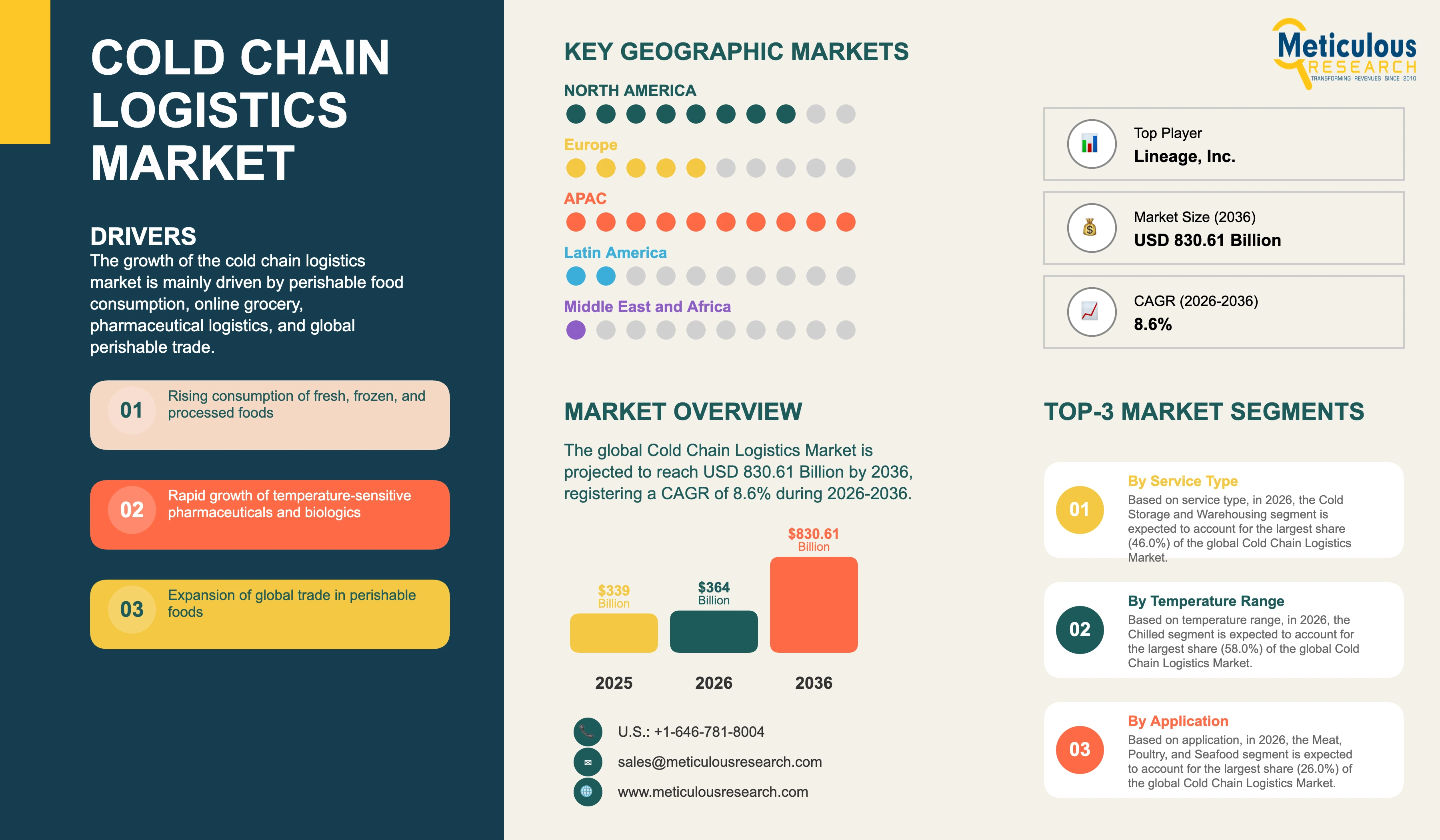
The global cold chain logistics market was valued at USD 339.00 billion in 2025. This market is expected to reach USD 830.61 billion by 2036 from an estimated USD 364.00 billion in 2026, registering a CAGR of 8.6% during the forecast period (2026-2036).
- Published
- Nov 2026
- Pages
- 264
- Format
- PDF + Excel
- Report ID
- MRAUTO - 1042596
- Base year
- 2025
- 2025 · BASELINE
- $339.0B
- 2036
- $830.6B
- CAGR 2026–2036
- 8.6%
2025 baseline · 2026–2036 forecast at 8.6% CAGR · hover a bar for the value
Key highlights
Lineage, the world's largest temperature-controlled warehouse real estate investment trust, reported total revenue of USD 5.36 billion in 2025, flat with the prior year, and operated about 501 warehouses with approximately 3.1 billion cubic feet of capacity at the end of 2025, while acquiring four cold storage warehouses from Tyson Foods for USD 256 million and agreeing to design, build, and operate two fully automated warehouses with Tyson Foods as anchor customer.
Americold Realty Trust reported 2025 revenue of about USD 2.6 billion, down 2.4% from 2024, with average economic occupancy in its global warehouse segment falling to 76.1% in the fourth quarter of 2025, as both Lineage and Americold pointed to excess cold storage capacity, changing consumer buying habits, and lower throughput volumes in the U.S. market.
CBRE data cited by Lineage management in February 2026 showed that U.S. public refrigerated warehouse supply increased by a cumulative 14.5% since 2021, while consumer demand grew by only about 5%, resulting in about 9.5% excess capacity, which has put pressure on storage rates and occupancy across the industry.
The Global Cold Chain Alliance (GCCA) reported in April 2026 that its Global Top 25 temperature-controlled warehousing and logistics companies operated 7.76 billion cubic feet (219.7 million cubic meters) of capacity, up 6.3% from 2025, while noting that growth slowed from 8.3% in the prior year as higher interest rates and tighter market conditions reduced new development.
According to the Indian Brand Equity Foundation (IBEF), India had about 10,000 refrigerated vehicles in operation, and the National Centre for Cold-chain Development (NCCD) projects that the number will grow to about 33,000 by 2031, while India's cold storage capacity reached about 40.22 million tonnes in 2025, highlighting the large growth potential of cold chain logistics in Asia-Pacific, where demand for refrigerated transport is growing much faster than the existing fleet.
By service type, cold storage and warehousing accounts for the largest share of 46.0% in 2026, while value-added and integrated services register the highest CAGR.
By temperature range, chilled accounts for the largest share in 2026, while deep-frozen and ultra-low registers the highest CAGR.
By application, meat, poultry, and seafood accounts for the largest share of 26.0% in 2026, while pharmaceuticals and healthcare registers the highest CAGR.
By geography, Asia-Pacific accounts for the largest share of 38.0% in 2026, while Asia-Pacific registers the highest CAGR of 10.2%.
Report summary
| Particulars | Details |
|---|---|
| Base Year | 2025 |
| Estimated Year | 2026 |
| Forecast Period | 2026-2036 |
| Market Size in 2025 | USD 339.00 billion |
| Market Size in 2026 | USD 364.00 billion |
| Market Size by 2036 | USD 830.61 billion |
| CAGR (2026-2036) | 8.6% |
| Format | PDF, Excel & Cloud Portal · 264 pages |
| Largest Segment by Service Type (2026) | Cold Storage and Warehousing (46.0%) |
| Largest Segment by Application (2026) | Meat, Poultry, and Seafood (26.0%) |
| Largest Region (2026) | Asia-Pacific (38.0%) |
| Fastest-Growing Region | Asia-Pacific (CAGR 10.2%) |
| Companies Profiled | 16 companies and other companies |
| Segments Covered | Service Type, Temperature Range, Application, Geography |
| Countries Covered | China, Japan, India, South Korea, Australia, Indonesia, Thailand, Vietnam, Philippines, Malaysia, Singapore, New Zealand, Rest of Asia-Pacific, U.S., Canada, Netherlands, Germany, U.K., France, Spain, Italy, Poland, Belgium, Sweden, Ireland, Switzerland, Rest of Europe, Brazil, Mexico, Argentina, Chile, Peru, Ecuador, Colombia, Rest of Latin America, Saudi Arabia, U.A.E., Qatar, Egypt, South Africa, Kenya, Nigeria, Morocco, Rest of Middle East & Africa |
Report overview
Segments covered: service type, temperature range, application.
The growth of this market is mainly driven by rising consumption of fresh, frozen, and processed foods that require temperature control, the growth of modern grocery retail, food service, and online grocery delivery, increasing global trade in perishable foods, the rapid growth of temperature-sensitive pharmaceuticals, biologics, vaccines, and cell and gene therapies, stricter food safety and pharmaceutical distribution regulations, the expansion of cold chain infrastructure in Asia-Pacific, Latin America, and the Middle East, and the adoption of automation, real-time monitoring, and energy-efficient refrigeration. However, factors such as high capital and energy costs, excess warehouse capacity in some developed markets, labor shortages, infrastructure gaps in developing countries, and regulatory pressure on refrigerants are expected to restrain the growth of this market to some extent.
Cold chain logistics refers to the storage, transportation, and handling of temperature-sensitive products at controlled temperatures from the point of production to the point of consumption. It includes cold storage and warehousing in public, private, and contract refrigerated warehouses, refrigerated transportation by road, rail, sea, and air, and value-added and integrated services such as blast freezing, tempering, repacking, labeling, order fulfillment, customs clearance, and supply chain management. This report covers cold chain logistics services across service types, temperature ranges, applications, and regions. Cold chain equipment, such as refrigeration systems, reefer units, and temperature monitoring devices, is covered separately and is included only where it is part of logistics service revenue. Farm-level and rural agricultural cold storage is analyzed in the separate agricultural cold storage report. The market is measured on a revenue basis, based on service revenue.
Cold chain logistics is essential for modern food and healthcare supply chains. Fresh and frozen meat, poultry, seafood, dairy products, fruits, vegetables, frozen foods, ice cream, and many processed foods must be kept within specific temperature ranges to maintain safety, quality, and shelf life. Pharmaceuticals, vaccines, biologics, blood products, clinical trial materials, and cell and gene therapies also require strict temperature control, often with detailed documentation and regulatory compliance. Without an effective cold chain, these products would spoil, lose potency, or become unsafe.
Cold storage and warehousing is the largest service type, since storage and handling generate recurring revenue across the whole year, and large public refrigerated warehouse operators such as Lineage, Americold, United States Cold Storage, NewCold, and Nichirei operate networks of facilities near food production, ports, and population centers, providing storage, handling, and distribution services to food producers, processors, retailers, and food service companies. According to the GCCA, global refrigerated warehouse capacity was 719 million cubic meters in its most recent global capacity report, with the U.S., India, and China as the largest markets, and the GCCA's Global Top 25 operators had 7.76 billion cubic feet of capacity in 2026.
Refrigerated transportation includes long-haul and regional refrigerated trucking, last-mile delivery, refrigerated rail, reefer container shipping, and temperature-controlled air freight. Road transport accounts for the largest share of refrigerated transportation, while reefer containers carry a large share of internationally traded perishable foods. Air freight is used for high-value and highly perishable products such as pharmaceuticals, seafood, berries, and flowers. Value-added and integrated services, including blast freezing, repacking, e-commerce fulfillment, and end-to-end supply chain management, are growing as customers seek to outsource more of their cold chain operations.
Chilled products, stored and transported at temperatures above freezing, account for the largest share of the market, followed by frozen products, while deep-frozen and ultra-low temperature logistics, which serve products such as certain vaccines, biologics, and cell and gene therapies, is a small but fast-growing segment.
Meat, poultry, and seafood are the largest application, followed by fruits and vegetables, processed and packaged foods, pharmaceuticals and healthcare, dairy and frozen desserts, and other applications such as chemicals, flowers, and electronics. Pharmaceuticals and healthcare is the fastest-growing application, supported by the growth of biologics, specialty drugs, and advanced therapies, which require validated storage and transport with continuous monitoring.
The market is fragmented and includes large global cold storage operators, regional and local cold storage companies, refrigerated trucking companies, container shipping lines, freight forwarders and third-party logistics providers, specialized pharmaceutical cold chain providers, and the in-house cold chain operations of food and retail companies. Leading companies include Lineage, Americold, United States Cold Storage, NewCold, Nichirei, Constellation Cold Logistics, Kloosterboer, VersaCold, Emergent Cold LatAm, Burris Logistics, Maersk, Kuehne+Nagel, DHL, C.H. Robinson, Snowman Logistics, and Cryoport.
Over the forecast period, the cold chain logistics market is expected to grow steadily, supported by growing demand for perishable foods and temperature-sensitive pharmaceuticals, expansion of cold chain infrastructure in emerging markets, and adoption of automation and digital technologies. However, near-term growth in the U.S. warehouse segment is expected to be slower due to excess capacity, while Asia-Pacific is expected to remain the largest and fastest-growing region.
Every shipment needs validated packaging, continuous monitoring, and full documentation, so we only work with logistics partners that meet good distribution practice standards.
This comment explains why pharmaceuticals and healthcare are the fastest-growing application and why value-added and integrated services are growing fastest.
Our dark stores need chilled and frozen storage for fresh and frozen products, and cold chain capacity is still one of our biggest constraints as we expand to new cities.
This comment explains why Asia-Pacific is the largest and fastest-growing region and why urban cold chain capacity is a key growth area.
Asia-Pacific is expected to account for the largest share of 38.0% of the market in 2026, mainly due to very large food consumption in China, India, Japan, and Southeast Asia, rapid growth of modern retail and online grocery, and government cold chain development plans.
Asia-Pacific is also projected to register the highest CAGR of 10.2% during the forecast period, driven by cold chain infrastructure development, quick commerce, perishable trade, and pharmaceutical growth.
The report profiles 16 companies, including Lineage, Americold, United States Cold Storage, NewCold, Nichirei, Constellation Cold Logistics, Kloosterboer, VersaCold, Emergent Cold LatAm, Burris Logistics, Maersk, Kuehne+Nagel, DHL, C.H. Robinson, Snowman Logistics, and Cryoport.
Report infographic
Market dynamics
18 factors across 5 forcesRising consumption of fresh, frozen, and processed foods
Global consumption of fresh, frozen, and processed foods that require temperature control continues to grow, supported by population growth, urbanization, rising incomes, and changing diets. Consumers in emerging markets are eating more meat, dairy, seafood, fresh fruits and vegetables, and frozen and ready-to-eat foods, while consumers in developed markets are buying more fresh, premium, and convenience foods. These trends increase the volume of products that need cold storage and refrigerated transport.
The expansion of modern grocery retail, including supermarkets, hypermarkets, convenience stores, and discount chains, in Asia, Latin America, Africa, and the Middle East is a major driver, since modern retailers rely on organized cold chains to supply fresh and frozen products. Quick-service restaurants and food service chains also require reliable cold chain logistics to supply their outlets with consistent products.
Frozen foods have also gained popularity due to convenience, longer shelf life, and reduced food waste, and growth in frozen food production and consumption increases demand for frozen storage and transport.
Food producers are also outsourcing more of their storage and distribution to specialized logistics providers, so that they can focus on production and marketing, which increases the share of cold chain activity handled by third-party providers. Large food companies increasingly sign long-term agreements with cold storage operators for dedicated or automated capacity near their plants.
Growth of online grocery and direct-to-consumer food delivery
Online grocery shopping, quick commerce, meal kit delivery, and direct-to-consumer food sales have grown significantly, especially in China, India, the U.S., and Europe. These channels require temperature-controlled fulfillment centers, dark stores, and last-mile delivery vehicles and packaging, which create new demand for cold chain logistics services. Retailers and e-commerce companies are investing in their own cold chain networks and partnering with third-party logistics providers to handle the complexity of delivering fresh and frozen products to consumers' homes.
Quick commerce, which promises delivery within minutes, has expanded rapidly in India and other countries, requiring dense networks of small temperature-controlled storage points in cities.
Last-mile cold chain delivery is complex and costly, since it requires frequent deliveries of small orders, temperature-controlled vehicles or insulated packaging, and careful handling, which creates opportunities for specialized providers and technology solutions.
Rapid growth of temperature-sensitive pharmaceuticals and biologics
The pharmaceutical industry is one of the fastest-growing users of cold chain logistics. Biologics, including monoclonal antibodies, insulin, vaccines, GLP-1 medications, and other protein-based drugs, require refrigerated storage and transport, and their share of the pharmaceutical market continues to grow. Cell and gene therapies, some mRNA-based products, and other advanced therapies require frozen, deep-frozen, or cryogenic temperatures and highly specialized logistics. Clinical trials for these products also require temperature-controlled logistics for drugs and samples.
Pharmaceutical cold chain logistics is subject to strict good distribution practice regulations and requires validated facilities, qualified packaging, continuous temperature monitoring, and detailed documentation, which creates demand for specialized providers and higher-value services. Logistics companies such as DHL, Kuehne+Nagel, and Cryoport are investing in pharmaceutical cold chain capabilities, and cold storage operators are expanding into healthcare logistics.
Expansion of global trade in perishable foods
International trade in meat, seafood, dairy products, fruits, and vegetables continues to grow, with major exports from the U.S., Brazil, Argentina, Chile, Peru, Mexico, Australia, New Zealand, the EU, and Southeast Asia to markets in Asia, the Middle East, Europe, and North America. This trade depends on reefer container shipping, port cold storage, and temperature-controlled inland transport, which supports demand for cold chain logistics services and infrastructure at ports and distribution hubs. Shipping lines such as Maersk have expanded their cold chain logistics services to offer end-to-end solutions for perishable cargo.
Free trade agreements, growing middle-class demand in Asia and the Middle East, and the shift of food production to lower-cost regions all support long-term growth in perishable trade, although trade policy changes and tariffs can disrupt specific trade flows from year to year.
Stricter food safety and pharmaceutical distribution regulations
Governments are introducing stricter regulations for food safety and pharmaceutical distribution, which require better temperature control, monitoring, and traceability throughout the supply chain. In the U.S., the Food Safety Modernization Act's sanitary transportation rule and the FDA's food traceability rule increase requirements for food shippers and carriers, and in the EU and many other countries, good distribution practice guidelines set strict requirements for pharmaceutical storage and transport. These regulations encourage companies to use professional cold chain logistics providers with compliant facilities and systems.
Retailers and food service companies also set their own strict requirements for temperature control and traceability, often stricter than regulations, which further increases demand for professional providers.
Table of contents
11 chapters · 164 sections · 264 pages · click to expandSegmental analysis
| Segment | Largest share (2026) | Fastest growth (2026–2036) |
|---|---|---|
| By Service Type | Cold storage and warehousing | Value-added and integrated services |
| By Temperature Range | Chilled | Deep-frozen and ultra-low |
| By Application | Meat, poultry, and seafood | Pharmaceuticals and healthcare |
| Other segments | Chilled | Deep-frozen and ultra-low |
By Service Type
- Cold Chain Logistics Market Analysis by Service Type
- The cold storage and warehousing segment is expected to account for the largest share of 46.0% of the global cold chain logistics market.
- The large share of this segment is mainly due to the large global network of public, private, and contract refrigerated warehouses, the essential role of cold storage in balancing supply and demand for perishable foods, the high value of storage and handling services, and continued investment in new and automated facilities in North America, Europe, and Asia-Pacific.
- Cold storage and warehousing includes public refrigerated warehouses, contract and dedicated facilities, port and import-export cold stores, and distribution centers operated by logistics providers.
- Storage revenue is typically based on pallets stored and space reserved, while handling revenue is based on the number of pallets moved in and out of the warehouse.
- Operators are increasingly moving customers to minimum storage guarantees and fixed commitment contracts, which provide more stable and predictable revenue, and they are adding value-added services within their warehouses to increase revenue per pallet.
- Large public refrigerated warehouse operators such as Lineage and Americold generate the majority of their revenue from storage and handling services, and they serve the world's largest food producers, processors, and retailers.
- However, the U.S. cold storage segment is currently affected by excess capacity, which has reduced occupancy and pricing, while demand for cold storage in Asia-Pacific, Latin America, and the Middle East continues to grow strongly.
- Location is a key competitive factor in the cold storage business, since facilities close to production plants, ports, and population centers reduce transport costs and transit times.
- Port-based cold storage is especially important for international trade in meat, seafood, and fruit, and new port cold stores have been built in Europe, Latin America, and Asia to handle growing reefer container volumes.
- However, the value-added and integrated services segment is projected to register the highest CAGR during the forecast period.
- The rapid growth of this segment is driven by customers' desire to outsource more of their cold chain operations, the growth of e-commerce fulfillment, repacking, and labeling services, demand for blast freezing and tempering, and the growth of end-to-end supply chain management for food and pharmaceutical companies.
- Refrigerated transportation accounts for a large share, supported by road, sea, rail, and air transport of perishable products.
- Refrigerated road transport is the largest part of the refrigerated transportation segment, used for both long-haul and local distribution, while reefer container shipping is the backbone of international perishable trade, and temperature-controlled air freight serves high-value pharmaceuticals and highly perishable foods.
- Rail transport is used for long-distance refrigerated freight in North America, Russia, China, and India today, and it is gaining attention as a lower-emission alternative to road transport.
By Temperature Range
- Cold Chain Logistics Market Analysis by Temperature Range
- The chilled segment is expected to account for the largest share of the global cold chain logistics market.
- The large share of this segment is mainly due to the large volumes of fresh meat, poultry, dairy products, fruits, vegetables, and refrigerated processed foods that are stored and transported at chilled temperatures, and the large share of pharmaceuticals and vaccines that require refrigerated temperatures.
- Chilled logistics also includes controlled room temperature services for pharmaceuticals, which require monitoring even when products are not refrigerated.
- Chilled products such as fresh meat, dairy, and produce often have short shelf lives, which require fast and frequent deliveries and close coordination between producers, logistics providers, and retailers.
- However, the deep-frozen and ultra-low segment is projected to register the highest CAGR during the forecast period.
- The rapid growth of this segment is driven by the growth of cell and gene therapies, certain vaccines and biologics, and other advanced therapies that require deep-frozen or cryogenic temperatures, as well as growing demand for deep-frozen storage of high-value seafood.
- Frozen products account for a large share of the market, supported by growing consumption of frozen foods, meat, and seafood.
- Frozen storage also requires more energy and specialized equipment than chilled storage, which gives it a higher value per unit of storage capacity, and large public refrigerated warehouses in North America and Europe are mainly used for frozen products such as meat, poultry, seafood, frozen vegetables, and ice cream.
- Investment in frozen capacity is growing strongly in Asia-Pacific and Latin America as frozen food consumption increases.
By Application
- Cold Chain Logistics Market Analysis by Application
- The meat, poultry, and seafood segment is expected to account for the largest share of 26.0% of the global cold chain logistics market.
- The large share of this segment is mainly due to the very large volumes of meat, poultry, and seafood produced, traded, and consumed worldwide, the strict temperature requirements of these products for food safety, the large share of frozen storage used for meat and seafood, and the large international trade in these products, which depends on reefer shipping and port cold storage.
- Major meat and poultry producers rely heavily on cold storage operators, as shown by Lineage's acquisition of four cold storage warehouses from Tyson Foods and its automated warehouse projects with the company.
- Growing meat and seafood consumption in Asia, Latin America, and Africa, and growing exports from Brazil, the U.S., Australia, and other producers, continue to support demand for cold chain logistics for these products.
- Seafood logistics is particularly demanding and specialized, since many seafood products require very low storage temperatures to maintain quality, and they are traded over long distances from producing countries in Asia, Latin America, and Northern Europe.
- However, the pharmaceuticals and healthcare segment is projected to register the highest CAGR during the forecast period.
- The rapid growth of this segment is driven by the growth of biologics, GLP-1 medications, vaccines, specialty drugs, and cell and gene therapies, strict good distribution practice requirements, the growth of clinical trials, and direct-to-patient delivery.
- Fruits and vegetables, processed and packaged foods, dairy and frozen desserts, and other applications such as chemicals, flowers, and electronics account for the remaining share.
- Fruits and vegetables require careful temperature and humidity control and fast transit, and they rely heavily on reefer shipping for international trade.
- Processed and packaged foods and dairy and frozen desserts are major users of frozen and chilled warehousing and distribution, especially for supermarkets and food service.
Other segments
- The chilled segment is expected to account for the largest share of the cold chain logistics market, while the deep-frozen and ultra-low segment is projected to register the highest CAGR during the forecast period.
Geographic analysis
Asia-Pacific
Largest shareIn 2026, Asia-Pacific is expected to account for the largest share of 38.0% of the global cold chain logistics market. Asia-Pacific is also projected to register the highest CAGR of 10.2% during the forecast period. The large share and rapid growth of this region are mainly driven by very large and growing food consumption in China, India, Japan, and Southeast Asia, rapid expansion of modern retail, online grocery, and quick commerce, government plans to develop cold chain infrastructure in China and India, growing imports and exports of meat, seafood, and fruits, and the growth of pharmaceutical production and consumption. China has one of the largest cold chain markets in the world, and India's cold chain is expanding rapidly from a low base, with about 10,000 refrigerated vehicles and plans for significant growth, according to IBEF. Japan, South Korea, Australia, Indonesia, Thailand, Vietnam, the Philippines, Malaysia, and Singapore are also important markets, and Nichirei is one of the region's leading cold chain logistics companies.
North America
North America accounts for a significant share of the market, supported by the largest refrigerated warehouse capacity in the world, large production and consumption of meat, dairy, frozen foods, and fresh produce, large imports of fresh produce and seafood, a strong pharmaceutical industry, and the presence of leading operators such as Lineage, Americold, United States Cold Storage, Burris Logistics, VersaCold, and Congebec. However, the U.S. cold storage segment faces excess capacity and soft demand in the near term. The U.S. is the largest market in the region, followed by Canada and Mexico.
Europe
Europe accounts for a significant share of the market, supported by large food production and trade, strict food safety and pharmaceutical regulations, a strong pharmaceutical industry, and the presence of operators such as Lineage, NewCold, Kloosterboer, Constellation Cold Logistics, and pharmaceutical logistics providers such as DHL and Kuehne+Nagel. The Netherlands, Germany, the U.K., France, Spain, Italy, Poland, and Belgium are important markets, and consolidation is reshaping the region's cold storage industry. The Nordic countries, Ireland, and Switzerland are also important markets.
Latin America
Latin America accounts for a growing share of the market, supported by large meat, poultry, fruit, and seafood exports from Brazil, Argentina, Chile, Peru, Ecuador, and Mexico, and growing domestic demand. Emergent Cold LatAm and other operators are expanding through acquisitions and new facilities.
Middle East & Africa
The Middle East & Africa accounts for a smaller share, but it is growing rapidly, supported by large food imports and food security investments in Saudi Arabia, the U.A.E., and other Gulf countries, growing modern retail, and cold chain development in Egypt, South Africa, Kenya, Nigeria, and Morocco.
Competitive landscape
The global cold chain logistics market is highly fragmented, with the top five players estimated to account for less than 10% of the market in 2025. The market includes large public refrigerated warehouse operators, regional and local cold storage companies, refrigerated trucking companies, shipping lines, freight forwarders and third-party logistics providers, specialized pharmaceutical cold chain providers, and in-house cold chain operations of food producers and retailers.
Lineage and Americold are the two largest temperature-controlled warehouse operators in the world, with networks across North America, Europe, and Asia-Pacific, and Lineage reported revenue of USD 5.36 billion and Americold about USD 2.6 billion in 2025. United States Cold Storage, NewCold, Nichirei, Constellation Cold Logistics, Kloosterboer, VersaCold, Emergent Cold LatAm, and Burris Logistics are other major cold storage and logistics operators.
In transportation and integrated logistics, Maersk offers reefer container shipping and end-to-end cold chain logistics, Kuehne+Nagel and DHL provide temperature-controlled freight forwarding and pharmaceutical logistics, and C.H. Robinson is a major provider of temperature-controlled truckload and less-than-truckload brokerage. Snowman Logistics is a leading integrated cold chain logistics provider in India, and Cryoport specializes in temperature-controlled supply chain solutions for cell and gene therapies and other life sciences products.
The market is fragmented because cold chain logistics is largely local and regional, with many small and medium-sized operators serving local food producers and retailers, and because transportation is provided by thousands of trucking companies. Large operators have advantages in scale, network coverage, automation, and relationships with major customers.
Food producers and retailers also operate their own cold storage and refrigerated fleets, which compete with third-party providers, although outsourcing is increasing.
Companies compete on network coverage, facility location and quality, service reliability, temperature compliance, technology and visibility, value-added services, price, and sustainability. Key strategies include acquisitions, build-to-suit developments with anchor customers, automation, expansion into pharmaceutical logistics, contracted capacity and minimum storage guarantees, and investment in renewable energy and energy efficiency.
We expect continued consolidation, especially in Europe, Latin America, and Asia-Pacific, as large operators and private equity-backed platforms acquire regional companies. In the U.S., excess capacity may lead to further asset sales and consolidation among developers and smaller operators.
Some of the key players operating in the cold chain logistics market are Lineage, Inc., Americold Realty Trust, Inc., United States Cold Storage (Swire), NewCold, Nichirei Logistics Group Inc., Constellation Cold Logistics, Kloosterboer, VersaCold Logistics Services, Emergent Cold LatAm, Burris Logistics, A.P. Moller-Maersk, Kuehne+Nagel International AG, DHL Group, C.H. Robinson Worldwide, Inc., Snowman Logistics Limited, and Cryoport, Inc., among others.
- —
Lineage acquired four cold storage warehouses from Tyson Foods for USD 256 million and agreed to build two fully automated warehouses with Tyson as anchor customer, Americold reached 60% fixed commitment contracts in 2025, and the GCCA reported 6.3% growth in Global Top 25 capacity in 2026, although growth slowed from the prior year.
- Europe
- Asia-Pacific
- NewCold
- Nichirei
- Constellation Cold Logistics
- Kloosterboer
- VersaCold
- Emergent Cold LatAm
- Burris Logistics
Expert perspectives
Cold chain logistics is essential infrastructure for modern food and healthcare systems, and long-term demand is supported by growing consumption of perishable foods, modern retail and e-commerce, global trade, and the growth of temperature-sensitive pharmaceuticals.
Over the forecast period, the market is expected to grow at a CAGR of 8.6%, from USD 364.00 billion in 2026 to USD 830.61 billion in 2036. Growth will be supported by food consumption, online grocery, pharmaceutical and biologics logistics, perishable trade, regulations, and infrastructure development in emerging markets.
Cold storage and warehousing remains the largest service type, while value-added and integrated services grow fastest. Chilled logistics is the largest temperature range, while deep-frozen and ultra-low logistics grows fastest. Meat, poultry, and seafood are the largest application, while pharmaceuticals and healthcare grow fastest. Asia-Pacific is both the largest and the fastest-growing region, with a CAGR of 10.2%.
In our view, the cold chain logistics market is currently in a period of adjustment in developed markets, especially the U.S., where excess warehouse capacity, softer food volumes, and higher interest rates have reduced growth and profitability. We expect this adjustment to continue over the next one to two years, as new development slows and growing demand gradually absorbs the excess capacity, with operators focusing on automation, cost reduction, and contracted capacity.
At the same time, emerging markets offer strong growth, as cold chain infrastructure catches up with rising demand. We expect Asia-Pacific, Latin America, and the Middle East to account for most of the market's growth over the forecast period, and we expect international operators to expand in these regions through acquisitions and partnerships with local companies.
Pharmaceutical cold chain logistics is the most attractive segment of the market in terms of growth and margins, but it requires specialized capabilities and quality systems. We expect more cold storage operators and logistics providers to invest in this segment through acquisitions and new facilities.
Integration of storage, transport, and value-added services into end-to-end offerings will also become more important for both food and pharmaceutical customers, as customers seek fewer, more capable logistics partners.
Finally, we believe that automation, energy efficiency, and digital visibility will define the leading cold chain operators of the future, since they help reduce costs, address labor shortages, meet customer and regulatory requirements, and lower emissions.
Overall, we expect the cold chain logistics market to remain one of the fastest-growing segments of the global logistics industry, supported by structural demand for temperature-controlled food and healthcare products in all major regions.
Customer perspectives
Buyers of cold chain logistics services include meat, poultry, and seafood producers, fruit and vegetable growers and exporters, dairy and frozen food manufacturers, food processors, grocery retailers, food service distributors, online grocery and quick commerce companies, pharmaceutical and biotechnology companies, and healthcare providers. Their purchase decisions depend mainly on network coverage and location, temperature reliability and compliance, cost, capacity availability, value-added services, technology and visibility, sustainability, and service quality.
Supply Chain Director - poultry processor, U.S.
We store most of our frozen product with third-party cold storage operators, and we are now signing longer contracts for automated capacity close to our plants to reduce costs and secure space.
This comment explains why cold storage and warehousing accounts for 46.0% of the market and why meat, poultry, and seafood account for 26.0% of the market. It also shows why build-to-suit and contracted capacity models are growing.
Frequently asked questions
The global cold chain logistics market was valued at USD 339.00 billion in 2025, up from USD 318.00 billion in 2024, and is estimated at USD 364.00 billion in 2026, despite near-term softness in the U.S. warehouse segment. The market includes cold storage and warehousing, refrigerated transportation, and value-added and integrated cold chain services.
Cite this report
Meticulous Research. (2026). Cold Chain Logistics Market - Global Opportunity Analysis and Industry Forecast (2026-2036) (Report No. MRAUTO - 1042596). Meticulous Market Research Pvt. Ltd. https://www.meticulousresearch.com/product/cold-chain-logistics-market-7279