Hydrogen Trucks Market (2026-2036)
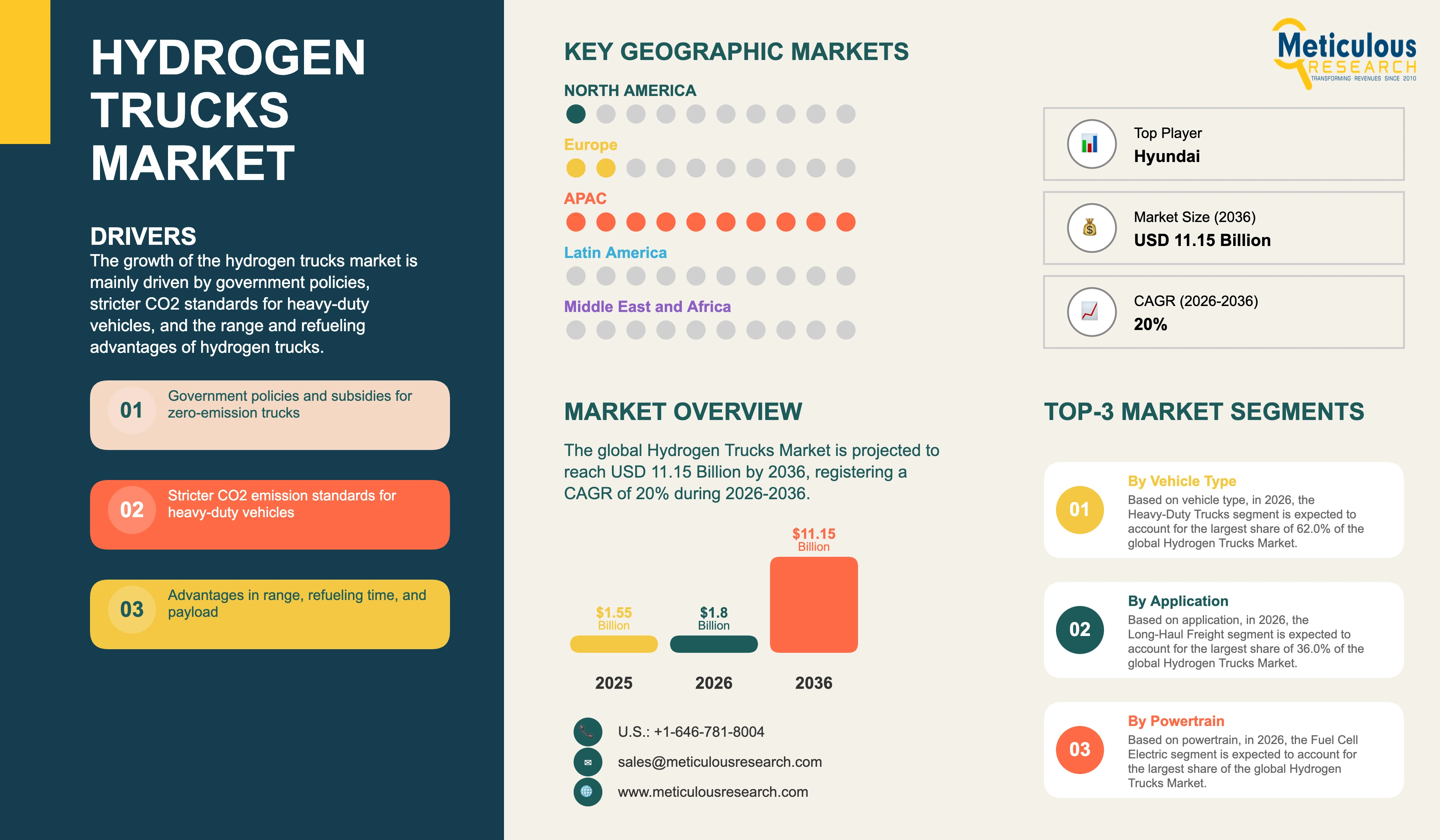
The global hydrogen trucks market was valued at USD 1.55 billion in 2025. This market is expected to reach USD 11.15 billion by 2036 from an estimated USD 1.80 billion in 2026, registering a CAGR of 20.0% during the forecast period (2026-2036).
- Published
- Nov 2026
- Pages
- 266
- Format
- PDF + Excel
- Report ID
- MRAUTO - 1042575
- Base year
- 2025
- 2025 · BASELINE
- $1.55B
- 2036
- $11.15B
- CAGR 2026–2036
- 20.0%
2025 baseline · 2026–2036 forecast at 20.0% CAGR · hover a bar for the value
Key highlights
Nearly 40,000 hydrogen fuel cell vehicles had been sold in China by the end of 2025, mostly commercial vehicles such as heavy trucks and buses, and the country had built 574 hydrogen refueling stations with a combined daily capacity of more than 360 tonnes, according to Chinese official media, although this network can support the daily refueling needs of only about 4,000 to 5,000 heavy trucks.
Daimler Truck unveiled the Mercedes-Benz NextGenH2 Truck in January 2026, with a small series of 100 liquid hydrogen fuel cell tractors to be produced at its Wörth plant and deployed with customers from the end of 2026, powered by two 150 kW BZA150 fuel cell units from cellcentric with a range of more than 1,000 kilometres, while series production of fuel cell trucks remains targeted for the early 2030s.
Toyota joined cellcentric, the fuel cell joint venture of Daimler Truck and the Volvo Group, as a third equal partner in 2026, creating an alliance of three major vehicle manufacturers to standardize and scale up fuel cell systems for heavy-duty trucks, while cellcentric continues to build a large-scale fuel cell production facility in Weilheim an der Teck, Germany.
Dongfeng reported in June 2026 that its 400 kW fuel cell stack had completed a 10, 000-hour durability test, and it cited publicly disclosed hydrogen fuel cell vehicle delivery orders of more than 1,800 units in China in the first four months of 2026, showing continued progress in high-power, long-life fuel cell systems for heavy trucks.
Battery-electric heavy trucks accounted for about 25.8% of China's heavy truck sales in the first eleven months of 2025, with about 184,900 units sold, which shows that battery-electric trucks have become the main zero-emission competitor to hydrogen trucks and are pushing hydrogen trucks toward long-haul, heavy-load, and high-utilization applications.
By vehicle type, heavy-duty trucks account for the largest share of 62.0% in 2026 and also register the highest CAGR.
By powertrain, fuel cell electric accounts for the larger share in 2026, while hydrogen internal combustion engine registers the higher CAGR.
By range, 400-700 km accounts for the largest share in 2026, while above 700 km registers the highest CAGR.
By application, long-haul freight accounts for the largest share of 36.0% in 2026 and also registers the highest CAGR.
By geography, Asia-Pacific accounts for the largest share of 78.0% in 2026, while Europe registers the highest CAGR of 26.9%.
Report summary
| Particulars | Details |
|---|---|
| Base Year | 2025 |
| Estimated Year | 2026 |
| Forecast Period | 2026-2036 |
| Market Size in 2025 | USD 1.55 billion |
| Market Size in 2026 | USD 1.80 billion |
| Market Size by 2036 | USD 11.15 billion |
| CAGR (2026-2036) | 20.0% |
| Format | PDF, Excel & Cloud Portal · 266 pages |
| Largest Segment by Vehicle Type (2026) | Heavy-Duty Trucks (62.0%) |
| Largest Segment by Application (2026) | Long-Haul Freight (36.0%) |
| Largest Region (2026) | Asia-Pacific (78.0%) |
| Fastest-Growing Region | Europe (CAGR 26.9%) |
| Companies Profiled | 14 companies and other companies |
| Segments Covered | Vehicle Type, Powertrain, Range, Application, Geography |
| Countries Covered | China, South Korea, Japan, India, Australia, Rest of Asia-Pacific, Germany, Switzerland, Netherlands, France, U.K., Norway, Sweden, Austria, Italy, Spain, Rest of Europe, U.S., Canada, Saudi Arabia, U.A.E., Oman, South Africa, Rest of Middle East & Africa, Chile, Brazil, Mexico, Rest of Latin America |
Report overview
Segments covered: vehicle type, powertrain, range, application.
The growth of this market is mainly driven by government policies and subsidies for zero-emission commercial vehicles, particularly China's fuel cell vehicle demonstration programs, increasingly strict carbon dioxide emission standards for heavy-duty vehicles in Europe and other regions, the advantages of hydrogen trucks in long range, fast refueling, and payload for heavy and high-utilization operations, the expansion of hydrogen refueling infrastructure along freight corridors, and the declining cost and improving durability of fuel cell systems. However, factors such as the high purchase cost of hydrogen trucks, the high cost and limited availability of low-carbon hydrogen, the limited number of hydrogen refueling stations, and strong competition from battery-electric trucks are expected to restrain the growth of this market to some extent.
Hydrogen trucks are commercial trucks that use hydrogen as fuel, either through a fuel cell that converts hydrogen into electricity to power electric motors, known as fuel cell electric trucks, or through an internal combustion engine adapted to burn hydrogen. They include heavy-duty tractors and rigid trucks for long-haul and regional freight, medium-duty trucks for urban and regional distribution, and light-duty trucks and vans, used in logistics, ports and drayage, municipal services and refuse collection, construction and mining, and other applications. This report covers the sales of new hydrogen trucks by original equipment manufacturers, including the value of fuel cell systems, hydrogen tanks, and other components installed in the trucks. Hydrogen buses, hydrogen passenger cars, hydrogen refueling infrastructure, and hydrogen fuel are analyzed in separate reports. The market is measured on a revenue basis.
Road freight is a major source of carbon dioxide emissions, and heavy-duty trucks account for a large share of transport emissions worldwide. Governments are introducing increasingly strict emission standards and incentives to decarbonize trucking, and truck manufacturers are developing both battery-electric and hydrogen trucks. Hydrogen trucks offer advantages in applications that require long ranges, fast refueling, high payloads, and high utilization, since hydrogen fuel systems are lighter than large battery packs and can be refueled in minutes. This has made heavy-duty long-haul and high-utilization regional freight the main target markets for hydrogen trucks.
China is by far the largest market for hydrogen trucks in terms of both sales and fleet size. Its fuel cell vehicle demonstration city cluster program, launched in 2021, provided subsidies for fuel cell vehicles and supported the development of a domestic fuel cell supply chain, and nearly 40,000 fuel cell vehicles had been sold in China by the end of 2025, most of them commercial vehicles. Chinese manufacturers such as Foton, SAIC, Dongfeng, Sinotruk, FAW Jiefang, Shacman, and Yutong, together with fuel cell suppliers and hydrogen companies, have deployed hydrogen trucks in logistics, steel, port, and mining operations in Beijing-Tianjin-Hebei, Shanghai, Guangdong, Henan, Hebei, Inner Mongolia, and other regions. South Korea is another important market, supported by Hyundai's XCIENT Fuel Cell truck and government subsidies.
In Europe and North America, hydrogen trucks are at an earlier stage. Hyundai has deployed XCIENT Fuel Cell trucks in Switzerland, Germany, and other countries, and in the U.S., including at its own logistics operations. Daimler Truck plans to deploy 100 NextGenH2 trucks with customers from the end of 2026, ahead of series production in the early 2030s, and the Volvo Group and Toyota are partners with Daimler Truck in the cellcentric fuel cell joint venture. Hydrogen internal combustion engine trucks are also being introduced as a lower-cost transitional technology, with MAN Truck & Bus delivering a small series of hTGX hydrogen combustion trucks. Several early hydrogen truck start-ups, such as Nikola, have exited the market, which has highlighted the commercial challenges of the sector.
Heavy-duty trucks account for the largest share of the market by vehicle type and are also the fastest-growing segment, reflecting the focus of manufacturers and policies on heavy freight. Fuel cell electric trucks account for most of the market by powertrain, while hydrogen internal combustion engine trucks are the fastest-growing segment from a small base. Long-haul freight is the largest application and is also the fastest-growing one. Asia-Pacific is the largest regional market, led by China, while Europe is the fastest-growing region.
The market faces significant commercial and infrastructure challenges that will shape its growth. Hydrogen trucks are much more expensive than diesel trucks, the cost of low-carbon hydrogen remains high, and refueling infrastructure is limited. Battery-electric trucks have improved rapidly and have gained a large share of zero-emission truck sales, especially in China, where battery-electric heavy trucks accounted for about a quarter of heavy truck sales in 2025. As a result, the outlook for hydrogen trucks depends on reductions in vehicle and hydrogen costs, infrastructure development, and policy support for applications where hydrogen has clear advantages.
The market is served by global truck manufacturers, including Hyundai, Daimler Truck, Toyota, Volvo, PACCAR, MAN, and IVECO, and Chinese manufacturers, including Foton, SAIC, Dongfeng, Sinotruk, FAW Jiefang, Shacman, and Yutong, supported by fuel cell system suppliers such as cellcentric, Toyota, Hyundai, Ballard Power Systems, SinoHytec, and Refire.
Over the forecast period, the hydrogen trucks market is expected to grow strongly from a small base, supported by policy support, emission standards, infrastructure development, and fuel cell cost reductions. At the same time, competition with battery-electric trucks and the cost of hydrogen will determine the scale of adoption.
Asia-Pacific is expected to account for the largest share of 78.0% of the market in 2026, mainly due to China's position as the largest hydrogen truck market, supported by demonstration programs, subsidies, and a domestic fuel cell supply chain, and South Korea's support for hydrogen trucks.
Europe is projected to register the highest CAGR of 26.9% during the forecast period, driven by strict EU CO2 standards for heavy-duty vehicles, hydrogen refueling requirements under the Alternative Fuels Infrastructure Regulation, national subsidies, and new hydrogen trucks from European manufacturers.
The report profiles 14 companies, including Hyundai, Daimler Truck, Toyota, Volvo Group, PACCAR, MAN, IVECO, Foton, SAIC, Dongfeng, Sinotruk, FAW Jiefang, Shacman, and Yutong.
Hydrogen trucks offer longer ranges, faster refueling, and higher payloads for heavy long-haul operations, while battery-electric trucks are more energy-efficient and generally cheaper to operate where charging is available, which is why battery-electric trucks currently lead zero-emission truck sales.
Report infographic
Market dynamics
18 factors across 5 forcesGovernment policies and subsidies for zero-emission trucks
Governments are supporting zero-emission trucks through purchase subsidies, tax incentives, toll exemptions, low-emission zones, public procurement, and funding for infrastructure. China's fuel cell vehicle demonstration city clusters, covering Beijing-Tianjin-Hebei, Shanghai, Guangdong, Henan, and Hebei, provided incentives for fuel cell vehicles and their core components, and many provinces and cities have introduced their own hydrogen strategies, subsidies, and highway toll exemptions for hydrogen trucks. South Korea provides substantial subsidies for hydrogen trucks and buses, and Europe supports hydrogen trucks through national programs in Germany, the Netherlands, France, and other countries and through EU funding.
These policies reduce the cost gap between hydrogen and diesel trucks and encourage fleet operators to test and deploy hydrogen trucks, which is essential in the early stages of market development.
China has also included hydrogen in its national energy planning and has encouraged hydrogen use in transport in regions with abundant renewable energy and industrial hydrogen production, which supports regional deployment of hydrogen trucks.
Stricter CO2 emission standards for heavy-duty vehicles
The EU has adopted carbon dioxide emission standards for new heavy-duty vehicles that require manufacturers to reduce average emissions by 45% from 2030, 65% from 2035, and 90% from 2040 compared with 2019 levels, which will require a rapid shift to zero-emission trucks. Manufacturers that do not meet these targets face significant penalties, which gives them strong incentives to develop and sell both battery-electric and hydrogen trucks. Other countries and regions, including the U.K., Switzerland, Japan, South Korea, and China, are also tightening emission rules for trucks.
Manufacturers such as Daimler Truck and the Volvo Group are pursuing a dual strategy of battery-electric and hydrogen trucks to meet these requirements, since they expect hydrogen to be needed for some long-haul and heavy applications.
Carbon pricing for road transport fuels under the EU's new emissions trading system for buildings and road transport is also expected to increase the cost of diesel, improving the relative economics of zero-emission trucks.
Advantages in range, refueling time, and payload
Hydrogen trucks can achieve long ranges and can be refueled in 10 to 20 minutes, which is similar to diesel trucks and much faster than charging a large battery truck. Hydrogen fuel systems are also lighter than the large battery packs required for long-range battery-electric trucks, which allows higher payloads in weight-limited applications. Daimler Truck's NextGenH2 Truck, for example, uses liquid hydrogen to achieve a range of more than 1,000 kilometres and can be refueled in about 10 to 15 minutes using the sLH2 standard developed with Linde. These advantages make hydrogen trucks attractive for long-haul freight, heavy loads, multi-shift operations, and routes without suitable charging infrastructure.
For fleet operators that run trucks around the clock, the ability to refuel quickly can be a decisive advantage, since long charging times reduce vehicle utilization.
Expansion of hydrogen refueling infrastructure
Hydrogen refueling infrastructure for trucks is expanding, supported by government programs and industry investment. China had 574 hydrogen refueling stations by the end of 2025, and the EU's Alternative Fuels Infrastructure Regulation requires hydrogen refueling stations at least every 200 kilometres along the core trans-European transport network and in urban nodes by 2030, which will create a basic network for hydrogen trucks across Europe. Energy companies, industrial gas companies, and truck manufacturers are cooperating to develop refueling stations along freight corridors, and Daimler Truck and Linde have developed a standard for refueling trucks with subcooled liquid hydrogen.
Infrastructure development is particularly important for long-haul trucks, which need refueling stations along entire routes, and coordinated planning between truck manufacturers, fleet operators, and station operators is helping to build networks in key corridors.
Declining fuel cell costs and improving durability
The cost of fuel cell systems for trucks has fallen significantly, particularly in China, where domestic production has scaled up and local suppliers now account for most core fuel cell components. Fuel cell power and durability have also improved, with high-power stacks of 300 kW to 400 kW now being developed and tested for heavy trucks, and Dongfeng reported in June 2026 that its 400 kW stack had completed a 10,000-hour durability test. Standardization and scale through alliances such as cellcentric, which includes Daimler Truck, the Volvo Group, and Toyota, are expected to reduce costs further.
Lower fuel cell costs and longer lifetimes reduce the total cost of ownership of hydrogen trucks, which is critical for adoption by cost-sensitive fleet operators.
Table of contents
12 chapters · 141 sections · 266 pages · click to expandSegmental analysis
| Segment | Largest share (2026) | Fastest growth (2026–2036) |
|---|---|---|
| By Vehicle Type | Heavy-duty trucks | Heavy-duty trucks |
By Vehicle Type
- The fuel cell electric segment is expected to account for the larger share of the hydrogen trucks market, while the hydrogen internal combustion engine segment is projected to register the higher CAGR during the forecast period.
- The 400-700 km segment is expected to account for the largest share of the hydrogen trucks market, while the above 700 km segment is projected to register the highest CAGR during the forecast period.
Geographic analysis
Asia-Pacific
Largest shareIn 2026, Asia-Pacific is expected to account for the largest share of 78.0% of the global hydrogen trucks market. The large share of this region is mainly due to China's position as the world's largest hydrogen truck market, supported by its fuel cell vehicle demonstration programs, provincial and city subsidies, a domestic fuel cell supply chain, and nearly 40,000 fuel cell vehicles sold by the end of 2025, as well as South Korea's support for Hyundai's XCIENT Fuel Cell trucks and Japan's development of fuel cell trucks by Toyota and its partners. China is the largest market in the region, followed by South Korea and Japan. Chinese manufacturers such as Foton, SAIC, Dongfeng, Sinotruk, FAW Jiefang, Shacman, and Yutong lead hydrogen truck production in the region.
Europe
Fastest growthEurope is projected to register the highest CAGR of 26.9% during the forecast period. The rapid growth of this region is mainly driven by the EU's strict CO2 standards for heavy-duty vehicles, which require a 45% reduction in average emissions from 2030 and 90% from 2040, the Alternative Fuels Infrastructure Regulation, which requires hydrogen refueling stations along the core trans-European transport network by 2030, national subsidy programs, and the launch of hydrogen trucks by Daimler Truck, the Volvo Group, MAN, IVECO, and Hyundai. Germany, Switzerland, the Netherlands, France, the U.K., Norway, Sweden, Austria, Italy, and Spain are important markets, and Switzerland was one of the first countries to deploy hydrogen trucks commercially.
North America
North America accounts for a smaller share of the market, with hydrogen trucks deployed mainly in California and other states for port drayage and regional freight. The bankruptcy of Nikola in 2025 and changes in U.S. federal policy have slowed the market, but Hyundai, Toyota, PACCAR, and others continue to develop and deploy hydrogen trucks, and ports in Los Angeles and Long Beach are important early markets. The U.S. is the largest market in the region, followed by Canada. Canada is supporting hydrogen truck trials in Alberta and British Columbia.
Latin America
The Middle East & Africa and Latin America account for small shares of the market but offer long-term potential, supported by renewable hydrogen projects in Saudi Arabia, the U.A.E., Oman, Morocco, Chile, and Brazil, and the use of hydrogen trucks in mining and industrial logistics. Chile's large mining sector and green hydrogen plans make it an important potential market in Latin America.
Competitive landscape
The global hydrogen trucks market is moderately consolidated, with the top five players estimated to account for about 45% of the market in 2025. The market includes global truck manufacturers, Chinese commercial vehicle manufacturers, and specialized hydrogen vehicle companies, supported by fuel cell system suppliers, hydrogen storage suppliers, and hydrogen and refueling companies.
Hyundai Motor Company is a leading global player with its XCIENT Fuel Cell truck, deployed in South Korea, Europe, and the U.S. Daimler Truck is preparing to deploy 100 NextGenH2 liquid hydrogen trucks from the end of 2026 and targets series production in the early 2030s, while Toyota develops fuel cell trucks with partners in Japan and North America and has joined cellcentric with Daimler Truck and the Volvo Group. PACCAR has developed fuel cell trucks with Toyota under its Kenworth and Peterbilt brands, MAN Truck & Bus offers the hTGX hydrogen combustion truck, and IVECO develops hydrogen trucks for Europe. In China, Foton, SAIC, Dongfeng, Sinotruk, FAW Jiefang, Shacman, and Yutong are leading manufacturers of hydrogen trucks.
Companies in this market compete on vehicle cost, range, fuel cell performance and durability, payload, reliability, service networks, access to hydrogen refueling, and partnerships with fleet operators and hydrogen suppliers. Key strategies include alliances for fuel cell development, partnerships with energy and hydrogen companies to develop refueling infrastructure, pilot and demonstration projects with fleet operators, offering trucks through leasing and transport-as-a-service models, and participation in government programs.
The market is in an early and uncertain stage, and several start-ups, such as Nikola, have exited, while established manufacturers are adjusting their timelines. Chinese manufacturers benefit from domestic subsidies, a large domestic market, and a local supply chain, while global manufacturers are focusing on technology development and preparing for future scale-up in Europe and other regions.
We expect partnerships between truck manufacturers, fuel cell suppliers, hydrogen producers, and station operators to remain essential, since the success of hydrogen trucks depends on coordinated development of vehicles, fuel, and infrastructure.
Some of the key players operating in the hydrogen trucks market are Hyundai Motor Company, Daimler Truck AG, Toyota Motor Corporation, Volvo Group, PACCAR Inc., MAN Truck & Bus SE, IVECO Group N.V., Beiqi Foton Motor Co., Ltd., SAIC Motor Corporation Limited, Dongfeng Motor Group Co., Ltd., China National Heavy Duty Truck Group Co., Ltd. (Sinotruk), FAW Jiefang Group Co., Ltd., Shaanxi Automobile Group Co., Ltd. (Shacman), and Yutong Group Co., Ltd., among others.
- —
Daimler Truck unveiled the NextGenH2 Truck in January 2026 with 100 units to be deployed from the end of 2026, Toyota joined the cellcentric fuel cell joint venture with Daimler Truck and the Volvo Group in 2026, and Dongfeng's 400 kW fuel cell stack completed a 10,000-hour durability test in 2026.
- Hyundai Motor Company
- Daimler Truck AG
- Toyota Motor Corporation
- Volvo Group
- PACCAR Inc.
- MAN Truck & Bus SE
- IVECO Group N.V.
- Beiqi Foton Motor Co., Ltd.
- SAIC Motor Corporation Limited
- Dongfeng Motor Group Co., Ltd.
- FAW Jiefang Group Co., Ltd.
- Shaanxi Automobile Group Co., Ltd. · Shacman
- Yutong Group Co., Ltd.
Expert perspectives
Hydrogen trucks are one of the main options for decarbonizing heavy road freight, but the market is at an early stage and faces strong competition from battery-electric trucks. The outcome of this competition will determine whether hydrogen trucks become a mainstream technology or remain focused on specific applications.
Over the forecast period, the market is expected to grow at a CAGR of 20.0%, from USD 1.80 billion in 2026 to USD 11.15 billion in 2036. Growth will be supported by government policies, emission standards, range and refueling advantages, infrastructure expansion, and falling fuel cell costs.
Among the market segments, heavy-duty trucks are the largest and fastest-growing vehicle type, fuel cell electric trucks are the larger powertrain, while hydrogen internal combustion engine trucks grow faster, the 400-700 km range is the largest range segment, while the above 700 km segment grows fastest, and long-haul freight is the largest and fastest-growing application. Asia-Pacific is the largest region, and Europe is the fastest-growing region at a CAGR of 26.9%.
In our view, hydrogen trucks will find their strongest role in long-haul, heavy-load, and high-utilization applications where battery-electric trucks face limitations, and in regions where low-cost hydrogen is available. China will remain the largest market during the forecast period, supported by policy and its domestic supply chain, while Europe will grow fastest as CO2 standards tighten and manufacturers launch series-production trucks around the end of the decade.
The cost of hydrogen at the pump is the most important factor for the market. Without significant reductions in the cost of low-carbon hydrogen and refueling, hydrogen trucks will struggle to compete with battery-electric trucks on total cost of ownership, even if vehicle costs fall.
We expect the market to consolidate around a small number of fuel cell platforms and established truck manufacturers, and partnerships across the hydrogen value chain to remain essential. Hydrogen combustion trucks may play a useful transitional role in heavy and off-road applications.
Policy support will remain critical during the forecast period, and changes in subsidies or regulations could significantly affect growth in individual markets. The development of hydrogen supply and refueling networks will be as important as vehicle technology for the success of the market. Close cooperation across the value chain will be needed.
Overall, we believe hydrogen trucks will grow strongly from a small base and become an important part of zero-emission heavy freight, but they are likely to remain smaller than battery-electric trucks. The pace of growth will vary by region, depending on policy, hydrogen supply, and infrastructure.
Customer perspectives
“Our hydrogen heavy trucks carry steel and chemicals on fixed routes near hydrogen production sites. Subsidies and local hydrogen supply make the economics work for us.”
“We need zero-emission trucks for long-haul routes where charging is not practical. We are testing hydrogen trucks, but the price of hydrogen and the number of stations will decide how many we buy.”
“We produce renewable hydrogen at our site and are evaluating hydrogen trucks for heavy haulage, where battery weight would reduce our payload.”
Frequently asked questions
The global hydrogen trucks market was valued at USD 1.55 billion in 2025, up from USD 1.35 billion in 2024, and is estimated at USD 1.80 billion in 2026. The market includes heavy-duty, medium-duty, and light-duty fuel cell electric and hydrogen internal combustion engine trucks.
Cite this report
Meticulous Research. (2026). Hydrogen Trucks Market - Global Opportunity Analysis and Industry Forecast (2026-2036) (Report No. MRAUTO - 1042575). Meticulous Market Research Pvt. Ltd. https://www.meticulousresearch.com/product/hydrogen-trucks-market-7258