Digital Freight Brokerage Market (2026-2036)
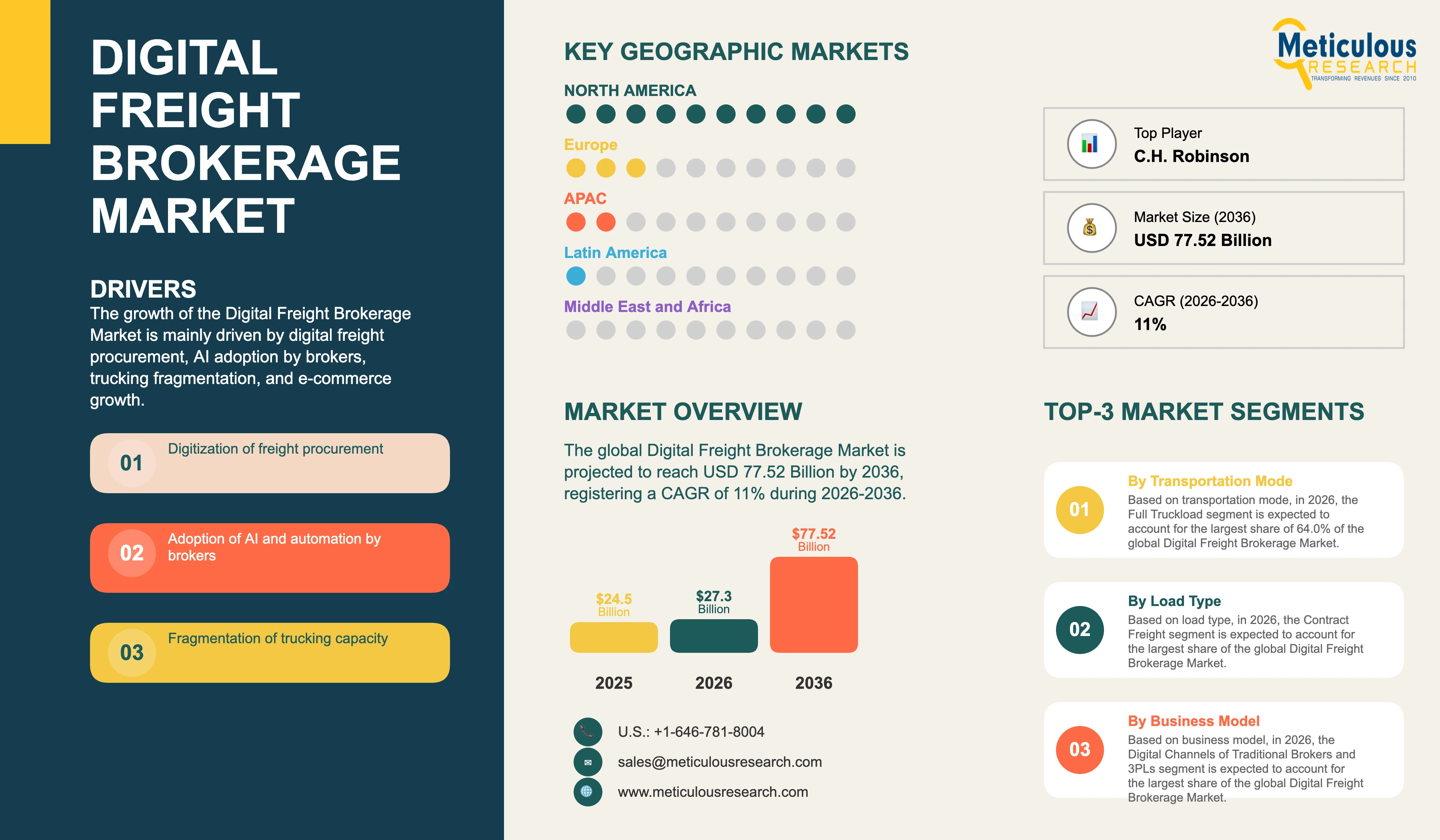
The global digital freight brokerage market was valued at USD 24.50 billion in 2025. This market is expected to reach USD 77.52 billion by 2036 from an estimated USD 27.30 billion in 2026, registering a CAGR of 11.0% during the forecast period (2026-2036).
- Published
- Nov 2026
- Pages
- 265
- Format
- PDF + Excel
- Report ID
- MRAUTO - 1042644
- Base year
- 2025
- 2025 · BASELINE
- $24.50B
- 2036
- $77.52B
- CAGR 2026–2036
- 11.0%
2025 baseline · 2026–2036 forecast at 11.0% CAGR · hover a bar for the value
Key highlights
Uber Freight reported first-quarter 2026 revenue of USD 1.34 billion, up USD 47 million from USD 1.26 billion a year earlier, marking the first year-over-year revenue gain in six quarters for the digital broker, according to Carrier Atlas. The company continued to report an operating loss, of USD 30 million in the quarter.
C.H. Robinson, one of the largest freight brokers, reported that its proprietary Lean AI strategy, which uses more than 30 in-house AI agents, has increased shipments per person per day by more than 40% since the end of 2022. In the fourth quarter of 2025, its North American Surface Transportation volume grew 1%, including about 3% truckload growth, compared with a 7.6% decline in the Cass Freight Shipment Index.
C.H. Robinson's chief financial officer told FreightWaves that the company receives about 600,000 rate quote requests each year in its North American surface transportation business and that an agentic AI tool now allows it to respond to 100% of these requests.
In the first quarter of 2026, C.H. Robinson's contractual truckload volume mix rose to about 70% from 65%, and the company expanded its operating margin in North American surface transportation by 310 basis points, which it attributed to AI-driven productivity and revenue management, according to its earnings call.
Convoy, once the second-largest pure-play digital freight broker in the U.S., shut down in October 2023 and sold its core technology to Flexport. According to GoFreight in July 2026, the digital truckload category is now led by Uber Freight, J.B. Hunt 360, C.H. Robinson Navisphere, Schneider FreightPower, Loadsmart, and Echo Global Logistics. GoFreight noted that these survivors combine digital matching with larger traditional brokerage businesses rather than operating as standalone digital start-ups. This marks a clear shift from the venture-funded model of the late 2010s. Shippers are also using digital tools to compare rates and carrier performance across brokers, which increases price transparency in the market. This transparency is changing how shippers procure and manage freight.
By transportation mode, full truckload accounts for the largest share of 64.0% in 2026, while drayage registers the highest CAGR.
By load type, contract freight accounts for the larger share in 2026 and also registers the higher CAGR.
By business model, digital channels of traditional brokers and 3PLs account for the largest share in 2026, while freight marketplace platforms register the highest CAGR.
By end-use industry, retail and e-commerce accounts for the largest share of 28.0% in 2026 and also registers the highest CAGR.
By geography, North America accounts for the largest share of 62.0% in 2026, while Asia-Pacific registers the highest CAGR of 14.8%.
Report summary
| Particulars | Details |
|---|---|
| Base Year | 2025 |
| Estimated Year | 2026 |
| Forecast Period | 2026-2036 |
| Market Size in 2025 | USD 24.50 billion |
| Market Size in 2026 | USD 27.30 billion |
| Market Size by 2036 | USD 77.52 billion |
| CAGR (2026-2036) | 11.0% |
| Format | PDF, Excel & Cloud Portal · 265 pages |
| Largest Segment by Transportation Mode (2026) | Full Truckload (64.0%) |
| Largest Segment by End-Use Industry (2026) | Retail and E-Commerce (28.0%) |
| Largest Region (2026) | North America (62.0%) |
| Fastest-Growing Region | Asia-Pacific (CAGR 14.8%) |
| Companies Profiled | 15 companies and other companies |
| Segments Covered | Transportation Mode, Load Type, Business Model, End-Use Industry, Geography |
| Countries Covered | U.S., Canada, Rest of North America, Germany, France, U.K., Italy, Spain, Poland, Netherlands, Belgium, Switzerland, Sweden, Denmark, Norway, Finland, Austria, Ireland, Rest of Europe, China, India, Japan, South Korea, Australia, Indonesia, Vietnam, Thailand, Singapore, Malaysia, Philippines, Taiwan, New Zealand, Rest of Asia-Pacific, Brazil, Mexico, Argentina, Chile, Colombia, Peru, Rest of Latin America, Saudi Arabia, U.A.E., South Africa, Israel, Turkey, Egypt, Rest of Middle East & Africa |
Report overview
Segments covered: transportation mode, load type, business model, end-use industry.
The growth of this market is mainly driven by the increasing digitization of freight procurement by shippers, the adoption of artificial intelligence and automation by freight brokers to improve productivity and pricing, the fragmentation of trucking capacity and the need for efficient carrier matching, the growth of e-commerce and demand for faster and more flexible freight capacity, rising expectations for real-time visibility and transparency, and the expansion of digital freight platforms in Europe, China, India, and Latin America. However, factors such as the cyclical nature of freight markets and pressure on brokerage margins, the high cost of building and scaling technology platforms, freight fraud and cargo theft, and the strong position of traditional brokers with established shipper and carrier relationships are expected to restrain the growth of this market to some extent.
Digital freight brokerage is the arrangement of freight transportation between shippers and carriers using digital platforms that automate key brokerage tasks, such as quoting, load tendering, carrier matching, booking, tracking, documentation, and payment. Like traditional freight brokers, digital freight brokers do not own trucks; they act as intermediaries that secure capacity from motor carriers on behalf of shippers. However, they use algorithms, data, mobile applications, and application programming interfaces to match loads with carriers, set prices, and manage shipments with less manual work. Shippers can obtain instant quotes and book capacity online or through integrations with their transportation management systems, while carriers can find and book loads through mobile apps.
This report covers the global digital freight brokerage market, measured as the gross revenue of freight brokered through digital platforms, including pure-play digital freight brokers, the digital channels of traditional brokers and third-party logistics providers, and freight marketplace platforms that act as brokers. The market is analyzed by transportation mode, load type, business model, end-use industry, and geography. Load boards and freight matching software that do not take brokerage responsibility for shipments, transportation management systems sold as software, and asset-based trucking revenue are analyzed in separate reports.
The digital freight brokerage market has gone through significant change since the late 2010s, when venture-funded start-ups such as Uber Freight, Convoy, and Transfix sought to disrupt the traditional brokerage industry. A prolonged freight recession from 2022 to 2025, with excess trucking capacity and low spot rates, compressed brokerage margins across the industry. Convoy, once the second-largest pure-play digital broker in the U.S., shut down in October 2023 and sold its technology to Flexport. The survivors have increasingly combined digital matching with broader brokerage and managed transportation businesses, and Uber Freight reported in May 2026 its first year-over-year revenue gain in six quarters.
At the same time, traditional brokers have invested heavily in digital capabilities, which has blurred the line between digital and traditional brokerage. C.H. Robinson has deployed more than 30 in-house AI agents and increased shipments per person per day by more than 40% since the end of 2022, and other large brokers such as J.B. Hunt, Schneider, RXO, Echo Global Logistics, and Total Quality Logistics have built digital platforms for shippers and carriers. As a result, the digital channels of traditional brokers and third-party logistics providers now account for the largest share of digitally brokered freight.
Artificial intelligence is the most important technology trend shaping the digital freight brokerage market today. Brokers are using AI agents to respond to rate requests, price loads, select carriers, answer carrier calls and emails, schedule appointments, track shipments, and process documents. C.H. Robinson's chief financial officer has said that an agentic AI tool allows the company to respond to all of its roughly 600,000 annual rate quote requests. These capabilities reduce the cost of handling each shipment and allow brokers to grow volume without adding staff, which strengthens the economics of digital brokerage.
Outside North America, digital freight brokerage is growing in Europe, where companies such as sennder have built large digital road freight businesses, in China, where Full Truck Alliance operates the country's largest digital freight platform, and in India and Latin America, where fragmented trucking markets and growing smartphone use are supporting digital platforms. The fragmentation of trucking capacity, with large numbers of small carriers and owner-operators, makes digital matching particularly valuable in these markets.
Full truckload freight accounts for the largest share of the market by transportation mode, while drayage is the fastest-growing mode. Contract freight accounts for the largest share by load type and is growing faster than spot freight, as shippers increasingly use digital brokers for committed capacity. The digital channels of traditional brokers and third-party logistics providers account for the largest share by business model, while freight marketplace platforms are the fastest-growing model. North America accounts for the largest share of the market, while Asia-Pacific is the fastest-growing region.
Over the forecast period, the digital freight brokerage market is expected to grow steadily as freight markets recover, shippers digitize procurement, brokers adopt AI, and platforms expand in Europe and Asia-Pacific. At the same time, the market's growth will depend on freight cycles, margin pressure, fraud prevention, and the ability of digital platforms to achieve sustainable profitability.
The digital channels of traditional brokers and third-party logistics providers are expected to account for the largest share of the market in 2026, while freight marketplace platforms are projected to register the highest CAGR.
North America is expected to account for the largest share of 62.0% of the market in 2026, mainly due to the large and fragmented U.S. trucking market, the presence of the largest digital and traditional brokers, and high adoption of digital procurement and AI.
Asia-Pacific is projected to register the highest CAGR of 14.8% during the forecast period, driven by fragmented trucking markets in China and India, large digital freight platforms, smartphone and digital payment adoption, and e-commerce growth.
The report profiles 15 companies, including C.H. Robinson, Uber Freight, J.B. Hunt, Schneider, RXO, Echo Global Logistics, Total Quality Logistics, Landstar, Arrive Logistics, Loadsmart, Cargomatic, Flexport, DAT Freight & Analytics, Full Truck Alliance, and sennder.
AI agents are automating quoting, pricing, carrier selection, communications, scheduling, tracking, and documentation, which allows brokers such as C.H. Robinson to respond to every rate request and increase shipments handled per employee by more than 40% since 2022.
Report infographic
Market dynamics
18 factors across 5 forcesDigitization of freight procurement by shippers
Shippers are increasingly digitizing the way they procure transportation, using transportation management systems, online portals, and application programming interface integrations to obtain quotes, tender loads, and manage shipments. Digital freight brokers allow shippers to obtain instant quotes, book capacity in seconds, and track shipments in real time, which reduces the time and effort required for freight procurement and improves service. Large shippers in retail, manufacturing, and consumer goods are integrating digital brokers into their routing guides and transportation management systems, which increases the volume of freight brokered digitally. Many large shippers now require brokers to support electronic tendering and automated status updates before they are added to routing guides.
Smaller shippers also benefit from digital brokerage, since online platforms give them access to competitive pricing and capacity without the need for dedicated transportation staff. As the share of freight procured digitally increases, digital brokers and the digital channels of traditional brokers are expected to capture a growing share of brokered freight.
Shippers also value the data generated by digital brokerage, such as lane-level pricing, carrier performance, and transit times, which helps them benchmark costs, improve forecasting, and negotiate contracts more effectively.
Adoption of artificial intelligence and automation by brokers
Freight brokers are adopting artificial intelligence and automation to improve productivity, pricing, and service. AI agents can respond to rate requests, price loads based on market data, select carriers, handle carrier communications, schedule appointments, and process documents, which reduces manual work and allows brokers to handle more shipments per employee. C.H. Robinson's Lean AI strategy, which uses more than 30 in-house AI agents, has increased shipments per person per day by more than 40% since the end of 2022, and the company has said it expects double-digit productivity gains in 2026.
AI also improves pricing accuracy and margin management by analyzing large amounts of data on lanes, capacity, and market conditions in real time. These capabilities make digital brokerage more profitable and scalable, which encourages both digital and traditional brokers to invest further in technology. AI tools can also identify unusual carrier behavior that may indicate fraud, which improves security as well as productivity.
Fragmentation of trucking capacity
Trucking capacity in most markets is highly fragmented, with large numbers of small carriers and owner-operators. In the U.S., most trucking companies operate small fleets, which makes it difficult for shippers to find and manage carriers directly. Freight brokers play a critical role in aggregating this capacity, and digital platforms make it easier to match loads with available carriers efficiently by using data on carrier location, equipment, preferences, and performance.
Mobile applications allow small carriers to find and book loads, receive payment quickly, and reduce empty miles, which helps digital brokers build large carrier networks. In markets such as China, India, and Latin America, where trucking is even more fragmented, digital platforms offer significant efficiency benefits. Quick payment programs, fuel discounts, and load recommendations offered through apps also help brokers attract and retain small carriers.
Growth of e-commerce and demand for flexible capacity
The growth of e-commerce has increased demand for fast, flexible, and reliable freight capacity, particularly for replenishment of distribution centers, fulfillment centers, and stores. Retailers and e-commerce companies need to respond quickly to changes in demand, and digital freight brokers can provide capacity on short notice through their large carrier networks. The growth of omnichannel retail and shorter delivery windows increases the importance of flexible capacity.
E-commerce also increases the number of shipments and the variety of lanes, which favors digital platforms that can price and match loads efficiently at scale. Retail and e-commerce is the largest end-use industry for digital freight brokerage, and its growth supports demand for digital capacity.
Expectations for real-time visibility and transparency
Shippers increasingly expect real-time visibility into the location and status of their shipments, as well as transparency in pricing and carrier performance. Digital brokers provide tracking through mobile apps, electronic logging devices, and telematics integrations, along with automated status updates and performance analytics. Digital brokers like Uber Freight publish lane rates within their apps, which increases pricing transparency for shippers and carriers.
Visibility and transparency improve service reliability and allow shippers to manage exceptions proactively, which strengthens the case for digital brokerage. As visibility becomes a standard requirement, brokers without strong digital capabilities are at a disadvantage. Visibility data also helps brokers measure carrier performance and allocate future loads to the most reliable carriers.
Table of contents
12 chapters · 166 sections · 265 pages · click to expandSegmental analysis
| Segment | Largest share (2026) | Fastest growth (2026–2036) |
|---|---|---|
| By Transportation Mode | Full truckload | Drayage |
| By Load Type | Contract freight | — |
| By Business Model | Digital channels of traditional brokers and 3PLs | Freight marketplace platforms |
| By End-Use Industry | Retail and e-commerce | Retail and e-commerce |
| Other segments | Retail and e-commerce | — |
By Transportation Mode
- Digital Freight Brokerage Market Analysis by Transportation Mode
- The full truckload segment is expected to account for the largest share of 64.0% of the global digital freight brokerage market.
- The large share of this segment is mainly due to the large size of the full truckload freight market, the suitability of full truckload shipments for digital matching, since each load is handled by a single carrier from origin to destination, the high fragmentation of truckload carriers, and the focus of most digital brokers and digital channels of traditional brokers on full truckload freight.
- Full truckload freight was also the original focus of digital freight start-ups such as Uber Freight and Convoy.
- Digital platforms are well suited to full truckload freight because loads can be priced and matched based on lane, equipment, timing, and carrier location, and carriers can book loads directly through mobile apps.
- Dry van, refrigerated, and flatbed truckload freight are all served by digital brokers.
- Dry van freight is the largest category, since it is the most standardized and easiest to match digitally.
- However, the drayage segment is projected to register the highest CAGR during the forecast period.
- The rapid growth of this segment is driven by the fragmentation and manual nature of drayage operations, growing container volumes at ports, the need for better appointment scheduling and container tracking, and the expansion of digital brokers into drayage, particularly on the U.S. West Coast.
- Less-than-truckload forms the second-largest segment, supported by digital quoting and booking platforms that connect shippers with LTL carriers, followed by intermodal, which benefits from shippers' interest in lower-cost and lower-emission alternatives to long-haul trucking.
- Other modes, including expedited and specialized freight, account for the remaining share.
- Multimodal capabilities are becoming increasingly important for digital brokers, since shippers prefer providers that can manage truckload, LTL, intermodal, and drayage through a single platform.
- Brokers that offer multimodal options can also recommend the most cost-effective mode for each shipment.
- Less-than-truckload and intermodal shipments are also moving to digital booking as carriers and brokers offer instant quotes and tracking, while drayage is benefiting from port digitization and the need to coordinate container pickups and deliveries more efficiently.
- Temperature-controlled freight is another area where digital brokers are adding capacity through specialized carrier networks.
By Load Type
- Digital Freight Brokerage Market Analysis by Load Type
- The contract freight segment is expected to account for the largest share of the global digital freight brokerage market.
- The large share of this segment is mainly due to the large share of freight moved under contracts and routing guides with committed rates, the integration of digital brokers into shippers' transportation management systems and routing guides, and the preference of large shippers for committed capacity at predictable prices.
- C.H.
- Robinson reported a further rise in the contractual share of its truckload volume in the first quarter of 2026, illustrating the importance of contract freight for large brokers.
- This segment is also projected to register the highest CAGR during the forecast period, driven by the growing use of digital brokers for contract freight, AI-driven pricing that allows brokers to bid on contract lanes more accurately, and the integration of brokerage with managed transportation services.
- The spot freight segment accounts for the remaining share of the market.
- Spot freight is important for digital brokers because it allows them to fill urgent capacity needs, handle overflow, and serve shippers without contracts, and digital platforms offer instant spot quotes and booking.
- Spot freight volumes are expected to increase as the freight market recovers and capacity tightens, although spot freight is more volatile than contract freight.
- Digital platforms are particularly effective at handling spot freight because they can quickly identify available carriers.
- Spot freight remains important for digital brokers because it allows them to respond quickly to shipper needs during capacity shortages and seasonal peaks, and many platforms use spot transactions to build relationships with new shippers before winning contract freight.
- The contract freight segment is expected to account for the larger share of the digital freight brokerage market, and it is also projected to register the higher CAGR during the forecast period.
By Business Model
- Digital Freight Brokerage Market Analysis by Business Model
- The digital channels of traditional brokers and third-party logistics providers segment is expected to account for the largest share of the global digital freight brokerage market.
- The large share of this segment is mainly due to the large freight volumes handled by traditional brokers such as C.H.
- Robinson, J.B.
- Hunt, Schneider, RXO, Echo Global Logistics, and Total Quality Logistics, their investment in digital platforms and AI, their established relationships with shippers and carriers, and their ability to combine digital matching with service for complex freight.
- These brokers have moved a growing share of their freight through digital channels, such as C.H.
- Robinson's Navisphere, J.B.
- Hunt 360, and Schneider FreightPower.
- However, the freight marketplace platforms segment is projected to register the highest CAGR during the forecast period.
- The rapid growth of this segment is driven by the expansion of large digital freight platforms in China, India, Europe, and Latin America, where fragmented trucking markets and mobile adoption support platform-based models, and the growth of platforms that combine freight matching, payments, and services for carriers.
- The pure-play digital freight brokers segment forms the second-largest segment, led by Uber Freight, which GoFreight describes as the largest pure-play digital broker by gross revenue, as well as companies such as Loadsmart in North America and sennder in Europe.
- The boundaries between these business models are blurring, since traditional brokers are becoming more digital, and digital brokers are adding service and managed transportation capabilities.
- Over time, the share of freight handled through digital channels is expected to increase across all business models.
- Asset-light platforms are also partnering with asset-based carriers to secure dedicated and reliable capacity for key shippers and peak seasons.
By End-Use Industry
- Digital Freight Brokerage Market Analysis by End-Use Industry
- The retail and e-commerce segment is expected to account for the largest share of 28.0% of the global digital freight brokerage market.
- The large share of this segment is mainly due to the large freight volumes generated by retailers and e-commerce companies for replenishment of distribution centers, fulfillment centers, and stores, the need for flexible capacity to respond to demand changes and seasonal peaks, and the growth of omnichannel retail.
- Retailers also generate a high number of shipments across many lanes, which favors digital platforms that can price and match loads efficiently.
- This segment is also projected to register the highest CAGR during the forecast period, driven by the continued growth of e-commerce, shorter delivery windows, and the expansion of fulfillment networks.
- Manufacturing forms the second-largest segment, supported by inbound and outbound freight for industrial and consumer goods manufacturers, followed by food and beverage, which requires refrigerated capacity and reliable service, automotive, chemicals, construction and building materials, and other industries.
- C.H.
- Robinson reported truckload volume growth in the retail and automotive verticals in the first quarter of 2026, reflecting the importance of these industries for freight brokers.
- Food and beverage shippers also value digital visibility for temperature-controlled loads.
- Construction and chemicals shippers increasingly use digital brokers for flatbed and specialized loads.
- Manufacturing, food and beverage, automotive, chemicals, and construction materials are also major users of digital freight brokerage.
- Manufacturers use digital brokers to manage inbound and outbound freight across multiple plants, food and beverage companies rely on temperature-controlled capacity, and automotive companies need reliable just-in-time deliveries, which encourages the use of platforms with real-time visibility and strong carrier networks.
Other segments
- The retail and e-commerce segment is expected to account for the largest share of 28.0% of the digital freight brokerage market, and it is also projected to register the highest CAGR during the forecast period.
Geographic analysis
North America
Largest shareIn 2026, North America is expected to account for the largest share of 62.0% of the global digital freight brokerage market. The large share of this region is mainly due to the large size of the U.S. trucking and freight brokerage market, the high fragmentation of U.S. trucking capacity, the presence of the largest digital and traditional freight brokers, such as Uber Freight, C.H. Robinson, J.B. Hunt, Schneider, RXO, Echo Global Logistics, and Total Quality Logistics, the high adoption of transportation management systems and digital procurement by shippers, and significant investment in AI and automation by brokers. Canada also has a significant market, supported by cross-border trade with the U.S.
Asia-Pacific
Fastest growthAsia-Pacific is projected to register the highest CAGR of 14.8% during the forecast period. The rapid growth of this region is mainly driven by the large and highly fragmented trucking markets of China and India, the scale of digital freight platforms such as Full Truck Alliance in China, rapid growth in smartphone use and digital payments, government initiatives to improve logistics efficiency, and the growth of e-commerce and manufacturing in China, India, Southeast Asia, and other countries. Japan, South Korea, Australia, and Indonesia are also adopting digital freight platforms to address driver shortages and improve efficiency.
Europe
Europe accounts for a significant share of the market, supported by digital road freight companies such as sennder, the fragmentation of European trucking markets across many countries, cross-border freight within the European Union, and the adoption of digital procurement by large shippers in Germany, France, the U.K., Italy, Spain, Poland, and the Netherlands. Europe's push to reduce empty truck miles and emissions also supports digital freight matching across borders.
Latin America
Latin America accounts for a smaller share of the market, with digital freight platforms growing in Brazil and Mexico, supported by nearshoring and cross-border trade with the U.S. The Middle East & Africa accounts for the smallest share, with early platforms in Saudi Arabia, the U.A.E., South Africa, and other countries. Regional differences in trucking fragmentation, digital adoption, and freight market maturity shape the growth of digital freight brokerage around the world. Regions with fragmented trucking markets and rapid digital adoption are expected to see the fastest growth. Cross-border digital platforms connecting the U.S. and Mexico are also expected to grow as nearshoring increases trade volumes. Latin America and the Middle East & Africa account for smaller shares of the market, but digital freight platforms are expanding in Brazil, Mexico, Colombia, Chile, Saudi Arabia, the U.A.E., Egypt, and South Africa, where trucking markets are highly fragmented and shippers face limited visibility. Cross-border trade between the U.S. and Mexico is creating demand for digital brokerage services that combine U.S. and Mexican carrier networks, customs coordination, and real-time tracking.
Middle East & Africa
Digital adoption in the Middle East is also rising with new logistics investment. In the Middle East, large logistics investments in Saudi Arabia and the U.A.E. are supporting the growth of digital freight marketplaces.
Competitive landscape
The global digital freight brokerage market is fragmented, with the top five players estimated to account for about 35% of the market in 2025. The market includes large traditional freight brokers and third-party logistics providers with digital channels, pure-play digital freight brokers, freight marketplace platforms, and digital freight forwarders with trucking capabilities.
C.H. Robinson is one of the largest freight brokers and has invested heavily in digital capabilities, including its Navisphere platform and more than 30 in-house AI agents. Uber Freight is the largest pure-play digital broker by gross revenue and also offers managed transportation through its acquisition of Transplace. J.B. Hunt, through J.B. Hunt 360, Schneider, through FreightPower, RXO, Echo Global Logistics, Total Quality Logistics, Landstar, and Arrive Logistics operate large brokerage businesses with digital channels. Loadsmart offers digital brokerage and software, Cargomatic focuses on drayage, Flexport offers digital trucking as part of its forwarding services, and DAT Freight & Analytics operates a large freight marketplace and analytics business. Outside North America, Full Truck Alliance operates China's largest digital freight platform, and sennder is a leading digital road freight company in Europe.
Companies in this market compete on pricing, capacity access, service reliability, technology and AI capabilities, visibility, integration with shipper systems, carrier experience, fraud prevention, and scale. Key strategies include investment in AI and automation, expansion into LTL, intermodal, drayage, and cross-border freight, integration with managed transportation, partnerships with shippers and technology providers, acquisitions, and geographic expansion.
We expect the market to continue consolidating around large players with the scale to invest in AI and data. Traditional brokers that successfully adopt AI are likely to gain share, while pure-play digital brokers will need to achieve profitability and differentiate through service and technology. Platforms in Asia-Pacific and Europe will continue to grow as digital adoption increases. Fraud prevention capabilities and carrier experience will also become increasingly important competitive factors, since both shippers and carriers are more selective about the platforms they trust. Partnerships between brokers and fraud prevention specialists are also becoming more common. We also expect continued investment in carrier experience.
Some of the key players operating in the digital freight brokerage market are C.H. Robinson Worldwide, Inc., Uber Freight LLC, J.B. Hunt Transport Services, Inc., Schneider National, Inc., RXO, Inc., Echo Global Logistics, Inc., Total Quality Logistics, LLC, Landstar System, Inc., Arrive Logistics, LLC, Loadsmart, Inc., Cargomatic, Inc., Flexport, Inc., DAT Freight & Analytics, Full Truck Alliance Co. Ltd., and sennder Technologies GmbH, among others.
- —
Uber Freight reported its first year-over-year revenue gain in six quarters in the first quarter of 2026, C.H. Robinson expanded its use of AI agents and raised its contractual truckload mix to about 70%, and the digital truckload category consolidated following Convoy's shutdown.
- C.H. Robinson Worldwide, Inc.
- Uber Freight LLC
- J.B. Hunt Transport Services, Inc.
- Schneider National, Inc.
- RXO, Inc.
- Echo Global Logistics, Inc.
- Total Quality Logistics, LLC
- Landstar System, Inc.
- Arrive Logistics, LLC
- Loadsmart, Inc.
- Cargomatic, Inc.
- Flexport, Inc.
- DAT Freight & Analytics
- Full Truck Alliance Co. Ltd.
Expert perspectives
Digital freight brokerage has evolved from a venture-funded attempt to disrupt traditional brokers into a broad transformation of the entire brokerage industry. The freight recession of 2022 to 2025 eliminated weaker digital players, while large brokers adopted digital tools and AI to improve productivity and service. Today, digital capabilities are a core part of how freight is brokered.
Over the forecast period, the market is expected to grow at a CAGR of 11.0%, from USD 27.30 billion in 2026 to USD 77.52 billion in 2036. Growth will be supported by digital procurement, AI adoption, trucking fragmentation, e-commerce, visibility expectations, and expansion in Asia-Pacific and Europe.
Among the market segments, full truckload is the largest transportation mode, while drayage grows fastest. Contract freight is the largest and fastest-growing load type. The digital channels of traditional brokers and third-party logistics providers are the largest business model, while freight marketplace platforms grow fastest, and retail and e-commerce is the largest and fastest-growing end-use industry. North America is the largest region, and Asia-Pacific is the fastest-growing region at a CAGR of 14.8%.
In our view, the most important factor for the market over the forecast period will be the adoption of agentic AI. Brokers that use AI agents to automate quoting, carrier matching, tracking, and documentation will be able to grow volume without proportionally increasing headcount, improve service, and achieve higher margins. This will widen the gap between brokers that invest in AI and those that do not, and it is likely to drive further consolidation.
We also expect the recovery of the freight market to support growth after several years of weak demand and low rates. As capacity tightens, digital platforms that can quickly access carrier capacity will be valuable to shippers. However, freight cycles will continue to create volatility, and digital brokers will need strong balance sheets to manage downturns. Brokers that maintained investment in technology during the downturn are well positioned to benefit from the recovery.
Outside North America, Asia-Pacific and Europe offer significant growth opportunities, supported by fragmented trucking markets and digital adoption. Overall, we believe the digital freight brokerage market will grow steadily over the forecast period, with value increasingly concentrated among large, AI-enabled brokers and platforms that combine technology, scale, and service. Small brokers that adopt AI tools from software providers will also be able to compete more effectively in specialized niches. Data quality and integration will be important foundations for this growth. Brokers that combine AI with experienced staff for complex freight are likely to deliver the best results for shippers. Margin discipline and operating efficiency will be important for profitability during freight downturns.
Customer perspectives
Director of Transportation - National retailer, U.S.
We want instant quotes and capacity that plugs into our TMS, but we also need a broker that will solve problems when things go wrong. The brokers that combine strong technology with service are winning more of our freight.
Logistics Manager - Manufacturer, U.S.
We have moved more lanes onto contracts with digital brokers because their pricing is more accurate and they respond to every request quickly. Spot loads are now mainly for overflow.
“Trucking in India is very fragmented, so digital platforms help us find reliable trucks quickly and track shipments, which was difficult before. Payment through the platform also makes it easier to work with small trucking companies. We now use these platforms for most of our regional shipments.”
Frequently asked questions
The global digital freight brokerage market was valued at USD 24.50 billion in 2025, up from USD 22.80 billion in 2024, and is estimated at USD 27.30 billion in 2026. The market is measured as the gross revenue of freight brokered through digital platforms, including pure-play digital brokers, the digital channels of traditional brokers, and freight marketplace platforms.
Cite this report
Meticulous Research. (2026). Digital Freight Brokerage Market - Global Opportunity Analysis and Industry Forecast (2026-2036) (Report No. MRAUTO - 1042644). Meticulous Market Research Pvt. Ltd. https://www.meticulousresearch.com/product/digital-freight-brokerage-market-7327