India Electric Two-Wheeler Market (2026-2036)
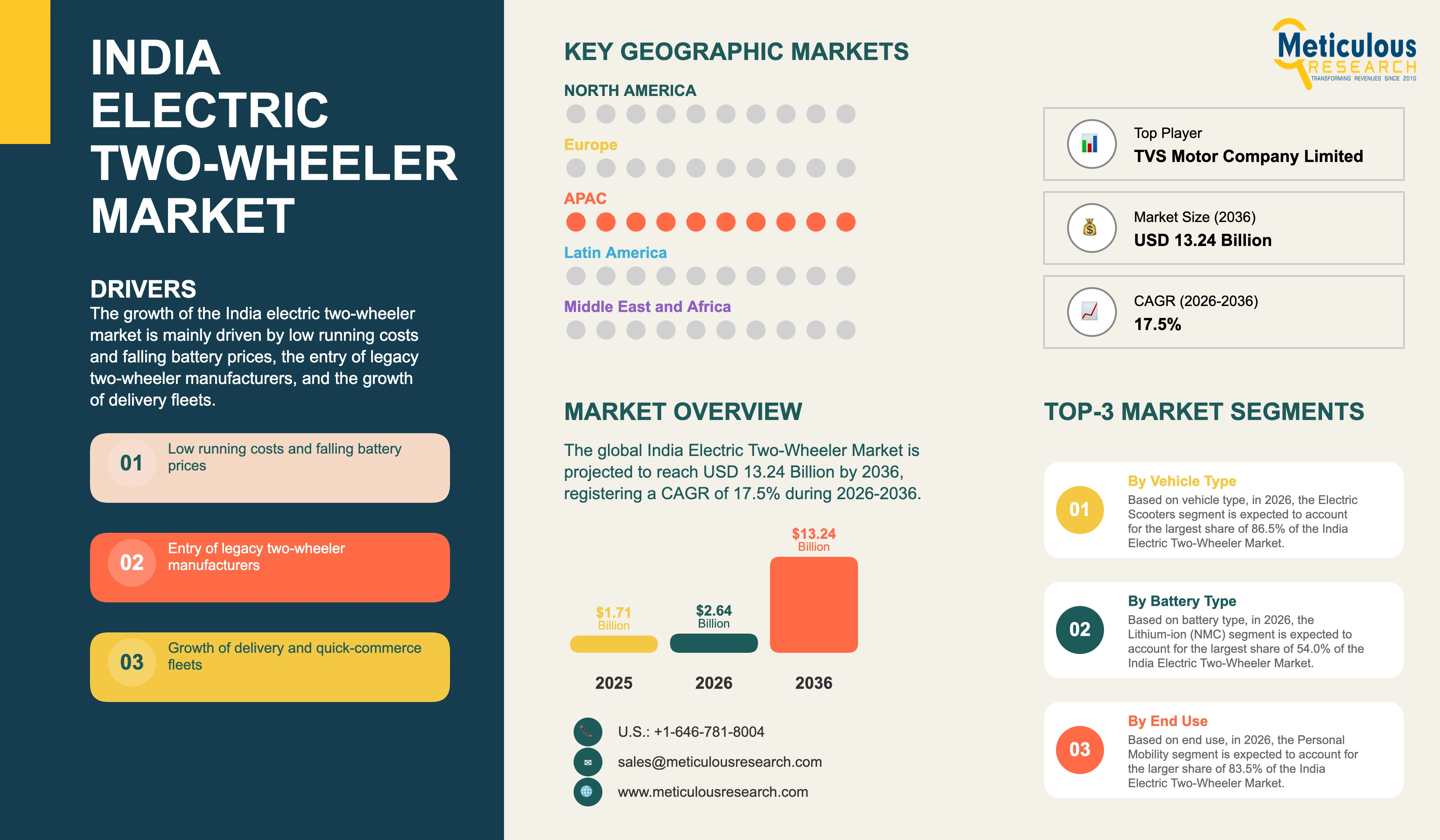
India Electric Two-Wheeler Market Size The India electric two-wheeler market was valued at USD 1.71 billion in 2025. This market is expected to reach USD 13.24 billion by 2036 from an estimated USD 2.64 billion in 2026, registering a CAGR of 17.5% during the forecast period (2026-2036). The growth of
- Published
- Nov 2026
- Pages
- 155
- Format
- PDF + Excel
- Report ID
- MRAUTO - 1042574
- Base year
- 2025
- 2025 · BASELINE
- $1.71B
- 2036
- $13.24B
- CAGR 2026–2036
- 17.5%
2025 baseline · 2026–2036 forecast at 17.5% CAGR · hover a bar for the value
Key highlights
According to retail registration data on the Vahan portal compiled by the Federation of Automobile Dealers Associations (FADA), about 12.8 lakh electric two-wheelers were sold in India in calendar year 2025, an increase of about 11% over 2024. Later Vahan revisions place the 2025 total at about 13.4 lakh units, and electric two-wheelers accounted for about 6.3% of all two-wheeler sales during the year.
Electric two-wheeler sales accelerated sharply in 2026, as Vahan data show that about 17.9 lakh units were registered between January and October 2026, already more than the full-year 2025 total, and October 2026 set a new monthly record of about 2.24 lakh units, up 48% year-on-year.
The competitive landscape changed significantly in 2025, when TVS Motor became the market leader with about 2.99 lakh units and a share of about 23%, followed by Bajaj Auto and Ather Energy, while Ola Electric, which led the market for three years, saw its sales fall by about 51% to roughly 1.99 lakh units.
The central PM E-DRIVE demand incentive for electric two-wheelers, which paid Rs 2,500 per kWh of battery capacity up to Rs 5,000 per vehicle, ended on 31 July 2026. Sales in September and October 2026 still set new records after the incentive closed, which shows that demand is increasingly driven by running cost savings, new models, and financing rather than subsidies.
The Southern region was the largest buyer of electric two-wheelers in 2025, with about 4.4 lakh units and a 34% share of all-India sales according to Vahan data analyzed by Autocar Professional. Maharashtra remains the largest single state, while Karnataka and Tamil Nadu rank second and third.
Legacy two-wheeler makers now dominate the market, as TVS Motor, Bajaj Auto, Hero MotoCorp (Vida), Greaves Electric Mobility, and Honda together outsold the new EV-only startups in 2025, which reflects the advantage of large dealer and service networks, established brands, and access to retail finance.
By vehicle type, electric scooters account for the largest share of 86.5% in 2026, while electric motorcycles register the highest CAGR.
By battery type, lithium-ion (NMC) accounts for the largest share in 2026, while lithium iron phosphate (LFP) registers the highest CAGR.
By battery capacity, 2-3 kWh accounts for the largest share in 2026, while above 4 kWh registers the highest CAGR.
By ownership model, outright purchase accounts for the larger share in 2026, while battery-as-a-service (BaaS) and subscription registers the higher CAGR.
By end use, personal mobility accounts for the larger share of 83.5% in 2026, while commercial and delivery fleets register the higher CAGR.
By region, South India accounts for the largest share of 34.0% in 2026, while North India registers the highest CAGR of 20.3%.
Report summary
| Particulars | Details |
|---|---|
| Forecast Period | 2026-2036 |
| Base Year | 2025 |
| Estimated Year | 2026 |
| CAGR (Value) | 17.5% |
| Format | PDF, Excel & Cloud Portal · 155 pages |
| Market Size (Value) in 2025 | USD 1.71 billion |
| Market Size (Value) in 2026 | USD 2.64 billion |
| Market Size (Value) by 2036 | USD 13.24 billion |
| Largest Segment by Vehicle Type (2026) | Electric Scooters (86.5%) |
| Largest Segment by End Use (2026) | Personal Mobility (83.5%) |
| Largest Region (2026) | South India (34.0%) |
| Fastest-Growing Region | North India (CAGR 20.3%) |
| Segments Covered | Vehicle Type, Battery Type, Battery Capacity, Ownership Model, End Use, Region |
| Countries Covered | Karnataka, Tamil Nadu, Kerala, Telangana, Andhra Pradesh, Rest of South India, Maharashtra, Gujarat, Goa, Rest of West India, Uttar Pradesh, Delhi, Rajasthan, Madhya Pradesh, Haryana, Punjab, Uttarakhand, Rest of North India, West Bengal, Odisha, Bihar, Assam, Jharkhand, Chhattisgarh, Rest of East and Northeast India |
| Key Companies | 16 companies and other companies |
Report overview
Segments covered: vehicle type, battery type, battery capacity, ownership model, end use.
Electric two-wheelers are battery-powered scooters, motorcycles, and mopeds that use an electric motor in place of a petrol engine. In India, they are mainly high-speed models registered with regional transport offices, along with a smaller number of low-speed scooters that do not require registration. This report covers the sale of new electric two-wheelers in India, measured at ex-showroom prices, across electric scooters, electric motorcycles, and electric mopeds, and across battery types, battery capacities, ownership models, end uses, and regions.
India is the world's largest two-wheeler market, with more than 2 crore two-wheelers sold in 2025, and two-wheelers are the main form of personal transport for most households. This large base makes two-wheelers the most important segment of India's electric vehicle transition. Electric two-wheelers accounted for about 56% to 63% of all electric vehicle sales in India in 2025 and 2026, more than electric three-wheelers, cars, buses, and commercial vehicles combined, according to Vahan data.
The market has grown in several phases, and early growth was supported by the FAME-II subsidy scheme, which offered large incentives per kWh of battery capacity and helped startups such as Ola Electric and Ather Energy scale quickly. When the subsidy was cut in June 2023, prices rose and sales dipped, but the market recovered as manufacturers launched lower-priced models. The FAME-II program was followed by the Electric Mobility Promotion Scheme in 2024 and the PM E-DRIVE scheme from October 2024, which offered smaller incentives until 31 July 2026.
The industry is now in a more mature, demand-driven phase in which electric scooters are cost-competitive with petrol scooters over their life, because charging an electric scooter costs a fraction of the fuel cost per kilometer, and maintenance is simpler. As battery prices have fallen and local battery and component production has expanded, manufacturers have been able to offer scooters at prices close to petrol models in many segments, especially when savings on fuel are included.
The competitive structure has also changed, since in the early years EV-only startups such as Ola Electric, Ather Energy, Okinawa, and Ampere led the market. Today, legacy manufacturers lead the market. TVS Motor (iQube), Bajaj Auto (Chetak), Hero MotoCorp (Vida), and Honda (Activa e and QC1) use their large dealer networks, service centers, brand trust, and relationships with financiers to reach buyers across the country. Ather Energy has grown strongly with a focus on product quality and its Rizta family scooter, while Ola Electric has lost share because of service and quality complaints.
Battery technology is a key area of change, as most electric scooters use lithium-ion cells with nickel manganese cobalt (NMC) chemistry, but lithium iron phosphate (LFP) cells are growing quickly because they are cheaper, safer, and last longer, and because new Indian cell factories under the Advanced Chemistry Cell PLI scheme will produce LFP cells at scale. Manufacturers are also offering a wider range of battery sizes, from small packs for low-cost commuter scooters to large packs of more than 4 kWh for premium scooters and motorcycles with longer range.
New ownership models are also changing how buyers pay for electric two-wheelers. Battery-as-a-service (BaaS) plans, such as those offered by Bajaj, Ather, and Vida, separate the cost of the battery from the vehicle and charge a monthly or per-kilometer fee for the battery, which lowers the upfront price. Battery swapping networks, operated by companies such as Sun Mobility, Battery Smart, and Yulu, are widely used by delivery riders and fleets, who need fast turnaround and cannot wait for charging.
Over the forecast period, the India electric two-wheeler market is expected to grow strongly, as electric models gain share in the scooter segment, electric motorcycles reach the mass market, and adoption spreads from the large cities of the South and West to the large two-wheeler markets of North and East India. Growth in value will also be supported by a shift toward larger batteries, connected features, and premium models, partly offset by falling battery prices.
Report infographic
Market dynamics
16 factors across 5 forcesLow running costs and falling battery prices
The main reason Indian buyers choose electric two-wheelers is the much lower cost of running them. Charging a typical electric scooter with a 3 kWh battery at home costs only a few rupees per charge at residential electricity tariffs and provides 100 to 150 km of real-world range, compared with petrol scooters that cost several times more per kilometer at current fuel prices. For daily commuters who ride 30 to 50 km per day, these savings can recover the price difference with a petrol scooter within two to three years. Lower maintenance costs, since electric motors have fewer moving parts and do not need oil changes, add further savings.
Battery prices have fallen sharply in recent years, as global lithium-ion cell prices declined with lower lithium prices and large manufacturing scale in China. Battery packs are the most expensive component of an electric two-wheeler, so lower cell prices have allowed manufacturers to cut vehicle prices, add more range, or both. Manufacturers such as Ola, Ather, TVS, and Bajaj have launched lower-priced models with smaller batteries for budget buyers, while also offering higher-range variants for buyers who want more performance.
Petrol price levels and the growing awareness of total cost of ownership are also important. As more buyers see friends, family members, and delivery riders using electric scooters reliably, concerns about range and reliability are falling, and running cost savings are becoming the main purchase consideration. This shift explains why demand stayed strong in late 2026 even after central purchase subsidies ended.
Entry of legacy two-wheeler manufacturers
The entry and expansion of large legacy two-wheeler manufacturers has transformed the market. TVS Motor, Bajaj Auto, Hero MotoCorp, Honda Motorcycle and Scooter India, and Greaves Electric Mobility have large dealer and service networks across cities and towns, trusted brands built over decades, and relationships with banks and non-bank lenders that provide two-wheeler loans. These strengths have helped them win buyers who were hesitant to buy from new startups.
TVS Motor and Bajaj Auto have become the two largest players, with TVS selling about 2.99 lakh electric scooters in 2025 and Bajaj about 2.70 lakh, according to Vahan data. Hero MotoCorp has grown its Vida brand quickly and recorded its best monthly electric scooter sales in late 2025, while Honda launched the Activa e and QC1 in 2025. These companies are also expanding their electric product ranges, adding lower-priced variants, family scooters, and electric motorcycles.
Legacy manufacturers can also produce electric two-wheelers at large scale in existing plants, source components through established supplier networks, and offer reliable after-sales service, which builds trust among buyers in smaller cities and rural areas. Their success has increased competition and pushed all players to improve quality, service, and pricing.
Growth of delivery, quick-commerce, and shared mobility fleets
The rapid growth of e-commerce, food delivery, and quick-commerce companies such as Zomato's Blinkit, Swiggy Instamart, Zepto, Flipkart Minutes, and Amazon has created strong demand for electric two-wheelers used by delivery riders. Delivery riders travel long distances every day, so fuel savings are large, and many fleets have committed to electrifying their delivery operations to reduce costs and meet sustainability goals.
Fleet operators and rental companies such as Yulu, Zypp Electric, and Bounce lease electric scooters to delivery riders, often with battery swapping included, which removes the need for riders to own a vehicle or wait for charging. These models are expanding rapidly in large cities. Low-speed scooters and models designed for delivery, with larger storage and rugged designs, are also popular in this segment.
Government policy and local manufacturing incentives
Government policy has supported the electric two-wheeler market at both central and state levels. Central schemes such as FAME-II, the Electric Mobility Promotion Scheme, and PM E-DRIVE offered purchase incentives, while the Goods and Services Tax on electric vehicles is 5%, compared with much higher rates on petrol two-wheelers. Many states, including Maharashtra, Delhi, Gujarat, Tamil Nadu, Karnataka, and Telangana, offer road tax and registration fee waivers and other incentives under their own EV policies.
The PLI scheme for automobiles and auto components and the PLI scheme for Advanced Chemistry Cell battery storage support local production of electric vehicles, components, and battery cells. Ola Electric has started production of its own 4680 cells at its Gigafactory in Tamil Nadu, and several other companies are building cell factories. Local production of motors, controllers, battery packs, and cells is expected to lower costs further and reduce dependence on imports over the forecast period.
Table of contents
13 chapters · 154 sections · 155 pages · click to expandSegmental analysis
| Segment | Largest share (2026) | Fastest growth (2026–2036) |
|---|---|---|
| By Vehicle Type | 2-3 kWh | Above 4 kWh |
By Vehicle Type
- The 2-3 kWh segment is expected to account for the largest share of the India electric two-wheeler market, while the above 4 kWh segment is projected to register the highest CAGR during the forecast period.
- The outright purchase segment is expected to account for the larger share of the India electric two-wheeler market, while the battery-as-a-service (BaaS) and subscription segment is projected to register the higher CAGR during the forecast period.
Geographic analysis
Asia-Pacific
Largest shareThe India electric two-wheeler market was valued at USD 1.71 billion in 2025. This market is expected to reach USD 13.24 billion by 2036 from an estimated USD 2.64 billion in 2026, registering a CAGR of 17.5% during the forecast period (2026-2036). The growth of this market is mainly driven by the falling cost of lithium-ion battery packs, the much lower running cost of electric scooters compared with petrol models, the entry of large legacy two-wheeler manufacturers such as TVS Motor, Bajaj Auto, and Hero MotoCorp with wide dealer networks, the rapid growth of last-mile delivery and quick-commerce fleets, battery-as-a-service and subscription models that lower the purchase price, state EV policies and road tax waivers, and the Production Linked Incentive (PLI) schemes for automobiles and advanced chemistry cells that are building a local supply chain. However, factors such as the end of central purchase subsidies under the PM E-DRIVE scheme, high upfront prices compared with entry-level petrol scooters and motorcycles, concerns about battery life and resale value, and gaps in public charging infrastructure in smaller cities are expected to restrain the growth of this market to some extent. In 2026, South India is expected to account for the largest share of 34.0% of the India electric two-wheeler market. The large share of this region is mainly due to high adoption in Karnataka, Tamil Nadu, Kerala, Telangana, and Andhra Pradesh, the presence of manufacturing plants and headquarters of TVS Motor, Ola Electric, and Ather Energy in the region, high urbanization, and supportive state EV policies. According to Vahan data analyzed by Autocar Professional, the Southern zone sold about 4.4 lakh electric two-wheelers in 2025, with Karnataka selling about 1.7 lakh units and Tamil Nadu about 1.4 lakh units. West India, led by Maharashtra, Gujarat, and Goa, is the second-largest region. Maharashtra is the largest single state for electric two-wheeler sales and recorded the highest EV penetration in two-wheelers among large states, with Pune, Mumbai, and Nagpur as important markets. Bajaj Auto's Chetak, produced in Pune, sells strongly in this region, and the state's EV policy offers road tax exemptions and other incentives. Gujarat is also an important market, supported by its own EV policy and strong two-wheeler demand in cities such as Ahmedabad and Surat. Goa has one of the highest electric two-wheeler penetration rates among smaller states, supported by state incentives and high urbanization. North India is projected to register the highest CAGR of 20.3% during the forecast period. The rapid growth of this region is mainly driven by the very large two-wheeler markets in Uttar Pradesh, Rajasthan, Madhya Pradesh, Haryana, and Punjab, where electric penetration is still low, the expansion of legacy manufacturer dealer networks into these states, the growth of delivery fleets in Delhi NCR, and Delhi's strong EV policy. Uttar Pradesh is India's largest state for overall vehicle sales and electric three-wheelers, but its electric two-wheeler penetration is still well below that of the South and West, which leaves a large opportunity for growth. Punjab and Uttarakhand are smaller markets but are expected to grow quickly as dealer networks expand and state EV policies are implemented. East and Northeast India, including West Bengal, Odisha, Bihar, Jharkhand, Assam, and other northeastern states, is currently the smallest region but is also expected to grow quickly as dealer networks expand, model prices fall, and state governments implement EV policies. Odisha and Assam have introduced incentives for electric two-wheelers, and rising fuel costs and growing urbanization in cities such as Kolkata, Bhubaneswar, Patna, and Guwahati are supporting demand. Bihar has already become one of the larger states for overall EV sales, mainly because of electric three-wheelers, and growing dealer coverage is expected to lift electric two-wheeler sales in the region over the forecast period. Chhattisgarh is also emerging as a growing market. India Electric Two-Wheeler Market Size Geographic Analysis
Competitive landscape
The India electric two-wheeler market is moderately concentrated, with the top five players estimated to account for about 80% of the market in 2025. The market includes legacy two-wheeler manufacturers, EV-only startups, and a large number of small assemblers. Leading companies include TVS Motor Company Limited, Bajaj Auto Limited, Ather Energy Limited, Ola Electric Mobility Limited, Hero MotoCorp Limited (Vida), Honda Motorcycle and Scooter India Private Limited, and Greaves Electric Mobility Limited (Ampere).
TVS Motor became the market leader in 2025 with its iQube range, and its sales continued to grow strongly in 2026, including a record of more than 60,000 units in October 2026. Bajaj Auto's Chetak is the second-largest brand, while Ather Energy has grown rapidly with its Rizta and 450 series and completed its initial public offering in 2025. Ola Electric, which led the market from 2022 to 2024, has lost significant share because of service issues and intense competition, although it continues to launch new scooters and motorcycles and is producing its own battery cells.
Hero MotoCorp's Vida brand has grown quickly and recorded its highest monthly sales in late 2025 and 2026, supported by Hero's large dealer network and battery-as-a-service plans. Honda launched its first electric scooters for India in 2025, including the Activa e with swappable batteries and the QC1 with a fixed battery, and is expanding its swapping network. Greaves Electric Mobility, River, BGauss, Kinetic Green, and Pure EV are other important players, while Revolt, Oben, Ultraviolette, and Matter focus on electric motorcycles.
Companies compete on price, range, performance, design, features, service network, brand trust, financing options, and battery warranties. Key strategies include new model launches at different price points, expansion of dealer and service networks into smaller cities, battery-as-a-service offerings, partnerships with financiers and fleet operators, investment in local battery and component production, and exports. Legacy manufacturers are also using their scale in petrol two-wheelers to secure components and lower costs.
Competition is expected to intensify further as more legacy manufacturers launch electric models, including Royal Enfield's planned electric motorcycles under the Flying Flea brand, and as Suzuki and Yamaha introduce electric scooters for India. Smaller companies that lack scale, service networks, or strong products are likely to lose share or exit the market.
Some of the key players operating in the India electric two-wheeler market are TVS Motor Company Limited, Bajaj Auto Limited, Ather Energy Limited, Ola Electric Mobility Limited, Hero MotoCorp Limited, Honda Motorcycle and Scooter India Private Limited, Greaves Electric Mobility Limited, River Mobility Private Limited, BGauss Auto Private Limited, Kinetic Green Energy and Power Solutions Limited, Revolt Motors, and Ultraviolette Automotive Private Limited, among others.
- —
TVS Motor became the market leader in 2025 and sold a record of more than 60,000 electric scooters in October 2026, Honda launched the Activa e and QC1 in 2025, Ola Electric launched its Roadster X electric motorcycles and began producing its own battery cells, and the PM E-DRIVE incentive for electric two-wheelers ended on 31 July 2026.
- EV-only startups
- Bajaj Auto Limited
- Ather Energy Limited
- Ola Electric Mobility Limited
- Hero MotoCorp Limited · Vida
- Honda Motorcycle and Scooter India Private Limited
- Greaves Electric Mobility Limited · Ampere
Expert perspectives
The India electric two-wheeler market has moved from a subsidy-driven startup market to a mainstream market led by large legacy manufacturers. Record sales in late 2026, after central purchase subsidies ended, show that demand is now driven mainly by running cost savings, a wider choice of models, and better financing. We see this as an important turning point for the industry and a sign that electric two-wheelers are becoming a normal choice for Indian buyers.
Over the forecast period, the market is expected to grow at a CAGR of 17.5%, from USD 2.64 billion in 2026 to USD 13.24 billion in 2036. Growth will be supported by rising penetration in scooters, the arrival of affordable electric motorcycles, the spread of adoption to North and East India, and the growth of delivery fleets. Falling battery prices will reduce average vehicle prices, but this will be partly offset by larger batteries and more premium features.
Electric scooters remain by far the largest vehicle type, while electric motorcycles grow fastest. LFP batteries are expected to gain share quickly as local cell production starts, and battery-as-a-service models are expected to grow faster than outright purchase. South India remains the largest region, while North India is the fastest-growing region at a CAGR of 20.3%.
For manufacturers, the key priorities are to keep reducing costs, build reliable service networks, offer longer battery warranties and buyback programs to address resale concerns, and develop affordable electric motorcycles. Manufacturers should also invest in local battery and component supply, including rare earth-free or reduced-rare-earth motors, to reduce exposure to import disruptions.
We expect the competitive structure to remain dominated by legacy manufacturers and a small number of strong EV-only brands, especially Ather Energy. Consolidation among smaller players is likely, and new entrants from among large Indian and Japanese manufacturers will add further competition. Over the long term, we expect electric two-wheelers to account for a large share of India's two-wheeler sales, with the speed of this shift depending mainly on battery costs, the success of electric motorcycles, and the availability of finance. The development of a reliable used-vehicle market, supported by battery health certification, will also be important for long-term adoption.
Policy will also remain important even without central purchase subsidies, as state EV policies, road tax waivers, PLI incentives for local manufacturing, battery swapping standards, and safety regulations will all shape the market. We see the development of interoperable battery swapping standards and a strong local cell manufacturing industry as the most important policy priorities for the next phase of growth.
Customer perspectives
“I spend almost nothing on charging at home compared with what I used to spend on petrol, and the scooter has enough range for my office trips all week. I chose a brand with a service center close to my house because I did not want any problems after buying.”
“Our riders cover more than 100 kilometers a day, so electric scooters save them a lot of money, but they cannot wait for charging. Battery swapping and leased vehicles are the only practical model for our fleet.”
“Customers in our town trust the brand they have bought for years, and they ask about the battery warranty and resale value before anything else. Many of them want an electric motorcycle, not a scooter, if the price is right.”
Frequently asked questions
The India electric two-wheeler market was valued at USD 1.71 billion in 2025, up from USD 1.54 billion in 2024, and is estimated at USD 2.64 billion in 2026, supported by record sales in 2026 that surpassed the full-year 2025 total by October. The market is measured as the ex-showroom value of new electric scooters, motorcycles, and mopeds sold in India.
Cite this report
Meticulous Research. (2026). India Electric Two-Wheeler Market - Global Opportunity Analysis and Industry Forecast (2026-2036) (Report No. MRAUTO - 1042574). Meticulous Market Research Pvt. Ltd. https://www.meticulousresearch.com/product/india-electric-two-wheeler-market-7257