Offshore Support Vessels Market (2026-2036)
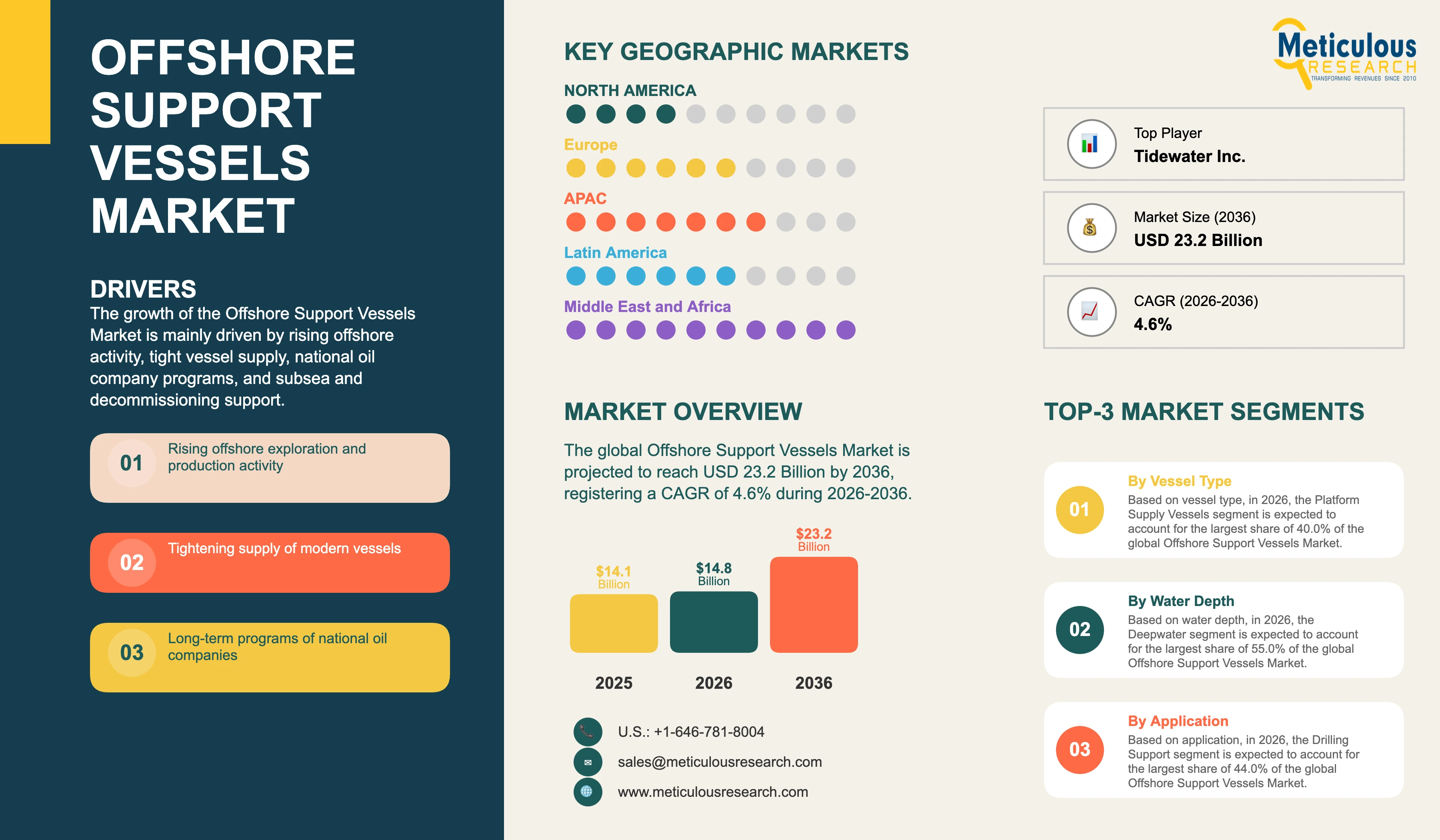
The global offshore support vessels market was valued at USD 14.10 billion in 2025. This market is expected to reach USD 23.20 billion by 2036 from an estimated USD 14.80 billion in 2026, registering a CAGR of 4.6% during the forecast period (2026-2036).
- Published
- Nov 2026
- Pages
- 272
- Format
- PDF + Excel
- Report ID
- MRAUTO - 1042721
- Base year
- 2025
- 2024 · HISTORICAL
- $559.6M
- 2036
- $23.20B
- CAGR 2026–2036
- 4.6%
2024–2025 baseline · 2026–2036 forecast at 4.6% CAGR · hover a bar for the value
Key highlights
Tidewater, the largest global operator of offshore support vessels with 191 offshore support vessels at the end of 2025, reported 2025 revenue of USD 1.35 billion, an average day rate of USD 22,573 per day, up 6.1%, active utilization of 78.7%, and adjusted EBITDA of USD 598.1 million, up from USD 559.6 million in 2024.
Tidewater raised its 2026 revenue guidance to USD 1.43 billion to USD 1.48 billion, including the acquisition of Wilson Sons Ultratug Offshore in Brazil for about USD 500 million, which marks its entry into the Brazilian offshore support vessel market. Tidewater reported firm backlog and options of about USD 1.1 billion.
Tidewater reported that its vessels in the UAE and Qatar remained safely in port and on hire during the 2026 regional conflict, and that no customers had ordered evacuations, although it expected higher insurance costs in the region.
Only five offshore support vessel newbuild orders were placed globally in 2026 through mid-year, comprising four anchor handling tug supply vessels and one platform supply vessel, mainly for Middle Eastern operators, while second-hand vessel values rose slightly because of scarce newbuild orders and tight supply of modern tonnage.
Very large anchor handling tug supply vessels with bollard pull of 250 tonnes or more saw strong demand in the North Sea spot market in 2026, where a small number of owners control most of the high-end capacity.
SEACOR Marine reported a contract backlog of more than USD 500 million at the end of 2025, its highest level to date, while Hornbeck Offshore secured a two-year North Sea contract for riserless well plugging and abandonment operations beginning in the second quarter of 2027.
Petrobras has contracted more than 20 new platform supply vessels to be built in Brazil for delivery in 2027 and 2028, which is expected to support growth in the Latin American market.
By vessel type, platform supply vessels account for the largest share of 40.0% in 2026, while multipurpose support vessels register the highest CAGR.
By water depth, deepwater accounts for the larger share in 2026 and also registers the higher CAGR.
By application, drilling support accounts for the largest share of 44.0% in 2026, while construction, installation, and decommissioning support registers the highest CAGR.
By geography, Middle East & Africa accounts for the largest share of 30.0% in 2026, while Latin America registers the highest CAGR of 6.0%.
Report summary
| Particulars | Details |
|---|---|
| Base Year | 2025 |
| Estimated Year | 2026 |
| Forecast Period | 2026-2036 |
| Market Size in 2025 | USD 14.10 billion |
| Market Size in 2026 | USD 14.80 billion |
| Market Size by 2036 | USD 23.20 billion |
| CAGR (2026-2036) | 4.6% |
| Format | PDF, Excel & Cloud Portal · 272 pages |
| Largest Segment by Vessel Type (2026) | Platform Supply Vessels (40.0%) |
| Largest Segment by Application (2026) | Drilling Support (44.0%) |
| Largest Region (2026) | Middle East & Africa (30.0%) |
| Fastest-Growing Region | Latin America (CAGR 6.0%) |
| Companies Profiled | 12 companies and other companies |
| Segments Covered | Vessel Type, Water Depth, Application, Geography |
| Countries Covered | Saudi Arabia, UAE, Qatar, Nigeria, Angola, Rest of Middle East & Africa, China, India, Malaysia, Indonesia, Australia, Rest of Asia-Pacific, Norway, U.K., Netherlands, Rest of Europe, Brazil, Guyana, Mexico, Rest of Latin America, U.S., Canada |
Report overview
Segments covered: vessel type, water depth, application.
The growth of this market is mainly driven by rising offshore exploration and production activity, particularly in deepwater regions such as Brazil, Guyana, West Africa, and the U.S. Gulf of Mexico, a tightening supply of modern vessels after nearly a decade of very limited newbuild orders, long-term drilling and production programs of national oil companies in the Middle East and Asia, growing demand for vessels to support subsea construction, floating production units, and decommissioning, and rising charter rates for high-specification anchor handling and platform supply vessels. However, factors such as the aging global fleet, high newbuild costs, crew shortages, volatility in offshore drilling activity, and regional disruptions such as the 2026 conflict in the Gulf are expected to restrain the growth of this market to some extent.
Offshore support vessels are specialized ships that support offshore oil and gas exploration, development, production, and decommissioning. They transport supplies, equipment, fuel, water, drilling fluids, and personnel to offshore rigs and platforms, tow and position drilling rigs and floating production units, handle anchors and mooring systems, support subsea construction and inspection work, provide emergency response and standby services, and carry out a range of other tasks. Offshore support vessels are essential to every offshore operation, and their demand is closely linked to the number of active drilling rigs, production facilities, and offshore projects.
This report covers global charter revenue from offshore support vessels serving the offshore oil and gas industry, including platform supply vessels, anchor handling tug supply vessels, multipurpose support vessels, and standby, rescue, crew, and utility vessels, in shallow water and deepwater, for drilling support, production support, and construction, installation, and decommissioning support. The construction and sale of new vessels, heavy construction and pipelay vessels, drilling rigs, liftboats, seismic vessels, and commissioning service operation vessels and service operation vessels dedicated to offshore wind farms are excluded from the scope of this report, as they are covered in separate studies.
Platform supply vessels are the largest type of offshore support vessel by revenue in most regions. They carry cargo, liquid mud, fuel, water, and dry bulk to offshore rigs and platforms, and modern large platform supply vessels have deck areas of 900 square meters or more and dynamic positioning systems. Anchor handling tug supply vessels combine towing, anchor handling, and supply capabilities and are used to move and moor drilling rigs and floating production units. The largest anchor handling tug supply vessels, with bollard pull of 250 tonnes or more, are used for deepwater mooring operations and command the highest day rates. Multipurpose support vessels are equipped with cranes, remotely operated vehicles, and other equipment to support subsea inspection, maintenance, repair, and light construction.
The offshore support vessel market went through a long downturn from 2015 to 2021, when oil prices fell and offshore activity declined. During this period, many vessels were laid up or scrapped, several major operators went through financial restructuring, and very few new vessels were ordered. The market recovered strongly from 2022 as offshore activity increased, and day rates and utilization rose to their highest levels in a decade by 2024. Activity softened in 2025 as some drilling programs were deferred, but Tidewater still reported a 6.1% increase in its average day rate for 2025.
The offshore support vessel industry is consolidating as operators seek greater scale and efficiency. Tidewater, the largest operator, has grown through acquisitions of GulfMark Offshore, Swire Pacific Offshore, and the vessels of Solstad Offshore, and in 2026 it agreed to acquire Wilson Sons Ultratug Offshore in Brazil. Other major operators include Edison Chouest Offshore and Bourbon, which are private companies, and publicly listed operators such as SEACOR Marine, Solstad Offshore, Havila Shipping, and Eidesvik Offshore. Regional operators such as Zamil Offshore and Topaz Energy and Marine in the Middle East, and Hornbeck Offshore and Harvey Gulf in the U.S., are also important.
The global fleet is aging, and very few new vessels have been ordered since 2015. Newbuild costs have risen significantly, and current charter rates do not yet justify new orders for most vessel types, especially large anchor handling tug supply vessels. As a result, older vessels that would previously have been retired are being dry-docked and kept working, and supply is expected to tighten further as demand grows.
Over the forecast period, the market is expected to grow steadily, supported by offshore drilling and production activity, deepwater projects, decommissioning, and a tight supply of modern vessels. Platform supply vessels are expected to remain the largest vessel type, while multipurpose support vessels grow fastest. Deepwater is expected to remain the largest and fastest-growing water depth. The Middle East & Africa is expected to remain the largest region, while Latin America is expected to grow fastest.
Report infographic
Market dynamics
16 factors across 5 forcesRising offshore exploration and production activity
Offshore exploration and production activity has increased since 2022, supported by the attractive economics of deepwater projects, the long-term programs of national oil companies, and the need for new oil and gas supply. Each offshore drilling rig typically requires two to three supply vessels, and floating production units and platforms require regular supply and support services throughout their operating lives. As the number of active rigs and production facilities increases, demand for offshore support vessels rises.
Deepwater drilling activity is expected to increase over the next few years, with drilling contractors expecting deepwater rig utilization to approach full capacity by 2027. New floating production units in Brazil, Guyana, West Africa, and other regions will also require long-term vessel support. These trends are expected to support demand for platform supply vessels and anchor handling tug supply vessels over the forecast period. Offshore production facilities also need support vessels for their entire operating lives, which often exceed 20 years, which provides a stable base of long-term demand that is less sensitive to short-term changes in drilling activity.
The 2026 regional conflict in the Gulf showed how important offshore support vessels are to continuous operations. Tidewater reported that its vessels in the UAE and Qatar remained on hire even while safely in port, which reflects the long-term nature of contracts with national oil companies in the region. As drilling and production activity recover, vessels are expected to return quickly to full operations.
Tightening supply of modern vessels
Very few offshore support vessels have been ordered since 2015, and the global fleet is aging. Newbuild costs have risen sharply, and current charter rates do not justify new orders for most vessel types, especially large anchor handling tug supply vessels. Only five offshore support vessel newbuild orders were placed globally in 2026 through mid-year, and yard lead times of three to four years mean that any vessels ordered now would not be delivered until the end of the decade.
At the same time, older vessels are being retired or are becoming less competitive as operators require modern, fuel-efficient vessels with dynamic positioning and high safety standards. This tightening supply is expected to support higher utilization and charter rates, particularly for high-specification vessels. Second-hand vessel values have risen as a result of scarce newbuilds and tight supply of modern tonnage.
Very few large anchor handling tug supply vessels are on order anywhere in the world, and the newbuild orderbook is concentrated in mid-size platform supply vessels for specific projects, such as those for Petrobras. This means that the supply of the largest and most capable vessels is expected to remain tight throughout the remainder of the decade, while vessel removals have slowed because older vessels are being kept in service.
Long-term programs of national oil companies
National oil companies in the Middle East, Asia, and Latin America operate large offshore fields that require continuous vessel support for drilling, production, and maintenance. Saudi Aramco, ADNOC, Qatar Energy, Petrobras, ONGC, PETRONAS, and Pemex contract large numbers of offshore support vessels on long-term charters. Most of the newbuild orders placed in 2026 were for Middle Eastern operators, which reflects the strength of demand in this region. Petrobras has contracted more than 20 new platform supply vessels to be built in Brazil for delivery in 2027 and 2028, which shows its long-term commitment to offshore development. These programs provide stable, long-term demand that supports vessel operators throughout the forecast period.
In the Middle East, national oil companies are also expanding offshore gas production, which requires additional vessel support for drilling, construction, and production. In Asia, ONGC, PETRONAS, and Pertamina continue to contract vessels for offshore programs, and in Mexico, Pemex remains a large user of offshore support vessels despite its financial constraints.
Growth in subsea, floating production, and decommissioning support
The growth of subsea developments, floating production units, and decommissioning activity is increasing demand for specialized vessels such as multipurpose support vessels and large anchor handling tug supply vessels. Subsea construction and inspection, maintenance, and repair work require vessels with cranes, remotely operated vehicles, and dynamic positioning, while floating production units require anchor handling vessels for mooring installation and hook-up.
Decommissioning programs in the North Sea, the Gulf of Mexico, and Asia-Pacific also require support vessels for well plugging and abandonment, subsea removal, and platform removal. Hornbeck Offshore's two-year North Sea contract for riserless well plugging and abandonment from 2027 shows how vessels are being used for decommissioning work. Offshore wind construction and maintenance also compete for some of the same vessels, especially multipurpose support vessels and platform supply vessels with walk-to-work systems, which tightens supply for oil and gas customers in Europe and other regions with large wind programs.
Table of contents
11 chapters · 122 sections · 272 pages · click to expandSegmental analysis
| Segment | Largest share (2026) | Fastest growth (2026–2036) |
|---|---|---|
| By Vessel Type | Platform supply vessels | Multipurpose support vessels |
By Vessel Type
- The deepwater segment is expected to account for the larger share of the offshore support vessels market, and it is also projected to register the higher CAGR during the forecast period.
Geographic analysis
Middle East & Africa
Largest shareIn 2026, the Middle East & Africa is expected to account for the largest share of 30.0% of the global offshore support vessels market. The large share of this region is mainly due to the large offshore operations of national oil companies in Saudi Arabia, the UAE, Qatar, and other Gulf countries, which require large fleets of supply, anchor handling, and crew vessels, as well as deepwater operations in West Africa, including Nigeria and Angola. Within the Middle East & Africa, Saudi Arabia is the largest country market, supported by Saudi Aramco's large offshore fleet requirements, followed by the UAE and Qatar, where national oil companies are expanding offshore oil and gas production. In West Africa, Nigeria and Angola are the largest markets, and deepwater programs by Shell, Chevron, ExxonMobil, and TotalEnergies are expected to support vessel demand. Tidewater, Bourbon, Zamil Offshore, and Topaz Energy and Marine have large operations in this region.
Asia-Pacific
Asia-Pacific is the second-largest market, supported by offshore activity in China, India, Malaysia, Indonesia, and Australia. In Asia-Pacific, demand softened in 2025 as some drilling programs were deferred, but long-term programs in India, Malaysia, and Australia are expected to support recovery.
Latin America
Fastest growthLatin America is projected to register the highest CAGR of 6.0% during the forecast period. The rapid growth of this region is mainly due to Petrobras' deepwater development programs in Brazil, including more than 20 new platform supply vessels to be built in Brazil, Tidewater's entry into Brazil, and the growth of offshore activity in Guyana and Suriname. In Latin America, Brazil is the largest country market, followed by Mexico and Guyana. Brazilian cabotage and local content rules favor Brazilian-flagged vessels, which is why Tidewater chose to enter the market through the acquisition of a local operator. Edison Chouest and other operators also have large Brazilian fleets, and Petrobras' new platform supply vessels are expected to add capacity in 2027 and 2028.
Europe
In Europe, the North Sea market is driven by drilling, production, and decommissioning in Norway and the U.K., and high-specification anchor handling vessels have been in strong demand.
North America
In North America, the U.S. Gulf of Mexico is served mainly by U.S.-flagged vessels under cabotage rules, with Edison Chouest, Hornbeck Offshore, and Harvey Gulf as leading operators.
Competitive landscape
The global offshore support vessels market is fragmented, with the top five players estimated to account for about 30% of the market in 2025. The market includes large international operators, regional operators, and many small local companies.
Tidewater is the largest global operator, with 191 offshore support vessels and 2025 revenue of USD 1.35 billion. Edison Chouest Offshore and Bourbon are other leading operators, while SEACOR Marine, Hornbeck Offshore, and Harvey Gulf are important operators in the Americas. Solstad Offshore, Havila Shipping, Eidesvik Offshore, and Siem Offshore are leading operators in the North Sea, and Zamil Offshore and Topaz Energy and Marine are leading operators in the Middle East. Companies compete on vessel specifications, safety performance, operational reliability, day rates, and geographic coverage. Key strategies include acquisitions, fleet renewal through second-hand purchases, long-term contracts, and investment in low-emission technologies.
Tidewater has a global presence across the Middle East, West Africa, the Americas, Europe, and Asia-Pacific, and it has grown through several acquisitions, including Swire Pacific Offshore and Solstad vessels, and the planned acquisition of Wilson Sons Ultratug Offshore in Brazil. Edison Chouest Offshore, a private company, operates a large fleet in the U.S. Gulf of Mexico, Brazil, and other regions, and Bourbon operates a large fleet in West Africa and other regions. SEACOR Marine reported a record backlog of more than USD 500 million at the end of 2025, and Hornbeck Offshore has expanded into decommissioning support in the North Sea. In the North Sea, a small number of owners, including Solstad Offshore, control most of the very large anchor handling tug supply vessels.
We expect consolidation to continue, with larger operators acquiring smaller fleets to gain scale and geographic coverage, and with private equity and other investors playing a role in transactions. Barriers to entry are moderate in the standard vessel segments but high in the high-specification segments, where vessels are expensive and customers require strong safety records. Smaller operators in Asia and the Middle East compete mainly on price and local relationships, and many operate older vessels that serve shelf operations at lower day rates.
Some of the key players operating in the offshore support vessels market are Tidewater Inc., Edison Chouest Offshore, Bourbon, SEACOR Marine Holdings Inc., Hornbeck Offshore Services, Inc., Harvey Gulf International Marine, LLC, Solstad Offshore ASA, Havila Shipping ASA, Eidesvik Offshore ASA, Siem Offshore AS, Zamil Offshore Services Company, and Topaz Energy and Marine, among others.
- —
Tidewater agreed to acquire Wilson Sons Ultratug Offshore in Brazil, SEACOR Marine reported a record backlog, Hornbeck Offshore secured a North Sea riserless well abandonment contract, and Petrobras contracted more than 20 new platform supply vessels to be built in Brazil.
- Tidewater Inc.
- Edison Chouest Offshore
- Bourbon
- SEACOR Marine Holdings Inc.
- Hornbeck Offshore Services, Inc.
- Harvey Gulf International Marine, LLC
- Solstad Offshore ASA
- Havila Shipping ASA
- Eidesvik Offshore ASA
- Siem Offshore AS
- Zamil Offshore Services Company
- Topaz Energy and Marine
Expert perspectives
The offshore support vessels market has entered a period of tightening supply after nearly a decade of very limited newbuild orders. We expect steady growth over the forecast period, supported by rising offshore activity, deepwater projects, and decommissioning.
Over the forecast period, the market is expected to grow at a CAGR of 4.6%, from USD 14.80 billion in 2026 to USD 23.20 billion in 2036. Growth will be supported by offshore activity, tight vessel supply, national oil company programs, and subsea and decommissioning work, while an aging fleet, high newbuild costs, crew shortages, and volatility will moderate growth.
In terms of segments, platform supply vessels remain the largest vessel type, while multipurpose support vessels grow fastest. Deepwater remains the largest and fastest-growing water depth, and drilling support remains the largest application, while construction, installation, and decommissioning support grows fastest. The Middle East & Africa remains the largest region, while Latin America grows fastest at a CAGR of 6.0%.
For vessel operators, the key priorities are to maintain modern fleets, secure long-term contracts, invest in low-emission technologies, and manage crew and operating costs. Consolidation is expected to continue. We believe that the lack of newbuilds will keep the market tight for high-specification vessels through the end of the decade.
We expect market revenue to grow in 2026, supported by higher day rates, the start of new contracts, and Tidewater's expansion into Brazil, followed by steady growth from 2027 as deepwater drilling activity increases. The pace of growth in the later years of the forecast period will depend on the level of offshore investment, the number of new vessels ordered, and the rate at which older vessels are retired. Our forecast assumes that oil prices remain in a range that supports offshore investment and that the regional conflict in the Gulf does not cause prolonged disruption to offshore operations.
In our view, operators with modern, high-specification fleets, diversified geographic exposure, and strong balance sheets will be the main beneficiaries of the market's growth. We expect day rates for large platform supply vessels and anchor handling vessels to rise faster than for smaller vessels, which will widen the gap between the high-end and standard segments of the market.
We also see the growing role of offshore support vessels in subsea and decommissioning work as a long-term positive for the market, as these activities are less sensitive to short-term changes in drilling activity. Owners with flexible vessels that can serve drilling, production, subsea, and decommissioning customers are expected to achieve the highest utilization over the forecast period.
Customer perspectives
Buyers of offshore support vessel services include national oil companies, international oil companies, independent operators, drilling contractors, and subsea contractors. Their decisions depend mainly on vessel specifications, safety performance, reliability, day rates, and availability.
This comment explains why Latin America is the fastest-growing region.
This comment explains why day rates for high-specification vessels are rising.
This comment explains why multipurpose support vessels are growing fastest.
Across all customer groups, safety performance, vessel reliability, and crew competence are critical selection criteria, and many operators now also evaluate vessels on fuel efficiency and emissions. Buyers increasingly prefer to sign longer contracts with operators that can provide modern vessels and consistent service across multiple regions.
National oil companies in the Middle East also place strong emphasis on local content and long-term relationships, and they often award multi-year contracts to operators with established local operations. Subsea contractors, in contrast, often charter vessels for specific campaigns and value flexibility, vessel capabilities, and availability at short notice. Both groups value proven safety records.
“We are contracting new platform supply vessels built in Brazil because we need reliable, modern vessels to support our growing deepwater operations.”
“We need large anchor handlers for our rig moves and mooring work, but there are very few available, so we book them well in advance.”
“Multipurpose support vessels with cranes and remotely operated vehicles allow us to carry out inspection and repair work efficiently.”
Frequently asked questions
The global offshore support vessels market was valued at USD 14.10 billion in 2025, up from USD 14.00 billion in 2024, and is estimated at USD 14.80 billion in 2026. The market is measured as charter revenue from offshore support vessels serving the oil and gas industry.
Cite this report
Meticulous Research. (2026). Offshore Support Vessels Market - Global Opportunity Analysis and Industry Forecast (2026-2036) (Report No. MRAUTO - 1042721). Meticulous Market Research Pvt. Ltd. https://www.meticulousresearch.com/product/offshore-support-vessels-market-7404