Textile Recycling Market (2026-2036)
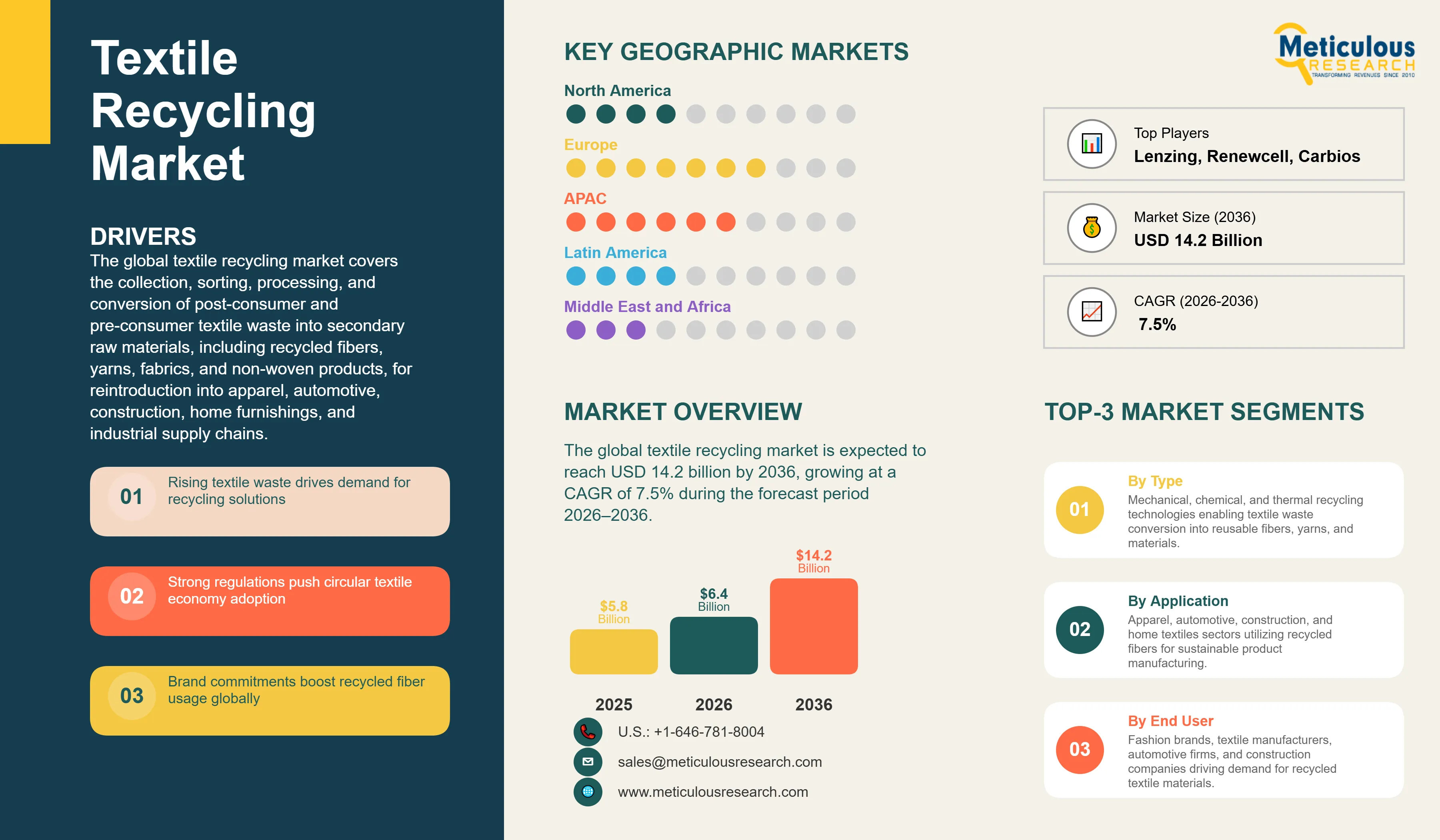
The global textile recycling market was valued at USD 5.8 billion in 2025. This market is expected to reach USD 14.2 billion by 2036 from an estimated USD 6.4 billion in 2026, growing at a CAGR of 7.5% during the forecast period 2026–2036.
- Published
- Apr 2026
- Pages
- 292
- Format
- PDF + Excel
- Report ID
- MR-1885
- Base year
- 2025
- 2025 · BASELINE
- $5.80B
- 2036
- $14.20B
- CAGR 2026–2036
- 7.5%
2025 baseline · 2026–2036 forecast at 7.5% CAGR · hover a bar for the value
Key highlights
The global textile recycling market is projected to reach USD 14.2 billion by 2036.
The market is expected to grow at a CAGR of 7.5% during the forecast period 2026–2036.
The global textile recycling market was valued at USD 5.8 billion in 2025 and is estimated to reach USD 6.4 billion in 2026.
Europe is expected to dominate the global textile recycling market with the largest market share in 2026.
By recycling process, the mechanical recycling segment is expected to hold the largest share of the global textile recycling market in 2026.
By material type, the polyester segment is expected to hold the largest share in 2026.
By source, the post-consumer textile waste segment is expected to hold the largest share in 2026.
By end product, the fibers and yarns segment is expected to hold the largest share in 2026.
By end-use industry, the apparel & fashion segment is expected to hold the largest share in 2026.
By fiber-to-fiber recycling type, the open-loop recycling segment is expected to hold the largest share in 2026.
Report summary
| Particulars | Details |
|---|---|
| Market Size by 2036 | USD 14.2 Billion |
| Market Size in 2026 | USD 6.4 Billion |
| Market Size in 2025 | USD 5.8 Billion |
| Revenue Growth Rate (2026–2036) | CAGR of 7.5% |
| Format | PDF, Excel & Cloud Portal · 292 pages |
| Dominating Recycling Process | Mechanical Recycling |
| Fastest Growing Recycling Process | Chemical Recycling |
| Dominating Material Type | Polyester |
| Fastest Growing Material Type | Blended Fabrics |
| Dominating Source | Post-Consumer Textile Waste |
| Fastest Growing Source | Pre-Consumer (Manufacturing) Waste |
| Dominating End Product | Fibers and Yarns |
| Fastest Growing End Product | Non-Woven Textiles |
| Dominating End-Use Industry | Apparel & Fashion |
| Fastest Growing End-Use Industry | Automotive |
| Dominating Fiber-to-Fiber Type | Open-Loop Recycling |
| Fastest Growing Fiber-to-Fiber Type | Closed-Loop Recycling |
| Dominating Geography | Europe |
| Fastest Growing Geography | Asia-Pacific |
| Base Year | 2025 |
| Forecast Period | 2026 to 2036 |
Report overview
Segments covered: recycling process, material type, source, end product, end-use industry, fiber-to-fiber recycling type.
The global textile recycling market covers the collection, sorting, processing, and conversion of post-consumer and pre-consumer textile waste into secondary raw materials, including recycled fibers, yarns, fabrics, and non-woven products, for reintroduction into apparel, automotive, construction, home furnishings, and industrial supply chains. The market encompasses the full spectrum of recycling technologies, including mechanical shredding and re-spinning, chemical depolymerization and dissolution, thermal energy recovery, and emerging enzymatic bio-based pathways, as well as the supporting infrastructure of waste collection networks, automated sorting facilities, and fiber regeneration and re-spinning capacity that collectively constitute the textile recycling value chain.
The growth of the global textile recycling market is primarily driven by the accelerating legislative pressure on fashion brands and textile manufacturers to incorporate recycled fiber content into their products and to finance end-of-life collection and recycling infrastructure through extended producer responsibility programs. The European Union’s revised Waste Framework Directive mandating separate collection of textile waste across all member states by January 2025, the French AGEC law requiring minimum recycled content in certain textile product categories, and the escalating corporate commitments of major apparel brands including H&M, Zara parent Inditex, Nike, and Adidas to achieve specific recycled fiber content targets by 2030 are collectively creating mandated demand that is stimulating investment in recycling technology development and infrastructure capacity expansion at unprecedented scale.
However, the market faces meaningful structural constraints. The complex blended fiber composition of the majority of post-consumer garments, which typically combine cotton, polyester, elastane, and multiple synthetic components in proportions that vary continuously across product lines and vintages, presents a fundamental technical challenge for both mechanical and chemical recycling processes that are most efficient when processing homogeneous single-fiber streams. The collection and sorting infrastructure required to aggregate, transport, grade, and prepare post-consumer textile waste for commercial recycling processes represents a significant cost burden that currently makes post-consumer textile recycling economically unviable in most geographies without policy support or brand subsidy.
Despite these challenges, the market outlook is strongly positive. The rapid advancement of chemical recycling technologies, particularly the dissolution-based cellulosic fiber recycling platforms developed by Renewcell, Infinited Fiber Company, and Circulose, and the depolymerization technologies for polyester recycling advanced by Eastman Chemical’s molecular recycling program and Carbios’ enzymatic PET depolymerization, is progressively extending the range of textile waste streams that can be recycled into near-virgin quality fiber feedstocks. The scaling of automated near-infrared sorting systems by Valvan Baling Systems, PICVISA, and Tomra is resolving the input quality bottleneck that has historically limited chemical recycling process efficiency.
Report infographic
Market dynamics
7 factors across 3 forcesRising Textile Waste and Landfill Pressure
The escalating global volume of post-consumer textile waste is the foundational structural driver underpinning long-term demand growth in the textile recycling market. The Ellen MacArthur Foundation estimates that more than 92 million tonnes of textile waste are generated globally each year, with less than 1% currently recycled into fiber of equivalent quality, and the remainder predominantly directed to landfill or incineration. The growth of fast fashion business models—which have increased average clothing purchase frequency while reducing average garment lifespan—has accelerated the volume and velocity of post-consumer textile waste generation in major consumption markets including the United States, the European Union, and China. The progressive exhaustion of landfill capacity in densely populated European nations and the escalating gate fees for textile waste landfill disposal are creating economic pressure on municipal waste authorities and brand take-back programs to divert textile waste toward recycling processing as the lowest-cost alternative to disposal, providing a volume and cost incentive for recycling infrastructure investment.
Increasing Regulations on Circular Economy and Waste Management
The accelerating adoption of binding circular economy and extended producer responsibility legislation across the European Union, the United Kingdom, France, and several U.S. states is creating mandatory structural demand for textile recycling infrastructure by requiring brands and importers to finance end-of-life collection and recycling of the textiles they place on the market. The EU Waste Framework Directive’s mandatory separate textile waste collection requirement, effective January 2025, is obligating member states to establish collection infrastructure capable of diverting post-consumer textiles from municipal solid waste streams into dedicated recycling processing channels. France’s REFASHION extended producer responsibility scheme for textiles, covering apparel, household linens, and footwear, collected approximately 235,000 tonnes of used textiles in 2023 and is scaling collection and sorting infrastructure investment under a mandatory eco-contribution framework paid by producers. The anticipated expansion of EPR frameworks for textiles to additional EU member states, and the separate textile waste legislative proposals in Germany, the Netherlands, and Sweden, will substantially expand the geographic scope and financial scale of brand-financed textile recycling infrastructure over the forecast period.
Table of contents
14 chapters · 127 sections · 292 pages · click to expandSegmental analysis
| Segment | Largest share (2026) | Fastest growth (2026–2036) |
|---|---|---|
| By Recycling Process | Mechanical Recycling | Chemical recycling |
| By End Product | Fibers and Yarns | Non-woven textiles |
| By End-Use Industry | Apparel & Fashion | Automotive |
| By Fiber-to-Fiber Recycling Type | Open-Loop | Closed-loop recycling |
By Recycling Process
- Mechanical Recycling to Dominate
- The mechanical recycling segment is expected to account for the largest share of the global textile recycling market.
- The large share of this segment is attributed to mechanical recycling’s status as the most established and commercially scaled textile recycling process, the extensive installed base of mechanical shredding and garnetting equipment across Europe, South Asia, and East Asia that currently processes the majority of collected textile waste, and the lower capital investment requirement of mechanical recycling relative to chemical processes that enables smaller-scale and geographically dispersed processing operations aligned with current textile waste collection infrastructure capacity.
- Mechanical recycling’s low processing cost per tonne—typically USD 100 to 300 per tonne depending on facility scale and input quality—provides the baseline commercial viability for textile waste processing that is supporting the functioning of current collection infrastructure economics across most markets.
- However, the chemical recycling segment is poised to register the highest CAGR during the forecast period.
- The high growth of this segment is attributed to the technology maturation and commercial scale-up of multiple chemical recycling platforms targeting the large unaddressed market of blended fiber and complex composite textile waste that mechanical recycling cannot effectively process, the substantial venture capital and corporate investment being deployed into chemical recycling technology developers, and the brand demand for near-virgin quality fiber-to-fiber recycled content that only chemical recycling can consistently deliver from post-consumer waste feedstocks.
- Polyester to Hold the Largest Share
- The polyester segment is expected to account for the largest share of the global textile recycling market.
- This dominance reflects polyester’s position as the largest single fiber type in global textile production—representing approximately 54% of total fiber output—and the commercial maturity of mechanical recycled polyester production from post-consumer PET bottle feedstocks, which has established large-scale rPET fiber manufacturing capacity and brand adoption infrastructure that is being progressively extended to textile-to-textile recycled polyester pathways.
- The availability of a well-developed commercial market for recycled PET fiber through Unifi’s REPREVE brand and multiple Asian rPET producers provides the revenue infrastructure for expanding polyester textile recycling volumes.
- However, the blended fabrics segment is projected to register the highest CAGR during the forecast period.
- This growth is driven by the development of chemical recycling technologies specifically targeting blended fiber waste streams, which represent the majority of post-consumer garment waste by volume, and the consequent expansion of the commercially addressable blended textile waste stream as blend-capable recycling technology platforms approach commercial scale over the forecast period.
- Post-Consumer Textile Waste to Hold the Largest Share
- The post-consumer textile waste segment is expected to account for the largest share of the global textile recycling market.
- This dominance reflects the substantially larger absolute volume of post-consumer textile waste generated globally relative to pre-consumer manufacturing waste, the focus of EPR policy frameworks on post-consumer waste management responsibilities, and the consumer-facing sustainability narrative that drives brand investment in post-consumer collection and recycling infrastructure.
- The pre-consumer textile waste segment is projected to grow at an above-average rate during the forecast period as the near-shore proximity of large-volume pre-consumer waste streams to garment manufacturing clusters enables lower-cost collection and higher-purity fiber fraction inputs that chemical recycling technology platforms can efficiently process.
By End Product
- Fibers and Yarns to Hold the Largest Share
- The fibers and yarns segment is expected to account for the largest share of the global textile recycling market.
- This dominance reflects the concentration of current textile recycling output in the form of recycled fiber and yarn intermediates for downstream garment, home textiles, and technical textiles manufacturing, the high commercial value of recycled fiber and yarn relative to other recycled textile product forms, and the direct alignment of fiber and yarn outputs with the supply chain requirements of apparel brands incorporating recycled content into their product lines.
- However, the non-woven textiles segment is projected to register the highest CAGR during the forecast period.
- This growth is driven by the expanding automotive industry demand for recycled fiber non-woven materials for vehicle interior insulation, sound dampening, and trunk lining applications, the construction industry’s adoption of recycled textile non-wovens for building thermal and acoustic insulation, and the growing use of recycled textile fiber in geotextile applications for civil engineering and landscaping.
By End-Use Industry
- Apparel & Fashion to Hold the Largest Share
- The apparel and fashion segment is expected to account for the largest share of the global textile recycling market.
- This dominance reflects the apparel industry’s role as the primary driver of commercial demand for recycled fiber through brand sustainability commitments, consumer preference for recycled content products, and the regulatory minimum content requirements beginning to emerge in European markets.
- The apparel and fashion industry’s scale provides a vast addressable demand pool for recycled fiber supply even at modest recycled content penetration rates.
- However, the automotive segment is projected to register the highest CAGR during the forecast period.
- This growth is driven by the automotive industry’s progressive adoption of recycled textile fiber non-wovens and technical textiles for interior trim, trunk liner, underbody shield, and acoustic insulation applications, the regulatory pressure on automotive manufacturers to demonstrate recycled content in vehicle components under EU end-of-life vehicle regulations, and the cost competitiveness of recycled textile fiber non-wovens relative to petroleum-derived synthetic fiber alternatives in automotive interior applications.
By Fiber-to-Fiber Recycling Type
- Open-Loop to Hold the Largest Share
- The open-loop recycling segment is expected to account for the largest share of the global textile recycling market.
- This dominance reflects the current commercial maturity stage of the industry, in which the majority of textile waste recycling produces lower-grade fiber outputs for non-apparel end uses including industrial wipers, insulation products, and automotive interior components rather than garment-quality fiber for direct reintroduction into apparel supply chains.
- Open-loop recycling’s lower processing cost and lower input quality requirements accommodate the heterogeneous post-consumer textile waste streams accessible under current collection infrastructure, enabling commercial viability at the current scale of market development.
- However, the closed-loop recycling segment is projected to register the highest CAGR during the forecast period.
- This growth is driven by the commercial scale-up of fiber-to-fiber recycling technology platforms targeting near-virgin quality fiber outputs, the brand demand for closed-loop recycled content claims supported by chain-of-custody certification, and the superior environmental credentials of closed-loop recycling relative to downcycling that are increasingly required to satisfy brand science-based targets and EU Taxonomy alignment requirements.
Geographic analysis
Europe
Largest shareIn 2026, Europe is expected to account for the largest share of the global textile recycling market. The largest share of this region is mainly due to Europe’s comprehensive and advanced regulatory framework for textile waste management and circular economy, the mandatory separate textile waste collection requirement under the EU Waste Framework Directive in effect from January 2025, and the established national EPR frameworks for textiles in France, Germany, the Netherlands, and Sweden that are providing structured financial flows for collection and recycling infrastructure investment. Europe’s first-mover advantage in chemical textile recycling technology development is anchored by the commercial operations of Renewcell in Sweden, Infinited Fiber Company in Finland, and the industrial demonstration of Carbios’ enzymatic recycling technology in France, which collectively represent the world’s most advanced commercial fiber-to-fiber recycling capability cluster. The U.K.’s WRAP Textiles 2030 initiative, Germany’s Biotexfuture program funding bio-based textile recycling research, and the Netherlands’ Fashion for Good innovation accelerator represent additional policy and institutional enablers of the European textile recycling ecosystem’s leadership position.
Asia-Pacific
Fastest growthHowever, the Asia-Pacific textile recycling market is expected to grow at the fastest CAGR during the forecast period. The region’s rapid growth is driven by the concentration of global textile manufacturing in China, Bangladesh, Vietnam, and India—which collectively produce approximately 65% of global apparel output—creating vast and geographically concentrated pre-consumer manufacturing waste streams that represent the most accessible and cost-effective feedstock for textile recycling investment in the near term. China’s national circular economy policy framework, which identifies textile recycling as a priority sector for industrial policy support, is stimulating investment in recycled fiber manufacturing capacity and textile waste collection infrastructure at a scale commensurate with China’s position as the world’s largest single textile producer and consumer. South Korea’s Hyosung TNC has established global leadership in nylon fiber recycling through its regen brand of recycled nylon and polyester, while Japan’s advanced industrial ecology culture and Extended Producer Responsibility frameworks for textiles are supporting above-average textile recycling rates relative to regional peers.
North America
North America is establishing an expanding textile recycling commercial presence concentrated in the United States, where the Inflation Reduction Act’s advanced manufacturing tax credits and the EPA’s National Recycling Strategy are providing policy support for domestic recycled fiber manufacturing investment. Unifi’s REPREVE recycled polyester fiber production from its Yadkinville, North Carolina manufacturing facility represents the most commercially established U.S. textile recycling operation, with over 35 billion PET bottles converted to recycled fiber since the program’s inception. The emerging U.S. textile EPR legislative proposals in California, New York, and Colorado, if enacted, would create the structural framework for substantially expanded post-consumer textile collection and recycling infrastructure investment over the second half of the forecast period.
Competitive landscape
- Lenzing AG · Austria
- Renewcell AB · Sweden
- Infinited Fiber Company · Finland
- Worn Again Technologies (U.K.)
- Evrnu Inc. (U.S.)
- Carbios · France
- Ambercycle (U.S.)
- Circ/Tyton BioSciences (U.S.)
- Unifi Inc. (U.S.)
- Birla Cellulose · India
- Hyosung TNC · South Korea
- Eastman Chemical Company (U.S.)
- BASF SE · Germany
- Veolia Environnement · France
- Suez SA · France
Frequently asked questions
The global textile recycling market is expected to reach USD 14.2 billion by 2036 from an estimated USD 6.4 billion in 2026, at a CAGR of 7.5% during the forecast period 2026–2036.
Cite this report
Meticulous Research. (2026). Textile Recycling Market - Global Opportunity Analysis and Industry Forecast (2026-2036) (Report No. MR-1885). Meticulous Market Research Pvt. Ltd. https://www.meticulousresearch.com/product/textile-recycling-market-6568