Boron Carbide Market (2026-2036)
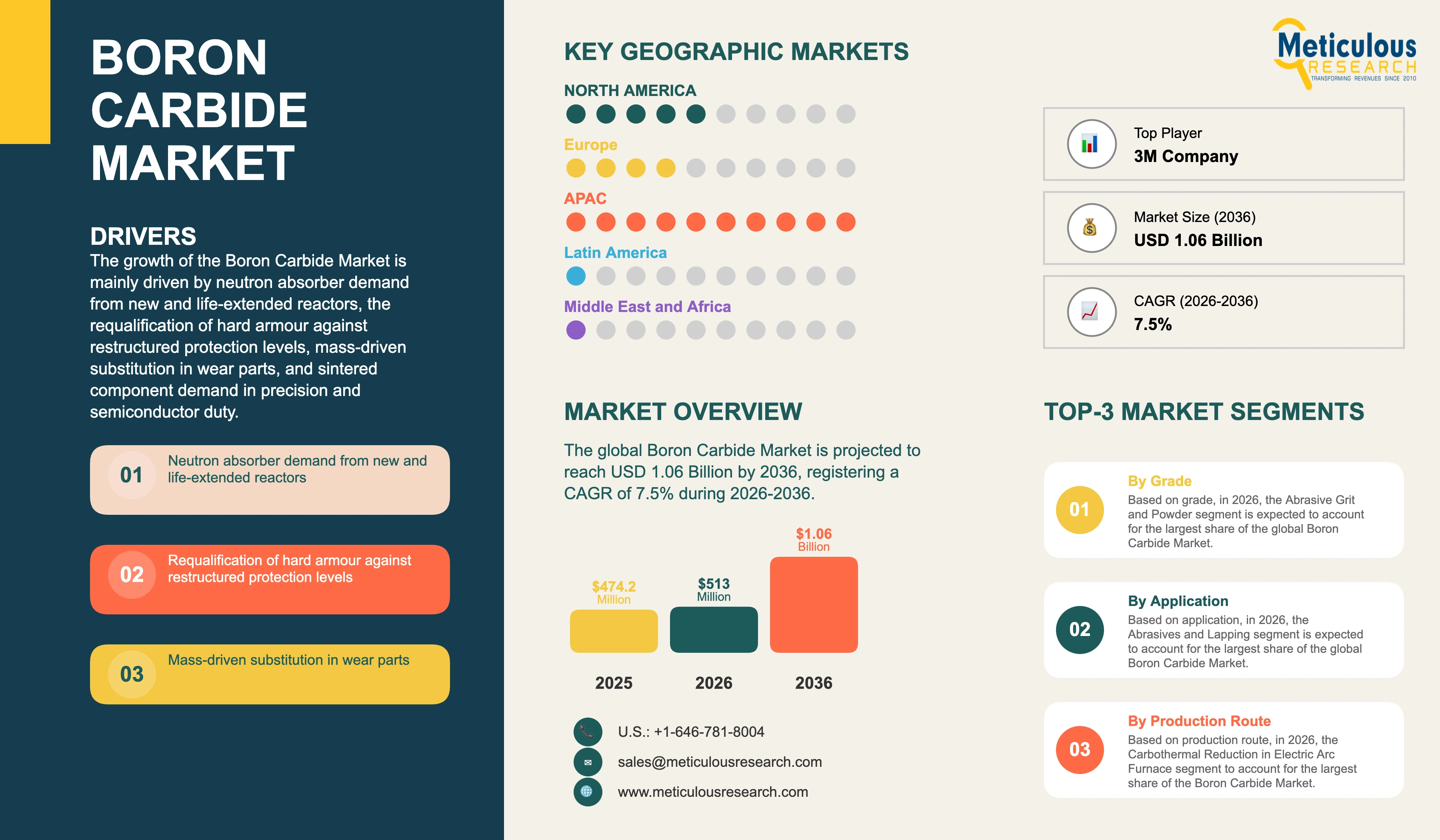
The boron carbide market is valued at USD 513.0 million in 2026 and is projected to reach USD 1.06 billion by 2036, at a CAGR of 7.5% during the forecast period. The market was valued at USD 474.2 million in 2025 and at USD 453.1 million in 2024.
- Published
- Nov 2026
- Pages
- 267
- Format
- PDF + Excel
- Report ID
- MRCHM - 1042778
- Base year
- 2025
- 2024 · HISTORICAL
- $453.1M
- 2036
- $1.06B
- CAGR 2026–2036
- 7.5%
2024–2025 baseline · 2026–2036 forecast at 7.5% CAGR · hover a bar for the value
Key highlights
This market measures boron carbide on a contained B4C basis across grit and powder, sintered and hot-pressed components, armour tiles and plates, and nuclear-grade pellets.
Boron carbide used as a sintering aid within another ceramic is counted in that ceramic and not here, because the quantity is a fraction of a percent and the buyer is specifying the host material.
Elemental boron, boron nitride, boric acid and the borate minerals are separate chemistries and are excluded. Only the carbide is measured.
The armour assembly beyond the ceramic itself, including the backing laminate, the strike face cover and the carrier, is counted in body armour and vehicle armour markets and not here.
The control rod assembly beyond the pellets, including cladding, spider and drive mechanism, is counted in nuclear components and not here.
Silicon carbide armour is counted in the silicon carbide titles in this series and is not additive to this market, although the two compete directly for the same hard armour duty.
Value growth at 7.5% runs at close to twice volume growth at 4.2%, because the mix shifts toward higher-value forms rather than because tonnage accelerates.
The National Institute of Justice replaced the protection levels of its body armour standard. Levels II and IIIA became HG1 and HG2, and Levels III and IV were replaced by three rifle levels, RF1, RF2 and RF3.
RF1 is tested against 7.62x51mm M80 ball at 847 m/s, a 7.62x39mm surrogate at 725 m/s and 5.56mm M193 at 990 m/s. RF2 adds 5.56mm M855 at 950 m/s, and RF3 is tested against .30-06 M2 armour piercing at 878 m/s.
RF2 has no predecessor in the earlier standard, so every plate design seeking it must be tested rather than mapped across from an old certification. That requalification is a demand event for armour ceramic independent of unit volume growth.
RF3 is where boron carbide is least advantaged. Shock loading from an armour-piercing core drives the material into a disordered state along the impact path, reducing its resistance at exactly the velocities RF3 specifies, so silicon carbide and alumina hold that level on cost and performance.
That physics is why armour, at 8.0%, grows more slowly than the nuclear absorber application at 11.4%, despite being the application most often named as the driver of this market.
Abrasives are the slowest application in this report at 5.0%. Boron carbide grit is several times the price of silicon carbide and is confined to lapping, precision finishing and the grinding of materials silicon carbide cannot cut.
Argonne National Laboratory, in work for the Office of Nuclear Energy on the Versatile Test Reactor, identifies boron carbide as the favoured absorber on the basis of extensive domestic and international experience.
The same work sets the preliminary control rod design on natural boron rather than enriched boron-10, having judged natural boron sufficient for the required reactivity worth.
Enrichment is not simply a performance upgrade. Argonne records that enriched boron reduces core excess reactivity, shortens rod lifetime and raises peak centerline temperatures, so the choice trades absorber worth against rod life and thermal margin.
Control rod life is limited by boron-10 depletion, diametral swelling of the pellet and pressure buildup in the gas plenum. A rod is consumed and replaced, which makes nuclear demand recurring rather than a charge arriving once with the reactor.
Supply is fragmented in grit, because carbothermal reduction is established and the barrier is energy cost rather than technology. Concentration rises sharply in armour tiles and nuclear pellets, where qualification rather than furnace capacity governs entry.
Report summary
| Particulars | Details |
|---|---|
| Base Year | 2025 |
| Actual Years | 2024-2025 |
| Forecast Period | 2026-2036 |
| Market Size in 2024 | USD 453.1 million |
| Market Size in 2025 | USD 474.2 million |
| Market Size in 2026 | USD 513.0 million |
| Market Size in 2036 | USD 1.06 billion |
| Value CAGR (2026-2036) | 7.5% |
| Format | PDF, Excel & Cloud Portal · 267 pages |
| Volume in 2025 | 13.10 kilotons |
| Volume in 2026 | 13.50 kilotons |
| Volume in 2036 | 20.37 kilotons |
| Volume CAGR (2026-2036) | 4.2% |
| Average Selling Price, 2026 | USD 38.00 per kg |
| Average Selling Price, 2036 | USD 52.00 per kg |
| Units | Value in USD million; volume in kilotons of boron carbide; price in USD per kg |
| Measurement Basis | Boron carbide on a contained B4C basis, across grit and powder, sintered and hot-pressed components, armour tiles and plates, and nuclear-grade pellets |
| Exclusions | Boron carbide used as a sintering aid within another ceramic; elemental boron, boron nitride, boric acid and borate minerals; the armour assembly beyond the ceramic; the control rod assembly beyond the pellets; silicon carbide armour |
| Segments: Grade | Abrasive Grit and Powder; Sintered and Hot-Pressed Components; Armour Tiles and Plates; Nuclear Grade |
| Segments: Application | Abrasives and Lapping; Personal and Vehicle Armour; Blasting Nozzles and Wear Parts; Nuclear Shielding and Control; Neutron Detection and Other |
| Segments: Production Route | Carbothermal Reduction in Electric Arc Furnace; Magnesiothermic and Other Routes |
| Largest Segment by Grade, 2026 | Abrasive Grit and Powder |
| Fastest-Growing Segment by Grade | Nuclear Grade, at 12.0% |
| Largest Segment by Application, 2026 | Abrasives and Lapping |
| Fastest-Growing Segment by Application | Nuclear Shielding and Control, at 11.4% |
| Largest Segment by Production Route, 2026 | Carbothermal Reduction in Electric Arc Furnace |
| Fastest-Growing Segment by Production Route | Magnesiothermic and Other Routes, at 9.4% |
| Largest Region, 2026 | Asia-Pacific |
| Fastest-Growing Region | Middle East & Africa, at 9.0% |
| Fastest-Growing Country | India, at 9.4% |
| Slowest-Growing Country | U.K., at 5.0% |
| Regions Covered | Asia-Pacific; North America; Europe; Latin America; Middle East & Africa |
| Countries Covered | China; India; Japan; South Korea; U.S.; Canada; Germany; France; U.K.; Saudi Arabia; U.A.E.; Brazil |
| Key Players | 3M Company; Saint-Gobain S.A.; Washington Mills Company; CoorsTek, Inc.; Mudanjiang Jingangzuan Boron Carbide Co., Ltd.; Dalian Zhengxing Abrasive Co., Ltd. |
| Top Five Share, 2026 | 51.6% |
| Profiled Companies Share, 2026 | 57.4% |
| Currency | USD |
Report overview
Market value is measured in in USD million; volume in kilotons of boron carbide; price in USD per kg. Segments covered: grade, application, production route.
The growth of this market is mainly driven by neutron absorber demand from new and life-extended reactors, the requalification of hard armour plates against restructured ballistic protection levels, and the substitution of boron carbide for tungsten carbide and alumina in wear parts where mass matters. However, factors such as the cost of boron carbide grit against silicon carbide and diamond in general abrasive duty, the energy intensity of carbothermal reduction, the loss of ballistic efficiency against high-velocity armour-piercing threats, and the long qualification cycles for nuclear and armour components are expected to restrain the growth of this market to some extent.
Boron carbide is made by reducing boric oxide with carbon in an electric arc furnace at above 2,000 degrees Celsius, after which the fused mass is crushed, milled and classified into grit and powder fractions. The process is simple in principle and punishing in practice: it consumes a great deal of electricity per tonne of product, and the furnace is the single largest cost in the supply chain. That cost structure is why production concentrates where power is cheap rather than where demand is, and why grit pricing moves with industrial electricity tariffs.
What the furnace produces is a feedstock rather than a finished article. Grit and powder are sold directly into abrasive and blasting duty, but every higher-value form requires a second step: milling to a controlled particle size distribution, then hot pressing or pressureless sintering with a sintering aid to produce a dense body. Because boron carbide has strong covalent bonding and very low self-diffusion, densification demands either high pressure or high temperature with an additive, and neither is cheap. The gap between grit at a few tens of dollars a kilogram and a finished armour tile at several hundred is almost entirely that second step.
The material is selected for a combination that no competing ceramic matches. It is the third hardest known material after diamond and cubic boron nitride, and its density is below that of aluminium, which means it delivers hardness at a mass penalty lower than any alternative. That single property pairing is the reason it appears in body armour and in abrasive lapping, two applications that otherwise have nothing in common.
Boron also has a very large thermal neutron capture cross section, concentrated in the boron-10 isotope, which occurs at about a fifth of natural boron. Boron carbide therefore serves as a neutron absorber in reactor control rods, shutdown systems, shielding and neutron detectors, and in that role the carbide form is preferred because it is chemically stable, refractory and dimensionally manageable under irradiation.
Argonne National Laboratory, in preliminary control rod work for the Office of Nuclear Energy on the Versatile Test Reactor, identifies boron carbide as the favoured absorber on the basis of extensive domestic and international experience. That is the decisive commercial fact about this application: the material is not competing for a position in reactor design, it holds one, and the design question is how much of it and at what enrichment.
The enrichment question has a counter-intuitive answer. The Argonne preliminary design uses natural boron, judged sufficient for the required reactivity worth, and records that enriched boron would reduce core excess reactivity, shorten rod lifetime and raise peak centerline temperatures. Higher boron-10 content absorbs more per unit volume but burns out faster and runs hotter, so enrichment buys worth at the cost of life and thermal margin rather than delivering an unqualified improvement.
A mixed configuration follows from that trade-off, with natural boron in the lower pin region and enriched boron in the upper, which Argonne suggests could raise worth while retaining the advantages of natural boron. For a supplier this matters because it means the addressable nuclear volume is not a single product but a graded set of enrichments sold into the same rod.
Rod life is the feature that makes nuclear demand recurring. Argonne analyses it against boron-10 depletion, diametral swelling of the boron carbide pellet and pressure buildup in the gas plenum, with boron-10 concentration and rod worth both approximately linear in irradiation time. A rod is consumed, swells and is replaced, so each reactor generates a repeating pellet requirement for as long as it operates.
On the armour side the governing change is regulatory rather than technical. The National Institute of Justice restructured the protection levels in its body armour standard, renaming Levels II and IIIA as HG1 and HG2 for handgun threats and replacing Levels III and IV with three rifle levels, RF1, RF2 and RF3. The earlier standard was published in 2008 and its compliance testing programme began accepting submissions in 2009, so the installed certification base is long-established.
The test conditions set where each ceramic can compete. RF1 is tested against 7.62x51mm M80 ball at 847 m/s, a 7.62x39mm surrogate at 725 m/s and 5.56mm M193 at 990 m/s; RF2 adds 5.56mm M855 at 950 m/s; and RF3 is tested against .30-06 M2 armour piercing at 878 m/s. The standard works by incorporating separate test methods by reference, covering clay block preparation, range configuration, backface deformation measurement, hard armour conditioning and the creation of female armour appliques.
RF2 is the consequential addition because it has no predecessor. A plate certified to the old Level III cannot be mapped to it, so a manufacturer seeking RF2 must submit a design for testing, and the M855 round it adds carries a steel penetrator at 950 m/s that sits between ball ammunition and full armour-piercing duty. That intermediate condition is where ceramic selection is genuinely open.
At RF3 the selection is less open than the material properties suggest. Under the shock loading an armour-piercing core imposes, boron carbide loses crystalline order along the impact path and its resistance falls off above a threshold velocity, a limitation that applies squarely at the 878 m/s the standard specifies. Silicon carbide, which does not degrade in the same way, and alumina, which is far cheaper per unit area, therefore retain duty at the highest rifle level despite being heavier.
The result is that boron carbide holds the part of the armour market where mass is the binding constraint rather than where the threat is most severe: aircrew and dismounted soldier plates, helicopter and light vehicle panels, and multi-hit configurations at RF1 and RF2. That is a defensible position but not an expanding share of the threat spectrum, and it is why armour is forecast at 8.0% rather than at the double-digit rate the standard transition might imply.
Abrasive duty is the oldest application and the slowest. Boron carbide grit is several times the price of silicon carbide and an order below diamond in hardness, so it occupies a narrow band: lapping and precision finishing of hard materials, wire sawing, and the grinding of carbides and ceramics that silicon carbide cannot cut efficiently. Where silicon carbide will do the job it is used instead, which caps the segment at 5.0% in this report.
Wear parts are the quieter growth story. Blasting nozzles, sandblast inserts, bearing components and nozzle liners use boron carbide because the combination of hardness and low density extends service life while reducing handling mass, and the duty is severe enough that the price premium over tungsten carbide is recovered in replacement intervals.
Taken together, the market is characterised by a cheap, energy-intensive feedstock feeding three quite different high-value conversions, with growth concentrated in the smallest of them. Tonnage rises at 4.2% on abrasive and blasting duty, while value rises at 7.5% because nuclear pellets and armour tiles take a larger share of the same contained boron carbide.
Report infographic
Market dynamics
21 factors across 5 forcesNeutron Absorber Demand from New and Life-Extended Reactors
Every reactor requires boron carbide in control rods, shutdown systems and shielding, and Argonne National Laboratory identifies it as the favoured absorber on the basis of extensive domestic and international experience. The material holds its position in reactor design rather than competing for one, so absorber demand follows the reactor fleet directly.
The demand recurs rather than arriving once. Argonne analyses control rod life against boron-10 depletion, diametral swelling of the pellet and pressure buildup in the gas plenum, with boron-10 concentration and rod worth both approximately linear in irradiation time, so a rod is consumed and replaced on a predictable cycle for as long as the unit operates.
Nuclear grade is forecast at 12.0% and the nuclear shielding and control application at 11.4%, the fastest segments in this report. Because a pellet set carries a price far above grit on the same contained boron carbide, this driver lifts the value of the market considerably faster than its tonnage.
Requalification of Hard Armour Against Restructured Protection Levels
The National Institute of Justice replaced Levels II and IIIA with HG1 and HG2 and replaced Levels III and IV with three rifle levels, RF1, RF2 and RF3. RF2, tested against 5.56mm M855 at 950 m/s in addition to the RF1 rounds, has no predecessor in the earlier standard.
A certification under the old standard cannot be mapped onto RF2, so a manufacturer seeking that level submits a design for testing against the incorporated methods for hard armour conditioning, backface deformation measurement and range configuration. Each submission consumes ceramic in development and test panels before a single production plate is sold.
Requalification is therefore a demand event independent of unit volume, and it favours boron carbide at RF1 and RF2 where mass is the binding constraint. Armour tiles and plates are forecast at 9.0% and the armour application at 8.0%, both above the market volume rate.
Mass-Driven Substitution in Wear Parts
Boron carbide is harder than tungsten carbide and less than a third its density, so in blasting nozzles, sandblast inserts and nozzle liners it extends service life while cutting handling mass. Operators replace nozzles on a wear schedule, which makes the comparison a cost-per-hour one rather than a purchase price one.
The same reasoning displaces alumina where abrasive media are aggressive enough that an alumina nozzle erodes within a shift. Blasting nozzles and wear parts are forecast at 7.4%, close to the market value rate, and the segment grows on replacement demand rather than on new installation.
Sintered Component Demand in Precision and Semiconductor Duty
Pressureless sintered and hot-pressed boron carbide bodies serve as mechanical seal faces, bearing components, wafer handling parts and nozzles where hardness, chemical inertness and low mass must coexist. Densification requires high pressure or high temperature with a sintering aid, because the material has strong covalent bonding and very low self-diffusion.
That processing difficulty is what supports the price. Sintered and hot-pressed components are forecast at 8.4%, and the segment grows on the substitution of boron carbide for silicon carbide and tungsten carbide in parts where the mass or the chemical environment rules those out.
Energy Cost Differentials Favouring Established Producers
Carbothermal reduction consumes a great deal of electricity per tonne, so the furnace is the largest cost in the chain and grit pricing moves with industrial electricity tariffs. Producers with long-term power positions convert that into a durable cost advantage over marginal capacity.
Where power costs rise, marginal grit capacity idles rather than discounting, which tightens availability and lifts price without any change in demand. That mechanism supports the average selling price path from USD 38.00 per kg to USD 52.00 per kg independently of the mix shift toward higher value forms.
Table of contents
11 chapters · 130 sections · 267 pages · click to expandSegmental analysis
| Segment | Largest share (2026) | Fastest growth (2026–2036) |
|---|---|---|
| By Grade | Abrasive grit and powder | Nuclear grade boron carbide |
| By Application | Abrasives and lapping | Nuclear shielding and control |
| By Production Route | Carbothermal reduction | — |
| By Geography | Asia-Pacific | Middle East & Africa |
By Grade
- This market is segmented by grade into abrasive grit and powder, sintered and hot-pressed components, armour tiles and plates, and nuclear grade boron carbide including enriched boron-10 material.
- Abrasive grit and powder are expected to hold the largest share of this market in 2026.
- The grade leads because it is the direct output of the electric arc furnace and requires no densification step, so it carries the lowest price and the highest tonnage, and because blasting, lapping and wire sawing consume it continuously.
- Growth is held to 5.4% by the price of boron carbide grit against silicon carbide, which takes the work wherever it is capable of it.
- Nuclear grade boron carbide is expected to record the highest CAGR of 12.0% during the forecast period.
- Argonne National Laboratory identifies boron carbide as the favoured absorber on the basis of extensive domestic and international experience, and because control rod life is bounded by boron-10 depletion, pellet swelling and gas plenum pressure, pellets are consumed and replaced rather than installed once.
- The grade also commands the highest price in this market, since it is qualified on isotopic assay and documented provenance as well as on density, so it contributes to value far out of proportion to its tonnage.
- Armour tiles and plates grow at 9.0%, supported by the restructuring of ballistic protection levels into HG1, HG2, RF1, RF2 and RF3.
- RF2 has no predecessor, so plates seeking it must be submitted for testing rather than carried across from an existing certification, and that requalification consumes ceramic in development and test panels before any production volume is sold.
- Sintered and hot-pressed components grow at 8.4% in mechanical seal faces, bearing parts, wafer handling components and nozzles.
- The grade is priced on the difficulty of densifying a material with strong covalent bonding and very low self-diffusion, which requires hot pressing or a sintering aid at high temperature and limits the geometries available.
By Application
- This market is segmented into abrasives and lapping, personal and vehicle armour, blasting nozzles and wear parts, nuclear shielding and control, and neutron detection and other applications.
- Abrasives and lapping are expected to account for the largest share of this market in 2026, on continuous consumption in precision finishing, wire sawing and the grinding of carbides and ceramics that silicon carbide cannot cut efficiently.
- The application is also the slowest in this report at 5.0%, because boron carbide grit costs several times silicon carbide and is displaced wherever the cheaper abrasive is adequate.
- Nuclear shielding and control is expected to register the highest CAGR of 11.4% during the forecast period.
- The application grows on replacement rather than installation: rod worth is approximately linear in irradiation time and rods are consumed through boron-10 depletion and pellet swelling, so each operating reactor generates a repeating requirement, and life extension multiplies that requirement without adding a unit.
- Personal and vehicle armour grows at 8.0%, which is below what the standard transition alone would imply.
- Under the shock loading an armour-piercing core imposes, boron carbide loses crystalline order along the impact path and its resistance falls away above a threshold velocity, and the .30-06 M2 armour piercing round specified for RF3 is tested at 878 m/s, within that regime.
- Silicon carbide and alumina therefore hold duty at the highest rifle level, and boron carbide concentrates where mass is the binding constraint, in aircrew plates, rotorcraft panels and dismounted soldier plates at RF1 and RF2.
- Neutron detection and other applications grow at 9.4% in research reactors, accelerators, medical isotope facilities and spent fuel handling, all drawing on the same thermal neutron capture cross section.
- Volumes are small and specifications demanding, and a supplier qualified for reactor-grade pellets reaches them without a new process.
- Blasting nozzles and wear parts grow at 7.4% on replacement demand.
- Boron carbide is harder than tungsten carbide at under a third its density, so nozzle service life extends while handling mass falls, and the comparison operators make is cost per hour of operation rather than purchase price.
By Production Route
- Boron Carbide Analysis by Production Route
- This market is segmented into carbothermal reduction in an electric arc furnace and magnesiothermic and other routes.
- Carbothermal reduction is expected to hold the largest share of this market in 2026, reducing boric oxide with carbon at above 2,000 degrees Celsius.
- The route dominates because it is established, scalable and produces the grit and powder that account for most of the tonnage, and its economics are set by industrial electricity tariffs rather than by raw material cost.
- Magnesiothermic and other routes grow faster at 9.4%, producing finer and more uniform powders at lower temperature, which suits the controlled particle size distributions that sintered components and nuclear pellets require.
- The routes carry a higher cost per kilogram and serve the high-value grades rather than bulk abrasive duty, which is why they grow with the mix shift in this market rather than with its tonnage.
By Geography
- Geographically, this market is segmented into Asia-Pacific, North America, Europe, Latin America, and the Middle East & Africa, with individual country sizing within each region.
- Asia-Pacific is expected to account for the largest share of this market in 2026, on the concentration of electric arc furnace capacity in China and on abrasive, blasting and reactor demand across the region.
- The Middle East & Africa is expected to register the highest CAGR of 9.0%, on reactor programmes in the Gulf and on defence procurement, from a small base.
- Europe is expected to record the lowest regional CAGR of 5.4%, on high industrial power costs that constrain furnace operation and on a mature abrasive base, even though the region holds some of the most advanced sintered component and armour tile capability in this market.
Geographic analysis
Asia-Pacific
Largest shareAsia-Pacific is expected to account for the largest share of this market in 2026. The region holds the majority of world electric arc furnace capacity for boron carbide, where power costs favour carbothermal reduction, and it consumes the output in abrasive, blasting and wear part duty as well as in an expanding reactor fleet. India is expected to record the highest country CAGR in this report at 9.4%, on reactor construction that generates both initial and replacement control rod demand and on domestic armour procurement. China follows at 9.0%, where the installed furnace base means the country sets grit availability and pricing for the rest of the market as well as consuming a large share of it. Japan grows at 6.4% and South Korea at 7.0%. Both hold high-specification sintered component and nuclear pellet capability rather than bulk grit capacity, so their growth comes from the converted grades where qualification matters more than furnace economics.
North America
North America is expected to grow at 7.2%, with the United States at the same rate and Canada at 7.4%. The region carries the restructured ballistic protection levels into procurement, and the requalification of hard armour plates against RF1, RF2 and RF3 concentrates armour ceramic demand here, alongside replacement control rod supply to the operating reactor fleet and research reactor programmes.
Middle East & Africa
The Middle East & Africa is expected to register the highest regional CAGR at 9.0%, led by the United Arab Emirates at 9.4% and Saudi Arabia at 9.0%. Reactor programmes in the Gulf generate absorber demand on a construction and then replacement cycle, and defence procurement adds armour tile volume, both from a base small enough that individual projects move the regional rate.
Europe
Europe is expected to record the lowest regional CAGR at 5.4%, with Germany at 5.6%, France at 5.4% and the United Kingdom at 5.0%. Industrial electricity costs constrain furnace operation in the region, so growth comes from converted grades rather than from grit, and the mature abrasive base adds little volume.
Latin America
Latin America is expected to grow at 7.4%, with Brazil at the same rate. Demand is led by blasting and wear part consumption in mining and oil and gas service work, where severe abrasive conditions justify the price premium over alumina nozzles, rather than by armour or nuclear duty.
Competitive landscape
The global boron carbide market is fragmented in grit and powder and concentrated in the converted grades, because carbothermal reduction is an established process whose barrier to entry is the cost of power, while armour tiles and nuclear pellets are entered through qualification rather than through furnace capacity. Some of the key players operating in the boron carbide market are 3M Company (U.S.), Saint-Gobain S.A. (France), Washington Mills Company (U.S.), CoorsTek, Inc. (U.S.), Mudanjiang Jingangzuan Boron Carbide Co., Ltd. (China), and Dalian Zhengxing Abrasive Co., Ltd. (China), among others.
3M Company holds the broadest position, spanning abrasive grade material, sintered components, armour ceramics and boron products for nuclear duty, having brought the Ceradyne armour and boron products business into the group in 2012 and operating technical ceramics capability originating in Kempten, Germany. That span lets the company carry a customer from grit through to a qualified tile or pellet, which is a position none of the grit-only producers can match.
Saint-Gobain S.A. competes through its ceramic materials and abrasives operations, where boron carbide sits within a portfolio that also carries silicon carbide and alumina. That breadth is commercially significant in armour, because the company can supply whichever ceramic the protection level and budget favour rather than advocating for one material at every threat level.
Washington Mills Company, Mudanjiang Jingangzuan Boron Carbide Co., Ltd. and Dalian Zhengxing Abrasive Co., Ltd. compete principally in grit and powder, where the decisive variables are furnace power cost, crushing and classification capability, and consistency of particle size distribution. CoorsTek, Inc. operates at the opposite end, in sintered and hot-pressed components and armour tiles, where densification capability and test qualification govern position rather than furnace economics.
The five largest participants are estimated to hold 51.6% of this market in 2026, and the six companies profiled in this report 57.4%. The remainder is held by regional grit producers in China, India and Eastern Europe and by specialist component fabricators, whose individual positions are not separately quantified in this report. Competitive movement over the forecast period is expected to come from qualification at RF2 and from nuclear pellet supply rather than from furnace expansion, because those are the segments where position cannot be bought with capacity.
- 3M Company
- Saint-Gobain S.A.
- Washington Mills Company
- CoorsTek, Inc.
- Mudanjiang Jingangzuan Boron Carbide Co., Ltd.
- Dalian Zhengxing Abrasive Co., Ltd
Expert perspectives
The named driver for this market is armour and abrasive applications, and both are the slower halves of it. Abrasives and lapping are forecast at 5.0%, the lowest rate of any application here, because boron carbide grit costs several times silicon carbide and is displaced wherever the cheaper abrasive can do the work. Armour is forecast at 8.0%, respectable but below the 11.4% in nuclear shielding and control and the 12.0% in nuclear grade material.
The limit on armour is physical rather than commercial. Under the shock loading an armour-piercing core imposes, boron carbide loses crystalline order along the impact path and its resistance falls away above a threshold velocity. The .30-06 M2 armour piercing round that the National Institute of Justice specifies for RF3 is tested at 878 m/s, inside that regime, so silicon carbide and alumina retain the highest rifle level on performance and on cost per unit area despite weighing more.
What the restructured standard does give boron carbide is the middle of the ladder. Levels II and IIIA became HG1 and HG2, Levels III and IV were replaced by RF1, RF2 and RF3, and RF2 was added against 5.56mm M855 at 950 m/s with no predecessor to carry a certification across from. That is the condition where a steel penetrator at high velocity meets a mass constraint, and it is where the material is decisive rather than merely competitive.
The growth in this market is in the nuclear absorber. Argonne National Laboratory, in control rod work for the Office of Nuclear Energy on the Versatile Test Reactor, identifies boron carbide as the favoured absorber on the basis of extensive domestic and international experience, which is a statement that the material holds its design position rather than contests for it.
More consequentially, that work shows the demand is consumable. Rod life is bounded by boron-10 depletion, diametral swelling of the pellet and pressure buildup in the gas plenum, with worth approximately linear in irradiation time, so every operating reactor buys pellets on a repeating cycle and a life extension multiplies that without adding a unit. Replacement supply is the most forecastable demand in this market and the least exposed to construction schedules.
Enrichment is where expectations most often run ahead of the engineering. The Versatile Test Reactor preliminary design uses natural boron, judged sufficient for the reactivity worth required, and Argonne records that enriched boron reduces core excess reactivity, shortens rod lifetime and raises peak centerline temperatures. Enrichment buys worth at the cost of life and thermal margin, which is why a graded configuration with natural boron below and enriched above is the likelier commercial outcome than a shift to uniformly enriched pellets.
Customer perspectives
Abrasive buyers compare boron carbide against silicon carbide on cost per unit of material removed, not on hardness, and specify it only where the cheaper abrasive cannot do the work.
We buy boron carbide for the jobs silicon carbide will not cut. Everywhere else the price difference decides it, and that is not a close call.
Armour manufacturers treat areal density as the specification that matters, because the plate is carried rather than mounted, and they accept a higher ceramic cost where the mass saving is real.
Plate makers report that RF2 requires a fresh test submission rather than a mapped certification, and they budget development panels and test rounds into the qualification before any production volume is quoted.
At the highest rifle level, buyers report selecting on demonstrated test performance rather than on material hardness, and in that comparison the cheaper ceramics frequently prevail.
Nuclear buyers specify pellets on isotopic assay, density and documented material provenance, and treat the supplier qualification as a multi-year undertaking that is not transferred between projects.
Reactor operators plan absorber purchases against burnup rather than against outage schedules, because rod worth declines predictably with irradiation and replacement timing follows from the depletion curve.
Designers report specifying natural boron wherever reactivity worth allows it, to avoid the shorter rod life and higher centerline temperatures that come with enrichment.
Component buyers accept the geometry limits that hot pressing imposes and design around them, because the alternative materials cannot meet the mass or chemical requirement.
Nozzle and wear part users evaluate on cost per operating hour, and report that boron carbide recovers its premium over tungsten carbide and alumina where the abrasive media are aggressive.
Grit buyers report that availability moves with industrial electricity tariffs rather than with their own demand, and hold inventory accordingly.
Frequently asked questions
The boron carbide market is valued at USD 513.0 million in 2026 and is projected to reach USD 1.06 billion by 2036, at a CAGR of 7.5% during the forecast period. In volume terms the market is estimated at 13.50 kilotons in 2026, rising to 20.37 kilotons by 2036 at a CAGR of 4.2%.
Neutron absorber demand from new and life-extended reactors, the requalification of hard armour plates against the restructured ballistic protection levels, mass-driven substitution of boron carbide for tungsten carbide and alumina in wear parts, sintered component demand in precision and semiconductor duty, and energy cost differentials that favour established furnace operators.
The restraints are the cost of boron carbide grit against silicon carbide and diamond in general abrasive duty, the loss of ballistic efficiency against high-velocity armour-piercing threats, and the energy intensity of carbothermal reduction. The principal challenges are the difficulty of densifying a material with very low self-diffusion, the length of nuclear and armour qualification cycles, and the narrowness of boron-10 enrichment capacity.
Boron carbide on a contained B4C basis, covering grit and powder, sintered and hot-pressed components, armour tiles and plates, and nuclear-grade pellets. Boron carbide used as a sintering aid within another ceramic is counted in that ceramic, and elemental boron, boron nitride, boric acid and the borate minerals are excluded as separate chemistries.
Silicon carbide armour is counted in those titles and is not additive to this market, although the two materials compete directly for the same hard armour duty. The armour assembly beyond the ceramic is counted in body armour and vehicle armour markets, and the control rod assembly beyond the pellets in nuclear components.
Tonnage growth sits in abrasive and blasting duty, which is the lowest-priced form, while value growth sits in pellets, tiles and sintered parts. The same contained boron carbide earns several multiples more once densified, so average selling price rises from USD 38.00 per kg to USD 52.00 per kg on the mix shift alone.
Abrasive grit and powder are expected to hold the largest share in 2026, because the grade is the direct furnace output, requires no densification and carries the highest tonnage. Nuclear grade boron carbide is projected to grow fastest at 12.0%, on consumable control rod demand and the highest price in the market.
Abrasives and lapping are expected to hold the largest share in 2026, on continuous consumption in precision finishing, wire sawing and the grinding of hard materials. Nuclear shielding and control is projected to grow fastest at 11.4%, because rods are consumed through boron-10 depletion and pellet swelling and are replaced on a burnup cycle.
Carbothermal reduction in an electric arc furnace is expected to hold the largest share in 2026, as the established and scalable route producing most of the tonnage. Magnesiothermic and other routes are projected to grow faster at 9.4%, because they yield the finer, more uniform powders that sintered components and nuclear pellets require.
Levels II and IIIA were renamed HG1 and HG2 for handgun threats, and Levels III and IV were replaced by three rifle levels, RF1, RF2 and RF3. RF1 is tested against 7.62x51mm M80 ball at 847 m/s, a 7.62x39mm surrogate at 725 m/s and 5.56mm M193 at 990 m/s; RF2 adds 5.56mm M855 at 950 m/s; and RF3 is tested against .30-06 M2 armour piercing at 878 m/s.
RF2 has no predecessor in the earlier standard, so an existing certification cannot be mapped onto it and every plate seeking that level must be submitted for testing. The M855 round it adds carries a steel penetrator at 950 m/s, which is the condition where ceramic selection is genuinely open and the mass advantage of boron carbide is decisive.
Under the shock loading an armour-piercing core imposes, the material loses crystalline order along the impact path and its resistance falls away above a threshold velocity. The .30-06 M2 armour piercing round specified for RF3 is tested at 878 m/s, within that regime, so silicon carbide and alumina hold duty at that level on both performance and cost per unit area despite being heavier.
In preliminary control rod work for the Office of Nuclear Energy on the Versatile Test Reactor, Argonne identifies boron carbide as the favoured absorber on the basis of extensive domestic and international experience. It analyses rod life against boron-10 depletion, diametral swelling of the pellet and pressure buildup in the gas plenum.
Not without cost. The Versatile Test Reactor preliminary design uses natural boron, and Argonne records that enriched boron reduces core excess reactivity, shortens rod lifetime and raises peak centerline temperatures. A mixed configuration with natural boron in the lower pin region and enriched boron in the upper is suggested to raise worth while retaining the advantages of natural boron.
Asia-Pacific is expected to account for the largest share in 2026, on the concentration of electric arc furnace capacity in China and on abrasive, blasting and reactor demand across the region. The Middle East & Africa is expected to grow fastest at 9.0%, while India records the highest country CAGR at 9.4%.
Europe is expected to record the lowest regional CAGR at 5.4%, because industrial electricity costs constrain furnace operation and the abrasive base is mature. Key players include 3M Company, Saint-Gobain S.A., Washington Mills Company, CoorsTek, Inc., Mudanjiang Jingangzuan Boron Carbide Co., Ltd. and Dalian Zhengxing Abrasive Co., Ltd.
Cite this report
Meticulous Research. (2026). Boron Carbide Market - Global Opportunity Analysis and Industry Forecast (2026-2036) (Report No. MRCHM - 1042778). Meticulous Market Research Pvt. Ltd. https://www.meticulousresearch.com/product/boron-carbide-market-7461