Silicon Carbide Powders Market (2026-2036)
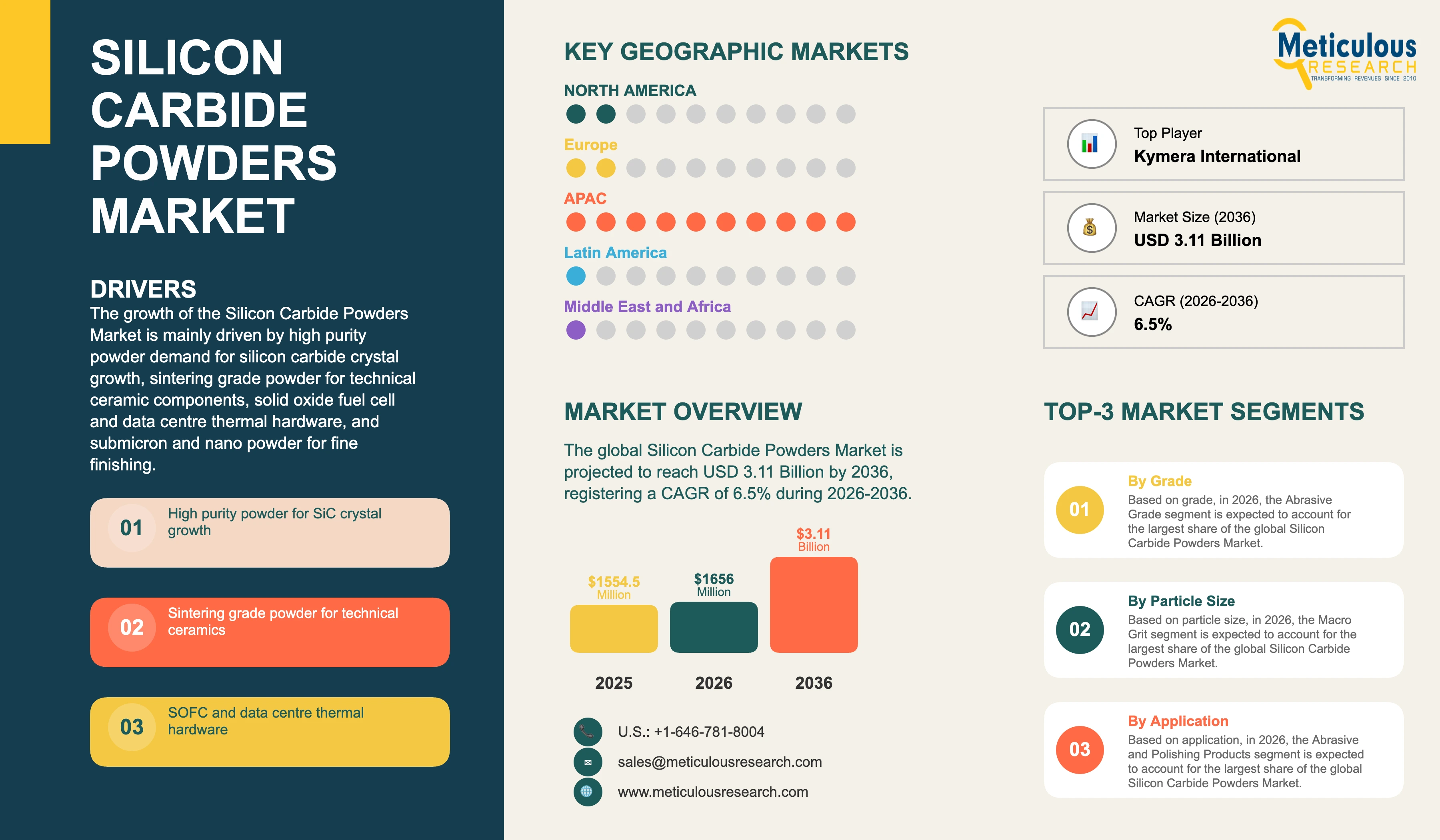
The silicon carbide powders market is valued at USD 1,656.0 million in 2026 and is projected to reach USD 3.11 billion by 2036, at a CAGR of 6.5% during the forecast period. The market was valued at USD 1,554.5 million in 2025 and at USD 1,459.5 million in 2024.
- Published
- Nov 2026
- Pages
- 260
- Format
- PDF + Excel
- Report ID
- MRCHM - 1042745
- Base year
- 2025
- 2024 · HISTORICAL
- $1.46B
- 2036
- $3.11B
- CAGR 2026–2036
- 6.5%
2024–2025 baseline · 2026–2036 forecast at 6.5% CAGR · hover a bar for the value
Key highlights
This market measures ground, graded and refined silicon carbide powder on a contained silicon carbide mass basis, from metallurgical grain through sintering grade ceramic powder to high purity powder for crystal growth.
Silicon carbide abrasive grain is also counted within the silicon carbide abrasives title in this series. The abrasive grade of this market is sized at USD 496.8 million in 2026, equal to the whole of that title, and is carried at the same growth rate, so the two remain equal across the forecast. The titles are not additive.
World silicon carbide capacity stands at about 1, 000,000 tonnes a year, of which China holds 450,000 tonnes, or 45% of the total, with 80,000 tonnes in Norway, 60,000 in Japan, 45,000 in Mexico, 40,000 each in the United States and Brazil, 35,000 in Germany and 30,000 in Venezuela.
That distribution follows electricity cost rather than demand, because the Acheson furnace consumes several thousand kilowatt hours for each tonne of crude silicon carbide produced.
United States apparent consumption of manufactured silicon carbide fell from 193, 000 tonnes in 2022 to an estimated 120,000 tonnes in 2025, a decline of 38%, while domestic production fell from 45,000 tonnes in 2023 to an estimated 30,000 in 2025 from two companies operating two plants.
Crude import unit values retreated from USD 1, 080 per tonne in 2022 to USD 829 in 2025, so the consumption decline came alongside falling prices rather than scarcity.
China supplied 97% of United States crude silicon carbide imports in 2025 and 57% of ground and refined imports, with Brazil at 14%, Canada at 10% and Norway at 8% of ground and refined across 2021 to 2024.
Carborundum Universal reported Electrominerals standalone sales of INR 906 crore in FY2026 against INR 815 crore in FY2025, a rise of 11.1%, with segment profit before interest and tax up 31.1% to INR 82 crore, and described the growth as volume driven with prices roughly flat.
Exports rose to about 33% of those sales from 11% a year earlier, exceeding INR 300 crore.
The same company has taken high purity silicon carbide to 5N purity, targets customer acquisition for 5N in FY2027 and has 6N at pilot scale, with serial supply of semiconductor fabrication equipment components beginning in FY2027 and material revenue expected from 2029, since qualification runs four to six years.
Core products covering fused alumina and silicon carbide are planned to fall from about 85% of that portfolio to between 55% and 60% by 2030, while transformational products including fuel cell powders, nitrides and high purity silicon carbide rise to about 10%.
Volzhsky Abrasive Works, sanctioned since January 2025, recorded sales of about RUB 6 billion in FY2026 against RUB 9.4 billion a year earlier, a fall of 35.3%, and no alternative source has been identified for the silicon carbide capacity withdrawn with it.
Only about 5% of silicon carbide is recycled, against up to 30% for fused aluminium oxide, so this market carries almost no secondary supply.
Engineering ceramics demand tied to solid oxide fuel cells and data centre hardware grew 30% in FY2026 at the same producer, the fastest growth recorded across its portfolio.
Kymera International completed the purchase of Fiven, announced on 31 July 2024, bringing silicon carbide plants in Norway, Belgium and Brazil under a single owner alongside a high purity programme aimed at semiconductors, lithium-ion batteries and defence.
Among particle sizes, macro grit is expected to hold the largest share in 2026, while submicron and nano powder is expected to grow fastest.
Among applications, abrasive and polishing products are expected to hold the largest share in 2026, while semiconductor and electronics is expected to grow fastest.
Report summary
| Particulars | Details |
|---|---|
| Base Year | 2025 |
| Actual Years | 2024-2025 |
| Forecast Period | 2026-2036 |
| Market Size in 2024 | USD 1,459.5 million |
| Market Size in 2025 | USD 1,554.5 million |
| Market Size in 2026 | USD 1,656.0 million |
| Market Size in 2036 | USD 3.11 billion |
| Value CAGR (2026-2036) | 6.5% |
| Format | PDF, Excel & Cloud Portal · 260 pages |
| Volume in 2025 | 795.15 kilotons |
| Volume in 2026 | 819.80 kilotons |
| Volume in 2036 | 1,112.49 kilotons |
| Volume CAGR (2026-2036) | 3.1% |
| Average Selling Price, 2026 | USD 2,020 per tonne |
| Average Selling Price, 2036 | USD 2,795 per tonne |
| Units | Value in USD million; volume in kilotons of silicon carbide powder; price in USD per tonne |
| Measurement Basis | Ground, graded and refined silicon carbide powder on a contained silicon carbide mass basis, from metallurgical grain through sintering grade ceramic powder to high purity powder for crystal growth |
| Overlap Note | The abrasive grade of this market, sized at USD 496.8 million in 2026, is also counted in full as the silicon carbide abrasives title in this series and is carried at the same growth rate; the two titles are not additive |
| Exclusions | Crude silicon carbide ingot before crushing and grading; silicon carbide crystal, boule, wafer and epitaxial material; sintered, reaction bonded and recrystallised components and filter bodies; finished abrasive articles; fused aluminium oxide, boron carbide, diamond and cubic boron nitride |
| Segments: Grade | Metallurgical Grade; Refractory Grade; Abrasive Grade; Ceramic Grade; High Purity Grade |
| Segments: Particle Size | Macro Grit; Micro Grit; Submicron and Nano Powder |
| Segments: Application | Metallurgical and Foundry Additives; Refractory Products; Abrasive and Polishing Products; Technical Ceramic Components; Semiconductor and Electronics; Energy and Filtration |
| Largest Segment by Grade, 2026 | Abrasive Grade |
| Fastest-Growing Segment by Grade | High Purity Grade, at 13.5% |
| Largest Segment by Particle Size, 2026 | Macro Grit |
| Fastest-Growing Segment by Particle Size | Submicron and Nano Powder, at 11.0% |
| Largest Segment by Application, 2026 | Abrasive and Polishing Products |
| Fastest-Growing Segment by Application | Semiconductor and Electronics, at 13.8% |
| Largest Region, 2026 | Asia-Pacific |
| Fastest-Growing Region | Middle East & Africa, at 7.8% |
| Fastest-Growing Country | India, at 8.8% |
| Slowest-Growing Country | France, at 4.2% |
| Regions Covered | Asia-Pacific; Europe; North America; Latin America; Middle East & Africa |
| Countries Covered | China; India; Japan; South Korea; Germany; Norway; France; U.S.; Mexico; Brazil; Venezuela; Saudi Arabia |
| Key Players | Kymera International; Washington Mills Company; Carborundum Universal Limited; Shinano Electric Refining Co., Ltd.; ESK-SIC GmbH; Elsid S.A. |
| Top Five Share, 2026 | 26.4% |
| Profiled Companies Share, 2026 | 29.1% |
| Currency | USD |
Report overview
Market value is measured in in USD million; volume in kilotons of silicon carbide powder; price in USD per tonne. Segments covered: grade, particle size, application.
In volume terms, the market is estimated at 819.80 kilotons of silicon carbide powder in 2026, rising to 1,112.49 kilotons by 2036, at a CAGR of 3.1%. The average selling price is estimated at USD 2,020 per tonne in 2026 and USD 2,795 per tonne in 2036, the increase reflecting a shift in the mix away from metallurgical and refractory grades toward ceramic and high purity grades, which carry prices orders of magnitude above crude grain.
The growth of this market is mainly driven by high purity powder demand for silicon carbide crystal growth, sintering grade powder for technical ceramic components, solid oxide fuel cell and data centre thermal hardware, and submicron and nano powder for fine finishing. However, factors such as world furnace capacity concentrated where electricity is cheapest, qualification cycles of four to six years at the high purity end, flat grain pricing against undiminished Chinese import intensity, and a recycling rate far below that of competing materials are expected to restrain the growth of this market to some extent.
Among grades, abrasive grade is expected to hold the largest share of this market in 2026, while high purity grade is expected to record the highest CAGR during the forecast period. Geographically, Asia-Pacific is expected to account for the largest share of this market in 2026, while the Middle East & Africa is expected to register the highest CAGR during the forecast period.
Silicon carbide powder is produced by reacting silica sand with petroleum coke in an Acheson resistance furnace at temperatures above 2,000 degrees Celsius, a batch process that runs for several days and yields a crude ingot graded by purity from the core outward. That ingot is crushed, chemically cleaned, sized and classified into powders ranging from coarse metallurgical grain through closely sized abrasive grit to submicron sintering powder, so a single furnace campaign feeds every grade in this market at different yields.
The furnace step is both the cost centre and the siting constraint. Electricity accounts for the largest single share of conversion cost, because several thousand kilowatt hours are consumed for each tonne of crude silicon carbide produced, and the resistance core cannot be throttled or restarted economically within a campaign. World capacity of about 1,000,000 tonnes a year therefore sits where power is cheap and long contracted rather than where powder is consumed.
China holds 450,000 tonnes of that capacity, 45% of the world total, concentrated in Ningxia, Gansu and Qinghai where coal-fired and hydroelectric generation is cheapest. Norway holds 80,000 tonnes, Japan 60,000, Mexico 45,000, the United States and Brazil 40,000 each, Germany 35,000 and Venezuela 30,000, with France at 20,000 and India at 5,000, and a further 200,000 tonnes spread across other countries.
Grade is set downstream of the furnace by purity and particle size rather than by a separate production route, which means the grade mix a producer can sell is partly determined by the ingot it already has. Metallurgical grade carries the lowest purity and the coarsest sizing and is used as a deoxidiser and as a combined carbon and silicon source in electric arc steelmaking and iron founding, where it competes directly against ferrosilicon and carbon raisers.
Refractory grade supports kiln furniture, crucibles, saggars and furnace linings, where the combination of high thermal conductivity and low thermal expansion gives resistance to thermal shock that oxide refractories cannot match. Abrasive grade is washed, acid treated and closely sized to a narrow particle size distribution for bonded, coated and loose abrasive duty, and the acid treatment step is what separates it commercially from refractory grain of similar sizing.
Ceramic grade is submicron sintering powder, usually supplied with a boron and carbon or an alumina and yttria sintering aid, for pressureless sintered, reaction bonded and recrystallised components. High purity grade, at 4N and above, is the feedstock for physical vapour transport crystal growth, where metallic contamination is controlled to parts per million because it carries into the boule and appears later as device yield loss.
Colour divides the grain commercially and tracks the grade split closely. Black silicon carbide is made from standard silica sand and carries higher aluminium and iron, which suits metallurgical, refractory and general abrasive duty. Green silicon carbide uses higher purity quartz and petroleum coke, reaches higher silicon carbide content, fractures to sharper edges and commands a substantial premium.
Green grain is the usual starting point for ceramic and high purity grades, so a producer without access to high purity raw materials and a dedicated furnace campaign cannot enter the upper grades at all, whatever classification capacity it holds.
Demand is spread across industries that share almost no purchasing behaviour, and that divergence is the defining commercial feature of this market. Steel and foundry buyers treat metallurgical powder as a consumable, price it on delivered cost per unit of contained silicon, and switch supplier within a quarter when a cheaper tonne appears.
Refractory and abrasive product makers buy to a particle size distribution and a chemistry window and change supplier slowly, because a shift in grain shape or fines content alters bond strength, firing behaviour and wheel performance. Technical ceramic and semiconductor buyers qualify a single lot history and then stay, because requalification carries more cost and schedule risk than any price difference on the powder itself.
The only published national consumption series shows the volume base contracting sharply. United States apparent consumption of manufactured silicon carbide fell from 193,000 tonnes in 2022 to 148,000 in 2023, 143,000 in 2024 and an estimated 120,000 in 2025, a decline of 38% across three years, while crude import unit values fell from USD 1,080 per tonne in 2022 to USD 905 in 2023, USD 832 in 2024 and USD 829 in 2025.
Falling volumes alongside falling prices point to demand weakness in the bulk grades rather than to supply scarcity. Net import reliance stood at an estimated 74% of apparent consumption in 2025, and domestic production fell from 45,000 tonnes in 2023 and 40,000 in 2024 to an estimated 30,000 in 2025 from two companies operating two plants, with crude silicon carbide valued at about USD 25 million.
Tariff structure protects processing rather than smelting, and the gradient is explicit in the schedule. Crude silicon carbide enters the United States free of duty under normal trade relations, while sized grain carries 0.5% ad valorem, and Chinese grain carries Section 301 duties in addition to that rate.
Importing crude and grading it domestically is therefore the favoured route, and it is one reason the declining domestic tonnage has been concentrated in furnace output rather than in processing capacity. China supplied 97% of United States crude imports in 2025 and 57% of ground and refined imports, against 61% of ground and refined across 2021 to 2024, with Brazil at 14%, Canada at 10% and Norway at 8% over that period.
Supply ownership has consolidated outside China. Kymera International completed the purchase of Fiven in an announcement dated 31 July 2024, placing plants in Norway, Belgium and Brazil under one owner serving metallurgy, refractories, filtration and technical ceramics, together with a high purity programme directed at semiconductors, lithium-ion batteries and defence.
Carborundum Universal operates furnace and processing assets in India, Russia and South Africa, and reported Electrominerals standalone sales of INR 906 crore in FY2026 against INR 815 crore a year earlier. The sanctioning of Volzhsky Abrasive Works from January 2025 cut that subsidiary by 35.3% to about RUB 6 billion in FY2026 and removed a substantial share of non-Chinese graded capacity from the addressable market, with no replacement source identified.
Asia-Pacific is expected to account for the largest share in 2026, holding 45% of world furnace capacity in China alone and a further 60,000 tonnes in Japan, together with the downstream abrasive, refractory, ceramic and electronics industries that consume the powder. The Middle East & Africa is projected to grow fastest at 7.8% from a small base, and India is the fastest growing country at 8.8%.
Europe holds 80,000 tonnes of capacity in Norway, 35,000 in Germany and 20,000 in France and grows at 5.2%. The Middle East & Africa grows fastest at 7.8% from a small base on refractory and foundry demand, and Latin America follows at 7.4% on 115,000 tonnes of capacity across Mexico, Brazil and Venezuela.
The abrasive grade of this market, sized at USD 496.8 million in 2026, is the whole of that title and is carried at the same growth rate, so the two remain equal across the forecast. The titles are not additive.
Growth is concentrated in high purity and submicron grades that carry prices orders of magnitude above metallurgical powder, so the mix shift raises the blended price from USD 2,020 per tonne to USD 2,795 per tonne while tonnage grows at 3.1%.
Apparent consumption fell 38% from 193,000 tonnes in 2022 to an estimated 120,000 in 2025 alongside crude import unit values falling from USD 1,080 per tonne to USD 829, which indicates weakness in the bulk grades rather than scarcity, and places the growth entirely in the high value grades.
Crude silicon carbide enters the United States free of duty under normal trade relations while sized grain carries 0.5% ad valorem, with Section 301 duties on Chinese grain in addition. That gradient favours importing crude and grading it domestically, and it is one reason the decline in domestic tonnage has fallen on furnace output rather than on processing capacity, with production down to an estimated 30,000 tonnes from two plants while net import reliance stood at an estimated 74%.
Kymera International, Washington Mills Company, Carborundum Universal Limited, Shinano Electric Refining Co., Ltd., ESK-SIC GmbH and Elsid S.A. The top five hold 26.4% of this market in 2026 and the six profiled companies hold 29.1%, with the majority of world capacity held by Chinese producers.
Report infographic
Market dynamics
20 factors across 5 forcesHigh purity powder demand for silicon carbide crystal growth
Physical vapour transport crystal growth consumes high purity silicon carbide powder as feedstock, and each boule carries a powder charge that is sublimed and largely lost to the process rather than recovered, so demand scales directly with wafer output rather than with installed equipment. Purity requirements run to 4N and above with metallic contamination controlled to parts per million, because contamination carries into the crystal and appears later as device yield loss.
Carborundum Universal has taken high purity silicon carbide to 5N purity and holds 6N at pilot scale, with customer acquisition for 5N targeted in FY2027. Kymera International acquired a high purity programme directed at semiconductors, lithium-ion batteries and defence when it completed the purchase of Fiven in July 2024.
Two established grain producers building purity capability within the same two years indicates that the feedstock position is being contested rather than settled, and the grade commands prices orders of magnitude above metallurgical powder, which is what justifies the capital against modest tonnage.
Sintering grade powder for technical ceramic components
Pressureless sintered and reaction bonded silicon carbide components require submicron powder with controlled oxygen content, free carbon and sintering aid chemistry, because those variables determine whether a part densifies to near theoretical density or fails in firing. The components are specified where hardness, thermal conductivity, stiffness and chemical inertness are all required at once, and few alternative materials meet that combination.
Semiconductor fabrication equipment is the clearest case, covering wafer carriers, susceptors, focus rings and chamber parts exposed to fluorine plasma. Carborundum Universal has committed INR 66 crore to wafer fabrication equipment components with serial supplies starting in FY2027, and has indicated that investment in the area could rise three to four times from that initial level.
Ceramic grade powder therefore grows with equipment build rates rather than with chip volumes, which makes it less cyclical than device demand, and the component qualification that gates entry also protects the supplier once the position is won.
Solid oxide fuel cell and data centre thermal hardware
Engineering ceramics demand linked to solid oxide fuel cells and data centre hardware grew 30% in FY2026 at Carborundum Universal, the strongest growth recorded anywhere across that portfolio, with management stating a line of sight to about 2028. Fuel cell stacks use silicon carbide in interconnect and manifold hardware where creep resistance at operating temperature is the binding requirement.
Fuel cell and electrolyser powders sit within the transformational category that the same producer plans to take to about 10% of its Electrominerals portfolio by 2030, from very little today, alongside nitrides, graphene and high purity silicon carbide.
That is a deliberate reallocation of furnace and processing output away from commodity grain rather than an addition on top of it, so it raises the value of the market while tightening availability of the grades being left behind.
Submicron and nano powder for fine finishing
Chemical mechanical planarisation, lapping of sapphire and silicon carbide wafers, and final polishing of optical and hydraulic components all call for closely controlled submicron powder, where the specification is a full particle size distribution rather than an average size, and where a tail of oversize particles causes scratch defects that scrap the workpiece.
Treated grains are planned to rise from about 5% to 6% of the Carborundum Universal Electrominerals portfolio to nearly 20% by 2030, supported by a treatment facility carrying INR 30 crore of capital expenditure against maximum revenue potential of about INR 120 crore.
A fourfold revenue multiple on invested capital, achieved without adding furnace capacity, explains why producers are moving down the particle size curve considerably faster than the underlying tonnage would justify.
Table of contents
11 chapters · 129 sections · 260 pages · click to expandSegmental analysis
| Segment | Largest share (2026) | Fastest growth (2026–2036) |
|---|---|---|
| By Grade | Abrasive grade | High purity grade |
| By Particle Size | Macro grit | Submicron and nano powder |
| By Application | Abrasive and polishing products | Semiconductor and electronics |
By Grade
- Silicon Carbide Powders Market Analysis by Grade
- Abrasive grade is expected to account for the largest share of this market in 2026.
- Washed, acid treated and closely sized grain serves bonded, coated and loose abrasive duty across metalworking, stone and glass finishing, lapping and foundry cleaning, and the United States Geological Survey states that bonded and coated abrasives account for most silicon carbide use.
- The acid treatment and classification steps that produce it carry real cost above refractory grain of similar sizing, so the grade holds a value share well above its tonnage share, and the narrow particle size distributions it is sold to limit the yield any single furnace campaign delivers.
- Metallurgical and refractory grades together carry more tonnage than abrasive grade but far lower unit value, because both are specified on chemistry and sizing rather than on cleanliness and both tolerate the outer regions of the ingot that abrasive and ceramic grades reject.
- High purity grade is projected to register the highest CAGR of 13.5% during the forecast period.
- Crystal growth feedstock at 4N and above is sublimed and lost in each growth run rather than recovered, so demand scales directly with wafer output, and purity is verified by the customer against metallic contamination limits in the parts per million range.
- Two established producers are building purity capability at the same time, one having reached 5N with 6N at pilot scale and the other having acquired a high purity programme with the Fiven plants, which indicates the position is contested.
- Ceramic grade is expected to follow at 9.6%, supported by sintered components for semiconductor equipment, solid oxide fuel cells and data centre thermal hardware, where engineering ceramics demand grew 30% in FY2026 at one established producer.
- Abrasive grade is expected to hold the largest share in 2026, because washed, acid treated and closely sized grain serves bonded, coated and loose abrasive duty and bonded and coated abrasives account for most silicon carbide use.
- High purity grade is projected to grow fastest at 13.5%, followed by ceramic grade at 9.6%.
- Macro grit is expected to hold the largest share in 2026, carrying metallurgical, refractory and bonded abrasive duty at the highest crushing yield.
- Submicron and nano powder is projected to grow fastest at 11.0%, constrained by treatment and classification capacity rather than by furnace output.
- Abrasive and polishing products are expected to hold the largest share in 2026, while semiconductor and electronics is projected to grow fastest at 13.8%, followed by technical ceramic components at 9.2%.
By Particle Size
- Silicon Carbide Powders Market Analysis by Particle Size
- Macro grit is expected to hold the largest share of this market in 2026.
- Coarse and medium sizings carry metallurgical, refractory and bonded abrasive duty, which is where the tonnage sits, and the sizing is achieved by crushing and screening without the air classification and sedimentation cost that finer cuts require.
- Yield is also highest at coarse sizes, because every crushing step generates fines that must find a home in a lower value product if the target cut is coarse.
- Micro grit serves lapping, fine finishing, wire sawing and fine grinding wheels, and commands a premium over macro grit because yield falls as the target cut narrows and because the shape and fines content of the cut have to be held consistent between lots.
- Submicron and nano powder is projected to register the highest CAGR of 11.0% during the forecast period.
- Sintering grade ceramic powder and planarisation slurries both sit in this band, and the specification is a full particle size distribution rather than an average size, because a tail of oversize particles scratches the workpiece or leaves a pore in the sintered part.
- Treatment and classification capacity rather than furnace output is the constraint on supply here, and treated grains are planned to rise toward 20% of one major portfolio by 2030 from about 5% to 6% today, against capital expenditure of INR 30 crore and revenue potential of about INR 120 crore.
By Application
- Silicon Carbide Powders Market Analysis by Application
- Abrasive and polishing products are expected to account for the largest share of this market in 2026, consistent with bonded and coated abrasives accounting for most silicon carbide use, and this application corresponds to the whole of the silicon carbide abrasives title in this series.
- Metallurgical and foundry additives follow on tonnage, where silicon carbide is used as a combined deoxidiser and carbon and silicon source in electric arc steelmaking and iron founding, competes against ferrosilicon and carbon raisers, and is bought on delivered cost per unit of contained silicon.
- Refractory products take the third position, covering kiln furniture, crucibles, saggars and furnace linings where thermal shock resistance is the binding requirement, and demand there follows steel, aluminium and ceramic firing capacity rather than any technology cycle.
- Semiconductor and electronics is projected to register the highest CAGR of 13.8% during the forecast period, covering crystal growth feedstock and sintered equipment components such as wafer carriers, susceptors and focus rings.
- Qualification running four to six years delays conversion into revenue but also secures the position once it is won.
- Technical ceramic components are expected to follow at 9.2%, with engineering ceramics demand tied to solid oxide fuel cells and data centre hardware having grown 30% in FY2026 at one established producer, which stated a line of sight to about 2028.
- Energy and filtration is the smallest application but grows at 8.0%, covering particulate filters, porous membrane supports for produced water and industrial effluent, and battery and defence uses that arrive without the qualification cycle governing semiconductor feedstock.
Geographic analysis
Asia-Pacific
Largest shareAsia-Pacific is expected to account for the largest share of this market in 2026. China alone holds 450,000 tonnes of world furnace capacity, 45% of the total, concentrated in Ningxia, Gansu and Qinghai where generation is cheapest, and Japan holds a further 60,000 tonnes, so the region contains both the bulk of production and the downstream abrasive, refractory, ceramic and electronics industries that consume it. China supplied 97% of United States crude silicon carbide imports in 2025 and 57% of ground and refined imports, against 61% of ground and refined across 2021 to 2024, which places the region at the centre of trade as well as of output and makes its export policy the single largest variable in world pricing. India holds only 5,000 tonnes of furnace capacity but hosts a disproportionate share of processing, treatment and purification investment, with Carborundum Universal planning about INR 400 crore of capital expenditure in FY2027 and taking high purity silicon carbide to 5N with 6N at pilot scale, which is why the country is projected to grow fastest in the region at 8.8%.
Middle East & Africa
Fastest growthThe Middle East & Africa is projected to register the highest CAGR of 7.8% during the forecast period, from a small base. Refractory and foundry demand follows steel and aluminium capacity additions in the Gulf, and long-contracted low-cost power draws interest in furnace siting, although no capacity of scale is currently recorded in the region.
Latin America
Latin America is expected to follow at 7.4%, supported by 45,000 tonnes of capacity in Mexico, 40,000 in Brazil and 30,000 in Venezuela, and by Brazil having supplied 14% of United States ground and refined imports across 2021 to 2024, which makes the region the established non-Chinese source for North American buyers.
Europe
Europe holds 80, 000 tonnes of capacity in Norway, 35,000 in Germany and 20,000 in France, together with the Belgian and Brazilian plants now held alongside the Norwegian assets under Kymera International, and Norway supplied 8% of United States ground and refined imports across 2021 to 2024. Regional growth of 5.2% is the slowest of the five, constrained by industrial electricity prices.
North America
North America carries the contracting consumption series, with apparent consumption down 38% since 2022, domestic production at an estimated 30,000 tonnes from two plants and net import reliance at an estimated 74%. Regional growth of 5.6% depends on processing and component value rather than on tonnage recovery, supported by a tariff schedule that admits crude duty free while charging grain.
Competitive landscape
This market is fragmented, with the majority of world capacity held by Chinese producers whose furnaces are sited against cheap power in Ningxia, Gansu and Qinghai rather than against demand. The named international producers compete on grading, purity, lot consistency and qualification history rather than on crude furnace output, and the top five hold 26.4% of this market in 2026 against the 45% of world capacity that sits in China.
Kymera International holds the consolidated Fiven position following completion of that purchase in July 2024, with silicon carbide plants in Norway, Belgium and Brazil serving metallurgy, refractories, filtration and technical ceramics, and a high purity programme directed at semiconductors, lithium-ion batteries and defence. The combination gives it the broadest non-Chinese grain and powder footprint in the market.
Carborundum Universal operates furnace and processing assets in India, Russia and South Africa, reported Electrominerals standalone sales of INR 906 crore in FY2026 with segment profit up 31.1% to INR 82 crore, and has taken high purity silicon carbide to 5N with 6N at pilot scale. It is moving its portfolio from core grain at about 85% toward 55% to 60% by 2030, with treated grains, specialties and transformational powders taking the balance.
Washington Mills Company, Shinano Electric Refining Co., Ltd., ESK-SIC GmbH and Elsid S.A. hold established positions in graded abrasive, refractory and ceramic powders from furnaces in the United States, Japan, Germany and Romania. Their scale is modest against Chinese capacity, but their qualification histories with refractory, ceramic and abrasive product makers are long, and that is the asset buyers are currently paying for.
Competitive activity over the last two years has concentrated on ownership and on purity rather than on capacity. One transaction consolidated three plants across two continents under a single owner, a sanction regime removed a fourth producer from the addressable market, and two producers disclosed purity programmes aimed at the same semiconductor feedstock position, while no new Acheson furnace of scale was announced outside China.
Integration downstream is the second line of activity. Wafer fabrication equipment components, aluminium nitride and direct bonded copper substrates, metallised cylinders for vacuum interrupters and solid oxide fuel cell powders are all in development at established grain makers, which shortens the merchant powder market at its highest value end and places powder producers in competition with their own customers.
Some of the key players operating in the silicon carbide powders market are Kymera International, Washington Mills Company, Carborundum Universal Limited, Shinano Electric Refining Co., Ltd., ESK-SIC GmbH, and Elsid S.A., among others.
- —
Kymera International completed the purchase of Fiven in an announcement dated 31 July 2024; Volzhsky Abrasive Works has been sanctioned since January 2025 and recorded a 35.3% sales decline in FY2026; and Carborundum Universal reported FY2026 Electrominerals sales up 11.1% with high purity silicon carbide at 5N and 6N at pilot scale in its results of 15 May 2026.
- Kymera International
- Washington Mills Company
- Carborundum Universal Limited
- Shinano Electric Refining Co., Ltd.
- ESK-SIC GmbH
- Elsid S.A
Expert perspectives
The growth in this market is concentrated in grades that carry almost none of its tonnage. High purity powder at 13.5% and submicron and nano powder at 11.0% set the pace, while metallurgical and refractory grades, which together carry most of the volume, grow at 3.4% and 4.2%, and abrasive grade, the largest by value, grows at 5.7%.
The one published national consumption series fell 38% between 2022 and 2025 alongside crude import unit values retreating from USD 1,080 per tonne to USD 829, so the bulk of this market has been contracting in both volume and price while the high value grades expanded. The value forecast therefore rests on mix rather than on throughput, and the blended price rising from USD 2,020 per tonne to USD 2,795 per tonne is the clearest expression of it.
The governing constraint is not demand but conversion. The Acheson furnace consumes several thousand kilowatt hours a tonne and cannot be throttled within a campaign, which is why 45% of world capacity sits in China and the rest follows cheap long-contracted power to Norway, Mexico, Brazil and Venezuela, and why a buyer seeking non-Chinese supply finds few alternatives at competitive cost.
Qualification is the second constraint and the more binding one at the top of the grade range. Four to six years to qualify a semiconductor grade, with material revenue expected from 2029 against serial supplies beginning in FY2027, means the fastest growing grade cannot be captured by capital alone, and a producer that has not already started cannot reach it inside the forecast period.
The sanctioning of Volzhsky Abrasive Works is the clearest near-term dislocation, having taken 35.3% off that business in FY2026 with abrasives down 14% and ceramics down 31%, and with its owner stating that no alternative capacity exists. It has already redirected trade, with one producer doubling exports to about a third of segment sales within a single year.
Taken together, the position favours the incumbent that can move up the grade range using treatment and purification capacity rather than new furnaces, where a fourfold revenue multiple on invested capital is available, over the entrant that would have to secure power first and qualify afterwards.
Customer perspectives
Steel and foundry buyers
Steel and foundry buyers treat metallurgical powder as a consumable and price it against ferrosilicon and carbon raisers on a delivered cost per unit of contained silicon, so supplier changes are frequent and purity beyond specification carries no value.
Refractory and abrasive product makers
Refractory and abrasive product makers buy to a particle size distribution and a chemistry window, and change supplier slowly because a shift in grain shape or fines content alters bond strength and wheel behaviour.
Technical ceramic fabricators
Technical ceramic fabricators are the most specification bound. Oxygen content, free carbon and sintering aid chemistry determine whether a part densifies, so a qualified lot history is worth more than a price concession.
Semiconductor buyers
Semiconductor buyers are the most constrained of all. A four to six year qualification cycle means the purchasing decision is effectively irreversible, and the cost of a failed boule exceeds any saving on feedstock.
Those buyers are consequently willing to pay for traceability and lot consistency rather than for headline purity, and they ask for documented process control.
Buyers across every grade
Buyers across every grade are asking about country of origin. United States purchasers facing 97% Chinese crude import dependence and sanctions-affected Russian supply are seeking qualified alternatives, which is why export share at non-Chinese producers has risen faster than their output.
Tariff structure shapes the question. Crude powder enters the United States duty free while sized grain carries 0.5% ad valorem plus Section 301 duties on Chinese material, so buyers increasingly ask whether grading happens inside or outside China.
Filtration, battery and defence buyers
Filtration, battery and defence buyers are newer entrants to this market and arrive without established specifications, so they ask producers to define the grade with them.
That gives the producer a position that price competition cannot easily displace, and it is one reason established grain makers are investing in treatment rather than in furnaces.
Larger buyers
Cost of ownership rather than price per tonne is the frame used by the larger buyers, because the powder is a small share of finished component cost and a large share of scrap risk.
Across all grades
Across all grades, buyers expect supply continuity statements, and the absence of a recycling stream at scale means a producer cannot offer recovered material as a hedge.
Frequently asked questions
The market is valued at USD 1,656.0 million in 2026, having stood at USD 1,554.5 million in 2025 and USD 1,459.5 million in 2024, and is projected to reach USD 3.11 billion by 2036.
Cite this report
Meticulous Research. (2026). Silicon Carbide Powders Market - Global Opportunity Analysis and Industry Forecast (2026-2036) (Report No. MRCHM - 1042745). Meticulous Market Research Pvt. Ltd. https://www.meticulousresearch.com/product/silicon-carbide-powders-market-7428