Silicon Carbide Abrasives Market (2026-2036)
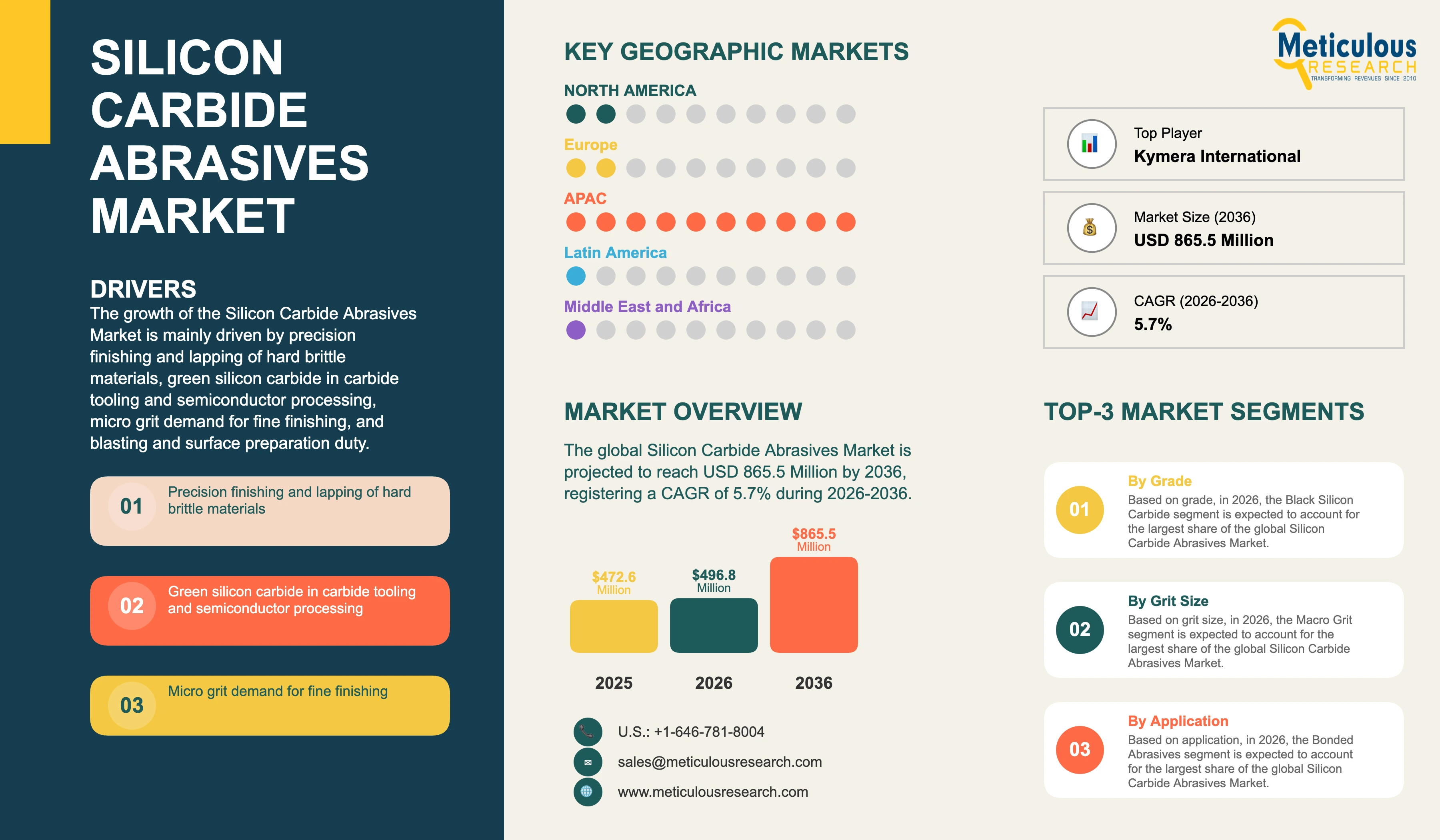
The silicon carbide abrasives market is valued at USD 496.8 million in 2026 and is projected to reach USD 865.5 million by 2036, at a CAGR of 5.7% during the forecast period. The market was valued at USD 472.6 million in 2025 and at USD 458.9 million in 2024.
- Published
- Nov 2026
- Pages
- 261
- Format
- PDF + Excel
- Report ID
- MRCHM - 1042746
- Base year
- 2025
- 2024 · HISTORICAL
- $458.9M
- 2036
- $865.5M
- CAGR 2026–2036
- 5.7%
2024–2025 baseline · 2026–2036 forecast at 5.7% CAGR · hover a bar for the value
Key highlights
This market measures silicon carbide abrasive grain and micro grit on a contained silicon carbide mass basis, covering macro grit for bonded, coated and blasting duty and micro grit for lapping, polishing and fine finishing.
Silicon carbide abrasive grain is also counted within the silicon carbide powders title in this series, as the abrasive grade of that market. The two titles are not additive, and the overlap is the whole of this market.
Sintering-grade technical ceramic powder, refractory-grade silicon carbide and metallurgical silicon carbide for steel and foundry use are counted in that powders title rather than here.
Semiconductor-grade crystal and substrate material is a separate product class and is excluded, as are silicon carbide filter bodies, which are a ceramic component rather than an abrasive.
The finished abrasive article is excluded: a bonded wheel, a coated belt and a formulated lapping slurry are counted in abrasive products markets, and this market ends at the grain.
Fused aluminium oxide, garnet, emery, staurolite, metallic abrasives, diamond and cubic boron nitride are competing abrasives counted in their own markets, and the United States Geological Survey names four of them as substitutes.
Value growth at 5.7% runs above volume growth at 2.6%, because the mix moves toward micro grit and green grain rather than because grain prices rise.
The only consumption series published for this product by a government statistical agency is falling. The Survey puts United States apparent consumption at 193,000 tonnes in 2022, 148,000 in 2023, 143,000 in 2024 and an estimated 120,000 in 2025.
United States production fell from 45, 000 tonnes in 2023 to an estimated 30,000 in 2025, from two companies operating two plants, with crude silicon carbide valued at about USD 25 million.
Imports for consumption fell from 165, 000 tonnes in 2022 to an estimated 95,000 in 2025, while net import reliance stood at an estimated 74% of apparent consumption.
Prices have fallen back from the 2022 spike. The crude import unit value was USD 1, 080 per tonne in 2022, USD 905 in 2023, USD 832 in 2024 and an estimated USD 829 in 2025.
World capacity is an order above United States consumption, at 1,000,000 tonnes in both 2024 and 2025 against apparent consumption of an estimated 120,000 tonnes.
China holds 450, 000 tonnes of that capacity, 45% of the world total, with 80,000 in Norway, 60,000 in Japan, 45,000 in Mexico, 40,000 each in the United States and Brazil, 35,000 in Germany and 30,000 in Venezuela.
That table is a map of cheap electricity rather than of abrasive demand, because the Acheson process fires silica sand and petroleum coke in an electric resistance furnace at around 2,500 degrees Celsius and power is the dominant cost.
The Survey states that China led production in 2025 with lower production costs, that foreign competition was expected to persist and continue to limit production in North America, and that lower-cost imports continued to challenge United States and Canadian manufacturers.
China supplied 97% of United States crude silicon carbide imports in 2025 and 57% of ground and refined imports, with Brazil at 14%, Canada at 10% and Norway at 8% of ground and refined across 2021 to 2024.
The tariff structure protects the processing step rather than the furnace. Crude silicon carbide enters the United States duty-free at normal trade relations rates while grain carries 0.5% ad valorem, with additional Section 301 duties on grain from China.
Only about 5% of silicon carbide is recycled, against up to 30% for fused aluminium oxide, so this market carries almost no secondary supply.
Report summary
| Particulars | Details |
|---|---|
| Base Year | 2025 |
| Actual Years | 2024-2025 |
| Forecast Period | 2026-2036 |
| Market Size in 2024 | USD 458.9 million |
| Market Size in 2025 | USD 472.6 million |
| Market Size in 2026 | USD 496.8 million |
| Market Size in 2036 | USD 865.5 million |
| Value CAGR (2026-2036) | 5.7% |
| Format | PDF, Excel & Cloud Portal · 261 pages |
| Volume in 2025 | 264.00 kilotons |
| Volume in 2026 | 270.00 kilotons |
| Volume in 2036 | 349.01 kilotons |
| Volume CAGR (2026-2036) | 2.6% |
| Average Selling Price, 2026 | USD 1,840 per tonne |
| Average Selling Price, 2036 | USD 2,480 per tonne |
| Units | Value in USD million; volume in kilotons of abrasive grain; price in USD per tonne |
| Measurement Basis | Silicon carbide abrasive grain and micro grit on a contained silicon carbide mass basis, covering macro grit for bonded, coated and blasting duty and micro grit for lapping, polishing and fine finishing |
| Overlap Note | Silicon carbide abrasive grain is also counted within the silicon carbide powders title in this series, as the abrasive grade of that market; the two titles are not additive and the overlap is the whole of this market |
| Exclusions | Sintering-grade technical ceramic, refractory-grade and metallurgical silicon carbide; semiconductor-grade crystal and substrate material; silicon carbide filter bodies; the finished abrasive article; fused aluminium oxide, garnet, emery, staurolite, metallic abrasives, diamond and cubic boron nitride |
| Segments: Grade | Black Silicon Carbide; Green Silicon Carbide |
| Segments: Grit Size | Macro Grit; Micro Grit |
| Segments: Application | Bonded Abrasives; Coated Abrasives; Loose Abrasive for Lapping and Polishing; Blasting Media; Wire Sawing and Other |
| Largest Segment by Grade, 2026 | Black Silicon Carbide |
| Fastest-Growing Segment by Grade | Green Silicon Carbide, at 8.4% |
| Largest Segment by Grit Size, 2026 | Macro Grit |
| Fastest-Growing Segment by Grit Size | Micro Grit, at 9.0% |
| Largest Segment by Application, 2026 | Bonded Abrasives |
| Fastest-Growing Segment by Application | Loose Abrasive for Lapping and Polishing, at 9.4% |
| Largest Region, 2026 | Asia-Pacific |
| Fastest-Growing Region | Middle East & Africa, at 8.6% |
| Fastest-Growing Country | India, at 9.0% |
| Slowest-Growing Country | France, at 3.4% |
| Regions Covered | Asia-Pacific; Europe; North America; Latin America; Middle East & Africa |
| Countries Covered | China; India; Japan; South Korea; Germany; Norway; France; U.S.; Mexico; Brazil; Venezuela; Saudi Arabia |
| Key Players | Kymera International; Washington Mills Company; Carborundum Universal Limited; Shinano Electric Refining Co., Ltd.; ESK-SIC GmbH; Elsid S.A. |
| Top Five Share, 2026 | 34.6% |
| Profiled Companies Share, 2026 | 38.2% |
| Currency | USD |
Report overview
Market value is measured in in USD million; volume in kilotons of abrasive grain; price in USD per tonne. Segments covered: grade, grit size, application.
In volume terms, the market is estimated at 270.00 kilotons of abrasive grain in 2026, rising to 349.01 kilotons by 2036, at a CAGR of 2.6%. The average selling price is estimated at USD 1,840 per tonne in 2026 and USD 2,480 per tonne in 2036, the increase reflecting a shift in the mix from macro grit toward micro grit and from black toward green silicon carbide, both of which carry a substantial premium over coarse black grain.
The growth of this market is mainly driven by precision finishing and lapping demand for hard and brittle materials, green silicon carbide consumption in carbide tooling and semiconductor processing, micro grit demand for fine finishing, and blasting and surface preparation duty. However, factors such as world production capacity that exceeds consumption, the concentration of that capacity where electricity is cheapest, competition from fused aluminium oxide at lower cost and from diamond and cubic boron nitride at the precision end, and a recycling rate far below that of competing abrasives are expected to restrain the growth of this market to some extent.
Among grades, black silicon carbide is expected to hold the largest share of this market in 2026, while green silicon carbide is expected to record the highest CAGR during the forecast period. Geographically, Asia-Pacific is expected to account for the largest share of this market in 2026, while the Middle East & Africa is expected to register the highest CAGR during the forecast period.
Silicon carbide is made by the Acheson process, firing silica sand with petroleum coke in an electric resistance furnace at around 2,500 degrees Celsius over several days. The crude crystalline mass that results is broken out of the furnace, crushed, milled, chemically washed and classified into graded fractions, and it is the classification step rather than the synthesis that determines what the product sells for.
Power is the dominant cost in that sequence, which is why capacity sits where electricity is cheapest rather than where abrasives are consumed. The United States Geological Survey puts world capacity at 1,000,000 tonnes in 2025 with 450,000 tonnes in China, 200,000 in other countries, 80,000 in Norway, 60,000 in Japan, 45,000 in Mexico, 40,000 each in the United States and Brazil, 35,000 in Germany, 30,000 in Venezuela, 20,000 in France and 5,000 in India, and states that China led production in 2025 with lower production costs.
The material divides into two grades by purity, and the division is commercially sharper than the chemistry suggests. Black silicon carbide, at around 98% to 99% silicon carbide, is tougher and is specified for cast iron, non-ferrous metals, stone, glass and ceramics. Green silicon carbide, at above 99%, is purer, more friable and more expensive, and is specified for carbide tooling, semiconductor processing and the finest lapping duty.
Friability is the property being bought at the green end. A grain that fractures to fresh sharp edges rather than dulling cuts hard brittle materials cleanly and leaves less subsurface damage, which is what finishing a carbide insert or a wafer requires. That is also why the grain is consumed rather than recovered, and the Survey records that only about 5% of silicon carbide is recycled against up to 30% for fused aluminium oxide.
Grit size is the second axis and it carries most of the price. Macro grit serves bonded wheels, coated belts and discs and blasting, where the grain removes material in bulk. Micro grit serves lapping, polishing and fine finishing, where it is classified to tight distributions that command a multiple of coarse grain and where yield within the target fraction governs the economics of the milling plant.
Where silicon carbide competes is narrower than its hardness implies. Fused aluminium oxide is tougher and cheaper and takes the great majority of steel grinding, with the Survey reporting world fused aluminium oxide capacity at 1,300,000 tonnes against 1,000,000 tonnes for silicon carbide and a ground and refined unit value of USD 1,500 per tonne. Diamond and cubic boron nitride take the duty where cost per unit of material removed justifies a superabrasive.
Silicon carbide holds the band between them: materials too hard or too brittle for alumina to cut cleanly, and volumes or tolerances that do not justify diamond. Cast iron, non-ferrous metals, stone, glass, ceramics, carbide tooling and lacquer sanding all sit in that band, and the Survey states that bonded and coated abrasive products account for most silicon carbide and fused aluminium oxide abrasive use.
That last point qualifies the demand driver usually attributed to this market. Precision finishing is real and it is the fastest-growing duty, but the tonnage sits in wheels and paper rather than in lapping slurries, so a forecast built on precision demand describes the smallest part of the market and the part most exposed to superabrasive substitution.
The published consumption evidence runs the other way. United States apparent consumption of silicon carbide, the only such series published for this product by a government statistical agency, fell from 193,000 tonnes in 2022 to 148,000 tonnes in 2023, 143,000 tonnes in 2024 and an estimated 120,000 tonnes in 2025.
Domestic production fell alongside it, from 45,000 tonnes in 2023 to 40,000 tonnes in 2024 and an estimated 30,000 tonnes in 2025, produced by two companies operating two plants, with crude silicon carbide valued at about USD 25 million. The Survey states that foreign competition was expected to persist and continue to limit production in North America.
Imports contracted at the same time rather than filling the gap. Imports for consumption fell from 165,000 tonnes in 2022 to an estimated 95,000 tonnes in 2025, with crude imports 20% below 2024 and ground and refined imports 18% below, while net import reliance stood at an estimated 74% of apparent consumption.
Prices have retreated from the 2022 disruption rather than trending upward. The crude import unit value fell from USD 1,080 per tonne in 2022 to USD 905 in 2023, USD 832 in 2024 and an estimated USD 829 in 2025, which is a market with capacity to spare rather than one short of grain.
Trade policy has responded at the processing step and not at the furnace. Crude silicon carbide enters the United States duty-free at normal trade relations rates while silicon carbide grain carries 0.5% ad valorem, with additional Section 301 duties on grain from China, which protects milling and classification in a country that has lost the furnace economics.
Import dependence on a single origin is the condition that follows. China supplied 97% of United States crude silicon carbide imports in 2025 and 57% of ground and refined imports, against 61% of ground and refined imports across 2021 to 2024, with Brazil at 14%, Canada at 10% and Norway at 8% over that period.
The growth that does exist in this market is therefore in the mix rather than in the tonnage. Green silicon carbide is forecast at 8.4% against 4.6% for black, micro grit at 9.0% against 4.2% for macro, and loose abrasive, lapping and polishing at 9.4% against 4.4% for bonded abrasives, which is why value compounds at 5.7% on volume of 2.6%.
Average selling price rises from USD 1,840 per tonne to USD 2,480 per tonne on that shift. A producer able to hold yield in the fine fractions and to supply green grain at specification earns a materially different return from one selling coarse black grain into a market with 1,000,000 tonnes of world capacity and falling consumption in its largest reporting economy.
Report infographic
Market dynamics
22 factors across 5 forcesPrecision Finishing and Lapping of Hard Brittle Materials
A silicon carbide grain fractures to fresh sharp edges rather than dulling, which cuts hard brittle materials cleanly and leaves less subsurface damage than a tougher abrasive that ploughs. That behaviour is what lapping and polishing of ceramics, glass, carbide tooling and semiconductor components requires.
Micro grit for that duty is classified to tight distributions and commands a multiple of coarse grain, so the driver lifts value far ahead of tonnage. Loose abrasive, lapping and polishing is forecast at 9.4% and micro grit at 9.0%, against 4.2% for macro grit.
The duty is nonetheless the part of this market most exposed to diamond and cubic boron nitride, which take work wherever cost per unit of material removed justifies a superabrasive. Growth here is real but it is contested at the top end rather than secure.
Green Silicon Carbide in Carbide Tooling and Semiconductor Processing
Green silicon carbide at above 99% purity is more friable and more expensive than black grain, and is specified where contamination and subsurface damage matter more than grain life. Carbide insert grinding, semiconductor component lapping and optical finishing all sit there.
Because the premium rests on purity and friability rather than on tonnage, the segment rewards furnace control and washing capability rather than scale. Green silicon carbide is forecast at 8.4% against 4.6% for black.
The grade is also the least substitutable part of this market, since fused aluminium oxide cannot match the cutting behaviour and diamond is uneconomic at the volumes and tolerances involved. It is the most defensible position a producer can hold.
Micro Grit Demand for Fine Finishing
Each step finer in classification narrows the particle distribution the customer requires and reduces the yield the milling plant achieves within the target fraction, so fine grades carry a price that reflects classification cost as much as material value.
A producer that cannot hold yield in the fine fractions is confined to coarse grain, where 1,000,000 tonnes of world capacity and an estimated United States apparent consumption of 120,000 tonnes set the competitive condition.
Micro grit is forecast at 9.0% and it is the principal mechanism lifting average selling price from USD 1,840 per tonne to USD 2,480 per tonne. The driver separates producers on process capability rather than on power cost, which is the only axis on which a non-Chinese producer can compete.
Blasting and Surface Preparation Duty
Silicon carbide blasting media cuts faster than alumina on hard surfaces and leaves a sharper profile, and it is specified for glass etching, stone work, aerospace component preparation and coating removal where the substrate cannot tolerate a slower, more ductile abrasive.
Media is consumed rather than recovered in most of that work, and with only about 5% of silicon carbide recycled against up to 30% for fused aluminium oxide the duty generates recurring primary demand rather than a circulating inventory.
Blasting media is forecast at 5.4%, close to the market value rate. It is the least technically contested application in this market and the one least exposed to superabrasive substitution.
Coated Abrasive Consumption in Wood, Lacquer and Floor Finishing
Silicon carbide dominates the coated abrasive grain used on lacquer, paint, floor sanding and automotive refinishing, because it cuts cured coatings cleanly at low pressure where alumina loads and tears the surface.
The Survey states that bonded and coated abrasive products account for most silicon carbide and fused aluminium oxide abrasive use, so this is where the tonnage of the market sits rather than in the precision duty usually cited as its driver.
Coated abrasives are forecast at 4.6%, below the market value rate, and they anchor the volume base that holds tonnage growth to 2.6%. The application is stable rather than expanding, and it is priced against fused aluminium oxide on cost per sheet.
Table of contents
11 chapters · 127 sections · 261 pages · click to expandSegmental analysis
| Segment | Largest share (2026) | Fastest growth (2026–2036) |
|---|---|---|
| By Grade | Black silicon carbide | Green silicon carbide |
| By Grit Size | Macro grit | — |
| By Application | Bonded abrasives | Loose abrasive for lapping and polishing |
| By Geography | Asia-Pacific | Middle East & Africa |
By Grade
- Silicon Carbide Abrasives Analysis by Grade
- This market is segmented by grade into black silicon carbide and green silicon carbide.
- Black silicon carbide is expected to hold the largest share of this market in 2026.
- At around 98% to 99% silicon carbide it is tougher and cheaper than green grain and is specified for cast iron, non-ferrous metals, stone, glass and ceramics, which between them account for most of the bonded and coated abrasive duty that the United States Geological Survey identifies as the principal use of silicon carbide.
- The grade grows at 4.6%, below the market value rate, because it is where world capacity of 1,000,000 tonnes bears most directly on price and where fused aluminium oxide competes hardest on cost.
- Green silicon carbide is expected to record the highest CAGR of 8.4% during the forecast period.
- At above 99% purity it is more friable and more expensive, fracturing to fresh sharp edges rather than dulling, which cuts carbide tooling, semiconductor components and optical surfaces cleanly and leaves less subsurface damage.
- Fused aluminium oxide cannot match that cutting behaviour and diamond is uneconomic at the volumes and tolerances involved, which makes the grade the least substitutable part of this market, and the premium rests on furnace control and chemical washing capability rather than on scale.
By Grit Size
- Silicon Carbide Abrasives Analysis by Grit Size
- This market is segmented into macro grit and micro grit.
- Macro grit is expected to account for the largest share of this market in 2026, serving bonded wheels, coated belts and discs and blasting media, where the grain removes material in bulk and the classification requirement is relatively loose.
- The segment grows at 4.2%, the slowest in this report, because it competes directly against the capacity concentrated in the lowest power cost regions and against fused aluminium oxide, whose world capacity of 1,300,000 tonnes exceeds that of silicon carbide.
- Micro grit is expected to record the higher CAGR of 9.0% during the forecast period, serving lapping, polishing and fine finishing.
- Each step finer narrows the particle distribution the customer requires and reduces the yield the milling plant achieves within the target fraction, so the price reflects classification cost as much as material value.
- That cost structure is what allows a producer outside the cheapest electricity regions to compete, since the return depends on process capability rather than on power price, and it is the principal mechanism lifting average selling price from USD 1,840 per tonne to USD 2,480 per tonne.
By Application
- Silicon Carbide Abrasives Analysis by Application
- This market is segmented into bonded abrasives, coated abrasives, loose abrasive for lapping and polishing, blasting media, and wire sawing and other applications.
- Bonded abrasives are expected to account for the largest share of this market in 2026, covering vitrified and resin wheels, segments and stones for cast iron, non-ferrous, stone, glass and carbide grinding.
- The United States Geological Survey states that bonded and coated abrasive products account for most silicon carbide and fused aluminium oxide abrasive use, so this is where the tonnage sits rather than in the precision duty usually cited as the driver of this market.
- The application grows at 4.4%.
- Loose abrasive for lapping and polishing is expected to register the highest CAGR of 9.4% during the forecast period, consuming the micro grit and green grain that carry the price in this market.
- The duty requires a grain that fractures cleanly rather than ploughs, which is what finishing ceramics, glass, carbide tooling and semiconductor components demands, and it is also the part of the market most exposed to diamond and cubic boron nitride wherever cost per unit of material removed justifies a superabrasive.
- Coated abrasives grow at 4.6%, where silicon carbide dominates the grain used on lacquer, paint, floor sanding and automotive refinishing because it cuts cured coatings cleanly at low pressure while alumina loads and tears the surface.
- Blasting media grows at 5.4% on glass etching, stone work, aerospace component preparation and coating removal, and it is the least technically contested application here.
- Wire sawing and other applications grow at 7.0%, covering slurry sawing of hard brittle materials and miscellaneous industrial duty.
- The segment is smaller than it once was, because diamond wire displaced silicon carbide slurry from the largest wafer sawing applications, and what remains is the work where diamond wire cannot be justified.
By Geography
- Silicon Carbide Abrasives Analysis by Geography
- Geographically, this market is segmented into Asia-Pacific, Europe, North America, Latin America, and the Middle East & Africa, with individual country sizing within each region.
- Asia-Pacific is expected to account for the largest share of this market in 2026, on the 450,000 tonnes of Chinese capacity that the United States Geological Survey records, 45% of the world total, together with 60,000 tonnes in Japan and 5,000 in India and the metalworking, stone and electronics demand across the region.
- The Middle East & Africa is expected to register the highest CAGR of 8.6%, on construction, stone and industrial maintenance demand from a small base.
- Europe is expected to record the lowest regional CAGR of 4.6%, holding 80,000 tonnes of capacity in Norway, 35,000 in Germany and 20,000 in France, against industrial demand that is not expanding and competition from lower-cost imported grain.
Geographic analysis
Asia-Pacific
Largest shareAsia-Pacific is expected to account for the largest share of this market in 2026. India is expected to record the highest country CAGR in this report at 9.0%, on metalworking, construction and stone processing growth against only 5,000 tonnes of domestic capacity, so demand growth there is met largely by imported grain. China follows at 5.4%, where the capacity position sets world pricing and the Survey attributes the leading production position to lower production costs. Japan grows at 3.6% and South Korea at 4.6%. Japan holds 60,000 tonnes of capacity weighted toward green grain and fine fractions for carbide tooling and electronics rather than toward coarse black grain, so its growth comes from the mix rather than from tonnage.
North America
The United States Geological Survey records 450, 000 tonnes of Chinese silicon carbide capacity, 45% of the world total of 1,000,000 tonnes, alongside 60,000 tonnes in Japan and 5,000 in India, and the region also carries the metalworking, stone, glass and electronics demand that consumes the grain. North America is expected to grow at 5.6%, with the United States at the same rate. Domestic production fell from 45,000 tonnes in 2023 to an estimated 30,000 tonnes in 2025 from two companies operating two plants, with the Survey stating that foreign competition was expected to persist and continue to limit production in the region, so growth is in processing and distribution rather than in synthesis.
Europe
Europe is expected to record the lowest regional CAGR at 4.6%, with Germany at 4.6%, Norway at 4.0% and France at 3.4%, the slowest country rate in this report. The region holds 80,000 tonnes of capacity in Norway on hydroelectric power, 35,000 in Germany and 20,000 in France, but industrial demand is not expanding and lower-cost imported grain competes directly with it.
Latin America
Latin America is expected to grow at 8.0%, with Mexico at 7.4% and Brazil at 7.4%. The region holds 45,000 tonnes of Mexican capacity, 40,000 in Brazil and 30,000 in Venezuela, and Brazil supplied 14% of United States ground and refined silicon carbide imports across 2021 to 2024, making it the principal alternative origin to China at that stage of processing.
Middle East & Africa
The Middle East & Africa is expected to register the highest regional CAGR at 8.6%, led by Saudi Arabia at 8.6%. Construction, stone processing and industrial maintenance demand is growing from a base small enough that individual projects move the regional rate, and the region holds no silicon carbide capacity of consequence, so the growth is import demand.
Competitive landscape
The global silicon carbide abrasives market is fragmented outside China and concentrated within it, because an Acheson furnace is a large electrically fired asset whose competitive position is set by power price rather than by abrasive technology. Some of the key players operating in the silicon carbide abrasives market are Kymera International (U.S.), Washington Mills Company (U.S.), Carborundum Universal Limited (India), Shinano Electric Refining Co., Ltd. (Japan), ESK-SIC GmbH (Germany), and Elsid S.A. (Romania), among others.
Kymera International holds the leading position outside China across black and green grades and across macro and micro grit through its Fiven silicon carbide business, acquired in July 2024, supplying abrasive, refractory and technical markets from plants in Norway, Belgium and Brazil. Breadth across grades matters because the growth in this market is in green grain and fine fractions while the tonnage remains in coarse black, and serving both from one asset base spreads the furnace fixed cost across a mix that a single-grade producer cannot assemble.
Washington Mills Company competes from North American and European positions in both silicon carbide and fused aluminium oxide, which matters commercially because the two abrasives are substitutes in much of the bonded and coated duty and a producer of both sells whichever the application favours. Domestic synthesis in the region has nonetheless contracted to an estimated 30,000 tonnes in 2025 from two companies operating two plants, so positions there increasingly rest on processing and classification.
Carborundum Universal Limited holds the principal Indian position, integrated from grain through to finished abrasive products, in a market growing at 9.0% against only 5,000 tonnes of domestic capacity. Shinano Electric Refining Co., Ltd. holds a Japanese position weighted toward green grain and fine fractions for carbide tooling and electronics, while ESK-SIC GmbH and Elsid S.A. operate European furnace and processing capacity within the 35,000 tonnes recorded for Germany and the regional total.
The five largest participants are estimated to hold 34.6% of this market in 2026, and the six companies profiled in this report 38.2%. The majority is held by Chinese producers concentrated in Ningxia, Gansu and Qinghai, operating within the 450,000 tonnes of national capacity recorded by the United States Geological Survey, whose individual positions are not separately quantified in this report. Competitive movement over the forecast period is expected to come from classification capability in fine and green fractions rather than from furnace capacity, which is in surplus.
- Kymera International
- Washington Mills Company
- Carborundum Universal Limited
- Shinano Electric Refining Co., Ltd.
- ESK-SIC GmbH
- Elsid S.A
Expert perspectives
The named driver for this market is precision finishing demand, and it describes the fastest part of it correctly. Loose abrasive for lapping and polishing is forecast at 9.4%, micro grit at 9.0% and green silicon carbide at 8.4%, all well above the market rate, because a grain that fractures to fresh sharp edges cuts hard brittle materials cleanly and leaves less subsurface damage than any alternative at that price.
It does not describe the market. The United States Geological Survey states that bonded and coated abrasive products account for most silicon carbide abrasive use, and those grow at 4.4% and 4.6% respectively, so the tonnage sits in wheels and paper while the growth sits in slurries. A forecast built on precision demand describes the smallest part of this market and the part most exposed to diamond and cubic boron nitride substitution.
The published evidence runs against a demand-led reading altogether. United States apparent consumption of silicon carbide, the only such series published for this product by a government statistical agency, fell from 193,000 tonnes in 2022 to 148,000 in 2023, 143,000 in 2024 and an estimated 120,000 in 2025, with imports down from 165,000 tonnes to an estimated 95,000 over the same period and the crude import unit value down from USD 1,080 per tonne to an estimated USD 829.
What governs the market instead is electricity. The Acheson process fires silica sand and petroleum coke in an electric resistance furnace at around 2,500 degrees Celsius, so the world capacity table of 1,000,000 tonnes reads as a map of cheap power: 450,000 tonnes in China, 80,000 in Norway, 45,000 in Mexico, 30,000 in Venezuela. The Survey attributes the Chinese position to lower production costs and states that foreign competition was expected to persist and continue to limit production in North America.
The tariff structure confirms where the contest has already been settled. Crude silicon carbide enters the United States duty-free at normal trade relations rates while grain carries 0.5% ad valorem with additional Section 301 duties on Chinese grain, and China supplied 97% of crude imports in 2025 but only 57% of ground and refined. Policy and trade flows both protect milling and classification in a country whose furnace output fell to an estimated 30,000 tonnes.
That is where the opportunity in this market lies, and it is narrower than the headline growth rate implies. Value compounds at 5.7% on volume of 2.6% because green grain and fine fractions carry a multiple of coarse black grain, and because classification yield rather than power price determines the return on them. A producer outside the cheapest electricity regions competes on process capability or it does not compete, and with only about 5% of silicon carbide recycled against up to 30% for fused aluminium oxide there is no secondary supply to soften either outcome.
Customer perspectives
Abrasive manufacturers select between silicon carbide and fused aluminium oxide on the material being cut rather than on hardness, specifying silicon carbide where the workpiece is hard and brittle and alumina where it is tough.
Alumina ploughs and silicon carbide cuts. On cast iron and stone that is the whole of the decision, and on steel it goes the other way every time.
Buyers of fine grit specify the particle distribution rather than a nominal grit number, and report that consistency between lots matters more than the mean size.
Lapping and polishing users report evaluating diamond alongside silicon carbide on cost per unit of material removed, and selecting silicon carbide where volumes or tolerances do not justify a superabrasive.
Carbide tooling and electronics buyers specify green grain on purity, because contamination and subsurface damage cost more than the price difference against black grain.
Coated abrasive makers report that silicon carbide is not substitutable on lacquer, paint and floor finishing, because alumina loads and tears cured coatings at the pressures involved.
Purchasers report that coarse black grain is bought on price across several qualified origins, with switching treated as routine, while fine and green grades are qualified and held.
Buyers report tracking origin concentration as a supply risk, with alternatives to Chinese grain limited to a short list of producers in Norway, Brazil, Mexico, Germany and North America.
Blasting media users treat the abrasive as consumed rather than recovered, and compare cost per unit of surface prepared rather than cost per tonne.
Buyers report that grain prices have fallen back from the levels of several years ago and plan on the assumption that coarse grain remains amply supplied.
Industrial users report specifying silicon carbide on stone, engineered quartz and technical ceramics as those surfaces spread in construction and consumer products, which is widening the application base away from metalworking.
Frequently asked questions
The silicon carbide abrasives market is valued at USD 496.8 million in 2026 and is projected to reach USD 865.5 million by 2036, at a CAGR of 5.7% during the forecast period. In volume terms the market is estimated at 270.00 kilotons of abrasive grain in 2026, rising to 349.01 kilotons by 2036 at a CAGR of 2.6%.
Cite this report
Meticulous Research. (2026). Silicon Carbide Abrasives Market - Global Opportunity Analysis and Industry Forecast (2026-2036) (Report No. MRCHM - 1042746). Meticulous Market Research Pvt. Ltd. https://www.meticulousresearch.com/product/silicon-carbide-abrasives-market-7429