Black Mass Hydrometallurgy Market (2026-2036)
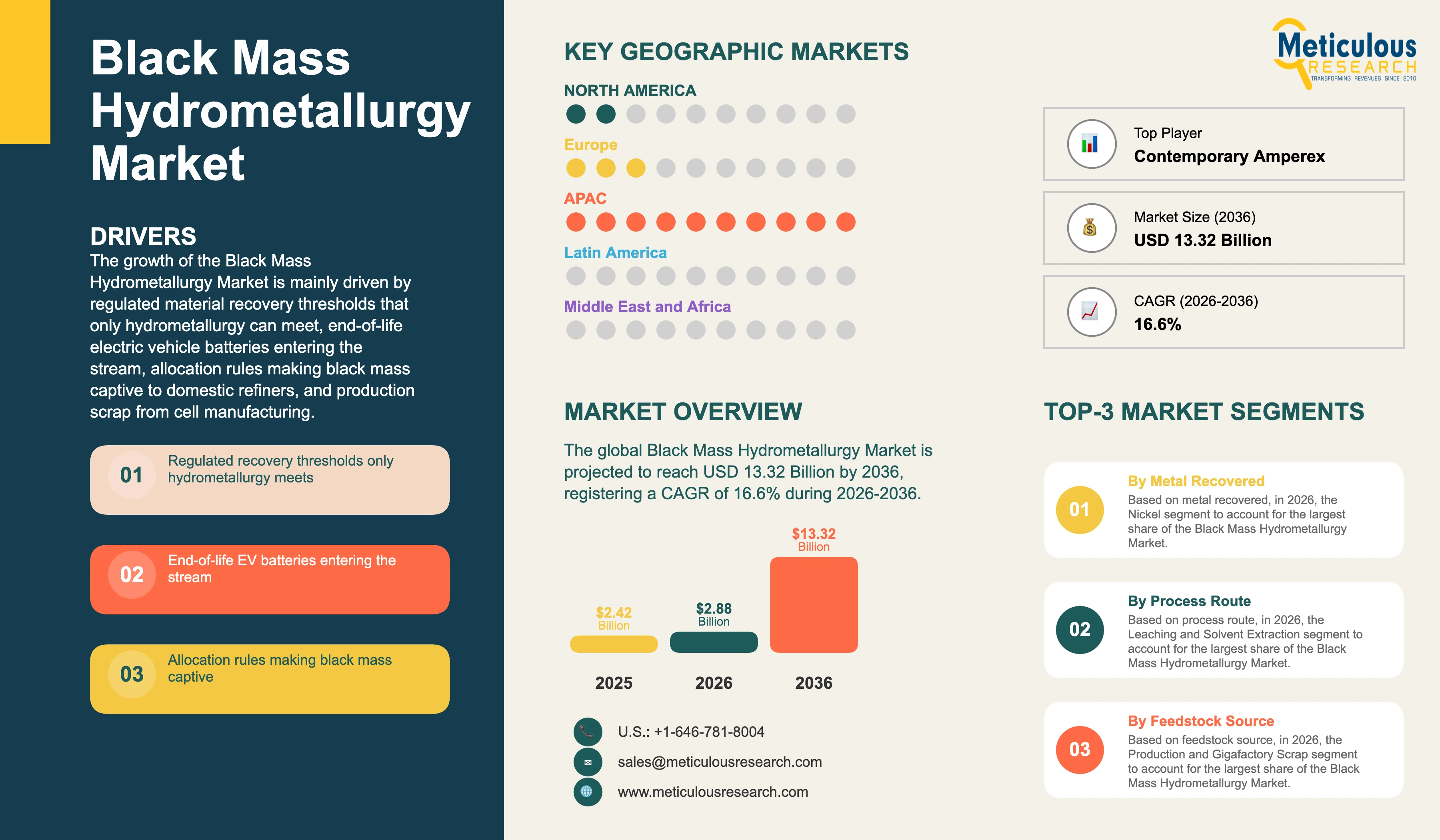
The black mass hydrometallurgy market is valued at USD 2.88 billion in 2026 and is projected to reach USD 13.32 billion by 2036, at a CAGR of 16.6% during the forecast period. The market was valued at USD 2.42 billion in 2025 and at USD 2.02 billion in 2024.
- Published
- Nov 2026
- Pages
- 273
- Format
- PDF + Excel
- Report ID
- MRCHM - 1042779
- Base year
- 2025
- 2024 · HISTORICAL
- $2.02B
- 2036
- $13.32B
- CAGR 2026–2036
- 16.6%
2024–2025 baseline · 2026–2036 forecast at 16.6% CAGR · hover a bar for the value
Key highlights
This market measures the value of refined products recovered from nickel and cobalt bearing black mass by hydrometallurgical processing, at the refinery gate, on a tonne of black mass processed basis.
Lithium iron phosphate black mass is excluded and is counted within the lithium iron phosphate recycling title in this series, because its recovery flowsheet, product set and economics differ from nickel and cobalt chemistries. The two titles are not additive.
Annex XII of Regulation (EU) 2023/1542 requires all recycling to recover at least 90% of cobalt, copper, lead and nickel and 50% of lithium by 31 December 2027, rising to 95% and 80% respectively by 31 December 2031.
The lithium threshold rather than the nickel threshold is what forces hydrometallurgy, because lithium reports to the slag in direct smelting and is recovered only in a leach and purification circuit.
The same regulation requires recycling efficiency of at least 65% by average weight of lithium-based batteries by 31 December 2025, rising to 70% by 31 December 2030.
The United States Bureau of Industry and Security published a temporary final rule on 6 August 2026 requiring United States persons selling black mass to allocate 100% of monthly sales to United States persons from 27 August 2026, with the material to remain physically in the country unless authorised.
It covers any shredded lithium-ion battery scrap containing cathode material, was issued under section 101 of the Defense Production Act and the Presidential Determination of 30 July 2026, and runs to 27 August 2027.
Customs and Border Protection may detain export shipments while the Bureau reviews them, and adjustments are case by case, including where refined material returns to the United States.
Veolia opened a plant in the Grand Est region of France on 16 November 2026 with capacity of nearly 7,000 tonnes of black mass a year, about 20,000 tonnes of batteries, recovering nickel, cobalt and copper at more than 90% with its own hydrometallurgical process.
It draws feedstock from France, the United Kingdom and Switzerland, and the company describes it as the first European project of its kind using in-house technology.
Veolia expects nearly 700, 000 tonnes of batteries to need processing in Europe within five years, carrying strategic metals valued at over EUR 1 billion.
A European study cited alongside that plant puts the average loss at about EUR 1.90 per kilogram to recycle a battery pack in Europe, so the activity is currently loss making on average and exists because recovery is compulsory rather than because the metals pay for it.
Electra Battery Materials set out a phased North American strategy on 16 September 2026, with a first phase nickel refinery of about 20,000 tonnes a year of contained nickel at a preliminary capital estimate of USD 530 million to USD 675 million, and a second phase black mass expansion adding a further 20,000 tonnes.
Preliminary modelling indicates nickel and cobalt recoveries of 97% or higher, and the study sits at the first stage of engineering with no offtake or funding announced.
Glencore completed the acquisition of the Li-Cycle assets in August 2025 through a credit bid sale, moving a substantial North American and European position into a single trading and smelting group.
Black mass runs at about 35% of pack mass on the Veolia conversion, so a pack collection figure cannot be read directly as refining demand.
Among process routes, leaching and solvent extraction is expected to hold the largest share in 2026, while direct recycling and cathode-to-cathode processing is expected to grow fastest.
Among feedstock sources, production and gigafactory scrap is expected to hold the largest share in 2026, while end-of-life electric vehicle batteries are expected to grow fastest.
Report summary
| Particulars | Details |
|---|---|
| Base Year | 2025 |
| Actual Years | 2024-2025 |
| Forecast Period | 2026-2036 |
| Market Size in 2024 | USD 2.02 billion |
| Market Size in 2025 | USD 2.42 billion |
| Market Size in 2026 | USD 2.88 billion |
| Market Size in 2036 | USD 13.32 billion |
| Value CAGR (2026-2036) | 16.6% |
| Format | PDF, Excel & Cloud Portal · 273 pages |
| Volume in 2025 | 366.81 kilotons |
| Volume in 2026 | 420.00 kilotons |
| Volume in 2036 | 1,624.60 kilotons |
| Volume CAGR (2026-2036) | 14.5% |
| Recovered Product Value, 2026 | USD 6,850 per tonne of black mass |
| Recovered Product Value, 2036 | USD 8,200 per tonne of black mass |
| Units | Value in USD million; volume in kilotons of black mass processed; price in USD per tonne of black mass processed |
| Measurement Basis | Value of refined products recovered from nickel and cobalt bearing black mass by hydrometallurgical processing, measured at the refinery gate on a tonne of black mass processed basis |
| Overlap Note | Lithium iron phosphate black mass is excluded and is counted within the lithium iron phosphate recycling title in this series, because its recovery flowsheet, product set and economics differ from nickel and cobalt chemistries; the two titles are not additive |
| Exclusions | Collection, discharge, dismantling, shredding and other pre-treatment that produces black mass; direct pyrometallurgical smelting of whole cells; cathode active material and precursor manufacture, which is counted in the cathode active material precursors title in this series; lead-acid and nickel-cadmium battery recycling; spent catalyst and electronic scrap hydrometallurgy |
| Segments: Metal Recovered | Nickel; Cobalt; Lithium; Copper; Manganese and Other |
| Segments: Process Route | Leaching and Solvent Extraction; Direct Precipitation and Crystallisation; Direct Recycling and Cathode-to-Cathode; Electrowinning and Electrochemical |
| Segments: Feedstock Source | Production and Gigafactory Scrap; End-of-Life Electric Vehicle Batteries; Consumer Electronics Batteries; Energy Storage System Batteries |
| Largest Segment by Metal Recovered, 2026 | Nickel |
| Fastest-Growing Segment by Metal Recovered | Lithium, at 22.2% |
| Largest Segment by Process Route, 2026 | Leaching and Solvent Extraction |
| Fastest-Growing Segment by Process Route | Direct Recycling and Cathode-to-Cathode, at 23.6% |
| Largest Segment by Feedstock Source, 2026 | Production and Gigafactory Scrap |
| Fastest-Growing Segment by Feedstock Source | End-of-Life Electric Vehicle Batteries, at 22.6% |
| Largest Region, 2026 | Asia-Pacific |
| Fastest-Growing Region | Europe, at 19.0% |
| Fastest-Growing Country | U.S., at 20.4% |
| Slowest-Growing Country | Japan, at 13.4% |
| Regions Covered | Asia-Pacific; Europe; North America; Latin America; Middle East & Africa |
| Countries Covered | China; South Korea; Japan; India; Germany; France; Norway; U.S.; Canada; Mexico; Brazil; Saudi Arabia |
| Key Players | Contemporary Amperex Technology Co., Limited; Glencore plc; Umicore SA; GEM Co., Ltd.; Veolia Environnement SA; Electra Battery Materials Corporation |
| Top Five Share, 2026 | 31.8% |
| Profiled Companies Share, 2026 | 34.6% |
| Currency | USD |
Report overview
Market value is measured in in USD million; volume in kilotons of black mass processed; price in USD per tonne of black mass processed. Segments covered: metal recovered, process route, feedstock source.
In volume terms, the market is estimated at 420.00 kilotons of black mass processed in 2026, rising to 1,624.60 kilotons by 2036, at a CAGR of 14.5%. The recovered product value is estimated at USD 6,850 per tonne of black mass in 2026 and USD 8,200 per tonne in 2036, the increase reflecting higher lithium recovery rates as regulated thresholds rise rather than a change in the metal content of the feedstock.
The growth of this market is mainly driven by regulated material recovery thresholds that only hydrometallurgy can meet, end-of-life electric vehicle batteries entering the stream, allocation rules that make black mass captive to domestic refiners, and production scrap from cell manufacturing. However, factors such as recycling economics that lose money per kilogram of pack treated, a United States allocation order that runs for only one year, refining capacity that is small against the feedstock arising, and metal prices outside the control of the refiner are expected to restrain the growth of this market to some extent.
Among metals recovered, nickel is expected to hold the largest share of this market in 2026, while lithium is expected to record the highest CAGR during the forecast period. Geographically, Asia-Pacific is expected to account for the largest share of this market in 2026, while Europe is expected to register the highest CAGR during the forecast period.
Black mass is the fine powder left after lithium-ion cells have been discharged, dismantled and shredded, and the ferrous, aluminium and plastic fractions removed. It carries the cathode and anode active materials together, so a nickel manganese cobalt feed yields a powder containing nickel, cobalt, manganese and lithium alongside graphite, copper and residual electrolyte salts, and it runs at roughly 35% of the mass of the pack it came from, which is the conversion that turns a collection target into a refining requirement.
That composition is also what makes the material strategically contested. A single tonne of black mass carries four separately traded metals at concentrations well above most mined ores, with no overburden, no comminution circuit and no tailings dam behind it, so a refiner buying black mass is buying a concentrate that has already been mined, smelted and assembled once.
Hydrometallurgical processing begins where that powder arrives. The material is leached, usually in sulphuric acid with a reductant, to take the metals into solution, then purified to remove iron, aluminium, copper and fluoride, then separated by solvent extraction into nickel, cobalt and manganese streams and crystallised as battery-grade sulphates, with lithium recovered last from the raffinate as carbonate or hydroxide.
The order of that circuit is what determines the economics. Nickel and cobalt report early and carry the most value per tonne of feed, so a flowsheet can be stopped after solvent extraction and still sell product into an established sulphate market. Lithium reports last, in a dilute raffinate contaminated with sodium and sulphate, and recovering it requires the whole circuit to be built, permitted and run, with the reagent consumption and effluent load that implies.
That asymmetry is the reason regulation rather than metal value drives the technology choice. Direct smelting recovers nickel, cobalt and copper into an alloy efficiently, but lithium and manganese report to the slag and are lost, so a smelter cannot meet a lithium recovery threshold whatever its nickel performance.
Annex XII of Regulation (EU) 2023/1542 requires all recycling to recover at least 90% of cobalt, copper, lead and nickel and 50% of lithium by 31 December 2027, rising to 95% of cobalt, copper, lead and nickel and 80% of lithium by 31 December 2031, alongside recycling efficiency of 65% by average weight of lithium-based batteries by 31 December 2025 and 70% by 31 December 2030.
An 80% lithium recovery obligation from the end of 2031 cannot be met by any route that sends lithium to slag, so the regulation effectively mandates a hydrometallurgical back end for every European recycler, which is why Europe is the fastest growing region in this market despite holding less capacity than Asia.
The commercial difficulty is that the activity does not currently pay. A European study cited alongside the new Veolia plant puts the average loss at about EUR 1.90 per kilogram to recycle a battery pack in Europe, which means the recovered metal value does not cover collection, pre-treatment and refining at prevailing prices.
Veolia nonetheless opened a plant in the Grand Est region of France on 16 November 2026 with capacity of nearly 7,000 tonnes of black mass a year, about 20,000 tonnes of batteries, recovering nickel, cobalt and copper at more than 90% with its own hydrometallurgical process and drawing feedstock from France, the United Kingdom and Switzerland.
That the company describes it as the first European project of its kind using in-house technology, at a capacity of 7,000 tonnes, against an expectation that nearly 700,000 tonnes of batteries will need processing in Europe within five years, is the clearest measure of how far refining capacity sits behind the feedstock arising.
United States policy has moved in a different direction, making the feedstock captive rather than the recovery compulsory. The Bureau of Industry and Security published a temporary final rule on 6 August 2026 requiring United States persons selling black mass to allocate 100% of monthly sales to United States persons from 27 August 2026, with the material to remain physically within the country unless authorised otherwise.
The rule defines black mass as any shredded lithium-ion battery scrap containing cathode material, covers Schedule B codes 8549.13.00.00, 8549.14.00.00 and 8549.19.00.00 alongside tungsten waste and scrap, and rests on section 101 of the Defense Production Act, the Defense Priorities and Allocations System and the Presidential Determination of 30 July 2026 on Recoverable Critical Minerals and Materials.
Customs and Border Protection may detain export shipments while the Bureau reviews them, and adjustments are case by case, including where material is sent abroad for processing and the refined product returns. The order runs from 27 August 2026 to 27 August 2027, with comments due on 4 November 2026.
A one-year term is the central uncertainty for North American capacity. Electra Battery Materials put a preliminary capital estimate of USD 530 million to USD 675 million on the first phase of a southeastern United States nickel refinery on 16 September 2026, about 20,000 tonnes a year of contained nickel, with a second phase black mass expansion adding a further 20,000 tonnes alongside cobalt, lithium and graphite byproducts.
That study sits at the first stage of engineering with no offtake, feedstock or funding arrangements announced, and the immediate corporate priority is commissioning an Ontario cobalt sulphate refinery, so the gap between an allocation order and a committed refinery remains wide.
Ownership has consolidated while that gap persists. Glencore completed the acquisition of the Li-Cycle assets in August 2025 through a credit bid sale, bringing a large part of the North American and European pre-treatment and refining position under a single trading and smelting group rather than leaving it with standalone recyclers. A credit bid sale is the mechanism of a distressed transfer, which is itself evidence that the standalone recycling model has struggled to fund itself at prevailing metal prices.
Asia-Pacific is expected to account for the largest share in 2026, holding the majority of world hydrometallurgical refining capacity alongside the cathode and precursor plants that buy the output. Europe is projected to grow fastest at 19.0%, and the United States is the fastest growing country at 20.4%.
Europe grows fastest at 19.0% because Annex XII of Regulation (EU) 2023/1542 mandates lithium recovery that only hydrometallurgy can deliver, against almost no installed refining capacity. Latin America grows at 17.0% and the Middle East & Africa at 16.0%, both from very small bases, with activity concentrated in collection and pre-treatment rather than refining.
Lithium iron phosphate black mass is excluded here and is counted in full within that title, because its recovery flowsheet, product set and economics differ from nickel and cobalt chemistries. The two titles are not additive.
Direct smelting recovers nickel, cobalt and copper efficiently but sends lithium and manganese to slag. Annex XII of Regulation (EU) 2023/1542 requires 50% lithium recovery by 31 December 2027 and 80% by 31 December 2031, which no pyrometallurgical route can meet at any nickel performance, so the obligation mandates a leach and purification circuit rather than merely favouring one.
The Bureau of Industry and Security temporary final rule published on 6 August 2026 requires United States persons selling black mass to allocate 100% of monthly sales to United States persons from 27 August 2026, with the material to remain physically in the country unless authorised. It covers Schedule B codes 8549.13.00.00, 8549.14.00.00 and 8549.19.00.00 alongside tungsten waste and scrap, and runs to 27 August 2027.
A European study cited alongside the Veolia plant opening in November 2026 puts the average loss at about EUR 1.90 per kilogram to recycle a battery pack in Europe, so recovered metal value does not cover collection, pre-treatment and refining at prevailing prices. The market exists because recovery is compulsory, and the gap is carried by producer fees, policy support or metal prices.
Recovered product value per tonne rises from USD 6,850 per tonne to USD 8,200 per tonne because lithium recovery rates rise as regulated thresholds tighten, so more metal is captured from feedstock of unchanged composition, while processed tonnage grows at 14.5%.
Contemporary Amperex Technology Co., Limited, Glencore plc, Umicore SA, GEM Co., Ltd., Veolia Environnement SA and Electra Battery Materials Corporation. The top five hold 31.8% of this market in 2026 and the six profiled companies hold 34.6%.
What comes next: Battery Recycling and the Circular Battery Economy, a Meticulous Next™ foresight brief.
Report infographic
Market dynamics
20 factors across 5 forcesRegulated material recovery thresholds that only hydrometallurgy can meet
Annex XII of Regulation (EU) 2023/1542 requires all recycling to recover at least 90% of cobalt, copper, lead and nickel and 50% of lithium by 31 December 2027, with those thresholds rising to 95% and 80% respectively by 31 December 2031. Recycling efficiency must reach 65% by average weight of lithium-based batteries by 31 December 2025 and 70% by 31 December 2030.
Lithium is the binding number. In direct smelting it reports to the slag and is lost, so no pyrometallurgical route can reach 50% recovery, let alone 80%, and the obligation therefore mandates a leach and purification circuit rather than merely encouraging one.
A dated statutory threshold is a stronger demand signal than any commercial forecast, because the obligation falls on the producer regardless of whether the metal value covers the cost, and it is why the lithium segment grows at 22.2% against 13.2% for cobalt.
End-of-life electric vehicle batteries entering the stream
Packs sold during the first large wave of electric vehicle production are reaching retirement, and Veolia expects nearly 700,000 tonnes of batteries to need processing in Europe within five years, carrying strategic metals valued at over EUR 1 billion. At about 35% of pack mass, that converts to a substantial black mass tonnage from a single region.
End-of-life packs differ from production scrap in chemistry and condition, arriving with mixed cathode types, uncertain state of charge and safety requirements for discharge and transport, so they demand a flowsheet tolerant of variation rather than one tuned to a single feed.
That segment grows at 22.6% against 13.2% for production scrap, and it is the part of the feedstock base that converts this market from a manufacturing by-product business into a waste management one.
Allocation rules making black mass captive to domestic refiners
The Bureau of Industry and Security temporary final rule of 6 August 2026 requires United States persons to allocate 100% of monthly black mass sales to United States persons from 27 August 2026, with the material remaining physically within the country unless authorised, and Customs and Border Protection may detain export shipments while the Bureau reviews them.
Black mass previously moved to refineries in Asia, where most hydrometallurgical capacity sits. Keeping it domestic creates refining demand inside the United States that did not exist before the order, at a time when little capacity is built.
The restriction also applies to tungsten waste and scrap under the same instrument, which indicates that the measure is part of a wider critical materials posture rather than a battery-specific intervention.
Production scrap from cell manufacturing
Cell plants generate scrap at every stage from electrode coating to formation, and that material arrives at a refinery clean, dry, of known chemistry and in predictable volume, which makes it the preferred feedstock for a circuit still proving its recoveries.
Production and gigafactory scrap holds 46% of feedstock in 2026, the largest single source, and it is the reason refining capacity can be commissioned before the end-of-life wave arrives.
Its growth of 13.2% tracks cell capacity additions rather than vehicle retirements, so it provides a base load that is independent of fleet age and gives a refiner a reason to build ahead of the end-of-life curve.
Table of contents
11 chapters · 125 sections · 273 pages · click to expandSegmental analysis
| Segment | Largest share (2026) | Fastest growth (2026–2036) |
|---|---|---|
| By Metal Recovered | Nickel | Lithium |
| By Process Route | Leaching and solvent extraction | Direct recycling and cathode-to-cathode processing |
| By Feedstock Source | Production and gigafactory scrap | End-of-life electric vehicle batteries |
| Other segments | Leaching and solvent extraction | Direct recycling and cathode-to-cathode processing |
By Metal Recovered
- Black Mass Hydrometallurgy Market Analysis by Metal Recovered
- Nickel is expected to account for the largest share of this market in 2026.
- It is the most abundant valuable metal in nickel manganese cobalt and nickel cobalt aluminium black mass, it reports early in the leach and solvent extraction circuit, and battery-grade nickel sulphate has an established market independent of the recycling route that produced it.
- Nickel is also the metal a refiner can sell without completing the circuit, so a plant can generate revenue before its lithium step is proven, and the segment grows at 15.6% broadly with feedstock volume.
- Cobalt holds the second position and grows slowest at 13.2%, because cathode chemistries have been reducing cobalt content for a decade, so each tonne of newer black mass carries less of it even as tonnage rises.
- Against that, cobalt remains the metal whose recycled supply most directly displaces a concentrated and contested primary source, so its recovery carries a procurement value above its market price for some buyers.
- Lithium is projected to register the highest CAGR of 22.2% during the forecast period.
- It reports last from a dilute raffinate, is lost entirely in direct smelting, and is the metal whose recovery is mandated at 50% from 31 December 2027 and 80% from 31 December 2031 under Annex XII of Regulation (EU) 2023/1542.
- Growth in the lithium segment therefore comes from rising recovery rates within an unchanged feedstock rather than from more feedstock, which is why recovered product value per tonne rises from USD 6,850 per tonne to USD 8,200 per tonne across the forecast.
- Copper grows at 14.8% and is recovered from current collector foils during purification rather than from the cathode, so it arrives as a by-product of impurity removal and requires no additional unit operation.
- Manganese and other metals grow at 16.8% from a small base as manganese sulphate recovery is added to circuits that previously bled it to effluent, driven by lithium manganese rich chemistries raising its content in the feed.
- Nickel is expected to hold the largest share in 2026, being the most abundant valuable metal in nickel manganese cobalt black mass and saleable before the circuit is complete.
- Lithium is projected to grow fastest at 22.2%, followed by manganese and other metals at 16.8%.
By Process Route
- Black Mass Hydrometallurgy Market Analysis by Process Route
- Leaching and solvent extraction is expected to hold the largest share of this market in 2026.
- Dissolving black mass in sulphuric acid with a reductant and separating the metals by solvent extraction is the established route, it produces battery-grade sulphates that cathode makers already buy, and it is the only configuration with a long operating record at scale.
- Its weakness is cost.
- The circuit carries many unit operations, high reagent consumption and a large effluent load, which is the main contributor to the average loss of about EUR 1.90 per kilogram of pack recycled in Europe, and the segment grows at 15.0%.
- Direct precipitation and crystallisation grows at 16.2%, taking mixed hydroxide or mixed sulphate products rather than separated salts.
- That shortens the circuit and cuts reagent cost, at the price of selling a less refined product into a narrower set of buyers who must then carry out the separation themselves, so it suits an operator with a committed downstream partner rather than one selling into a merchant market.
- Direct recycling and cathode-to-cathode processing is projected to register the highest CAGR of 23.6% during the forecast period.
- Rebuilding cathode active material without taking every metal back to a separated salt removes unit operations and reagent cost, which addresses the economics rather than the recovery rate.
- It works best on production scrap of known single chemistry, 46% of feedstock in 2026, so it can be proven on clean feed before being applied to mixed end-of-life material, and that sequencing is why it grows fastest from the smallest base among the established routes.
- Electrowinning and electrochemical routes grow at 19.0%, recovering metal directly from solution as cathode rather than crystallising a salt, which suits copper and nickel and is being extended to modular plant designs sited close to the shredder.
By Feedstock Source
- Black Mass Hydrometallurgy Market Analysis by Feedstock Source
- Production and gigafactory scrap is expected to account for the largest share of this market in 2026.
- Cell plants generate scrap at electrode coating, cell assembly and formation, and it reaches a refinery clean, dry, of known chemistry and in predictable volume, which is what allows a circuit to be commissioned and its recoveries demonstrated.
- The segment grows at 13.2%, the slowest of the four, because it tracks cell capacity additions rather than vehicle retirements and because scrap rates fall as plants mature and yields improve.
- It nonetheless provides the base load that allows a refinery to be financed before the end-of-life wave arrives, which is why almost every announced project names it as first feed.
- End-of-life electric vehicle batteries are projected to register the highest CAGR of 22.6% during the forecast period, with Veolia expecting nearly 700,000 tonnes of batteries to need processing in Europe within five years carrying strategic metals valued at over EUR 1 billion.
- Consumer electronics batteries grow slowest at 11.8% from a mature base, carrying high cobalt lithium cobalt oxide chemistry that is valuable per tonne but declining in volume, while energy storage system batteries grow at 20.2% from a small base as grid installations from the early 2020s approach replacement.
Other segments
- Leaching and solvent extraction is expected to hold the largest share in 2026 as the established route with an operating record at scale, while direct recycling and cathode-to-cathode processing is projected to grow fastest at 23.6%, followed by electrowinning and electrochemical routes at 19.0%.
- Production and gigafactory scrap is expected to hold the largest share in 2026 at 46% of feedstock, arriving clean, dry and of known chemistry.
- End-of-life electric vehicle batteries are projected to grow fastest at 22.6%, followed by energy storage system batteries at 20.2%.
Geographic analysis
Asia-Pacific
Largest shareAsia-Pacific is expected to account for the largest share of this market in 2026. China holds the majority of world hydrometallurgical refining capacity for black mass alongside the cathode and precursor plants that buy the output, and South Korea and Japan hold established refining positions tied to their own cell industries. The region grows at 15.4%, the slowest of the five, because its capacity base is already large and because the United States allocation order removes a feedstock flow that previously moved toward it from North America.
Europe
Fastest growthEurope is projected to register the highest CAGR of 19.0% during the forecast period. Annex XII of Regulation (EU) 2023/1542 requires 90% recovery of cobalt, copper and nickel and 50% of lithium by 31 December 2027, rising to 95% and 80% by 31 December 2031, and only a hydrometallurgical circuit can meet the lithium threshold. Against that obligation the first European plant of its kind using in-house technology opened in the Grand Est region of France on 16 November 2026 at nearly 7,000 tonnes a year, drawing feedstock from France, the United Kingdom and Switzerland, so capacity sits far behind a quantified pool of nearly 700,000 tonnes of batteries expected to need processing within five years.
North America
North America grows at 18.4%, with demand created directly by the Bureau of Industry and Security temporary final rule of 6 August 2026 requiring 100% domestic allocation of black mass sales from 27 August 2026 and keeping the material in the country, and the United States is the fastest growing country in this market at 20.4%. That growth rests on policy with a stated end date of 27 August 2027, against a first phase refinery capital estimate of USD 530 million to USD 675 million at the first stage of engineering, so the regional forecast assumes the allocation regime is extended or replaced rather than allowed to lapse.
Latin America
Latin America grows at 17.0% and the Middle East & Africa at 16.0%, both from very small bases, with activity concentrated in collection and pre-treatment rather than refining and with black mass exported to refineries elsewhere where destination rules permit.
Competitive landscape
This market is moderately fragmented, with the six companies profiled holding 34.6% of it in 2026 and the top five 31.8%. Participants arrive from four directions, the integrated cell maker recycling its own scrap, the mining and trading group extending its metallurgical assets, the waste and water utility reaching forward from collection, and the standalone refiner, and no single model has yet established cost leadership.
Contemporary Amperex Technology Co., Limited holds the largest position through its Brunp recycling business, with Chinese hydrometallurgical capacity integrated directly into precursor and cathode production, which closes the loop within one group and removes the need to sell refined salts into a merchant market.
Glencore plc completed the acquisition of the Li-Cycle assets in August 2025 through a credit bid sale, adding a North American and European pre-treatment and refining position to its existing smelting, refining and trading network. GEM Co., Ltd. holds a large Chinese recycling and precursor position built on the same integration logic.
Umicore SA holds a long-established battery recycling and refining position in Europe with a combined pyrometallurgical and hydrometallurgical flowsheet, while Veolia Environnement SA entered refining directly, opening a plant in the Grand Est region of France on 16 November 2026 at nearly 7,000 tonnes of black mass a year with recoveries above 90% for nickel, cobalt and copper using its own process.
Electra Battery Materials Corporation represents the standalone refiner model, setting out a phased North American strategy on 16 September 2026 with a first phase of about 20,000 tonnes a year of contained nickel at a preliminary capital estimate of USD 530 million to USD 675 million and a second phase black mass expansion, while its immediate priority remains commissioning an Ontario cobalt sulphate refinery.
Competitive activity over the last eighteen months has been shaped by policy and by distress rather than by capacity races. A credit bid sale transferred a major North American and European position in August 2025, a United States allocation order redirected feedstock from August 2026, and the first European plant using in-house hydrometallurgy opened in November 2026 at 7,000 tonnes a year, so position is currently being won by permitting and policy access rather than by scale.
Some of the key players operating in the black mass hydrometallurgy market are Contemporary Amperex Technology Co., Limited, Glencore plc, Umicore SA, GEM Co., Ltd., Veolia Environnement SA, and Electra Battery Materials Corporation, among others.
- —
The Bureau of Industry and Security published its black mass allocation order in the Federal Register on 6 August 2026, effective 27 August 2026; Veolia opened a plant in the Grand Est region of France on 16 November 2026 at nearly 7,000 tonnes of black mass a year; Electra Battery Materials set out a phased North American refining strategy on 16 September 2026; and Glencore completed the acquisition of the Li-Cycle assets in August 2025 through a credit bid sale.
- Contemporary Amperex Technology Co., Limited
- Glencore plc
- Umicore SA
- GEM Co., Ltd.
- Veolia Environnement SA
- Electra Battery Materials Corporation
Expert perspectives
The stated demand driver for this market is battery recycling capacity, and the evidence points to refining rather than collection as the constraint. Pre-treatment and shredding have run ahead, while the first European plant of its kind using in-house technology opened in November 2026 at nearly 7,000 tonnes of black mass a year against a quantified pool of nearly 700,000 tonnes of batteries expected to need processing in Europe within five years.
The activity is also not currently profitable. An average loss of about EUR 1.90 per kilogram to recycle a battery pack in Europe means this market exists because recovery is compulsory, not because the metals pay for it, and that changes how the growth rate should be read.
Europe and the United States have regulated in different ways, and the durability of each matters more than its strength. Annex XII of Regulation (EU) 2023/1542 sets recovery thresholds with fixed dates running to 31 December 2031, which underwrites investment; the Bureau of Industry and Security allocation order runs only from 27 August 2026 to 27 August 2027.
A twelve-month order cannot finance a refinery whose first phase alone carries a preliminary capital estimate of USD 530 million to USD 675 million at the first stage of engineering, so the North American forecast rests on an assumption that the policy is extended rather than on the policy as written.
Lithium is the variable that distinguishes this market from smelting. It is lost to slag in direct smelting, must be recovered at 50% from the end of 2027 and 80% from the end of 2031, and grows at 22.2% against 13.2% for cobalt, which is why recovered product value rises from USD 6,850 per tonne to USD 8,200 per tonne on feedstock of unchanged composition.
The route to profitability runs through removing unit operations rather than through raising recoveries. Direct recycling and cathode-to-cathode processing grows fastest at 23.6% because it addresses reagent and effluent cost, and it can be proven on the 46% of feedstock that arrives as clean single-chemistry production scrap before being applied to mixed end-of-life material.
Frequently asked questions
The market is valued at USD 2.88 billion in 2026, having stood at USD 2.42 billion in 2025 and USD 2.02 billion in 2024, and is projected to reach USD 13.32 billion by 2036.
A CAGR of 16.6% in value terms and 14.5% in volume terms between 2026 and 2036, with recovered product value rising from USD 6,850 per tonne of black mass to USD 8,200 per tonne.
Regulated material recovery thresholds that only hydrometallurgy can meet, end-of-life electric vehicle batteries entering the stream, allocation rules making black mass captive to domestic refiners in the United States, and production scrap from cell manufacturing.
An average loss of about EUR 1.90 per kilogram to recycle a battery pack in Europe, a United States allocation order that runs only to 27 August 2027, refining capacity far behind the feedstock arising, metal prices outside the control of the refiner, and feedstock quality that varies with chemistry and condition.
The lithium recovery step that smelting cannot perform at any nickel performance, domestic refining created by the United States allocation rules, direct recycling and cathode-to-cathode routes growing at 23.6%, and European capacity against a quantified feedstock pool with a fixed regulatory deadline.
Nickel is expected to hold the largest share in 2026, being the most abundant valuable metal in nickel manganese cobalt black mass and saleable before the circuit is complete. Lithium is projected to grow fastest at 22.2%, followed by manganese and other metals at 16.8%.
Leaching and solvent extraction is expected to hold the largest share in 2026 as the established route with an operating record at scale, while direct recycling and cathode-to-cathode processing is projected to grow fastest at 23.6%, followed by electrowinning and electrochemical routes at 19.0%.
Production and gigafactory scrap is expected to hold the largest share in 2026 at 46% of feedstock, arriving clean, dry and of known chemistry. End-of-life electric vehicle batteries are projected to grow fastest at 22.6%, followed by energy storage system batteries at 20.2%.
Asia-Pacific is expected to account for the largest share in 2026, holding the majority of world hydrometallurgical refining capacity alongside the cathode and precursor plants that buy the output. Europe is projected to grow fastest at 19.0%, and the United States is the fastest growing country at 20.4%.
Europe grows fastest at 19.0% because Annex XII of Regulation (EU) 2023/1542 mandates lithium recovery that only hydrometallurgy can deliver, against almost no installed refining capacity. Latin America grows at 17.0% and the Middle East & Africa at 16.0%, both from very small bases, with activity concentrated in collection and pre-treatment rather than refining.
Lithium iron phosphate black mass is excluded here and is counted in full within that title, because its recovery flowsheet, product set and economics differ from nickel and cobalt chemistries. The two titles are not additive.
Direct smelting recovers nickel, cobalt and copper efficiently but sends lithium and manganese to slag. Annex XII of Regulation (EU) 2023/1542 requires 50% lithium recovery by 31 December 2027 and 80% by 31 December 2031, which no pyrometallurgical route can meet, so the obligation mandates a leach and purification circuit.
The Bureau of Industry and Security temporary final rule published on 6 August 2026 requires United States persons selling black mass to allocate 100% of monthly sales to United States persons from 27 August 2026, with the material to remain physically in the country unless authorised. It runs to 27 August 2027.
A European study cited alongside the Veolia plant opening in November 2026 puts the average loss at about EUR 1.90 per kilogram to recycle a battery pack in Europe, so recovered metal value does not cover collection, pre-treatment and refining at prevailing prices. The market exists because recovery is compulsory.
Recovered product value per tonne rises from USD 6,850 per tonne to USD 8,200 per tonne because lithium recovery rates rise as regulated thresholds tighten, so more metal is captured from feedstock of unchanged composition, while processed tonnage grows at 14.5%.
Contemporary Amperex Technology Co., Limited, Glencore plc, Umicore SA, GEM Co., Ltd., Veolia Environnement SA and Electra Battery Materials Corporation. The top five hold 31.8% of this market in 2026 and the six profiled companies hold 34.6%.
The Bureau of Industry and Security published its black mass allocation order on 6 August 2026, effective 27 August 2026; Veolia opened a plant in the Grand Est region of France on 16 November 2026; Electra Battery Materials set out a phased North American refining strategy on 16 September 2026; and Glencore completed the acquisition of the Li-Cycle assets in August 2025.
Cite this report
Meticulous Research. (2026). Black Mass Hydrometallurgy Market - Global Opportunity Analysis and Industry Forecast (2026-2036) (Report No. MRCHM - 1042779). Meticulous Market Research Pvt. Ltd. https://www.meticulousresearch.com/product/black-mass-hydrometallurgy-market-7462