Light Cure Acrylic Adhesives Market (2026-2036)
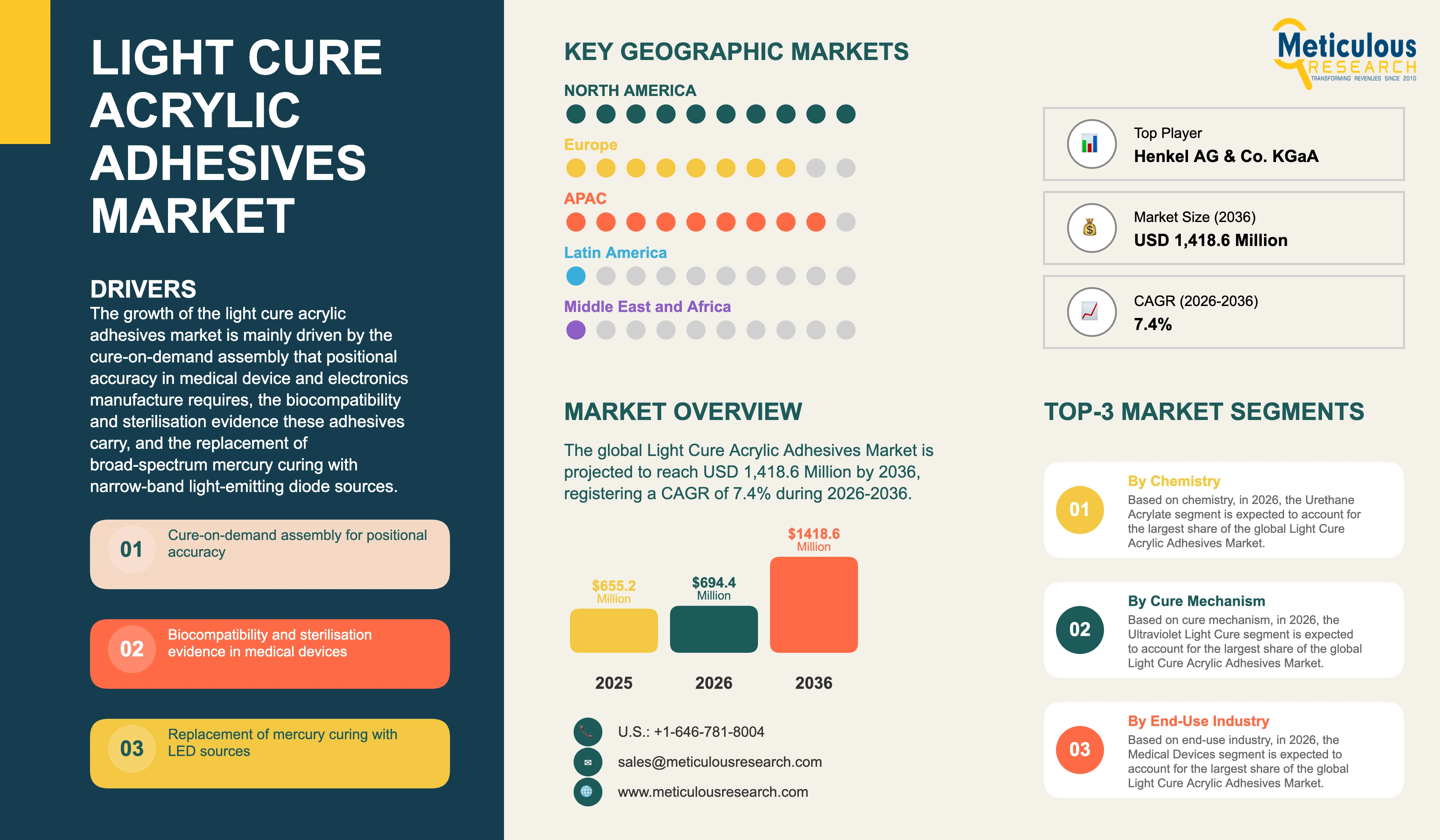
The global light cure acrylic adhesives market was valued at USD 655.2 million in 2025. This market is expected to reach USD 1,418.6 million by 2036 from an estimated USD 694.4 million in 2026, registering a CAGR of 7.4% during the forecast period (2026-2036).
- Published
- Nov 2026
- Pages
- 269
- Format
- PDF + Excel
- Report ID
- MRCHM - 1042654
- Base year
- 2025
- 2025 · BASELINE
- $655.2M
- 2036
- $1.42B
- CAGR 2026–2036
- 7.4%
2025 baseline · 2026–2036 forecast at 7.4% CAGR · hover a bar for the value
Key highlights
The global light cure acrylic adhesives market is estimated at USD 694.4 million in 2026 and is projected to reach USD 1,418.6 million by 2036.
Market volume is estimated at 5.60 kilotons in 2026 and is projected to reach 12.78 kilotons by 2036 at a CAGR of 8.6%.
The average selling price is estimated at USD 124.00 per kg in 2026 and is projected to reach USD 111.00 per kg by 2036.
Urethane acrylate is expected to account for the largest chemistry share in 2026, while acrylated epoxy is projected to register the highest CAGR of 9.2%.
Ultraviolet light cure is expected to hold the largest share by cure mechanism in 2026, while dual cure is projected to grow fastest at a CAGR of 10.2%.
Broad-spectrum sources are expected to account for the largest share by light source in 2026, while light-emitting diode curing is projected to register the highest CAGR of 12.6%.
Low viscosity and wicking grades are expected to hold the largest viscosity share in 2026, while high viscosity and gel grades are projected to grow fastest at a CAGR of 8.4%.
Medical devices are expected to be the largest end-use industry in 2026, while optics and optoelectronics are projected to register the highest CAGR of 10.6%.
North America is expected to hold the largest regional share in 2026, while Asia-Pacific is projected to register the highest CAGR of 9.8%.
Trimethylbenzoyl diphenylphosphine oxide, a principal acyl phosphine oxide photoinitiator for light-emitting diode curing, was reclassified as a CMR Category 1B substance in the European Union by Delegated Regulation (EU) 2024/197.
Following that reclassification, Delegated Regulation (EU) 2025/877, published on 12 May 2025, prohibited the substance in cosmetic products in the European Union from 1 September 2025 with no transitional period for existing stock.
That prohibition applies to cosmetic products rather than to industrial adhesives, but the underlying CMR Category 1B classification applies to the substance wherever it is used and has moved photoinitiator selection in light cure formulation.
Current light cure acrylic adhesive products are formulated for narrow-band curing, with Dymax Corporation specifying 385 to 405 nanometre light-emitting diode cure for its needle bonding grade.
That grade is stated at 150 centipoise nominal viscosity, 150% elongation at break and Shore D70 hardness, and bonds stainless steel, polycarbonate, poly(methyl methacrylate), FR4 and ABS.
The same grade is stated as tested to ISO 10993-5 for cytotoxicity and compliant with RoHS Directive 2015/863/EC.
Cure verification features are supplied with the adhesive rather than added by the assembler, including bright red fluorescence under 365 nanometre low-intensity black light for bond-line inspection and a blue to colourless change on cure.
Report summary
| Particulars | Details |
|---|---|
| Base Year | 2025 |
| Forecast Period | 2026-2036 |
| Market Size in 2025 | USD 655.2 million |
| Market Size in 2026 | USD 694.4 million |
| Market Size by 2036 | USD 1,418.6 million |
| Value CAGR (2026-2036) | 7.4% |
| Format | PDF, Excel & Cloud Portal · 269 pages |
| Volume in 2026 | 5.60 kilotons |
| Volume by 2036 | 12.78 kilotons |
| Volume CAGR (2026-2036) | 8.6% |
| Average Selling Price in 2026 | USD 124.00 per kg |
| Average Selling Price by 2036 | USD 111.00 per kg |
| Measurement Basis | Light cure and dual cure acrylate and methacrylate adhesives supplied for assembly bonding, excluding cyanoacrylate adhesives, light cure epoxy and silicone chemistries, ultraviolet curable coatings, inks and varnishes, ultraviolet curable pressure sensitive adhesive tapes, and anaerobic threadlockers and retaining compounds |
| Largest Chemistry Segment | Urethane acrylate |
| Fastest-Growing Chemistry Segment | Acrylated epoxy (CAGR 9.2%) |
| Largest Cure Mechanism Segment | Ultraviolet light cure |
| Fastest-Growing Cure Mechanism Segment | Dual cure (CAGR 10.2%) |
| Largest Light Source Segment | Broad-spectrum |
| Fastest-Growing Light Source Segment | Light-emitting diode (CAGR 12.6%) |
| Largest Viscosity Segment | Low viscosity and wicking |
| Fastest-Growing Viscosity Segment | High viscosity and gel (CAGR 8.4%) |
| Largest End-Use Industry | Medical devices |
| Fastest-Growing End-Use Industry | Optics and optoelectronics (CAGR 10.6%) |
| Largest Region | North America |
| Fastest-Growing Region | Asia-Pacific (CAGR 9.8%) |
| Segments Covered | Chemistry, Cure Mechanism, Light Source, Viscosity, End-Use Industry, and Geography |
| Geographies Covered | North America, Asia-Pacific, Europe, Middle East & Africa, and Latin America |
| Companies Profiled | 12 companies, including Henkel AG & Co. KGaA, Dymax Corporation, DELO Industrie Klebstoffe GmbH & Co. KGaA, 3M Company, Arkema S.A., and H.B. Fuller Company |
Report overview
Segments covered: chemistry, cure mechanism, light source, viscosity, end-use industry.
The growth of this market is mainly driven by the cure-on-demand assembly that positional accuracy in medical device and electronics manufacture requires, the biocompatibility and sterilisation evidence that medical device assembly adhesives have to carry, the reclassification of a principal photoinitiator under the European classification rules, and the replacement of broad-spectrum mercury curing with narrow-band light-emitting diode sources. However, factors such as the line-of-sight requirement that confines these adhesives to joints light can reach, and the oxygen inhibition and depth-of-cure limits inherent to free-radical acrylate curing, are expected to restrain the growth of this market to some extent.
Light cure acrylic adhesives are one-part, solvent-free acrylate and methacrylate formulations that remain liquid until exposed to ultraviolet or visible light and then cure in seconds by free-radical polymerisation. Market sizing in this report is on both a value basis in USD and a volume basis in kilotons, with average selling price derived from the two. The measurement basis is light cure and dual cure acrylate and methacrylate adhesives supplied for assembly bonding, and it excludes cyanoacrylate adhesives, light cure epoxy and silicone chemistries, ultraviolet curable coatings, inks and varnishes, ultraviolet curable pressure sensitive adhesive tapes, and anaerobic threadlockers and retaining compounds.
The commercial property being sold is control over when the adhesive sets. An assembler dispenses the adhesive, positions the parts, inspects the placement and then triggers the cure, which removes the open-time constraint that governs two-part and moisture-cure systems and allows the same line to run at the pace of the handling equipment rather than of the chemistry. That sequence is what makes the chemistry suitable for high-volume assembly of small parts to tight positional tolerance, and it is why the applications concentrate in medical devices, electronics and optics rather than in general industrial bonding.
Formulations are specified against a cure source wavelength rather than against light generally. Dymax Corporation specifies 385 to 405 nanometre light-emitting diode cure for its needle bonding grade, which reflects the narrow emission bands of current curing equipment against the broad output of a mercury arc lamp. A photoinitiator package tuned to a mercury spectrum absorbs poorly at a diode wavelength and a joint can appear cured at the surface while remaining liquid below, so changing the light source in a plant requires requalifying the adhesive. The equipment transition and the formulation transition are therefore a single commercial event rather than two.
Photoinitiator availability has become a formulation constraint rather than a technical choice. Trimethylbenzoyl diphenylphosphine oxide, a principal acyl phosphine oxide photoinitiator for light-emitting diode curing, was reclassified as a CMR Category 1B substance in the European Union by Delegated Regulation (EU) 2024/197, and Delegated Regulation (EU) 2025/877, published on 12 May 2025, prohibited it in cosmetic products from 1 September 2025 with no transitional period for existing stock. The prohibition reaches cosmetics rather than industrial adhesives, but the classification applies to the substance wherever it is used and carries downstream consequences for labelling, workplace exposure assessment and customer substitution policies.
Medical device assembly is the application that sets the evidence requirement for the whole market. An adhesive used in a device that contacts tissue or fluid has to carry biocompatibility test evidence, and the Dymax needle bonding grade is stated as tested to ISO 10993-5 for cytotoxicity and compliant with RoHS Directive 2015/863/EC. The adhesive also has to survive the sterilisation route the finished device uses and hold its properties through the stated shelf life of that device. A formulation change therefore reaches the device file of the customer rather than only their process, which is what keeps qualified products in place for years.
Needle and cannula bonding is the defining application within that industry. A stainless steel needle is bonded into a moulded plastic hub by wicking a low viscosity adhesive into the annular gap and curing it through the translucent hub, which requires a material that flows into a capillary and then cures through a plastic wall. The Dymax grade for that application is stated at 150 centipoise nominal viscosity with 150% elongation at break and Shore D70 hardness, and bonds stainless steel, polycarbonate, poly(methyl methacrylate), FR4 and ABS. Low viscosity and adhesion across dissimilar metal and plastic substrates in one formulation are the properties that application demands.
Inspection is built into the product rather than added to the line. Cure verification features supplied with the adhesive include bright red fluorescence under 365 nanometre low-intensity black light for bond-line inspection and a blue to colourless change on cure that confirms both material placement and full cure. A cured acrylate bond line is otherwise transparent and indistinguishable from an uncured one by eye, and a device assembler running at high volume needs a pass or fail check at the station rather than a destructive test on a sample. Those features are specified as part of the adhesive on medical and electronics lines.
The limits of the chemistry define where it is not used. Light has to reach the joint, so a bond line concealed between two opaque parts cannot be cured and the adhesive has to be selected around the geometry rather than the geometry around the adhesive. Free-radical acrylate cure is inhibited by atmospheric oxygen at the exposed surface, which can leave a tacky skin at the bond edge, and cure depth falls as light is absorbed through thickness and through pigmented or filled substrates. Dual cure formulations that complete through moisture or heat where light does not reach exist precisely to address those conditions.
Medical devices are expected to hold the largest share in 2026, covering needle and cannula bonding, catheter and tube set assembly and device housing bonding.
Optics and optoelectronics are projected to register the highest CAGR of 10.6% during the forecast period.
North America is expected to account for the largest share in 2026, supported by the concentration of medical device design and manufacture in the United States and by the presence of specialist light cure formulators. The United States is projected to grow at 6.8%.
Asia-Pacific is projected to register the highest CAGR of 9.8% during the forecast period, with China at 10.4% and India at 11.8%.
Europe is projected to grow at a CAGR of 5.8%, with Germany at 5.4% and Ireland at 7.2% as a concentration of medical device manufacture. The region carries the photoinitiator reclassification most directly, since Delegated Regulation (EU) 2024/197 and Delegated Regulation (EU) 2025/877 apply there first.
The Middle East & Africa is projected to grow at a CAGR of 7.0%. Latin America is projected to grow at a CAGR of 5.4%, with Mexico the principal market as medical device assembly serving the North American market expands.
Henkel AG & Co. KGaA, Dymax Corporation, DELO Industrie Klebstoffe GmbH & Co. KGaA, 3M Company and Arkema S.A. together accounted for an estimated 52.6% of this market in 2026. The 12 companies profiled in this report together accounted for an estimated 79.0%.
Report infographic
Market dynamics
15 factors across 5 forcesCure-on-Demand Assembly for Positional Accuracy at High Volume
A light cure adhesive remains liquid until the assembler triggers the cure, so parts can be dispensed, positioned and inspected before the bond sets and the cure then completes in seconds. That removes the open time and pot life constraints that govern two-part and moisture-cure systems, and it lets a line run at the pace of the handling equipment rather than of the chemistry. Medical device and electronics assembly operate at volumes and positional tolerances where a fixture-and-wait cure is not viable, and the floor space that racking and oven curing consume is itself a cost. The chemistry is consequently selected for the production method rather than for the joint strength, which is why it holds positions that stronger adhesives do not. Inspection before cure also lowers scrap on parts whose value lies in the components rather than the adhesive, since a misplaced part can be repositioned while the joint is still liquid instead of being discarded.
Biocompatibility and Sterilisation Evidence Required in Medical Device Assembly
An adhesive used where a device contacts tissue or fluid has to carry biocompatibility test evidence, and the Dymax Corporation needle bonding grade is stated as tested to ISO 10993-5 for cytotoxicity and compliant with RoHS Directive 2015/863/EC. The adhesive also has to survive the sterilisation route of the finished device and hold its properties across that device shelf life, so the evidence set extends beyond the adhesive specification into the device file of the customer. Formulators maintaining that evidence across a product range serve a requirement that general industrial adhesive suppliers do not meet. The documentation rather than the chemistry is what makes a product specifiable in the application, and it supports a price per kilogram far above general assembly adhesives. The evidence also has to be maintained rather than generated once, since test standards are revised and a customer conformity assessment can call for current data on a product qualified years earlier.
Reclassification of a Principal Photoinitiator Under European Classification Rules
Trimethylbenzoyl diphenylphosphine oxide, a principal acyl phosphine oxide photoinitiator for light-emitting diode curing, was reclassified as a CMR Category 1B substance in the European Union by Delegated Regulation (EU) 2024/197, and Delegated Regulation (EU) 2025/877, published on 12 May 2025, prohibited it in cosmetic products from 1 September 2025 with no transitional period for existing stock. The prohibition covers cosmetics rather than industrial adhesives, but the classification follows the substance into every use and reaches labelling, workplace exposure assessment and the substitution policies of customers. Reformulating a photoinitiator package changes cure speed, depth of cure and yellowing behaviour, so the substitution is a development programme rather than a swap. Suppliers holding qualified alternative packages have gained position while that work proceeds across the industry.
Replacement of Broad-Spectrum Mercury Curing with Light-Emitting Diode Sources
Light-emitting diode curing equipment emits in a narrow band, and current adhesive grades are specified against it, with Dymax Corporation stating 385 to 405 nanometre cure for its needle bonding product. A photoinitiator package tuned to the broad output of a mercury arc lamp absorbs poorly at a diode wavelength, which can leave a joint cured at the surface and liquid below, so a plant converting its curing equipment has to requalify its adhesive at the same time. Diode sources draw less power, need no warm-up, contain no mercury and have far longer service life, which makes the conversion a maintenance and energy decision as much as a process one. Every such conversion opens an adhesive qualification that had been closed, which is the mechanism behind the growth of diode-optimised grades. Narrow-band output also delivers less infrared heating at the joint than a mercury lamp, which matters where the adhesive is cured through a thin thermoplastic part that would otherwise distort.
Table of contents
13 chapters · 146 sections · 269 pages · click to expandSegmental analysis
| Segment | Largest share (2026) | Fastest growth (2026–2036) |
|---|---|---|
| By Chemistry | Urethane acrylate | Acrylated epoxy |
| By Cure Mechanism | Ultraviolet light cure | Large share of this |
| By Light Source | Broad-spectrum | Light-emitting diode |
| By Viscosity | Low viscosity and wicking | High viscosity and gel |
| By End-Use Industry | Medical devices | Optics and optoelectronics |
| Other segments | Ultraviolet light cure | Dual cure |
By Chemistry
- Light Cure Acrylic Adhesives Market Analysis by Chemistry
- The urethane acrylate segment is expected to account for the largest share of the global light cure acrylic adhesives market.
- The large share of this segment is mainly due to the combination of elongation and adhesion the backbone provides across dissimilar metal and plastic substrates, which device assembly requires where a stainless steel component is bonded into a moulded plastic part with different thermal expansion, and the toughness that allows a bond line to accommodate handling and sterilisation stress without cracking.
- Grades at high elongation combined with a hard durometer reflect that balance being formulated rather than compromised.
- However, the acrylated epoxy segment is projected to register the highest CAGR of 9.2% during the forecast period.
- The rapid growth of this segment is attributed to the lower cure shrinkage and higher modulus that optical and semiconductor assembly require, where dimensional movement after cure displaces a lens or stresses a die, the better adhesion to glass and inorganic surfaces that those applications present, and the thermal and chemical resistance needed where the bond line sits inside a sealed optical or electronic package.
- Methacrylate chemistries hold positions where a slower, more controllable cure and lower odour are required, and the remaining acrylate chemistries occupy narrow positions defined by a single substrate or optical requirement.
- Chemistry selection in practice follows the substrate pair and the stiffness the joint can tolerate rather than cure speed, since every product in this market cures in seconds by definition.
- Urethane acrylate is expected to account for the largest share in 2026, supported by the elongation and adhesion it provides across dissimilar metal and plastic substrates.
- Acrylated epoxy is projected to register the highest CAGR of 9.2% during the forecast period.
By Cure Mechanism
- Light Cure Acrylic Adhesives Market Analysis by Cure Mechanism
- The ultraviolet light cure segment is expected to account for the largest share of the global light cure acrylic adhesives market.
- The large share of this segment is mainly due to the installed ultraviolet curing capacity in medical device and electronics assembly, the photoinitiator packages that absorb efficiently in the ultraviolet and deliver the fastest cure, and the transparency of the polycarbonate and acrylic components that these adhesives cure through to ultraviolet wavelengths.
- However, the dual cure segment is projected to register the highest CAGR of 10.2% during the forecast period.
- The rapid growth of this segment is attributed to the shadowed and thick-section joints that a pure light cure cannot reach, which otherwise exclude the chemistry from part-concealed geometries in electronics and automotive assembly, the secondary moisture or heat mechanism that completes the cure where light is blocked, and the higher price per kilogram that carrying two cure systems commands.
By Light Source
- Light Cure Acrylic Adhesives Market Analysis by Light Source
- The broad-spectrum segment is expected to account for the largest share of the global light cure acrylic adhesives market.
- The large share of this segment is mainly due to the mercury arc curing equipment installed across existing assembly lines, the broad output that cures a wide range of photoinitiator packages without requalification, and the reluctance of regulated manufacturers to change a curing source on a qualified line while the equipment continues to function.
- However, the light-emitting diode segment is projected to register the highest CAGR of 12.6% during the forecast period.
- The rapid growth of this segment is attributed to the specification of current grades against narrow emission bands, with Dymax Corporation stating 385 to 405 nanometre cure for its needle bonding product, the lower power consumption, absence of warm-up, absence of mercury and far longer service life of diode sources, and the requalification of the adhesive that each equipment conversion forces and that reopens a settled specification.
By Viscosity
- Light Cure Acrylic Adhesives Market Analysis by Viscosity
- The low viscosity and wicking segment is expected to account for the largest share of the global light cure acrylic adhesives market.
- The large share of this segment is mainly due to needle and cannula bonding, where the adhesive has to flow into the annular gap between a stainless steel needle and a moulded hub by capillary action before being cured through the hub wall, and to the comparable capillary joints in tube set and fluid path assembly.
- The Dymax needle bonding grade stated at 150 centipoise nominal viscosity indicates the flow behaviour that application requires.
- However, the high viscosity and gel segment is projected to register the highest CAGR of 8.4% during the forecast period.
- The rapid growth of this segment is attributed to the gap filling and vertical surface applications where a wicking grade runs out of the joint before it can be cured, the encapsulation and potting of components in electronics assembly that require a material holding its shape before cure, and the thicker bond lines that dual cure formulations are used in.
By End-Use Industry
- Light Cure Acrylic Adhesives Market Analysis by End-Use Industry
- The medical devices segment is expected to account for the largest share of the global light cure acrylic adhesives market.
- The large share of this segment is mainly due to needle and cannula bonding, catheter and tube set assembly and device housing bonding, all carried out at volumes and positional tolerances that suit cure-on-demand assembly, the biocompatibility evidence these adhesives carry with grades tested to ISO 10993-5 for cytotoxicity, and the translucent moulded components that allow cure through the part.
- However, the optics and optoelectronics segment is projected to register the highest CAGR of 10.6% during the forecast period.
- The rapid growth of this segment is attributed to the camera module, sensor, display and photonic assemblies in which a lens or emitter has to be fixed to sub-micron positional tolerance and cured without movement, the low cure shrinkage and optical clarity those joints require, and the growth of imaging and sensing content in consumer, automotive and industrial equipment.
Other segments
- Ultraviolet light cure is expected to hold the largest share in 2026.
- Dual cure is projected to register the highest CAGR of 10.2% during the forecast period.
- Broad-spectrum sources are expected to account for the largest share in 2026, reflecting the mercury arc curing equipment installed across existing assembly lines.
- Light-emitting diode curing is projected to register the highest CAGR of 12.6% during the forecast period.
- Low viscosity and wicking grades are expected to hold the largest share in 2026, driven by needle and cannula bonding where the adhesive flows into a capillary gap before cure.
- High viscosity and gel grades are projected to register the highest CAGR of 8.4% during the forecast period.
Geographic analysis
North America
Largest shareIn 2026, North America is expected to account for the largest share of the global light cure acrylic adhesives market. The large share of this region is mainly due to the concentration of medical device design and manufacture in the United States, where needle, catheter and drug delivery device assembly is carried out at scale, the presence of the specialist light cure adhesive formulators including Dymax Corporation, and the regulatory documentation requirements that favour suppliers able to maintain biocompatibility and compliance evidence locally. The United States is projected to register a CAGR of 6.8% during the forecast period.
Asia-Pacific
Fastest growthHowever, Asia-Pacific is projected to register the highest CAGR of 9.8% during the forecast period. The rapid growth of this region is attributed to the electronics and optical module assembly concentrated in China, Japan, South Korea and Taiwan where camera, sensor and display bonding volumes are largest, the medical device contract manufacturing being established in China, Malaysia and India, and the local formulation capacity being added close to those assembly bases. China is projected to register a CAGR of 10.4% and India a CAGR of 11.8%.
Europe
Europe holds a substantial share built on medical device manufacture and on precision engineering, and is projected to grow at 5.8%, with Germany at 5.4% and Ireland at 7.2% as a concentration of medical device manufacture. The European position also carries the photoinitiator reclassification most directly, since Delegated Regulation (EU) 2024/197 and Delegated Regulation (EU) 2025/877 apply there first.
Middle East & Africa
The Middle East & Africa is projected to grow at 7.0% and Latin America at 5.4%, with Mexico the principal market as medical device assembly serving the North American market expands. Where the adhesive is formulated and where it is used diverge more in this market than in most. Formulation and photoinitiator expertise sit with a small number of specialists in North America, Germany and Japan, while assembly volume is concentrated in Asia-Pacific contract manufacturing, so material crosses regions in small, high-value quantities that bear the freight comfortably. Qualification is granted by the device owner rather than by the assembly site, which means a formulator can hold a specification written in one region and supply the assembly carried out in another. That pattern is why regional filling capacity matters less here than in most adhesive markets, and why local technical support at the assembly site matters more. Application engineering is consequently placed close to the assembly base while formulation stays centralised.
Competitive landscape
The global light cure acrylic adhesives market is characterised by the presence of specialist light cure adhesive formulators, diversified adhesives and sealants companies, and chemical groups supplying both formulated adhesives and the acrylate oligomers behind them. Competition is contested on qualified position in customer device files and process specifications rather than on formulation, since changing a qualified adhesive reaches the technical documentation of a regulated device or the validated process of an electronics line. Henkel AG & Co. KGaA, Dymax Corporation, DELO Industrie Klebstoffe GmbH & Co. KGaA, 3M Company and Arkema S.A. together accounted for an estimated 52.6% of this market in 2026, while the companies profiled in this report together accounted for an estimated 79.0%.
Trimethylbenzoyl diphenylphosphine oxide was reclassified as a CMR Category 1B substance by Delegated Regulation (EU) 2024/197, and Delegated Regulation (EU) 2025/877, published on 12 May 2025, prohibited it in cosmetic products in the European Union from 1 September 2025 with no transitional period, which moved photoinitiator selection across light cure formulation. Suppliers responded through alternative photoinitiator packages qualified against the original cure performance, light-emitting diode optimised grades specified at 385 to 405 nanometres, and cure verification features supplied in the adhesive including 365 nanometre fluorescence for bond-line inspection and a blue to colourless change on cure. Photoinitiator substitution and diode-optimised grades accounted for most competitive activity through 2026.
Specialist formulators hold positions in medical device and optical assembly that scale alone does not deliver, because the qualification is written around a specific grade and its evidence set. Dymax Corporation and DELO Industrie Klebstoffe GmbH & Co. KGaA supply light cure adhesives as their principal business, while the diversified suppliers compete through broader adhesive portfolios and global technical support. Some of the key players operating in the light cure acrylic adhesives market are Henkel AG & Co. KGaA (Germany), Dymax Corporation (U.S.), DELO Industrie Klebstoffe GmbH & Co. KGaA (Germany), 3M Company (U.S.), Arkema S.A. (France), H.B. Fuller Company (U.S.), ThreeBond Holdings Co., Ltd. (Japan), Nagase & Co., Ltd. (Japan), Resonac Holdings Corporation (Japan), Mitsubishi Chemical Group Corporation (Japan), Parker-Hannifin Corporation (U.S.), and ALTANA AG (Germany), among others.
- —
Delegated Regulation (EU) 2024/197 reclassified trimethylbenzoyl diphenylphosphine oxide as a CMR Category 1B substance in the European Union, and Delegated Regulation (EU) 2025/877, published on 12 May 2025, prohibited the substance in cosmetic products from 1 September 2025 with no transitional period for existing stock. Suppliers have brought forward light-emitting diode optimised grades specified at 385 to 405 nanometres, with cure verification features including 365 nanometre bond-line fluorescence and a blue to colourless change on cure.
- Henkel AG & Co. KGaA
- Dymax Corporation
- DELO Industrie Klebstoffe GmbH & Co. KGaA
- 3M Company
- Arkema S.A.
- H.B. Fuller Company
Expert perspectives
Volume grows at 8.6% against 7.4% in value over the forecast period, and the average selling price falls from USD 124.00 per kg in 2026 to USD 111.00 per kg by 2036 as high-volume medical device and electronics contracts move from syringe to cartridge and bulk supply and as regional formulation capacity expands in Asia-Pacific. Packaging format carries a large share of delivered cost at these price levels, so the decline reflects contract size rather than erosion of the formulation premium.
What is being bought is control of the moment of cure. The adhesive stays liquid until the assembler triggers it, which removes open time and pot life from the process and lets the line run at the pace of the handling equipment. That is why the chemistry holds positions in medical device and electronics assembly against adhesives with better mechanical properties, and why the applications cluster where positional tolerance and throughput matter more than joint strength.
The photoinitiator reclassification is the most consequential event in this market and it is widely misread. Delegated Regulation (EU) 2025/877, published on 12 May 2025, prohibited trimethylbenzoyl diphenylphosphine oxide in cosmetic products from 1 September 2025, not in industrial adhesives, but the CMR Category 1B classification established by Delegated Regulation (EU) 2024/197 follows the substance into every use. Customers act on it through their own substitution policies, and because the initiator sets cure speed, cure depth and yellowing, replacing it is a requalification rather than a swap.
Wavelength has become the first selection criterion. Dymax Corporation specifies 385 to 405 nanometre diode cure for its needle bonding grade, and a package tuned to a mercury spectrum can leave a joint cured at the surface and liquid below. A plant converting its curing equipment therefore requalifies its adhesive at the same time, and that conversion is the only routine occasion on which a settled specification reopens in these industries.
The barrier to entry sits in the customer documentation rather than in the chemistry. An adhesive in a regulated medical device carries its biocompatibility, sterilisation and stability evidence into the technical file of that device, so changing it is a cost the device manufacturer bears. Incumbent grades consequently hold position long past the point at which better formulations exist, and a challenger reaches only new device programmes and newly converted lines.
The geometric limit is what caps this market rather than competition. Light has to reach the joint, oxygen inhibits cure at the exposed surface and cure depth falls through thickness and through pigmented substrates, none of which formulation removes. Dual cure grades exist to address exactly those conditions and grow fastest among the cure mechanisms for that reason, which is the clearest indication of where the unserved demand sits.
Customer perspectives
“The reason we use light cure on needle bonding is that we can wick the adhesive in, look at it, and then cure it. Nothing sets before we are ready. The adhesive is in our device file with its biocompatibility and sterilisation data, so changing it is not a purchasing decision, it is a regulatory one, and we do not open that unless we have to.”
“We are fixing a lens to a tolerance where any shrinkage after cure moves the image, so cure shrinkage and modulus matter more to us than peel strength. We also need to know the adhesive cures at the wavelength our diode array actually emits. A product qualified under a mercury lamp tells us very little about that.”
“Half our joints are partly hidden behind a component, so a pure light cure leaves us guessing whether the shadowed part is cured. Dual cure solves that but costs more. The other thing we now ask on every enquiry is what is in the photoinitiator package, because our customers have substitution lists and we have to answer to them.”
Frequently asked questions
This market was valued at USD 620.8 million in 2024 and USD 655.2 million in 2025, and is estimated at USD 694.4 million in 2026. In volume terms it is estimated at 5.60 kilotons in 2026.
This market is projected to reach USD 1,418.6 million by 2036 in value and 12.78 kilotons in volume.
This market is projected to register a value CAGR of 7.4% and a volume CAGR of 8.6% during the forecast period 2026-2036. The average selling price is projected to move from USD 124.00 per kg in 2026 to USD 111.00 per kg by 2036.
Growth is driven by cure-on-demand assembly for positional accuracy and throughput in medical device and electronics manufacture, biocompatibility and sterilisation evidence, the CMR Category 1B reclassification of trimethylbenzoyl diphenylphosphine oxide, and the replacement of mercury curing with narrow-band LED sources specified at 385 to 405 nanometres.
Light has to reach the joint, so concealed bond lines cannot be cured, and oxygen inhibition and depth-of-cure limits constrain free-radical cure. Qualified adhesives are locked into regulated device files, and replacing a photoinitiator alters cure speed, depth and yellowing, making substitution a requalification.
Dual cure formulations extend the chemistry into shadowed and thick-section joints, and qualified alternative photoinitiator packages answer enquiries created by the European reclassification. LED optimised grades reach accounts when plants convert curing equipment, and cure verification features differentiate comparable products.
Urethane acrylate is expected to account for the largest share in 2026, supported by the elongation and adhesion it provides across dissimilar metal and plastic substrates.
Acrylated epoxy is projected to register the highest CAGR of 9.2% during the forecast period.
Ultraviolet light cure is expected to hold the largest share in 2026.
Dual cure is projected to register the highest CAGR of 10.2% during the forecast period.
Broad-spectrum sources are expected to account for the largest share in 2026, reflecting the mercury arc curing equipment installed across existing assembly lines.
Light-emitting diode curing is projected to register the highest CAGR of 12.6% during the forecast period.
Low viscosity and wicking grades are expected to hold the largest share in 2026, driven by needle and cannula bonding where the adhesive flows into a capillary gap before cure.
High viscosity and gel grades are projected to register the highest CAGR of 8.4% during the forecast period.
Medical devices are expected to hold the largest share in 2026, covering needle and cannula bonding, catheter and tube set assembly and device housing bonding.
Optics and optoelectronics are projected to register the highest CAGR of 10.6% during the forecast period.
North America is expected to account for the largest share in 2026, supported by the concentration of medical device design and manufacture in the United States and by the presence of specialist light cure formulators. The United States is projected to grow at 6.8%.
Asia-Pacific is projected to register the highest CAGR of 9.8% during the forecast period, with China at 10.4% and India at 11.8%.
Europe is projected to grow at a CAGR of 5.8%, with Germany at 5.4% and Ireland at 7.2% as a concentration of medical device manufacture. The region carries the photoinitiator reclassification most directly, since Delegated Regulation (EU) 2024/197 and Delegated Regulation (EU) 2025/877 apply there first.
The Middle East & Africa is projected to grow at a CAGR of 7.0%. Latin America is projected to grow at a CAGR of 5.4%, with Mexico the principal market as medical device assembly serving the North American market expands.
Henkel AG & Co. KGaA, Dymax Corporation, DELO Industrie Klebstoffe GmbH & Co. KGaA, 3M Company and Arkema S.A. together accounted for an estimated 52.6% of this market in 2026. The 12 companies profiled in this report together accounted for an estimated 79.0%.
Delegated Regulation (EU) 2024/197 reclassified trimethylbenzoyl diphenylphosphine oxide as a CMR Category 1B substance, and Delegated Regulation (EU) 2025/877, published on 12 May 2025, prohibited it in cosmetic products from 1 September 2025. Suppliers have brought forward LED optimised grades specified at 385 to 405 nanometres, with cure verification features including 365 nanometre bond-line fluorescence and a blue to colourless change on cure.
Cite this report
Meticulous Research. (2026). Light Cure Acrylic Adhesives Market - Global Opportunity Analysis and Industry Forecast (2026-2036) (Report No. MRCHM - 1042654). Meticulous Market Research Pvt. Ltd. https://www.meticulousresearch.com/product/light-cure-acrylic-adhesives-market-7337