
Artificial Casings Market (2024-2031)
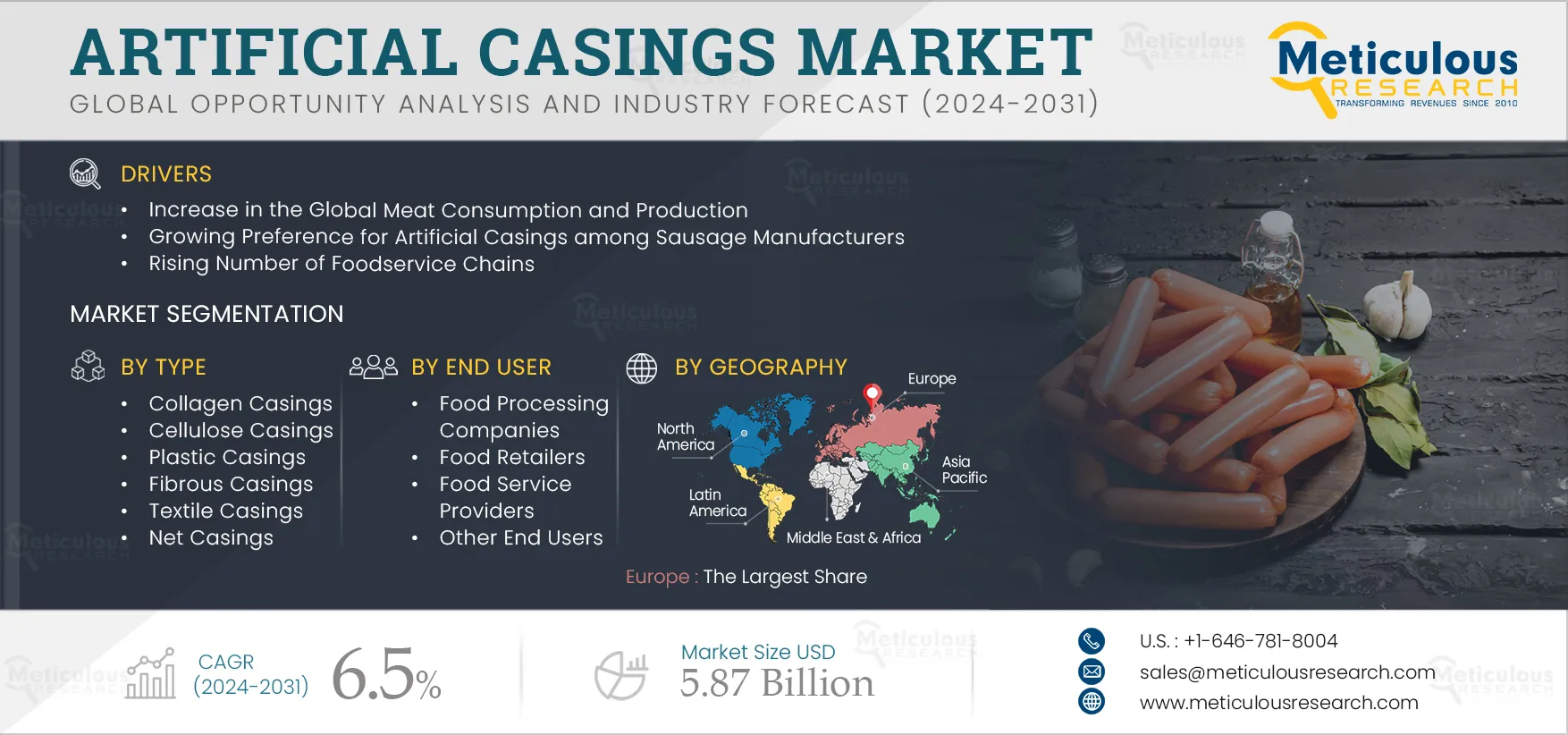
The Artificial Casings Market was valued at $3.56 billion in 2023. This market is expected to reach $5.87 billion by 2031 from an estimated $3.99 billion in 2024, at a CAGR of 6.5% during the forecast period from 2024 to 2031. Artificial Casings Market Size & Forecast The growth of this market is driven
- Published
- Nov 2025
- Pages
- 270
- Format
- PDF + Excel
- Report ID
- MR-335
- Base year
- 2024
- 2023 · HISTORICAL
- $3.56B
- 2031
- $5.87B
- CAGR 2024–2031
- 6.5%
2023 baseline · 2024–2031 forecast at 6.5% CAGR · hover a bar for the value
Key highlights
Based on application, the artificial casings market is segmented into animal-based sausages and plant-based sausages. In 2024, the animal-based sausages segment is expected to account for the largest share of the market. This segment’s large market share is primarily attributed to the heightening consumption of meat, the high acceptance of collagen casings, and increased consumer preference for a protein-rich diet.
However, the plant-based sausages segment is anticipated to register the highest CAGR during the forecast period. The growth of this segment is driven by the changing consumer preference for healthy, flavorsome, sustainable, and environment-friendly sausage options.
Based on end user, the artificial casings market is segmented into food-processing companies, food service providers, food retailers, and other end users. In 2024, the food-processing companies segment is expected to dominate the market. The increasing consumer preference for sausages has spurred bulk manufacturing. This is also propelling the demand for artificial casings. Moreover, the growing consumer demand for modern food options and the integration of automation in sausage manufacturing to maximize output augments this segment's market growth.
However, the food service providers segment is anticipated to register the highest CAGR during the forecast period. This segment's growth is driven by the growing demand for cooked meals due to the hectic routine of the employed population and expanding distribution channels of food service providers.
Report summary
| Particulars | Details |
|---|---|
| Number of Pages | 270 |
| Format | |
| Forecast Period | 2024–2031 |
| Base Year | 2024 |
| CAGR (Value) | 6.5% |
| Market Size (Value) | $5.87 Billion by 2031 |
| Segments Covered | By Type · Collagen Casings · Edible Collagen Casings · Non-edible Collagen Casings · Cellulose Casings · Plastic Casings · Tubular Plastic Casings · Flat Film Plastic Casings · Fibrous Casings · Textile Casings · Net Casings · Vegetarian Casings · By Application · Animal-based Sausages · Processed Sausages · Pre-Cooked Sausages · Smoked Sausages · Cured Sausages · Fresh Sausages · Plant-based Sausages · By Distribution Channel · Offline · Online · By End User · Food Processing Companies · Food Retailers · Food Service Providers · Other End Users |
| Countries Covered | North America (U.S., Canada), Europe (Germany, France, Italy, U.K., Spain, Poland, Netherlands, Russia, Austria, and Rest of Europe), Asia-Pacific (China, India, Japan, Australia, and Rest of Asia-Pacific), Latin America (Brazil, Mexico, Chile, Argentina, Colombia, and Rest of Latin America), and the Middle East & Africa (UAE, Saudi Arabia, South Africa, and Rest of Middle East & Africa) |
| Key Companies | Viscofan, S.A. (Spain), SARIA SE & Co. KG (Germany), Selo B.V. (Netherlands), Shenguan Holdings (Group) Limited (China), DAT-Schaub Group (Part of Danish Crown AmbA) (Denmark), ViskoTeepak Holding Ab Ltd (Finland), Fibran S.A. (Spain), Viskase Companies, Inc. (U.S.), Nippi. Inc. (Japan), FABIOS S.A. (Poland), Kalle GmbH (Germany), Oversea Casing Company (U.S.), Nutra Produkte AG (Switzerland), Ruitenberg Ingredients B.V. (Netherlands), and Ennio International (Australia). |
Report overview
Segments covered: type, application, distribution channel, end user—. Regions: North America, Europe, Asia-Pacific, Latin America, Middle East & Africa.
The growth of this market is driven by the increase in global meat consumption and production, growing preference for artificial casings among sausage manufacturers, casings manufacturers’ shift from natural casings to artificial casings due to operational challenges, and the rising number of food service chains. In addition, the emerging economies of Southeast Asia, Latin America, and Africa and the surge in the demand for vegetarian sausage casings are expected to create lucrative opportunities for players operating in this market.
However, factors such as consumers' high preference for natural sausage casings over artificial sausage casings are expected to significantly hinder the growth of this market.
Market dynamics
3 factors across 2 forcesIncrease in Global Meat Consumption and Production
The growth in the global population, especially the urban population, is playing a key role in boosting the use of artificial casings globally. According to the Department of Economic and Social Affairs of the United Nations (UN DESA), the world population reached 8.1 billion in 2023, an increase of around one billion over 2013. The global population is projected to increase further, to reach 8.5 billion by 2030, 9.7 billion by 2050, and 11.2 billion by 2100. Moreover, according to the World Health Organization, the urban population accounted for 57% of the total global population in 2023, up from 55% in 2014, and continues to grow further. The global urban population grew by approximately 1.84% per year between 2015 and 2020 and is expected to grow by 1.63% per year between 2020 and 2025 and 1.44% per year between 2025 and 2030. Urban consumers have a much wider choice and better availability of sausages than consumers living in rural areas. Urbanization is characterized by improved living standards and rising incomes which influence the affordability of sausages and processed meat products to a great extent.
This rise in the global population has led to a significant increase in meat and sausage consumption and production globally. Moreover, according to data from the OECD-FAO Agricultural Outlook 2023–2033, the global consumption of meat is projected to increase by 12% by 2033 compared to the base period 2021–2023, driven largely by income and population growth. Protein availability from beef, pork, poultry, and sheep meat is projected to grow by 8%, 9%, 21%, and 3%, respectively, from 2023 to 2033. Much of the increase in global meat production is attributed to the U.S.; however, Argentina, India, Mexico, the Russian Federation, and Turkey are also major contributors. In addition, per capita global meat consumption is expected to increase by 2% to reach 28.6 kg RWE (retail weight equivalent) by 2033 from 2023. The rising meat production and consumption are impacting the demand for artificial casings such as collagen casings, cellulose casings, plastic casings, and fibrous casings due to the increased manufacture of sausages globally.
Growing Preference for Artificial Casings Among Sausage Manufacturers
For decades, sausages have been prepared by stuffing meat into natural casings made from the intestines of animals; however, artificial casings are now available in the market due to the tremendous focus on innovation and product development in the casings industry. Natural sausage casings are irregular in size and shape, whereas artificial casings come in different shapes and sizes. If natural sausage casings are not stored properly, they tend to smell bad, making them unusable. Also, the possibility of breakage and microbial contamination is much higher with natural casings compared to artificial casings. In addition, artificial casings may contain coloring agents, spices, smoke flavoring, and other materials that accumulate on the product surface after stuffing and processing, adding taste and texture to the product. The variety offered by artificial casings is almost unlimited.
Furthermore, the cost benefits of using artificial casings, especially collagen casings for sausage manufacturers, can be substantial, with significant savings in time and labor costs, as collagen casing is easy to work with due to its better consistency and stability compared to natural casings. Artificial casings help sausage manufacturers save costs significantly—over 50% in some cases. Also, unlike natural casings, collagen casings are ready for use, and soaking or other preparation is not required. Collagen casings are particularly effective when sausages are filled mechanically with conventional stuffing machines, as the casings are replenished automatically. This factor helps reduce throughput times. These advantages of artificial casings over natural casings have increased their adoption among sausage manufacturers, driving the growth of the artificial casings market.
Table of contents
12 chapters · 130 sections · 270 pages · click to expandSegmental analysis
| Segment | Largest share (2024) | Fastest growth (2024–2031) |
|---|---|---|
| By Type | Collagen Casings | Vegetarian casings |
| By Distribution Channel | Offline | Online |
By Type
- The Collagen Casings Segment to Dominate the Artificial Casings Market in 2024
- The collagen casings segment is expected to account for the largest share of 42.9% of the market.
- Collagen casings can be produced at lower costs than other artificial sausage casings as they can be produced in a short span with less labor engagement.
- In addition, collagen casings are edible and offer standard diameter, uniformity, and strength.
- However, the vegetarian casings segment is projected to record the highest CAGR of 9.4% during the forecast period.
- This segment's growth is driven by advancements in food technology, rising cases of allergy to animal protein, increasing investments in plant-based companies, and growing vegetarian and vegan populations.
By Distribution Channel
- The Offline Segment to Dominate the Artificial Casings Market in 2024
- The offline segment is expected to account for a larger share of 84.3% of the artificial casings market.
- This segment's large market share is primarily attributed to factors such as the availability of a wide range of food products and the modernization of grocery stores to enhance the shopping experience.
- However, the online segment is anticipated to register the highest CAGR of 8.6% during the forecast period.
- This segment's growth is driven by convenience and cost-effectiveness, increasing internet and smartphone penetration, and rising disposable income.
Geographic analysis
Europe
Largest shareIn 2024, Europe is expected to hold the largest share of 30.8% of the artificial casings market. The market in Europe is estimated to be worth $1.16 billion in 2024. The growth of this regional market is attributed to the demand for artificial sausage casings from leading sausage manufacturers in the region for food integrity and safety, the expanding meat processing industry, and the increased average meat consumption. Europe Dominates the Artificial Casings Market
Asia-Pacific
Fastest growthHowever, the Asia-Pacific region is expected to record the fastest CAGR of 8.1% during the forecast period. This segment's rapid growth is due to the increasing demand for fast food outlets and the growing consumption of cross-cultural food.
Competitive landscape
- April 2023
SARIA SE & Co. KG (Germany) acquired Devro plc (U.K.) to expand their product portfolio and strengthen their position in the sausage casings market.
- October 2021
Viscofan, S.A. (Spain) invested $16.6 million in a fibrous casing manufacturing facility in Cáseda (Spain) to increase the production capacity.
- Viscofan, S.A. · Spain
- SARIA SE & Co. KG · Germany
- Selo B.V. · Netherlands
- Shenguan Holdings (Group) Limited · China
- DAT-Schaub Group (Part of Danish Crown AmbA) · Denmark
- ViskoTeepak Holding Ab Ltd · Finland
- Fibran S.A. · Spain
- Viskase Companies, Inc. (U.S.)
- Nippi. Inc. · Japan
- FABIOS S.A. · Poland
- Kalle GmbH · Germany
- Oversea Casing Company (U.S.)
- Nutra Produkte AG · Switzerland
- Ruitenberg Ingredients B.V. · Netherlands
- Ennio International · Australia
Frequently asked questions
This study focuses on market analysis and opportunity assessment based on the sales of artificial casings across various countries, regions, and market segments. The study also includes a competitive analysis based on key market players’ product portfolios, geographic presence, and growth strategies adopted in the last 3 to 4 years.
The artificial casings market study provides valuable insights, market sizes, and forecasts in terms of both value and volume by type and geography. However, the study provides insights, market sizes, and forecasts only in terms of value based on application, distribution channel, and end user.
Cite this report
Meticulous Research. (2025). Artificial Casings Market - Global Opportunity Analysis and Industry Forecast (2024-2031) (Report No. MR-335). Meticulous Market Research Pvt. Ltd. https://www.meticulousresearch.com/reports/artificial-casings-market-5035