High-Protein Foods Market (2026-2036)
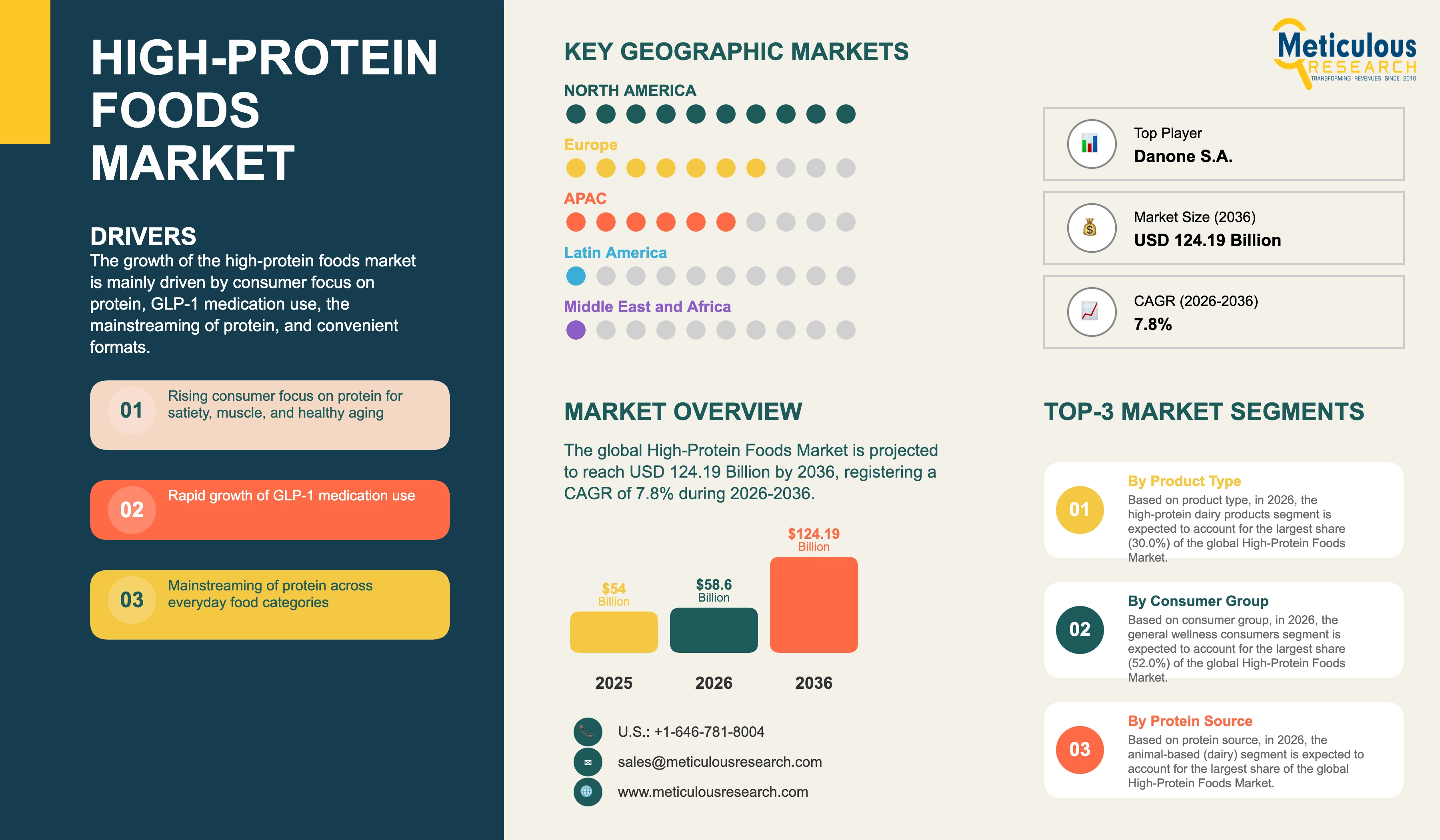
The global high-protein foods market was valued at USD 54.00 billion in 2025. This market is expected to reach USD 124.19 billion by 2036 from an estimated USD 58.60 billion in 2026, registering a CAGR of 7.8% during the forecast period (2026-2036).
- Published
- Nov 2026
- Pages
- 305
- Format
- PDF + Excel
- Report ID
- MRFB - 1042579
- Base year
- 2025
- 2025 · BASELINE
- $54.00B
- 2036
- $124.2B
- CAGR 2026–2036
- 7.8%
2025 baseline · 2026–2036 forecast at 7.8% CAGR · hover a bar for the value
Key highlights
According to NielsenIQ data reported by the Financial Times in January 2026, unit sales of U.S. grocery foods carrying protein claims rose by 4.6% in 2025, as food companies facing stagnant overall sales added protein to everyday products from cereals and snacks to coffee drinks and restaurant menus.
Danone reported that its Oikos high-protein yogurt brand exceeded EUR 1 billion in U.S. revenue in 2025, and the company expanded the brand into shelf-stable Oikos Protein Shakes, entering the more than USD 7 billion U.S. shelf-stable protein drink category, and into Oikos Fusion, a 7-ounce cultured dairy drink launched in 2025 for consumers using GLP-1 medications.
Data prepared for Danone by The Hartman Group in 2026 showed that protein remains the number-one nutrient U.S. consumers are intentionally adding to their diets, with 35% of Americans increasing their protein intake in the past year, while Mintel found that U.S. households using GLP-1 medications consume yogurt at nearly three times the average rate.
Danone acquired Huel, the UK-based complete nutrition and meal replacement brand, for about EUR 1.2 billion, adding high-protein shakes, powders, and bars to its portfolio, while Danone's Kate Farms launched High Protein Nutrition Shakes designed for people managing their weight, including GLP-1 users.
Coca-Cola has said that fairlife has grown into one of its fastest-growing brands in the U.S., and the company has invested in new production capacity, including a large dairy plant in New York State, to meet demand for ultra-filtered, high-protein milk and protein shakes, showing how quickly protein drinks have scaled in mainstream retail.
Innova Market Insights identified 'Powerhouse Protein' as the leading food and beverage trend for 2026, and ingredient suppliers such as Arla Foods Ingredients and FrieslandCampina Ingredients are developing high-protein solutions with additional health benefits to support new product launches.
By product type, high-protein dairy products account for the largest share of 30.0% in 2026, while ready-to-drink protein beverages register the highest CAGR.
By protein source, animal-based (dairy) accounts for the largest share in 2026, while novel proteins register the highest CAGR.
By consumer group, general wellness consumers account for the largest share of 52.0% in 2026, while weight management and GLP-1 users register the highest CAGR.
By distribution channel, supermarkets and hypermarkets account for the largest share in 2026, while online retail registers the highest CAGR.
By geography, North America accounts for the largest share of 40.0% in 2026, while Asia-Pacific registers the highest CAGR of 9.9%.
Report summary
| Particulars | Details |
|---|---|
| Base Year | 2025 |
| Estimated Year | 2026 |
| Forecast Period | 2026-2036 |
| Market Size in 2025 | USD 54.00 billion |
| Market Size in 2026 | USD 58.60 billion |
| Market Size by 2036 | USD 124.19 billion |
| CAGR (2026-2036) | 7.8% |
| Format | PDF, Excel & Cloud Portal · 305 pages |
| Largest Segment by Product Type (2026) | High-Protein Dairy Products (30.0%) |
| Largest Segment by Consumer Group (2026) | General Wellness Consumers (52.0%) |
| Largest Region (2026) | North America (40.0%) |
| Fastest-Growing Region | Asia-Pacific (CAGR 9.9%) |
| Companies Profiled | 15 companies and other companies |
| Segments Covered | Product Type, Protein Source, Consumer Group, Distribution Channel, Geography |
| Countries Covered | U.S., Canada, Germany, U.K., France, Italy, Spain, Netherlands, Sweden, Denmark, Norway, Finland, Poland, Belgium, Switzerland, Ireland, Rest of Europe, China, Japan, India, South Korea, Australia, Indonesia, Thailand, Vietnam, Singapore, Malaysia, Rest of Asia-Pacific, Brazil, Mexico, Argentina, Chile, Colombia, Rest of Latin America, Saudi Arabia, U.A.E., Turkey, South Africa, Rest of Middle East & Africa |
Report overview
Segments covered: product type, protein source, consumer group, distribution channel.
The growth of this market is mainly driven by rising consumer interest in protein as the nutrient most associated with satiety, muscle health, and healthy aging, the rapid growth in the use of GLP-1 weight-loss medications, whose users need nutrient-dense, high-protein foods to help preserve muscle while eating less, the mainstreaming of protein beyond sports nutrition into everyday dairy, beverages, snacks, bakery, and cereals, continuous product innovation by large food and beverage companies, and the growth of convenient on-the-go formats such as ready-to-drink protein shakes and protein bars. However, factors such as higher prices compared with conventional foods, volatility in the cost of dairy and other protein ingredients, taste and texture challenges in high-protein formulations, and regulatory scrutiny of protein claims are expected to restrain the growth of this market to some extent.
High-protein foods are packaged foods and beverages that contain significantly more protein than standard products in their category, usually enough to carry a 'high protein' or 'source of protein' claim under local labeling rules. This report covers high-protein dairy products, such as protein yogurts, protein milks, and cottage cheese, ready-to-drink protein beverages, protein bars, protein snacks, high-protein bakery, cereals, and pasta, and other high-protein foods, such as frozen meals and plant-based products. Protein powders and dietary supplements sold mainly for sports nutrition are not included, and the market is measured on a sales value basis across all distribution channels.
Protein has become the most sought-after nutrient for many consumers, since it is associated with feeling full, maintaining and building muscle, managing weight, supporting energy, and healthy aging, and nutrition science and popular media have reinforced its importance. Surveys show that a large and growing share of consumers in the U.S., Europe, and Asia-Pacific are actively trying to eat more protein, and protein claims on packaging have become a powerful driver of purchase decisions.
For many years, high-protein foods were mainly sports nutrition products, such as protein bars and shakes aimed at athletes and bodybuilders. Today, protein has moved into the mainstream. Leading food companies are adding protein to yogurt, milk, cereals, granola, pasta, bread, snacks, coffee drinks, and frozen meals, and high-protein products are sold in mainstream supermarket aisles rather than only in specialty or sports nutrition sections. Brands such as Danone's Oikos, Coca-Cola's fairlife, BellRing Brands' Premier Protein, and Simply Good Foods' Quest have grown into large mainstream businesses.
The rapid growth of GLP-1 weight-loss medications, such as semaglutide and tirzepatide, has added a powerful new driver. These medications reduce appetite and food intake, and doctors and dietitians advise users to eat enough protein to help preserve muscle mass during weight loss. As a result, GLP-1 users are seeking small, nutrient-dense, high-protein foods and drinks, and food companies are launching products designed specifically for them. The expected introduction of oral GLP-1 medications and broader insurance coverage could further increase the number of users.
Dairy is the largest protein source in the market, since milk proteins, such as whey and casein, offer high nutritional quality, good taste, and functional properties that make them suitable for yogurts, drinks, and bars. Ultra-filtered milk, high-protein Greek and Icelandic yogurts, and cottage cheese have seen strong growth. Plant-based proteins from soy, pea, and other sources are used in plant-based dairy alternatives, bars, and snacks, while meat and egg proteins are used in meat snacks and other products. Novel proteins from fermentation, algae, and insects are emerging but remain small.
The market is also shaped by retailers, which are expanding protein sections and launching private-label high-protein yogurts, bars, and shakes at lower prices. Foodservice operators, including coffee chains and quick-service restaurants, are adding protein drinks, bowls, and snacks to their menus, which helps introduce protein products to new consumers and reinforces the idea that protein belongs in everyday eating.
Ready-to-drink protein beverages are one of the fastest-growing product categories, as consumers value their convenience, portability, and ease of use for breakfast, snacks, and post-workout recovery. Shelf-stable protein shakes have become a large category in the U.S., and dairy companies are expanding chilled protein drinks. Protein bars remain a large category, while protein snacks, such as chips, puffs, cookies, and meat snacks, are growing as companies apply protein to indulgent and savory formats.
The market includes multinational food and beverage companies, dairy companies, specialized protein brands, and private-label manufacturers. Leading companies include Danone, Nestlé, The Coca-Cola Company (fairlife), PepsiCo, BellRing Brands, The Simply Good Foods Company, Mondelez International, Mars, The Hershey Company, Glanbia, Lactalis, Arla Foods, Chobani, General Mills, and Meiji Holdings.
Over the forecast period, the high-protein foods market is expected to grow steadily, as protein continues to move into everyday foods, as GLP-1 use expands, as aging populations seek to maintain muscle and strength, and as companies develop better-tasting, more affordable, and more sustainable high-protein products.
High-protein yogurt and cottage cheese are among the fastest movers in our dairy aisle, and we keep adding space for protein drinks. Shoppers look for the protein number on the front of the pack, and our own private-label protein range is growing quickly too.
This comment explains why high-protein dairy products account for 30.0% of the market, why supermarkets and hypermarkets are the largest channel, and why North America accounts for 40.0% of the market.
Registered Dietitian, weight management clinic - U.S.
My patients on GLP-1 medications struggle to eat enough protein, so I recommend small, high-protein yogurts and shakes they can finish easily, even when their appetite is low.
This comment explains why weight management and GLP-1 users are the fastest-growing consumer group in the market and why ready-to-drink protein beverages are growing fastest.
Consumers in our region are just starting to look for protein on the label, but awareness is rising fast. Protein drinks and dairy are growing quickly, especially among older adults and young professionals in large cities.
This comment explains why general wellness consumers account for 52.0% of the market and why Asia-Pacific is the fastest-growing region.
General wellness consumers are expected to account for the largest share of 52.0% of the market in 2026, while weight management and GLP-1 users are projected to register the highest CAGR as GLP-1 medication use expands.
North America is expected to account for the largest share of 40.0% of the market in 2026, mainly due to very strong consumer interest in protein, large protein drink and bar categories, and rapid GLP-1 adoption in the U.S.
Asia-Pacific is projected to register the highest CAGR of 9.9% during the forecast period, driven by rising incomes, urbanization, and health awareness, aging populations, and new product launches in China, Japan, India, and Southeast Asia.
The report profiles 15 leading companies, including Danone, Nestlé, Coca-Cola (fairlife), PepsiCo, BellRing Brands, Simply Good Foods, Mondelez, Mars, Hershey, Glanbia, Lactalis, Arla Foods, Chobani, General Mills, and Meiji.
Report infographic
Market dynamics
16 factors across 5 forcesRising consumer focus on protein for satiety, muscle, and healthy aging
Consumers increasingly see protein as essential for feeling full, managing weight, maintaining muscle, and staying healthy as they age. Research by The Hartman Group for Danone found that protein is the number-one nutrient U.S. consumers are intentionally adding to their diets, and many consumers in Europe and Asia-Pacific share this focus. Social media, fitness influencers, and nutrition experts have reinforced the message that most people benefit from more protein, especially at breakfast and in snacks.
This interest is not limited to athletes, as older adults are increasingly aware of the risk of age-related muscle loss, known as sarcopenia, and the role of protein in maintaining strength and mobility. Women, younger consumers, and people managing their weight are also major buyers of high-protein foods. As a result, food companies are adding protein to everyday products to meet broad consumer demand, and protein claims have become one of the most effective ways to differentiate products on crowded supermarket shelves.
Protein's positive health image also makes it attractive to consumers who are reducing sugar and refined carbohydrates, since high-protein products are often positioned as better-for-you alternatives to conventional snacks and breakfast foods.
Rapid growth of GLP-1 medication use
The use of GLP-1 medications for weight loss and diabetes has grown rapidly in the U.S. and other markets, and it is reshaping food consumption. GLP-1 users eat less and often lose interest in high-fat, sugary foods, while doctors recommend that they consume adequate protein to help preserve muscle mass during weight loss. This has created strong demand for small, nutrient-dense, high-protein foods and drinks, such as protein yogurts, shakes, and snacks.
Food companies are responding with products designed specifically for GLP-1 users, such as Danone's Oikos Fusion and Kate Farms' High Protein Nutrition Shakes, and with marketing and nutrition resources targeted at this group. Mintel found that households using GLP-1 medications consume yogurt at nearly three times the average rate. The introduction of oral GLP-1 medications and broader insurance coverage is expected to further increase the number of users, which should support continued demand for high-protein foods.
GLP-1 users also tend to prefer smaller portions and more frequent eating occasions, which favors single-serve formats such as cups, bottles, bars, and snack packs.
Mainstreaming of protein across everyday food categories
Protein has moved from specialty sports nutrition into mainstream food categories, as large food and beverage companies add protein to yogurt, milk, cereals, bread, pasta, snacks, coffee drinks, and frozen meals. NielsenIQ data show that unit sales of U.S. grocery foods with protein claims rose in 2025, even as overall food sales were stagnant, which makes protein one of the few clear growth drivers for packaged food companies.
This mainstreaming expands the market by reaching consumers who would not buy traditional sports nutrition products, and it encourages retailers to give more shelf space to high-protein products. Restaurant and coffee chains are also adding protein options to their menus, which increases consumer awareness and familiarity.
For food manufacturers, protein offers a way to add value and justify higher prices in mature categories such as cereals, bread, and snacks, where volume growth has been weak. Retailers also benefit, since high-protein products often carry higher prices and margins than standard items, which encourages them to give these products more shelf space and promotion.
Innovation in convenient and better-tasting formats
Advances in protein ingredients and food technology have improved the taste, texture, and stability of high-protein products, which has been a key barrier in the past. Ultra-filtration, new whey and milk protein ingredients, improved plant protein isolates, and better flavor systems allow companies to create high-protein yogurts, drinks, bars, and snacks that taste similar to conventional products. Shelf-stable protein shakes, protein chips, and protein cookies have attracted new consumers.
Convenient formats, such as ready-to-drink shakes, single-serve yogurt cups, bars, and snack packs, fit busy lifestyles and on-the-go eating, and they are among the fastest-growing parts of the market. Companies continue to launch new flavors, formats, and protein levels to attract consumers and retain their interest.
Packaging innovation also plays a role, as resealable bottles, single-serve cups, and multipacks make high-protein products easier to carry, store, and portion. Private-label manufacturers have also improved quality, which brings high-protein products to more price-sensitive consumers.
Table of contents
12 chapters · 170 sections · 305 pages · click to expandSegmental analysis
| Segment | Largest share (2026) | Fastest growth (2026–2036) |
|---|---|---|
| By Product Type | Animal-based (dairy) | Novel proteins |
By Product Type
- The animal-based (dairy) segment is expected to account for the largest share of the high-protein foods market, while the novel proteins segment is projected to register the highest CAGR during the forecast period.
- The supermarkets and hypermarkets segment is expected to account for the largest share of the high-protein foods market, while the online retail segment is projected to register the highest CAGR during the forecast period.
Geographic analysis
North America
Largest shareIn 2026, North America is expected to account for the largest share of 40.0% of the global high-protein foods market. The large share of this region is mainly due to the very strong consumer interest in protein in the U.S., the large market for shelf-stable protein shakes, protein bars, and high-protein dairy, the rapid growth of GLP-1 medication use, the presence of leading brands such as Oikos, fairlife, Premier Protein, Quest, and Chobani, and the high level of product innovation by U.S. food companies. Canada also has strong demand for high-protein dairy and snacks. The U.S. has also seen strong growth in high-protein foodservice offerings, such as protein coffee drinks and protein bowls at quick-service restaurants.
Europe
Europe is the second-largest market, supported by strong demand for high-protein dairy, such as skyr, quark, and protein yogurts, in Germany, the U.K., France, the Nordic countries, the Netherlands, Spain, Italy, Poland, and Belgium, the presence of dairy companies such as Danone, Lactalis, Arla Foods, FrieslandCampina, and Müller, and the growth of protein bars and snacks. EU rules on nutrition claims shape product development in the region. Switzerland and Ireland are also important markets for high-protein dairy innovation, and Ireland is a major supplier of dairy protein ingredients. The U.K. has a particularly active market for protein bars, snacks, and meal replacements.
Asia-Pacific
Fastest growthAsia-Pacific is projected to register the highest CAGR of 9.9% during the forecast period. The rapid growth of this region is mainly driven by rising incomes and health awareness in China, India, and Southeast Asia, aging populations in Japan, South Korea, and China that need protein for muscle health, the growth of fitness cultures, and the launch of high-protein dairy, drinks, and snacks by international and local companies. Japan has a large market for protein drinks and bars led by companies such as Meiji, while Australia, Indonesia, Thailand, and Vietnam are growing markets.
Latin America
Latin America and the Middle East & Africa account for smaller shares of the market. Brazil and Mexico have growing demand for high-protein dairy, bars, and drinks, while Argentina, Chile, and Colombia are emerging markets.
Middle East & Africa
In the Middle East, Saudi Arabia, the U.A.E., and Turkey are growing markets supported by fitness trends and modern retail, while South Africa is the largest market in Africa. Growth in these regions is supported by expanding gyms and fitness centers, rising urban incomes, and the growth of modern retail and e-commerce.
Competitive landscape
The global high-protein foods market is fragmented, with the top five players estimated to account for about 25% of the market in 2025. The market includes multinational food and beverage companies, dairy companies, specialized protein brands, and private-label manufacturers.
Danone is one of the leading companies in the market, with its Oikos brand, which exceeded EUR 1 billion in U.S. revenue in 2025, and its acquisition of Huel. The Coca-Cola Company's fairlife has become one of the largest protein drink brands in the U.S., while BellRing Brands' Premier Protein is a leader in shelf-stable protein shakes. The Simply Good Foods Company, with Quest and Atkins, leads in protein bars and snacks, while Mondelez International (Clif), Mars, The Hershey Company (ONE), and Glanbia are major players in protein bars.
Nestlé, PepsiCo, Lactalis, Arla Foods, Chobani, General Mills, and Meiji Holdings are important players in high-protein dairy, drinks, cereals, and snacks. Private-label products from large retailers are also gaining share, especially in protein yogurts, bars, and shelf-stable shakes, where retailers can offer similar nutrition at lower prices. Many smaller and emerging brands compete in protein snacks, plant-based products, and niche categories.
The market is fragmented because high-protein products span many categories, from dairy and beverages to bars, snacks, and bakery, and different companies lead in each category. Large companies benefit from brand strength, distribution, and purchasing power for protein ingredients, while smaller brands compete through innovation, social media marketing, and direct-to-consumer sales.
Companies in this market compete on protein content, taste, texture, price, brand strength, ingredient quality, clean labels, and distribution. Key strategies adopted by these companies include product launches and line extensions, acquisitions of fast-growing brands, investment in production capacity, products for GLP-1 users, partnerships with retailers and healthcare providers, and expansion in Asia-Pacific.
We expect continued consolidation, as large food and beverage companies acquire fast-growing protein brands, as shown by Danone's purchase of Huel, and increasing competition from private-label products. Capacity investment in dairy proteins and protein drinks will be important to meet demand, and companies with secure protein supply will have a clear competitive advantage.
Some of the key players operating in the high-protein foods market are Danone S.A., Nestlé S.A., The Coca-Cola Company (fairlife), PepsiCo, Inc., BellRing Brands, Inc., The Simply Good Foods Company, Mondelez International, Inc., Mars, Incorporated, The Hershey Company, Glanbia plc, Groupe Lactalis, Arla Foods amba, Chobani, LLC, General Mills, Inc., and Meiji Holdings Co., Ltd., among others.
- —
Danone's Oikos passed EUR 1 billion in U.S. revenue in 2025, Danone acquired Huel and launched GLP-1-focused Oikos Fusion and shelf-stable Oikos Protein Shakes, and NielsenIQ reported a 4.6% rise in U.S. unit sales of grocery foods with protein claims in 2025.
- Danone S.A.
- Nestlé S.A.
- Coca-Cola Company (fairlife)
- PepsiCo, Inc.
- BellRing Brands, Inc.
- Simply Good Foods Company
- Mondelez International, Inc.
- Mars, Incorporated
- Hershey Company
- Glanbia plc
- Groupe Lactalis
- Arla Foods amba
- Chobani, LLC
- General Mills, Inc.
- Meiji Holdings Co., Ltd.
Expert perspectives
Protein has become one of the strongest and most durable growth drivers in the global packaged food and beverage industry. Consumer interest in protein, the mainstreaming of protein into everyday foods, the rapid growth of GLP-1 use, and aging populations together create a broad and long-lasting base of demand.
Over the forecast period from 2026 to 2036, the market is expected to grow at a CAGR of 7.8%, from USD 58.60 billion in 2026 to USD 124.19 billion in 2036. Growth will be supported mainly by everyday protein demand, GLP-1-related nutrition, healthy aging, convenient formats, and expansion in Asia-Pacific.
High-protein dairy products remain the largest product type, while ready-to-drink protein beverages grow fastest. Dairy protein dominates protein sources, while novel proteins grow fastest from a small base. General wellness consumers are the largest consumer group, while weight management and GLP-1 users grow the fastest of all consumer groups. Supermarkets and hypermarkets remain the largest channel, while online retail grows fastest. North America remains the largest region, and Asia-Pacific is the fastest-growing region at a CAGR of 9.9%.
We view the GLP-1 trend as a long-term structural change in eating habits rather than a short-term fad. As GLP-1 medications become more widely used, including in oral form, demand for protein-dense, smaller-portion foods is likely to grow, and companies that build trusted brands and products for this group will benefit the most.
Supply of high-quality protein, especially dairy protein, is a key constraint on growth, and companies that secure supply through investment, partnerships, and ingredient innovation, and that manage costs effectively, will have an advantage. Taste and clean labels will remain critical to winning repeat purchases from consumers.
We also expect private-label products to gain share in mature categories, such as protein yogurts and bars, which will push branded companies to differentiate through taste, functional benefits, and targeted products for specific consumer groups. Innovation in formats, such as protein-enriched coffee drinks and snacks, will continue to bring new consumers into the market.
In the longer term, we expect plant-based and novel proteins to gain share slowly but steadily, as technology improves and sustainability pressures grow, while dairy remains the main protein source throughout the forecast period.
Asia-Pacific, especially China, India, and Southeast Asia, offers the largest long-term growth potential, as protein awareness rises from a low base and as international and local companies invest in the region. Companies that adapt products to local tastes, diets, and price points will be best placed to capture this growth.
Customer perspectives
Buyers of high-protein foods include everyday consumers, athletes and active consumers, GLP-1 users and people managing their weight, and older adults, as well as retailers and foodservice operators. Their purchasing decisions depend mainly on protein content, taste, texture, price, ingredient quality, convenience, and brand trust.
Frequently asked questions
The global high-protein foods market was valued at USD 54.00 billion in 2025, rising from USD 50.10 billion in 2024, and is estimated to reach USD 58.60 billion in 2026. The market includes all high-protein dairy, ready-to-drink protein beverages, protein bars, protein snacks, high-protein bakery and cereals, and other high-protein foods.
Cite this report
Meticulous Research. (2026). High-Protein Foods Market - Global Opportunity Analysis and Industry Forecast (2026-2036) (Report No. MRFB - 1042579). Meticulous Market Research Pvt. Ltd. https://www.meticulousresearch.com/product/high-protein-foods-market-7262