India Nutraceuticals Market (2026-2036)
India is one of the fastest-growing nutraceutical markets in the world, supported by its size, demographics, and changing consumer habits. According to CareEdge Ratings, the Indian nutraceutical market was valued at about USD 29-30 billion in 2024 and is expected to reach USD 55-57 billion by 2030.
- Published
- Nov 2026
- Pages
- 175
- Format
- PDF + Excel
- Report ID
- MRFB - 1042573
- Base year
- 2025
- 2025 · BASELINE
- $33.30B
- 2036
- $93.79B
- CAGR 2026–2036
- 11.0%
2025 baseline · 2026–2036 forecast at 11.0% CAGR · hover a bar for the value
Key highlights
According to a June 2026 report by CareEdge Ratings, India's nutraceutical market was valued at about USD 29-30 billion in 2024 and is projected to reach USD 37-38 billion by 2026 and USD 55-57 billion by 2030, growing at a CAGR of about 10-11%. CareEdge also noted that functional foods and beverages account for nearly 70% of consumption and that exports are gaining momentum.
Speaking at the fourth edition of Vitafoods India in Mumbai in February 2026, a regional director of the Food Safety and Standards Authority of India (FSSAI) said that India's nutraceutical industry currently represents nearly 2% of the global market and is closely aligned with the vision of Viksit Bharat 2047, according to Medical Dialogues.
In March 2026, Food Processing Industries Minister Chirag Paswan said at an Assocham event that India is working with international bodies, including the Codex Alimentarius Commission, to develop comprehensive regulations for the nutraceutical industry covering nutritional security, licensing, labeling, and advertising, according to Devdiscourse.
Large consumer companies and investors continue to commit capital to nutraceutical brands in India. Hindustan Unilever acquired a majority stake in the plant-based nutrition brand OZiva and a stake in Wellbeing Nutrition to expand its health and wellbeing portfolio, while HealthKart, founded in 2011, has built one of India's largest online platforms for sports nutrition and supplements through brands such as MuscleBlaze and HK Vitals. Quick-commerce and online pharmacy platforms have also become important channels for these brands in large Indian cities.
The FSSAI's Health Supplements and Nutraceuticals Regulations, first notified in 2016 and amended since, require FSSAI licenses for manufacturing and sale, set labeling requirements, and prohibit genetically modified ingredients, while industry commentators writing in FnB News in May 2026 called for clearer division of responsibilities between FSSAI and the Central Drugs Standard Control Organisation.
By product type, functional foods account for the largest share of 46.0% in 2026, while dietary supplements register the highest CAGR.
By ingredient, vitamins and minerals account for the largest share of 26.0% in 2026, while probiotics and prebiotics register the highest CAGR.
By application, general wellness and immunity accounts for the largest share in 2026, while weight management and sports nutrition registers the highest CAGR.
By distribution channel, pharmacies and drug stores account for the largest share in 2026, while online and direct-to-consumer registers the highest CAGR.
By geography, West India accounts for the largest share of 31.0% in 2026, while East and Northeast India registers the highest CAGR of 11.0%.
Report summary
| Particulars | Details |
|---|---|
| Forecast Period | 2026-2036 |
| Base Year | 2025 |
| Estimated Year | 2026 |
| CAGR (Value) | 9.6% |
| Format | PDF, Excel & Cloud Portal · 175 pages |
| Market Size in 2025 | USD 33.30 billion |
| Market Size in 2026 | USD 37.50 billion |
| Market Size by 2036 | USD 93.79 billion |
| Largest Segment by Product Type (2026) | Functional Foods (46.0%) |
| Largest Segment by Ingredient (2026) | Vitamins and Minerals (26.0%) |
| Largest Region (2026) | West India (31.0%) |
| Fastest-Growing Region | East and Northeast India (CAGR 11.0%) |
| Segments Covered | Product Type, Ingredient, Application, Distribution Channel, Region |
| States Covered | Maharashtra, Gujarat, Rajasthan, Madhya Pradesh, Goa, Rest of West India, Delhi NCR, Uttar Pradesh, Haryana, Punjab, Uttarakhand, Rest of North India, Karnataka, Tamil Nadu, Telangana, Kerala, Andhra Pradesh, Rest of South India, West Bengal, Odisha, Bihar, Jharkhand, Assam, Rest of East and Northeast India |
| Companies Profiled | 15 companies and other companies |
Report overview
Segments covered: product type, ingredient, application, distribution channel.
Nutraceuticals are food-based products, ingredients, and supplements that provide health benefits beyond basic nutrition, including the prevention of nutritional deficiencies, support for specific physiological functions, and the promotion of overall wellbeing. In India, the nutraceutical category includes functional foods, such as fortified foods, health food drinks, protein-enriched foods, and foods for special dietary use, functional beverages, such as health drinks, protein shakes, probiotic drinks, and fortified juices, and dietary supplements, such as vitamins and minerals, protein powders, herbal and Ayurvedic supplements, probiotics, and omega-3 fatty acids, sold as tablets, capsules, powders, gummies, and liquids. This report covers products regulated under the FSSAI's nutraceutical and health supplement regulations and similar functional food categories. Prescription medicines and Ayurvedic medicines regulated as drugs under AYUSH regulations are analyzed in separate reports. The market is measured on a revenue basis at manufacturer selling prices.
An FSSAI official said in February 2026 that India currently represents nearly 2% of the global nutraceutical market, which suggests substantial room for growth given India's large population. Rising incomes, urbanization, greater exposure to global health trends, and the impact of the COVID-19 pandemic have made Indian consumers more aware of immunity, nutrition, fitness, and preventive health.
India's health and nutrition profile creates strong and broad-based demand for nutraceutical products. The country has a high and growing prevalence of diabetes, obesity, hypertension, and cardiovascular disease, particularly in urban areas, and many consumers are seeking products that support metabolic health, weight management, and heart health. At the same time, micronutrient deficiencies remain widespread, including iron deficiency anemia among women and children and deficiencies in vitamin D, vitamin B12, and protein across large parts of the population. CareEdge Ratings has cited persistent malnutrition and supportive government policies as key drivers of the industry's long-term growth.
Functional foods are the largest product type in India, reflecting the long-established popularity of malt-based and other health food drinks, such as Horlicks, Bournvita, Complan, and Boost, as well as fortified foods, protein-enriched foods, and nutrition products for children, older adults, and patients. Dietary supplements are the fastest-growing product type, supported by the growing use of multivitamins, protein supplements, herbal supplements, and probiotics, the growth of online channels, and the rising popularity of fitness and sports nutrition among young urban consumers. Functional beverages, including health drinks, protein shakes, and probiotic drinks, account for the remaining share.
India's tradition of Ayurveda and herbal medicine gives the market a distinctive character. Herbal and Ayurvedic ingredients such as ashwagandha, turmeric, tulsi, amla, giloy, moringa, and shilajit are widely used in nutraceutical products, and companies such as Dabur, Himalaya Wellness, and Patanjali have built strong herbal portfolios. Global interest in these ingredients also supports India's growing nutraceutical exports.
The market is served by multinational companies such as Abbott, Nestlé, Danone, Amway, Herbalife, and Glanbia, large Indian consumer and pharmaceutical companies such as Hindustan Unilever, Dabur, Zydus Wellness, Mankind Pharma, Sun Pharma, and Cipla Health, Ayurvedic companies such as Himalaya Wellness and Patanjali, and a growing number of digitally native brands such as HealthKart's MuscleBlaze and HK Vitals, OZiva, and Wellbeing Nutrition. Pharmacies and drug stores are the largest distribution channel, while online and direct-to-consumer channels are the fastest-growing, supported by e-commerce marketplaces, quick-commerce platforms, and online pharmacies.
The regulatory framework has become clearer since the FSSAI introduced its nutraceutical and health supplement regulations in 2016, which set standards for ingredients, composition, labeling, and claims. However, concerns about misleading claims, product quality, and adulteration persist, and industry participants have called for clearer division of responsibilities between FSSAI and the Central Drugs Standard Control Organisation. The government is also working with international bodies such as Codex Alimentarius to strengthen regulations.
West India accounts for the largest share of the market, supported by Maharashtra and Gujarat, while East and Northeast India is the fastest-growing region from a smaller base. Over the forecast period, the India nutraceuticals market is expected to grow strongly, supported by preventive health, lifestyle diseases, nutrition needs, rising incomes, e-commerce, and herbal products. At the same time, quality, evidence, regulation, and affordability will shape the competitive landscape.
West India is expected to account for the largest share of 31.0% of the market in 2026, mainly due to high urbanization and incomes in Maharashtra and Gujarat, large consumer markets in Mumbai, Pune, and Ahmedabad, and the strong presence of manufacturers and pharmacy chains.
East and Northeast India is projected to register the highest CAGR of 11.0% during the forecast period, driven by rising incomes and urbanization, growing health awareness, the expansion of e-commerce and pharmacy chains, nutrition programs, and low current penetration.
The report profiles 15 companies, including Abbott India, Nestlé India, Hindustan Unilever, Dabur India, Himalaya Wellness, Zydus Wellness, Mankind Pharma, Sun Pharma, Cipla Health, Amway India, Herbalife, Patanjali Ayurved, Danone India, HealthKart, and Glanbia.
Nutraceuticals in India are regulated by the FSSAI under its regulations for health supplements, nutraceuticals, foods for special dietary use, foods for special medical purposes, functional foods, and novel foods, first notified in 2016, which cover licensing, ingredients, composition, labeling, claims, and advertising.
Report infographic
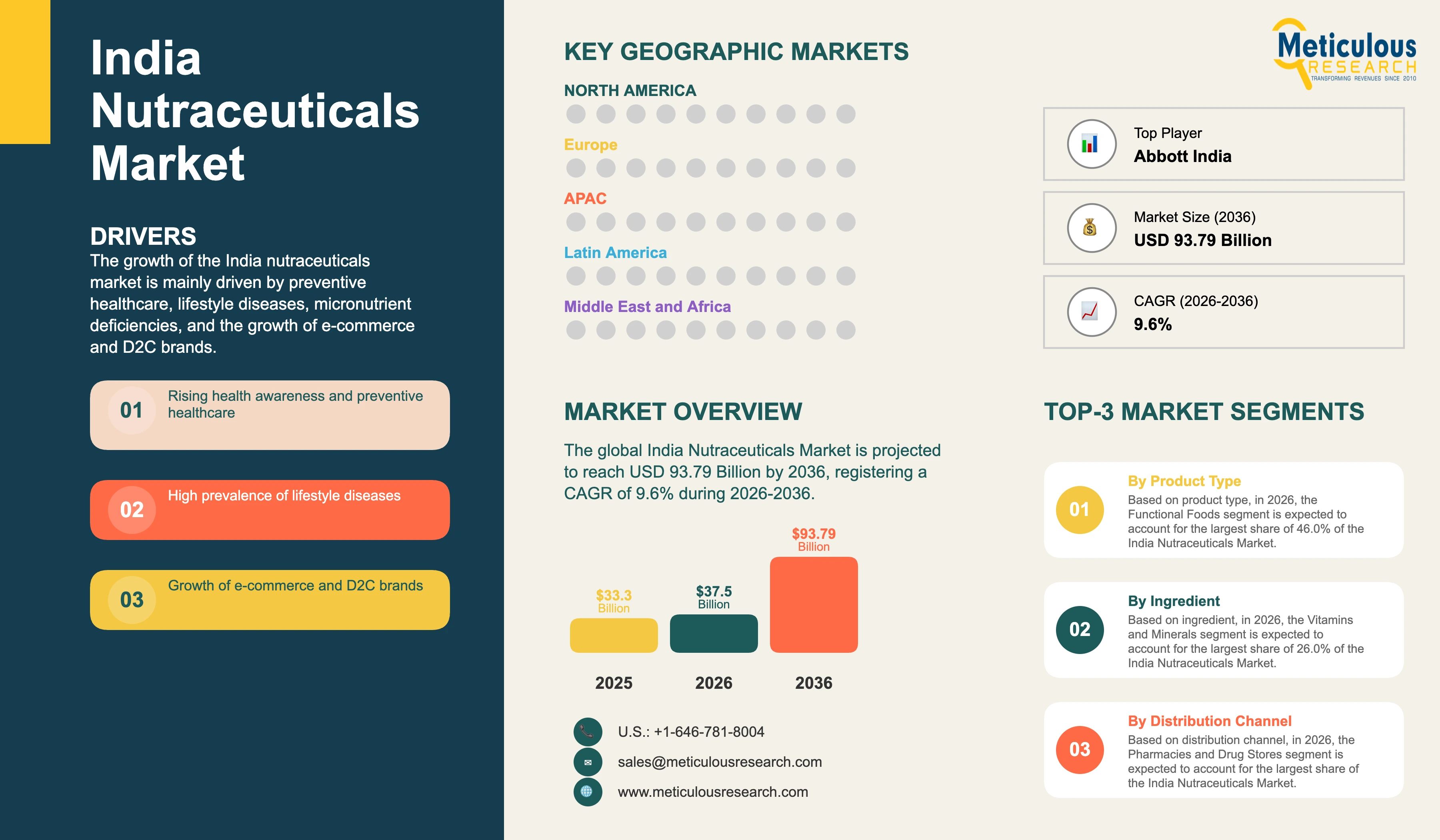
Market dynamics
18 factors across 5 forcesRising health awareness and shift toward preventive healthcare
Indian consumers are becoming increasingly aware of the importance of nutrition, immunity, and preventive health, supported by social media, health influencers, doctors, fitness trends, and the experience of the COVID-19 pandemic, which led to a sharp increase in the use of immunity supplements such as vitamin C, vitamin D, zinc, and herbal products. Many consumers now use nutraceuticals as part of daily routines to maintain health rather than only to address illness. CareEdge Ratings has described India's nutraceutical sector as transitioning from a wellness category to a core component of preventive healthcare.
Health awareness is spreading beyond the largest cities to tier 2 and tier 3 cities and rural areas, supported by smartphones, digital media, and wider distribution, which expands the potential consumer base. Younger consumers in particular are adopting protein supplements, multivitamins, and fitness products as part of their lifestyle.
Employers are also adding nutrition and wellness benefits to corporate health programs, and health insurers are beginning to reward healthy behaviors, which further encourages preventive health spending among working professionals and their families.
Doctors, pharmacists, nutritionists, and fitness trainers also play an important role in recommending nutraceuticals, particularly multivitamins, vitamin D, calcium, iron, and protein supplements, which strengthens consumer trust and supports regular use.
High prevalence of lifestyle diseases
India has one of the largest populations of people with diabetes in the world, and the prevalence of obesity, hypertension, high cholesterol, and cardiovascular disease is rising, particularly in urban areas, driven by sedentary lifestyles, changing diets, and stress. These conditions create demand for nutraceuticals that support blood sugar management, weight management, heart health, and digestive health, such as diabetic nutrition products, fiber supplements, omega-3 fatty acids, plant sterols, and herbal products such as fenugreek, bitter gourd, and cinnamon.
Companies are launching specialized products for people with diabetes and other lifestyle conditions, such as diabetes-specific nutrition drinks and low-sugar health foods, and doctors increasingly recommend nutritional support alongside medical treatment. The large and growing population of older adults in India, many of whom live with one or more chronic conditions, adds to demand for nutrition products that support muscle strength, bone health, and blood sugar control.
Persistent micronutrient deficiencies and malnutrition
Despite economic progress, micronutrient deficiencies and malnutrition remain significant public health challenges in India. Anemia affects a large share of women and children, and deficiencies in vitamin D, vitamin B12, iodine, zinc, and protein are common across income groups, including among urban consumers with vegetarian diets and limited sun exposure. These deficiencies create strong demand for iron and folic acid supplements, vitamin D and B12 supplements, protein supplements, and fortified foods.
Government programs, such as food fortification initiatives and nutrition programs for mothers and children, raise awareness of nutrition and complement private-sector products. CareEdge Ratings has cited persistent malnutrition as one of the key factors supporting the long-term growth of the nutraceutical industry.
India's large vegetarian population, combined with low average protein intake, has also made protein one of the most important nutrition gaps addressed by nutraceutical brands, supporting demand for protein powders, protein-enriched foods, and ready-to-drink protein beverages.
Rising incomes and growth of e-commerce and D2C brands
Rising disposable incomes, urbanization, and the growth of India's middle class are increasing spending on health and wellness products. The rapid growth of e-commerce marketplaces, online pharmacies, and quick-commerce platforms has made nutraceuticals widely accessible, including in smaller cities where specialized retail options are limited. Online channels also allow consumers to compare products, read reviews, and access a wider range of brands, including international brands.
Digitally native and direct-to-consumer brands, such as HealthKart's MuscleBlaze and HK Vitals, OZiva, Wellbeing Nutrition, and many others, have grown rapidly by using social media marketing, influencer partnerships, and subscription models, and many have attracted investment from venture capital firms and large consumer companies. These brands have also introduced new formats and flavors and have made products more appealing to younger consumers who are comfortable shopping online.
Strong tradition of ayurveda and herbal products
India's long tradition of Ayurveda and herbal medicine provides strong consumer acceptance of herbal and natural health products. Ingredients such as ashwagandha, turmeric, tulsi, amla, giloy, moringa, and shilajit are widely trusted, and companies are combining traditional ingredients with modern formats such as capsules, gummies, and effervescent tablets. Government support for AYUSH systems of medicine, including dedicated ministries and promotion programs, strengthens the visibility of herbal products.
The global popularity of Indian herbal ingredients also supports exports and attracts investment in extraction, standardization, and clinical research, which benefits the domestic market as well.
Table of contents
12 chapters · 156 sections · 175 pages · click to expandSegmental analysis
| Segment | Largest share (2026) | Fastest growth (2026–2036) |
|---|---|---|
| By Product Type | General wellness and immunity | Weight management and sports nutrition |
By Product Type
- The general wellness and immunity segment is expected to account for the largest share of the India nutraceuticals market, while the weight management and sports nutrition segment is projected to register the highest CAGR during the forecast period.
- The pharmacies and drug stores segment is expected to account for the largest share of the India nutraceuticals market, while the online and direct-to-consumer segment is projected to register the highest CAGR during the forecast period.
Geographic analysis
Asia-Pacific
Largest shareThe India nutraceuticals market was valued at USD 33.30 billion in 2025. This market is expected to reach USD 93.79 billion by 2036 from an estimated USD 37.50 billion in 2026, registering a CAGR of 9.6% during the forecast period (2026-2036). The growth of this market is mainly driven by rising health awareness and the growing adoption of preventive healthcare among Indian consumers, the high prevalence of lifestyle diseases such as diabetes, obesity, and cardiovascular disease, persistent micronutrient deficiencies and malnutrition, rising disposable incomes and urbanization, the rapid growth of e-commerce and direct-to-consumer brands, India's strong tradition of Ayurveda and herbal products, and a clearer regulatory framework under the Food Safety and Standards Authority of India. However, factors such as misleading product claims and quality concerns, limited scientific validation for some products, regulatory overlap and compliance complexity, and price sensitivity among a large share of consumers are expected to restrain the growth of this market to some extent. In 2026, West India is expected to account for the largest share of 31.0% of the India nutraceuticals market. The large share of this region is mainly due to the high urbanization and incomes of Maharashtra and Gujarat, the large consumer markets of Mumbai, Pune, and Ahmedabad, the strong presence of pharmaceutical and nutraceutical manufacturers in Maharashtra and Gujarat, well-developed pharmacy chains, and high adoption of fitness and wellness trends. Gujarat is also an important manufacturing hub for pharmaceuticals and nutraceuticals, and many leading companies have manufacturing or headquarters operations in the region. Rajasthan, Goa, and Madhya Pradesh also contribute to demand in the broader western region. East and Northeast India is projected to register the highest CAGR of 11.0% during the forecast period. The rapid growth of this region is mainly driven by rising incomes and urbanization in West Bengal, Odisha, Bihar, Jharkhand, and Assam, growing health awareness, the expansion of e-commerce, quick-commerce, and organized pharmacy chains into these states, government nutrition programs addressing high rates of anemia and malnutrition, and the relatively low current penetration of nutraceuticals, which leaves significant room for growth. State governments in the region are also expanding health and nutrition programs, which raises awareness of nutrition among families. Kolkata is the largest market in the region, while Guwahati and other cities in the Northeast are growing rapidly from a small base. North India accounts for a significant share of the market, supported by the large consumer market of Delhi NCR, high health awareness and incomes in Delhi, Haryana, and Punjab, the large population of Uttar Pradesh, and a strong fitness and sports nutrition culture. South India also accounts for a significant share, supported by high health awareness, strong pharmacy networks, and large urban markets in Bengaluru, Chennai, Hyderabad, and Kochi, as well as the significant presence of Ayurvedic and herbal brands in Kerala and Karnataka. South India's high rates of diabetes and its large population of older adults also support demand for metabolic and healthy ageing products. Regional differences in incomes, urbanization, dietary habits, and distribution infrastructure shape the demand for different products across India. Brands that tailor products, pack sizes, and marketing to regional preferences and languages are expected to gain share over the forecast period. Organized pharmacy chains and quick-commerce platforms are also expanding beyond the largest metropolitan areas, which will reduce regional differences in access to nutraceutical products over time. India Nutraceuticals Market Size Geographic Analysis
Competitive landscape
The India nutraceuticals market is highly fragmented, with the top five players estimated to account for about 25% of the market in 2025. The market includes multinational food, nutrition, and consumer health companies, large Indian consumer and pharmaceutical companies, Ayurvedic and herbal companies, direct-selling companies, digitally native and direct-to-consumer brands, and many small regional manufacturers and contract manufacturers.
Abbott India offers nutrition brands such as Ensure and PediaSure, and Nestlé India and Danone India, with Protinex, are also leading players in nutrition products. Hindustan Unilever, with Horlicks, Boost, OZiva, and Wellbeing Nutrition, is one of the largest players in functional foods and health products. Zydus Wellness offers Complan, Glucon-D, and Sugar Free, Dabur, Himalaya Wellness, and Patanjali are leaders in herbal and Ayurvedic products, Mankind Pharma, Sun Pharma, with Revital, and Cipla Health offer over-the-counter nutraceuticals, Amway India and Herbalife lead the direct-selling channel, and HealthKart, through MuscleBlaze and HK Vitals, and Glanbia, through Optimum Nutrition, are leaders in sports nutrition.
Companies in this market compete on brand trust, product quality, scientific evidence, price, distribution reach, doctor and pharmacist recommendations, digital marketing, and product innovation. Key strategies include launches of new products and formats, acquisitions and investments in digitally native brands, expansion into tier 2 and tier 3 cities, partnerships with e-commerce and quick-commerce platforms, investment in clinical research, and expansion of manufacturing capacity and exports.
Multinational companies benefit from global brands, research capabilities, and established nutrition portfolios, while Indian companies benefit from deep distribution networks, relationships with doctors and pharmacists, and understanding of local preferences, including herbal ingredients. Digitally native brands compete through targeted marketing, innovation, and direct relationships with consumers, but face high customer acquisition costs. We expect consolidation to continue, as large companies acquire fast-growing brands and smaller brands seek scale. Contract manufacturers also play an important role by enabling new brands to enter the market quickly. Regulatory compliance and quality are expected to become increasingly important competitive factors as enforcement strengthens. Companies with strong quality certifications and transparent testing are likely to win the trust of doctors and consumers.
Some of the key players operating in the India nutraceuticals market are Abbott India Limited, Nestlé India Limited, Hindustan Unilever Limited, Dabur India Limited, Himalaya Wellness Company, Zydus Wellness Limited, Mankind Pharma Limited, Sun Pharmaceutical Industries Limited, Cipla Health Limited, Amway India Enterprises Pvt. Ltd., Herbalife International India Pvt. Ltd., Patanjali Ayurved Limited, Danone India Pvt. Ltd., Bright Lifecare Pvt. Ltd. (HealthKart), and Glanbia plc (Optimum Nutrition), among others.
- —
CareEdge Ratings projected in June 2026 that the market will reach USD 55-57 billion by 2030, an FSSAI official said in February 2026 that India accounts for nearly 2% of the global market, and the Food Processing Industries Minister said in March 2026 that India is working with Codex Alimentarius on comprehensive nutraceutical regulations.
- Abbott India Limited
- Nestlé India Limited
- Hindustan Unilever Limited
- Dabur India Limited
- Himalaya Wellness Company
- Zydus Wellness Limited
- Mankind Pharma Limited
- Sun Pharmaceutical Industries Limited
- Cipla Health Limited
- Amway India Enterprises Pvt. Ltd.
- Herbalife International India Pvt. Ltd.
- Patanjali Ayurved Limited
- Danone India Pvt. Ltd.
- Bright Lifecare Pvt. Ltd. (HealthKart)
- Glanbia plc · Optimum Nutrition
Expert perspectives
India's nutraceutical market is moving from a niche wellness category to a mainstream part of preventive healthcare. A large population, rising incomes, growing health awareness, lifestyle diseases, persistent nutrition gaps, and a strong herbal tradition give India one of the most attractive long-term growth outlooks among nutraceutical markets globally.
Over the forecast period, the market is expected to grow at a CAGR of 9.6%, from USD 37.50 billion in 2026 to USD 93.79 billion in 2036. Growth will be supported by preventive health, lifestyle diseases, micronutrient deficiencies, e-commerce and D2C brands, and herbal products.
Among the market segments, functional foods are the largest product type, while dietary supplements grow fastest. Vitamins and minerals are the largest ingredient, while probiotics and prebiotics grow fastest, general wellness and immunity is the largest application, while weight management and sports nutrition grows fastest, and pharmacies and drug stores are the largest distribution channel, while online and direct-to-consumer channels grow fastest. West India is the largest region, and East and Northeast India is the fastest-growing region at a CAGR of 11.0%.
In our view, the most important change in the market over the forecast period will be the shift from broad wellness claims to quality-assured and evidence-based products. As regulators strengthen enforcement and consumers become more discerning, brands that invest in quality systems, clinical research, and transparent communication will gain trust and share, while brands that rely on exaggerated claims face increasing regulatory and reputational risks. Pharmaceutical companies with strong relationships with doctors are particularly well positioned in this environment.
We also expect dietary supplements to gain share from functional foods, as consumers adopt targeted supplements for protein, micronutrients, gut health, and specific health needs, and as online channels make these products widely accessible. Expansion into tier 2 and tier 3 cities and rural areas will be the largest source of new consumers, but brands will need affordable pricing, regional marketing, and broad distribution to succeed in these markets. Women's health, diabetes management, and healthy ageing are also likely to become larger categories, since they address large and underserved needs in the Indian population.
Exports and contract manufacturing are likely to become increasingly important, supported by India's herbal ingredients, manufacturing capabilities, and engagement with international standards. Overall, we believe the India nutraceuticals market will grow strongly over the forecast period and become more organized, regulated, and evidence-based, with consolidation favoring companies that combine trusted brands, quality, and broad distribution. Companies that also invest in research and digital engagement will be best placed to lead the market.
Customer perspectives
This comment explains why dietary supplements are the fastest-growing product type, why online and direct-to-consumer channels are growing fastest, and why West India accounts for 31.0% of the market. It also shows the importance of doctor recommendations and authenticity for consumers.
This comment explains why East and Northeast India is the fastest-growing region, why vitamins and minerals account for 26.0% of the market, and why pharmacies remain the largest distribution channel.
This comment explains why functional foods account for 46.0% of the market and why established brands retain strong positions in Indian households.
“My doctor found I was low on vitamin D and B12, so I take supplements daily, and I also use a protein powder after the gym. I buy most of them online, but I check that the brand is genuine.”
“More customers are asking for multivitamins, iron, and immunity products than a few years ago, and many come with a doctor's recommendation. Health drinks for children remain a steady seller.”
“I give my children a health drink with milk every day and take an iron supplement myself. I prefer brands that my family has trusted for years.”
Frequently asked questions
The India nutraceuticals market was valued at USD 33.30 billion in 2025, up from USD 29.50 billion in 2024, and is estimated at USD 37.50 billion in 2026. The market includes functional foods, functional beverages, and dietary supplements regulated under the FSSAI's nutraceutical and health supplement regulations.
Cite this report
Meticulous Research. (2026). India Nutraceuticals Market - Global Opportunity Analysis and Industry Forecast (2026-2036) (Report No. MRFB - 1042573). Meticulous Market Research Pvt. Ltd. https://www.meticulousresearch.com/product/india-nutraceuticals-market-7256