Functional Water Market (2026-2036)
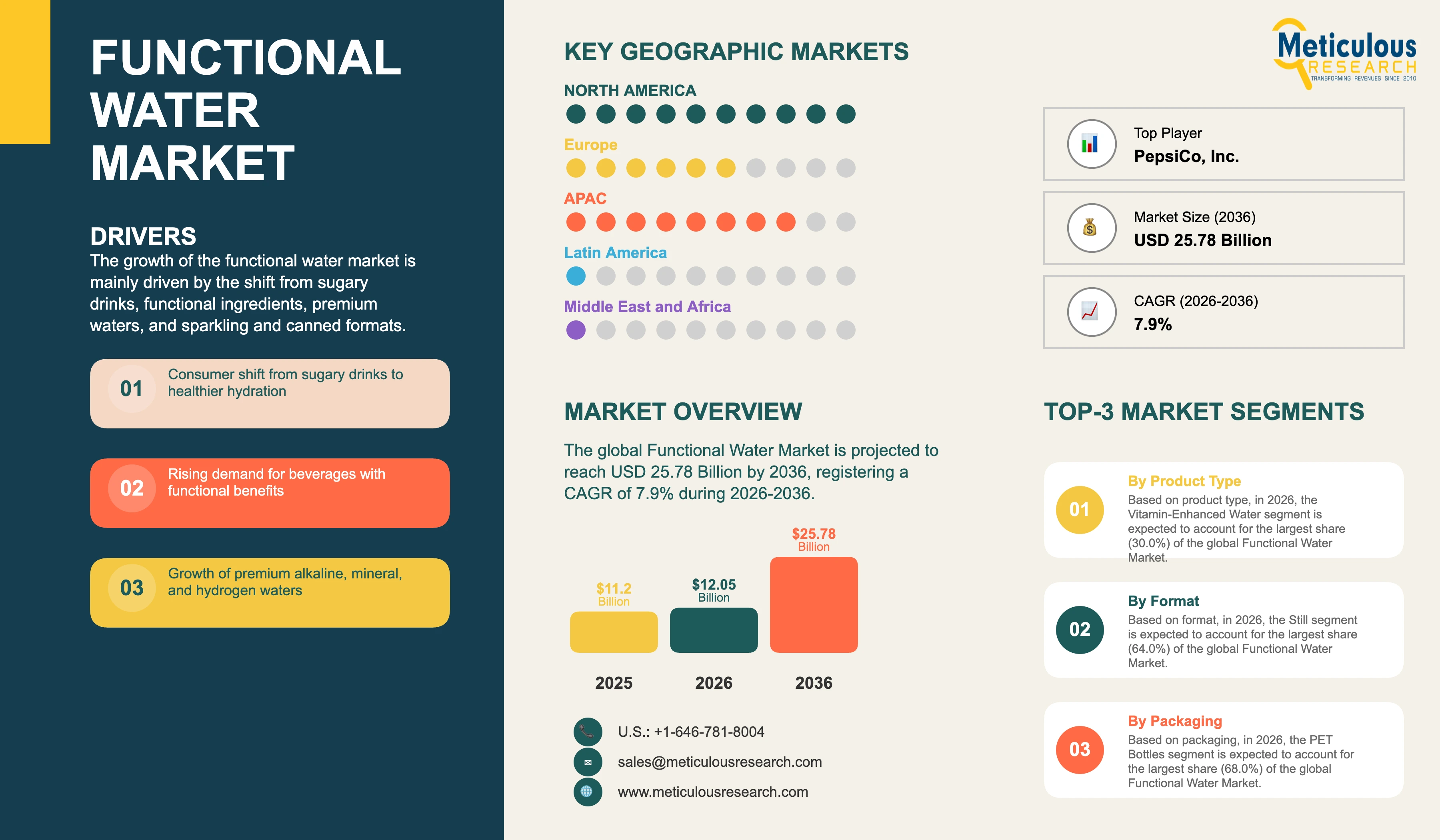
The global functional water market was valued at USD 11.20 billion in 2025. This market is expected to reach USD 25.78 billion by 2036 from an estimated USD 12.05 billion in 2026, registering a CAGR of 7.9% during the forecast period (2026-2036).
- Published
- Nov 2026
- Pages
- 267
- Format
- PDF + Excel
- Report ID
- MRFB - 1042587
- Base year
- 2025
- 2025 · BASELINE
- $11.20B
- 2036
- $25.78B
- CAGR 2026–2036
- 7.9%
2025 baseline · 2026–2036 forecast at 7.9% CAGR · hover a bar for the value
Key highlights
PepsiCo stated in its fourth-quarter and full-year 2025 remarks in February 2026 that its Propel fitness water brand exceeded USD 1 billion in estimated annual retail sales in 2025, showing the large scale that leading functional water brands can reach in the U.S. market when they combine clear benefits, zero-sugar options, and wide distribution in grocery, convenience, and club channels.
According to the International Bottled Water Association (IBWA), U.S. bottled water consumption reached 16.8 billion gallons in 2025, up 2.5% from the previous year, keeping bottled water the largest beverage category by volume in the U.S. and providing a large and growing base of water drinkers who can trade up to functional and enhanced waters.
Beverage Industry reported in September 2026 that bottled water accounted for 45.5% of U.S. refreshment beverage volume in 2025, and industry commentary cited by the publication noted that alkaline waters continue to show modest growth while purified and mineral waters trend down, with examples of functional innovation including Propel products, Smartwater's antioxidant and alkaline water variants, and BodyArmor Flash I.V.
Specialty functional water brands such as oHy hydrogen sparkling water, Flow Beverage, Essentia from Primo Brands, and HFactor continue to launch new alkaline, hydrogen, mineral, and botanical waters in North America, while major beverage companies including PepsiCo, The Coca-Cola Company, Keurig Dr Pepper, Danone, and Nestlé maintain large functional water portfolios across vitamin, alkaline, mineral, and sparkling waters.
In Asia-Pacific, Japanese beverage companies such as Suntory, Kirin, and Asahi offer functional waters with vitamins, minerals, and other ingredients, including products with Japanese Foods for Specified Health Uses and Foods with Function Claims status, and hydrogen water has long been popular in Japan and South Korea, where it is widely sold in cans, aluminum pouches, and through home generators.
By product type, vitamin-enhanced water accounts for the largest share of 30.0% in 2026, while hydrogen and oxygenated water registers the highest CAGR.
By format, still accounts for the largest share of 64.0% in 2026, while concentrates and drops register the highest CAGR.
By packaging, PET bottles account for the largest share in 2026, while cans register the highest CAGR.
By distribution channel, supermarkets and hypermarkets account for the largest share in 2026, while online retail registers the highest CAGR.
By geography, North America accounts for the largest share of 38.0% in 2026, while Asia-Pacific registers the highest CAGR of 9.4%.
Report summary
| Particulars | Details |
|---|---|
| Forecast Period | 2026-2036 |
| Base Year | 2025 |
| Estimated Year | 2026 |
| CAGR (Value) | 7.9% |
| Market Size (Value) in 2025 | USD 11.20 billion |
| Market Size (Value) in 2026 | USD 12.05 billion |
| Market Size (Value) in 2036 | USD 25.78 billion |
| Largest Segment by Product Type (2026) | Vitamin-Enhanced Water (30.0%) |
| Largest Segment by Format (2026) | Still (64.0%) |
| Largest Region (2026) | North America (38.0%) |
| Fastest-Growing Region | Asia-Pacific (CAGR 9.4%) |
| Segments Covered | Product Type, Format, Packaging, Distribution Channel, Geography |
| Countries Covered | U.S., Canada, China, Japan, South Korea, India, Australia, Indonesia, Thailand, Vietnam, Philippines, Malaysia, Rest of Asia-Pacific, Germany, France, U.K., Italy, Spain, Netherlands, Poland, Belgium, Switzerland, Sweden, Rest of Europe, Brazil, Mexico, Argentina, Colombia, Chile, Peru, Rest of Latin America, Saudi Arabia, U.A.E., Qatar, Kuwait, Turkey, Egypt, South Africa, Rest of Middle East & Africa |
| Key Companies | 13 companies and other companies |
Report overview
Segments covered: product type, format, packaging, distribution channel.
The growth of this market is mainly driven by the consumer shift away from sugary soft drinks toward healthier hydration, the continued growth of bottled water as the largest refreshment beverage category, rising demand for beverages with added vitamins, minerals, antioxidants, botanicals, and other functional ingredients, the strong performance of major functional water brands, growing interest in alkaline, hydrogen, and other premium waters, innovation in sparkling, flavored, and canned formats, and expanding online and convenience retail. However, factors such as limited scientific support for some functional claims, higher prices than plain bottled water, concerns about plastic packaging, and strict regulations on health claims are expected to restrain the growth of this market to some extent.
Functional water refers to packaged water that has been enhanced with ingredients or processing designed to provide benefits beyond basic hydration. This includes vitamin-enhanced water, alkaline and pH-balanced water, mineral-enhanced water, botanical and plant-infused water, hydrogen and oxygenated water, protein, collagen, and fiber water, and other functional waters such as those with antioxidants, adaptogens, or prebiotics. This report covers functional water across product types, formats, packaging, and distribution channels. Electrolyte-led sports and hydration drinks positioned primarily for electrolyte replacement are covered in a separate electrolyte drinks report, although some lightly enhanced electrolyte waters overlap with this market. The market is measured on a sales value basis.
Functional water sits between plain bottled water and sugary beverages in terms of price, taste, and positioning, since many consumers are trying to reduce their intake of sugar and calories and are drinking more water, but they want more flavor, variety, or perceived health benefits than plain water provides. Functional waters offer a low-sugar or zero-sugar alternative to soft drinks and juices, with added ingredients that address needs such as energy, immunity, hydration, skin health, digestion, and recovery.
Bottled water is the largest beverage category by volume in the U.S. and many other countries, and its continued growth provides a large base for functional water. According to the International Bottled Water Association, U.S. bottled water consumption reached 16.8 billion gallons in 2025, up 2.5%. As consumers trade up from plain water and trade away from sugary drinks, functional water captures a growing share of beverage spending, although plain purified and mineral waters remain much larger by volume.
Health organizations generally recommend water as the best choice for hydration, and this message has helped bottled water grow at the expense of soft drinks. Functional water brands benefit from the positive image of water while offering added flavor and benefits, which allows them to charge higher prices than plain water.
Vitamin-enhanced water is the largest product type, led by brands such as Vitaminwater from The Coca-Cola Company and Propel from PepsiCo, which combine vitamins, flavors, and in some cases electrolytes. Alkaline and pH-balanced water is another major category, led by brands such as Essentia, Smartwater alkaline variants, Core from Keurig Dr Pepper, and The Alkaline Water Company. Mineral-enhanced waters, botanical and plant-infused waters, and newer categories such as hydrogen water, protein water, collagen water, and fiber water are also growing.
Still water accounts for most sales, but sparkling functional waters are growing quickly as consumers look for alternatives to soda, and brands are launching sparkling versions of vitamin, botanical, and hydrogen waters. Concentrates and drops that consumers add to their own water are a small but fast-growing format, supported by sustainability concerns about single-use bottles and by convenience. Packaging is dominated by PET bottles, while aluminum cans are growing quickly because of their recyclability and premium image.
Distribution is led by supermarkets and hypermarkets, followed by convenience stores, where functional waters are sold as single-serve, on-the-go beverages. Online retail is growing quickly, supported by multipack and subscription sales, and other channels include gyms, vending, foodservice, and drugstores.
Placement in refrigerated coolers in convenience stores and supermarkets is important for single-serve functional waters, while multipacks are sold in ambient aisles and club stores. Many brands also sell through gyms, offices, hotels, and airports.
The market includes global beverage companies, bottled water companies, and specialty functional water brands. Leading companies include PepsiCo, The Coca-Cola Company, Keurig Dr Pepper, Danone, Nestlé, Primo Brands (Essentia), Flow Beverage Corp., The Alkaline Water Company, HFactor, oHy, Suntory, Kirin, and Asahi.
Over the forecast period, the functional water market is expected to grow steadily, supported by continued health-driven shifts in beverage consumption, product innovation, premium waters, sparkling and canned formats, and growth in Asia-Pacific. However, growth in some categories, such as vitamin water, is expected to be more moderate, while newer categories such as hydrogen water and protein and fiber waters grow faster.
North America is expected to account for the largest share of 38.0% of the market in 2026, mainly due to very high bottled water consumption, leading functional water brands, and the large alkaline water market in the U.S.
Asia-Pacific is projected to register the highest CAGR of 9.4% during the forecast period, driven by large populations, rising incomes, health awareness, established functional beverage markets in Japan and South Korea, and e-commerce.
The report profiles 13 companies, including PepsiCo, The Coca-Cola Company, Keurig Dr Pepper, Danone, Nestlé, Primo Brands (Essentia), Flow Beverage, The Alkaline Water Company, HFactor, oHy, Suntory, Kirin, and Asahi.
Report infographic
Market dynamics
17 factors across 5 forcesConsumer shift from sugary drinks to healthier hydration
Consumers in many countries are reducing their consumption of sugary soft drinks and juices because of concerns about sugar, calories, obesity, and diabetes, and they are drinking more water. Sugar taxes in many countries, public health campaigns, and nutrition labeling have reinforced this shift. Functional water benefits from this trend because it offers flavor and perceived benefits with little or no sugar, making it an attractive alternative for consumers who find plain water boring.
Bottled water has become the largest refreshment beverage category by volume in the U.S., and Beverage Industry reported that bottled water accounted for 45.5% of U.S. refreshment beverage volume in 2025. As consumers drink more water, many trade up to functional waters that provide added value, such as vitamins, minerals, alkalinity, or botanical ingredients.
Younger consumers, in particular, are drinking less soda and more water and functional beverages, and they are more open to new types of functional water, such as hydrogen water, collagen water, and adaptogen-infused water.
Retailers have responded by expanding water and enhanced water sections and reducing space for some carbonated soft drinks, which increases the visibility of functional water brands.
Many schools, workplaces, and public institutions have also reduced the availability of sugary drinks and increased the availability of water and low-sugar beverages, which supports the long-term shift toward water-based products.
Rising demand for beverages with functional benefits
Consumers increasingly look for beverages that provide specific health benefits, such as energy, immunity, hydration, skin health, digestion, focus, and relaxation. Functional water allows consumers to get these benefits in a light, refreshing, and low-calorie format that can be consumed throughout the day. Vitamins, minerals, antioxidants, electrolytes, botanicals, adaptogens, collagen, prebiotic fiber, and protein are among the ingredients added to functional waters.
Interest in immunity, gut health, and beauty-from-within has supported launches of functional waters with vitamin C, zinc, prebiotic fiber, and collagen. Consumers also look for clean-label products with natural ingredients and flavors, and many functional waters use natural sweeteners or no sweeteners at all.
The strong performance of brands such as Propel, which PepsiCo said exceeded USD 1 billion in estimated annual retail sales in 2025, shows how functional waters can grow into major brands when they combine clear benefits with taste and wide distribution, and it has encouraged other beverage companies to invest in the category.
Growth of premium alkaline, mineral, and hydrogen waters
Premium waters, such as alkaline water, mineral-enhanced water, and hydrogen water, have grown as consumers look for higher-quality and differentiated water products. Alkaline water brands, such as Essentia, Core, and The Alkaline Water Company, have built strong positions in the U.S., and industry commentary cited by Beverage Industry noted that alkaline waters continue to show modest growth while purified and mineral waters trend down.
Hydrogen water, which contains dissolved molecular hydrogen, has long been popular in Japan and South Korea and is gaining attention in North America and Europe, with brands such as oHy and HFactor offering canned and pouched hydrogen water. Mineral-enhanced waters, including those with magnesium, calcium, and trace minerals, also appeal to consumers who want added nutrients. These premium products typically command higher prices, which increases the value of the market.
Some consumers choose premium waters because of perceived purity, taste, or smoothness rather than specific health benefits, and brands often highlight their filtration processes, natural spring sources, or mineral content. Premium waters are also popular in restaurants, hotels, gyms, and wellness centers.
Innovation in sparkling, flavored, and canned formats
Beverage companies are launching sparkling functional waters, new flavors, and canned products to attract consumers and compete with soft drinks and sparkling waters. Sparkling functional waters offer a soda-like experience with added benefits and little or no sugar, which appeals to consumers who are trying to quit soda. Aluminum cans are increasingly used for functional waters because of their recyclability, premium appearance, and ability to protect ingredients such as dissolved hydrogen. Flavor innovation, including fruit, botanical, and tea flavors, also helps brands attract new consumers and increase repeat purchases.
Limited-edition flavors, seasonal products, and collaborations with influencers and athletes are also used to generate interest and keep consumers engaged. Smaller single-serve cans and bottles allow consumers to try new products at lower cost.
Table of contents
12 chapters · 156 sections · 267 pages · click to expandSegmental analysis
| Segment | Largest share (2026) | Fastest growth (2026–2036) |
|---|---|---|
| By Product Type | Vitamin-enhanced water | Hydrogen and oxygenated water |
| By Format | Still | Concentrates and drops |
| By Packaging | PET bottles | Cans |
| By Distribution Channel | Supermarkets and hypermarkets | Online retail |
| Other segments | PET bottles | Cans |
By Product Type
- Functional Water Market Analysis by Product Type
- The vitamin-enhanced water segment is expected to account for the largest share of 30.0% of the global functional water market.
- The large share of this segment is mainly due to the strong presence of established brands such as Vitaminwater from The Coca-Cola Company and Propel from PepsiCo, which have wide distribution in supermarkets, convenience stores, and other channels, consumer familiarity with vitamin-enhanced beverages, the appeal of added vitamins for energy and immunity, and the availability of zero-sugar and low-sugar options.
- Propel, which also includes electrolytes, became a billion-dollar retail brand in 2025, according to PepsiCo, which shows the scale that leading vitamin-enhanced water brands can reach.
- Vitamin-enhanced waters are sold in many flavors and are often positioned as healthier alternatives to soft drinks and juices.
- However, the segment is relatively mature in North America, and brands are reformulating products to reduce sugar, add new functional ingredients, and launch sparkling versions to maintain growth.
- Vitamin-enhanced waters are also widely available in foodservice, vending, and convenience stores, where they compete directly with soft drinks, and many consumers who switch away from soda choose these products as their first alternative.
- Zero-sugar and low-calorie versions have become increasingly important as consumers become more concerned about sugar.
- However, the hydrogen and oxygenated water segment is projected to register the highest CAGR during the forecast period.
- The rapid growth of this segment is driven by growing consumer interest in hydrogen water in North America and Europe, its established popularity in Japan and South Korea, the launch of canned and pouched hydrogen water by brands such as oHy and HFactor, and premium pricing.
- Alkaline and pH-balanced water is the second-largest segment, supported by brands such as Essentia and Core, while mineral-enhanced, botanical and plant-infused, protein, collagen, and fiber, and other functional waters account for the remaining share.
- Botanical and plant-infused waters, and protein, collagen, and fiber waters are also growing quickly as brands introduce new ingredients.
By Format
- Functional Water Market Analysis by Format
- The still segment is expected to account for the largest share of 64.0% of the global functional water market.
- The large share of this segment is mainly due to the large sales of still vitamin-enhanced, alkaline, and mineral-enhanced waters, consumer preference for still water for everyday hydration and during exercise, the wide availability of still functional waters in single-serve and multipack formats, and the ease of drinking large amounts of still water throughout the day.
- Most leading functional water brands, such as Propel, Vitaminwater, Essentia, and Core, are mainly still products.
- Still functional waters are also generally easier to formulate with a wide range of functional ingredients and are commonly sold in larger bottle sizes for daily hydration, which supports high volumes.
- Still functional waters are also generally preferred during exercise and for hydration in hot weather, when consumers want to drink large volumes quickly and comfortably.
- However, the concentrates and drops segment is projected to register the highest CAGR during the forecast period.
- The rapid growth of this segment is driven by sustainability concerns about single-use plastic bottles, the popularity of reusable water bottles, the convenience and portability of concentrates and drops, and lower shipping costs, which make them well suited to online sales.
- The sparkling segment accounts for a significant share and is growing quickly as consumers look for alternatives to soda, supported by the launch of sparkling versions of vitamin, botanical, and hydrogen waters.
By Packaging
- Functional Water Market Analysis by Packaging
- The PET bottles segment is expected to account for the largest share of the global functional water market.
- The large share of this segment is mainly due to the low cost, light weight, durability, and resealability of PET bottles, their wide use by leading functional water brands, the availability of a range of bottle sizes, and established bottling and recycling infrastructure.
- Many brands are increasing the use of recycled PET to address environmental concerns and comply with regulations.
- PET bottles are especially important for still waters sold in large sizes and multipacks, and for on-the-go consumption, since consumers can reseal bottles and drink throughout the day.
- Many beverage companies have set targets to increase recycled PET content, and some brands already use bottles made entirely from recycled PET, which helps maintain the role of PET as sustainability pressure increases.
- However, the cans segment is projected to register the highest CAGR during the forecast period.
- The rapid growth of this segment is driven by the growth of sparkling functional waters, consumer and regulatory pressure to reduce plastic, the high recyclability of aluminum, the premium image of cans, and the ability of cans to protect sensitive ingredients, such as dissolved hydrogen.
- Glass bottles and other packaging, such as cartons and pouches, account for the remaining share.
- Glass bottles are mainly used for premium waters and foodservice, while cartons are used by brands such as Flow Beverage to reduce plastic use.
By Distribution Channel
- Functional Water Market Analysis by Distribution Channel
- The supermarkets and hypermarkets segment is expected to account for the largest share of the global functional water market.
- The large share of this segment is mainly due to the wide range of functional waters available in supermarkets and hypermarkets, the popularity of multipacks for home consumption, promotions and discounts, and the convenience of buying water during regular grocery shopping.
- Club stores and mass merchandisers, which sell large multipacks, are also important within this channel.
- Supermarkets also allow brands to reach a large number of consumers and to introduce new products through in-store displays and sampling.
- Supermarkets and hypermarkets also offer a very wide range of brands and price points, from private-label to premium waters, which allows consumers to compare products and try new categories, such as hydrogen and botanical waters.
- However, the online retail segment is projected to register the highest CAGR during the forecast period.
- The rapid growth of this segment is driven by the convenience of home delivery for heavy multipacks, subscriptions, direct-to-consumer sales by specialty brands, and the growth of e-commerce in Asia-Pacific.
- Convenience stores account for a significant share, supported by single-serve, on-the-go purchases, while other channels include gyms, vending, foodservice, and drugstores.
- Convenience stores are especially important for single-serve chilled functional waters bought for immediate consumption.
Other segments
- The PET bottles segment is expected to account for the largest share of the functional water market, while the cans segment is projected to register the highest CAGR during the forecast period.
- The supermarkets and hypermarkets segment is expected to account for the largest share of the functional water market, while the online retail segment is projected to register the highest CAGR during the forecast period.
Geographic analysis
North America
Largest shareIn 2026, North America is expected to account for the largest share of 38.0% of the global functional water market. The large share of this region is mainly due to very high bottled water consumption in the U.S., the strong presence of leading functional water brands such as Propel, Vitaminwater, Smartwater, Core, Bai, and Essentia, the large alkaline water market, strong consumer interest in health and wellness, the shift away from sugary soft drinks, and wide distribution in supermarkets, convenience stores, and online channels. According to the IBWA, U.S. bottled water consumption reached 16.8 billion gallons in 2025. The U.S. is the largest market in the region, while Canada has growing demand for functional waters, supported by the same health trends and many of the same brands.
Asia-Pacific
Asia-Pacific is the second-largest market and is projected to register the highest CAGR of 9.4% during the forecast period. The rapid growth of this region is mainly driven by large populations, rising incomes, growing health awareness, concerns about tap water quality in some countries, established functional beverage markets in Japan and South Korea, where hydrogen water and functional waters with health claims are well known, the presence of major beverage companies such as Suntory, Kirin, and Asahi, and rapid growth of modern retail and e-commerce in China, India, and Southeast Asia. China, Japan, South Korea, India, Indonesia, Thailand, Vietnam, the Philippines, and Australia are important markets.
Europe
Europe accounts for a significant share of the market, supported by strong bottled and mineral water consumption, the presence of companies such as Danone and Nestlé, and growing demand for functional, sparkling, and botanical waters in Germany, France, the U.K., Italy, Spain, the Netherlands, Poland, and the Nordic countries. However, EU rules on health claims, fortification, and single-use plastics affect product development and marketing. Belgium, Switzerland, and Austria are also important markets, with strong traditions of mineral water consumption.
Latin America
Latin America and the Middle East & Africa account for smaller shares of the market. Brazil, Mexico, Argentina, Colombia, and Chile are important markets in Latin America, supported by high bottled water consumption and growing interest in healthier beverages.
Middle East & Africa
In the Middle East & Africa, Saudi Arabia, the U.A.E., Qatar, Kuwait, Egypt, Turkey, and South Africa have growing demand for functional and mineral-enhanced waters, supported by hot climates, high bottled water consumption, and modern retail.
Competitive landscape
The global functional water market is moderately concentrated, with the top five players estimated to account for about 40% of the market in 2025. The market includes global beverage companies, bottled water companies, Asian beverage companies, and specialty functional water brands.
PepsiCo is a leading player with Propel, which exceeded USD 1 billion in estimated annual retail sales in 2025, and LIFEWTR. The Coca-Cola Company offers Vitaminwater and Smartwater, including alkaline and antioxidant variants, and BodyArmor products. Keurig Dr Pepper offers Core hydration and Bai beverages, while Danone and Nestlé offer bottled and mineral waters with functional variants in many countries. Primo Brands owns Essentia, one of the leading alkaline water brands in the U.S.
Specialty brands include Flow Beverage Corp., which offers mineral-rich and alkaline spring water in cartons, The Alkaline Water Company, HFactor and oHy, which offer hydrogen water, and many smaller brands offering botanical, collagen, protein, and fiber waters. In Asia-Pacific, Suntory, Kirin, and Asahi offer functional waters and other functional beverages, and many local companies compete in China, South Korea, and Southeast Asia.
Companies compete on brand strength, taste, functional ingredients, health positioning, price, packaging, sustainability, and distribution. Key strategies include product launches, reformulation to reduce sugar, sparkling and canned products, sustainable packaging, acquisitions of specialty brands, and expansion in Asia-Pacific.
Large beverage companies have strong advantages in distribution, marketing, and manufacturing, but specialty brands have been successful in creating new categories, such as alkaline and hydrogen water. We expect large companies to continue acquiring or partnering with successful specialty brands.
Large companies have also used their distribution networks to scale acquired brands quickly, which makes acquisition an attractive growth route for both large companies and specialty brand founders.
Private-label functional waters and lower-priced alkaline waters from large retailers also compete in supermarkets and club stores, increasing price pressure.
Sustainability has also become a point of competition, as companies compete to offer packaging with higher recycled content, cans, and cartons, and as retailers and consumers increasingly consider environmental performance when choosing brands. Companies that can combine functional benefits with sustainable packaging and strong distribution are expected to gain share.
Some of the key players operating in the functional water market are PepsiCo, Inc., The Coca-Cola Company, Keurig Dr Pepper Inc., Danone S.A., Nestlé S.A., Primo Brands Corporation (Essentia), Flow Beverage Corp., The Alkaline Water Company, HFactor, oHy, Suntory Holdings Limited, Kirin Holdings Company, Limited, and Asahi Group Holdings, Ltd., among others.
- —
PepsiCo said Propel exceeded USD 1 billion in estimated annual retail sales in 2025, U.S. bottled water consumption reached 16.8 billion gallons in 2025, up 2.5% from 2024, according to the IBWA, and brands continue to launch new alkaline, hydrogen, sparkling, and canned functional waters, while beverage companies increase recycled content in packaging.
- PepsiCo, Inc.
- Coca-Cola Company
- Keurig Dr Pepper Inc.
- Danone S.A.
- Nestlé S.A.
- Primo Brands Corporation · Essentia
- Flow Beverage Corp.
- Alkaline Water Company
- HFactor
- oHy
- Suntory Holdings Limited
- Kirin Holdings Company, Limited
- Asahi Group Holdings, Ltd.
Expert perspectives
Functional water is benefiting from one of the most important long-term trends in beverages: the shift from sugary drinks to water. As consumers drink more water, many are willing to pay more for water that offers flavor, functional ingredients, or premium positioning, and functional water captures this demand.
Over the forecast period, the market is expected to grow at a CAGR of 7.9%, from USD 12.05 billion in 2026 to USD 25.78 billion in 2036. Growth will be supported by healthier hydration, functional ingredients, premium waters, sparkling and canned formats, and growth in Asia-Pacific.
Vitamin-enhanced water remains the largest product type, while hydrogen and oxygenated water grows fastest. Still water is the largest format, while concentrates and drops grow fastest. PET bottles are the largest packaging type, while cans grow fastest. Supermarkets and hypermarkets are the largest channel, while online retail grows fastest. North America is the largest region, and Asia-Pacific is the fastest-growing region at a CAGR of 9.4%.
In our view, the functional water market is becoming more diverse in terms of products, ingredients, and formats, and traditional vitamin waters are mature, while growth is shifting to newer categories such as hydrogen water, protein and fiber waters, botanical waters, and sparkling functional waters. Brands that can create new categories or reinvent existing ones will capture most of the growth.
We also expect continued reformulation of mature brands to reduce sugar, add new functional ingredients, and introduce sparkling and canned versions.
We note that the boundary between functional water and electrolyte drinks is increasingly blurred, as many waters add electrolytes and many electrolyte drinks are positioned as enhanced waters. Companies should consider both categories when planning products and strategies.
For this reason, this report focuses on waters whose main positioning is functional enhancement, and electrolyte-led hydration drinks are analyzed separately to avoid double counting.
Sustainability will become an increasingly important competitive factor in this market over the next decade, and companies that move to cans, recycled plastic, cartons, and concentrates will be better positioned as regulations tighten and consumers become more concerned about plastic.
Finally, we believe that credible and well-supported claims will matter more over time, since consumers and regulators are becoming more skeptical of exaggerated health claims, and brands that focus on taste, hydration, and well-supported ingredients will build longer-lasting businesses.
Overall, we expect the functional water market to remain one of the most stable growth categories in beverages, supported by long-term health and hydration trends that show no sign of slowing.
Customer perspectives
Buyers of functional water include health-conscious consumers, people reducing soda and sugar, athletes and active consumers, office workers, younger consumers, and retailers. Their purchase decisions depend mainly on taste, functional benefits, sugar content, brand trust, price, packaging, and sustainability.
Consumer - 29, U.S.
I stopped drinking soda last year, and now I drink flavored vitamin water or sparkling water with no sugar. It feels healthier and I still get some flavor.
This comment explains why vitamin-enhanced water accounts for 30.0% of the market, why still water accounts for 64.0% of the market, and why North America is the largest region. It also shows how consumers who stop drinking soda often choose flavored and enhanced waters as their first alternative, since these products still offer taste, variety, and a sense of treat.
This comment explains why hydrogen and oxygenated water is the fastest-growing product type, why cans are the fastest-growing packaging type, and why Asia-Pacific is the fastest-growing region, led by Japan and South Korea.
This comment explains why concentrates and drops are the fastest-growing format and why sustainable packaging is a key trend, especially in Europe, where regulations on single-use plastics are strict.
“Hydrogen water and functional waters with health claims sell well in our stores, and we see more interest from customers in canned products that keep the water fresh.”
“Retailers and regulators are pushing us to reduce virgin plastic, so we are increasing recycled content and testing cans and concentrates.”
Frequently asked questions
The global functional water market was valued at USD 11.20 billion in 2025, up from USD 10.42 billion in 2024, and is estimated at USD 12.05 billion in 2026, reflecting steady growth across both mature and emerging functional water categories. The market includes vitamin-enhanced, alkaline, mineral-enhanced, botanical, hydrogen, protein, collagen, fiber, and other functional waters.
Cite this report
Meticulous Research. (2026). Functional Water Market - Global Opportunity Analysis and Industry Forecast (2026-2036) (Report No. MRFB - 1042587). Meticulous Market Research Pvt. Ltd. https://www.meticulousresearch.com/product/functional-water-market-7270