Ethylene Absorbers Market (2026-2036)
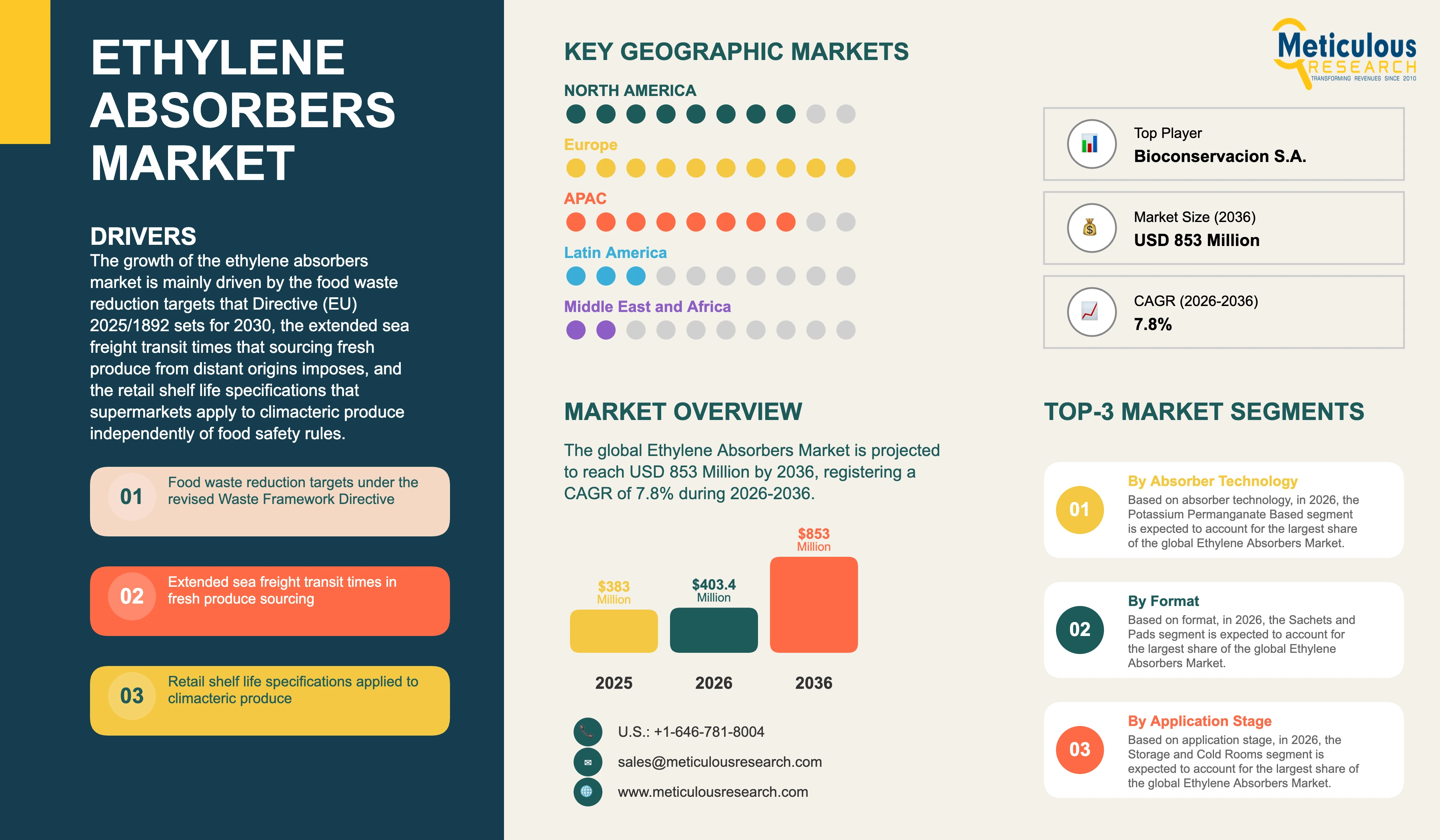
The global ethylene absorbers market was valued at USD 383.0 million in 2025. This market is expected to reach USD 853.0 million by 2036 from an estimated USD 403.4 million in 2026, registering a CAGR of 7.8% during the forecast period (2026-2036).
- Published
- Nov 2026
- Pages
- 274
- Format
- PDF + Excel
- Report ID
- MRFB - 1042661
- Base year
- 2025
- 2025 · BASELINE
- $383.0M
- 2036
- $853.0M
- CAGR 2026–2036
- 7.8%
2025 baseline · 2026–2036 forecast at 7.8% CAGR · hover a bar for the value
Key highlights
The global ethylene absorbers market is estimated at USD 403.4 million in 2026 and is projected to reach USD 853.0 million by 2036.
Market volume is estimated at 24.60 kilotons in 2026 and is projected to reach 56.12 kilotons by 2036 at a CAGR of 8.6%, measured as finished absorber media and devices supplied.
The average selling price is estimated at USD 16.40 per kg in 2026 and is projected to reach USD 15.20 per kg by 2036.
Potassium permanganate based absorbers are expected to account for the largest technology share in 2026, while palladium-promoted adsorbers are projected to register the highest CAGR of 12.8%.
Sachets and pads are expected to hold the largest format share in 2026, while packaging film and masterbatch are projected to grow fastest at a CAGR of 11.4%.
Storage and cold rooms are expected to be the largest application stage in 2026, while transport and containers are projected to register the highest CAGR of 10.2%.
Climacteric fruits are expected to account for the largest produce type share in 2026, while cut flowers and ornamentals are projected to grow fastest at a CAGR of 9.6%.
Packers and exporters are expected to be the largest end user in 2026, while cold storage and logistics operators are projected to register the highest CAGR of 10.6%.
Europe is expected to hold the largest regional share in 2026, while Asia-Pacific is projected to register the highest CAGR of 11.2%.
Directive (EU) 2025/1892 amended the Waste Framework Directive and entered into force on 16 October 2025.
That directive sets a 10% food waste reduction target for food processing and manufacturing by 2030.
It sets a 30% per capita food waste reduction target by 2030 measured jointly across retail, restaurants, food services and households.
The baseline is the annual average of food waste generated from 2021 to 2023, with 2020 available as an alternative reference period on notification to the Commission and other member states.
Member states have until 17 April 2027 to notify an alternative reference period, and the Commission has until 17 October 2027 to establish a tourism correction factor for the retail and consumption target.
The Commission is to review the 2030 targets by the end of 2027, including whether to introduce legally binding targets for 2035.
Under Commission Regulation (EC) No 450/2009, active materials and articles are those intended to extend the shelf life or maintain or improve the condition of packaged food, and expressly include components that absorb substances as well as those that release them.
Only authorised substances may be used in the components of an active material, subject to defined exemptions.
A substance behind a functional barrier must not migrate into the food above 0.01 mg per kg, and substances classified as carcinogenic, mutagenic or toxic to reproduction, or engineered to particle sizes with significantly different properties, are excluded from that route.
Where non-edible parts of an active material could be perceived as edible, they must be labelled "DO NOT EAT" in characters at least 3 mm high.
A written declaration of compliance must accompany active materials and components through the supply chain, and must be renewed when production changes affect migration or when new scientific data emerge.
Under the transitional provisions of that regulation, registered substances may remain on the market under existing food rules until their authorisation status is resolved.
Report summary
| Particulars | Details |
|---|---|
| Base Year | 2025 |
| Forecast Period | 2026-2036 |
| Market Size in 2025 | USD 383.0 million |
| Market Size in 2026 | USD 403.4 million |
| Market Size by 2036 | USD 853.0 million |
| Value CAGR (2026-2036) | 7.8% |
| Volume in 2026 | 24.60 kilotons |
| Volume by 2036 | 56.12 kilotons |
| Volume CAGR (2026-2036) | 8.6% |
| Volume Basis | Finished absorber media and devices supplied, not active substance |
| Average Selling Price in 2026 | USD 16.40 per kg |
| Average Selling Price by 2036 | USD 15.20 per kg |
| Measurement Basis | Ethylene-removing media, sachets, pads, filters, films and scrubber units sold for post-harvest use, excluding 1-methylcyclopropene and other ethylene action inhibitors, ethylene generators and ripening gas, controlled and modified atmosphere equipment and gases, oxygen and moisture scavengers, antimicrobial active packaging, and refrigeration and cold chain equipment |
| Largest Absorber Technology | Potassium permanganate based |
| Fastest-Growing Absorber Technology | Palladium-promoted (CAGR 12.8%) |
| Largest Format | Sachets and pads |
| Fastest-Growing Format | Packaging film and masterbatch (CAGR 11.4%) |
| Largest Application Stage | Storage and cold rooms |
| Fastest-Growing Application Stage | Transport and containers (CAGR 10.2%) |
| Largest Produce Type | Climacteric fruits |
| Fastest-Growing Produce Type | Cut flowers and ornamentals (CAGR 9.6%) |
| Largest End User | Packers and exporters |
| Fastest-Growing End User | Cold storage and logistics operators (CAGR 10.6%) |
| Largest Region | Europe |
| Fastest-Growing Region | Asia-Pacific (CAGR 11.2%) |
| Segments Covered | Absorber Technology, Format, Application Stage, Produce Type, End User, and Geography |
| Geographies Covered | Europe, Asia-Pacific, North America, Latin America, and Middle East & Africa |
| Companies Profiled | 8 companies, including Bioconservacion S.A., Ethylene Control, Inc., It’s Fresh! Ltd, Mitsubishi Gas Chemical Company, Inc., Sealed Air Corporation, and Clariant AG |
Report overview
Segments covered: absorber technology, format, application stage, produce type, end user.
In volume terms, this market is estimated at 24.60 kilotons in 2026 and is projected to reach 56.12 kilotons by 2036, registering a CAGR of 8.6% during the same period, measured as finished absorber media and devices supplied rather than as active substance. The average selling price is estimated at USD 16.40 per kg in 2026 and is projected to decline to USD 15.20 per kg by 2036 as sachet and pad formats move to higher volume contract supply and regional converting capacity expands in Asia-Pacific.
The growth of this market is mainly driven by the food waste reduction targets that Directive (EU) 2025/1892 sets for 2030, the extended sea freight transit times that sourcing fresh produce from distant origins imposes, the status of ethylene absorption as an absorbing function recognised under the active materials regulation, and the retail shelf life specifications that supermarkets apply to climacteric produce independently of food safety rules. However, factors such as the absence of an established Union list of authorised substances for active materials, which leaves the sector on transitional provisions, and the competing receptor-blocking treatments that act on the fruit rather than on the atmosphere, are expected to restrain the growth of this market to some extent.
Potassium permanganate based absorbers account for the largest share of this market because oxidative destruction of ethylene on an inert carrier is the lowest cost per unit of gas removed and the technology is established across cold storage. Palladium-promoted adsorbers grow faster because they remove ethylene at the low concentrations and high humidity of a refrigerated container without the colour change and disposal handling that a permanganate medium requires.
Ethylene absorbers are materials and devices that remove ethylene from the atmosphere surrounding harvested fruit, vegetables and flowers in order to slow ripening and senescence. Market sizing in this report is on both a value basis in USD and a volume basis in kilotons measured as finished absorber media and devices supplied rather than as active substance, with average selling price derived from the two. The measurement basis is ethylene-removing media, sachets, pads, filters, films and scrubber units sold for post-harvest use, and it excludes 1-methylcyclopropene and other ethylene action inhibitors, ethylene generators and ripening gas, controlled and modified atmosphere equipment and gases, oxygen and moisture scavengers, antimicrobial active packaging, and refrigeration and cold chain equipment.
The exclusion of receptor-blocking treatments is what makes this market definable. 1-Methylcyclopropene binds the ethylene receptor in the fruit so that the fruit stops responding to the gas, which is a different intervention from removing the gas from the air, and it is applied as a single treatment to the produce rather than supplied as a consumable through the cold chain. The two technologies address the same commercial problem and are frequently discussed together, but one is a plant protection style treatment applied once and the other is a packaging and storage consumable. Combining them would obscure both the size and the structure of this market.
Ethylene drives its own production in climacteric produce, which is why removal has a disproportionate effect. A ripening apple, banana, avocado or tomato releases ethylene that accelerates ripening in the fruit around it, so a single advanced unit in a pallet raises the ripening rate of the whole load. Removing the gas from the headspace interrupts that feedback rather than merely slowing one fruit, and the benefit therefore scales with the quantity of produce in the enclosure rather than with the quantity treated. That is the reason the absorber is specified by room or container volume and air exchange rate rather than by the weight of produce.
Commission Regulation (EC) No 450/2009 on active and intelligent materials and articles intended to come into contact with food places these products in a defined regulatory class. An active material is one intended to extend the shelf life or maintain or improve the condition of packaged food, and the definition expressly includes components that absorb substances as well as those that release them, so an ethylene absorber inside a pack is an active material rather than an inert packaging component. Only authorised substances may be used in the components of such a material, subject to defined exemptions, and the material must be suitable and effective for its intended use.
The exemption routes matter because they determine how an absorber can be constructed. A substance with a technological effect added by grafting or immobilisation, and a substance held behind a functional barrier, are both exempt from the authorisation requirement on stated conditions, with migration from behind a functional barrier limited to 0.01 mg per kg and substances classified as carcinogenic, mutagenic or toxic to reproduction excluded from that route along with those engineered to particle sizes with significantly different properties. Immobilising an active on a carrier rather than allowing it to migrate is therefore the design that the regulation most readily accommodates.
Labelling and documentation obligations attach to the physical form of the product. Where non-edible parts of an active material could be perceived as edible, they must be labelled "DO NOT EAT" in characters at least 3 mm high, which applies directly to a sachet placed inside a consumer pack, and a written declaration of compliance must accompany the material and its components through the supply chain and be renewed when production changes affect migration or when new scientific data emerge. A sachet supplier therefore carries a documentation obligation down the chain to the packer and retailer rather than discharging it at the point of sale.
The structural anomaly in this market is that the authorisation framework has not been completed. Under the transitional provisions of the same regulation, registered substances may remain on the market under existing food rules until their authorisation status is resolved, and no Union list of authorised substances for active and intelligent materials has been established. Products therefore reach the market against national food law and the general requirements of the framework regulation rather than against a completed positive list. That leaves suppliers compliant but without the commercial certainty a published list would provide.
Directive (EU) 2025/1892, which amended the Waste Framework Directive and entered into force on 16 October 2025 supplies the demand-side driver. It sets a 10% food waste reduction target for food processing and manufacturing and a 30% per capita reduction measured jointly across retail, restaurants, food services and households, both by 2030, against a baseline of the annual average of food waste generated from 2021 to 2023, with 2020 available as an alternative reference period on notification. Member states have until 17 April 2027 to notify an alternative period and the Commission until 17 October 2027 to establish a tourism correction factor for the consumption target. A review by the end of 2027 will consider legally binding targets for 2035.
Fresh produce is where those targets are most readily met, which is what connects them to this market. Fruit and vegetables account for a large share of avoidable food waste because they deteriorate on a biological timetable rather than a shelf date, and an intervention that extends usable life reduces waste at retail and in the household without changing consumer behaviour. A retailer facing a per capita reduction target can act on shrink in produce faster than on any other category. Shelf life extension therefore moves from a margin measure to a reported performance measure.
Sea freight duration rather than refrigeration capability is what has made in-transit absorption a growth application. Sourcing counter-seasonal and tropical produce means transits of two to five weeks in refrigerated containers where temperature is controlled but ethylene accumulates in a sealed atmosphere, and a load that arrives advanced has lost shelf life before it reaches the distribution centre. Absorber media placed in the container addresses the accumulation directly, and the unit economics are favourable because the consumable cost is small against the value of the load. Container applications also face high humidity and low ethylene concentrations, which is where permanganate media perform least well.
Report infographic
Market dynamics
15 factors across 5 forcesFood Waste Reduction Targets Under the Revised Waste Framework Directive
Directive (EU) 2025/1892 entered into force on 16 October 2025 and sets a 10% food waste reduction target for food processing and manufacturing and a 30% per capita reduction across retail, restaurants, food services and households, both by 2030, against the annual average generated from 2021 to 2023. Member states have until 17 April 2027 to notify an alternative reference period, the Commission has until 17 October 2027 to set a tourism correction factor, and a review by the end of 2027 will consider binding targets for 2035. Fresh produce is the category where a retailer can move shrink fastest, because deterioration follows a biological timetable rather than a date code and shelf life extension requires no change in consumer behaviour. The targets convert shelf life from a margin measure into a reported performance measure, which is what brings a consumable like an absorber into a retail specification rather than leaving it to the discretion of a packer, and it applies across the whole produce category rather than to individual lines.
Extended Sea Freight Transit Times in Fresh Produce Sourcing
Counter-seasonal and tropical sourcing moves produce in refrigerated containers over transits of two to five weeks, during which temperature is controlled but ethylene accumulates in a sealed atmosphere and a load that arrives advanced has already lost shelf life before distribution. Ethylene autocatalysis in climacteric produce means one advanced unit raises the ripening rate of the surrounding fruit, so the effect compounds over a long transit rather than remaining proportional to it. Absorber media placed in the container addresses the accumulation at a consumable cost that is small against the value of a full load. The driver grows with trade distance rather than with produce volume, which is why transport and container applications grow faster than storage, and the demand follows trade routes rather than production volumes.
Recognition of Absorption as an Active Function in Food Contact Law
Commission Regulation (EC) No 450/2009 defines an active material as one intended to extend the shelf life or maintain or improve the condition of packaged food and expressly includes components that absorb substances alongside those that release them, which places an ethylene absorber inside a pack in a defined regulatory class rather than in an undefined one. A material in that class must be suitable and effective for its intended use and must carry a written declaration of compliance through the supply chain. Having a defined class and a documentation route allows a retailer or packer to specify the product with a compliance basis rather than treating it as an unregulated insert. Regulatory definition rather than regulatory restriction is the effect here, and it supports adoption inside consumer packaging where an undefined insert would have been resisted by a food safety team.
Retail Shelf Life Specifications Applied to Climacteric Produce
Supermarkets set shelf life and quality specifications on delivered produce that sit alongside food safety requirements rather than within them, and a load rejected on firmness, colour or residual shelf life carries the full cost to the supplier. Climacteric fruit is the hardest category to deliver against such a specification because it continues to ripen after harvest and does so faster in the presence of its own ethylene. A packer or exporter facing those specifications adopts absorption to protect the acceptance rate rather than to extend life in the abstract. The requirement is commercial rather than regulatory, which means it applies in every market the retailer buys from regardless of local law, and it is enforced through acceptance at the depot rather than through inspection, which makes it immediate.
Table of contents
13 chapters · 155 sections · 274 pages · click to expandGeographic analysis
Europe
Largest shareIn 2026, Europe is expected to account for the largest share of the global ethylene absorbers market. The large share of this region is mainly due to the food waste reduction targets that Directive (EU) 2025/1892 sets for 2030 following its entry into force on 16 October 2025, the active materials framework under Commission Regulation (EC) No 450/2009 that gives absorbing components a defined regulatory class, the concentration of fresh produce and cut flower import and distribution capacity in the Netherlands and Spain, and the retail shelf life specifications that European supermarkets apply across their supply base. The Netherlands is projected to register a CAGR of 7.2% and Spain a CAGR of 7.0% during the forecast period.
Asia-Pacific
Fastest growthHowever, Asia-Pacific is projected to register the highest CAGR of 11.2% during the forecast period. The rapid growth of this region is attributed to the horticultural production volumes in India and China against cold chain coverage that remains incomplete, which makes post-harvest loss a larger proportion of output than in mature markets, the growth of organised retail that introduces delivered quality specifications where none previously applied, and the export programmes in mango, banana and table grape that require produce to survive long transits. India is projected to register a CAGR of 13.0% and China a CAGR of 10.6%.
North America
North America is projected to grow at 6.0%, with the United States at 6.0%, on an established cold storage base in apple, pear and potato holding and on a long-distance domestic distribution network, within a framework where receptor-blocking treatment is widely registered and competes directly with absorption in controlled atmosphere storage.
Latin America
Latin America is projected to grow at 7.8%, with Chile at 8.2% and Ecuador at 8.6% as export programmes in table grapes, avocado and banana extend transit distances.
Middle East & Africa
The Middle East & Africa is projected to grow at 7.0%, where Kenyan and Ethiopian cut flower exports rather than domestic produce consumption account for most of the demand. Demand follows the length of the chain rather than the quantity of produce, which separates where absorbers are consumed from where food is grown. A short chain from field to local market generates little ethylene exposure and little demand however large the harvest, while a long refrigerated chain generates demand in proportion to its duration and the number of handling points, so exporting origins and importing distribution hubs consume more than domestic markets of the same size. The regulatory and retail specification pressure also originates with the importer and travels back to the origin, which is why exporting regions adopt against requirements written elsewhere. Media manufacture is by contrast concentrated, since the products are light, stable and shipped economically.
Competitive landscape
The global ethylene absorbers market is characterised by the presence of specialist post-harvest ethylene management companies, sorbent and active packaging producers, and packaging converters incorporating absorbing actives into films and liners. Competition is contested on media performance under the humidity and concentration conditions of a specific application and on the compliance documentation a food contact use requires, rather than on absorption capacity measured in isolation. Bioconservacion S.A., Ethylene Control, Inc., It’s Fresh! Ltd, Mitsubishi Gas Chemical Company, Inc. and Sealed Air Corporation together accounted for an estimated 29.5% of this market in 2026, while the companies profiled in this report together accounted for an estimated 44.0%.
Directive (EU) 2025/1892 entered into force on 16 October 2025 with a 10% food waste reduction target for processing and manufacturing and a 30% per capita target across retail, restaurants, food services and households by 2030, against a 2021 to 2023 baseline, and a review by the end of 2027 will consider binding 2035 targets. Under Commission Regulation (EC) No 450/2009 no Union list of authorised substances for active materials has been established, so registered substances remain on the market under the transitional provisions. Palladium-promoted media for container conditions, absorber masterbatch and film for pack-level use, and headspace measurement offered alongside media accounted for most competitive activity through 2026.
This market is markedly more fragmented than most in post-harvest technology, because an absorber can be formulated and packed by a specialist without the registration infrastructure a crop treatment requires. Bioconservacion S.A., Ethylene Control, Inc. and It’s Fresh! Ltd compete as post-harvest specialists while Mitsubishi Gas Chemical Company, Inc., Clariant AG and Desiccare, Inc. come from sorbent and active packaging positions and Sealed Air Corporation from produce packaging. Some of the key players operating in the ethylene absorbers market are Bioconservacion S.A. (Spain), Ethylene Control, Inc. (U.S.), It’s Fresh! Ltd (U.K.), Mitsubishi Gas Chemical Company, Inc. (Japan), Sealed Air Corporation (U.S.), Clariant AG (Switzerland), Desiccare, Inc. (U.S.), and Sanitized AG (Switzerland), among others, alongside a long tail of regional media packers serving local cold storage and packing operations on short supply chains where the documentation burden is lighter.
- —
Directive (EU) 2025/1892 amended the Waste Framework Directive and entered into force on 16 October 2025, setting a 10% food waste reduction target for food processing and manufacturing and a 30% per capita target across retail, restaurants, food services and households by 2030 against a 2021 to 2023 baseline. Member states have until 17 April 2027 to notify an alternative reference period, the Commission has until 17 October 2027 to establish a tourism correction factor, and a review by the end of 2027 will consider legally binding targets for 2035.
- Bioconservacion S.A.
- Ethylene Control, Inc.
- It’s Fresh! Ltd
- Mitsubishi Gas Chemical Company, Inc.
- Sealed Air Corporation
- Clariant AG
Expert perspectives
Volume grows at 8.6% against 7.8% in value over the forecast period, and the average selling price falls from USD 16.40 per kg in 2026 to USD 15.20 per kg by 2036 as sachet and pad formats move to higher volume contract supply and regional converting capacity expands in Asia-Pacific. The decline is a contract size and geography effect rather than competitive erosion, since the premium technologies for container conditions are priced against the value of a load rather than against a sachet.
Separating absorption from receptor blocking is necessary to size this market at all. 1-Methylcyclopropene binds the ethylene receptor in the fruit so the fruit stops responding, which is a single treatment applied to the produce, while an absorber removes the gas from the air as a consumable supplied through the chain. They solve the same commercial problem by opposite means, and conflating them obscures both the size and the structure of this market.
Autocatalysis is why removal pays. A ripening climacteric fruit releases ethylene that accelerates ripening in the fruit around it, so a single advanced unit raises the rate for a whole pallet and removal interrupts a feedback loop rather than slowing one item. The benefit therefore scales with the produce in the enclosure rather than the produce treated, which is also why the product is specified by room or container volume and air exchange rate rather than by tonnage.
The regulatory position is defined but unfinished, and that combination is unusual. Regulation (EC) No 450/2009 expressly includes absorbing components in the definition of an active material and requires a declaration of compliance through the chain, yet no Union list of authorised substances has been established and the transitional provisions keep registered substances on the market under national food rules. Suppliers are compliant without a listing to rely on, which holds back pack-level adoption more than bulk storage use.
The fastest-growing technology and the fastest-growing stage are the same decision. A refrigerated container runs at high humidity and low ethylene concentration over weeks, which consumes a permanganate oxidant before the transit ends, so palladium-promoted catalytic media grow at 12.8% alongside transport and container applications at 10.2%. Neither number is explained by the other technology improving; it is the application conditions selecting the chemistry.
What limits this market is attribution rather than efficacy. Temperature governs ripening far more strongly than ethylene concentration, commercial cold chains do not hold temperature constant, and no adsorptive or catalytic medium gives a reliable end-of-life indication. Suppliers therefore demonstrate on headspace concentration rather than on delivered shelf life, and operators replace media on a schedule that is either wasteful or late.
Customer perspectives
In-transit ethylene accumulation rather than temperature control is the unaddressed variable on long sailings, and temperature excursions make the contribution of an absorber difficult to demonstrate.
Shared-room liability places the specification with the operator rather than the cargo owner, and the absence of a reliable end-of-life indicator is the unmet requirement in the installed base.
Reported food waste targets have made produce shelf life a performance measure, and at consumer pack level the labelling and loose-component consequences of a sachet favour incorporating the active into the film the labelling and loose-component consequences of a sachet favour incorporating the active into the film rather than adding a separate component to the consumer pack.
“Our problem is a five week sail with one advanced pallet setting off the rest of the container. Temperature we control, ethylene we did not until we started treating the container atmosphere. The honest difficulty is proving it, because if the box sat on a hot dock for six hours that swamps anything the absorber did.”
“We hold other people goods in shared rooms, so if one customer apples gas off another customer produce the claim comes to us. That is why we now specify room treatment as part of what we sell rather than asking the cargo owner. What we would really like is a cartridge that tells us when it is finished.”
“Produce is where we can move waste numbers fastest, and now we are reporting against a target that matters. For consumer packs we would rather have the function in the film than a sachet, because a sachet means a do not eat warning and something a customer can find loose in the bag.”
Frequently asked questions
This market was valued at USD 362.5 million in 2024 and USD 383.0 million in 2025, and is estimated at USD 403.4 million in 2026. In volume terms it is estimated at 24.60 kilotons in 2026 as finished absorber media and devices supplied.
Cite this report
Meticulous Research. (2026). Ethylene Absorbers Market - Global Opportunity Analysis and Industry Forecast (2026-2036) (Report No. MRFB - 1042661). Meticulous Market Research Pvt. Ltd. https://www.meticulousresearch.com/product/ethylene-absorbers-market-7344