Hexane Free Oilseed Extraction Market (2026-2036)
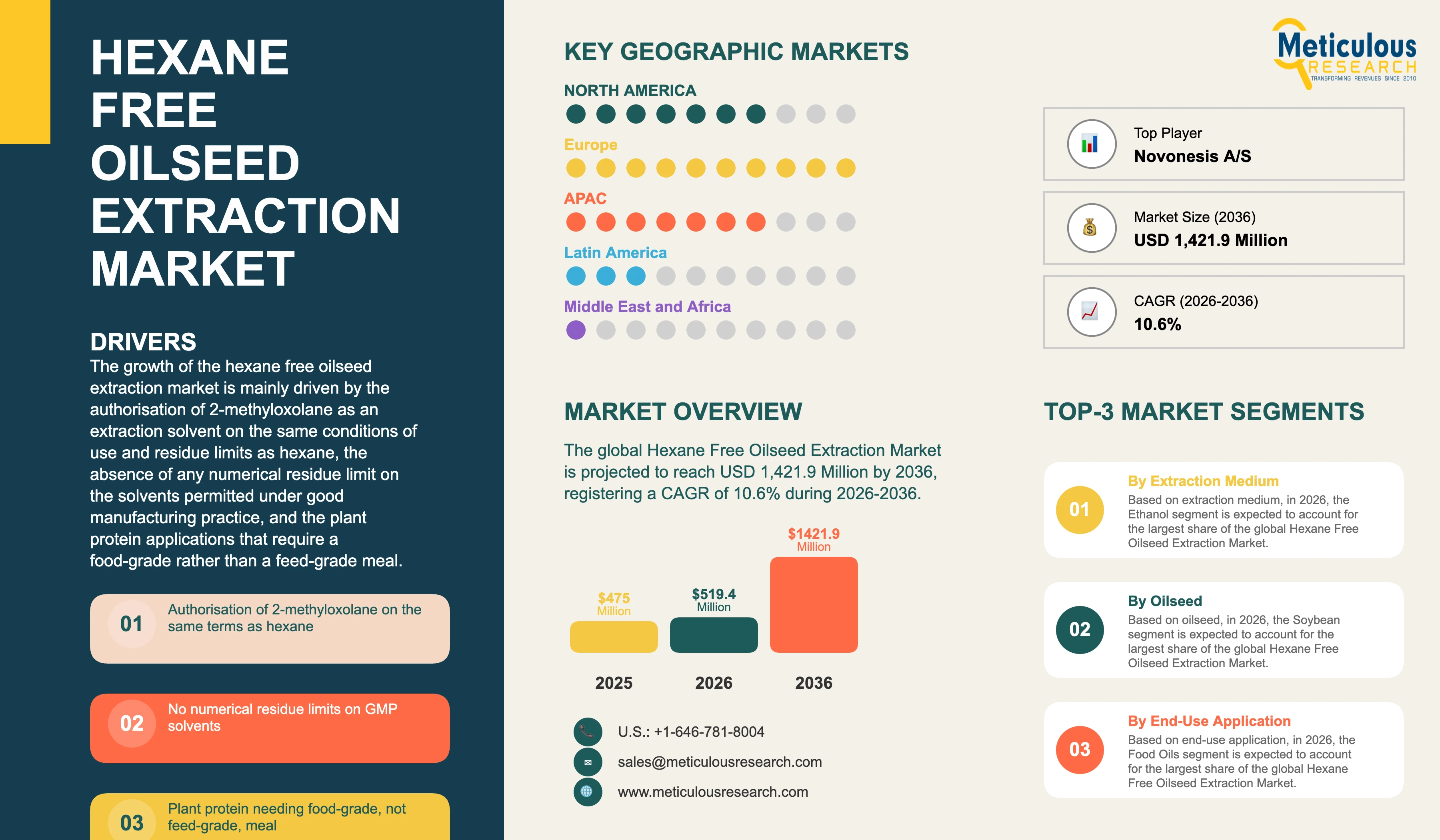
The global hexane free oilseed extraction market was valued at USD 475.0 million in 2025. This market is expected to reach USD 1,421.9 million by 2036 from an estimated USD 519.4 million in 2026, registering a CAGR of 10.6% during the forecast period (2026-2036).
- Published
- Nov 2026
- Pages
- 275
- Format
- PDF + Excel
- Report ID
- MRFB - 1042662
- Base year
- 2025
- 2025 · BASELINE
- $475.0M
- 2036
- $1.42B
- CAGR 2026–2036
- 10.6%
2025 baseline · 2026–2036 forecast at 10.6% CAGR · hover a bar for the value
Key highlights
The global hexane free oilseed extraction market is estimated at USD 519.4 million in 2026 and is projected to reach USD 1,421.9 million by 2036.
Market volume is estimated at 212.00 kilotons in 2026 and is projected to reach 623.63 kilotons by 2036 at a CAGR of 11.4%, measured as extraction medium and enzyme preparation consumed.
The average selling price is estimated at USD 2.45 per kg in 2026 and is projected to reach USD 2.28 per kg by 2036.
Ethanol is expected to account for the largest extraction medium share in 2026, while 2-methyloxolane is projected to register the highest CAGR of 24.6%.
Solvents permitted under good manufacturing practice are expected to hold the largest regulatory status share in 2026, while solvents carrying numerical residue limits are projected to grow fastest at a CAGR of 12.4%.
Soybean is expected to be the largest oilseed in 2026, while specialty and minor oilseeds are projected to register the highest CAGR of 14.8%.
Oil is expected to account for the largest output stream share in 2026, while protein meal and concentrate are projected to grow fastest at a CAGR of 12.4%.
Food oils are expected to be the largest end-use application in 2026, while plant protein ingredients are projected to register the highest CAGR of 14.2%.
Europe is expected to hold the largest regional share in 2026, while Asia-Pacific is projected to register the highest CAGR of 14.2%.
Commission Directive (EU) 2023/175 inserted 2-methyloxolane into Part II of the Annex to Directive 2009/32/EC as a permitted extraction solvent.
That insertion gives 2-methyloxolane the same conditions of use and the same maximum residue limits as hexane, namely 1 mg per kg in the fat, oil or cocoa butter, 10 mg per kg in defatted protein products and defatted flours, 30 mg per kg in defatted soya products sold to the final consumer, and 5 mg per kg in defatted cereal germ.
2-Methyloxolane is additionally permitted under Part III for the production of flavourings from natural flavouring materials, with a residue limit of 1 mg per kg in the foodstuff.
Propane, butane, ethyl acetate, ethanol, carbon dioxide, acetone and nitrous oxide are listed in Part I of that Annex for use under good manufacturing practice, with no numerical residue limits stated.
Propan-2-ol and methanol are permitted under Part II for all uses with a maximum residue limit of 10 mg per kg.
Dimethyl ether is permitted for defatted animal protein products including gelatine at 0.009 mg per kg, and for collagen and collagen derivatives other than gelatine at 3 mg per kg.
Ethylmethylketone is permitted for the fractionation of fats and oils at 5 mg per kg in the fat or oil.
Methyl acetate is permitted for the production of sugar from molasses at 1 mg per kg in the sugar and for coffee and tea decaffeination at 20 mg per kg.
The absence of a numerical residue limit on the Part I solvents is the principal regulatory distinction between the carbon dioxide and ethanol routes and every solvent that competes with hexane on its own terms.
Report summary
| Particulars | Details |
|---|---|
| Base Year | 2025 |
| Forecast Period | 2026-2036 |
| Market Size in 2025 | USD 475.0 million |
| Market Size in 2026 | USD 519.4 million |
| Market Size by 2036 | USD 1,421.9 million |
| Value CAGR (2026-2036) | 10.6% |
| Format | PDF, Excel & Cloud Portal · 275 pages |
| Volume in 2026 | 212.00 kilotons |
| Volume by 2036 | 623.63 kilotons |
| Volume CAGR (2026-2036) | 11.4% |
| Volume Basis | Extraction medium and enzyme preparation consumed, not oilseed processed |
| Average Selling Price in 2026 | USD 2.45 per kg |
| Average Selling Price by 2036 | USD 2.28 per kg |
| Measurement Basis | Food-grade extraction solvents, supercritical carbon dioxide and enzyme preparations consumed in hexane free oilseed extraction, excluding extraction plant, vessels, presses and recovery equipment, mechanical and cold pressing which consumes no extraction medium, n-hexane itself, refining and bleaching chemicals, and downstream protein isolation and fractionation inputs |
| Largest Extraction Medium | Ethanol |
| Fastest-Growing Extraction Medium | 2-Methyloxolane (CAGR 24.6%) |
| Largest Regulatory Status Segment | Good manufacturing practice solvents |
| Fastest-Growing Regulatory Status Segment | Solvents carrying numerical residue limits (CAGR 12.4%) |
| Largest Oilseed | Soybean |
| Fastest-Growing Oilseed | Specialty and minor oilseeds (CAGR 14.8%) |
| Largest Output Stream | Oil |
| Fastest-Growing Output Stream | Protein meal and concentrate (CAGR 12.4%) |
| Largest End-Use Application | Food oils |
| Fastest-Growing End-Use Application | Plant protein ingredients (CAGR 14.2%) |
| Largest Region | Europe |
| Fastest-Growing Region | Asia-Pacific (CAGR 14.2%) |
| Segments Covered | Extraction Medium, Regulatory Status, Oilseed, Output Stream, End-Use Application, and Geography |
| Geographies Covered | Europe, Asia-Pacific, North America, Latin America, and Middle East & Africa |
| Companies Profiled | 10 companies, including Novonesis A/S, International Flavors & Fragrances Inc., Air Liquide S.A., Linde plc, Pennakem, LLC, and Greenfield Global Inc. |
Report overview
Segments covered: extraction medium, regulatory status, oilseed, output stream, end-use application.
In volume terms, this market is estimated at 212.00 kilotons in 2026 and is projected to reach 623.63 kilotons by 2036, registering a CAGR of 11.4% during the same period, measured as extraction medium and enzyme preparation consumed rather than as oilseed processed. The average selling price is estimated at USD 2.45 per kg in 2026 and is projected to decline to USD 2.28 per kg by 2036 as ethanol and carbon dioxide supply contracts move to industrial scale and solvent recovery rates improve on installed plant.
The growth of this market is mainly driven by the authorisation of 2-methyloxolane as an extraction solvent on the same conditions of use and residue limits as hexane, the absence of any numerical residue limit on the extraction solvents permitted under good manufacturing practice, the plant protein applications that require a food-grade meal rather than a feed-grade one, and the classification of n-hexane as a reproductive and target organ toxicant, which places it on corporate substitution lists. However, factors such as the oil recovery shortfall that every alternative medium carries against hexane, and the capital cost of converting an installed hexane extraction plant rather than building new capacity, are expected to restrain the growth of this market to some extent.
Ethanol accounts for the largest share of this market because it is permitted under good manufacturing practice with no numerical residue limit, is available at food grade at industrial scale, and extracts both oil and the soluble components that protein applications require. 2-Methyloxolane grows faster because its authorisation gives a bio-based solvent the same permitted uses and residue limits as hexane, which makes substitution possible without changing the residue basis a processor already works to.
Hexane free oilseed extraction covers the routes by which oil and protein are recovered from oilseeds without n-hexane, and this report measures the extraction media and process consumables those routes require. Market sizing is on both a value basis in USD and a volume basis in kilotons measured as extraction medium and enzyme preparation consumed rather than as oilseed processed, with average selling price derived from the two. The measurement basis is food-grade extraction solvents, supercritical carbon dioxide and enzyme preparations consumed in hexane free oilseed extraction, and it excludes extraction plant, vessels, presses and recovery equipment, mechanical and cold pressing, which consumes no extraction medium, n-hexane itself, refining and bleaching chemicals, and downstream protein isolation and fractionation inputs.
The exclusion of mechanical pressing requires explanation because it is the oldest hexane free route. A screw press or expeller recovers oil by pressure alone and consumes no extraction medium at all, so it generates no demand in the market this report measures even though it produces hexane free oil. Pressing also leaves between six and twelve per cent of the oil in the cake against under one per cent for solvent extraction, which is why it occupies high-value and low-volume positions rather than commodity crushing. Pressing competes with the media measured here and is treated as a competing route rather than as part of the market.
Directive 2009/32/EC on extraction solvents used in the production of foodstuffs and food ingredients, as amended governs which media may be used and on what terms, and it divides them into three parts that carry materially different burdens. Part I lists propane, butane, ethyl acetate, ethanol, carbon dioxide, acetone and nitrous oxide for use under good manufacturing practice with no numerical residue limits stated. Part II lists solvents permitted for specified uses with maximum residue limits attached. Part III covers solvents for producing flavourings from natural flavouring materials. Which part a medium sits in determines whether a processor has a residue specification to meet at all.
Hexane sits in Part II with precise limits that define the compliance burden it carries. The permitted uses and limits are 1 mg per kg in the fat, oil or cocoa butter for fat and oil production and fractionation and for cocoa butter production, 10 mg per kg in the food containing defatted protein products and defatted flours, 30 mg per kg in defatted soya products sold to the final consumer, and 5 mg per kg in defatted cereal germ. A processor using hexane therefore operates a residue monitoring programme against four separate limits depending on which stream the material enters.
The most consequential recent change gave a bio-based alternative exactly that status. Commission Directive (EU) 2023/175 inserted 2-methyloxolane into Part II with the same conditions of use and the same maximum residue limits as hexane, and additionally permitted it under Part III for flavourings from natural flavouring materials at 1 mg per kg in the foodstuff. Parity rather than advantage is what matters commercially, because a processor substituting 2-methyloxolane for hexane keeps the same residue specification, the same monitoring programme and the same documentation rather than rewriting them. The solvent is also miscible and recoverable on equipment broadly comparable to a hexane plant.
The Part I solvents carry a different and stronger position that is frequently overlooked. Carbon dioxide and ethanol are permitted under good manufacturing practice with no numerical residue limit stated at all, which removes the residue specification rather than tightening it. A processor on a Part I medium has no residue limit to test against, no monitoring programme to run for the solvent and no limit to declare to a customer, which is a documentation saving as well as a technical one. That distinction, rather than any difference in extraction efficiency, is the principal regulatory advantage of the carbon dioxide and ethanol routes.
What drives substitution at all is the classification of the incumbent. n-Hexane is classified as a reproductive toxicant and as causing damage to organs through prolonged or repeated exposure, with peripheral neuropathy the characteristic effect, and it is highly flammable and an aspiration hazard. Those properties bring occupational exposure monitoring, explosion protection, vapour recovery and emission control obligations into a crushing plant, and they place the substance on the restricted substance lists that food manufacturers apply to their supply chains. The driver is therefore the incumbent rather than the alternative.
Protein rather than oil is where the economics of substitution have changed. A hexane extracted meal is a feed material in practice because the solvent, the desolventiser toaster temperature and the resulting protein denaturation leave it unsuitable for food protein isolation, whereas ethanol and aqueous routes produce a meal whose protein remains functional and whose residue position is clean. Plant protein ingredient applications value the meal at a multiple of feed meal, which changes the revenue basis of the whole crush rather than the cost of the oil. That shift is why protein meal grows faster than oil in this market.
Oil recovery is the constraint every alternative shares. Hexane recovers oil to under one per cent residual in the meal, which no other medium matches at commodity scale: ethanol is less selective for triglycerides and requires more passes, supercritical carbon dioxide recovers well but at pressures that limit throughput, and aqueous and enzyme-assisted routes leave more oil and generate an emulsion that has to be broken. A commodity crusher operating on a few dollars per tonne of margin cannot absorb a recovery shortfall, which is why the hexane free routes establish first where the output is valued above commodity oil and meal.
Conversion economics rather than technology availability govern the pace. An installed hexane extraction plant represents a large sunk investment in vessels, desolventiser toasters, vapour recovery and explosion protection that an alternative medium does not reuse in full, and a processor converting rather than building new writes off part of that asset. New capacity built for a protein application can be specified hexane free from the outset at no conversion penalty, which is why adoption tracks new plant and specialty capacity rather than the installed commodity base.
Soybean is expected to account for the largest share in 2026, reflecting global crush volume and the 30 mg per kg limit that applies specifically to defatted soya products sold to the final consumer.
Specialty and minor oilseeds are projected to register the highest CAGR of 14.8% during the forecast period.
Oil is expected to hold the largest share in 2026.
Protein meal and concentrate are projected to register the highest CAGR of 12.4% during the forecast period.
Food oils are expected to account for the largest share in 2026.
Plant protein ingredients are projected to register the highest CAGR of 14.2% during the forecast period.
Europe is expected to account for the largest share in 2026, supported by Directive 2009/32/EC and the authorisation of 2-methyloxolane, and by plant protein ingredient capacity in France, Germany and the Netherlands. France is projected to grow at 10.2% and the Netherlands at 9.8%.
Asia-Pacific is projected to register the highest CAGR of 14.2% during the forecast period, with India at 15.6% and China at 13.8%.
Europe is projected to grow at a CAGR of 9.6% and holds the largest regional share, supported by the extraction solvents framework that authorised the only bio-based substitute operating on the same residue basis as hexane, by plant protein ingredient manufacturing capacity, and by brand owner restricted substance lists reaching back through European supply chains. France is projected at 10.2% and the Netherlands at 9.8%.
The Middle East & Africa is projected to grow at a CAGR of 9.0% from a small base, where imported oil rather than domestic crushing accounts for most consumption. Latin America is projected to grow at a CAGR of 9.6%, with Brazil at 10.0%.
Novonesis A/S, International Flavors & Fragrances Inc., Air Liquide S.A., Linde plc and Pennakem, LLC together accounted for an estimated 34.8% of this market in 2026. The 10 companies profiled in this report together accounted for an estimated 52.0%.
Report infographic
Market dynamics
15 factors across 5 forcesAuthorisation of 2-Methyloxolane on the Same Terms as Hexane
Commission Directive (EU) 2023/175 inserted 2-methyloxolane into Part II of the Annex to Directive 2009/32/EC with the same conditions of use and the same maximum residue limits as hexane, namely 1 mg per kg in the fat, oil or cocoa butter, 10 mg per kg in defatted protein products and defatted flours, 30 mg per kg in defatted soya products sold to the final consumer and 5 mg per kg in defatted cereal germ, and additionally permitted it under Part III at 1 mg per kg in the foodstuff for flavourings from natural flavouring materials. Regulatory parity rather than regulatory advantage is what makes substitution practical, because the processor keeps the same residue specification, monitoring programme and customer documentation. The solvent is bio-based and recoverable on equipment broadly comparable to a hexane plant, which keeps the conversion within the existing process concept rather than requiring a new unit operation. Authorisation from a near-zero commercial base is why this medium grows fastest in the market, and why its share remains modest even in 2036.
Absence of Numerical Residue Limits on Good Manufacturing Practice Solvents
Part I of the Annex lists propane, butane, ethyl acetate, ethanol, carbon dioxide, acetone and nitrous oxide for use under good manufacturing practice with no numerical residue limits stated, against the four separate limits that a hexane processor monitors. A processor on ethanol or carbon dioxide therefore has no solvent residue limit to test against, no monitoring programme to run for the solvent and no limit to declare to a customer, which removes a documented control rather than tightening one. That saving applies to every batch and every stream rather than to a single approval. It is the principal regulatory reason the ethanol and carbon dioxide routes hold the largest combined share of this market, and the saving is realised on every batch rather than at approval.
Plant Protein Applications Requiring Food-Grade Rather Than Feed-Grade Meal
A hexane extracted meal is in practice a feed material, because the solvent, the desolventiser toaster temperature and the resulting protein denaturation leave it unsuitable for food protein isolation, while ethanol and aqueous routes yield a meal whose protein remains functional and whose solvent residue position is clean. Plant protein ingredient applications value that meal at a multiple of feed meal, which changes the revenue basis of the whole crush rather than the cost of extracting the oil. A processor can therefore justify a lower oil recovery against a far higher meal value, which is the only arithmetic under which a hexane free route beats hexane on margin, since the oil side of the comparison always favours hexane. Protein demand rather than oil demand is consequently what pulls capacity into this market, and the oil is increasingly the secondary consideration in the investment case.
Classification of n-Hexane as a Reproductive and Target Organ Toxicant
n-Hexane is classified as a reproductive toxicant and as causing damage to organs through prolonged or repeated exposure, with peripheral neuropathy the characteristic effect, and it is highly flammable and an aspiration hazard. Those properties bring occupational exposure monitoring, explosion protection, vapour recovery and emission control into a crushing plant as permanent operating obligations, and they place the substance on the restricted substance lists that food manufacturers apply to their supply chains. A brand owner can specify hexane free sourcing without any change in food law, and frequently does. The driver operates through procurement policy and plant operating cost rather than through a residue limit, which is why it applies in markets that have set no limit at all.
Table of contents
13 chapters · 145 sections · 275 pages · click to expandSegmental analysis
| Segment | Largest share (2026) | Fastest growth (2026–2036) |
|---|---|---|
| By Extraction Medium | Ethanol | 2-methyloxolane |
| By Regulatory Status | Good manufacturing practice solvents | Solvents carrying numerical residue limits |
| By Oilseed | Soybean | Specialty and minor oilseeds |
| By Output Stream | Oil | Protein meal and concentrate |
| By End-Use Application | Food oils | Plant protein ingredients |
| Other segments | Good manufacturing practice solvents under Part I | Solvents carrying numerical residue limits under Part II |
By Extraction Medium
- Hexane Free Oilseed Extraction Market Analysis by Extraction Medium
- The ethanol segment is expected to account for the largest share of the global hexane free oilseed extraction market.
- The large share of this segment is mainly due to its listing in Part I of the Annex to Directive 2009/32/EC for use under good manufacturing practice with no numerical residue limit stated, the availability of food grade material at industrial scale and price, and the extraction of soluble components alongside the oil, which is what allows the resulting meal to enter food protein manufacture rather than feed.
- However, the 2-methyloxolane segment is projected to register the highest CAGR of 24.6% during the forecast period.
- The rapid growth of this segment is attributed to Commission Directive (EU) 2023/175, which inserted the solvent into Part II with the same conditions of use and the same maximum residue limits as hexane, the resulting ability to substitute without changing the residue specification, monitoring programme or customer documentation already in place, and the near-zero commercial base from which the medium is growing.
- Supercritical carbon dioxide holds the second-largest medium position on the strength of its Part I status and its low-temperature operation, which preserves minor components in high-value oils, while propan-2-ol is permitted under Part II for all uses at 10 mg per kg and occupies positions where its selectivity suits the seed.
- Aqueous and enzyme preparations serve routes that use water as the medium and carry no solvent residue question at all.
- Medium selection in practice follows the regulatory part the medium sits in and the value of the output streams rather than extraction efficiency alone, since hexane remains the most efficient medium available.
By Regulatory Status
- Hexane Free Oilseed Extraction Market Analysis by Regulatory Status
- The good manufacturing practice solvents segment is expected to account for the largest share of the global hexane free oilseed extraction market.
- The large share of this segment is mainly due to the listing of ethanol, carbon dioxide and the other Part I media without any numerical residue limit, which removes the solvent residue monitoring programme and the customer declaration rather than tightening them, and the industrial availability of both principal media in that part at food grade.
- However, the solvents carrying numerical residue limits segment is projected to register the highest CAGR of 12.4% during the forecast period.
- The rapid growth of this segment is attributed to the authorisation of 2-methyloxolane in Part II with the same limits as hexane, which brings a bio-based substitute into the part of the Annex that commodity crushing already operates under, and to the suitability of that part for processors converting an existing plant rather than building a new one.
By Oilseed
- Hexane Free Oilseed Extraction Market Analysis by Oilseed
- The soybean segment is expected to account for the largest share of the global hexane free oilseed extraction market.
- The large share of this segment is mainly due to the global soybean crush volume, the protein content that makes the meal rather than the oil the principal product by value in food applications, and the 30 mg per kg residue limit that applies specifically to defatted soya products sold to the final consumer under the Annex, which makes the solvent position a labelled consumer matter for this seed alone.
- However, the specialty and minor oilseeds segment is projected to register the highest CAGR of 14.8% during the forecast period.
- The rapid growth of this segment is attributed to processing volumes too small to justify a hexane plant, oil and meal values well above commodity soybean or rapeseed that render the recovery shortfall immaterial, and the suitability of supercritical carbon dioxide for seeds whose value lies in minor components that a high-temperature solvent route would degrade.
By Output Stream
- Hexane Free Oilseed Extraction Market Analysis by Output Stream
- The oil segment is expected to account for the largest share of the global hexane free oilseed extraction market.
- The large share of this segment is mainly due to the position of oil as the stream the extraction step exists to recover, the 1 mg per kg residue limit that applies to the fat or oil under the Annex and governs the solvent decision, and the food oil applications that have driven hexane free capacity to date.
- However, the protein meal and concentrate segment is projected to register the highest CAGR of 12.4% during the forecast period.
- The rapid growth of this segment is attributed to the functional protein that ethanol and aqueous routes preserve where hexane extraction and desolventiser toaster temperatures denature it, the valuation of a food-grade meal at a multiple of feed meal, and the effect on the revenue basis of the whole crush, since the meal is the larger output stream by mass.
By End-Use Application
- Hexane Free Oilseed Extraction Market Analysis by End-Use Application
- The food oils segment is expected to account for the largest share of the global hexane free oilseed extraction market.
- The large share of this segment is mainly due to the consumer-facing nature of edible oil, which is where a hexane free claim carries the clearest value, the cold pressed and alternatively extracted oils already established in retail, and the 1 mg per kg limit in the fat or oil that makes the extraction medium a declarable matter.
- However, the plant protein ingredients segment is projected to register the highest CAGR of 14.2% during the forecast period.
- The rapid growth of this segment is attributed to the requirement for a meal whose protein remains functional and whose solvent residue position is clean, which hexane extraction does not deliver, the multiple of feed meal value that food protein applications support, and the growth of the plant protein ingredient sector independently of the oils it shares a feedstock with.
Other segments
- Good manufacturing practice solvents under Part I are expected to hold the largest share in 2026, since they carry no numerical residue limit.
- Solvents carrying numerical residue limits under Part II are projected to register the highest CAGR of 12.4% during the forecast period.
Geographic analysis
Europe
Largest shareIn 2026, Europe is expected to account for the largest share of the global hexane free oilseed extraction market. The large share of this region is mainly due to Directive 2009/32/EC and the insertion of 2-methyloxolane into Part II of its Annex by Commission Directive (EU) 2023/175, which originated the only authorised bio-based substitute operating on the same residue basis as hexane, the plant protein ingredient manufacturing capacity concentrated in France, Germany and the Netherlands, and the brand owner restricted substance lists that reach back through European supply chains. France is projected to register a CAGR of 10.2% and the Netherlands a CAGR of 9.8% during the forecast period.
Asia-Pacific
Fastest growthHowever, Asia-Pacific is projected to register the highest CAGR of 14.2% during the forecast period. The rapid growth of this region is attributed to the new crushing and protein processing capacity being built in India and China, which can be specified hexane free from the outset without the conversion penalty an installed plant carries, the specialty oilseed processing base across the region, and the domestic plant protein ingredient demand developing alongside export programmes. India is projected to register a CAGR of 15.6% and China a CAGR of 13.8%.
North America
North America is projected to grow at 8.8%, with the United States at 8.8%, on plant protein ingredient capacity and specialty extraction rather than on commodity crushing, where the installed hexane base is both large and recently invested in.
Latin America
Latin America is projected to grow at 9.6%, with Brazil at 10.0% as soybean crushing capacity expands and a share of new capacity is specified for food protein output.
Middle East & Africa
The Middle East & Africa is projected to grow at 9.0% from a small base, where imported oil rather than domestic crushing accounts for most consumption. Substitution follows new capacity rather than production volume, which separates where oilseeds are crushed from where hexane free extraction is installed. A region with a large and recently built hexane base has the least incentive to convert, because conversion writes off part of a sunk asset without adding crushing capacity, while a region building new protein-oriented capacity can specify a hexane free route at no conversion penalty. Regulatory origin and procurement pressure likewise travel from the importing brand owner back to the processing origin rather than arising locally. Extraction media supply is by contrast regional for ethanol and carbon dioxide, since both are bulk commodities shipped uneconomically over distance, while 2-methyloxolane and enzyme preparations are traded internationally.
Competitive landscape
The global hexane free oilseed extraction market is characterised by the presence of industrial gas companies supplying food-grade carbon dioxide, enzyme producers serving aqueous and enzyme-assisted routes, food-grade alcohol producers, and the specialty producer of the authorised bio-based solvent. Competition is contested on the regulatory part a medium occupies and on recovery performance in a specific plant configuration rather than on extraction efficiency alone, since hexane remains the most efficient medium and every alternative is selected for what it avoids. Novonesis A/S, International Flavors & Fragrances Inc., Air Liquide S.A., Linde plc and Pennakem, LLC together accounted for an estimated 34.8% of this market in 2026, while the companies profiled in this report together accounted for an estimated 52.0%.
Commission Directive (EU) 2023/175 inserted 2-methyloxolane into Part II of the Annex to Directive 2009/32/EC with the same conditions of use and maximum residue limits as hexane, at 1 mg per kg in the fat, oil or cocoa butter, 10 mg per kg in defatted protein products and flours, 30 mg per kg in defatted soya products for the final consumer and 5 mg per kg in defatted cereal germ, and permitted it under Part III at 1 mg per kg for flavourings from natural flavouring materials. Enzyme systems for demulsification in aqueous routes, food-grade carbon dioxide supply for specialty extraction, and solvent recovery improvement on installed plant accounted for most competitive activity through 2026.
The supplier base is drawn from four different industries rather than from a single extraction sector, which is why the market is fragmented and why no participant competes across the whole of it. Air Liquide S.A., Linde plc and Messer SE & Co. KGaA supply carbon dioxide, Novonesis A/S, International Flavors & Fragrances Inc. and Associated British Foods plc supply enzyme preparations, Greenfield Global Inc. and MGP Ingredients, Inc. supply food-grade alcohol, and Pennakem, LLC produces the authorised bio-based solvent. Some of the key players operating in the hexane free oilseed extraction market are Novonesis A/S (Denmark), International Flavors & Fragrances Inc. (U.S.), Air Liquide S.A. (France), Linde plc (U.K.), Pennakem, LLC (U.S.), Greenfield Global Inc. (Canada), Associated British Foods plc (U.K.), Messer SE & Co. KGaA (Germany), LyondellBasell Industries N.V. (Netherlands), and MGP Ingredients, Inc. (U.S.), among others.
- —
Commission Directive (EU) 2023/175 inserted 2-methyloxolane into Part II of the Annex to Directive 2009/32/EC with the same conditions of use and maximum residue limits as hexane, at 1 mg per kg in the fat, oil or cocoa butter, 10 mg per kg in defatted protein products and defatted flours, 30 mg per kg in defatted soya products sold to the final consumer and 5 mg per kg in defatted cereal germ, and permitted it under Part III at 1 mg per kg in the foodstuff for the production of flavourings from natural flavouring materials.
- Novonesis A/S
- International Flavors & Fragrances Inc.
- Air Liquide S.A.
- Linde plc
- Pennakem, LLC
- Greenfield Global Inc
Expert perspectives
Volume grows at 11.4% against 10.6% in value over the forecast period, and the average selling price falls from USD 2.45 per kg in 2026 to USD 2.28 per kg by 2036 as ethanol and carbon dioxide supply contracts move to industrial scale and solvent recovery rates improve on installed plant. Better recovery reduces make-up consumption per tonne of seed, so part of the volume growth comes from more plants rather than from more medium per plant.
The Part I and Part II distinction in the Annex does more commercial work than any performance figure. Ethanol and carbon dioxide are permitted under good manufacturing practice with no numerical residue limit, while hexane carries four separate limits and 2-methyloxolane now carries the same four. A processor on a Part I medium has no solvent residue programme to run and nothing to declare, which is a documentation saving applying to every batch rather than a one-off approval.
Parity rather than superiority is what made 2-methyloxolane commercially interesting. Commission Directive (EU) 2023/175 gave it hexane conditions of use and hexane limits, so a converting processor keeps the residue specification, the monitoring programme and the customer documentation unchanged and changes only the solvent. That is why it grows at 24.6% from a near-zero base while remaining a small share of the market in 2036.
No alternative medium beats hexane on oil recovery, and pretending otherwise misreads this market. Hexane reaches under one per cent residual oil in the meal, ethanol is less selective and needs more passes, carbon dioxide recovers well but at throughput-limiting pressure, and aqueous routes leave oil in an emulsion. A commodity crusher on a few dollars per tonne cannot absorb that, which is why substitution happens where output value is above commodity rather than across the crushing base.
What actually changes the arithmetic is the meal, not the oil. Ethanol and aqueous routes leave protein functional and the residue position clean, so the meal enters food protein manufacture at a multiple of feed meal value, and the meal is the larger output stream by mass. That is the only basis on which a lower oil recovery is commercially acceptable, and it is why protein meal grows at 12.4% and plant protein ingredients at 14.2%.
Conversion economics set the pace and explain the geography. An installed hexane plant is a sunk investment in extractors, desolventiser toasters, vapour recovery and explosion protection that an alternative does not fully reuse, so regions with large recently built hexane capacity have the least incentive to convert while regions building new protein-oriented capacity specify hexane free at no penalty. Adoption therefore tracks new plant, which is why Asia-Pacific grows fastest and North America slowest.
Customer perspectives
Meal destination rather than oil recovery determines whether an alternative route is viable, and solvent recovery efficiency becomes a determinant of viability once the medium costs more than hexane.
The absence of a residue limit on good manufacturing practice media removes a customer conversation entirely, and protein functionality rather than solvent residue alone rules out hexane extracted meal for ingredient use.
Brand owner restricted substance lists operate independently of food law, are enforced by audit rather than residue testing, and apply across the meal and protein streams as well as the oil.
“On a commodity crush I cannot give away oil, so the alternatives only work for me where the meal is worth more than feed. The other thing people underestimate is recovery. Hexane is cheap and we get nearly all of it back, so with a more expensive solvent the recovery rate stops being a detail and starts being the business case.”
“What our customers ask first is which solvent touched the protein. On ethanol or carbon dioxide there is no residue limit to test against, so there is nothing to declare, and that is a much easier conversation than explaining a limit we comply with. The protein also has to still function, and hexane meal does not give us that.”
“Hexane is legal and we are not disputing that, but it is on our restricted substance list because of its classification, so our suppliers have to move regardless. We audit against the specification rather than testing residues, and it applies to the meal and the protein as much as to the oil.”
Frequently asked questions
This market was valued at USD 434.3 million in 2024 and USD 475.0 million in 2025, and is estimated at USD 519.4 million in 2026. In volume terms it is estimated at 212.00 kilotons in 2026 as extraction medium and enzyme preparation consumed.
Cite this report
Meticulous Research. (2026). Hexane Free Oilseed Extraction Market - Global Opportunity Analysis and Industry Forecast (2026-2036) (Report No. MRFB - 1042662). Meticulous Market Research Pvt. Ltd. https://www.meticulousresearch.com/product/hexane-free-oilseed-extraction-market-7345