4D Imaging Radar Market (2026-2036)
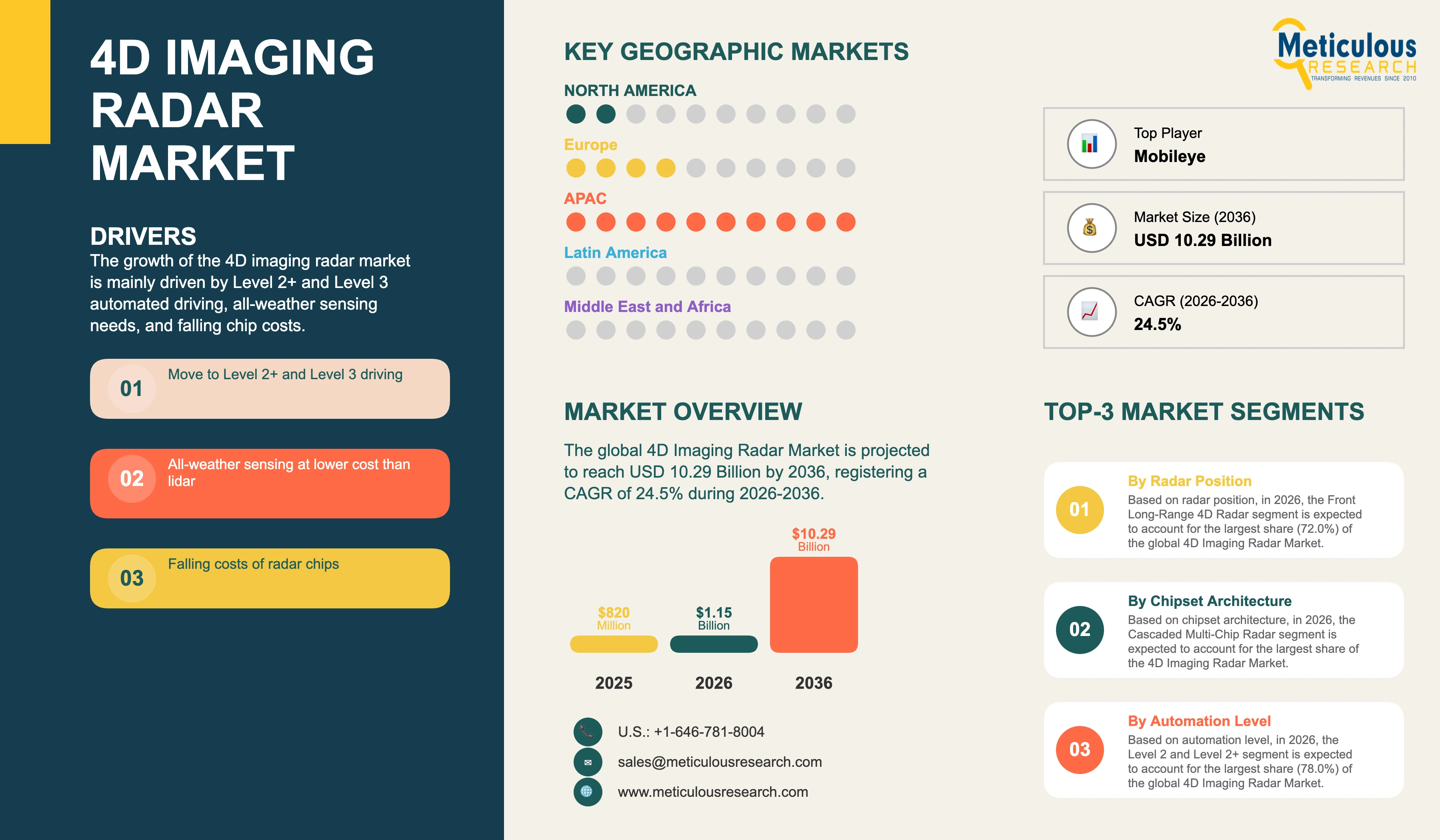
The global 4D imaging radar market was valued at USD 820.0 million in 2025. This market is expected to reach USD 10.29 billion by 2036 from an estimated USD 1.15 billion in 2026, registering a CAGR of 24.5% during the forecast period (2026-2036). 4D imaging radar is a high-resolution automotive radar that measures four dimensions of each object, namely range, speed, horizontal angle, and elevation, using a large number of transmit and receive channels.
- Published
- Nov 2026
- Pages
- 270
- Format
- PDF + Excel
- Report ID
- MRAUTO - 1042883
- Base year
- 2025
- 2025 · BASELINE
- $820.0M
- 2036
- $10.29B
- CAGR 2026–2036
- 24.5%
2025 baseline · 2026–2036 forecast at 24.5% CAGR · hover a bar for the value
Key highlights
A leading global vehicle maker chose Mobileye's 4D imaging radar as a key component of its eyes-off, hands-off automated driving system, planned to deliver SAE Level 3 driving at highway speeds starting in 2028, according to Mobileye. Mobileye's imaging radar, in development since 2018, uses Mobileye-designed radar radio-frequency chips and was designed to provide sensor redundancy alongside cameras at affordable cost.
Hirain Technologies and Arbe Robotics were selected in September 2026 by one of the world's largest automotive groups to supply imaging radar for a Level 3 automated driving program across multiple brands in China, with series-production deliveries scheduled to begin in the fourth quarter of 2027, according to the companies. A Chinese state-owned vehicle maker had earlier selected Hirain's LRR610 radar, powered by Arbe's chipset, for a Level 4 program with production from 2027.
Arbe's radar chipset features 48 transmitting and 48 receiving channels, supporting 2,304 virtual channels for ultra-high-resolution 4D imaging, according to Arbe. Arbe reported full-year 2025 revenue of USD 1.0 million, showing that the market for high-channel-count imaging radar is still at an early stage before series production.
Volvo Cars awarded Aptiv's Gen 8 radar platform for deployment in future cars beginning in 2028, according to Aptiv. Aptiv's Gen 8 forward radar provides detection beyond 300 meters with fine 4D angular resolution and can classify over- and under-drivable static objects using radar alone.
Continental, whose automotive business is now AUMOVIO, produced 200 million radar sensors and announced major radar series orders with production starts planned for 2026 and 2027, depending on the vehicle maker, showing the shift of leading radar suppliers to new radar generations, including 4D imaging radar.
Leading suppliers include AUMOVIO, Bosch, ZF, Aptiv, Valeo, Mobileye, Hirain Technologies, Huizhou Desay SV, Huawei, HL Klemove, and Arbe Robotics. Level 3 and above systems are the fastest-growing automation level, and single-chip radars are expected to account for more than half of the market by 2036.
By radar position, front long-range 4D radar accounts for the larger share of 72.0% in 2026, while corner and short-range 4D radar registers the higher CAGR.
By chipset architecture, cascaded multi-chip radar accounts for the larger share in 2026, while single-chip radar registers the higher CAGR.
By automation level, level 2 and level 2+ accounts for the larger share in 2026, while level 3 and above registers the higher CAGR.
By vehicle type, passenger cars account for the larger share of 90.0% in 2026, while commercial vehicles register the higher CAGR.
By geography, Asia-Pacific accounts for the largest share of 58.0% in 2026, while Europe registers the highest CAGR of 27.3%.
Report summary
| Particulars | Details |
|---|---|
| Forecast Period | 2026-2036 |
| Base Year | 2025 |
| Estimated Year | 2026 |
| CAGR (Value) | 24.5% |
| Format | PDF, Excel & Cloud Portal · 270 pages |
| Market Size (Value) in 2025 | USD 820.0 million |
| Market Size (Value) in 2026 | USD 1.15 billion |
| Market Size (Value) by 2036 | USD 10.29 billion |
| Largest Segment by Radar Position (2026) | Front Long-Range 4D Radar (72.0%) |
| Largest Segment by Vehicle Type (2026) | Passenger Cars (90.0%) |
| Largest Region (2026) | Asia-Pacific (58.0%) |
| Fastest-Growing Region | Europe (CAGR 27.3%) |
| Segments Covered | Radar Position, Chipset Architecture, Automation Level, Vehicle Type, Geography |
| Countries Covered | U.S., Canada, Germany, France, U.K., Sweden, Italy, Spain, Czech Republic, Poland, Hungary, Netherlands, Belgium, Austria, Slovakia, Romania, Rest of Europe, China, Japan, South Korea, India, Taiwan, Thailand, Indonesia, Malaysia, Vietnam, Philippines, Singapore, Australia, Rest of Asia-Pacific, Mexico, Brazil, Argentina, Chile, Colombia, Rest of Latin America, Israel, Turkey, UAE, Saudi Arabia, Morocco, South Africa, Rest of Middle East & Africa |
| Key Companies | 11 companies and other companies |
Report overview
Segments covered: radar position, chipset architecture, automation level, vehicle type.
It produces a dense point cloud, similar to a low-resolution lidar image, which allows the vehicle to separate closely spaced objects, detect small and stationary objects, and tell the difference between objects on the road and objects above it, such as bridges and overhead signs. It works in rain, fog, snow, darkness, and glare, where cameras and lidar can struggle.
The growth of this market is mainly driven by the move to Level 2+ and Level 3 automated driving, which requires high-resolution sensors with redundancy, the need for sensors that work in all weather and lighting conditions at a lower cost than lidar, stricter safety regulations and ratings for automatic emergency braking, especially for pedestrians at night, falling costs of high-resolution radar chips as single-chip designs reach production, and the fast adoption of advanced driver assistance by Chinese vehicle makers. In addition, robotaxi and autonomous truck programs are creating demand for high-performance imaging radar. However, the higher cost of 4D imaging radar compared with conventional radar, competition from lidar and camera-only systems, and the large data processing needs of imaging radar are expected to restrain the growth of this market to some extent.
Conventional automotive radars measure the distance, speed, and horizontal angle of objects, but they have limited angular resolution and little or no ability to measure height. As a result, they can struggle to separate objects that are close together, such as a pedestrian next to a parked car, and they cannot easily tell the difference between a stopped vehicle under a bridge and the bridge itself. For this reason, many conventional radar systems ignore stationary objects at higher speeds, which limits their use in automated driving.
This report covers the global 4D imaging radar market, including front long-range 4D radars and corner and short-range 4D radars, using cascaded multi-chip and single-chip architectures, for Level 2 and Level 2+ systems and Level 3 and above systems, in passenger cars and commercial vehicles. The market is valued at the selling price of complete 4D imaging radar sensor modules supplied to vehicle makers and system integrators, including radars supplied for robotaxi and autonomous truck programs. The market is analyzed by radar position, chipset architecture, automation level, vehicle type, and geography. Conventional radars, radar chips sold separately, lidar, and cameras are not included.
4D imaging radar solves these problems by using many more transmit and receive channels, often 12 to 48 or more of each, arranged in multiple-input, multiple-output antenna arrays that create hundreds or thousands of virtual channels. This gives much finer horizontal and vertical resolution and produces a dense point cloud of the vehicle's surroundings. Combined with advanced signal processing and artificial intelligence, 4D imaging radar can detect and classify vehicles, pedestrians, cyclists, debris, and road edges, and it can tell which stationary objects are safe to drive under or over.
There are two main hardware approaches to 4D imaging radar, and they differ in cost, size, and maturity. Cascaded multi-chip designs combine several standard radar chips to increase the number of channels, which allows suppliers to use proven chips but increases size, power use, and cost. Single-chip designs use new radar chips with many channels on one chip, such as Arbe's chipset with 48 transmitting and 48 receiving channels and Mobileye's in-house radar chips, which can reduce cost and power use. Single-chip designs are the fastest-growing architecture in this market as these new chips reach production.
4D imaging radar plays an important role in automated driving because it provides a second, independent view of the road that works when cameras are blinded by glare or darkness and when lidar is affected by fog, rain, or dirt. Vehicle makers developing Level 3 systems, which allow the driver to take their eyes off the road, need this kind of redundancy to make the system safe. Because 4D imaging radar costs less than lidar, it also allows vehicle makers to offer advanced Level 2+ features on more affordable models.
The market is served by large automotive radar suppliers that have developed 4D imaging radars, such as AUMOVIO, Bosch, ZF, Aptiv, Valeo, and HL Klemove, Chinese suppliers, such as Hirain Technologies, Huizhou Desay SV, and Huawei, and new entrants, such as Mobileye, which designs its own radar chips and has partnered with Wistron NeWeb for production, and Arbe Robotics, which supplies imaging radar chipsets to radar makers. China has been an early adopter, with several vehicle makers fitting 4D imaging radar to new electric vehicles with advanced driver assistance.
In 2026, front long-range 4D radars account for the largest share of the market by radar position, while corner and short-range 4D radars are the fastest-growing radar position. Cascaded multi-chip radars account for the largest share by chipset architecture, while single-chip radars are the fastest-growing architecture. Level 2 and Level 2+ systems account for the largest share by automation level, while Level 3 and above systems are the fastest-growing automation level. Passenger cars account for the largest share by vehicle type, while commercial vehicles are the fastest-growing vehicle type. Asia-Pacific accounts for the largest share of the market, while Europe is the fastest-growing region.
Market growth over the forecast period will depend on the pace of Level 2+ and Level 3 adoption, the cost of 4D imaging radar compared with conventional radar and lidar, the production ramp-up of new single-chip radar designs, and vehicle makers' sensor strategies. Because the market starts from a small base and major programs begin production in 2027 and 2028, growth is expected to accelerate in the second half of the decade. Overall, 4D imaging radar is expected to replace conventional front radar in a growing share of vehicles with advanced driver assistance through 2036.
Passenger cars are expected to account for the largest share of 90.0% of the market in 2026, while commercial vehicles are projected to register the highest CAGR, driven by autonomous trucks and robotaxis.
Asia-Pacific is expected to account for the largest share of 58.0% of the market in 2026, mainly due to the fast adoption of 4D imaging radar by Chinese vehicle makers and strong Chinese radar suppliers.
Europe is projected to register the highest CAGR of 27.3% during the forecast period, driven by Level 3 programs from European premium vehicle makers and strict pedestrian and cyclist safety requirements.
The report profiles 11 companies, including AUMOVIO, Bosch, ZF, Aptiv, Valeo, Mobileye, Hirain Technologies, Huizhou Desay SV, Huawei, HL Klemove, and Arbe Robotics.
4D imaging radar adds elevation measurement and much higher resolution by using many more channels, which allows it to separate closely spaced objects and detect stationary and overhead objects that conventional radar cannot.
4D imaging radar is one segment of the wider automotive radar market, which also includes conventional front, corner, and in-cabin radars. The wider market is covered in a separate automotive radar report.
In 2026, the level 2 and level 2+ segment is expected to account for the larger share of the 4D imaging radar market, while the level 3 and above segment is projected to register the higher CAGR during the forecast period.
What comes next: 4D Imaging Radar and the Future of Driver Assistance, a Meticulous Next™ foresight brief.
Report infographic
Market dynamics
17 factors across 5 forcesMove to level 2+ and level 3 automated driving
Vehicle makers are introducing Level 2+ systems that allow hands-free driving on highways and in cities and Level 3 systems that allow eyes-off driving in certain conditions. These systems must detect vehicles, pedestrians, cyclists, debris, and stationary objects reliably at highway speeds, in all weather and lighting conditions, and they need redundant sensors so that the system remains safe if one sensor fails or is blinded. Conventional radar does not have enough resolution for these tasks, and cameras alone can struggle in darkness, glare, and bad weather.
4D imaging radar provides the resolution, range, and all-weather performance needed for these systems at a lower cost than lidar. A leading global vehicle maker chose Mobileye's imaging radar for a Level 3 highway system starting in 2028, according to Mobileye, and Hirain Technologies and Arbe were selected for a Level 3 program across multiple brands of a large automotive group in China, with deliveries from the fourth quarter of 2027, according to the companies. Level 3 and above systems are the fastest-growing automation level in this market.
Need for all-weather sensing at lower cost than lidar
Cameras and lidar are both strong sensors, but each has weaknesses in some driving conditions. Cameras can be blinded by glare, darkness, and heavy rain, and lidar performance can fall in fog, heavy rain, snow, and when the sensor is dirty. Radar uses radio waves that pass through rain, fog, snow, and dust, and it measures speed directly, which makes it valuable for reliable detection in all conditions.
4D imaging radar combines this all-weather performance with resolution that approaches low-resolution lidar, at a cost that is expected to be well below lidar. This makes it attractive for vehicle makers that want high-performance sensing without the cost of lidar, especially for mid-priced vehicles. Some vehicle makers are considering 4D imaging radar as an alternative to lidar for Level 2+ systems, while others use both for Level 3 and above systems.
Stricter safety regulations and ratings
Safety regulations and ratings are becoming stricter, especially for automatic emergency braking for pedestrians and cyclists at night and in complex scenarios. NHTSA's FMVSS No. 127 requires automatic emergency braking, including pedestrian detection in daylight and darkness, on all new light vehicles in the U.S. from September 2029, and the EU General Safety Regulation made advanced emergency braking that detects pedestrians and cyclists mandatory for all newly registered cars and vans from July 2026.
Safety rating programs, such as Euro NCAP and C-NCAP, also test more difficult scenarios, such as pedestrians emerging from behind parked cars and junction crashes. 4D imaging radar can separate pedestrians from nearby parked vehicles and detect them in darkness, which helps vehicle makers meet these requirements. This supports adoption of 4D imaging radar in front radar positions on mainstream vehicles over time.
Falling costs of high-resolution radar chips
Early 4D imaging radars used several standard radar chips cascaded together, which increased cost, size, and power use. New single-chip radar devices with many channels, such as Arbe's chipset and Mobileye's in-house radar chips, as well as new chips from established semiconductor companies, are reducing the cost of 4D imaging radar. As these chips reach series production and volumes grow, prices are expected to fall further.
Lower costs make 4D imaging radar affordable for more vehicles and for corner positions, not only front radars. This is expected to broaden adoption from premium vehicles to mid-priced models over the forecast period. Single-chip radars are the fastest-growing chipset architecture, and corner and short-range 4D radars are the fastest-growing radar position in this market.
Fast adoption of advanced driver assistance in China
Chinese vehicle makers are adopting advanced driver assistance, such as highway and city navigation assistance, faster than vehicle makers in other regions, and they use these features to differentiate their electric vehicles. Many Chinese vehicle makers have fitted 4D imaging radar to new models, together with cameras and, in some cases, lidar, and Chinese radar suppliers, such as Hirain Technologies, Huizhou Desay SV, and Huawei, offer 4D imaging radars at competitive prices. Chinese vehicle makers are also among the first to launch Level 3 programs, such as the multi-brand Level 3 program for which Hirain and Arbe were selected, and Chinese regulators have been developing rules to allow Level 3 driving on public roads. As a result, Asia-Pacific accounts for the largest share of this market, and Chinese vehicle makers are expected to remain the largest buyers of 4D imaging radar through the forecast period, while also bringing the technology to other markets as they expand abroad.
Table of contents
12 chapters · 182 sections · 270 pages · click to expandSegmental analysis
| Segment | Largest share (2026) | Fastest growth (2026–2036) |
|---|---|---|
| By Radar Position | Front long-range 4D radar | Corner and short-range 4D radar |
| By Chipset Architecture | Cascaded multi-chip radar | Single-chip radar |
| By Automation Level | Level 2 and Level 2+ | Level 3 and above |
| By Vehicle Type | Passenger cars | Commercial vehicles |
By Radar Position
- 4D Imaging Radar Market Analysis by Radar Position
- The front long-range 4D radar segment is expected to account for the largest share of 72.0% of the global 4D imaging radar market.
- The large share of this segment is mainly due to the use of 4D imaging radar mainly as the front radar in vehicles with Level 2+ and Level 3 systems, the need for long-range detection of vehicles, pedestrians, and stationary objects at highway speeds, the ability of front 4D radars to classify over- and under-drivable objects, and the higher value of front long-range 4D radars compared with corner radars.
- AUMOVIO, Bosch, ZF, Aptiv, Mobileye, Hirain Technologies, and Huawei are among the leading suppliers of front 4D imaging radars.
- However, the corner and short-range 4D radar segment is projected to register the highest CAGR during the forecast period.
- The rapid growth of this segment is driven by the use of 4D imaging corner radars for 360-degree perception in city driving, lane changes, and automated parking, the falling cost of single-chip radar devices, which makes 4D corner radars affordable, the need for high-resolution detection of pedestrians and cyclists near the vehicle, and the improved vertical resolution of new corner radars, such as Aptiv's Gen 8 corner radar.
- Corner 4D radars are also used for parking.
By Chipset Architecture
- 4D Imaging Radar Market Analysis by Chipset Architecture
- The cascaded multi-chip radar segment is expected to account for the largest share of the global 4D imaging radar market.
- The large share of this segment is mainly due to the use of cascaded designs, which combine several proven radar chips, in most 4D imaging radars in production today, the availability of standard radar chips from established semiconductor companies, the lower development risk of cascaded designs, and their use by leading radar suppliers in current programs.
- However, the single-chip radar segment is projected to register the highest CAGR during the forecast period.
- The rapid growth of this segment is driven by new radar chips with many channels on one chip, such as Arbe's chipset with 48 transmitting and 48 receiving channels and Mobileye's in-house radar chips, the lower cost, size, and power use of single-chip designs, and new production programs using these chips from 2027 and 2028.
- Single-chip radars are expected to account for more than half of the market by 2036.
- Established chip suppliers are also launching high-channel single-chip devices for this market.
- The cascaded multi-chip radar segment is expected to account for the larger share of the 4D imaging radar market, while the single-chip radar segment is projected to register the higher CAGR during the forecast period.
By Automation Level
- 4D Imaging Radar Market Analysis by Automation Level
- The Level 2 and Level 2+ segment is expected to account for the largest share of the global 4D imaging radar market.
- The large share of this segment is mainly due to the use of 4D imaging radar in vehicles with highway and city navigation assistance, especially in China, the much larger number of vehicles with Level 2 and Level 2+ systems compared with Level 3 systems, and the use of 4D imaging radar to improve automatic emergency braking and adaptive cruise control in these vehicles.
- However, the Level 3 and above segment is projected to register the highest CAGR during the forecast period.
- The rapid growth of this segment is driven by Level 3 programs starting in 2027 and 2028, such as the Mobileye and Hirain-Arbe programs, the need for redundant high-resolution sensors in eyes-off systems, robotaxi and autonomous truck programs, and the expected spread of Level 3 systems to more vehicle models and regions.
- Level 3 and above systems are expected to account for more than a third of the market by 2036.
By Vehicle Type
- 4D Imaging Radar Market Analysis by Vehicle Type
- The passenger cars segment is expected to account for the largest share of 90.0% of the global 4D imaging radar market.
- The large share of this segment is mainly due to the fast adoption of Level 2+ systems with 4D imaging radar in passenger cars, especially Chinese electric vehicles, the Level 3 programs being developed by passenger car makers, and the much larger production of passenger cars compared with commercial vehicles.
- Premium passenger cars in Europe and North America are also adopting 4D imaging radar, especially for highway assistance and Level 3 systems.
- However, the commercial vehicles segment is projected to register the highest CAGR during the forecast period.
- The rapid growth of this segment is driven by autonomous truck and robotaxi programs that require high-performance radar, the need for long-range detection at highway speeds for trucks, stricter safety rules for trucks and buses, and the use of imaging radar in off-highway vehicles.
- Commercial vehicle radars also command higher prices than passenger car radars because of their performance and durability requirements.
Geographic analysis
Asia-Pacific
Largest shareIn 2026, Asia-Pacific is expected to account for the largest share of 58.0% of the global 4D imaging radar market. The large share of this region is mainly due to the fast adoption of 4D imaging radar by Chinese vehicle makers in new electric vehicles with highway and city navigation assistance, the presence of Chinese radar suppliers, such as Hirain Technologies, Huizhou Desay SV, and Huawei, the early launch of Level 3 and Level 4 programs in China, and the large Asian operations of global suppliers, such as Bosch, AUMOVIO, ZF, Aptiv, and HL Klemove. South Korea and Japan are also developing 4D imaging radar programs. Chinese vehicle makers often fit 4D imaging radar as standard on new electric vehicles with navigation assistance, rather than as an option, which supports high volumes. Chinese suppliers also benefit from local radar chip development and lower production costs.
Europe
Fastest growthHowever, Europe is projected to register the highest CAGR of 27.3% during the forecast period. The rapid growth of this region is mainly driven by the launch of Level 3 programs by European premium vehicle makers, such as Volvo Cars' use of Aptiv's Gen 8 radar from 2028, Germany's early legal framework for Level 3 driving, strict EU General Safety Regulation and Euro NCAP requirements for pedestrian and cyclist protection, and the presence of leading radar suppliers, such as Bosch, AUMOVIO, ZF, and Valeo. European vehicle makers are expected to adopt 4D imaging radar widely in their next-generation platforms, as they need all-weather sensing for Level 3 systems while controlling sensor costs. Europe's strong focus on vulnerable road user protection also favors high-resolution radar. Germany is the largest market in Europe, supported by premium vehicle makers, such as Mercedes-Benz and BMW, that offer advanced driver assistance and Level 3 systems, and by the presence of radar development and production. Sweden, France, the U.K., and Italy are also important markets.
Middle East & Africa
Israel is an important center for imaging radar technology development, with companies such as Mobileye and Arbe based there. Central and Eastern European countries, such as the Czech Republic, Poland, and Hungary, are important locations for radar and electronics production supplying European vehicle plants.
North America
North America accounts for a significant share of the market, supported by the development of Level 2+ systems by U.S. vehicle makers, robotaxi and autonomous truck programs, FMVSS No. 127 requirements for pedestrian automatic emergency braking at night, and the presence of Aptiv and other suppliers. However, the use of camera-only systems by some vehicle makers limits demand. The U.S. is the largest market in the region, and robotaxi services in several U.S. cities use imaging radar as part of their sensor suites.
Latin America
Latin America and the Middle East & Africa account for small shares, with growth expected later in the forecast period as advanced driver assistance spreads to these markets and as Chinese vehicle makers export vehicles with 4D imaging radar.
Competitive landscape
The global 4D imaging radar market includes large automotive radar suppliers, Chinese radar suppliers, technology companies, and chipset specialists. The market is still at an early stage, with many established and new companies competing for the first large production programs, and the competitive landscape is expected to change as single-chip designs reach production and as Level 3 programs begin.
AUMOVIO, Bosch, ZF, Aptiv, Valeo, and HL Klemove are established radar suppliers with 4D imaging radar products. Mobileye has developed its own imaging radar with in-house radar chips and won a Level 3 program from 2028. Hirain Technologies, Huizhou Desay SV, and Huawei are leading Chinese suppliers, and Arbe Robotics supplies imaging radar chipsets used in Hirain's radars. Semiconductor companies, such as NXP, Infineon, and Texas Instruments, supply radar chips for cascaded designs and are developing new high-channel devices.
Companies in this market compete on resolution, range, detection performance, cost, power use, size, software and AI capabilities, and the ability to support Level 3 safety requirements. Key strategies include developing single-chip imaging radar designs, building strong perception software, winning early Level 3 and Level 4 programs, forming partnerships between radar makers and chip companies, and expanding production capacity.
Recent competitive activity in this market has focused mainly on Level 3 program wins with large vehicle makers. A leading global vehicle maker chose Mobileye's imaging radar for a Level 3 system from 2028, according to Mobileye, Hirain Technologies and Arbe were selected for a multi-brand Level 3 program in China with deliveries from the fourth quarter of 2027, according to the companies, and Volvo Cars awarded Aptiv's Gen 8 radar platform for cars from 2028, according to Aptiv.
We expect competition to increase over the forecast period as more suppliers bring single-chip 4D imaging radars to market, as Chinese suppliers expand abroad, and as vehicle makers decide between radar, lidar, and camera strategies. Suppliers that win early Level 3 programs, offer low-cost single-chip designs, and have strong software capabilities are expected to lead the market, while consolidation among smaller radar and chip companies is likely, as some start-ups struggle to fund development until series production begins.
Some of the key players operating in the 4D imaging radar market are AUMOVIO SE, Robert Bosch GmbH, ZF Friedrichshafen AG, Aptiv PLC, Valeo SE, Mobileye Global Inc., Hirain Technologies Co., Ltd., Huizhou Desay SV Automotive Co., Ltd., Huawei Technologies Co., Ltd., HL Klemove Corp., and Arbe Robotics Ltd., among others.
- —
Mobileye's imaging radar was chosen for a Level 3 system from 2028, Hirain and Arbe were selected for a multi-brand Level 3 program in China with deliveries from late 2027, and Volvo Cars awarded Aptiv's Gen 8 radar for cars from 2028.
- AUMOVIO SE
- Robert Bosch GmbH
- ZF Friedrichshafen AG
- Aptiv PLC
- Valeo SE
- Mobileye Global Inc.
- Hirain Technologies Co., Ltd.
- Huizhou Desay SV Automotive Co., Ltd.
- Huawei Technologies Co., Ltd.
- HL Klemove Corp.
- Arbe Robotics Ltd.
Expert perspectives
4D imaging radar is moving from development to series production, driven by the move to Level 2+ and Level 3 automated driving and the need for affordable all-weather sensing. The market is small today, but major programs starting in 2027 and 2028 and the arrival of single-chip designs are expected to drive very fast growth over the forecast period.
Over the forecast period, the market is expected to grow at a CAGR of 24.5%, from USD 1.15 billion in 2026 to USD 10.29 billion in 2036. Growth will be driven by the move to Level 2+ and Level 3 automated driving, the need for all-weather sensing at lower cost than lidar, stricter safety regulations and ratings, falling costs of high-resolution radar chips, and the fast adoption of advanced driver assistance in China.
Among the market segments, front long-range 4D radars are the largest radar position, while corner and short-range 4D radars grow fastest. Cascaded multi-chip radars are the largest chipset architecture, while single-chip radars grow fastest. Level 2 and Level 2+ systems are the largest automation level, while Level 3 and above systems grow fastest. Passenger cars are the largest vehicle type, while commercial vehicles grow fastest. Asia-Pacific is the largest region, while Europe grows fastest, at a CAGR of 27.3%.
In our view, the arrival of single-chip 4D imaging radar will be the turning point for this market. Single-chip designs will bring costs close enough to conventional radar to make 4D imaging radar the standard front radar in vehicles with advanced driver assistance and to extend it to corner positions. We expect 4D imaging radar to replace conventional front radar in most new vehicles with Level 2+ systems by the end of the forecast period.
We also see the competition between radar and lidar as a key factor shaping this market. In China, low-cost lidar is widely used, while in Europe and North America, vehicle makers are more likely to rely on 4D imaging radar as a lower-cost alternative or complement. Suppliers must show clear performance and cost benefits and build strong software to win in both regions.
Overall, we believe the 4D imaging radar market will grow very quickly over the forecast period, with corner 4D radars, single-chip designs, Level 3 and above systems, commercial vehicles, and Europe providing the fastest growth. Companies that win early Level 3 programs, offer low-cost single-chip designs, and have strong AI perception software will be best positioned to capture this growth, while competition from lidar and cameras and the uncertain pace of Level 3 adoption remain the main risks.
Customer perspectives
“For our Level 3 system, we need a radar that sees stopped cars under bridges and works in fog. 4D imaging radar gives us that redundancy at a lower cost than another lidar.”
“Our next platform uses a 4D imaging front radar on every trim. Single-chip designs brought the price down enough to add 4D corner radars next.”
“Our trucks need to see stopped vehicles far ahead at highway speed, day or night, in any weather. Imaging radar is essential in our sensor suite.”
Frequently asked questions
The global 4D imaging radar market was valued at USD 820.0 million in 2025, up from USD 540.0 million in 2024, and is estimated at USD 1.15 billion in 2026. The market includes front and corner 4D imaging radars for passenger cars and commercial vehicles.
The global 4D imaging radar market is expected to reach USD 10.29 billion by 2036, driven by Level 2+ and Level 3 automated driving, all-weather sensing needs, safety rules, and falling chip costs.
The market is expected to register a CAGR of 24.5% from 2026 to 2036, with the fastest growth in corner 4D radars, single-chip designs, Level 3 and above systems, commercial vehicles, and Europe.
Market growth is mainly driven by the move to Level 2+ and Level 3 automated driving, the need for all-weather sensing at lower cost than lidar, stricter safety regulations and ratings, falling costs of high-resolution radar chips, and fast adoption of advanced driver assistance in China.
The higher cost compared with conventional radar and competition from lidar and camera-only systems restrain growth, while data processing and power consumption and interference, validation, and standards are key challenges.
Key growth opportunities include Level 3 programs starting in 2027 and 2028, 4D imaging corner radars for 360-degree perception, robotaxis, autonomous trucks, and off-highway vehicles, and software and AI-based radar perception.
Front long-range 4D radars are expected to account for the largest share of 72.0% of the market in 2026, while corner and short-range 4D radars are projected to register the highest CAGR, driven by 360-degree perception.
In 2026, the cascaded multi-chip radar segment is expected to account for the larger share of the 4D imaging radar market, while the single-chip radar segment is projected to register the higher CAGR during the forecast period.
In 2026, the level 2 and level 2+ segment is expected to account for the larger share of the 4D imaging radar market, while the level 3 and above segment is projected to register the higher CAGR during the forecast period.
Passenger cars are expected to account for the largest share of 90.0% of the market in 2026, while commercial vehicles are projected to register the highest CAGR, driven by autonomous trucks and robotaxis.
Asia-Pacific is expected to account for the largest share of 58.0% of the market in 2026, mainly due to the fast adoption of 4D imaging radar by Chinese vehicle makers and strong Chinese radar suppliers.
Europe is projected to register the highest CAGR of 27.3% during the forecast period, driven by Level 3 programs from European premium vehicle makers and strict pedestrian and cyclist safety requirements.
The report profiles 11 companies, including AUMOVIO, Bosch, ZF, Aptiv, Valeo, Mobileye, Hirain Technologies, Huizhou Desay SV, Huawei, HL Klemove, and Arbe Robotics.
Mobileye's imaging radar was chosen for a Level 3 system from 2028, Hirain and Arbe were selected for a multi-brand Level 3 program in China with deliveries from late 2027, and Volvo Cars awarded Aptiv's Gen 8 radar for cars from 2028.
4D imaging radar adds elevation measurement and much higher resolution by using many more channels, which allows it to separate closely spaced objects and detect stationary and overhead objects that conventional radar cannot.
4D imaging radar is one segment of the wider automotive radar market, which also includes conventional front, corner, and in-cabin radars. The wider market is covered in a separate automotive radar report.
Cite this report
Meticulous Research. (2026). 4D Imaging Radar Market - Global Opportunity Analysis and Industry Forecast (2026-2036) (Report No. MRAUTO - 1042883). Meticulous Market Research Pvt. Ltd. https://www.meticulousresearch.com/product/4d-imaging-radar-market-7566