Automotive Pedal Systems Market (2026-2036)
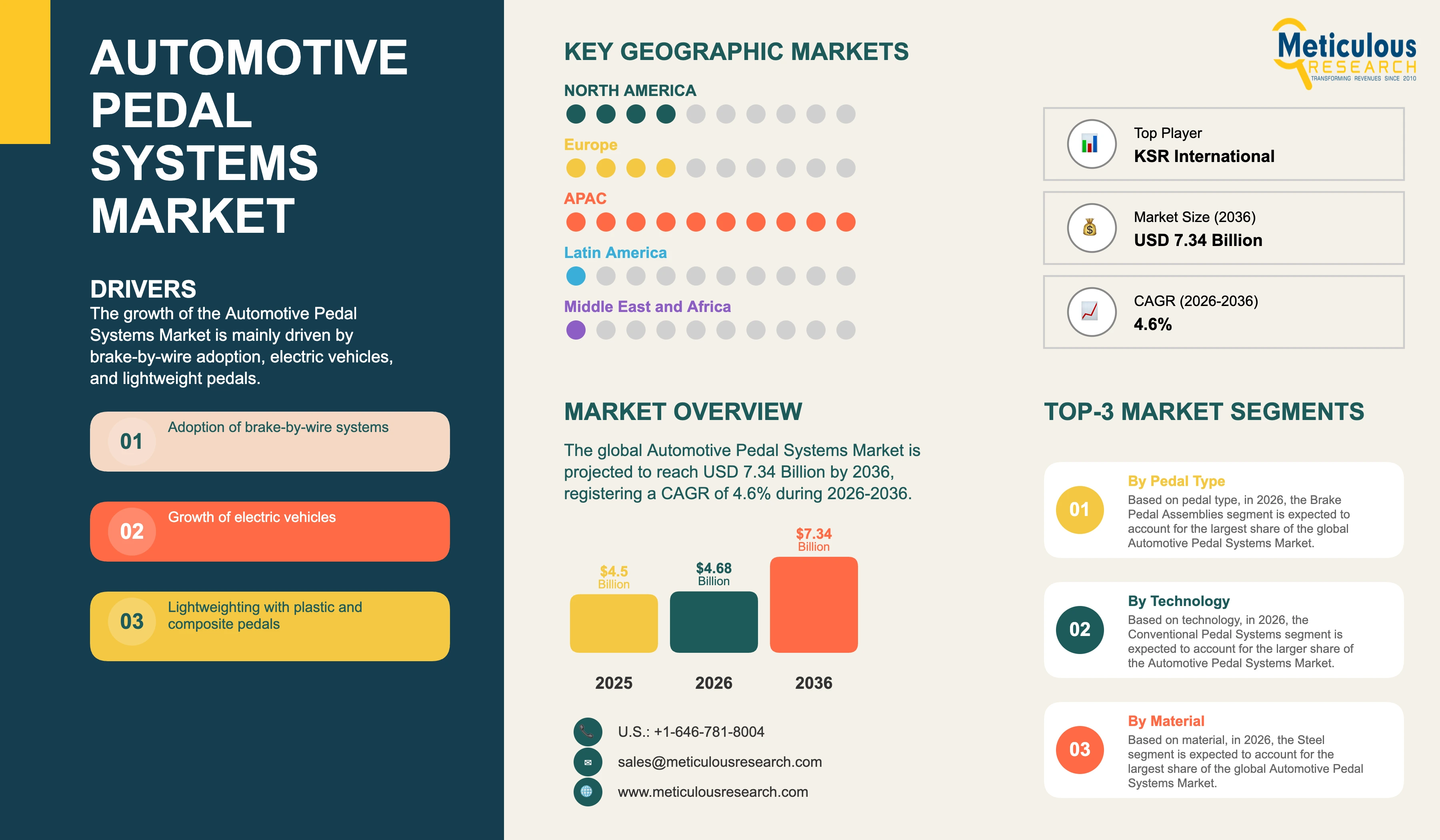
The global automotive pedal systems market was valued at USD 4.50 billion in 2025. This market is expected to reach USD 7.34 billion by 2036 from an estimated USD 4.68 billion in 2026, registering a CAGR of 4.6% during the forecast period (2026-2036).
- Published
- Nov 2026
- Pages
- 267
- Format
- PDF + Excel
- Report ID
- MRAUTO - 1042899
- Base year
- 2025
- 2025 · BASELINE
- $4.50B
- 2036
- $7.34B
- CAGR 2026–2036
- 4.6%
2025 baseline · 2026–2036 forecast at 4.6% CAGR · hover a bar for the value
Key highlights
Brembo started mass production of its Sensify fluid-free brake-by-wire system for a major global vehicle maker in May 2026, according to Brembo. Sensify keeps a regular brake pedal, but sensors measure how hard and how fast the driver presses it and send the request electronically, which shows how by-wire braking increases the role of the pedal as a sensing device rather than a mechanical lever.
FORVIA HELLA developed a fully electric brake pedal sensor for brake-by-wire systems and was commissioned for the world's first large-scale production of such a sensor, with series production starting in its European plants for a German vehicle maker, according to FORVIA HELLA. The company has supplied accelerator pedal sensors for about 30 years.
KSR International offers an e-brake pedal that sends the driver's input to electro-hydraulic and electro-mechanical brake systems without a traditional hydraulic connection, as well as an e-clutch pedal, both designed to meet ISO 26262 functional safety standards, according to KSR International.
China's national standard GB 21670-2025 on passenger car braking systems was released on May 30, 2025 and takes effect on January 1, 2026, giving electro-mechanical brake systems a legal basis for installation in vehicles. Electro-mechanical brakes need fully electronic brake pedals, which supports the growth of by-wire pedal systems in China.
Global electric car sales topped 20 million units in 2025, according to the IEA. Electric vehicles use regenerative braking and one-pedal driving, which require accurate accelerator and brake pedal sensing, and many new electric vehicle platforms use decoupled or by-wire brake systems.
Leading suppliers include KSR International, CTS Corporation, FORVIA HELLA, ZF Friedrichshafen, Toyoda Iron Works, F-Tech Inc., Kyung Chang Industrial, and Batz. Electronic and by-wire pedal systems are the fastest-growing technology, and plastic and composite pedals are the fastest-growing material, as vehicle makers adopt brake-by-wire and seek lighter pedal systems. This experience in contactless pedal sensing helps the company in by-wire brake pedals. Kyung Chang Industrial and Toyoda Iron Works hold strong positions with Korean and Japanese vehicle makers.
By pedal type, brake pedal assemblies account for the largest share of 48.0% in 2026 and also register the highest CAGR.
By technology, conventional pedal systems account for the larger share in 2026, while electronic and by-wire pedal systems register the higher CAGR.
By material, steel accounts for the largest share in 2026, while plastic and composite registers the highest CAGR.
By vehicle type, passenger cars account for the larger share of 83.0% in 2026 and also register the higher CAGR.
By geography, Asia-Pacific accounts for the largest share of 50.0% in 2026, while Asia-Pacific registers the highest CAGR of 5.4%.
Report summary
| Particulars | Details |
|---|---|
| Forecast Period | 2026-2036 |
| Base Year | 2025 |
| Estimated Year | 2026 |
| CAGR (Value) | 4.6% |
| Format | PDF, Excel & Cloud Portal · 267 pages |
| Market Size (Value) in 2025 | USD 4.50 billion |
| Market Size (Value) in 2026 | USD 4.68 billion |
| Market Size (Value) in 2036 | USD 7.34 billion |
| Largest Segment by Pedal Type (2026) | Brake Pedal Assemblies (48.0%) |
| Largest Segment by Vehicle Type (2026) | Passenger Cars (83.0%) |
| Largest Region (2026) | Asia-Pacific (50.0%) |
| Fastest-Growing Region | Asia-Pacific (CAGR 5.4%) |
| Segments Covered | Pedal Type, Technology, Material, Vehicle Type, Geography |
| Countries Covered | U.S., Canada, Mexico, Germany, France, U.K., Spain, Italy, Sweden, Czech Republic, Poland, Slovakia, Hungary, Romania, Rest of Europe, China, Japan, South Korea, India, Thailand, Indonesia, Malaysia, Vietnam, Philippines, Taiwan, Australia, Rest of Asia-Pacific, Brazil, Argentina, Chile, Colombia, Rest of Latin America, Turkey, Morocco, South Africa, Saudi Arabia, UAE, Israel, Rest of Middle East & Africa |
| Key Companies | 8 companies and other companies |
Report overview
Segments covered: pedal type, technology, material, vehicle type.
Automotive pedal systems are the foot-operated controls that drivers use to brake, accelerate, and, in manual transmission vehicles, operate the clutch. They include brake pedal assemblies, accelerator pedal modules with position sensors, clutch pedal assemblies, pedal boxes, and the brackets, springs, sensors, and feel simulators fitted to them. Pedal systems are safety-critical parts, as a failure of the brake or accelerator pedal can directly lead to a crash, so they must meet strict functional safety standards, such as ISO 26262, and pass demanding durability and crash tests before they enter series production.
The growth of this market is mainly driven by steady growth of global vehicle production, the shift to brake-by-wire systems that need electronic brake pedals with sensors and feel simulators, the growth of electric vehicles, which use one-pedal driving and regenerative braking that depend on precise pedal sensing, the use of lightweight plastic and composite pedals to reduce vehicle weight, and new safety features, such as retractable pedals and pedal misapplication prevention. In addition, new standards, such as China's GB 21670-2025 braking standard, which takes effect on January 1, 2026 and gives a legal basis for electro-mechanical brakes, support by-wire adoption. However, the decline of manual transmissions and clutch pedals, strong price pressure from vehicle makers, and the high cost of by-wire pedal systems are expected to restrain the growth of this market to some extent.
Pedal systems have changed significantly over the past three decades, moving from purely mechanical parts toward electronic controls. Accelerator pedals moved from cable-operated designs to electronic accelerator pedal modules with contactless position sensors, which send the driver's request to the engine or motor controller electronically. Brake pedals have long been mechanically connected to a vacuum or electric booster and the hydraulic brake system, but this is now changing as vehicle makers adopt decoupled electro-hydraulic and electro-mechanical brake systems, in which the pedal is no longer directly connected to the brakes. In these systems, the pedal becomes a sensing device with redundant sensors and a feel simulator that recreates the resistance of a conventional brake pedal for the driver.
This report covers the global automotive pedal systems market, including brake pedal assemblies, accelerator pedal modules, and clutch pedal assemblies, supplied as single pedals or complete pedal boxes. The market is analyzed by pedal type, technology, material, vehicle type, and geography. Conventional pedal systems include mechanically linked brake and clutch pedals and standard electronic accelerator pedal modules. Electronic and by-wire pedal systems include brake pedals for decoupled and by-wire brake systems with feel simulators, clutch-by-wire pedals, and active and retractable pedals. The market is valued at the selling price of pedal systems supplied to vehicle makers. Brake boosters, master cylinders, brake control units, and aftermarket replacement pedals are not included.
Steel has been the traditional material for pedal arms and brackets because of its strength and low cost, especially for brake pedals, which must withstand high forces when the driver brakes hard in an emergency. Plastic and composite pedals, made from glass fiber reinforced polyamide and similar materials, are now widely used for accelerator pedals and are increasingly used for brake and clutch pedals because they are lighter, can integrate several functions in one molded part, and are less expensive to produce in large volumes. Aluminum pedals are used in some premium and performance vehicles where low weight and appearance matter, and in some brake pedal designs where high strength at low weight is needed.
Safety is a key consideration in pedal system design, as pedals are among the most safety-critical parts in a vehicle. Brake pedals must withstand very high loads without bending, and in frontal crashes, pedals can be pushed backward into the footwell and injure the driver's legs. To reduce this risk, many vehicle makers use pedal release or retraction systems that let the pedal move away from the driver's feet in a crash. Accelerator pedal modules must use redundant sensors so that a sensor failure cannot cause unintended acceleration. Pedal misapplication, in which a driver presses the accelerator instead of the brake, is also a concern, and several vehicle makers are adding software features that detect and block such errors, which depend on accurate pedal sensing.
The market includes specialist pedal suppliers, braking and chassis system suppliers, and electronics suppliers. KSR International, CTS Corporation, and FORVIA HELLA are strong in accelerator pedal modules and pedal sensors, and KSR and FORVIA HELLA also offer brake-by-wire pedals. ZF Friedrichshafen offers brake pedal modules as part of its brake-by-wire systems. Toyoda Iron Works, F-Tech Inc., and Kyung Chang Industrial supply pedal systems mainly to Japanese and Korean vehicle makers, while Batz supplies pedal boxes to European vehicle makers. Many vehicle makers buy pedals from long-standing suppliers that know their platforms well, which makes the market relatively stable.
Electric vehicles are changing the design and value of pedal systems in several important ways. Many electric vehicles offer one-pedal driving, in which the driver slows the vehicle mainly by lifting off the accelerator pedal, which uses regenerative braking and requires very precise accelerator pedal sensing. Electric vehicles also need to blend regenerative braking with friction braking smoothly, which is easier with decoupled brake systems in which the brake pedal sends an electronic request. In addition, electric vehicles do not need clutch pedals, which reduces the share of clutch pedals in the market as electric vehicles grow.
In 2026, brake pedal assemblies account for the largest share of the market by pedal type and are also the fastest-growing pedal type. Conventional pedal systems account for the largest share by technology, while electronic and by-wire pedal systems are the fastest-growing technology. Steel accounts for the largest share by material, while plastic and composite materials are the fastest-growing material. Passenger cars account for the largest share by vehicle type and are also the fastest-growing vehicle type. Asia-Pacific accounts for the largest share of the market and is also the fastest-growing region.
Market growth over the forecast period will depend on vehicle production, the speed of brake-by-wire adoption, the growth of electric vehicles, the decline of manual transmissions, and price pressure from vehicle makers. Brake-by-wire pedals have much higher value than conventional brake pedals because they include redundant sensors, electronics, and feel simulators, which will increase the value of pedal systems per vehicle. At the same time, the decline of clutch pedals and strong price pressure on conventional pedals will limit growth. Overall, the market is expected to grow slightly faster than vehicle production through 2036.
Passenger cars are expected to account for the largest share of 83.0% of the market in 2026 and are also projected to register the higher CAGR, driven by electric passenger cars and by-wire brake adoption.
Asia-Pacific is expected to account for the largest share of 50.0% of the market in 2026, mainly due to China's large vehicle production and fast adoption of by-wire brake systems.
Asia-Pacific is also projected to register the highest CAGR of 5.4% during the forecast period, driven by China's electric vehicle growth, the GB 21670-2025 standard, and production growth in India and Southeast Asia.
The report profiles 8 companies, including KSR International, CTS Corporation, FORVIA HELLA, ZF Friedrichshafen, Toyoda Iron Works, F-Tech Inc., Kyung Chang Industrial, and Batz.
A brake-by-wire pedal sends the driver's braking request electronically through redundant sensors instead of a direct hydraulic connection, and it uses a feel simulator to recreate the feel of a conventional brake pedal.
Plastic and composite materials are growing fastest, as vehicle makers use molded pedals and pedal boxes to reduce weight and part count, while steel remains the largest material because of its strength and low cost.
Clutch pedals are declining because vehicle makers are shifting to automatic transmissions and electric vehicles, which do not need a clutch pedal, although manual transmissions remain common in India and some emerging markets.
Report infographic
Market dynamics
17 factors across 5 forcesAdoption of brake-by-wire systems
Vehicle makers are moving from conventional brake systems, in which the brake pedal is mechanically connected to the booster and hydraulic system, to decoupled electro-hydraulic and electro-mechanical brake systems, in which the pedal sends an electronic signal. These by-wire systems allow faster and more precise braking, smooth blending of regenerative and friction braking in electric vehicles, and automated braking for driver assistance and automated driving features. They also free space in the engine compartment and firewall, which helps vehicle packaging and allows the same pedal module to be used in left-hand and right-hand drive vehicles.
By-wire systems need brake pedals with redundant sensors and feel simulators, which have much higher value than conventional brake pedals. Brembo started mass production of its Sensify fluid-free brake-by-wire system in May 2026, according to Brembo, and FORVIA HELLA was commissioned for the first large-scale production of a fully electric brake pedal sensor, according to FORVIA HELLA. In China, the GB 21670-2025 standard, effective January 1, 2026, gives a legal basis for electro-mechanical brakes. These developments support strong growth of electronic and by-wire pedal systems, the fastest-growing technology in this market.
Growth of electric vehicles
Global electric car sales topped 20 million units in 2025, according to the IEA, and electric vehicles are expected to account for a growing share of new vehicle sales over the forecast period. Electric vehicles rely on regenerative braking to recover energy, and many offer one-pedal driving, in which the accelerator pedal controls both acceleration and much of the deceleration. These features require very accurate and reliable accelerator pedal sensing, as well as brake pedals that can work with brake systems that blend regenerative and friction braking smoothly.
Many new electric vehicle platforms use decoupled or by-wire brake systems, which increases the value of brake pedal systems per vehicle. Electric vehicle makers also use the freedom of new platforms to adopt lightweight plastic and composite pedal boxes and compact pedal modules. Although electric vehicles do not need clutch pedals, the higher value of their brake and accelerator pedal systems more than offsets this loss. Electric vehicles are therefore an important driver of value growth in the pedal systems market.
Lightweighting with plastic and composite pedals
Vehicle makers must reduce weight to meet emission standards in conventional vehicles and to extend driving range in electric vehicles, and they look for weight savings in every part of the vehicle. Pedal systems made from glass fiber reinforced plastics and other composites can be significantly lighter than steel pedals, and they allow several parts, such as the pedal arm, bracket, and sensor housing, to be combined in one molded part. This reduces part count, assembly steps, and cost in large-volume production.
Plastic accelerator pedals are already common, and plastic and composite brake and clutch pedals are spreading as suppliers prove that they can meet the high strength and durability requirements of these safety-critical parts. Plastic and composite materials are the fastest-growing material in this market, supported by vehicle makers' weight reduction targets and by new by-wire pedal modules, which are often designed with plastic housings that hold sensors and feel simulators. Suppliers with strong plastic engineering and testing capabilities are best placed to capture this growth.
Rising vehicle production in Asia-Pacific
Asia-Pacific is the largest vehicle producing region in the world, led by China, Japan, India, and South Korea, and vehicle production continues to grow in China, India, and Southeast Asia. Every vehicle needs at least a brake pedal and an accelerator pedal, and vehicles with manual transmissions also need a clutch pedal, so vehicle production growth directly increases demand for pedal systems. Chinese vehicle makers are also growing rapidly in export markets and are building new plants in Southeast Asia, Latin America, Europe, and other regions.
Chinese vehicle makers are among the fastest adopters of new technologies, including decoupled and by-wire brake systems in electric vehicles, which increases the value of pedal systems per vehicle. India's vehicle production is also growing steadily, supported by rising incomes and new models, which increases demand for pedal systems. Asia-Pacific is the largest and fastest-growing region in this market, supported by production growth and rapid technology adoption.
New safety features and automated driving
New safety features are increasing the technical requirements for pedal systems in all major vehicle markets. Pedal misapplication prevention systems, which detect when a driver presses the accelerator by mistake and reduce engine or motor power, rely on accurate accelerator pedal sensing and are being adopted by more vehicle makers, especially in Japan, where such systems are becoming common. Crash safety requirements also encourage pedal designs that retract or release in a frontal crash to protect the driver's legs. In addition, automated driving features need brake systems that can act without driver input and pedals that can handle the handover between the driver and the automated system smoothly. Some vehicle concepts for higher levels of automated driving include retractable pedals that move out of the way when the vehicle drives itself, which would further increase the value of pedal systems in those vehicles. These requirements increase the value and complexity of pedal systems and favor suppliers with strong sensor, electronics, and functional safety capabilities, such as KSR International, CTS Corporation, FORVIA HELLA, and ZF Friedrichshafen. As these features spread to more vehicle segments and regions, they are expected to support steady growth in pedal system value over the forecast period.
Table of contents
12 chapters · 174 sections · 267 pages · click to expandSegmental analysis
| Segment | Largest share (2026) | Fastest growth (2026–2036) |
|---|---|---|
| By Pedal Type | Brake pedal assemblies | Brake pedal assemblies |
| By Technology | — | Rapid growth of this |
| By Material | Steel | Plastic and composite |
| By Vehicle Type | Passenger cars | Rapid growth of this |
| Other segments | Steel | Plastic and composite |
By Pedal Type
- Automotive Pedal Systems Market Analysis by Pedal Type
- The brake pedal assemblies segment is expected to account for the largest share of 48.0% of the global automotive pedal systems market.
- The large share of this segment is mainly due to the use of a brake pedal in every vehicle, the strong and heavy design that brake pedals need to withstand high braking forces, the higher value of brake pedals with sensors and feel simulators for decoupled and by-wire brake systems, and the safety features, such as crash release mechanisms, that many brake pedals include.
- KSR International, FORVIA HELLA, ZF Friedrichshafen, Toyoda Iron Works, and Batz are among the leading suppliers of brake pedal systems.
- The brake pedal assemblies segment is also projected to register the highest CAGR during the forecast period.
- The rapid growth of this segment is driven by the shift to decoupled and by-wire brake systems, which increases brake pedal value per vehicle, the growth of electric vehicles, which often use such brake systems, the start of mass production of fluid-free brake-by-wire systems, such as Brembo's Sensify in May 2026, and new standards, such as China's GB 21670-2025, which supports electro-mechanical brakes.
- Accelerator pedal modules are growing steadily with vehicle production, while clutch pedal assemblies are declining as manual transmissions lose share.
By Technology
- Automotive Pedal Systems Market Analysis by Technology
- The conventional pedal systems segment is expected to account for the larger share of the global automotive pedal systems market.
- The large share of this segment is mainly due to the large number of vehicles with mechanically connected brake and clutch pedals, the wide use of standard electronic accelerator pedal modules in all vehicles, the low cost and proven reliability of conventional pedals, and the large production volumes of entry-level and mid-range vehicles in Asia-Pacific, Latin America, and other regions.
- KSR International, CTS Corporation, Toyoda Iron Works, F-Tech Inc., and Kyung Chang Industrial are among the leading suppliers of conventional pedal systems.
- However, the electronic and by-wire pedal systems segment is projected to register the higher CAGR during the forecast period.
- The rapid growth of this segment is driven by the adoption of decoupled and by-wire brake systems in electric and premium vehicles, the start of mass production of electro-mechanical brake systems, the need for redundant pedal sensing for automated driving features, and new products, such as KSR International's e-brake and e-clutch pedals and FORVIA HELLA's brake-by-wire pedal sensor.
- Higher value per vehicle also supports this segment's growth.
- The conventional pedal systems segment is expected to account for the larger share of the automotive pedal systems market, while the electronic and by-wire pedal systems segment is projected to register the higher CAGR during the forecast period.
By Material
- Automotive Pedal Systems Market Analysis by Material
- The steel segment is expected to account for the largest share of the global automotive pedal systems market.
- The large share of this segment is mainly due to the high strength and low cost of steel, its wide use in brake and clutch pedal arms and brackets, which must withstand high forces, the large production of entry-level and mid-range vehicles that use steel pedals, and the proven durability and crash performance of steel pedal designs.
- Toyoda Iron Works, F-Tech Inc., Kyung Chang Industrial, and Batz are among the leading suppliers of steel pedal systems.
- However, the plastic and composite segment is projected to register the highest CAGR during the forecast period.
- The rapid growth of this segment is driven by vehicle makers' weight reduction targets, the lower weight and part count of molded plastic pedals and pedal boxes, the wide use of plastic accelerator pedal modules, the growing use of plastic brake and clutch pedals as suppliers prove their strength and durability, and the use of plastic housings in by-wire pedal modules to hold sensors and feel simulators.
- Aluminum is used mainly in premium and performance vehicles.
By Vehicle Type
- Automotive Pedal Systems Market Analysis by Vehicle Type
- The passenger cars segment is expected to account for the largest share of 83.0% of the global automotive pedal systems market.
- The large share of this segment is mainly due to the very large number of passenger cars produced each year, the faster adoption of electronic and by-wire pedal systems in passenger cars, especially electric and premium models, the growing use of lightweight plastic pedal boxes in passenger cars, and new safety features, such as pedal misapplication prevention, that are spreading in passenger cars.
- KSR International, CTS Corporation, and FORVIA HELLA supply pedal systems across many passenger car platforms.
- The passenger cars segment is also projected to register the higher CAGR during the forecast period.
- The rapid growth of this segment is driven by the growth of electric passenger cars, the adoption of decoupled and by-wire brake systems in new passenger car platforms, and vehicle production growth in China, India, and Southeast Asia.
- Commercial vehicles use heavier and more durable pedal systems, often with pneumatic brake valves in trucks, but their growth is slower.
Other segments
- The steel segment is expected to account for the largest share of the automotive pedal systems market, while the plastic and composite segment is projected to register the highest CAGR during the forecast period.
Geographic analysis
Asia-Pacific
Largest shareIn 2026, Asia-Pacific is expected to account for the largest share of 50.0% of the global automotive pedal systems market. The large share of this region is mainly due to China's position as the largest vehicle and electric vehicle producer in the world, the large vehicle production of Japan, South Korea, and India, the fast adoption of decoupled and by-wire brake systems by Chinese vehicle makers, and the presence of pedal suppliers, such as Toyoda Iron Works, F-Tech Inc., and Kyung Chang Industrial, which serve Japanese and Korean vehicle makers worldwide. China is the largest market in the region, followed by Japan, India, and South Korea. Asia-Pacific is also projected to register the highest CAGR of 5.4% during the forecast period. The rapid growth of this region is mainly driven by continued growth of vehicle and electric vehicle production in China, the GB 21670-2025 braking standard, which supports electro-mechanical brakes from January 2026, rising vehicle production in India, and the growth of vehicle production in Southeast Asia, including new plants built by Chinese vehicle makers. India is expected to be one of the fastest-growing countries, supported by vehicle production growth and the continued use of manual transmissions, which supports clutch pedal demand.
Europe
Europe accounts for a significant share of the market, supported by the large production of premium vehicles, which adopt electronic and by-wire pedal systems early, the growth of electric vehicles, the shift from manual to automatic transmissions, and the presence of suppliers, such as FORVIA HELLA, ZF Friedrichshafen, and Batz, as well as European plants of KSR International and CTS Corporation. Germany is the largest market in the region, followed by France, Spain, and Italy. Eastern European countries, such as the Czech Republic, Poland, Slovakia, Hungary, and Romania, are important production hubs for vehicles and pedal systems. However, the decline of clutch pedals limits value growth.
North America
North America accounts for a significant share of the market, supported by the large production of SUVs and pickup trucks, the very high share of automatic transmissions, the growth of electric vehicles, and the presence of suppliers, such as KSR International and CTS Corporation. The U.S. is the largest market in the region, followed by Mexico and Canada, and Mexico is an important production base for vehicles and pedal systems.
Latin America
Latin America and the Middle East and Africa account for smaller shares, with Brazil the largest market in Latin America and Turkey, Morocco, and South Africa important vehicle production hubs in the Middle East and Africa. Within Latin America, Brazil is the largest market, supported by local vehicle production by global vehicle makers and a high share of manual transmissions, which supports clutch pedal demand, while Argentina, Chile, and Colombia are smaller markets.
Middle East & Africa
In the Middle East and Africa, Turkey and Morocco are important vehicle production hubs that supply Europe, and their pedal system demand follows the European vehicle programs built there, while South Africa produces vehicles for export and Saudi Arabia and the UAE are mainly import markets with growing vehicle sales.
Competitive landscape
The global automotive pedal systems market includes specialist pedal suppliers, electronics and sensor suppliers, braking and chassis system suppliers, and regional suppliers that serve local vehicle makers. The market is moderately concentrated, with a few global suppliers holding strong positions in accelerator pedal modules and by-wire pedals, while Japanese, Korean, and Chinese suppliers hold strong positions with their home vehicle makers. Long-standing relationships between pedal suppliers and vehicle makers make the market relatively stable, but the shift to by-wire is opening new opportunities for suppliers with strong electronics capabilities.
KSR International supplies accelerator pedals, brake pedals, and e-brake and e-clutch pedals for by-wire systems, according to KSR International. CTS Corporation supplies accelerator pedal modules and has developed brake-by-wire pedal products. FORVIA HELLA supplies accelerator pedal sensors and has developed a fully electric brake pedal sensor for by-wire systems, according to FORVIA HELLA. ZF Friedrichshafen offers brake pedal modules as part of its brake-by-wire systems. Toyoda Iron Works, F-Tech Inc., Kyung Chang Industrial, and Batz supply pedal systems to Japanese, Korean, and European vehicle makers.
Companies in this market compete mainly on safety and reliability, functional safety capabilities, sensor technology, pedal feel, weight, cost, integration with brake systems and vehicle electronics, global production footprint, and long-term relationships with vehicle makers. Key strategies in this market include developing by-wire brake pedal modules, using contactless and redundant sensors, designing lightweight plastic pedal boxes, partnering with brake system suppliers, and building plants close to vehicle makers in growing markets.
Recent competitive activity in this market has mainly focused on brake-by-wire pedals, sensors, and complete by-wire brake systems. FORVIA HELLA was commissioned for the first large-scale production of a fully electric brake pedal sensor, with series production in its European plants for a German vehicle maker, according to FORVIA HELLA. KSR International offers e-brake and e-clutch pedals designed to meet ISO 26262, according to KSR International. Brembo started mass production of its Sensify brake-by-wire system, which uses a sensor-equipped brake pedal, in May 2026, according to Brembo.
We expect competition to increase over the forecast period as suppliers compete for by-wire brake pedal business on new electric vehicle platforms, as brake system suppliers expand their role in pedal modules, and as Chinese suppliers grow in their home market and abroad. Suppliers with strong sensor, electronics, functional safety, and plastic engineering capabilities, as well as global production footprints, are expected to strengthen their positions.
Some of the key players operating in the automotive pedal systems market are KSR International Inc., CTS Corporation, FORVIA HELLA, ZF Friedrichshafen AG, Toyoda Iron Works Co., Ltd., F-Tech Inc., Kyung Chang Industrial Co., Ltd., and Batz S. Coop., among others.
- —
Brembo started mass production of its Sensify brake-by-wire system in May 2026, FORVIA HELLA was commissioned for large-scale production of a fully electric brake pedal sensor, and KSR International offers e-brake and e-clutch pedals.
- KSR International Inc.
- CTS Corporation
- FORVIA HELLA
- ZF Friedrichshafen AG
- Toyoda Iron Works Co., Ltd.
- F-Tech Inc.
- Kyung Chang Industrial Co., Ltd.
- Batz S. Coop
Expert perspectives
Automotive pedal systems are a mature market that is entering an important period of change. Every vehicle needs brake and accelerator pedals, and the shift to brake-by-wire, the growth of electric vehicles, and new safety features are turning pedals from simple mechanical levers into electronic sensing devices with higher value. At the same time, the decline of manual transmissions and strong price pressure on conventional pedals limit growth.
Over the forecast period, the market is expected to grow at a CAGR of 4.6%, from USD 4.68 billion in 2026 to USD 7.34 billion in 2036. Growth will be driven by the adoption of brake-by-wire systems, the growth of electric vehicles, lightweighting with plastic and composite pedals, rising vehicle production in Asia-Pacific, and new safety features and automated driving. The decline of manual transmissions and clutch pedals and strong price pressure will limit growth to some extent.
Among the market segments, brake pedal assemblies are the largest pedal type and also grow fastest. Conventional pedal systems are the largest technology, while electronic and by-wire pedal systems grow fastest. Steel is the largest material, while plastic and composite materials grow fastest. Passenger cars are the largest vehicle type and also grow fastest. Asia-Pacific is the largest region and is also the fastest-growing region, led by China and India.
In our view, brake-by-wire will be the most important driver of value growth in this market. By-wire brake pedals have much higher value than conventional pedals, and the start of mass production of systems such as Brembo's Sensify and new standards in China show that by-wire braking is moving into mainstream production. Suppliers that win by-wire brake pedal business on new platforms will gain long-term positions, as pedal suppliers are rarely changed during a vehicle's production life.
We also see a shift in the competitive balance as electronics become more important. Suppliers with strong sensor and functional safety capabilities, such as KSR International, CTS Corporation, and FORVIA HELLA, are well placed, while brake system suppliers may supply more pedal modules as part of complete brake systems. Traditional steel pedal suppliers will need to develop electronic capabilities or partnerships to keep their positions, especially with vehicle makers that move quickly to by-wire brake systems.
Overall, we believe that the automotive pedal systems market will grow steadily over the forecast period, with brake pedal assemblies, electronic and by-wire pedal systems, plastic and composite materials, passenger cars, and Asia-Pacific providing the fastest growth. Companies with strong electronics, functional safety, and lightweight design capabilities, and with global production footprints, will be best positioned to capture this growth.
Customer perspectives
Customers in the automotive pedal systems market are mainly vehicle makers and, in some cases, brake system suppliers that supply complete brake systems including pedal modules. They focus on safety and reliability, functional safety compliance, pedal feel, weight, cost, sensor accuracy, integration with brake systems and vehicle electronics, crash safety, global production footprint, and long-term supply. Electric vehicle makers place the highest value on by-wire brake pedals and precise accelerator sensing for regenerative braking and one-pedal driving, while makers of entry-level vehicles focus strongly on cost and proven reliability. Customers also expect suppliers to support them across several regions, as the same vehicle platform is often built in several countries.
This comment explains why electronic and by-wire pedal systems are the fastest-growing technology and why brake pedal assemblies account for 48.0% of the market and grow fastest.
This comment explains why Asia-Pacific is the fastest-growing region and why clutch pedals remain important in India even as they decline elsewhere.
This comment explains why plastic and composite materials are the fastest-growing material, while passenger cars account for 83.0% of the market and are also the fastest-growing vehicle type.
“Our new platform uses a decoupled brake system, so the pedal is now a sensor with a feel simulator. We chose a supplier that could tune the pedal feel for each brand.”
“Most of our models still offer a manual gearbox, so we buy complete pedal boxes with clutch pedals. Cost and durability on rough roads come first.”
“We moved the accelerator and brake pedals to plastic to save weight. The crash and durability tests took time, but the pedal box is now lighter and simpler.”
Frequently asked questions
The global automotive pedal systems market was valued at USD 4.50 billion in 2025, up from USD 4.35 billion in 2024, and is estimated at USD 4.68 billion in 2026. The market includes brake, accelerator, and clutch pedal systems.
The global automotive pedal systems market is expected to reach USD 7.34 billion by 2036, driven by brake-by-wire adoption, electric vehicles, lightweight plastic pedals, Asia-Pacific production growth, and new safety features.
The market is expected to register a CAGR of 4.6% from 2026 to 2036, with the fastest growth in brake pedal assemblies, electronic and by-wire pedal systems, plastic and composite pedals, passenger cars, and Asia-Pacific.
Market growth is mainly driven by the adoption of brake-by-wire systems, the growth of electric vehicles, lightweighting with plastic and composite pedals, rising vehicle production in Asia-Pacific, and new safety features and automated driving.
The decline of manual transmissions and clutch pedals and strong price pressure restrain growth, while meeting functional safety and pedal feel requirements and competition from brake system suppliers are key challenges.
Key growth opportunities include by-wire brake pedal modules for new vehicle platforms, integrated lightweight pedal boxes, growth in India and Southeast Asia, and pedal systems for automated and shared vehicles.
Brake pedal assemblies are expected to account for the largest share of 48.0% of the market in 2026 and are also projected to register the highest CAGR, driven by the shift to decoupled and by-wire brake systems.
In 2026, the conventional pedal systems segment is expected to account for the larger share of the automotive pedal systems market, while the electronic and by-wire pedal systems segment is projected to register the higher CAGR during the forecast period.
In 2026, the steel segment is expected to account for the largest share of the automotive pedal systems market, while the plastic and composite segment is projected to register the highest CAGR during the forecast period.
Passenger cars are expected to account for the largest share of 83.0% of the market in 2026 and are also projected to register the higher CAGR, driven by electric passenger cars and by-wire brake adoption.
Asia-Pacific is expected to account for the largest share of 50.0% of the market in 2026, mainly due to China's large vehicle production and fast adoption of by-wire brake systems.
Asia-Pacific is also projected to register the highest CAGR of 5.4% during the forecast period, driven by China's electric vehicle growth, the GB 21670-2025 standard, and production growth in India and Southeast Asia.
The report profiles 8 companies, including KSR International, CTS Corporation, FORVIA HELLA, ZF Friedrichshafen, Toyoda Iron Works, F-Tech Inc., Kyung Chang Industrial, and Batz.
Brembo started mass production of its Sensify brake-by-wire system in May 2026, FORVIA HELLA was commissioned for large-scale production of a fully electric brake pedal sensor, and KSR International offers e-brake and e-clutch pedals.
A brake-by-wire pedal sends the driver's braking request electronically through redundant sensors instead of a direct hydraulic connection, and it uses a feel simulator to recreate the feel of a conventional brake pedal.
Plastic and composite materials are growing fastest, as vehicle makers use molded pedals and pedal boxes to reduce weight and part count, while steel remains the largest material because of its strength and low cost.
Clutch pedals are declining because vehicle makers are shifting to automatic transmissions and electric vehicles, which do not need a clutch pedal, although manual transmissions remain common in India and some emerging markets.
Cite this report
Meticulous Research. (2026). Automotive Pedal Systems Market - Global Opportunity Analysis and Industry Forecast (2026-2036) (Report No. MRAUTO - 1042899). Meticulous Market Research Pvt. Ltd. https://www.meticulousresearch.com/product/automotive-pedal-systems-market-7582