Automotive Radar Market (2026-2036)
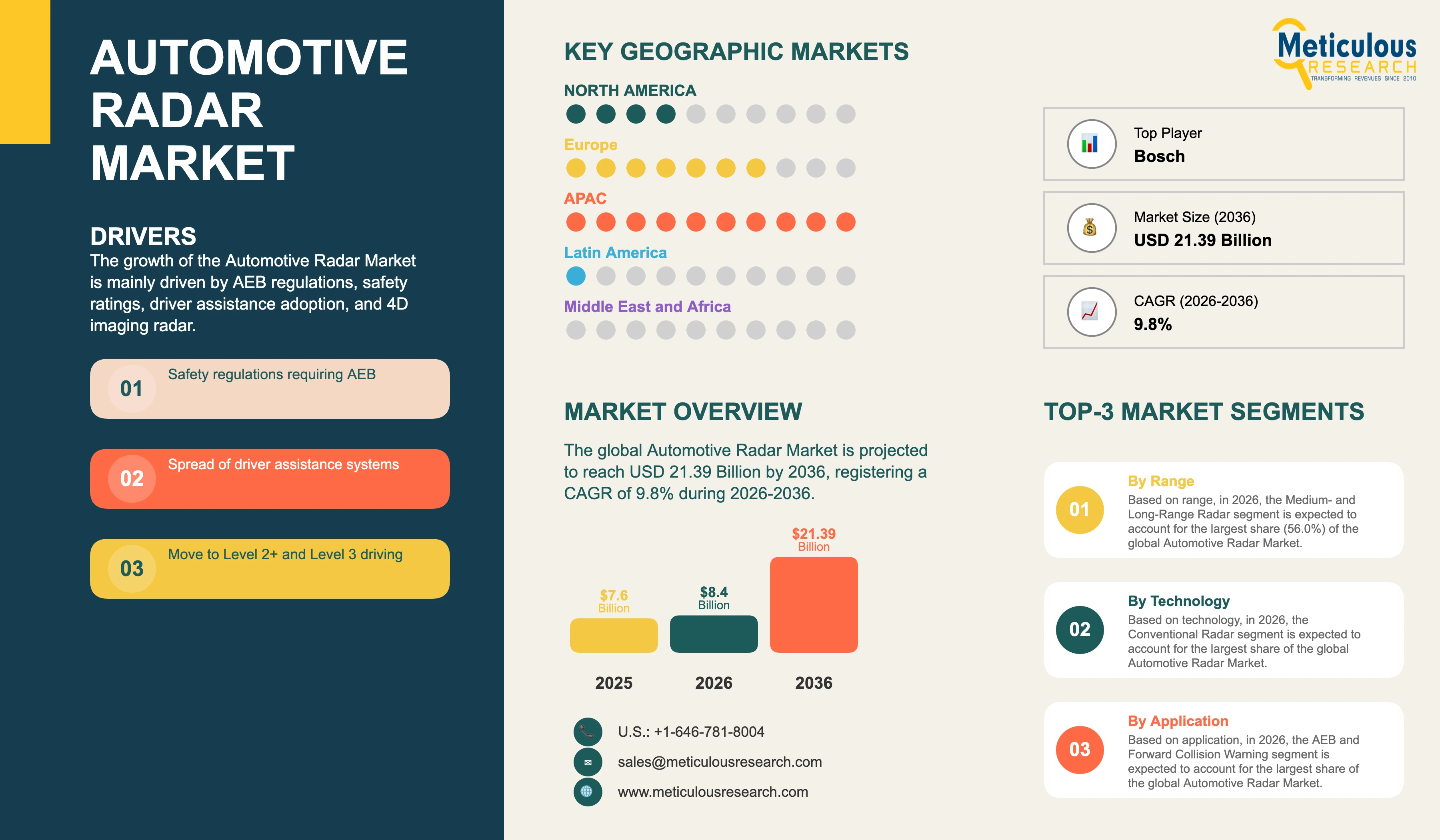
The global automotive radar market was valued at USD 7.60 billion in 2025. This market is expected to reach USD 21.39 billion by 2036 from an estimated USD 8.40 billion in 2026, registering a CAGR of 9.8% during the forecast period (2026-2036).
- Published
- Nov 2026
- Pages
- 281
- Format
- PDF + Excel
- Report ID
- MRAUTO - 1042882
- Base year
- 2025
- 2025 · BASELINE
- $7.60B
- 2036
- $21.39B
- CAGR 2026–2036
- 9.8%
2025 baseline · 2026–2036 forecast at 9.8% CAGR · hover a bar for the value
Key highlights
NHTSA's FMVSS No. 127 requires automatic emergency braking, including pedestrian automatic emergency braking and forward collision warning, on all new passenger cars and light trucks manufactured on or after September 1, 2029. Pedestrian AEB must work in both daylight and darkness, which favors radar sensors that work in low light.
The second phase of the EU General Safety Regulation took effect for all newly registered cars and vans on July 7, 2026, requiring advanced emergency braking that detects pedestrians and cyclists, according to the European Commission. These requirements increase the use of front radar and sensor fusion in mass-market vehicles.
Continental, whose automotive business is now AUMOVIO, celebrated the production of 200 million radar sensors, after supplying its first 100 million radar systems between 1999 and 2021, showing how quickly radar adoption has grown in recent years.
Volvo Cars awarded Aptiv's Gen 8 radar platform for deployment in future cars beginning in 2028, according to Aptiv. Aptiv's Gen 8 forward radar provides detection beyond 300 meters with fine 4D angular resolution, and its corner radar improves vertical resolution for automated parking and low-speed driving.
A leading global vehicle maker chose Mobileye's 4D imaging radar for an eyes-off, hands-off Level 3 automated driving system starting in 2028, according to Mobileye, while Valeo secured a contract for next-generation radar technology with a North American electric vehicle maker in June 2026, according to Valeo.
Leading suppliers include Bosch, AUMOVIO, Aptiv, Denso, ZF, Valeo, Forvia Hella, Hyundai Mobis, HL Klemove, Magna, Huizhou Desay SV, Hirain Technologies, and Mobileye. 4D imaging radar is the fastest-growing technology and is expected to account for nearly half of the market by 2036, as Level 2+ and Level 3 systems reach production from 2027 and 2028. In-cabin radar for child presence detection is the fastest-growing application, supported by Euro NCAP requirements. Commercial vehicles are the fastest-growing vehicle type, supported by new truck and bus safety rules in Europe, North America, and other regions. Radar is fitted to most new cars in major markets.
By range, medium- and long-range radar accounts for the larger share of 56.0% in 2026, while short-range radar registers the higher CAGR.
By technology, conventional radar accounts for the larger share in 2026, while 4D imaging radar registers the higher CAGR.
By application, AEB and forward collision warning accounts for the largest share in 2026, while in-cabin sensing registers the highest CAGR.
By vehicle type, passenger cars account for the larger share of 88.0% in 2026, while commercial vehicles register the higher CAGR.
By geography, Asia-Pacific accounts for the largest share of 46.0% in 2026, while Asia-Pacific registers the highest CAGR of 10.7%.
Report summary
| Particulars | Details |
|---|---|
| Base Year | 2025 |
| Estimated Year | 2026 |
| Forecast Period | 2026-2036 |
| Market Size in 2025 | USD 7.60 billion |
| Market Size in 2026 | USD 8.40 billion |
| Market Size by 2036 | USD 21.39 billion |
| CAGR (2026-2036) | 9.8% |
| Format | PDF, Excel & Cloud Portal · 281 pages |
| Largest Segment by Range (2026) | Medium- and Long-Range Radar (56.0%) |
| Largest Segment by Vehicle Type (2026) | Passenger Cars (88.0%) |
| Largest Region (2026) | Asia-Pacific (46.0%) |
| Fastest-Growing Region | Asia-Pacific (CAGR 10.7%) |
| Companies Profiled | 13 companies and other companies |
| Segments Covered | Range, Technology, Application, Vehicle Type, Geography |
| Countries Covered | U.S., Canada, Germany, France, U.K., Spain, Italy, Sweden, Czech Republic, Poland, Slovakia, Hungary, Romania, Netherlands, Belgium, Austria, Rest of Europe, China, Japan, South Korea, India, Thailand, Indonesia, Malaysia, Vietnam, Philippines, Taiwan, Singapore, Australia, Rest of Asia-Pacific, Mexico, Brazil, Argentina, Chile, Colombia, Rest of Latin America, Turkey, Morocco, South Africa, Saudi Arabia, UAE, Israel, Rest of Middle East & Africa |
Report overview
Segments covered: range, technology, application, vehicle type.
Automotive radar sensors use radio waves, mainly in the 76-81 GHz band, to detect the distance, speed, and angle of vehicles, pedestrians, cyclists, and other objects around the vehicle, and they work well in rain, fog, darkness, and glare. They include front medium- and long-range radars used for automatic emergency braking and adaptive cruise control, corner and short-range radars used for blind spot detection and cross-traffic alerts, high-resolution 4D imaging radars, and in-cabin radars that detect occupants and children left in vehicles.
The growth of this market is mainly driven by safety regulations that make automatic emergency braking standard, such as FMVSS No. 127 in the U.S. and the EU General Safety Regulation, stricter vehicle safety ratings from programs such as Euro NCAP, the spread of advanced driver assistance systems to mainstream vehicles, which increases the number of radars per vehicle, the move to Level 2+ and Level 3 automated driving, which requires high-resolution 4D imaging radar, and growing use of in-cabin radar for child presence detection. In addition, falling sensor costs and the shift to single-chip CMOS radar designs are making radar affordable for lower-priced vehicles. However, strong price pressure, competition from camera-only systems, and slower adoption of higher automation are expected to restrain the growth of this market to some extent.
Radar has become one of the core sensors for advanced driver assistance systems, together with cameras. A radar sensor sends out radio waves and measures the reflections from objects to determine their distance, relative speed, and angle. Because radar measures speed directly and works in rain, fog, snow, darkness, and direct sunlight, it complements cameras, which are better at recognizing objects, reading signs, and detecting lane markings. Most vehicles with advanced driver assistance combine one front radar with a front camera, and higher-end systems add four or more corner radars for 360-degree coverage.
This report covers the global automotive radar market, including medium- and long-range radars and short-range radars, conventional radars and 4D imaging radars, used for automatic emergency braking and forward collision warning, adaptive cruise control, blind spot detection and cross-traffic alerts, in-cabin sensing, and other applications, in passenger cars and commercial vehicles. The market is valued at the selling price of complete radar sensor modules supplied to vehicle makers, including radar sensors integrated into driver assistance systems. The market is analyzed by range, technology, application, vehicle type, and geography. Radar chips sold separately, lidar, ultrasonic sensors, and cameras are not included.
Front radars, which are usually medium- or long-range sensors mounted behind the grille or emblem, are used for automatic emergency braking, forward collision warning, and adaptive cruise control. Corner radars, which are short-range sensors mounted in the bumper corners, are used for blind spot detection, rear cross-traffic alerts, lane change assistance, and, increasingly, for automated parking and 360-degree sensing. In-cabin radars mounted in the roof detect occupants, monitor breathing, and help prevent children from being left in hot vehicles.
Radar technology is changing quickly, both in the chips used in the sensor and in the software that interprets radar data. Older radars used several separate chips made with silicon-germanium technology, while new radars increasingly use single-chip CMOS designs that combine the radio front end and signal processing, which reduces cost, size, and power use. 4D imaging radars add elevation measurement and much higher resolution, using many more transmit and receive channels, which allows them to separate closely spaced objects and detect objects such as bridges and overhead signs. Software and artificial intelligence are also being used to improve object detection and classification from radar data.
The market is served by large automotive suppliers that design and produce complete radar sensors, such as Bosch, AUMOVIO, Aptiv, Denso, ZF, Valeo, Forvia Hella, Hyundai Mobis, HL Klemove, and Magna, together with fast-growing Chinese suppliers, such as Huizhou Desay SV and Hirain Technologies, and new entrants in imaging radar, such as Mobileye. Radar chips are supplied by semiconductor companies, such as NXP, Infineon, and Texas Instruments, and by radar chip specialists, such as Arbe. Competition is strong, and Chinese suppliers have gained share quickly with Chinese vehicle makers.
Regulations and safety ratings are the strongest drivers of radar adoption in all major markets. FMVSS No. 127 in the U.S. requires automatic emergency braking, including pedestrian detection in daylight and darkness, on all new light vehicles from September 2029. The EU General Safety Regulation made advanced emergency braking that detects pedestrians and cyclists mandatory for all newly registered cars and vans from July 2026. Safety rating programs, such as Euro NCAP, C-NCAP in China, and IIHS in the U.S., reward vehicles with strong automatic emergency braking and blind spot systems, which encourages vehicle makers to add front and corner radars.
In 2026, medium- and long-range radars account for the largest share of the market by range, while short-range radars are the fastest-growing range type. Conventional radars account for the largest share by technology, while 4D imaging radars are the fastest-growing technology. Automatic emergency braking and forward collision warning account for the largest share by application, while in-cabin sensing is the fastest-growing application. Passenger cars account for the largest share by vehicle type, while commercial vehicles are the fastest-growing vehicle type. Asia-Pacific accounts for the largest share of the market and is also the fastest-growing region.
Market growth over the forecast period will depend on vehicle production, the number of radars per vehicle, the adoption of 4D imaging radar for higher levels of automated driving, regulation and safety rating requirements in each region, and price trends. Falling prices per sensor will limit growth in value compared with unit volume, while the shift to higher-value 4D imaging radar will support value growth. Overall, rising radar content per vehicle is expected to drive steady growth of the automotive radar market through 2036.
Passenger cars are expected to account for the largest share of 88.0% of the market in 2026, while commercial vehicles are projected to register the highest CAGR, driven by truck and bus safety regulations.
Asia-Pacific is expected to account for the largest share of 46.0% of the market in 2026, mainly due to China's large vehicle production and fast adoption of driver assistance and 4D imaging radar.
Asia-Pacific is also projected to register the highest CAGR of 10.7% during the forecast period, driven by intelligent driving growth in China, new safety requirements in India, and vehicle production growth in Southeast Asia.
The report profiles 13 companies, including Bosch, AUMOVIO, Aptiv, Denso, ZF, Valeo, Forvia Hella, Hyundai Mobis, HL Klemove, Magna, Huizhou Desay SV, Hirain Technologies, and Mobileye.
4D imaging radar measures distance, speed, horizontal angle, and elevation with much higher resolution than conventional radar, allowing it to separate closely spaced objects and detect stationary and overhead objects.
This report covers all automotive radar sensors, including 4D imaging radar as one segment. The 4D imaging radar market is analyzed in more detail in a separate report, and complete ADAS systems are covered in another report.
What comes next: 4D Imaging Radar and the Future of Driver Assistance, a Meticulous Next™ foresight brief.
Report infographic
Market dynamics
17 factors across 5 forcesSafety regulations requiring automatic emergency braking
Governments are making automatic emergency braking mandatory on new vehicles in the largest markets. In the U.S., FMVSS No. 127 requires automatic emergency braking, including pedestrian automatic emergency braking and forward collision warning, on all new passenger cars and light trucks manufactured on or after September 1, 2029, and pedestrian detection must work in both daylight and darkness. In the EU, the second phase of the General Safety Regulation made advanced emergency braking that detects pedestrians and cyclists mandatory for all newly registered cars and vans from July 7, 2026, according to the European Commission.
Many vehicle makers meet these requirements using a front radar together with a front camera, as radar measures distance and speed accurately and works in darkness and bad weather. Japan, South Korea, India, and other countries are also introducing or tightening automatic emergency braking rules, and commercial vehicle rules are being extended to trucks and buses. These regulations make front radar standard on a growing share of vehicles worldwide.
Stricter vehicle safety ratings
Vehicle safety rating programs, such as Euro NCAP in Europe, C-NCAP in China, IIHS in the U.S., and programs in Japan, Korea, Australia, and Latin America, test automatic emergency braking, lane support, blind spot detection, and other driver assistance functions. To achieve top ratings, vehicle makers must offer systems that detect vehicles, pedestrians, cyclists, and motorcycles in many scenarios, including at junctions and when reversing.
Meeting these requirements often requires corner radars in addition to front radar and cameras, which increases radar content per vehicle. Euro NCAP is also adding requirements for child presence detection, which encourages the use of in-cabin radar. Because top safety ratings are important for sales, vehicle makers fit these sensors as standard on many models, even where regulations do not require them.
Spread of advanced driver assistance systems to mainstream vehicles
Advanced driver assistance features, such as adaptive cruise control, lane centering, blind spot detection, rear cross-traffic alerts, and automated parking, are spreading from premium vehicles to mainstream and entry-level models. Consumers increasingly expect these features, and vehicle makers use them to differentiate their models, especially in China, where intelligent driving features are a key selling point.
Each of these features relies on radar, and vehicles with Level 2 and Level 2+ systems often use five radars, one front and four corner, which greatly increases radar content per vehicle. Short-range radars are the fastest-growing range type in this market, supported by the use of corner radars for 360-degree sensing and automated parking.
Move to level 2+ and level 3 automated driving
Vehicle makers are introducing Level 2+ systems that allow hands-free driving on highways and in cities, and some are launching Level 3 systems that allow eyes-off driving in certain conditions. These systems need sensors with higher resolution, longer range, and redundancy, so that the vehicle can detect small or stationary objects at highway speeds and keep working if one sensor fails.
4D imaging radar meets these needs by adding elevation measurement and much higher resolution, which allows it to detect objects such as debris, stopped vehicles under bridges, and pedestrians near parked cars. A leading global vehicle maker chose Mobileye's imaging radar for a Level 3 system from 2028, according to Mobileye, and Volvo Cars selected Aptiv's Gen 8 radar platform for cars beginning in 2028, according to Aptiv. 4D imaging radars are the fastest-growing technology in this market.
Falling costs and single-chip CMOS radar
The move from multi-chip silicon-germanium radar designs to single-chip CMOS designs, which combine the radio front end, signal processing, and control in one chip, has greatly reduced the cost, size, and power use of radar sensors. Lower costs make it possible to fit radar to lower-priced vehicles and to use more radars per vehicle. Semiconductor companies, such as NXP, Infineon, and Texas Instruments, offer single-chip radar devices, and Chinese chip makers are also entering the market. Lower costs also support new applications, such as in-cabin radar for child presence detection and occupant monitoring, which require low-cost sensors that can be mounted in the roof. As costs fall, radar is expected to be fitted to almost all new vehicles in major markets, supporting volume growth even as prices per sensor decline. At the same time, falling costs of high-resolution radar chips are bringing 4D imaging radar within reach of mid-priced vehicles, which supports value growth.
Table of contents
12 chapters · 182 sections · 281 pages · click to expandSegmental analysis
| Segment | Largest share (2026) | Fastest growth (2026–2036) |
|---|---|---|
| By Range | Medium- and long-range radars | Short-range radars |
By Range
- Medium- and long-range radars are expected to account for the largest share of 56.0% of the market in 2026, while short-range radars are projected to register the highest CAGR, driven by corner radars for 360-degree sensing.
- The conventional radar segment is expected to account for the larger share of the automotive radar market, while the 4D imaging radar segment is projected to register the higher CAGR during the forecast period.
- The AEB and forward collision warning segment is expected to account for the largest share of the automotive radar market, while the in-cabin sensing segment is projected to register the highest CAGR during the forecast period.
Geographic analysis
Asia-Pacific
Largest shareIn 2026, Asia-Pacific is expected to account for the largest share of 46.0% of the global automotive radar market. The large share of this region is mainly due to China's position as the largest vehicle producer in the world, the fast adoption of Level 2 and Level 2+ driver assistance and 4D imaging radar by Chinese vehicle makers, C-NCAP safety ratings, the large vehicle production of Japan, South Korea, and India, and the presence of leading radar suppliers, such as Denso, Hyundai Mobis, HL Klemove, Huizhou Desay SV, and Hirain Technologies, together with the large Asian operations of Bosch, AUMOVIO, Aptiv, ZF, and Valeo. Chinese vehicle makers fit radars to a large share of new models, including many mid-priced electric vehicles, and often use four or five radars per vehicle. Asia-Pacific is also projected to register the highest CAGR of 10.7% during the forecast period. The rapid growth of this region is mainly driven by continued growth of vehicle production and intelligent driving features in China, the adoption of 4D imaging radar for Level 2+ and Level 3 systems by Chinese vehicle makers, new driver assistance requirements and Bharat NCAP ratings in India, the growth of vehicle production in Southeast Asia, and stricter safety rules in Japan and South Korea. Chinese radar suppliers are growing quickly with local vehicle makers and expanding abroad, often at lower prices than global suppliers. India is expected to be one of the fastest-growing countries as radar spreads from premium to mass-market cars.
Europe
Europe accounts for a large share of the market, supported by the EU General Safety Regulation, which made advanced emergency braking that detects pedestrians and cyclists mandatory for all newly registered cars and vans from July 2026, strict Euro NCAP ratings, the production of premium vehicles with many radars, and the presence of leading radar suppliers, such as Bosch, AUMOVIO, ZF, Valeo, and Forvia Hella. Germany is the largest market in the region, supported by premium vehicle production, followed by France, Spain, Italy, the U.K., and Central and Eastern European countries, which are important locations for vehicle and radar production. Euro NCAP's new requirements for child presence detection are also supporting in-cabin radar adoption in Europe.
North America
North America accounts for a significant share of the market, led by the U.S., supported by FMVSS No. 127, which requires automatic emergency braking on all new light vehicles from September 2029, IIHS safety ratings, the large production of SUVs and pickup trucks with many driver assistance features, and the presence of Aptiv, Magna, and other suppliers. The U.S. is the largest market in the region, while Mexico is an important production location.
Latin America
Latin America and the Middle East & Africa account for smaller shares, with growth supported by Latin NCAP ratings and vehicle production in Brazil, Mexico, Argentina, Turkey, and Morocco. The Gulf countries are also seeing growing sales of vehicles with driver assistance features.
Competitive landscape
The global automotive radar market is led by a group of large automotive suppliers that design and produce complete radar sensors, together with fast-growing Chinese suppliers and new entrants in 4D imaging radar. The market is relatively concentrated, as front radar supply requires long experience, large production scale, and close relationships with vehicle makers, while Chinese suppliers have gained share quickly in corner radars and with Chinese vehicle makers.
Bosch, AUMOVIO, Aptiv, Denso, ZF, Valeo, Forvia Hella, Hyundai Mobis, HL Klemove, and Magna are leading global radar suppliers, each supplying several of the largest vehicle makers. AUMOVIO, the former automotive business of Continental, has produced more than 200 million radar sensors. Huizhou Desay SV and Hirain Technologies are leading Chinese suppliers, and Mobileye has entered the market with its imaging radar. Radar chips are supplied by NXP, Infineon, Texas Instruments, and specialists such as Arbe, and some radar suppliers design their own chips.
Companies in this market compete on detection performance, resolution, range, reliability, cost, software capability, and the ability to support sensor fusion and automated driving. Key strategies include developing 4D imaging radars and single-chip designs, using AI to improve radar perception, offering complete driver assistance systems that combine radar and cameras, expanding in China and other growth markets, and forming partnerships with chip companies.
Recent competitive activity has focused on next-generation radar platforms and program wins. Volvo Cars awarded Aptiv's Gen 8 radar platform for cars beginning in 2028, according to Aptiv, a leading global vehicle maker selected Mobileye's imaging radar for a Level 3 system from 2028, according to Mobileye, and Valeo secured a next-generation radar contract with a North American electric vehicle maker in June 2026, according to Valeo.
We expect competition to increase over the forecast period as Chinese suppliers expand abroad, as new entrants bring 4D imaging radars to market, and as vehicle makers move radar processing to central computers. Suppliers with strong 4D imaging radar technology, low-cost production in several regions, software and AI capabilities, and close relationships with vehicle makers are expected to strengthen their positions, while consolidation among smaller suppliers is likely, especially in Europe and China.
Some of the key players operating in the automotive radar market are Robert Bosch GmbH, AUMOVIO SE, Aptiv PLC, Denso Corporation, ZF Friedrichshafen AG, Valeo SE, Forvia Hella, Hyundai Mobis Co., Ltd., HL Klemove Corp., Magna International Inc., Huizhou Desay SV Automotive Co., Ltd., Hirain Technologies Co., Ltd., and Mobileye Global Inc., among others.
- —
Volvo Cars awarded Aptiv's Gen 8 radar for cars from 2028, a global vehicle maker selected Mobileye's imaging radar for a Level 3 system from 2028, and Valeo won a next-generation radar contract with a North American electric vehicle maker in June 2026.
- Robert Bosch GmbH
- AUMOVIO SE
- Aptiv PLC
- Denso Corporation
- ZF Friedrichshafen AG
- Valeo SE
- Forvia Hella
- Hyundai Mobis Co., Ltd.
- HL Klemove Corp.
- Magna International Inc.
- Huizhou Desay SV Automotive Co., Ltd.
- Hirain Technologies Co., Ltd.
- Mobileye Global Inc.
Expert perspectives
Automotive radar has become a standard safety sensor, driven by regulations and safety ratings that require automatic emergency braking and other driver assistance features. The market is now moving into a new phase, as 4D imaging radar brings much higher resolution for Level 2+ and Level 3 automated driving and as radar spreads to new applications, such as in-cabin sensing.
Over the forecast period, the market is expected to grow at a CAGR of 9.8%, from USD 8.40 billion in 2026 to USD 21.39 billion in 2036. Growth will be driven by safety regulations requiring automatic emergency braking, stricter vehicle safety ratings, the spread of driver assistance systems to mainstream vehicles, the move to Level 2+ and Level 3 automated driving, and falling costs from single-chip CMOS radar.
Among the market segments, medium- and long-range radars are the largest range type, while short-range radars grow fastest. Conventional radars are the largest technology, while 4D imaging radars grow fastest. Automatic emergency braking and forward collision warning is the largest application, while in-cabin sensing grows fastest. Passenger cars are the largest vehicle type, while commercial vehicles grow fastest. Asia-Pacific is both the largest and the fastest-growing region, at a CAGR of 10.7%.
In our view, 4D imaging radar will be the most important source of value growth in this market. As vehicle makers launch Level 2+ and Level 3 systems from 2027 and 2028, they will need high-resolution sensors that work in all conditions at a cost below lidar, and 4D imaging radar fits this need. We expect 4D imaging radars to account for nearly half of the market by 2036, up from about one-seventh in 2026.
We also see regulations as a strong and steady base for growth. FMVSS No. 127 and the EU General Safety Regulation make front radar or equivalent sensing standard on most new vehicles in two of the largest markets, and similar rules in Asia and Latin America will extend this trend. Price pressure and camera-only systems will limit growth in some segments, but most vehicle makers will continue to rely on radar for safety and redundancy, especially for night-time and bad-weather performance.
Overall, we believe the automotive radar market will grow steadily over the forecast period, with short-range radars, 4D imaging radars, in-cabin sensing, commercial vehicles, and Asia-Pacific providing the fastest growth. Companies with strong 4D imaging radar technology, low-cost production, AI and software capabilities, and close relationships with vehicle makers will be best positioned to capture this growth, while price pressure and competition from cameras and lidar remain the main risks.
Customer perspectives
Customers in the automotive radar market are mainly vehicle makers and tier-one suppliers of driver assistance systems, which buy radar sensors for passenger cars and commercial vehicles. They focus on detection performance in all weather and lighting conditions, resolution and range, reliability, cost, size, software and sensor fusion support, and compliance with regulations and safety ratings. Vehicle makers increasingly ask for 4D imaging radars for Level 2+ and Level 3 systems, low-cost corner radars for 360-degree sensing, and in-cabin radars for child presence detection. They also value suppliers that can deliver regular software updates and long-term technical support over the life of the vehicle and that can support production in several regions. Commercial vehicle customers focus on durability and side detection. Many also want two qualified radar sources for each vehicle program to reduce supply risk.
This comment explains why medium- and long-range radars account for 56.0% of the market and why AEB and forward collision warning is the largest application.
This comment explains why 4D imaging radars and short-range radars are the fastest-growing segments and why Asia-Pacific is the fastest-growing region.
This comment explains why commercial vehicles are the fastest-growing vehicle type, while passenger cars account for 88.0% of the market.
“Pedestrian and cyclist AEB is now required on every new car we register. Radar gives us reliable detection at night and in rain.”
“Our new platform uses a 4D imaging front radar and four corner radars. Customers expect city navigation assist even on mid-priced models.”
“Side radars that warn drivers about cyclists when turning have cut our near-misses. We now specify them on every new truck.”
Frequently asked questions
The global automotive radar market was valued at USD 7.60 billion in 2025, up from USD 6.80 billion in 2024, and is estimated at USD 8.40 billion in 2026. The market includes front, corner, 4D imaging, and in-cabin radar sensors for passenger cars and commercial vehicles.
The global automotive radar market is expected to reach USD 21.39 billion by 2036, driven by automatic emergency braking regulations, safety ratings, driver assistance adoption, and 4D imaging radar.
The market is expected to register a CAGR of 9.8% from 2026 to 2036, with the fastest growth in short-range radars, 4D imaging radars, in-cabin sensing, commercial vehicles, and Asia-Pacific.
Market growth is mainly driven by safety regulations requiring automatic emergency braking, stricter vehicle safety ratings, the spread of driver assistance systems to mainstream vehicles, the move to Level 2+ and Level 3 automated driving, and falling costs from single-chip CMOS radar.
Strong price pressure and competition from camera-only systems restrain growth, while radar interference and spectrum management and validation, software, and sensor fusion complexity are key challenges.
Key growth opportunities include 4D imaging radar for Level 2+ and Level 3 systems, in-cabin radar for child presence detection and occupant monitoring, radar for commercial vehicles, and growth in India, Southeast Asia, and Latin America.
Medium- and long-range radars are expected to account for the largest share of 56.0% of the market in 2026, while short-range radars are projected to register the highest CAGR, driven by corner radars for 360-degree sensing.
In 2026, the conventional radar segment is expected to account for the larger share of the automotive radar market, while the 4D imaging radar segment is projected to register the higher CAGR during the forecast period.
In 2026, the AEB and forward collision warning segment is expected to account for the largest share of the automotive radar market, while the in-cabin sensing segment is projected to register the highest CAGR during the forecast period.
Passenger cars are expected to account for the largest share of 88.0% of the market in 2026, while commercial vehicles are projected to register the highest CAGR, driven by truck and bus safety regulations.
Asia-Pacific is expected to account for the largest share of 46.0% of the market in 2026, mainly due to China's large vehicle production and fast adoption of driver assistance and 4D imaging radar.
Asia-Pacific is also projected to register the highest CAGR of 10.7% during the forecast period, driven by intelligent driving growth in China, new safety requirements in India, and vehicle production growth in Southeast Asia.
The report profiles 13 companies, including Bosch, AUMOVIO, Aptiv, Denso, ZF, Valeo, Forvia Hella, Hyundai Mobis, HL Klemove, Magna, Huizhou Desay SV, Hirain Technologies, and Mobileye.
Volvo Cars awarded Aptiv's Gen 8 radar for cars from 2028, a global vehicle maker selected Mobileye's imaging radar for a Level 3 system from 2028, and Valeo won a next-generation radar contract with a North American electric vehicle maker in June 2026.
4D imaging radar measures distance, speed, horizontal angle, and elevation with much higher resolution than conventional radar, allowing it to separate closely spaced objects and detect stationary and overhead objects.
This report covers all automotive radar sensors, including 4D imaging radar as one segment. The 4D imaging radar market is analyzed in more detail in a separate report, and complete ADAS systems are covered in another report.
Cite this report
Meticulous Research. (2026). Automotive Radar Market - Global Opportunity Analysis and Industry Forecast (2026-2036) (Report No. MRAUTO - 1042882). Meticulous Market Research Pvt. Ltd. https://www.meticulousresearch.com/product/automotive-radar-market-7565