Automotive Window Regulators Market (2026-2036)
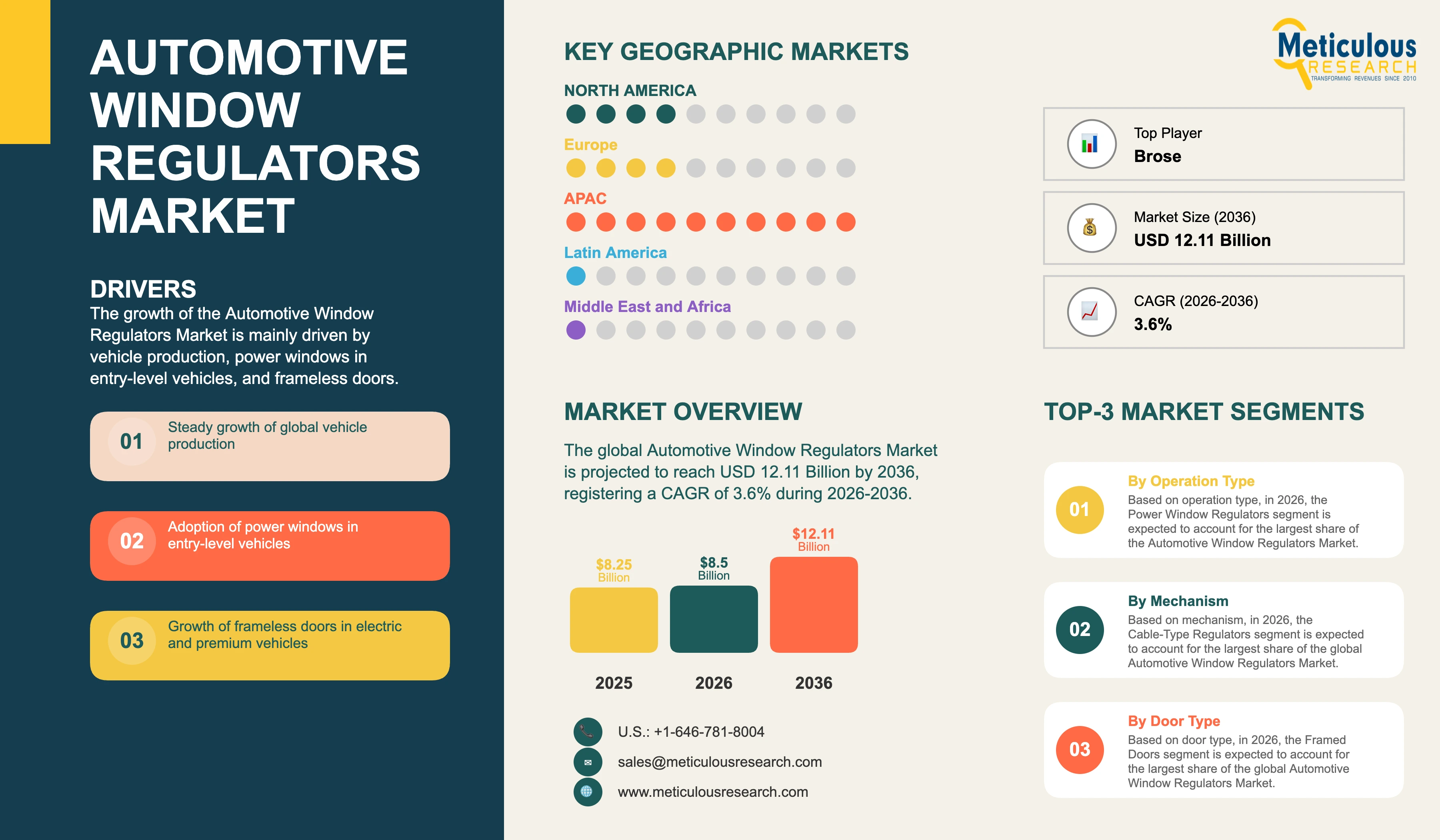
The global automotive window regulators market was valued at USD 8.25 billion in 2025. This market is expected to reach USD 12.11 billion by 2036 from an estimated USD 8.50 billion in 2026, registering a CAGR of 3.6% during the forecast period (2026-2036).
- Published
- Nov 2026
- Pages
- 274
- Format
- PDF + Excel
- Report ID
- MRAUTO - 1042900
- Base year
- 2025
- 2025 · BASELINE
- $8.25B
- 2036
- $12.11B
- CAGR 2026–2036
- 3.6%
2025 baseline · 2026–2036 forecast at 3.6% CAGR · hover a bar for the value
Key highlights
Brose, which launched the manual window regulator in 1928 and the power window regulator in 1962, remains one of the leading suppliers of window regulators and door systems, according to WardsAuto. Brose has developed door control electronics that integrate all door functions, from the window regulator to collision protection, which reduces costs, space, and weight in vehicle doors.
Inteva Products received U.S. patent 12, 410,649 in September 2025 for a window regulator designed for frameless doors, using a cable system with several guide rails, according to the U.S. Patent and Trademark Office. Brose also published a patent application in November 2025 for a device that adjusts the inclination of the window regulator guide rail in frameless doors, showing the focus of leading suppliers on frameless door designs.
Kwangjin, a Korean supplier of window regulators and door modules, was named a 2025 Supplier of the Year by General Motors in April 2025, according to General Motors, along with other door system suppliers, such as Magna International.
Global electric car sales topped 20 million units in 2025, according to the IEA. Many electric vehicles use frameless doors, which require window regulators with short-drop functions that lower the window slightly when the door opens and raise it again when the door closes, which increases the value of window regulators per vehicle.
Power window regulators are standard in almost all new passenger cars in North America, Europe, China, Japan, and South Korea, and they are spreading quickly to entry-level vehicles in India, Southeast Asia, and Latin America, where manual window regulators remain in use in some rear doors and low-cost models.
Leading suppliers include Brose, Grupo Antolin, Hi-Lex, Magna International, Inteva Products, Aisin, Johnan Manufacturing, and Kwangjin. Frameless doors are the fastest-growing door type, as electric and premium vehicle makers adopt frameless designs for style and aerodynamics. Suppliers are also adding electronics to their regulators to support comfort functions. Japanese and Korean suppliers follow their home vehicle makers into India, Southeast Asia, and North America. Door module supply is also growing.
By operation type, power window regulators account for the larger share of 91.0% in 2026 and also register the higher CAGR.
By mechanism, cable-type regulators account for the larger share in 2026 and also register the higher CAGR.
By door type, framed doors account for the larger share in 2026, while frameless doors register the higher CAGR.
By vehicle type, passenger cars account for the larger share of 87.0% in 2026 and also register the higher CAGR.
By geography, Asia-Pacific accounts for the largest share of 52.0% in 2026, while Asia-Pacific registers the highest CAGR of 4.3%.
Report summary
| Particulars | Details |
|---|---|
| Base Year | 2025 |
| Estimated Year | 2026 |
| Forecast Period | 2026-2036 |
| Market Size in 2025 | USD 8.25 billion |
| Market Size in 2026 | USD 8.50 billion |
| Market Size by 2036 | USD 12.11 billion |
| CAGR (2026-2036) | 3.6% |
| Format | PDF, Excel & Cloud Portal · 274 pages |
| Largest Segment by Operation Type (2026) | Power Window Regulators (91.0%) |
| Largest Segment by Vehicle Type (2026) | Passenger Cars (87.0%) |
| Largest Region (2026) | Asia-Pacific (52.0%) |
| Fastest-Growing Region | Asia-Pacific (CAGR 4.3%) |
| Companies Profiled | 8 companies and other companies |
| Segments Covered | Operation Type, Mechanism, Door Type, Vehicle Type, Geography |
| Countries Covered | U.S., Canada, Mexico, Germany, France, U.K., Spain, Italy, Sweden, Czech Republic, Poland, Slovakia, Hungary, Romania, Rest of Europe, China, Japan, South Korea, India, Thailand, Indonesia, Malaysia, Vietnam, Philippines, Taiwan, Australia, Rest of Asia-Pacific, Brazil, Argentina, Chile, Colombia, Rest of Latin America, Turkey, Morocco, South Africa, Saudi Arabia, UAE, Israel, Rest of Middle East & Africa |
Report overview
Segments covered: operation type, mechanism, door type, vehicle type.
Automotive window regulators are the mechanisms inside vehicle doors that raise and lower the side windows. A window regulator consists of guide rails, a glass carrier, and either a cable and pulley system or a set of lifting arms, and in power window regulators, it also includes an electric motor, which is often combined with an electronic control unit that provides anti-pinch protection. Most vehicles have four or more window regulators, one in each side door, which makes window regulators a high-volume part with steady demand linked closely to vehicle production.
The growth of this market is mainly driven by steady growth of global vehicle production, the near-universal adoption of power windows in new vehicles, including entry-level vehicles in emerging markets, the growing use of frameless doors in electric, premium, and sporty vehicles, which need more complex window regulators with short-drop functions, the shift to lightweight cable-type regulators with plastic carriers, and the integration of window regulators with door modules and electronics, such as anti-pinch control and one-touch operation. However, strong price pressure from vehicle makers, the maturity of the product in developed markets, and the decline of manual window regulators are expected to restrain the growth of this market to some extent.
Window regulators have evolved from hand-cranked mechanical devices into electrically powered systems with electronic controls. Early regulators used a gear and lifting arm mechanism operated by a hand crank, which is still used in some low-cost vehicles today. Power window regulators, which became common in the 1980s and 1990s, use an electric motor to drive either a cable system or a lifting arm. Today, most power window regulators use cable systems, which are lighter and more compact than arm systems, and they are often combined with electronic controls that provide anti-pinch protection, one-touch operation, and integration with the vehicle's central locking and comfort functions.
This report covers the global automotive window regulators market, including power and manual window regulators, cable-type and arm-type regulators, and regulators for framed and frameless doors, for passenger cars and commercial vehicles. The market is valued at the selling price of window regulator assemblies supplied to vehicle makers and door module suppliers, including the window lift motor for power regulators where it is supplied as part of the regulator assembly. The market is analyzed by operation type, mechanism, door type, vehicle type, and geography. Complete door modules, door glass, door control units sold separately, and aftermarket replacement regulators are not included.
Cable-type window regulators use a motor-driven drum that winds and unwinds steel cables running over pulleys at the top and bottom of one or two guide rails. The glass carrier is attached to the cables and slides along the rails. Cable-type regulators are light, compact, and can be designed for different door shapes, which makes them the most common type in modern passenger cars. Arm-type regulators, including single-arm and X-arm designs, use a gear sector and one or two lifting arms to move the glass. They are strong and durable and are still used in many commercial vehicles, some passenger cars, and in manual window regulators, but they take more space and are heavier than cable designs.
Frameless doors, in which the window glass has no surrounding metal frame, are popular in coupes, convertibles, sporty vehicles, and a growing number of electric vehicles. They give vehicles a sleek appearance and can reduce aerodynamic drag, but they require more complex window regulators. When the door is opened, the window must drop slightly so that it clears the roof seal, and when the door is closed, the window must rise again to seal tightly. This short-drop function requires precise motor control and sensors, and the regulator must hold the glass firmly at high speeds without a frame, which increases its value compared with regulators for framed doors.
Safety and comfort requirements also shape window regulator design in every major vehicle market. Regulations, such as FMVSS 118 in the U.S. and UN R21 in Europe, require power windows to include protection against trapping fingers or other body parts, which is usually provided by anti-pinch electronics that detect resistance and reverse the window. Customers also expect quiet and smooth window operation, so suppliers design regulators and motors to reduce noise, vibration, and harshness. These requirements increase the importance of motor and electronics expertise in the window regulator market.
The market includes door system specialists, motor and electronics suppliers, and regional suppliers that serve local vehicle makers. Brose, Grupo Antolin, Hi-Lex, Magna International, and Inteva Products supply window regulators and door systems to vehicle makers worldwide. Aisin and Johnan Manufacturing supply window regulators mainly to Japanese vehicle makers, while Kwangjin supplies Korean and other vehicle makers. Many suppliers also supply door modules, in which the window regulator, motor, and other door hardware are mounted on a carrier plate that is installed in the door in one step.
In 2026, power window regulators account for the largest share of the market by operation type and are also the fastest-growing operation type. Cable-type regulators account for the largest share by mechanism and are also the fastest-growing mechanism. Framed doors account for the largest share by door type, while frameless doors are the fastest-growing door type. Passenger cars account for the largest share by vehicle type and are also the fastest-growing vehicle type. Asia-Pacific accounts for the largest share of the market and is also the fastest-growing region.
Market growth over the forecast period will depend on vehicle production, the spread of power windows to entry-level vehicles in emerging markets, the growth of frameless doors in electric and premium vehicles, the shift to lightweight cable designs, and price pressure from vehicle makers. Power windows in entry-level vehicles and frameless doors will increase the value of window regulators per vehicle, while strong price competition and the maturity of the product in developed markets will limit growth. Overall, the market is expected to grow at about the same rate as vehicle production, with value per vehicle rising slowly through 2036.
Passenger cars are expected to account for the larger share of 87.0% of the market in 2026 and are also projected to register the higher CAGR, driven by electric vehicles, frameless doors, and power windows in emerging markets.
Asia-Pacific is expected to account for the largest share of 52.0% of the market in 2026, mainly due to China's large vehicle production and the strong presence of Japanese and Korean suppliers.
Asia-Pacific is also projected to register the highest CAGR of 4.3% during the forecast period, driven by China's electric vehicle growth, frameless doors, and the shift to power windows in India and Southeast Asia.
The report profiles 8 companies, including Brose, Grupo Antolin, Hi-Lex, Magna International, Inteva Products, Aisin, Johnan Manufacturing, and Kwangjin.
Frameless doors need window regulators that lower the glass slightly when the door opens and raise it when the door closes, and that hold the glass firmly at high speeds without a frame, which requires precise motor control.
Cable-type regulators use motor-driven cables and pulleys to move the glass along guide rails and are lighter and more compact, while arm-type regulators use lifting arms and are stronger but heavier.
Manual window regulators are declining because power windows are becoming standard in nearly all new vehicles, including entry-level models in India, Southeast Asia, and Latin America, as customers expect more comfort features.
Report infographic
Market dynamics
17 factors across 5 forcesSteady growth of global vehicle production
Every passenger car and most commercial vehicles have at least two window regulators, and most passenger cars have four, one in each side door. As a result, demand for window regulators is closely linked to vehicle production, which continues to grow in China, India, Southeast Asia, and other emerging markets. Chinese vehicle makers are growing rapidly in export markets and are building new plants in Southeast Asia, Latin America, Europe, and other regions, which adds demand for window regulators in these regions.
Vehicle production growth in Asia-Pacific, which is the largest and fastest-growing region in this market, is the main source of volume growth for window regulators. India is one of the fastest-growing vehicle markets in the world, and Southeast Asian countries, such as Indonesia, Thailand, and Vietnam, are growing as production hubs for Japanese and Chinese vehicle makers. Suppliers with local production in these countries are best placed to capture this growth.
Adoption of power windows in entry-level vehicles
Power windows are standard in almost all new passenger cars in developed markets, but manual window regulators are still used in some entry-level vehicles and rear doors in India, Southeast Asia, Latin America, and Africa. As incomes rise and customers in these markets expect more comfort features, vehicle makers are replacing manual regulators with power regulators in more models and in all four doors. Power window regulators have much higher value than manual regulators because they include an electric motor and, often, anti-pinch electronics.
This shift increases the value of window regulators per vehicle in emerging markets and supports the growth of power window regulators, which are the largest and fastest-growing operation type in this market. Vehicle makers in India and Southeast Asia are also adding one-touch and anti-pinch functions to more models, which further increases value. Manual window regulators are expected to decline over the forecast period as power windows become standard in nearly all vehicles.
Growth of frameless doors in electric and premium vehicles
Frameless doors are used in coupes, convertibles, and sporty vehicles, and they are now spreading to electric vehicles and premium SUVs because they give vehicles a sleek appearance and can reduce aerodynamic drag, which helps driving range. Several electric vehicle makers, including Tesla and a number of Chinese brands, use frameless doors on popular models. Global electric car sales topped 20 million units in 2025, according to the IEA, which supports the growth of frameless doors.
Window regulators for frameless doors must lower the window slightly when the door opens and raise it when the door closes, and they must hold the glass firmly at high speeds without a frame. This requires stronger regulators, precise motor control, and sensors, which increases their value compared with regulators for framed doors. Leading suppliers are developing new designs for frameless doors, such as Inteva Products' patented frameless window regulator, according to the U.S. Patent and Trademark Office. Frameless doors are the fastest-growing door type in this market.
Lightweight cable-type regulators and plastic carriers
Vehicle makers must reduce weight to meet emission standards in conventional vehicles and to extend driving range in electric vehicles, and they look for savings in every part of the vehicle. Cable-type window regulators are lighter and more compact than arm-type regulators, and suppliers are reducing their weight further by using plastic glass carriers, plastic or aluminum guide rails, and smaller and more efficient motors. Lighter regulators also free space in the door for speakers, side airbags, and other parts.
Cable-type regulators are the largest and fastest-growing mechanism in this market, supported by lightweighting, their flexibility for different door shapes, and their use in frameless doors. Arm-type regulators remain in use in commercial vehicles and some low-cost vehicles, where durability and low cost matter most, but their share is expected to decline slowly as vehicle makers move to cable designs in more models.
Integration with door modules and door electronics
Vehicle makers increasingly buy complete door modules, in which the window regulator, motor, speakers, latch, and wiring are mounted on a carrier plate and installed in the door in one step. Door modules reduce assembly time and cost at vehicle plants and allow suppliers to optimize the layout of door components. Suppliers are also integrating door electronics, such as anti-pinch control, one-touch operation, and communication with the vehicle network, into the window regulator motor or a door control unit. Brose has developed door control electronics that integrate all door functions, from the window regulator to collision protection, which reduces cost, space, and weight, according to Brose. These integrated solutions increase the value supplied per door and favor suppliers with strong mechanical, motor, and electronics capabilities. As vehicle makers move to new electrical architectures with zonal controllers, window regulator motors and door electronics are expected to become more closely integrated with the vehicle network, which will support further development of smart window regulator systems over the forecast period.
Table of contents
12 chapters · 174 sections · 274 pages · click to expandSegmental analysis
By Operation Type
- The cable-type regulators segment is expected to account for the larger share of the automotive window regulators market, and it is also projected to register the higher CAGR during the forecast period.
- The framed doors segment is expected to account for the larger share of the automotive window regulators market, while the frameless doors segment is projected to register the higher CAGR during the forecast period.
Geographic analysis
Asia-Pacific
Largest shareIn 2026, Asia-Pacific is expected to account for the largest share of 52.0% of the global automotive window regulators market. The large share of this region is mainly due to China's position as the largest vehicle and electric vehicle producer in the world, the large vehicle production of Japan, South Korea, and India, the growing use of frameless doors by Chinese electric vehicle makers, and the presence of window regulator suppliers, such as Aisin, Johnan Manufacturing, Hi-Lex, and Kwangjin, along with large plants of Brose, Grupo Antolin, and Inteva Products. China is the largest market in the region, followed by Japan, India, and South Korea. Asia-Pacific is also projected to register the highest CAGR of 4.3% during the forecast period. The rapid growth of this region is mainly driven by continued growth of vehicle and electric vehicle production in China, the shift from manual to power windows in entry-level vehicles in India and Southeast Asia, rising vehicle production in India, and the growth of vehicle production in Southeast Asia, including new plants built by Chinese vehicle makers. India is expected to be one of the fastest-growing countries, supported by vehicle production growth and the spread of power windows to all four doors in more models.
Europe
Europe accounts for a significant share of the market, supported by the large production of premium vehicles, which often use frameless doors and advanced door electronics, the growth of electric vehicles, and the presence of leading suppliers, such as Brose, Grupo Antolin, and Magna International. Germany is the largest market in the region, followed by France, Spain, and Italy, while Sweden and the U.K. have smaller but important premium vehicle production. Eastern European countries, such as the Czech Republic, Poland, Slovakia, Hungary, and Romania, are important production hubs for vehicles and window regulators. However, slow vehicle production growth and market maturity limit growth in the region.
North America
North America accounts for a significant share of the market, supported by the large production of SUVs and pickup trucks, the near-universal use of power windows, the growth of electric vehicles, and the presence of suppliers, such as Brose, Magna International, Inteva Products, and Hi-Lex. The U.S. is the largest market in the region, followed by Mexico and Canada, and Mexico is an important production base for vehicles and window regulators.
Latin America
Latin America and the Middle East and Africa account for smaller shares. Brazil is the largest market in Latin America, where manual window regulators are still used in some entry-level vehicles, while Turkey, Morocco, and South Africa are important vehicle production hubs in the Middle East and Africa. Within Latin America, Brazil is the largest market, supported by local vehicle production by global vehicle makers, while Argentina, Chile, and Colombia are smaller markets.
Middle East & Africa
In the Middle East and Africa, Turkey and Morocco are important vehicle production hubs that supply Europe, and their window regulator demand follows the European vehicle programs built there, while South Africa produces vehicles for export and Saudi Arabia and the UAE are mainly import markets with growing vehicle sales and a high share of SUVs.
Competitive landscape
The global automotive window regulators market includes door system specialists, Japanese and Korean suppliers that serve their home vehicle makers, and Chinese and other regional suppliers that serve local vehicle makers. The market is moderately concentrated, with a few global door system suppliers holding strong positions with global vehicle makers, while regional suppliers compete strongly in their home markets. Suppliers increasingly compete on door module capabilities, frameless door designs, and integrated door electronics, as well as on cost.
Brose supplies window regulators, door systems, and door control electronics to vehicle makers worldwide and has more than 90 years of experience in window regulators, according to WardsAuto. Grupo Antolin, Hi-Lex, Magna International, and Inteva Products supply window regulators and door modules globally, and Inteva Products has developed a patented frameless window regulator. Aisin and Johnan Manufacturing supply window regulators mainly to Japanese vehicle makers, while Kwangjin supplies Korean vehicle makers and General Motors, which named it a 2025 Supplier of the Year, according to General Motors.
Companies in this market compete mainly on quality, durability, noise performance, weight, cost, door module and electronics capabilities, frameless door expertise, global production footprint, and long-term relationships with vehicle makers. Key strategies in this market include developing frameless door regulators, offering complete door modules, integrating door electronics, using lightweight materials, building plants close to vehicle makers in growing markets, and moving production to lower-cost countries.
Recent competitive activity in this market has mainly focused on frameless door regulators and door electronics. Inteva Products received a U.S. patent for a frameless window regulator in September 2025, and Brose published a patent application for a frameless door guide rail adjustment device in November 2025, according to the U.S. Patent and Trademark Office. Kwangjin and Magna International were among the suppliers named 2025 Supplier of the Year by General Motors, according to General Motors.
We expect competition to increase over the forecast period as suppliers compete for frameless door and door module business on new electric vehicle platforms, as Chinese suppliers grow in their home market and abroad, and as vehicle makers continue to apply price pressure. Suppliers with strong door module, frameless door, and electronics capabilities, as well as global production footprints and low-cost production in growing markets, are expected to strengthen their positions.
Some of the key players operating in the automotive window regulators market are Brose Fahrzeugteile SE & Co. KG, Grupo Antolin-Irausa, S.A., Hi-Lex Corporation, Magna International Inc., Inteva Products, LLC, Aisin Corporation, Johnan Manufacturing Inc., and Kwangjin Co., Ltd., among others.
- —
Inteva Products received a U.S. patent for a frameless window regulator in September 2025, Brose published a frameless door patent application in November 2025, and General Motors named Kwangjin a 2025 Supplier of the Year.
- Brose Fahrzeugteile SE & Co. KG
- Grupo Antolin-Irausa, S.A.
- Hi-Lex Corporation
- Magna International Inc.
- Inteva Products, LLC
- Aisin Corporation
- Johnan Manufacturing Inc.
- Kwangjin Co., Ltd.
Expert perspectives
Automotive window regulators are a mature, high-volume market with steady demand linked closely to vehicle production. Almost every vehicle has four window regulators, and power windows are standard in most markets. Growth in value per vehicle comes mainly from the shift to power windows in emerging markets, the growth of frameless doors, and the integration of door electronics, while strong price pressure keeps the market highly competitive.
Over the forecast period, the market is expected to grow at a CAGR of 3.6%, from USD 8.50 billion in 2026 to USD 12.11 billion in 2036. Growth will be driven by steady growth of vehicle production, the adoption of power windows in entry-level vehicles, the growth of frameless doors in electric and premium vehicles, lightweight cable-type regulators, and integration with door modules and electronics. Strong price pressure and market maturity in developed regions will limit growth to some extent.
Among the market segments, power window regulators are the largest operation type and also grow fastest. Cable-type regulators are the largest mechanism and also grow fastest. Framed doors are the largest door type, while frameless doors grow fastest. Passenger cars are the largest vehicle type and also grow fastest. Asia-Pacific is the largest region and is also the fastest-growing region, led by China and India.
In our view, frameless doors will be the most important source of value growth in this market. Electric vehicle makers, especially in China, are adopting frameless doors to give their vehicles a premium look and better aerodynamics, and frameless door regulators sell at higher prices than standard regulators. Suppliers that win frameless door business on new electric vehicle platforms will gain long-term positions, as regulators are rarely changed during a vehicle's production life and the same design is often used across several models.
We also expect the market to become more closely linked with door modules and door electronics. Vehicle makers want to reduce assembly complexity and add new comfort and safety functions, which favors suppliers that can deliver complete door modules with integrated electronics. Suppliers that only offer standard regulators will face strong price competition from low-cost regional suppliers, especially in China and other parts of Asia-Pacific.
We also expect suppliers to keep moving production to lower-cost regions to protect margins. Overall, we believe that the automotive window regulators market will grow steadily over the forecast period, with power window regulators, cable-type regulators, frameless doors, passenger cars, and Asia-Pacific providing the fastest growth. Companies with strong door module, frameless door, and electronics capabilities, and with low-cost production in growing markets, will be best positioned to capture this growth.
Customer perspectives
“Frameless doors are now expected on our premium models, and customers notice every detail. The regulator has to drop and lift the glass precisely every time, without wind noise at highway speeds.”
“Our buyers now expect power windows in all four doors, even on entry models. We need regulators that are reliable and cost-effective at high volumes.”
“We moved to cable regulators with plastic carriers to save weight. Buying the complete door module also cut assembly time at our plant.”
Frequently asked questions
The global automotive window regulators market was valued at USD 8.25 billion in 2025, up from USD 8.05 billion in 2024, and is estimated at USD 8.50 billion in 2026. The market includes power and manual regulators for framed and frameless doors.
The global automotive window regulators market is expected to reach USD 12.11 billion by 2036, driven by vehicle production growth, power windows in entry-level vehicles, frameless doors, lightweight regulators, and door module integration.
The market is expected to register a CAGR of 3.6% from 2026 to 2036, with the fastest growth in power regulators, cable-type regulators, frameless doors, passenger cars, and Asia-Pacific.
Market growth is mainly driven by steady growth of vehicle production, the adoption of power windows in entry-level vehicles, the growth of frameless doors, lightweight cable-type regulators, and integration with door modules and door electronics.
Strong price pressure and market maturity in developed regions restrain growth, while meeting noise, durability, and safety requirements and competition from low-cost regional suppliers are key challenges.
Key growth opportunities include window regulators for frameless doors, smart window regulators and door electronics, growth in India and Southeast Asia, and door modules for new electric vehicle platforms.
Power window regulators are expected to account for the larger share of 91.0% of the market in 2026 and are also projected to register the higher CAGR, driven by the shift to power windows in entry-level vehicles.
In 2026, the cable-type regulators segment is expected to account for the larger share of the automotive window regulators market, and it is also projected to register the higher CAGR during the forecast period.
In 2026, the framed doors segment is expected to account for the larger share of the automotive window regulators market, while the frameless doors segment is projected to register the higher CAGR during the forecast period.
Passenger cars are expected to account for the larger share of 87.0% of the market in 2026 and are also projected to register the higher CAGR, driven by electric vehicles, frameless doors, and power windows in emerging markets.
Asia-Pacific is expected to account for the largest share of 52.0% of the market in 2026, mainly due to China's large vehicle production and the strong presence of Japanese and Korean suppliers.
Asia-Pacific is also projected to register the highest CAGR of 4.3% during the forecast period, driven by China's electric vehicle growth, frameless doors, and the shift to power windows in India and Southeast Asia.
The report profiles 8 companies, including Brose, Grupo Antolin, Hi-Lex, Magna International, Inteva Products, Aisin, Johnan Manufacturing, and Kwangjin.
Inteva Products received a U.S. patent for a frameless window regulator in September 2025, Brose published a frameless door patent application in November 2025, and General Motors named Kwangjin a 2025 Supplier of the Year.
Frameless doors need window regulators that lower the glass slightly when the door opens and raise it when the door closes, and that hold the glass firmly at high speeds without a frame, which requires precise motor control.
Cable-type regulators use motor-driven cables and pulleys to move the glass along guide rails and are lighter and more compact, while arm-type regulators use lifting arms and are stronger but heavier.
Manual window regulators are declining because power windows are becoming standard in nearly all new vehicles, including entry-level models in India, Southeast Asia, and Latin America, as customers expect more comfort features.
Cite this report
Meticulous Research. (2026). Automotive Window Regulators Market - Global Opportunity Analysis and Industry Forecast (2026-2036) (Report No. MRAUTO - 1042900). Meticulous Market Research Pvt. Ltd. https://www.meticulousresearch.com/product/automotive-window-regulators-market-7583